Recent Tiger years are 1986, 1998, 2010 and 2022. The usual keyword is courage, but the stronger Chinese context is protection: tiger power is repeatedly borrowed to guard bodies, homes and vulnerable children.
Year of the Tiger dates and exact boundaries
Tiger years include 1926, 1938, 1950, 1962, 1974, 1986, 1998, 2010, 2022 and 2034.
| Tiger year | Begins | Ends | Element |
|---|---|---|---|
| 1986 | February 9, 1986 | January 28, 1987 | Fire |
| 1998 | January 28, 1998 | February 15, 1999 | Earth |
| 2010 | February 14, 2010 | February 2, 2011 | Metal |
| 2022 | February 1, 2022 | January 21, 2023 | Water |
Someone born on January 20, 2022 is an Ox, not a Tiger. The full-date calculator handles this boundary.
The complete Chinese zodiac guide explains the twelve-animal order and the distinction between animal imagery and the Earthly Branches beneath it.
Our conclusion: Tiger power is valuable when it protects someone else
“Brave, competitive, confident” is the standard Tiger personality package. It makes the sign sound like a motivational poster and misses the social use of the animal.
In documented children's clothing from the Qing dynasty and early twentieth century, tiger force could be transferred to a vulnerable wearer. A child did not need to defeat a tiger; a hat or shoe borrowed the tiger's face as protection. The Pitt Rivers Museum describes the logic directly: the image could frighten harmful spirits or make them mistake the child for a fearsome animal.
That is more specific than courage. The Tiger's important cultural move is converting danger into defense. The same animal that threatens life can become a guardian when its image is placed on the side of the household.
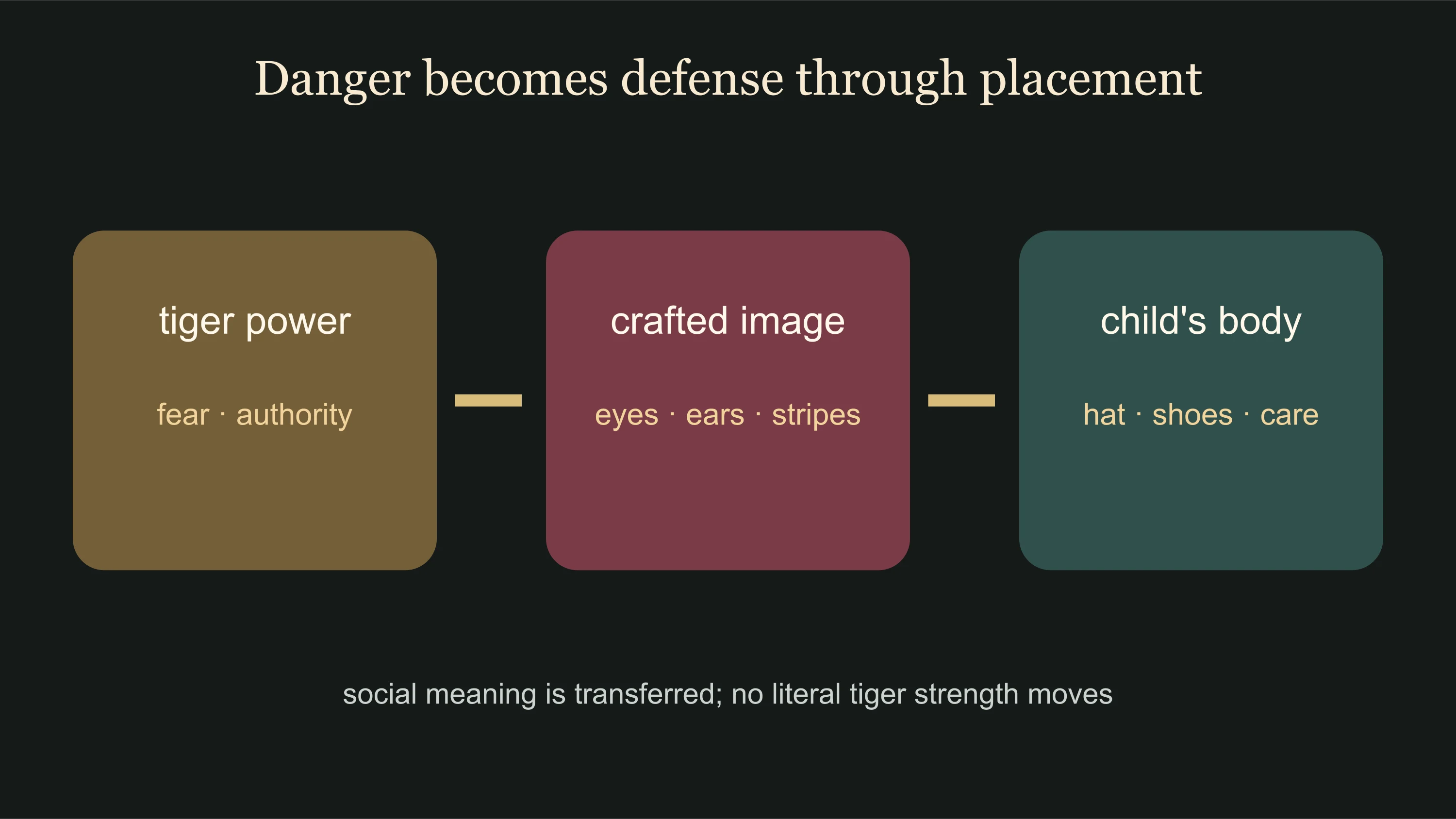
What moves is not literal strength but social meaning. Cloth ears, embroidered eyes and forehead stripes let a caregiver place imagined tiger authority around a child's body. Fear and affection are not opposites here: fear of harm motivates the affectionate labor of making protection visible.
Yin is the branch, not yin energy
The Tiger corresponds to 寅 (yin), the third Earthly Branch. The animal word is 虎 (hu).
This yin is not the same character as 阴 / 陰, the yin in yin-yang. English romanization makes them look identical, but the Chinese characters and meanings differ. 寅 marks a branch and is traditionally linked to roughly 3 a.m. to 5 a.m.; 阴 names the yin side of a different conceptual pair. In the zodiac order, Tiger follows Ox and precedes the Year of the Rabbit.
That distinction is exactly the kind of detail generic zodiac pages skip. Seeing “Yin Tiger” does not mean the Tiger is automatically yin in every classification. First identify which Chinese character is being used.
A thirteenth-century Tiger is not a mascot

The Metropolitan Museum of Art dates this grey earthenware zodiac figure to the thirteenth century. Pigment survives on an upright, fully animal figure with a broad tiger head, compact torso and modeled paws.
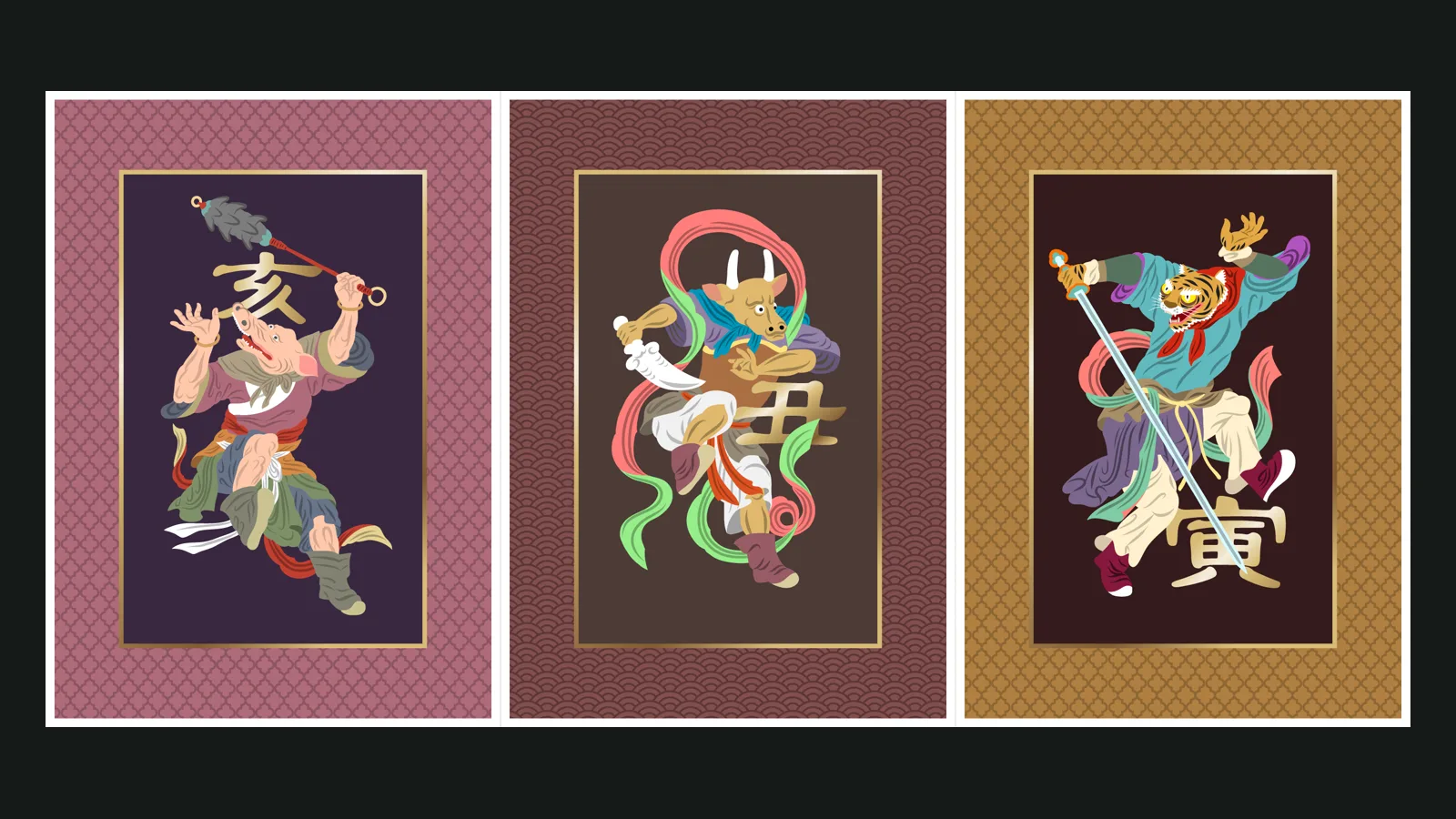
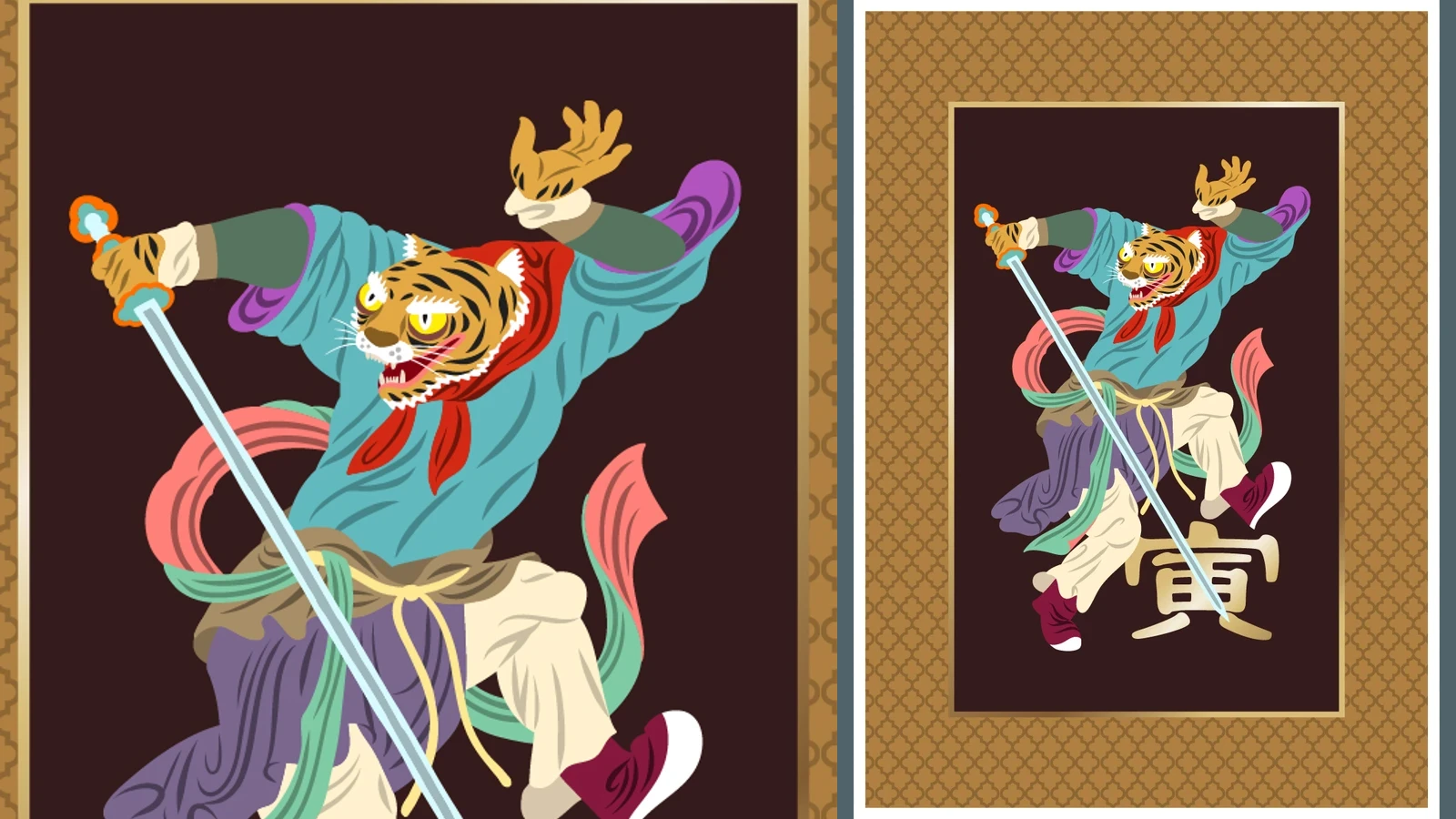
The vertical seated pose makes the tiger more figure-like than a naturalistic wildlife study without turning it into a clothed human body. Compare it with the contemporary first-party hero: the modern illustration uses saturated color, diagonal movement and a giant 寅; the older figure depends on modeled mass, paws and head. The difference is evidence of changing visual language, not a competition over which looks more “authentic.”
The object also disciplines interpretation. It proves that a tiger zodiac figure existed in this material and period. It does not prove that every later tiger hat or New Year poster descends directly from this one object.
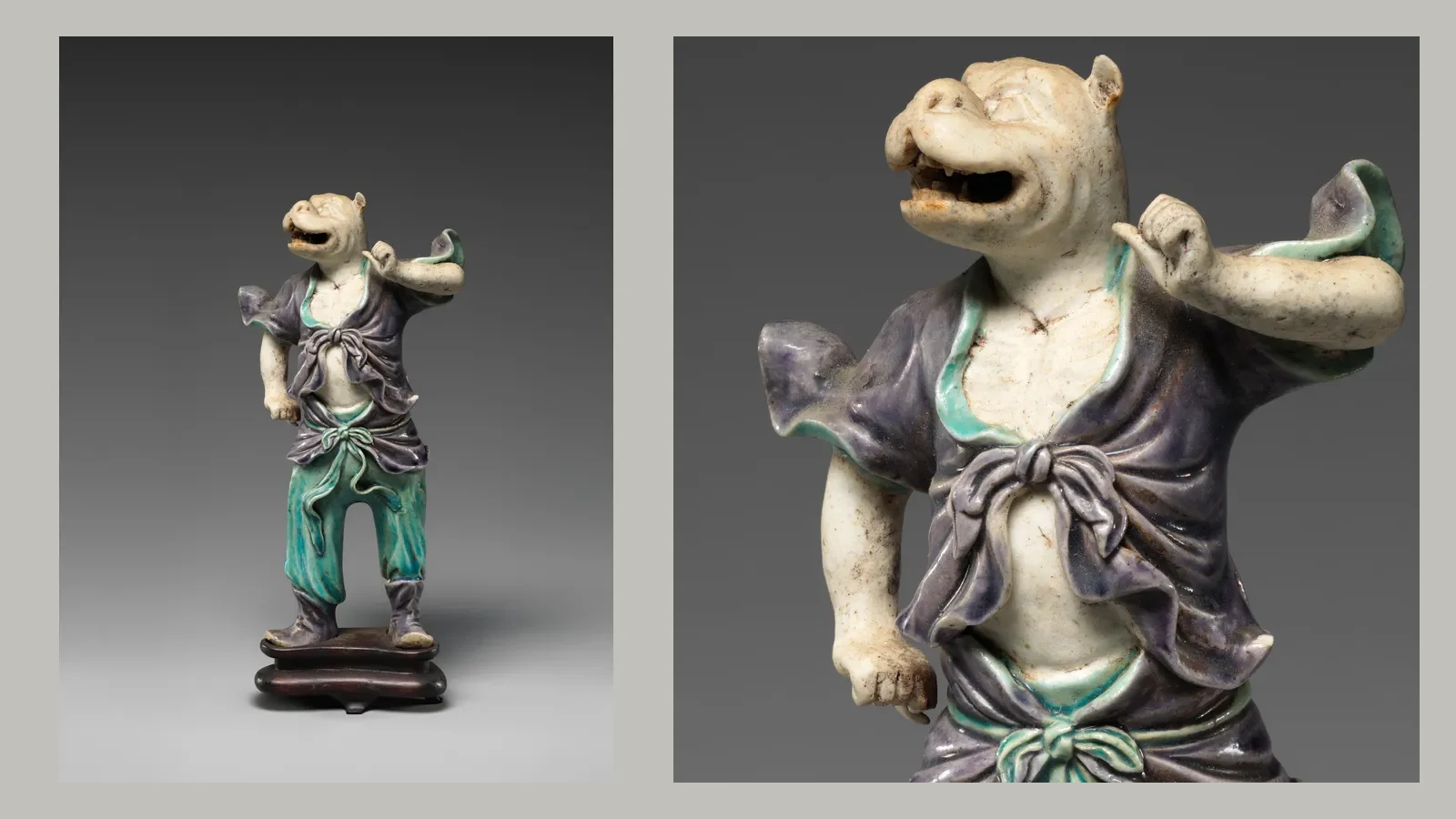
A second Met zodiac Tiger, made in Jingdezhen centuries later, changes the material and the social temperature. Enamel color, clothing and a more animated face pull the animal closer to a theatrical person. The two museum objects do not form a complete evolutionary line, and I will not pretend they do. They prove something more honest: “traditional Tiger” never meant one frozen look. Medium, workshop and period kept rewriting the same zodiac identity.
Why tiger foreheads often resemble 王
The dark stripes on a tiger's forehead are traditionally read visually as 王 (wang), “king.” The Santa Barbara Museum of Art presents this as a historical Chinese interpretation, and artists can emphasize the resemblance to strengthen the animal's claim to authority.
This is a visual interpretation, not zoological writing placed there by nature. It works because the audience already recognizes both the animal's apex power and the character's meaning. When a design sharpens three horizontal strokes and a vertical line, it is making the Tiger's face readable as a title.
That “king” association helps explain why tiger imagery can guard rather than merely attack. Authority is being recruited to patrol a boundary.
Zodiac Tiger is not automatically the White Tiger
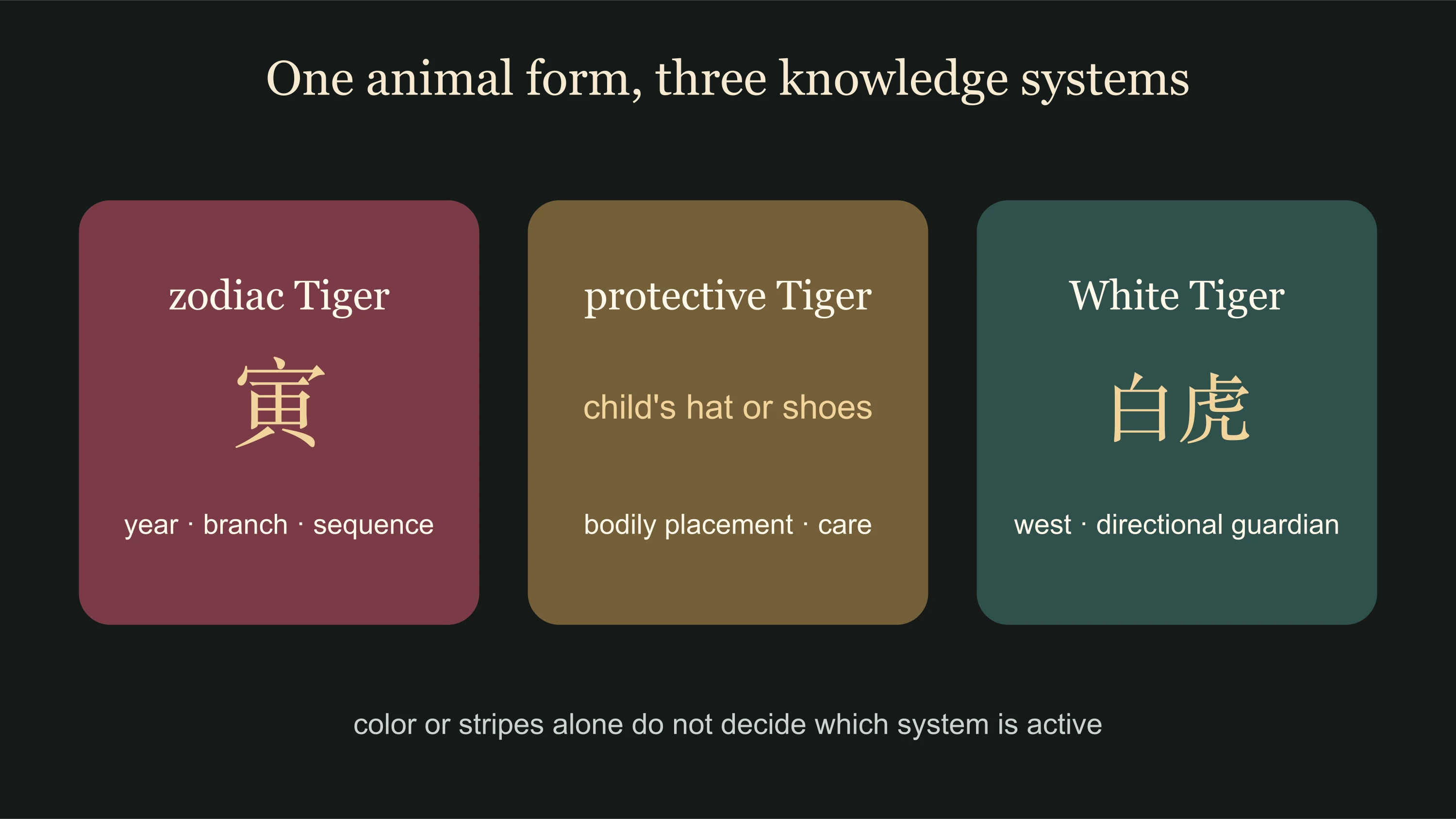
Chinese culture also has the White Tiger (Baihu, 白虎), a directional guardian associated with the west in a different cosmological system. It is easy to see a white tiger on a zodiac page and assume the two identities are interchangeable.
They are not. A Tiger-year image needs evidence such as 寅, a birth year or the twelve-animal sequence. A White Tiger image needs directional, astronomical or guardian context. Artists can combine these systems, but color alone does not prove the identification.
This distinction matters because “Chinese tiger symbolism” is not one container. Zodiac branch, protective folk object and directional guardian can all use tiger form while organizing different knowledge.
Tiger children and protective design
Tiger-faced hats and shoes are among the clearest ways to understand the animal outside horoscope copy. A Pitt Rivers Museum example is a child's embroidered silk hat collected in Guizhou in the 1980s; its record places the wider protective clothing practice in the Qing dynasty and early twentieth century. The wearer may be a small child—the opposite of physically intimidating—but the object gives that child bright eyes, ears, stripes and sometimes teeth.
The power lies in placement. A tiger on a distant painting is admired. A tiger face wrapped around a child's head or feet becomes intimate protection. Craft, affection and fear meet in one wearable object.
Not every tiger item has the same date, region or ritual meaning. Identify the maker, location and collection record before making precise historical claims. “Traditional Chinese tiger hat” without provenance is a category label, not evidence.
What Tiger personality folklore gets wrong
Popular descriptions can still be enjoyed, but they should not be treated as psychological measurement.
| Popular shortcut | Stronger reading |
|---|---|
| Tigers are fearless | Tiger imagery manages fear by placing danger on the protective side |
| Tigers are natural leaders | Authority comes from visual and ecological power, not birth-year destiny |
| Tigers are aggressive | The same force can attack, deter or guard depending on context |
| Tiger signs need compatible partners | Pairing charts are folklore, not relationship evidence |
The Year of the Tiger becomes culturally useful when “be brave” is replaced by a sharper question: whose vulnerability is this tiger image being asked to protect?
That question also changes what counts as evidence. 寅 or a year establishes zodiac context; a child's wearable object establishes bodily placement; west, constellational or named Baihu context establishes the directional guardian. Orange stripes alone establish only that a designer wants us to see a tiger.
A Year of the Tiger image needs someone or something to protect
Power without direction is the laziest reading of the Tiger. In Chinese children's objects, doorway images and protective design, ferocity is often pointed away from the vulnerable person and toward danger. The open mouth, staring eyes and forehead markings are not simply advertising aggression. They make a guardian visible.

A tiger hat placed on a child changes the meaning immediately. The child is not being described as violent. The frightening animal is recruited as protection for a small body moving through an uncertain world. The Pitt Rivers Museum's tiger-hat record gives the object context that a detached product photo cannot supply.
This is why I reject “born leader” as the page's main conclusion. Leadership is a flattering personality forecast. Protection is a relationship we can inspect. Who is at risk? Where is the threshold? Is the tiger facing outward? Those questions let the image speak before astrology starts talking over it.
Not every Chinese tiger is the zodiac Tiger
The White Tiger of the directional system, a military tiger tally, a child's tiger shoe and a zodiac-year mascot belong to different structures. Their forms may overlap, but provenance decides the reading. A white animal in western position is not automatically somebody's birth-year sign; a Tiger-year red envelope is not automatically invoking the White Tiger.
The forehead resemblance to the character 王, “king,” helps explain why modern viewers notice rank in tiger imagery, but it should not become a universal identification test. Fur patterns vary, artists stylize, and the cultural reading is stronger when other clues support it. Anatomy, inscription, date and use must agree.
The Met's Chinese Zodiac Figure, Tiger is especially useful because the animal is held as an attribute. It confirms zodiac identity in a figure type that looks nothing like a modern New Year mascot. That historical distance prevents us from treating one contemporary graphic style as the tradition itself.
Courage is valuable only when the danger is named
Families may call Tiger-year children brave, forceful or independent. Keep those words as hopes, not diagnoses. A child should not have to perform fearlessness because a calendar animal was chosen before they could speak. Real courage includes asking for help, retreating from a bad situation and protecting someone without turning protection into control.
My preferred Tiger question is therefore ethical: what deserves this force? On a gate, force may guard the household. On a child's hat, it may frighten away danger. In a political or commercial image, it may be borrowing ferocity to sell authority. The animal does not purify the purpose.
Use the zodiac calculator for the date and the Chinese New Year guide for the celebration setting. Then return to the object and locate the person, space or value being defended. A Tiger with no protected relationship is only a loud design.
Tiger authority depends on the space it controls
A tiger embroidered on a child's shoe, painted beside a mountain or carved on a military tally does not perform the same job. One protects through intimate folk practice; one stages wild sovereignty; one participates in state power. The stripes alone cannot explain the object.
This is why I read Tiger imagery from the perimeter inward: first the setting, then the opponent or protected body, then the posture. Ferocity becomes meaningful only when we know what boundary it defends—or violates.
A child's tiger shoe and a mountain tiger are opposite scales of power
On a child's shoe or cap, the tiger's force is miniaturised and brought close to the body. The fearsome animal becomes protective design. In a mountain painting, distance and landscape restore wild scale; the human viewer is no longer the centre.
That change of scale matters. “Tiger means courage” misses who receives the courage and where danger is imagined. A wearable tiger can guard vulnerable life. A military tiger can authorise force. A wild tiger can expose the limits of human control.
The sign cannot prove that a Tiger-year person is brave or aggressive. What it can do is open a precise conversation about protective ferocity. My rule is simple: name the threatened boundary before praising the power. Otherwise the same visual language that protects a child can be used to glamorise domination.
Conservation changes the modern Tiger reading
The tiger is not only an ancient emblem; it is a threatened living animal. Modern admiration that treats skin, bone or captivity as proof of power can collide with conservation ethics.
That collision belongs in a contemporary Year of the Tiger page. Cultural symbolism can be preserved without turning the living species into a consumable charm.
My boundary is firm: celebrate the tiger's visual and historical force, but do not use tradition as an excuse for harm. Protection must include the animal, not only the human wearing its image.