Recent Monkey years are 1980, 1992, 2004 and 2016. The most important correction is simple: the zodiac Monkey is not Sun Wukong. One belongs to the stem-branch calendar; the other is a named literary character whose fame now influences how almost every Chinese monkey image is read.
Year of the Monkey dates and exact boundaries
Monkey years include 1920, 1932, 1944, 1956, 1968, 1980, 1992, 2004, 2016, 2028 and 2040.
| Monkey year | Begins | Ends | Element |
|---|---|---|---|
| 1980 | February 16, 1980 | February 4, 1981 | Metal |
| 1992 | February 4, 1992 | January 22, 1993 | Water |
| 2004 | January 22, 2004 | February 8, 2005 | Wood |
| 2016 | February 8, 2016 | January 27, 2017 | Fire |
A January 15, 2016 birthday belongs to the Goat year. The zodiac calculator uses the full date rather than guessing from 2016 alone.
The complete Chinese zodiac guide places Monkey in the calendar cycle before literary and personality interpretations are added.
Our conclusion: Monkey imagery is now read through a literary celebrity
Most animals in the zodiac do not have one Chinese character so famous that it absorbs the whole species. The Monkey does.
Sun Wukong—the Monkey King of Journey to the West—has a name, weapons, supernatural abilities, a rebellious history and an enormous afterlife in opera, animation, television, games and global popular culture. His visual gravity is so strong that a staff, golden headband or cloud can make an ordinary monkey image look Wukong-coded immediately.
But the zodiac Monkey predates any need to reference that novel. The right reading separates calendrical identity from literary character first, then studies where modern artists choose to merge them.
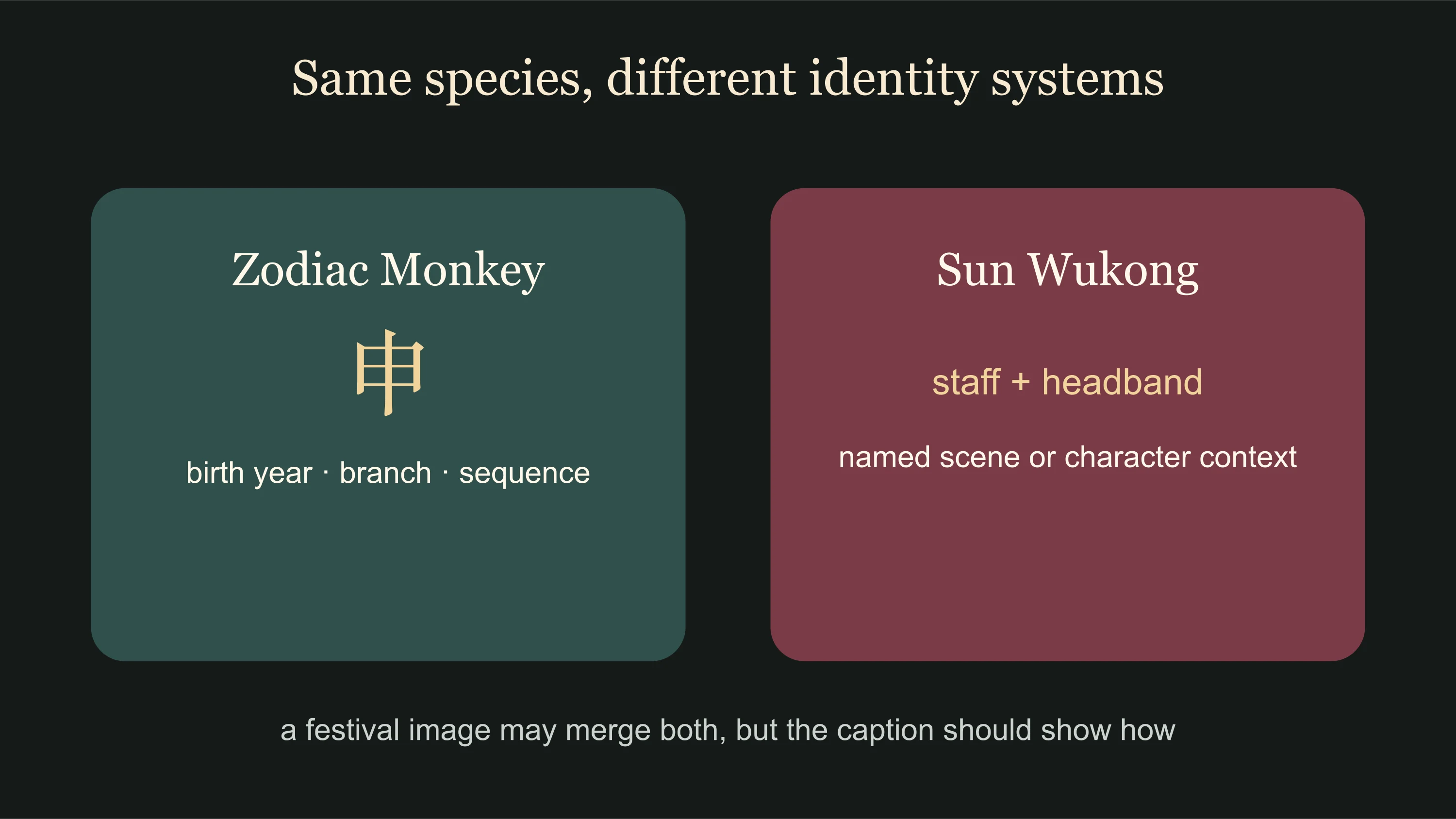
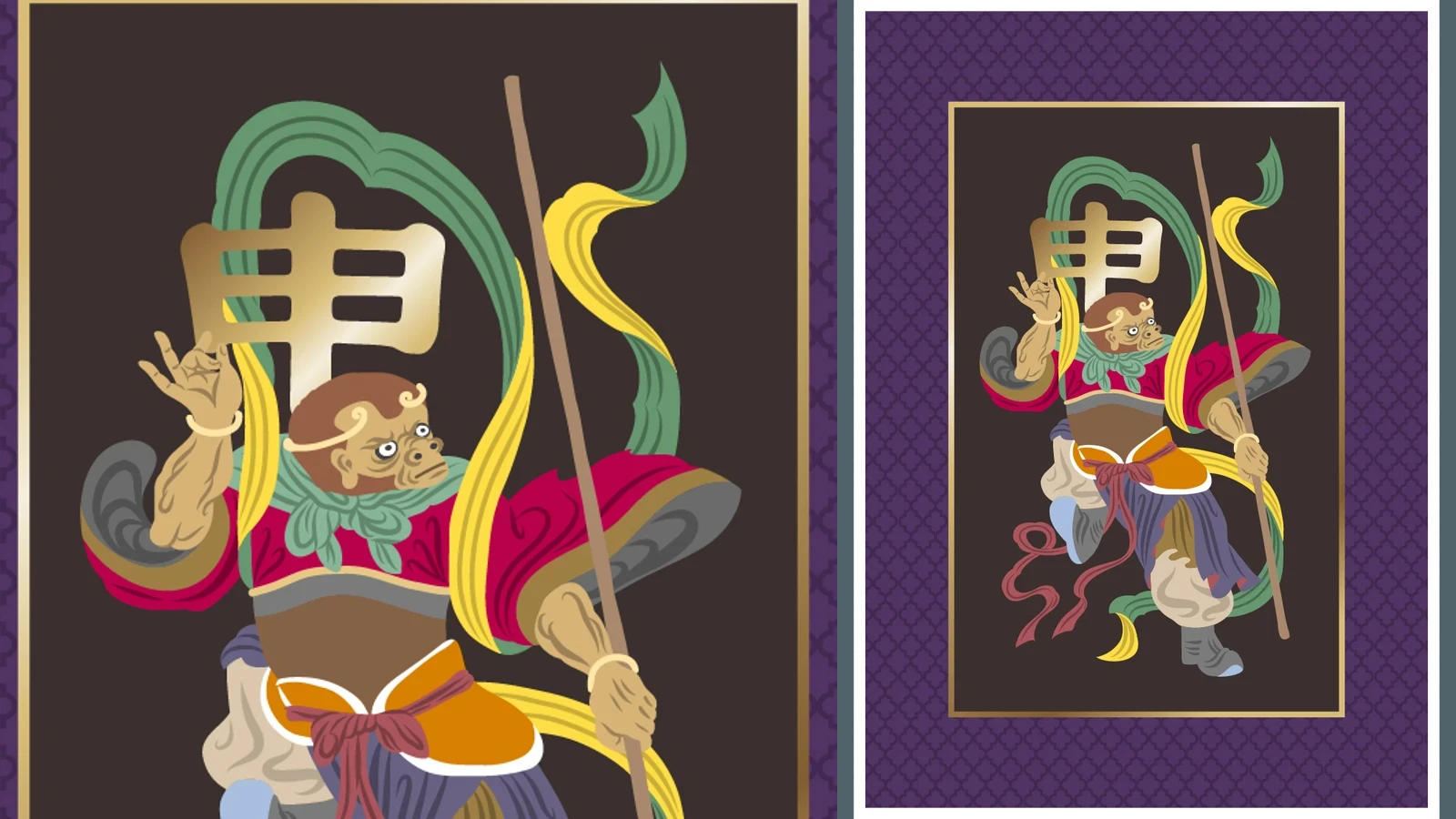
I do not want to solve this by stripping Wukong out of every New Year image. The crossover can be joyful and culturally intelligent. I want the caption to admit what creates it. A monkey beside 申 is calendrical; a monkey carrying the extending staff is literary; a Spring Festival poster containing both is an intentional merger. Naming the mechanism makes the image richer, not less magical.
Shen is not the word monkey
The Monkey corresponds to 申 (shen), the ninth Earthly Branch. The animal word is 猴 (hou).
Shen is traditionally associated with roughly 3 p.m. to 5 p.m. It follows the Year of the Goat and precedes Rooster in the branch cycle. When 申 appears beside a monkey on a New Year object, it identifies the calendar position rather than spelling the animal's name.
This distinction also blocks a common translation mistake. A branch is not a personality adjective. 申 has uses and meanings outside this zodiac pairing; its role here is positional.
An eleventh-century monkey without a magic staff

The Metropolitan Museum of Art identifies this eleventh-century Jingdezhen qingbai porcelain as a Chinese zodiac figure of a monkey. A robed human figure holds the small animal as an attribute.
This object is especially useful because it predates the sixteenth-century novel usually associated with Journey to the West. It does not need Sun Wukong's staff, headband or cloud to communicate Monkey zodiac identity. The held animal does the identifying work.
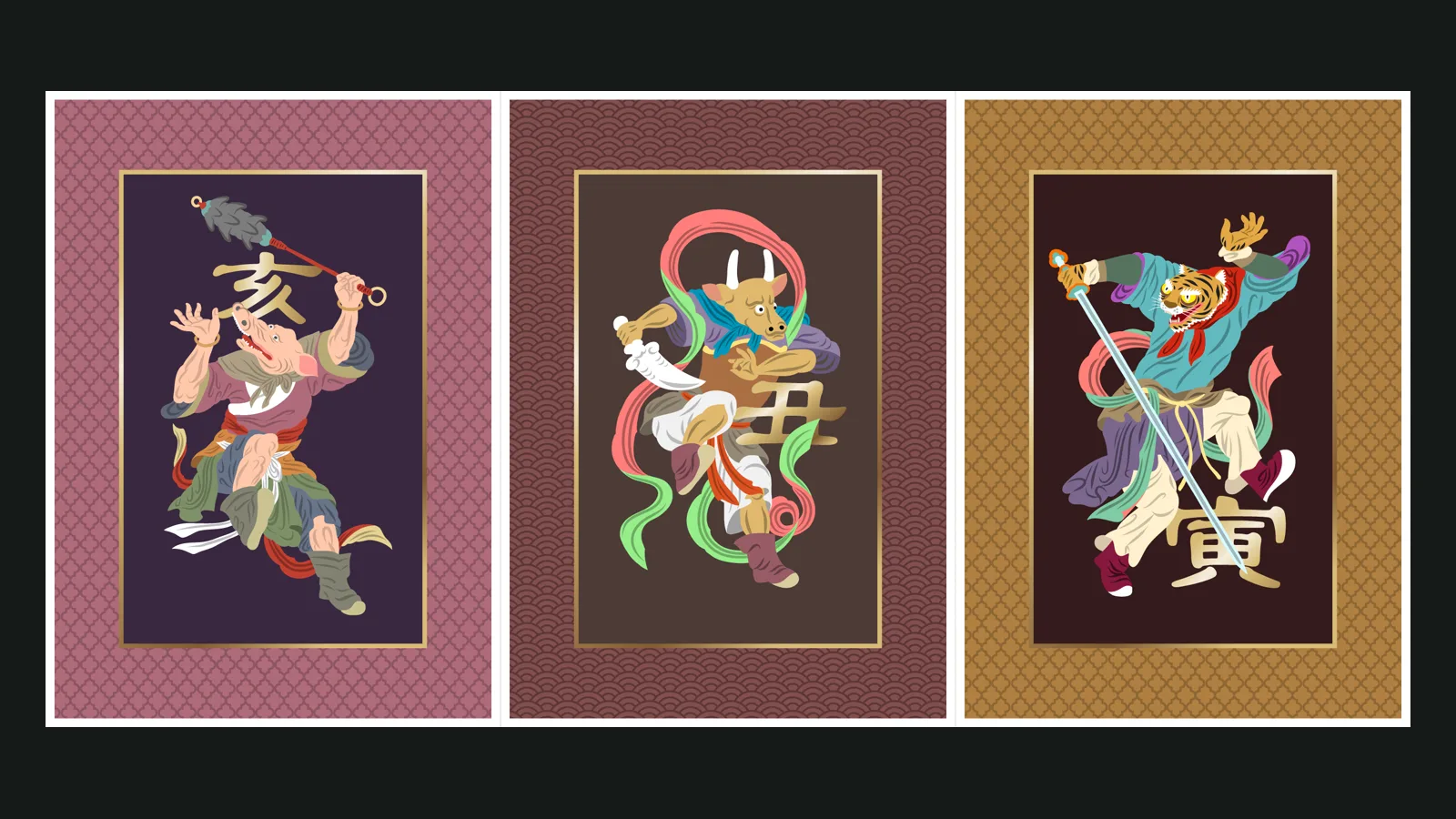
Compare the object with the contemporary East Moment hero. One makes the monkey a compact sign in human hands; the other expands it into the animal-headed protagonist of the frame and adds 申. The subject persists while the visual grammar changes.
How to tell zodiac Monkey from Sun Wukong
Use evidence rather than mood.
| Signal | Zodiac Monkey | Sun Wukong |
|---|---|---|
| Branch 申 or twelve-animal sequence | Strong | Not required |
| Birth year or Spring Festival context | Strong | Possible crossover |
| Extending staff | Not required | Strong |
| Golden headband | Not required | Strong |
| Named Journey to the West scene | No | Decisive |
A mischievous expression proves neither category. Cleverness and playfulness are generic monkey associations. Specific attributes and context make the identification.
Hou can turn a monkey into a promotion wish
Chinese decorative art often builds rebuses from similar sounds. The Met explicitly notes that monkey, 猴 (hou), is a homophone for marquis, 侯 (hou), and that monkey imagery can convey academic or professional advancement. The visual pun works when the surrounding objects and composition complete the wish.
This is a separate mechanism from both Shen zodiac identity and Sun Wukong storytelling. The same pictured species can therefore work in at least three systems:
- 申 or a birth year makes it calendrical.
- Staff, headband or a named episode makes it literary.
- Rank-related rebus context makes the hou sound relationship important.
Do not identify a rebus from a monkey alone. Read the surrounding objects and the institutional caption. Wordplay is powerful precisely because the whole composition completes it.
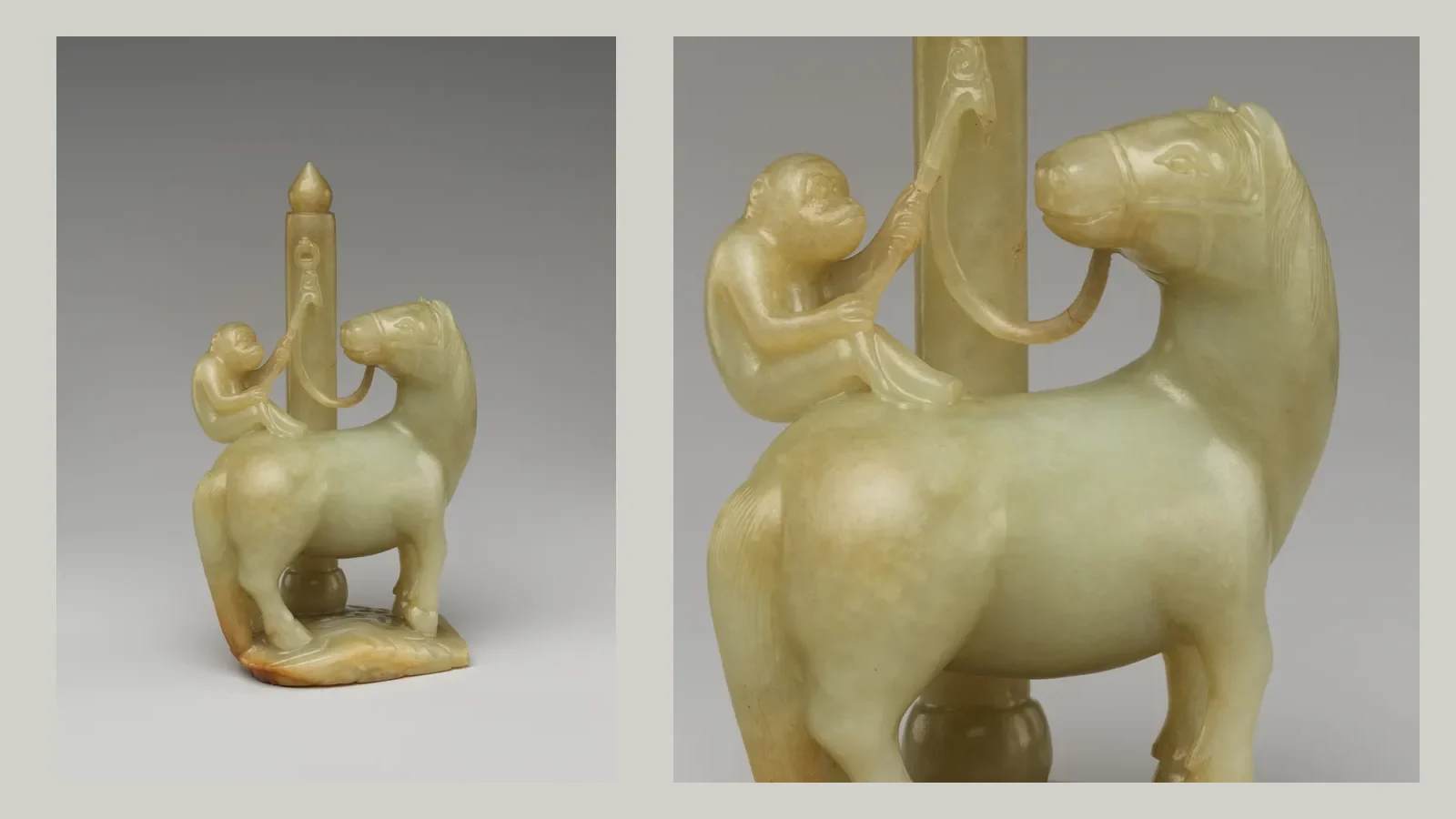
This seventeenth-century jade group gives the pun a physical grammar. The monkey is not simply placed near a horse; it climbs onto the animal, making “on the horse” part of what the eye reads. The Met identifies the object as Horse and monkey. In the auspicious phrase mashang fenghou, the arrangement helps carry the wish for immediate elevation to noble rank. It is a promotion object, not proof that Monkey-year people are destined for a better job. The distinction is sharp: composition creates the rebus; a birth year does not.
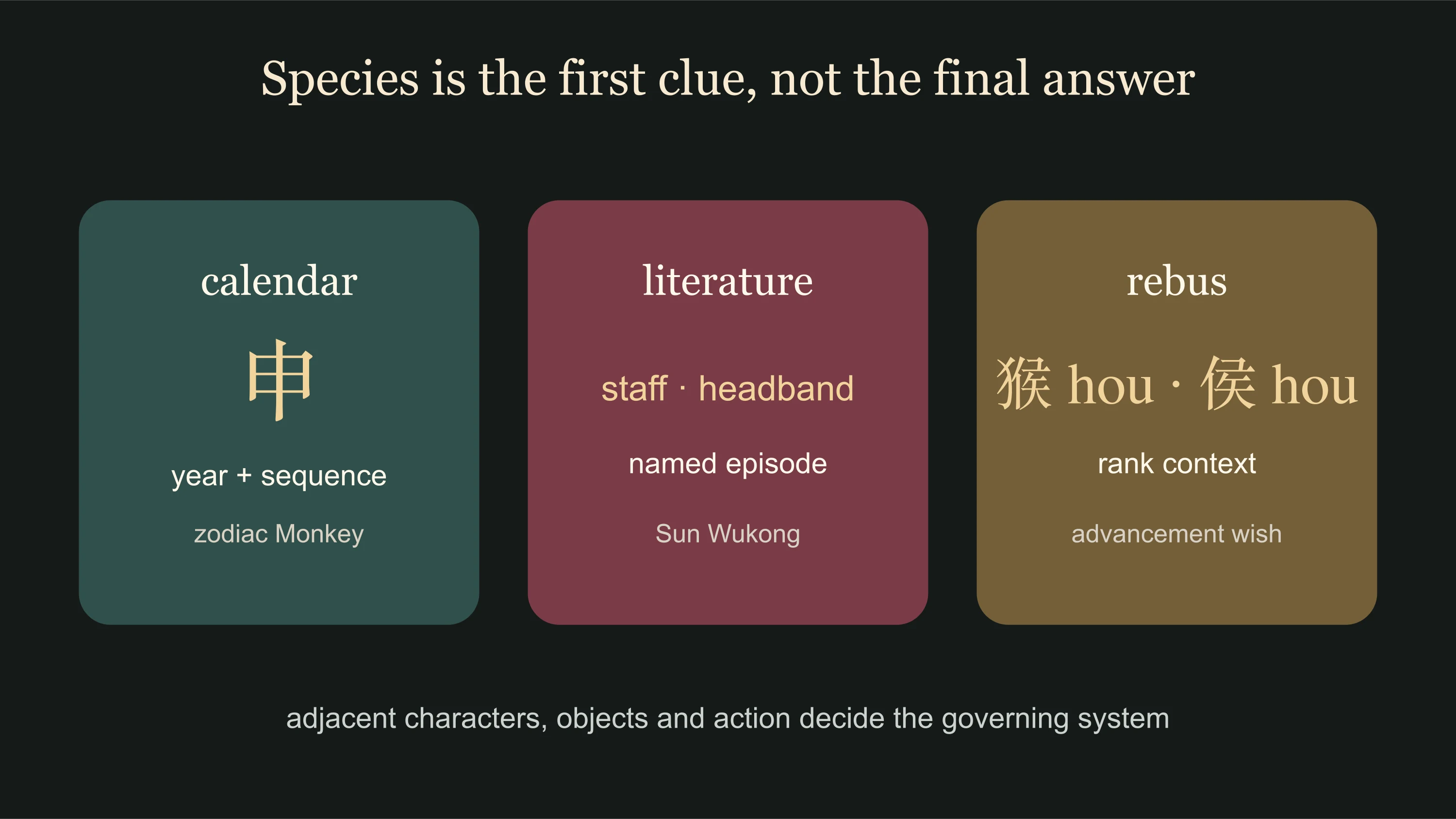
This is the Monkey page's central visual discipline: species is only the first clue. A monkey tells us what animal is present. It does not yet tell us whether the governing system is calendar, novel or sound-based auspicious design. That second answer comes from adjacent characters, objects and narrative action.
What the Great Race adds
In popular Great Race retellings, Monkey, Rooster and Goat cooperate to cross the river. This gives the Monkey a role different from the solo trickster stereotype: intelligence works inside a temporary team.
The story is legend, not evidence for the historical origin of the branch system. Its value is mnemonic and ethical. It remembers positions eight through ten as a small collaboration rather than three disconnected arrivals.
This cooperation also complicates the horoscope claim that Monkey signs are simply independent rule-breakers. Stories can make the same animal strategic, social, disruptive or helpful depending on what the plot requires.
I find that more human than a list of traits. Intelligence is not a substance someone receives at birth; it appears through a problem, companions and choices. The race story gives Monkey something to do, while a horoscope adjective merely tells a stranger who they supposedly are.
That is also why Monkey should not borrow the Year of the Tiger page's language of protective force. Tiger authority is directed at a body or threshold; Monkey intelligence becomes legible through a problem, pun or narrative maneuver. Different animals deserve different verbs.
Personality folklore versus visual evidence
Monkey-born people are often called clever, curious, funny and unpredictable. Enjoy those descriptions as cultural shorthand, but do not confuse the animal's observed dexterity or Sun Wukong's charisma with a birth-year psychological test.
Images provide a better task. Ask whether the artist emphasizes hands, face, group action, branch 申 or Wukong attributes. Those choices are visible and arguable. A stranger's personality is not.
The Year of the Monkey becomes more interesting once every monkey stops being automatically labeled Monkey King. Separation creates accuracy; deliberate crossover creates meaning.
That is the answer I want readers to carry into the next museum label, game trailer or New Year poster: first identify the monkey, then identify the system around it. Calendar, novel and rebus can overlap, but they should never be collapsed by assumption.
The Year of the Monkey is not a Sun Wukong costume
The Year of the Monkey inherits an unfair advantage: Chinese culture already has the world's most famous monkey hero. Sun Wukong arrives with a staff, cloud travel, rebellion, transformation and an entire novel behind him. A zodiac monkey has none of those details by default.
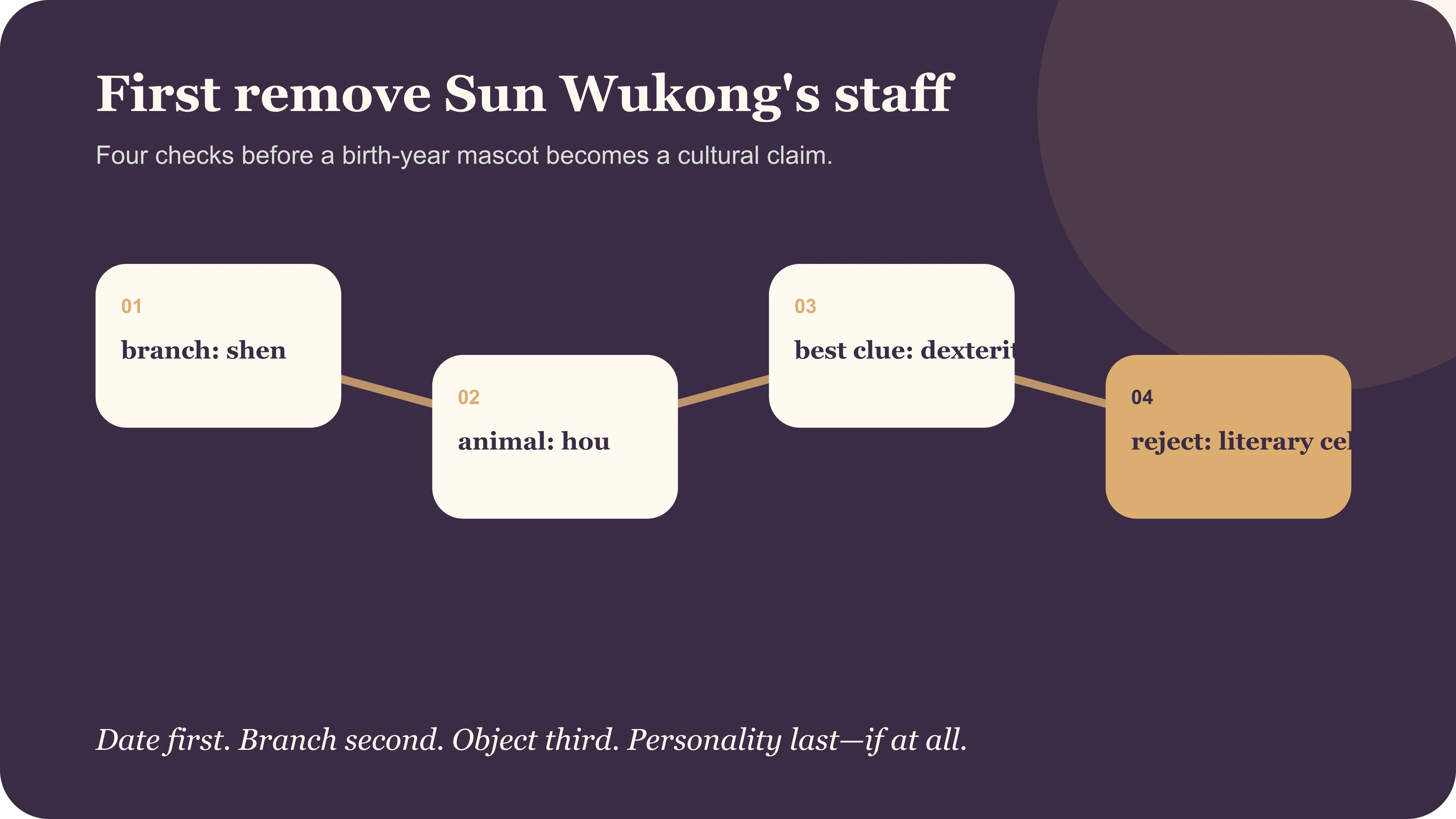
If a figure carries the golden-hooped staff, wears armour or appears with the monk Tang Sanzang, it belongs first to the narrative world of Journey to the West. If it sits among eleven other animals, names the earthly branch shen or marks a birth year, it belongs to the zodiac system. The same species does not erase the difference in role.
I make this distinction because search pages routinely use Wukong artwork as visual shorthand for every Monkey-year claim. That shortcut is exciting and wrong. It replaces a calendar animal with a named literary character, then smuggles Wukong's courage and defiance into personality descriptions of real people.
Cleverness needs an object, not a compliment
Monkey profiles praise intelligence, wit and adaptability. Those ideas grow from observed dexterity and from stories of imitation and problem-solving. Yet “clever” is too cheap unless the scene shows what the intelligence achieves.
Look at hands, fruit, branch, tool, companion and escape route. Is the monkey opening, stealing, offering, grooming or balancing? The verb determines whether cleverness appears as care, appetite, cooperation or opportunism. A visual reading that names the action is stronger than a list of flattering traits.
Chinese decorative arts also use monkey imagery in rebuses. A monkey may participate in wishes for rank or promotion because words can echo across images and speech. But the rebus depends on the specific combination. One monkey alone cannot prove every auspicious phrase associated with monkeys.
The branch, the animal and the hero form three different systems
The earthly branch shen is a calendrical coordinate. The monkey is its conventional animal partner. Sun Wukong is a literary and religious figure with changing interpretations across opera, print, television, animation and games. Those three layers can meet in a New Year design, but a responsible caption names the meeting instead of collapsing it.
The British Library's overview of Journey to the West helps establish the novel's literary world. It does not validate zodiac compatibility or prove the personality of a Monkey-year reader.
My favourite Monkey images have a little resistance in them. The animal is not merely smiling for the zodiac poster; it is doing something precise with space or another body. That is where agility becomes visible. It also gives us a clean path from the Year of the Monkey into Chinese mythology and literature without pretending the two categories are the same.
I refuse to borrow Sun Wukong's entire personality and hand it to millions of people born in one calendar year. The Monkey sign must first remain an animal-and-time relationship; the literary rebel enters only when staff, cloud, armor, name or story makes him visible. I insist on this boundary because it does not drain the fun from the image. It lets zodiac wit and literary defiance remain two powerful ideas instead of one lazy mascot.
The honest limitation remains: birth year cannot measure intelligence, loyalty or temperament. Use the sign to begin a conversation about objects, stories and calendar practice. Do not use it to finish a judgment about a person.
Mischief is not a complete moral judgment
A monkey reaching for fruit may look comic to the viewer and costly to the grower. An animal copying a gesture can appear intelligent, disruptive or both. The meaning depends on whose order has been disturbed.
That is why “mischievous” is more interesting than it first appears. It contains a struggle over rules. Sun Wukong turns that struggle into cosmic rebellion; an observed macaque turns it into a practical contest over food and space. A zodiac ornament may only borrow the smile.
I keep the moral question open but the categories firm. Name the character when it is Wukong. Name the species or object when the source permits. Name the zodiac only when calendar context is present. Cleverness survives this discipline; cliché does not.
The face can mislead the reading
Human viewers recognise expressions in monkey faces quickly, sometimes too quickly. A bared-teeth display may be captioned as a smile; an alert stare may be turned into comic curiosity. Documentary reading needs behaviour and source context, not projection alone.
The same caution applies to decorative figures. A smiling monkey holding fruit may participate in auspicious wordplay, childhood design or a narrative scene. Identify the companion object before claiming a zodiac meaning.
Monkey symbolism remains lively because it comes close to human action without becoming human. That nearness invites recognition and discomfort. I would preserve both instead of turning the animal into a cute certificate of intelligence.