A Chinese spear is a long-shafted weapon family commonly called qiang (枪) in modern martial-arts language; older objects may also be identified as mao (矛). The clean definition is a point fixed to a shaft. The important definition is a moving line that connects the point, shaft, hands, body, feet and distance. That is why the spear can look almost empty when it is still—and why it can take over an entire screen when it moves.
Chinese spear: one small point moves an entire body
The first thing most people notice is the spearhead. It shines, threatens and gives the eye somewhere obvious to land. I think that is exactly why so many explanations misunderstand the weapon. They talk about the point as if the two metres behind it were packaging.
They are not packaging. They are the argument.
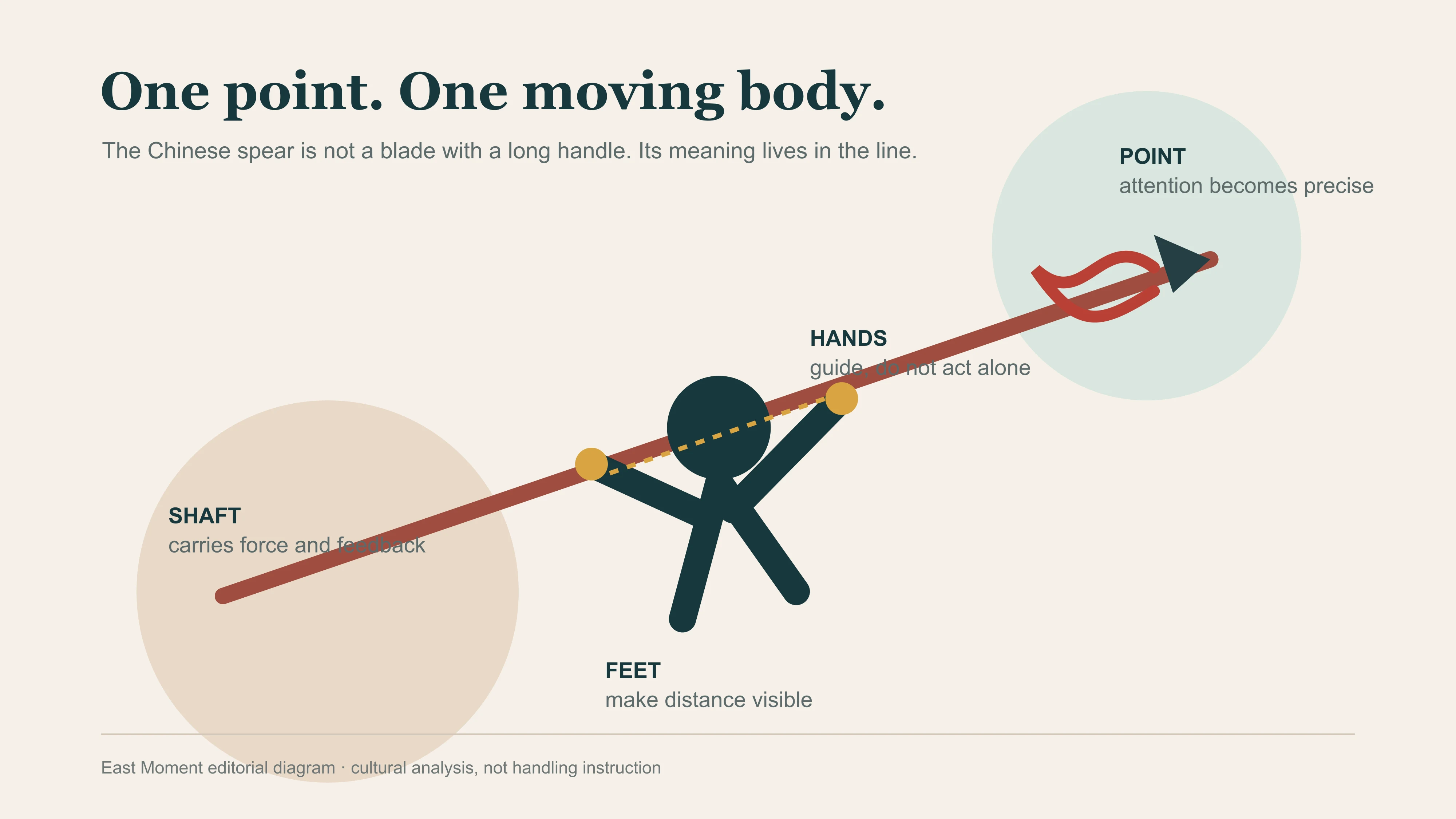
A spear turns a small point into a long relationship between a person and the space around them. The shaft makes tiny errors visible. If the hands quarrel with the feet, the far end announces it. If the body overcommits, the line becomes difficult to recover. If the performer produces only speed, the weapon becomes a blur without a sentence.
This is my central judgment: the Chinese spear is not visually powerful because it is long; it is powerful because length refuses to hide disconnection. A sword can stay close enough to borrow charisma from the body. A spear places the consequence far away. The person has to reach that point without abandoning everything behind it.
That idea belongs to history, modern sport and screen choreography in different ways. It does not make those worlds interchangeable. A museum spear proves material survival. A qiangshu routine proves contemporary athletic control inside a sport. A film scene proves how a director uses line, distance and interruption to tell a story. The page becomes intelligent only when we stop asking one image to prove all three.
Qiang, mao and “spear” are not one frozen object
English needs one broad word, so spear receives a huge range of shafted weapons. Chinese also has changing and overlapping weapon vocabularies. In contemporary wushu, qiang (枪) is the standard word behind qiangshu (枪术), spear routine. Museum records for earlier objects may use mao (矛). Neither translation gives permission to imagine one unchanged design crossing three thousand years.
The simplest useful distinction is contextual:
| Label | Where you are likely to meet it | What the label establishes | What it does not establish |
|---|---|---|---|
| Qiang 枪 | Modern Chinese, martial arts, military and popular culture | A spear/long-gun word whose meaning depends on context | One fixed historical shape or school |
| Mao 矛 | Ancient texts, archaeology and museum catalogues | A historical spear term attached to documented objects or periods | Automatic continuity with a modern wushu implement |
| Qiangshu 枪术 | Contemporary sport wushu | A judged spear-routine event with defined equipment and movement requirements | An ancient battlefield reconstruction |
| Chinese spear | English search, museums, games and films | A practical umbrella for finding the object family | Precise date, subtype, material or use |
This is not pedantry. The word determines which evidence you should demand next. An archaeological mao needs excavation history, dating and material analysis. A modern qiang needs the school, sport or performance context. A game spear needs design intent and mechanics. If the source gives only a dramatic photograph, the honest answer may remain “Chinese-style spear” rather than a confident historical subtype.
Our broader Chinese martial arts weapons guide compares weapon families. This page goes narrower: it explains why the long line matters and how to read it without turning translation into certainty.
An eighteenth-century object makes length concrete
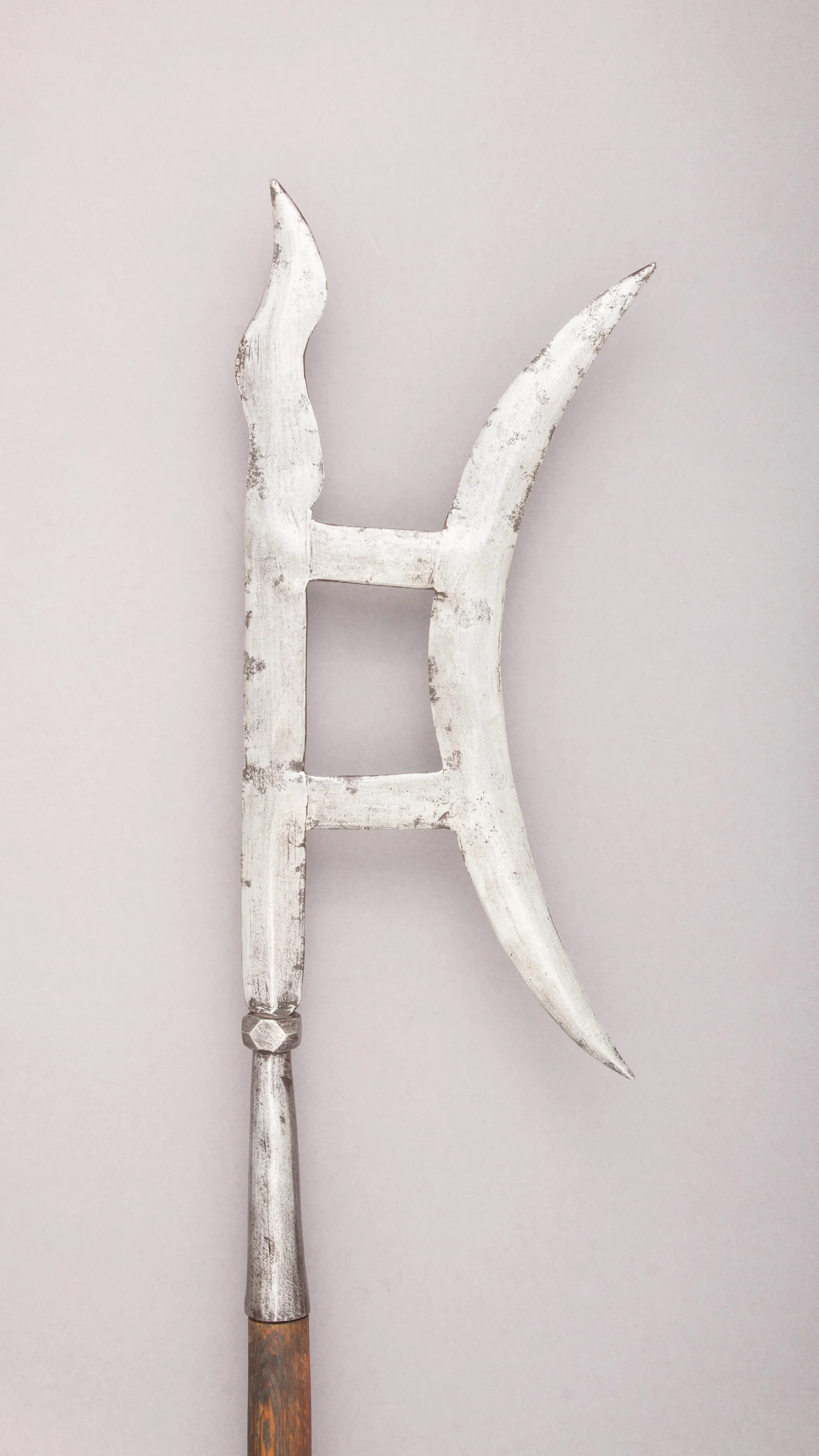
The Metropolitan Museum of Art records this Chinese spear as an eighteenth-century object made from steel, wood and pigment. Its full length is 89¼ inches—226.7 centimetres—and the museum lists the head itself at 61.6 centimetres. It weighs about 2.39 kilograms. Those numbers immediately destroy the weightless “prop” that search thumbnails encourage us to imagine.
The object is visually surprising. Its head divides into projecting blades rather than forming the narrow leaf shape many viewers expect. The surviving shaft is not a neutral stick: wood, pigment, socket and metal belong to one construction. The photograph lets us inspect shape and surface. The Met collection record gives us material, dimensions, date, culture and provenance inside the museum collection.
It does not show a person using it. It does not tell us that every eighteenth-century spear had this form. It does not certify a martial-arts method preserved today. The object is strong evidence precisely because we refuse to make it perform jobs it cannot perform.
I like this spear because it looks inconvenient to fantasy. Its forked geometry resists the clean red-tassel silhouette of cinema. It reminds us that historical weapons were made inside particular military, ceremonial, technological and social systems—not inside a modern search-results grid trying to produce one perfect “Chinese spear.”
The ancient spearhead is small enough to make history feel close

The second object is older and quieter. The Met identifies it as a spear head (mao) from the Eastern Zhou dynasty, dated to the sixth through fourth century BCE. It is bronze with metallic inlay, 27.3 centimetres high and only 5.2 centimetres wide.
That narrowness changes how I see the idea of “ancient weapon.” The object is not a cinematic wall of metal. It is a carefully made surface: central ridge, patterned inlay, corrosion, edge and socket. The photograph lets the eye stay with craft after the threat has faded. Someone designed a point that also carried visual order.
The museum record securely gives the object a date range, material and collection identity. It cannot reconstruct the missing shaft. It cannot tell us the exact movement of a person who once held a related object. It certainly cannot prove that a modern practitioner performs an unchanged Eastern Zhou method.
This is the second judgment I want readers to keep: survival is not continuity. An ancient spearhead survives. A modern word survives. A movement family may survive through teaching and reinterpretation. Those three continuities can touch, but they are not automatically the same line.
The more attractive an object is, the more discipline the caption needs. A beautiful inlay invites a story. Provenance decides how much of that story we have earned.
The red tassel is real; most confident explanations are not
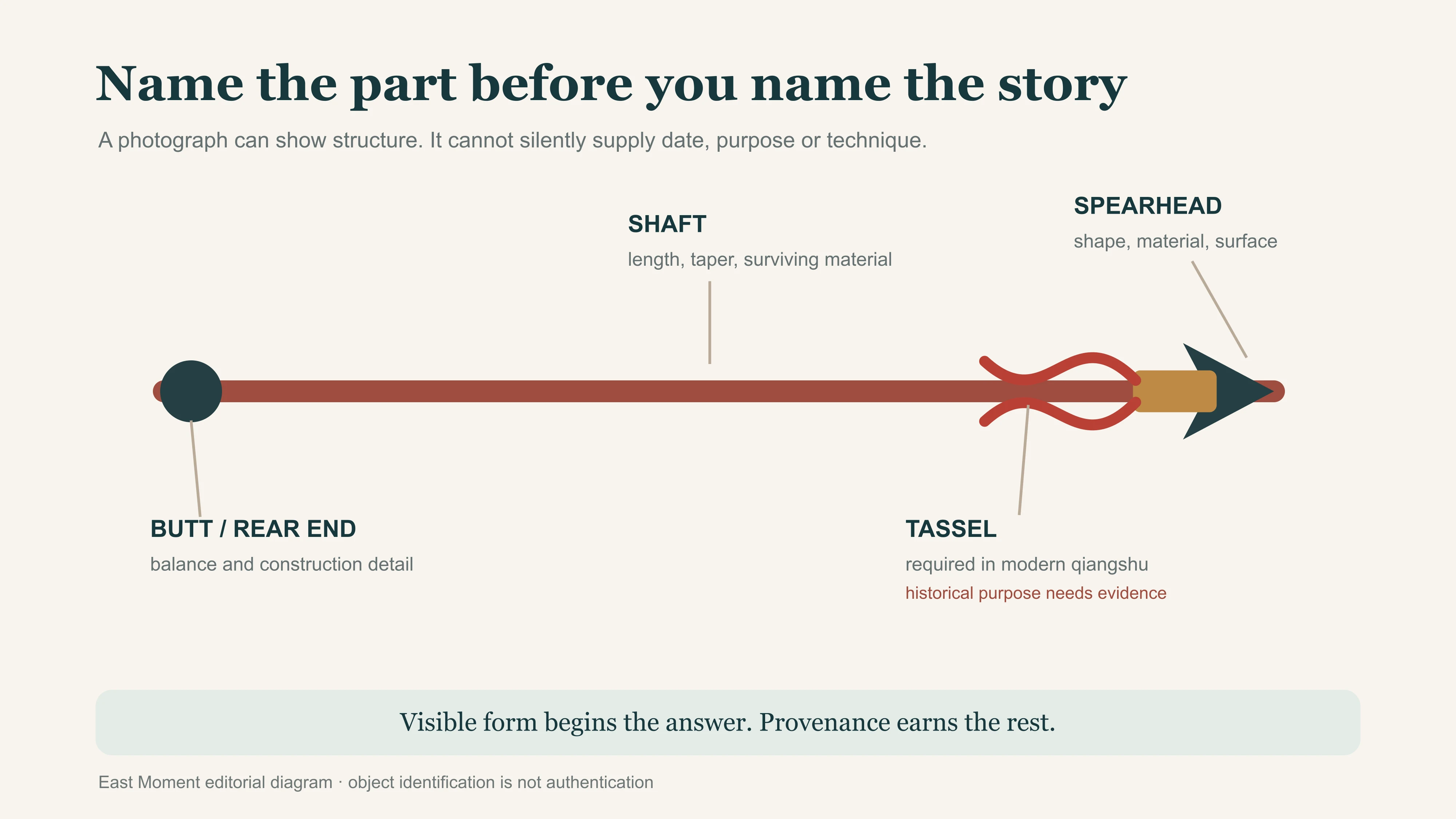
Search for a Chinese spear and red fibres flare beneath the blade. Films love the movement. Competition routines make it highly visible. Replica shops attach a ready-made explanation: the tassel confused opponents, caught blood, protected the hands or showed rank.
Some of those ideas may belong to particular periods, practices or later explanations. I could not verify a single universal historical function strong enough to present as the answer. So I will not borrow confidence from repetition.
What can we verify? In modern sport wushu, the tassel is part of the regulated implement. The International Wushu Federation's 2019 rules excerpt required a spear tassel at least 20 centimetres long and not excessively sparse. The current IWUF taolu page visually and textually identifies qiangshu as a contemporary spear discipline. On that floor, the tassel participates in the object's readable motion whether or not a judge awards it a separate symbolic meaning.
What can we see? Fibres make rotation, reversal and vibration easier for an audience to notice. They create colour near the point. They amplify the moment when a long line changes direction. That is a visual observation, not proof of why every historical tassel existed.
My rule is blunt: the red tassel should make the movement more visible, not make the history more fictional. If a page offers one neat ancient function without a period-specific source, treat it as an explanation to investigate, not a fact to repeat.
Qiangshu turns the Chinese spear into a judged sentence
Modern qiangshu does not pretend to be a museum demonstration. It is a taolu event: a performer organizes spear methods, stances, direction, rhythm and difficulty into a routine that judges and spectators can read.
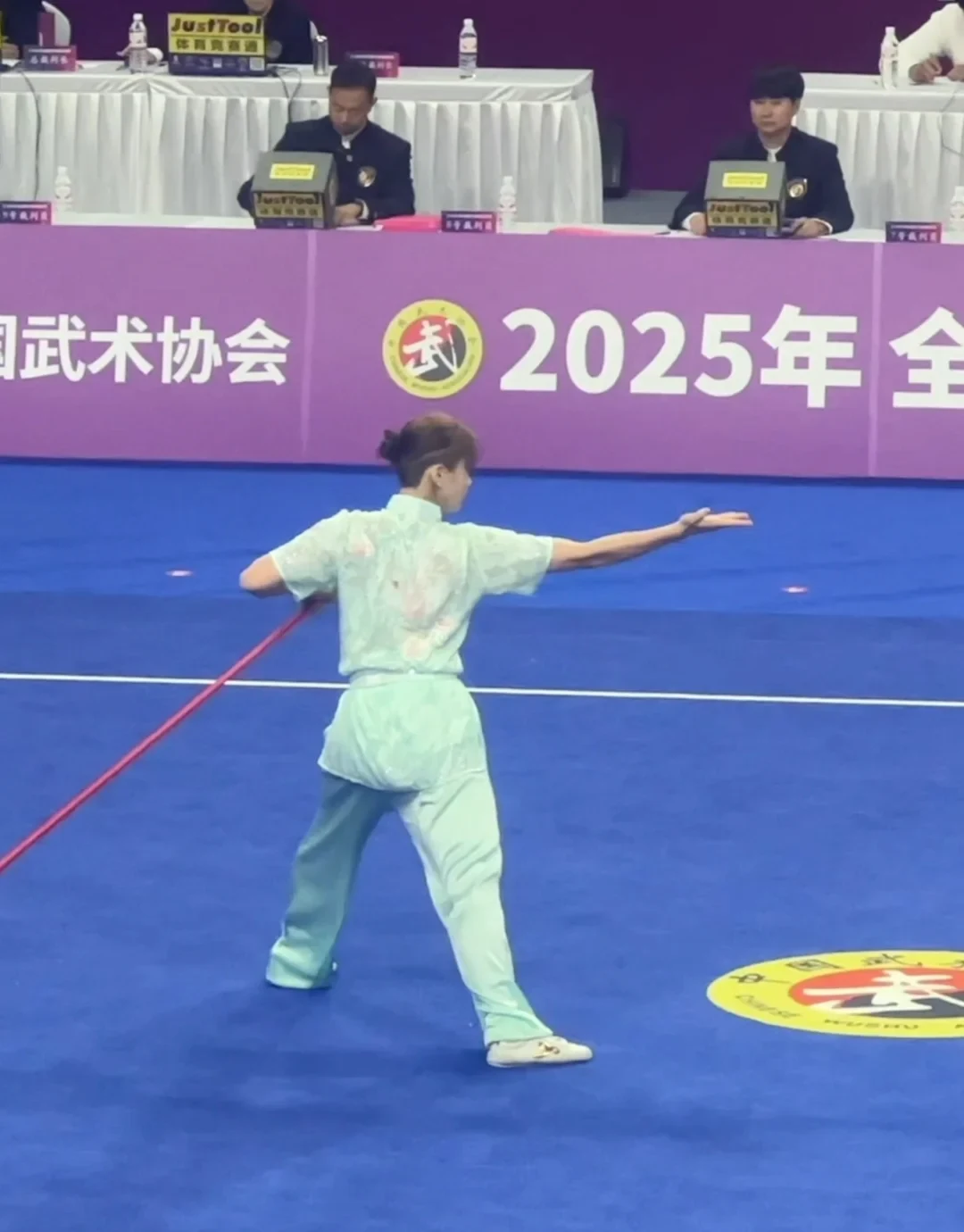
The IWUF's 2024 rules name core spear methods including outward and inward circular blocks, thrusting, piercing, tilting, pointing, figure-eight movement and an upward handle action. Those categories matter because they show that “spear equals thrust” is too thin even inside a standardized sport. The point can travel straight, but the weapon also circles, redirects, frames and returns.
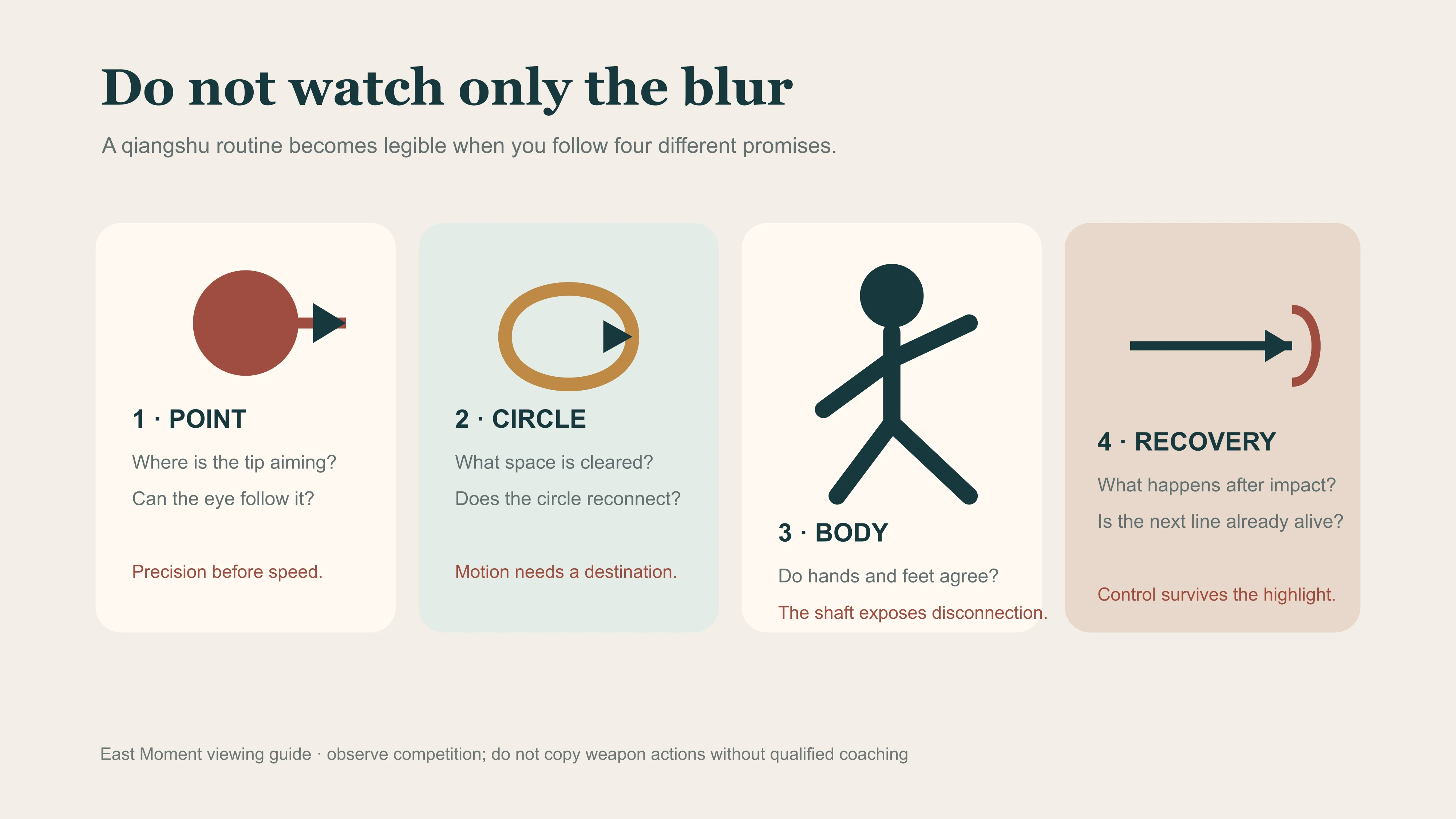
When I watch qiangshu, I refuse to count only spins. I follow four promises:
- Point: Can I tell where the spearhead intends to arrive, or has speed erased intention?
- Circle: Does a circular action organize space and reconnect to the next line, or is it only decorative rotation?
- Body: Do footwork, torso and hands send the same message, or does the shaft expose a broken chain?
- Recovery: After the sharpest moment, does the performer own the next fraction of a second?
Recovery is the part I value most. Any highlight clip can begin at the peak. A complete routine has to live before and after it. The spear must stop being a special effect and become grammar.
That is also why the wider wushu guide separates taolu from sanda and both from traditional practice and screen choreography. Qiangshu can prove athletic control and performance quality inside its system. It cannot, by itself, settle historical lineage or an unrestricted combat argument. Clear limits do not diminish the athlete. They protect the achievement from borrowed claims.
“King of weapons” is a demand, not a victory trophy
The Chinese spear is often called bǎibīng zhī wáng (百兵之王), “king of the hundred weapons.” The IWUF itself uses the “king of all weapons” description for qiangshu. Online, that phrase is quickly converted into a tournament result: spear beats sword, therefore spear is king.
I read it differently.
The title is valuable when it names the spear's demand for whole-body coordination, distance and continuous control. It becomes childish when it is used as a universal superiority claim without terrain, armour, formation, period, training, rules or purpose. Weapons do not compete in a blank white room. People, systems and situations do.
“King” should therefore raise the standard of observation. Does the far point remain precise while the near body changes? Can a long object move without the performer losing the room? Does the shaft connect the action, or merely enlarge the mistake?
The spear earns the metaphor through exposure. It gives the practitioner more space to organize—and more space in which incoherence can be seen.
Spear, staff and sword do not create the same room
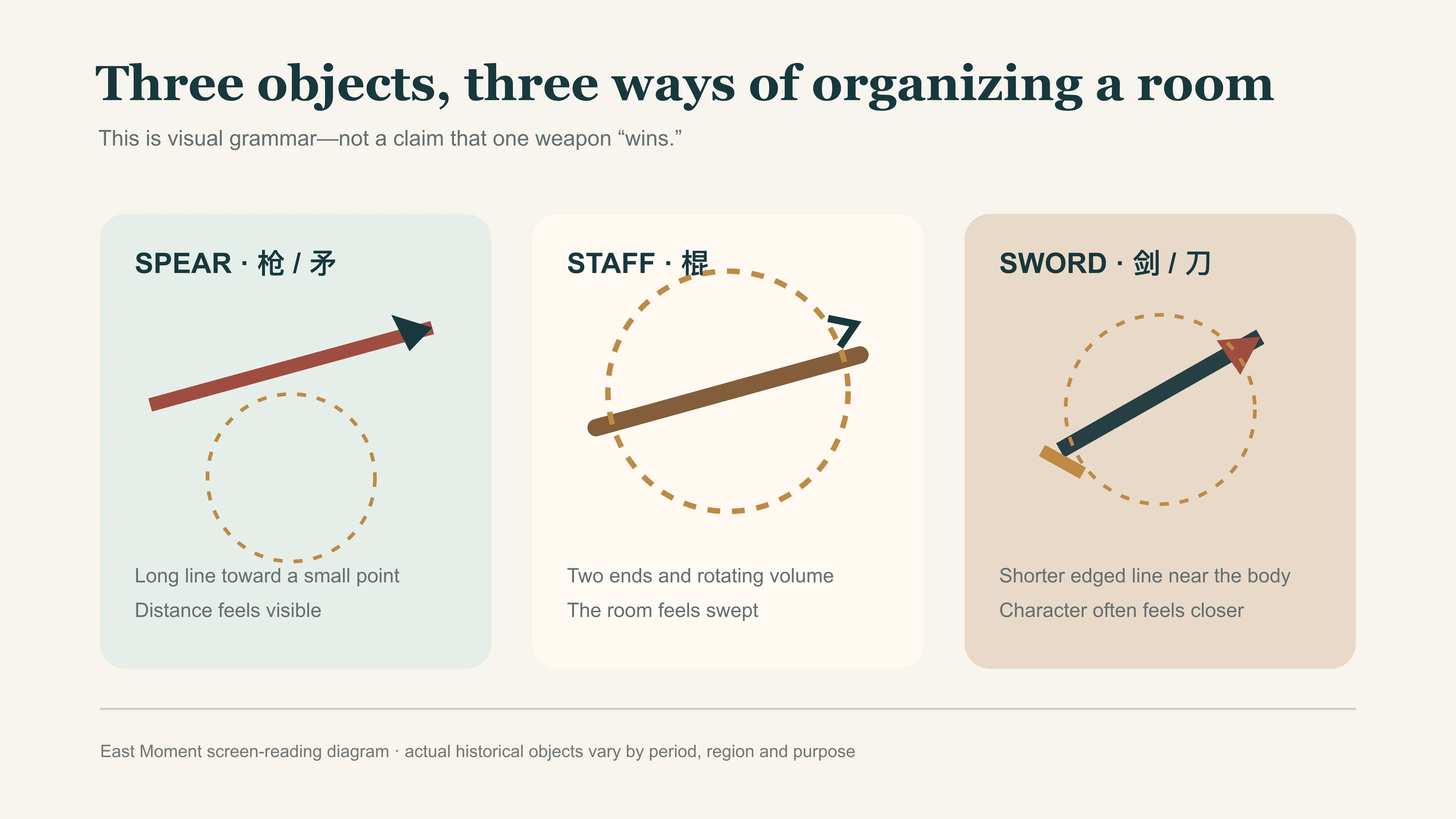
A staff has two available ends and no separate blade. On screen, rotation can make it feel like a moving boundary around the body. A jian or dao usually brings an edged line closer to the character. It can make a gesture feel intimate, ceremonial or personally consequential. A spear projects intention through a long line toward a comparatively small point. It makes approach and hesitation visible.
These are not instructions about which weapon wins. They are ways of reading an image.
Our jian sword versus dao sword guide begins with edge geometry because cinema often turns blades into personality stereotypes. The spear has its own stereotype: the battlefield general, the loyal young warrior, the silver flash that arrives before an army. It works because the weapon writes authority across distance. A character can stop another person without standing close enough for a private conversation.
That distance can also express loneliness. Put a spear carrier alone in a wide frame and the long line emphasizes how much empty world the body has to cross. Put several spears through a gate and they become architecture. Point them inward at one person and the room hardens before anyone moves.
This is what generic weapon lists miss. Length is not only a measurement. It is social pressure made visible.
Wuxia and games turn the spear into character language
Wuxia does not need a spear to behave like a museum object in order to use it intelligently. It needs the exaggeration to reveal character rather than replace character.
A disciplined spear scene lets us read timing, restraint and relationship. Who lowers the point first? Who crosses the line without permission? Does the weapon protect a doorway, announce a challenge, hold a formation together or isolate its owner from everybody nearby? The larger meaning of wuxia lives in debts, justice, loyalty and freedom. A weapon matters when it changes one of those relationships.
Games add repetition. A player chooses reach, timing, animation and role again and again. In Where Winds Meet, a weapon belongs to a designed wuxia world, not an archaeological reconstruction. The meaningful question is not “Is every movement historically exact?” It is “What fantasy of distance, identity and control does the game teach me to repeat?”
I enjoy impossible screen movement when it tells the truth about a character's desire. I reject it only when spectacle borrows documentary authority. A slow-motion red tassel can be beautiful. It cannot authenticate a dynasty.
How to recognize a Chinese spear image without pretending expertise
Begin with what the image actually gives you.
- Can you see the head, socket, shaft and rear end, or only a blurred silhouette?
- Is the source a museum catalogue, competition federation, school demonstration, film still, game asset or replica listing?
- Does the caption provide date, material, dimensions, athlete, event or production title?
- Is the tassel part of a modern wushu implement, a theatrical prop or a documented historical object?
- Is the image showing the whole object, or has the crop removed the evidence needed for identification?
Then write three separate sentences:
I can see: a narrow metal point, red fibres below it and a flexible-looking shaft in a competition setting.
The source establishes: this is a qiangshu implement used in a named wushu event.
The image cannot establish: ancient construction, battlefield use, lineage or effectiveness outside the event.
That method sounds slower than calling everything a “traditional Chinese spear.” It is actually faster. It prevents a beautiful mistake from spreading through captions, mood boards, AI answers and replica listings.
If you want to try spear practice, the page stops here. A long implement, shared training space and fast movement create risks that photographs cannot teach you to manage. Learn with a qualified instructor who can control progression, spacing, equipment condition and the room. This article is a viewing and cultural guide, not a handling lesson.
My verdict: follow the line, then ask who made it
The best way to understand the Chinese spear is not to memorize one legend. Follow the line.
In an archaeological object, follow it from decorated bronze into a missing shaft and admit what has been lost. In an eighteenth-century museum spear, follow materials and dimensions before inventing technique. In qiangshu, follow the point through circle, body and recovery. In film, follow the line until it changes a relationship. In a game, follow the action you are asked to repeat.
The spear is called king because people love rankings. I keep the title for another reason: no other common Chinese weapon makes the distance between intention and consequence so visually unforgiving. The point may be small. The truth of the movement is not.
Draw the line the spear creates
Bring one spear image to East Moment's Moments community. It can be a museum object, qiangshu still, film frame or game screenshot. Label the category. Draw or describe the line your eye follows—from body to point, across a doorway, around an opponent or through empty space.
Then add two short sentences:
“This image proves…”
“It still cannot prove…”
We will build a reader-made atlas of how Chinese spear images organize space without turning every beautiful frame into false history. That is a better conversation than asking which weapon wins. The Chinese martial arts collection places that line beside empty-hand systems, sword traditions, performance and modern sport.