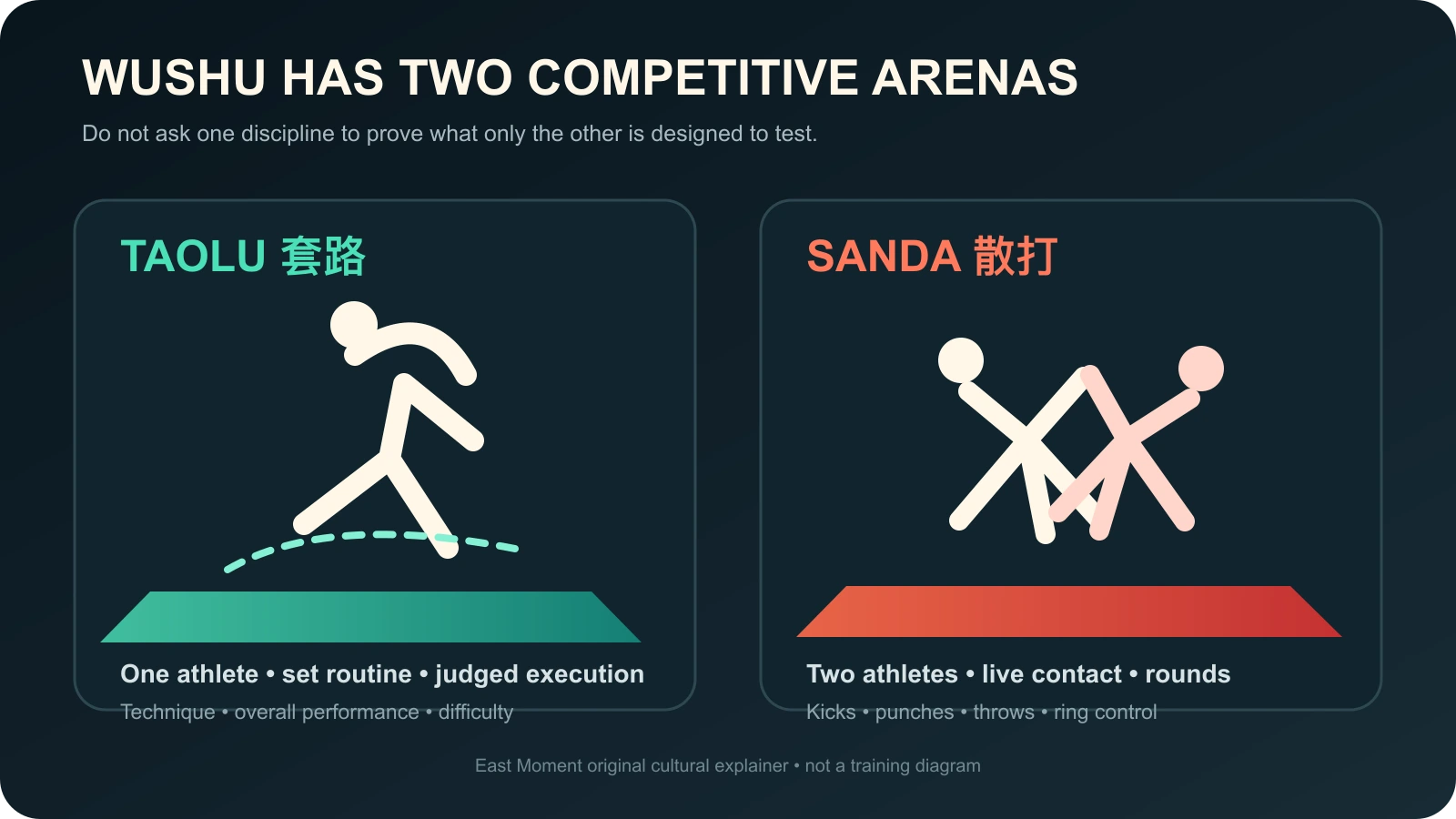
Wushu is not a failed version of fighting, and it is not one elegant routine pretending to be every Chinese martial art. In modern competition it has two distinct arenas: taolu, where an athlete makes technique, rhythm, line and difficulty legible through a set routine; and sanda, where two athletes solve distance, contact, scoring and platform pressure in real time. The argument becomes much clearer the moment we stop forcing one arena to prove the promise of the other.
Why wushu is personal for me
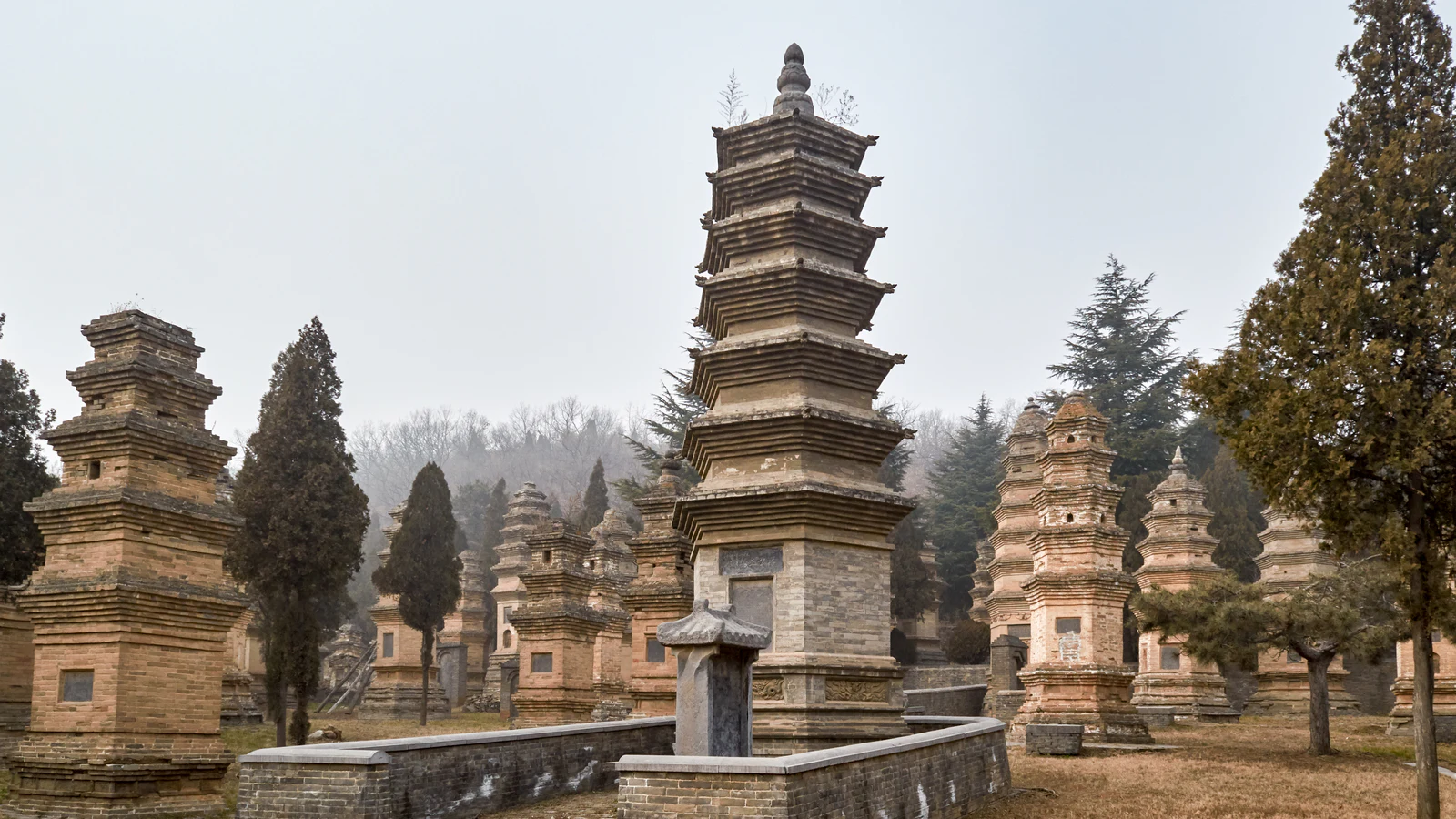
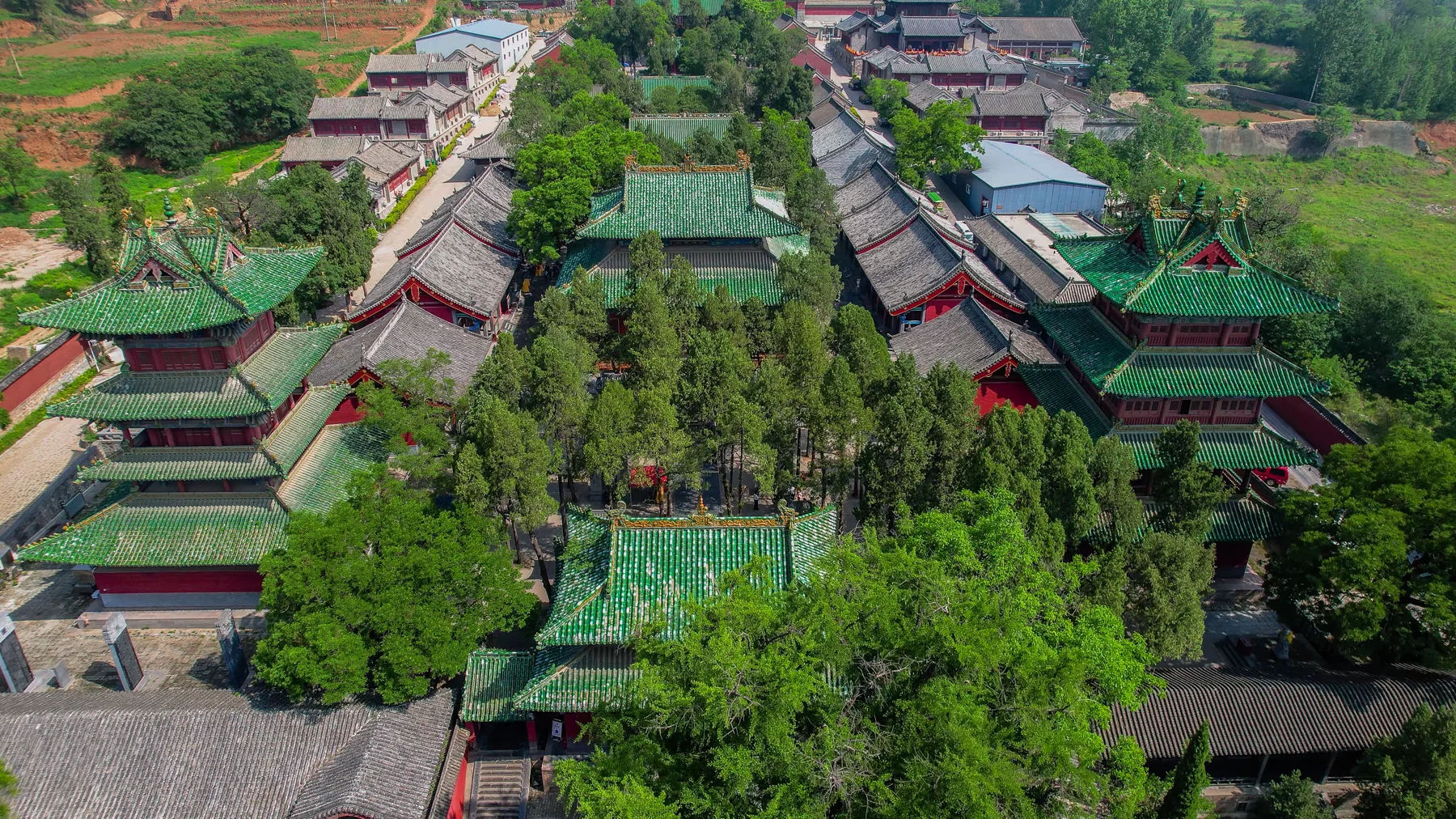
I began learning martial arts in first grade. My hometown in Henan is about an hour by car from Shaolin Temple, so martial-arts culture was not an exotic film image that arrived from somewhere else. It was part of the regional atmosphere: schools, demonstrations, conversations about discipline and the knowledge that Songshan stood close enough to shape local pride.
That background affects how I read wushu now. I respect the beauty of a routine, but I also know that a child's first lesson is usually less cinematic: standing correctly, repeating a basic action, listening to a teacher and returning the next day. The body learns culture through repetition before it learns how to perform an impressive frame.
My experience is not proof that every Henan child trained in the same way, and living near Shaolin does not make every local practice identical to Shaolin Temple kung fu. It does explain why I resist two stereotypes at once: wushu is not only a tourist show, and proximity to a famous temple is not a substitute for naming the school, method or discipline being discussed.
Wushu is two competitive sports sharing one Chinese name
One athlete crosses a carpet alone. The body expands, stops, changes direction, leaves the floor and has to return without looking as if gravity surprised it. In another venue, two athletes circle on a raised platform. A clean kick matters, but so does the throw that follows, the angle that prevents a reply and the awareness that the edge is part of the contest.
Both are wushu. They are not doing the same job.
That single distinction solves most English-language confusion. Wushu (武术) can be used broadly in Chinese for martial arts, but sport wushu has an organized competition system. The International Wushu Federation divides that system into taolu, or routines competition, and sanda, or free-fighting competition. Treating “wushu” as only the airborne half of taolu erases sanda; treating taolu as defective sanda erases the thing the routine is actually built to reveal.
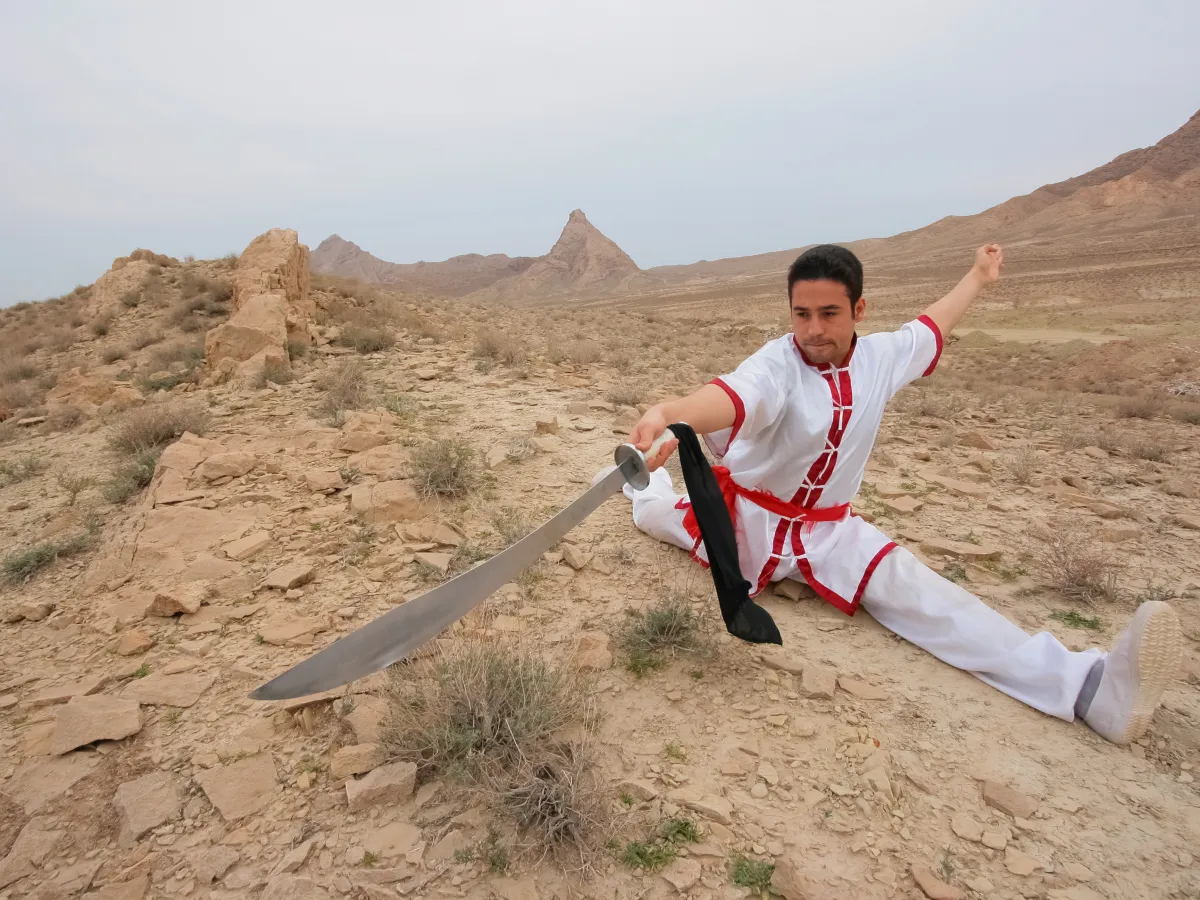
This photograph gives us extension, direction and an athletic silhouette. It does not prove a historical lineage, a competition result or fighting effectiveness. That boundary is exactly how a wushu page should use images: let the body show what the body visibly shows, then use rules and context for the rest.
| Discipline | What happens | What the result can establish | What it cannot establish |
|---|---|---|---|
| Taolu 套路 | One athlete performs a predetermined bare-hand or weapon routine | Quality of movement, overall performance and registered difficulty inside a judging system | Performance under unscripted contact or every traditional use behind a movement |
| Sanda 散打 | Two athletes exchange punches, kicks and throws under rules and weight classes | Tactical success against a resisting opponent inside that ruleset | Safety or superiority in every situation outside sport |
| Traditional practice | A school or community may train forms, applications, partner work, weapons, conditioning or ritual | What that particular practice preserves and tests | A universal claim about all Chinese martial arts |
| Screen choreography | Performers and filmmakers design movement for character, camera and emotion | Visual storytelling, timing and performance craft | A sport result, lineage or safe technical lesson |
I refuse the online habit of using one column to humiliate another. Clear categories make wushu more interesting. They do not make it smaller.
The wider Chinese martial arts collection explains where sport, traditional practice, cinema and cultural history meet. This page owns the narrower viewing decision: when a clip says “wushu,” identify which arena you are watching before you praise or attack it.
“It is performance” is a description, not a dismissal
The quickest insult aimed at taolu is huāquán xiùtuǐ (花拳绣腿): flowery fists and embroidered legs. In everyday argument it means something looks beautiful but lacks substance. The phrase is memorable, so people throw it at any leap, low stance or fast weapon routine and feel the case is closed.
It is not closed. It has barely started.
Competition taolu is openly performative because the movement must be judged. That does not mean the athlete is pretending to be athletic. Speed, flexibility, coordination, balance, power expression, spatial memory and landing control are real demands. The official IWUF taolu description identifies three judging dimensions: quality of movements, overall performance and degree of difficulty. The current rules were issued in 2024 and implemented from 2025, according to the federation's rules announcement.
The fair judgment is precise: taolu can prove taolu excellence. It cannot, by itself, prove what happens when another athlete interrupts the plan. But an inability to prove unscripted fighting does not make balance imaginary or rhythm fake. A diver is not fraudulent because a dive is choreographed. A gymnast does not have to turn a floor routine into a street altercation before the routine counts as sport.
The most impressive taolu performances make difficulty look subordinate to intention. I am less moved by a jump that begs for applause than by the half-second after it: the foot receives the floor, the torso reorganizes, the eyes already know the next direction, and the routine continues without losing its sentence. That recovery is where spectacle becomes control.
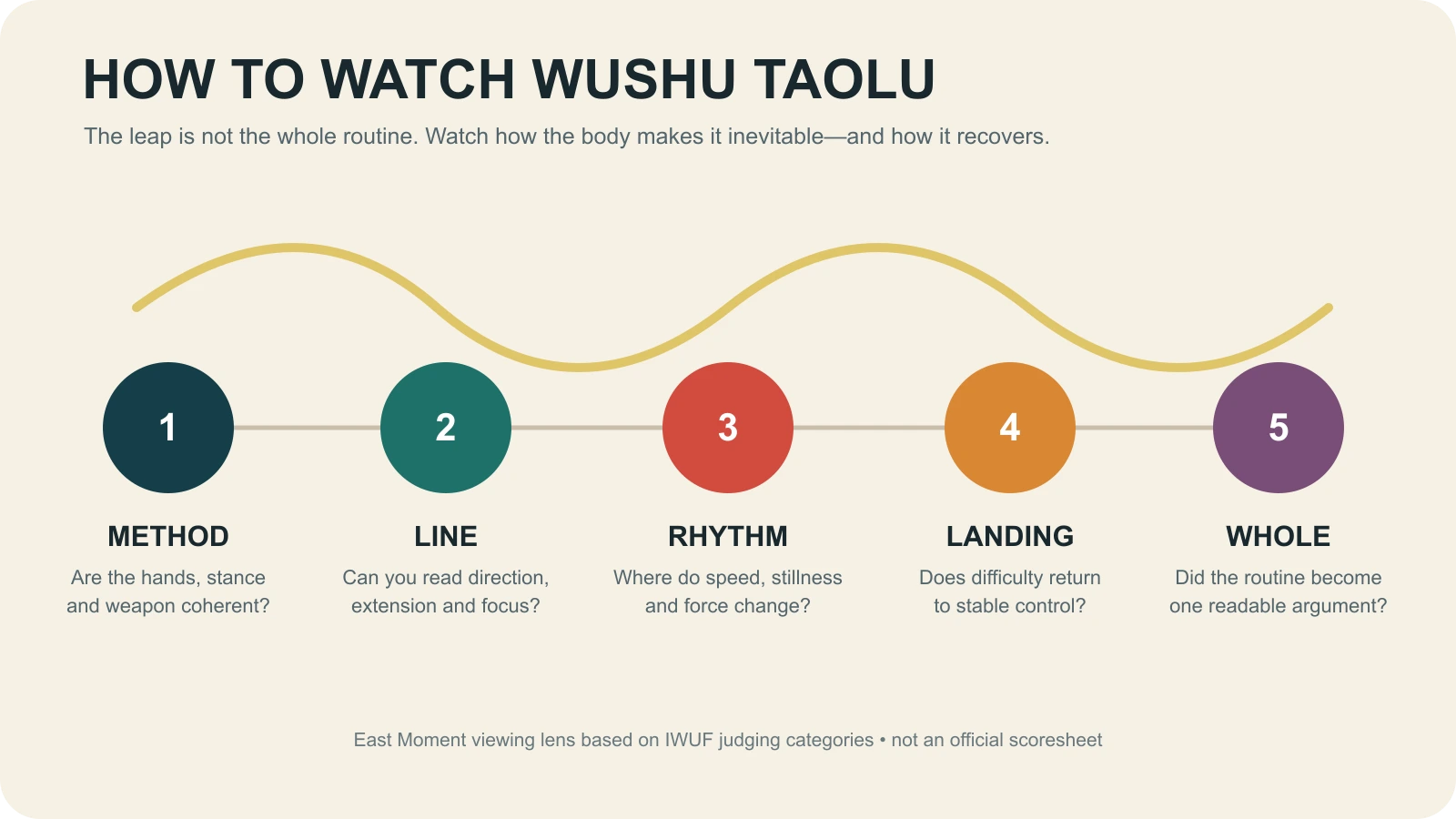
Read a taolu routine as a complete argument
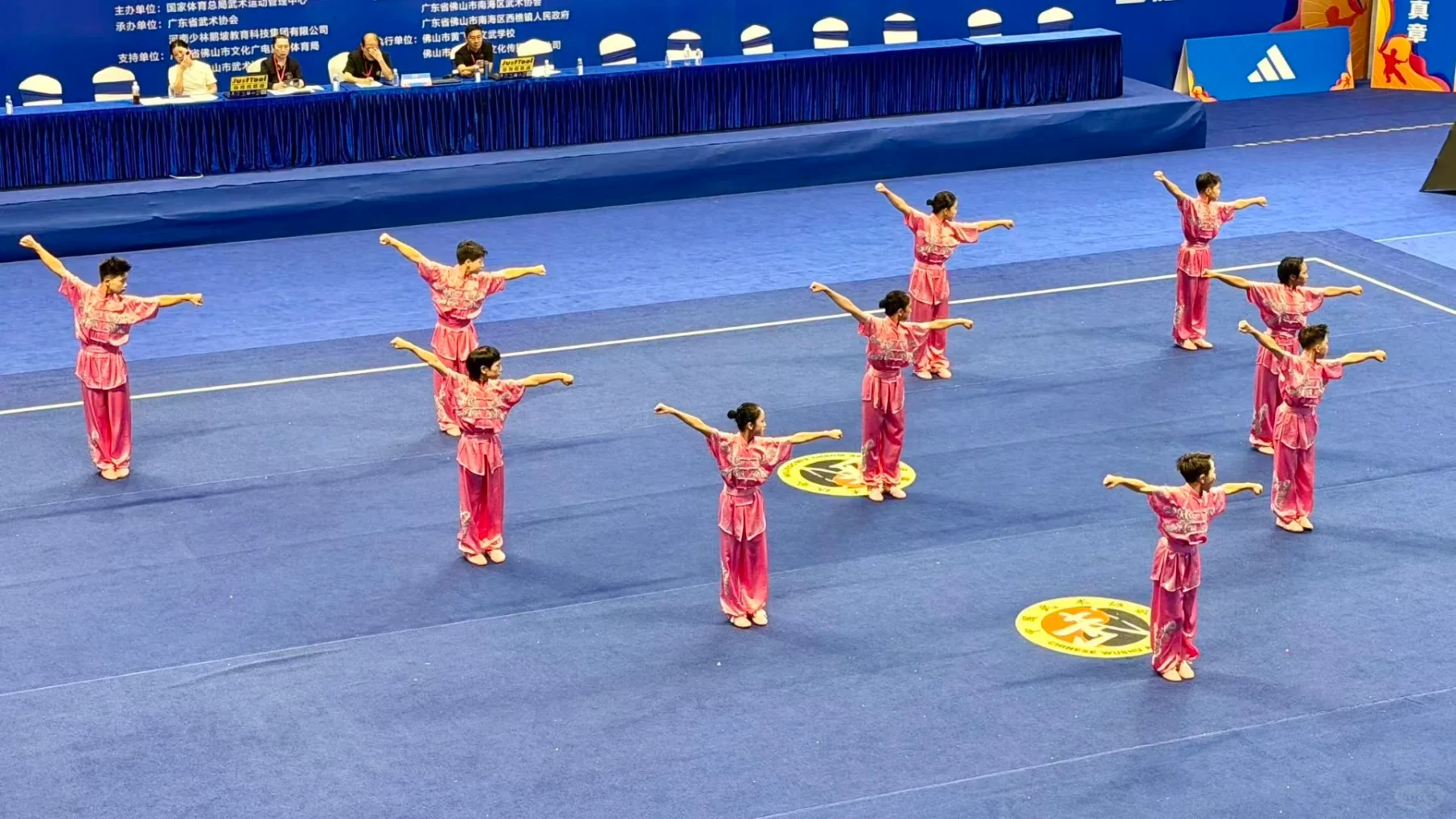
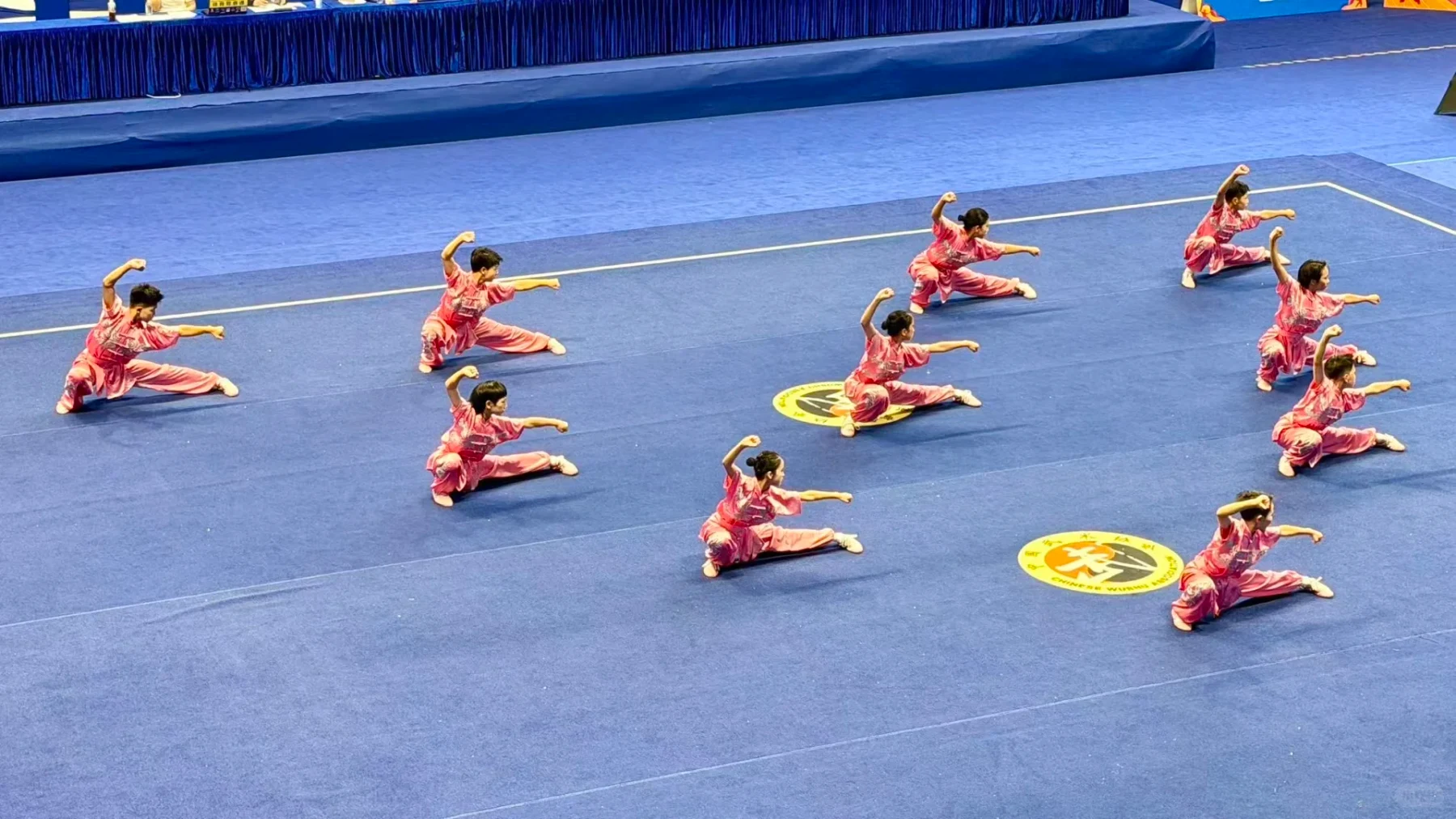
These two frames come from the same 2025 school-wushu exchange final. The first spreads the team upright across the floor; the second compresses bodies toward the ground. Neither still can prove timing, synchronization, difficulty or the final result. Together they prove something a single hero pose cannot: a taolu sequence changes level, density and direction, and its meaning lies in the transition between pictures. That is why I judge a routine as a complete argument. The peak frame is only one word.
Do not wait for the highest jump and ignore everything around it. A stronger reading begins earlier.
First, look at method. Does the hand shape, stance, step or weapon path remain coherent, or does the athlete merely rush between highlights? Then look at line: where is force directed, and can the eye follow the intention? Rhythm is not nonstop speed. A routine needs acceleration, suspension, impact and stillness; otherwise every movement has the same emotional weight.
Then watch the landing. Difficulty should return to control. A wobble tells the truth immediately, but so does a recovery so clean that the next technique seems to have pulled the athlete out of the air. Finally, ask whether the routine became a whole. Did its changes in direction, level and pace produce a readable style, or did it feel like a list of difficult fragments?
The main families help you know what kind of sentence you are watching:
- Changquan (长拳, Long Fist) uses extended shapes, speed, large movement and aerial difficulty. Its openness is designed to be read across space.
- Nanquan (南拳, Southern Fist) emphasizes compact power, firm stances, forceful rhythm and a different relationship between upper body and base.
- Taijiquan (太极拳) uses continuity, controlled weight transfer and a slower visible surface, although competition difficulty can add balances and jumps that differ from many public park routines.
- Jianshu, daoshu, qiangshu and gunshu bring the straight sword, broadsword, spear and staff into weapon events. Each object changes reach, line, rhythm and the consequence of imprecision.
Qiangshu deserves a closer look because its long shaft makes disconnection visible. The Chinese spear guide separates historical qiang and mao objects from the modern red-tassel competition implement, then shows how to follow point, circle, body and recovery without treating a routine as a handling lesson.
Jianshu needs its own lens for the opposite reason: the sword stays close enough for the hand and costume to steal attention from the body. The Chinese swordsmanship guide follows point, centre, feet, distance and the recovery after the highlight frame, while keeping museum object, modern sport, traditional school and screen choreography in separate evidence worlds.
This is where our martial arts weapons guide becomes useful: it explains why a weapon changes the space around a body. It does not turn a competition implement into an ancient battlefield object. The shared name is a bridge, not proof that the objects, rules and purposes are identical.
Sanda turns wushu into a live problem
Sanda is not taolu with a second person added. It is a modern full-contact combat sport developed from Chinese martial-arts techniques. The IWUF sanda page describes punches, kicks, throws, wrestling and defensive methods, contested across three two-minute rounds on a raised leitai platform.
That platform changes the intelligence of the bout. Space is not neutral. An athlete can score with a clean technique, disrupt balance with a catch and throw, pressure an opponent toward the edge or lose position while chasing too eagerly. The bout becomes a conversation between contact and geography.
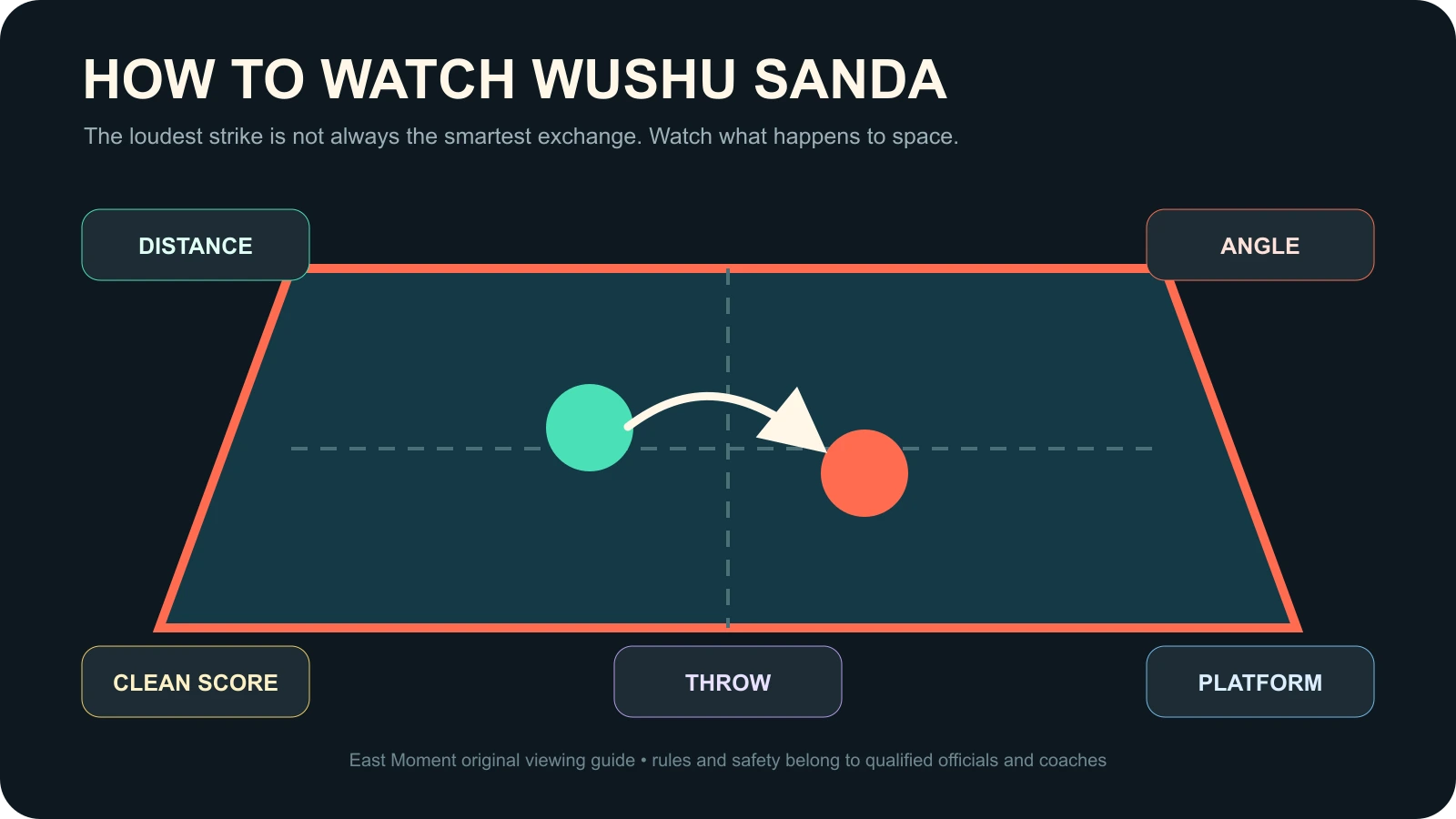
I watch the feet before I watch the fists. Who is able to leave after scoring? Who is being turned? Who has mistaken forward movement for control? A loud collision can dominate a short clip, but a quieter exchange may reveal more: one athlete creates an angle, lands cleanly and exits before the response is organized.
Throws also give sanda a visual identity that casual viewers can miss if they expect only kickboxing. A kick can become an opportunity for a catch; a clinch can change level and direction; a fighter near the platform boundary must calculate both the opponent and the remaining floor. These are sport-specific decisions, not evidence that any technique should be copied without qualified coaching, equipment and rules.
Sanda deserves the same honesty I ask for taolu. It tests resistance and tactical adaptation in a way solo routine cannot. It still does not reproduce every environment, legal context or danger outside a bout. Rules do not make contact unreal. They make the contest possible.
Wushu, kung fu and traditional martial arts overlap without becoming synonyms
English search results often turn three related terms into a ladder: traditional martial arts at the top, “real kung fu” somewhere in the middle and modern wushu at the bottom as state-made spectacle. That picture is satisfying because it is simple. It is also too simple to explain living practice.
Our Chinese kung fu guide begins with a broader word. Gongfu (功夫) means skill earned through time and effort, while English-language “kung fu” became strongly associated with Chinese martial arts through Cantonese-speaking communities and cinema. Wushu is the more direct Mandarin term for martial arts, yet institutional sport gives it a narrower international meaning in many contexts.
Traditional systems and modern competition are connected through techniques, movement vocabulary, teachers and history. They are also changed by standardization. A competition needs common event names, dimensions, time limits and judging procedures. A family system or local school may care about methods that do not fit neatly into those categories. Neither fact gives us permission to call every old claim true or every modern form empty.
The right question is not “Which one owns authenticity?” Ask what a practice promises, how it tests that promise and whether it states its limits. A traditional school that never applies pressure should not borrow sanda's evidence. A taolu medal should not be marketed as proof of unregulated combat. A sanda record should not automatically settle historical or cultural authority. Precision protects everyone from borrowed prestige.
If the reader wants the wider map—Shaolin, Wing Chun, Bajiquan, Tai Chi and other labels—the kung fu styles guide owns that decision. This page stays with modern sport wushu because one URL should solve one search task completely.
Jet Li shows why the categories blur on screen
Jet Li is one reason global audiences learned to see competitive-wushu clarity as cinematic power. His athletic record belongs to modern competition; his film movement belongs to choreography, performance, camera placement, editing and character. The two histories touch, but they do not collapse.
What transfers beautifully is organization. A stance reads before acceleration. A turn finishes with the body still legible. A line can be widened for the camera without becoming visually muddy. In the Jet Li profile, that competitive background matters because it helps explain why his movement photographs so cleanly—not because medals answer an imaginary no-rules fight.
This distinction lets us enjoy cinema without insulting sport or mistaking the screen for documentation. The movie can exaggerate speed, impact and distance while still revealing the performer's control. The athlete supplied capacities; filmmakers built a new language from them.
I would rather keep both achievements than flatten one into marketing for the other.
Is wushu good for fighting, fitness or a first martial art?
The answer depends on which wushu program you mean.
Taolu training can develop flexibility, coordination, balance, speed, spatial memory and performance discipline. Those are real qualities. A class centered on solo routines does not automatically provide experience against a resisting opponent.
Sanda training is built around live exchange under a contact ruleset. It trains distance, timing, scoring, defense and adaptation against another person. It also carries contact and injury considerations that require a qualified coach, suitable progression and honest safety culture.
A mixed school may offer basics, taolu, partner drills, weapons and sanda, but the label on the door does not tell you the proportions. Ask what beginners actually do during the first months, how contact is introduced, which competition rules are used, and how instructors respond when a student needs to slow down.
I distrust schools that sell certainty before they describe the class. “Wushu” is not a guarantee of self-defence, performance quality, health benefit or historical depth. A serious program should be able to name its goal without borrowing every other goal at once.
For a beginner, clarity is more valuable than mythology:
- Decide whether you want routine performance, contact sport, traditional practice, general movement or cultural study.
- Watch a complete class, not only a promotional montage.
- Ask how skill is assessed and how injury risk is managed.
- Notice whether questions are welcomed and limits are stated plainly.
- Choose the environment whose actual practice matches your reason for arriving.
That is not cautious language for its own sake. It is the fastest route to the right room.
Wushu belongs to the future because it made itself legible
Standardization always loses something. Local vocabulary, lineage detail and purposes that resist scoring can be compressed when a practice enters an international sport system. But standardization also allows athletes from different countries to meet under shared rules and allows viewers to understand what is being judged.
Wushu's place at the 2025 World Games in Chengdu brought both taolu and sanda into a global multi-sport setting. The sport's inclusion in the Dakar 2026 Youth Olympic Games program pushes that translation further. An international audience will see Chinese names, weapons, movement families and judging categories—but not the totality of Chinese martial culture.
That boundary should be spoken with confidence. Sport wushu is not a museum containing every tradition. It is a contemporary Chinese creation with its own athletes, rules, aesthetics and arguments. Its modernity is not a defect. It is the reason a centuries-deep movement vocabulary can enter a shared arena without pretending that the arena is the whole world.
The future I want for wushu is not a louder claim that it is “real.” It is better visual literacy. Viewers should know when they are admiring a landing, reading a tactical exit, recognizing a traditional reference or enjoying choreography. Once the promise is named, the achievement becomes easier to respect.
My verdict: name the promise before judging the movement
Wushu becomes confusing only when we demand one proof from every body we see. Taolu makes control visible through composition. Sanda tests decision under resistance. Traditional schools preserve and change particular systems. Cinema turns movement into feeling.
None needs to impersonate the others.
The next time a short clip appears on your screen, do not ask only, “Is this real?” Ask a better question: What is this movement promising me, and what evidence would honestly prove that promise? That question protects curiosity from hype and respect from blind worship.
Take one still or short sequence to East Moment's Moments community. Label it taolu, sanda, traditional practice or screen choreography. Then name one thing the image proves and one thing it cannot prove. That small act of classification will create a more intelligent martial-arts conversation than another hundred comments shouting “fake” or “invincible.”