Chinese swordsmanship is not one unbroken style, one weapon or one set of ancient techniques. It is a broad English doorway into historical sword traditions, modern jianshu, daoshu and taijijian, partner practice, stage movement and screen choreography. The useful question is not “How fast can the blade move?” It is “Can the body make the blade’s intention, distance and recovery remain intelligible?”
Chinese swordsmanship: the body must finish what the blade begins
A sword catches light before a body catches attention. That is why the internet keeps rewarding the wrong half of Chinese swordsmanship: a silver arc, a snapping tassel, a sleeve flying across the frame, a point frozen under somebody’s chin. The image is beautiful. It is also incomplete.
I care more about the fraction of a second after the beautiful frame.
Where did the weight go? Did the feet arrive with the point or chase it? Can the person stop, redirect or leave? Has the sword changed the distance between two people, or merely drawn a bright line for the camera? A blade can look decisive while the body underneath it is still negotiating with itself.
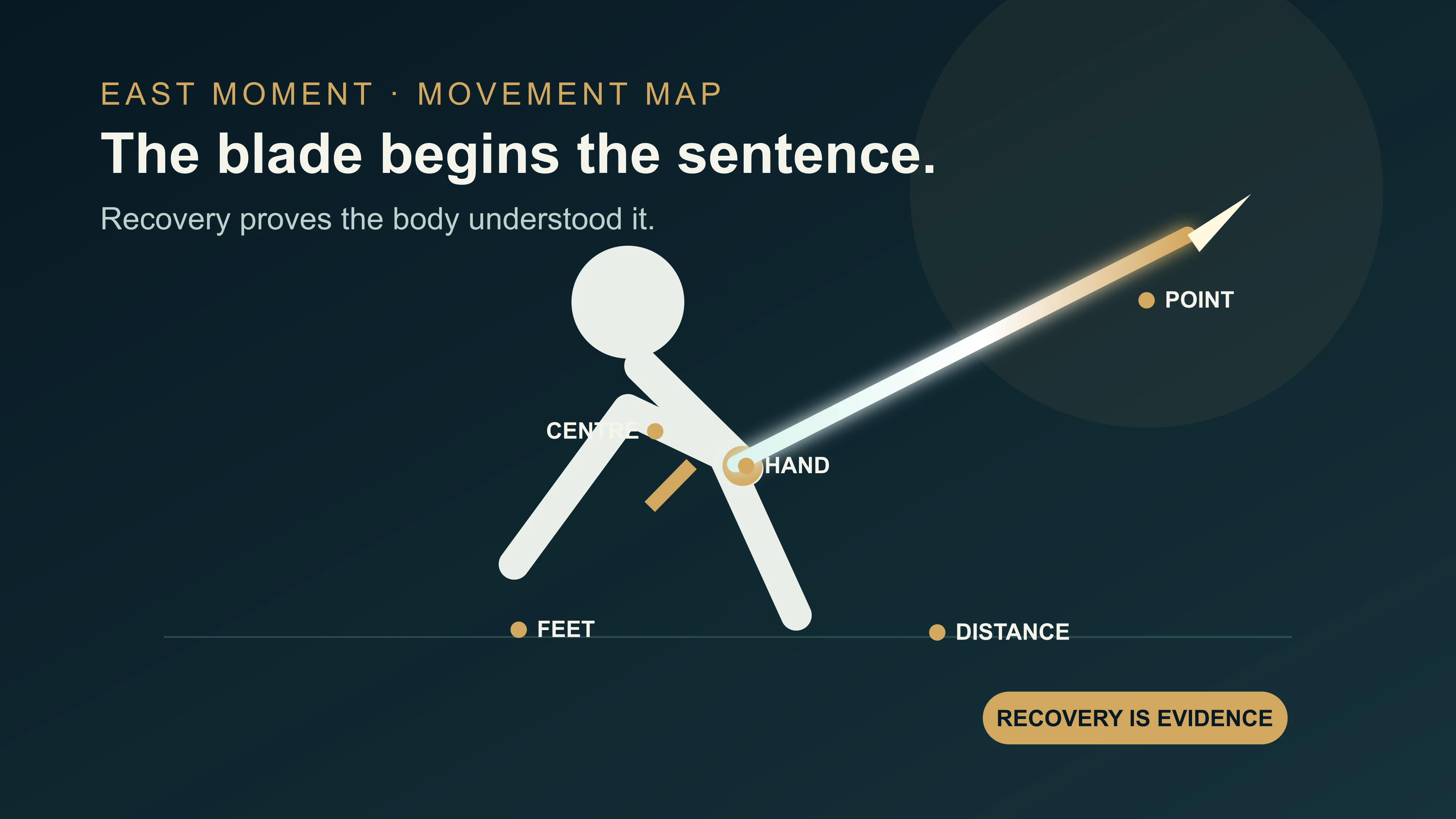
This is my central judgment: the blade begins the sentence, but recovery proves whether the body understood it. Chinese swordsmanship becomes interesting when point, hand, centre, feet, space and consequence agree. Speed can decorate that agreement. Speed cannot replace it.
That judgment applies differently in a museum, a modern wushu event and a wuxia scene. A museum sword proves surviving material, dimensions and recorded provenance. A jianshu routine proves contemporary athletic control inside rules. A film sequence proves how movement, camera and character create meaning. None can silently authenticate the others.
Our Chinese spear guide follows a long line from body to point. The sword brings the line closer, but closeness does not make it simpler. It makes every hesitation more personal.
“Chinese sword” already contains several different questions
An English search for Chinese swordsmanship often mixes at least five intentions:
| What the reader may mean | The evidence that actually answers it | The common mistake |
|---|---|---|
| Historical Chinese sword use | Dated objects, texts, archaeological context and period-specific research | Treating a modern routine as an ancient reconstruction |
| Modern jianshu or daoshu | Current sport rules, full routines, athletes and judging context | Calling judged performance “fake fighting” |
| Traditional school practice | A named teacher, lineage, curriculum, partner work and stated purpose | Assuming every school preserved the same “Chinese sword art” |
| Wuxia or opera movement | Complete scenes, staging, character and production context | Reading choreography as documentary technique |
| Learning sword practice | A qualified instructor, safe equipment and controlled space | Copying a clip or diagram as instruction |
The phrase therefore needs a map before it needs a definition. A jian is generally a straight, double-edged Chinese blade family. A dao is a single-edged family, not automatically the heavy “broadsword” imagined in English. Jianshu and daoshu are also names of modern wushu events. Taijijian places a straight sword inside the movement principles of taijiquan. Historical fencing, local traditions and paired methods extend beyond those event labels.
The Jian Sword vs Dao Sword guide owns the object and translation problem. This page owns the moving problem: what a blade asks of a body, what a routine makes visible and what a screen image hides.
One English umbrella is convenient. It is not proof of one timeless system.
A bronze sword gives us an object, not a choreography
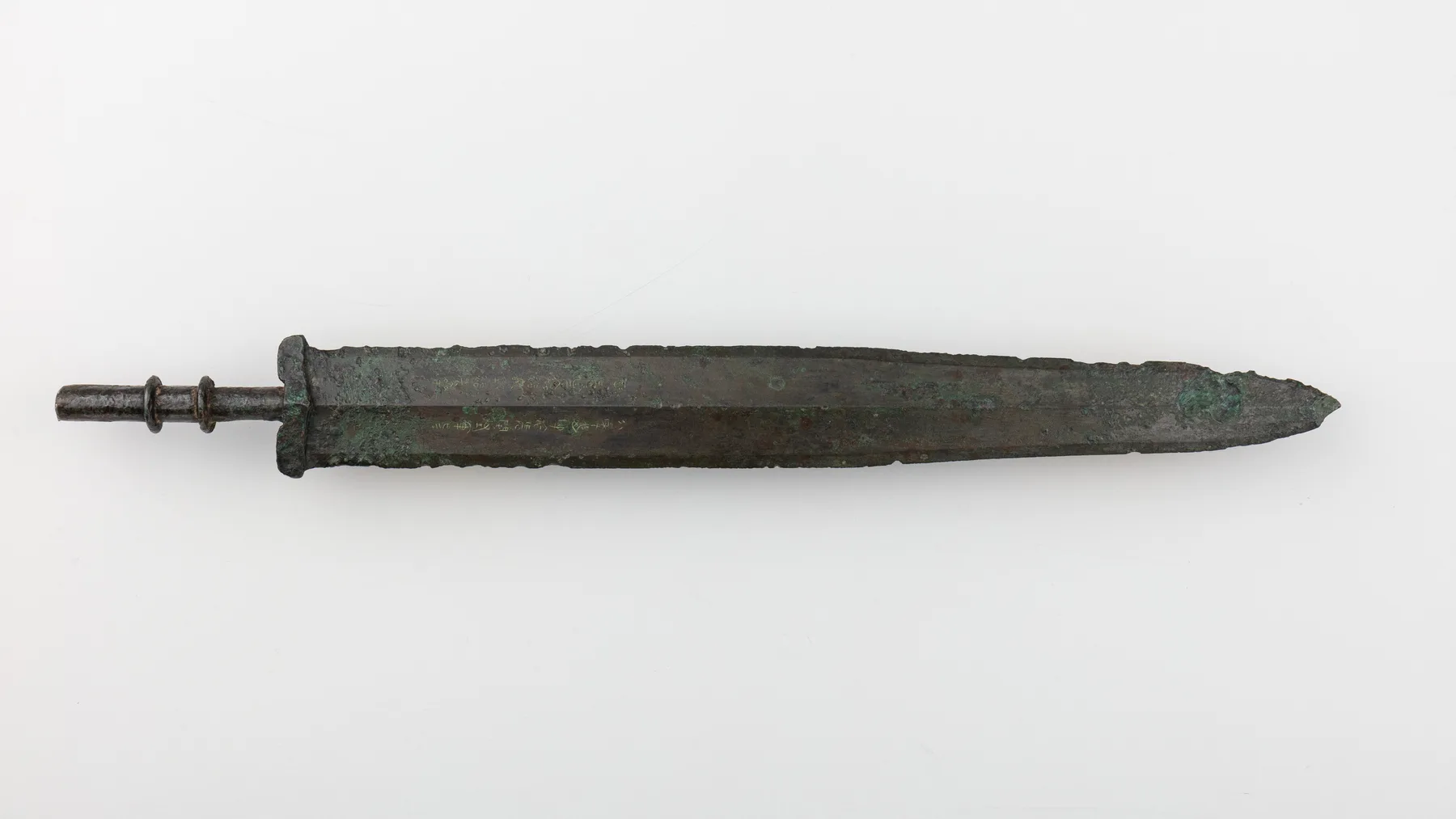
The Metropolitan Museum of Art records this Chinese bronze sword as a fifth- to fourth-century BCE object. It is 46.7 centimetres long, 5.7 centimetres wide and weighs 734.3 grams. The photograph lets us see a straight, double-edged form, central organization, surface corrosion, hilt and point. The Met collection record gives those facts a secure institutional home.
What does the image not give us? A person. A scabbard. A named school. A movement sequence. A reason for drawing the sword. The object survived; its complete human situation did not.
That absence matters because viewers instinctively animate weapons. We imagine a wrist, a stance and an opponent the instant we see a blade. Cinema has trained the imagination so well that a quiet museum photograph can begin moving inside our heads. The movement may be plausible. It is not evidence.
I refuse to call this “an ancient jianshu sword.” Modern jianshu is a current sport category with its own equipment, compulsory content and judging. A bronze object dated more than two millennia earlier cannot be recruited into that system by resemblance alone. The honest description is more powerful: this sword proves that one carefully proportioned Chinese bronze blade existed in a documented period. It makes the distance between object and living practice visible.
Survival gives us a question worth asking. It does not give us the missing answer for free.
Eight jianshu verbs turn a flash into readable movement
Modern sport wushu gives the viewer something history cannot: a current, explicit movement vocabulary.
The International Wushu Federation’s taolu rules name eight straight-sword methods in optional jianshu: cì (thrust), guà (hooking parry), liāo (uppercut), diǎn (pointing), pī (chop), bēng (upward tilt), jié (intercept) and jiǎn wàn huā (figure eight). Those English glosses are not a complete dictionary of every school. They are a sport’s way of making required content identifiable.
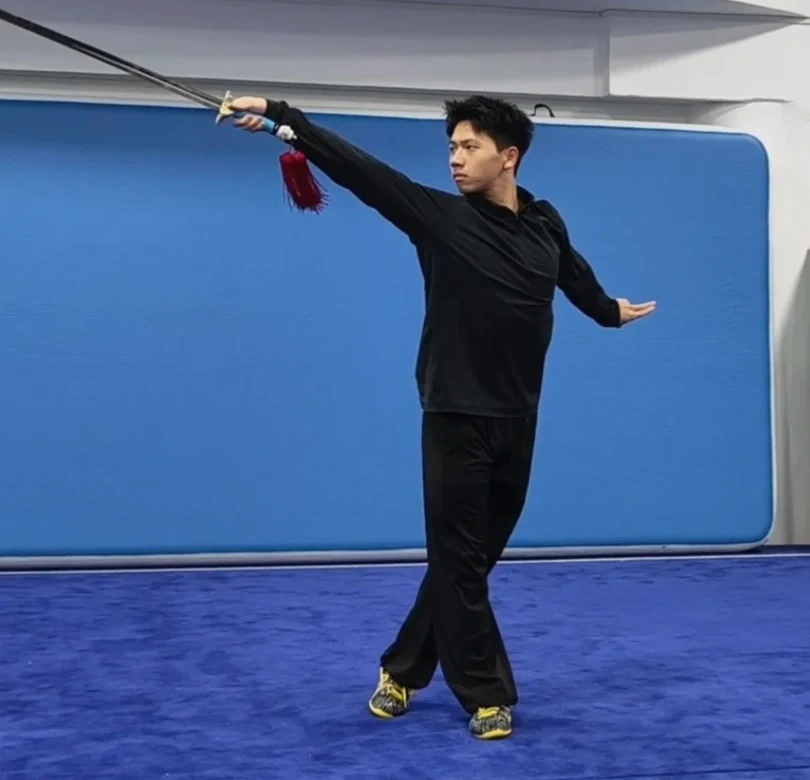
This practice photograph matters because it refuses the usual close-up of a flashing wrist. We can see the crossed stance, the lowered centre, the sword arm extending beyond the left edge and the free hand finishing a second line above the head. The crop cannot tell us whether the method was correct, safe or competition-ready. It can prove the article's central visual claim: Chinese swordsmanship has to be read as a relationship among blade, hands, torso and feet, not as a blade floating by itself.
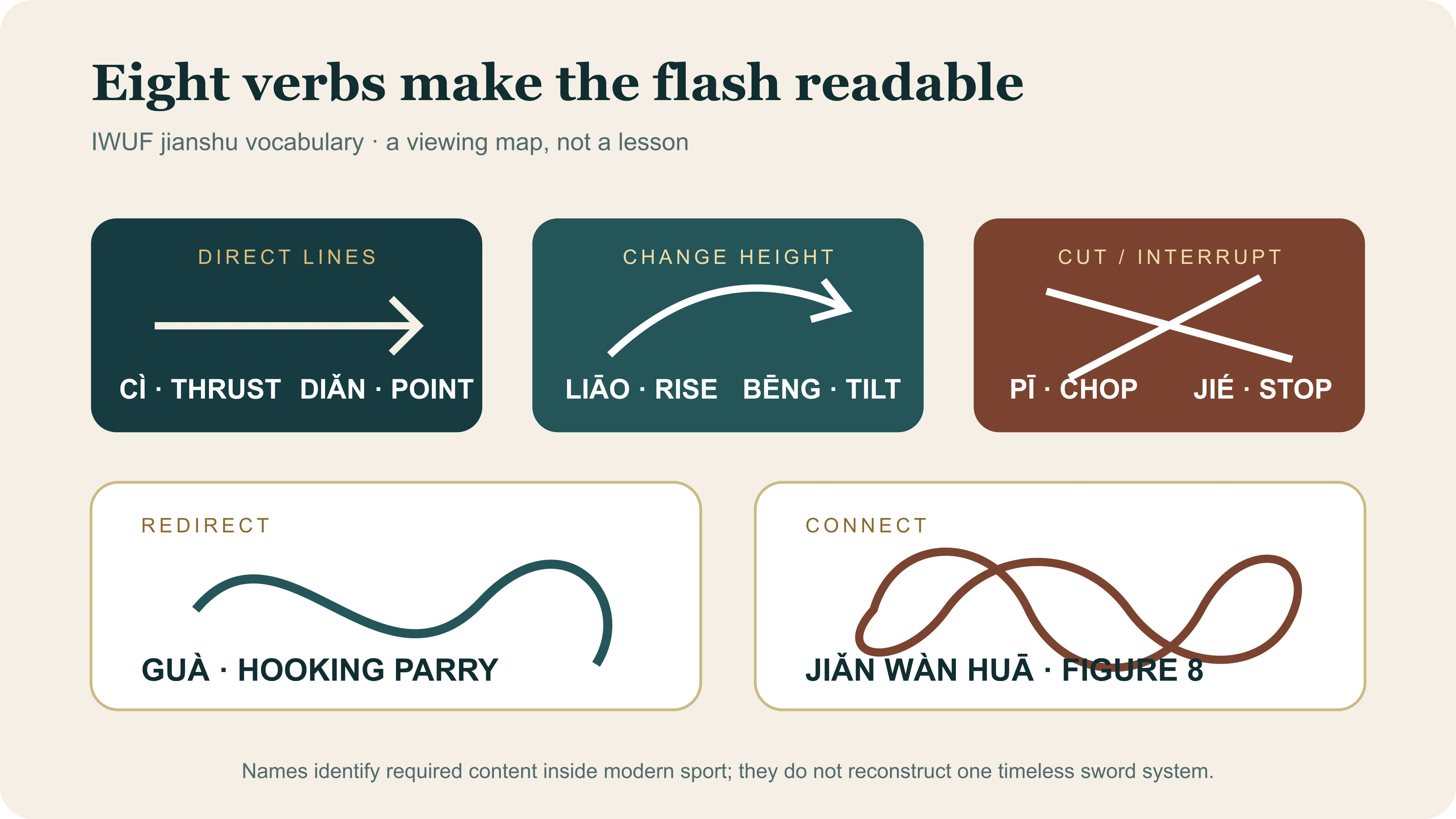
The vocabulary changes how I watch. “Sword flourish” is no longer enough. A point can travel directly, rise, cut across a line, redirect, interrupt or circle into another action. The verbs give shape to attention.
But I do not watch by ticking eight boxes. I watch whether each verb has a beginning, a destination and a way out. A thrust that arrives without the body is a detached punctuation mark. A figure eight that never resolves becomes decorative weather. An intercept matters only if the viewer can feel which line has been interrupted.
This is where sport becomes more intelligent than viral commentary. The rulebook does not ask whether a routine “looks real.” It defines events, methods and deductions inside a shared system. The athlete accepts that system and makes precision visible under pressure. We can debate aesthetics without stealing evidence from combat, history or film.
The broader wushu guide explains why taolu and sanda test different promises. Jianshu belongs to taolu. Its achievement is not diminished by naming the promise correctly.
The wrist is not the star; the whole body edits the point
Sword clips often zoom toward the hand because the hand looks busy. The wrist turns, the blade changes direction, the tassel draws a loop. Viewers then assume Chinese swordsmanship is delicate wrist work wrapped in silk.
That is a terrible way to read a whole body.
The hand matters because it transmits and refines. It cannot manufacture stable distance by itself. The feet place the person in relation to the line. The legs carry weight from one possibility to another. The torso decides whether a turn is connected or merely twisted. The free hand can clarify balance and direction, but it can also become theatrical punctuation with no relationship to the blade.
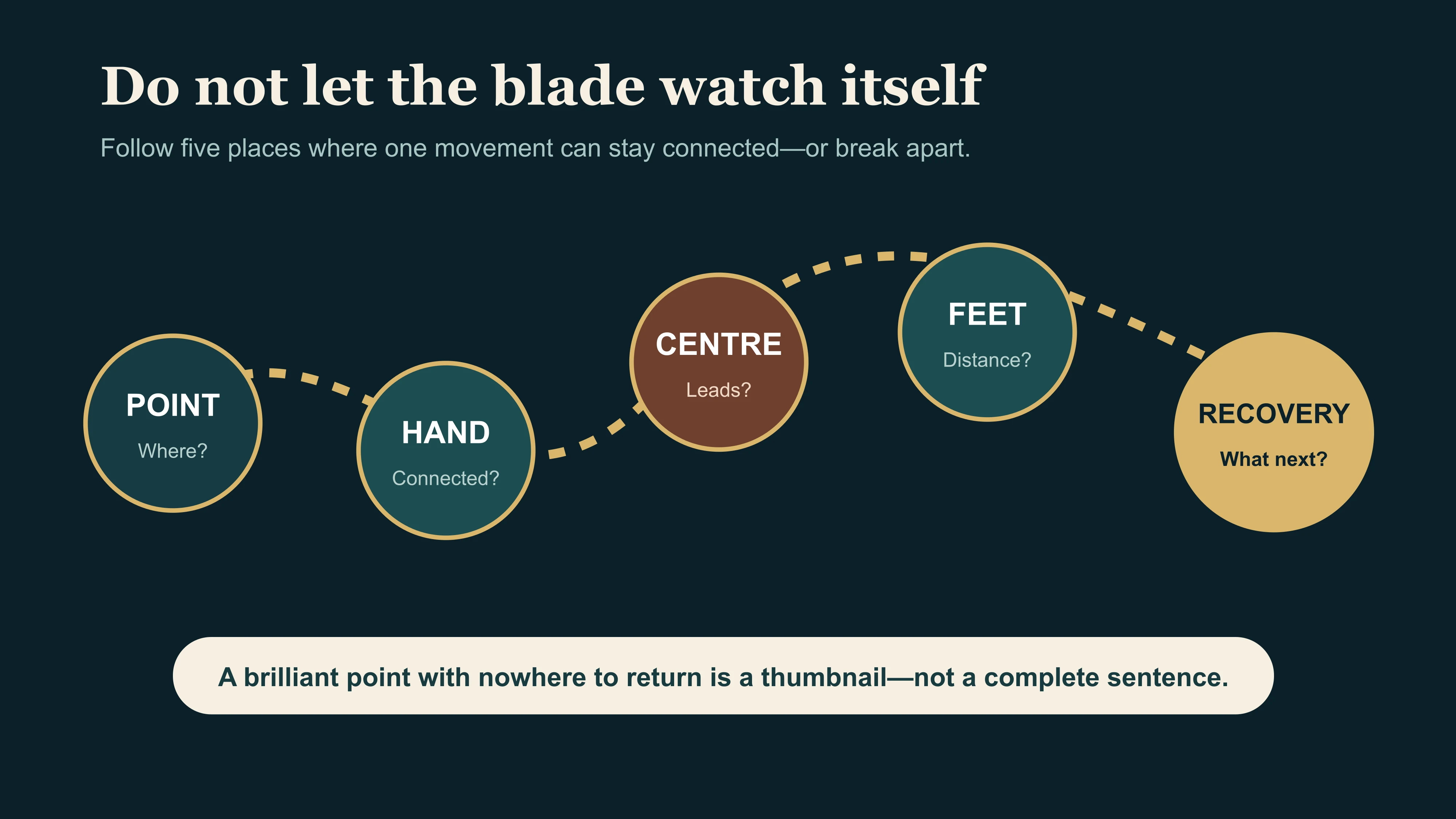
My five-part viewing test is deliberately non-instructional:
- Point: Can I tell where the sword intends to arrive?
- Hand: Does the change of direction remain connected to the rest of the body?
- Centre: Does the torso organize the action, or chase it?
- Feet: Has the distance actually changed when the blade says it has?
- Recovery: Does the performer still own the next moment?
The fifth question exposes empty spectacle fastest. Editors love to cut at maximum extension because extension looks final. Bodies do not end there. The person must remain somewhere, with weight, breath, attention and space still demanding an answer.
This is why I keep returning to recovery. It is not a decorative return to pose. It is the moment when confidence either becomes structure or collapses into a thumbnail.
A double sword makes classification harder—and better

The Met’s nineteenth-century Double Sword with Scabbard refuses the assumption that “Chinese sword” means one long straight blade in one hand. The museum records two short steel blades with wood, brass and leather, sharing a scabbard. Each sword is 44.5 centimetres long without the scabbard; each blade is 33 centimetres.
The image immediately changes the movement questions. How are two objects carried? How do paired lines divide attention? What happens to symmetry when one hand leads and the other follows? The object makes those questions reasonable.
It does not answer them.
A paired surviving object cannot prove a specific routine. The photograph cannot tell us whether the pair was designed for practical use, display, collection, performance or a combination. The collection record gives materials, dimensions, date, culture and provenance. It does not give a complete social biography.
I love this object because it breaks the clean silhouette that SEO prefers. Search pages want one sword, one definition and one hero. Material culture keeps returning with awkward plurals: paired weapons, remounted fittings, shared scabbards, regional forms and objects whose intended use remains partly uncertain.
Real expertise does not make that complexity disappear. It gives complexity a clean label.
Jianshu, daoshu and taijijian do not speak with one rhythm
The IWUF taolu overview separates jianshu, daoshu and taijijian as distinct disciplines. That fact alone should stop a common shortcut: “Chinese swordsmanship is graceful.” Which discipline? Which implement? Which routine? Which athlete? Grace is an observation that needs an object.
Modern jianshu often makes the straight sword’s point, direction changes and linked actions highly legible inside a changquan-related performance language. Daoshu organizes a single-edged blade through a different vocabulary that includes wrapping and twining around the body. Taijijian places the straight sword inside the slower, continuous organization associated with taijiquan, while still allowing changes of tempo.
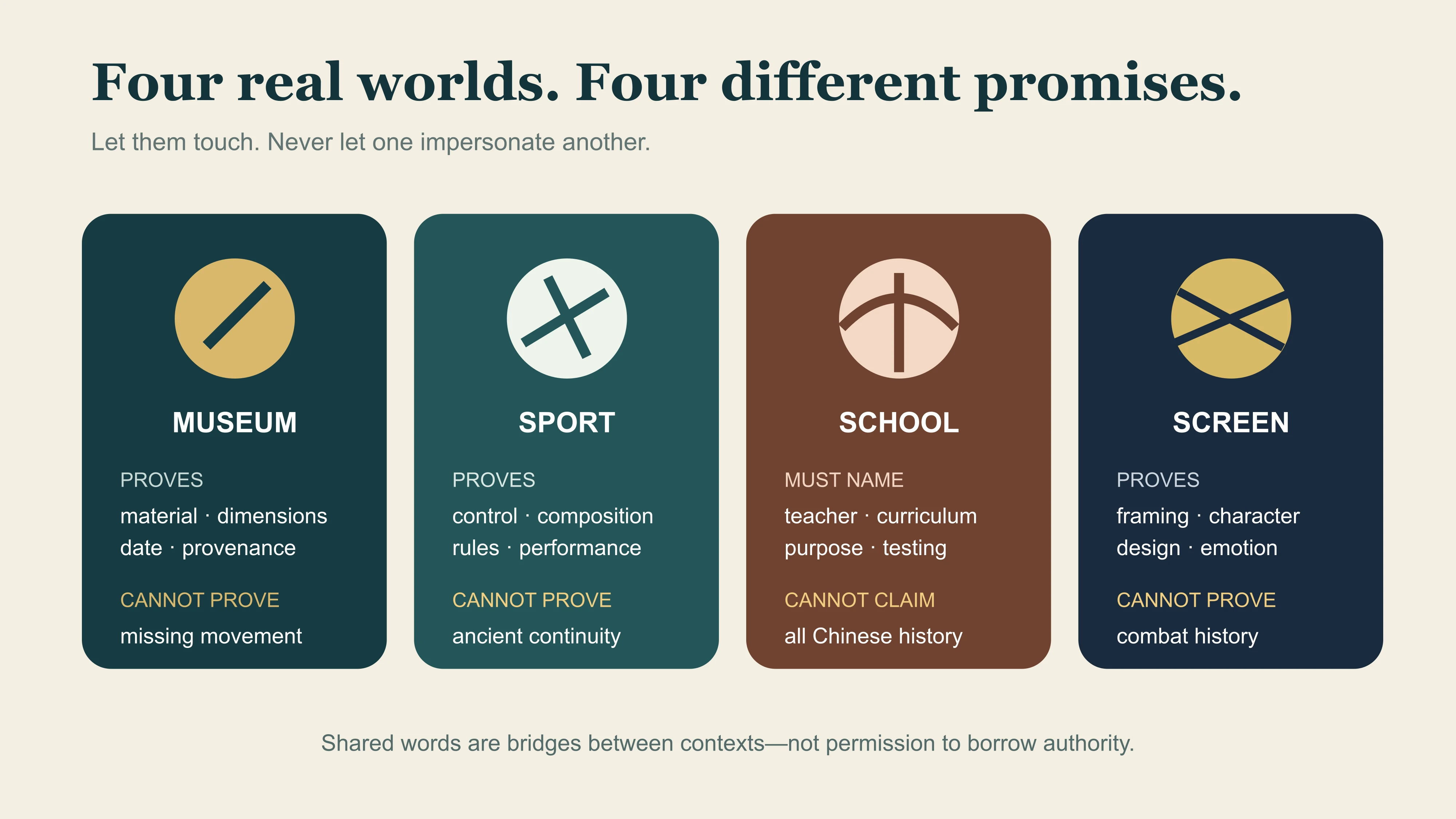
I do not rank those rhythms by authenticity. I ask what each one promises.
- A museum object promises material evidence and provenance.
- A sport routine promises visible control inside published rules.
- A traditional school should name its own curriculum, transmission and testing rather than claim all Chinese history.
- A screen sequence promises dramatic meaning built through bodies, props, camera and editing.
Confusion begins when one world borrows another world’s authority. A medal does not automatically prove historical lineage. An old object does not automatically validate a current movement. A beautiful film does not document combat. A traditional label does not exempt a school from explaining what it actually practises.
The categories touch. They must not impersonate one another.
Chinese sword fighting is a different search from a solo routine
The phrase Chinese sword fighting usually carries a second person inside it. A reader expects distance, timing, response and consequence between bodies. A solo jianshu routine can display extraordinary coordination, but it cannot provide the same evidence as paired practice or resistant exchange.
That does not make solo work empty. It makes the task different.
A routine reveals whether the performer can organize direction, balance, speed, rhythm and apparatus across a complete composition. Paired work introduces another person’s timing, but even paired demonstrations may remain cooperative or choreographed. Competition rules can constrain which actions, targets and levels of contact exist. Historical sword use belonged to still other conditions shaped by period, equipment, status and purpose.
There is no honest one-minute clip that settles all of those worlds.
The useful viewer asks three questions: Is the sequence solo, cooperative or resistant? What rules or choreography govern it? What claim is the uploader asking this evidence to support? If the claim is larger than the test, the problem is not the movement. The problem is borrowed certainty.
This page stops before instruction. A sword-shaped training implement still creates risk through speed, reach, space and contact. A diagram cannot evaluate your equipment, room, partners or judgment. Learn physical practice from a qualified instructor who can control those variables—not from my visual vocabulary.
Wuxia turns distance into emotion
Wuxia understands something that generic weapon explainers miss: the most important distance around a sword is often social.
A blade laid on a table can divide two friends without moving. A sword returned to its scabbard can be more decisive than another exchange. A point stopped one centimetre short can hold anger, mercy and humiliation in the same image. The action becomes memorable because a relationship changes.
Our guide to what wuxia means explains the larger world of justice, loyalty, debt and freedom. In that world, swordsmanship is not merely a method for winning space. It is a way of making private pressure visible.
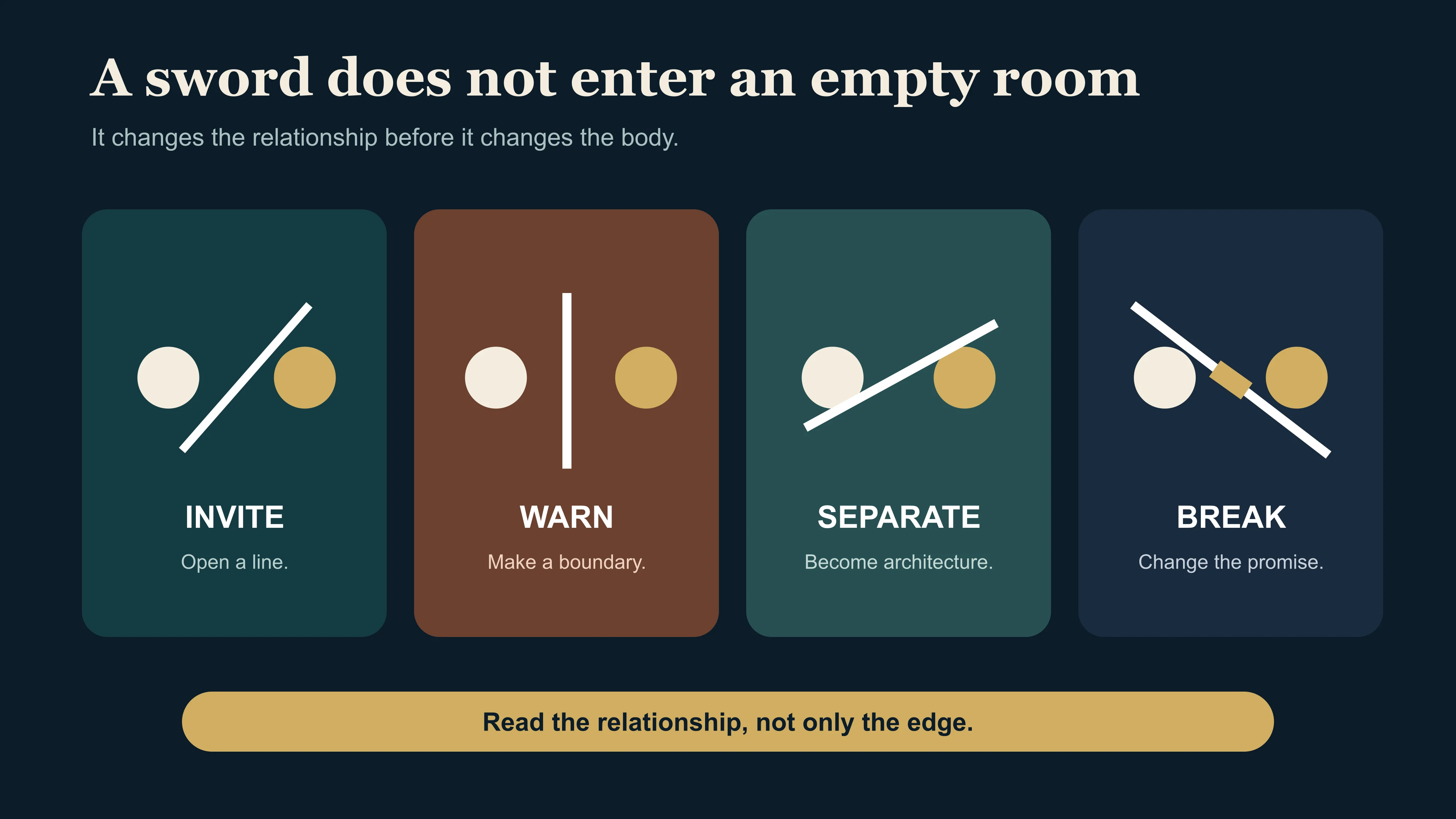
I read a sword scene through four spatial verbs:
- Invite: The line opens a path and asks somebody to enter it.
- Warn: The line makes a boundary visible before contact.
- Separate: The blade becomes architecture between people.
- Break: The movement changes a promise, allegiance or relationship.
This is also why wire work and impossible movement can tell emotional truth. A leap may be physically fantastical yet perfectly precise about a character’s refusal to remain inside ordinary limits. I accept exaggeration when it reveals desire. I reject it only when spectacle is repackaged as historical proof.
In Where Winds Meet, the sword becomes a decision the player repeats. Animation, timing and role design create a wuxia identity. That identity is real as game experience. It is not a museum label.
The sword tassel is visible evidence, not a ready-made legend
Straight-sword images often carry a tassel at the pommel. Online explanations quickly assign it one permanent ancient function: distraction, balance, rank, blood control or spiritual meaning. The confidence is much stronger than the evidence.
The honest approach begins with context. On a modern wushu implement, a tassel can make rotation, stopping and direction change more visible. In a film, it can extend colour and rhythm beyond the blade. On a documented historical object, material, attachment and provenance may support a period-specific interpretation. These are different claims.
I will not give every tassel one universal biography. The visible fact is enough to begin: fibres react after the hand and blade change direction. They make delay visible. That is fascinating because the tassel can expose exactly what a still photograph hides—the continuation of movement after the point appears to stop.
The tassel therefore belongs to my argument, but not as folklore. It is a small visual witness to recovery. It shows that the famous frame has an afterlife.
How to watch Chinese swordsmanship without being fooled by editing
The best clip is not always the clearest evidence. Slow motion can enlarge detail while hiding rhythm. A close crop can reveal the hand while erasing the feet. Rapid cuts can create impact while destroying continuity. Music can make every pause feel intentional.
Use this viewing sequence:
- Watch once for pleasure. Let the scene work.
- Watch the complete body, not the blade.
- Watch the distance to other people and objects.
- Find the moment immediately after the most shared frame.
- Ask whether the camera showed continuity or manufactured it.
- Name the evidence world: museum, sport, school, stage, film or game.
You are not trying to catch a performer making a mistake. You are refusing to let editing make a claim it has not earned.
The same habit improves museum viewing. Read the object label before imagining movement. Check material, dimensions, date range and whether all parts belong together. Then allow imagination to begin from evidence instead of replacing it.
Our Chinese martial-arts weapons guide gives this habit a wider home. Staff, spear, jian and dao do not merely have different shapes. They make different parts of space legible.
My verdict: the recovery is the real signature
Chinese swordsmanship is not one timeless art waiting to be summarized. It is a field of historical objects, living schools, modern sports, theatrical traditions, films and games that share words and silhouettes without sharing identical purposes.
The sword is easy to admire because it draws attention away from everything required to move it well. I want the opposite. Watch the point, then return to the hand. Watch the hand, then return to the centre. Watch the centre, then check the feet. Watch the feet, then ask what happened to the room and the people inside it.
Finally, watch the recovery.
That is where the pose ends and understanding begins. The athlete must continue. The character must live with the choice. The camera must either reveal continuity or hide it. The viewer must decide whether beauty has become evidence, emotion or only decoration.
The blade may be the signature everyone remembers. Recovery is the handwriting that proves who made it.
Show us the frame after the famous frame
Bring two consecutive images to East Moment’s Moments community. The first should be the sword frame everybody would share: the point, leap, turn or confrontation. The second must show what happens immediately afterward.
Label the source sport, traditional school, stage, film or game. Then answer three questions:
- Where did the body’s weight finish?
- How did the distance change?
- What relationship or intention became clearer after the beautiful frame?
Do not post another “best Chinese sword style” ranking. Build a gallery of recoveries. That is a conversation only attentive viewers can make—and exactly the kind of evidence East Moment should teach people to see. Use the Chinese martial arts collection to continue from sword movement into weapons, schools, sport and screen language without collapsing them into one claim.