A jian sword is usually a straight, double-edged Chinese blade. A dao sword is a single-edged Chinese blade family that includes straight, curved, narrow and broad forms. That is the clean answer. The important answer is harder: neither word names one timeless object, and neither blade assigns a personality. History, construction, setting and the body using it create meaning. Cinema then turns those differences into character language—sometimes beautifully, sometimes lazily.
Jian sword and dao sword: the difference you can actually see
I understand why English speakers call both objects a “Chinese sword.” English needs a broad shelf, and sword is the nearest shelf available. But once both objects are pushed onto it, the most useful distinction disappears.
The jian (劍 in traditional Chinese, 剑 in simplified Chinese) is generally a straight, double-edged blade with a point organized around the centre line. The dao (刀) is generally single-edged: one side is sharpened and the other forms a spine. A dao may be curved, but curvature is not the definition. Historical dao include straight and curved forms, different tips, different proportions and different relationships between blade, guard, grip and scabbard.
That is why I do not translate dao as “broadsword” without explanation. The International Wushu Federation uses broadsword for modern daoshu and straight sword for jianshu. Those English event names are useful inside sport. They become misleading when a reader assumes every historical dao must be broad or every jian must look like a flexible competition implement.
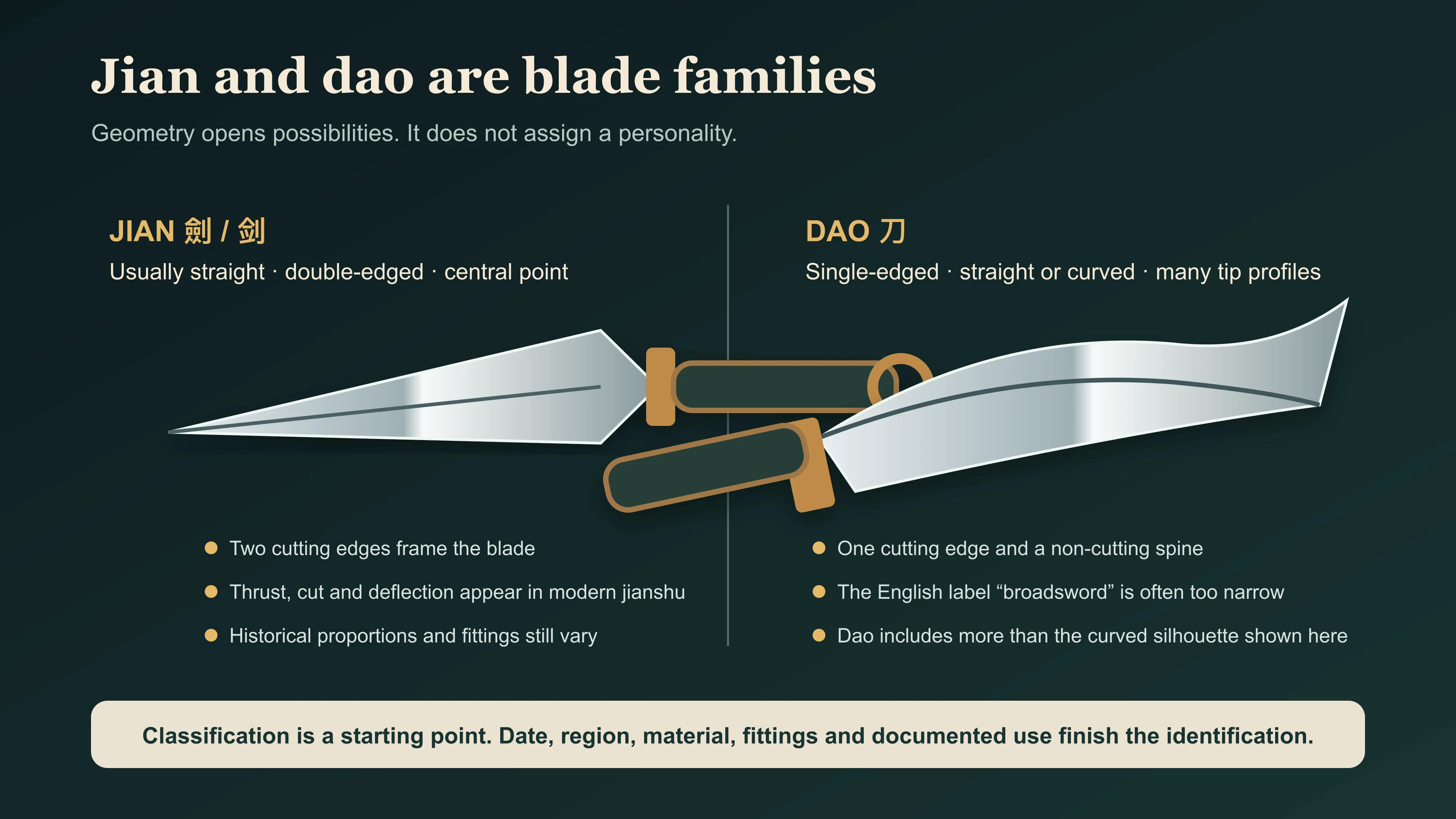
| Question | Jian 劍 / 剑 | Dao 刀 |
|---|---|---|
| Defining edge pattern | Usually double-edged | Single-edged with a spine |
| Common overall line | Usually straight and centred | Straight or curved; highly varied |
| Common English label | Straight sword | Saber or broadsword, depending on context |
| Modern wushu event | Jianshu | Daoshu |
| Screen stereotype | Restraint, cultivation, precision | Force, military directness, rebellion |
| What the stereotype gets wrong | A jian does not make its holder refined | A dao does not make its holder crude |
My rule is simple: identify the edge geometry first, then ask the date, region and context. Do not begin with the hero's costume and work backward toward an object name.
The phrase “dao sword” is awkward English because dao already names the Chinese blade category, yet I still use it once as a search bridge. A reader typing those words is not committing a cultural offense; they are trying to escape a translation problem. The responsible answer is to lead them toward dao, Chinese saber and the visible single edge—not to sneer at the query. Precision should make entry easier, not become a password test.
Continue through the Chinese martial arts collection when your question moves from identifying the object to schools, sport, history and screen movement. This page stays with the two blade families and the evidence needed to name them honestly.
The museum object refuses the fantasy shortcut
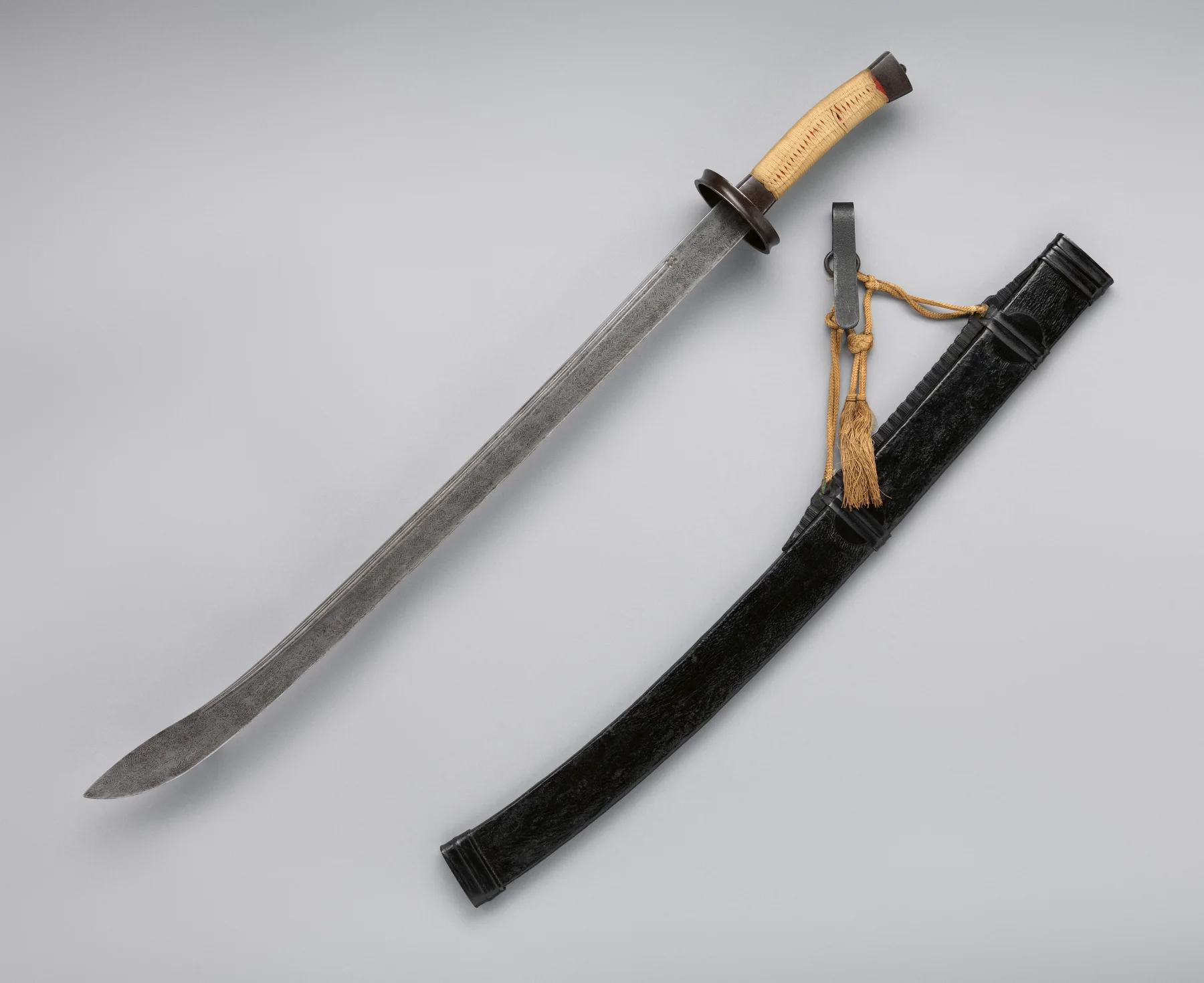
The page's hero is an eighteenth-century Chinese dao, not a generic prop. The Metropolitan Museum of Art records it as a saber with scabbard and belt hook, made from steel, iron, silk, leather and wood. Its blade is pattern-welded; its suspension also belonged to a larger system of bow case, quiver, belt and mounted movement.
Look closely and the lazy definition “dao equals a big chopping blade” collapses. The blade is elegant, narrow and carefully patterned. The fittings are not decoration pasted onto violence; they tell us that the object lived against a dressed body and among other equipment. The museum dimensions tell us its scale. The collection record gives it a date and material context. None of that tells us every method by which every eighteenth-century person used such a saber.
That final limit matters. A photographed survivor is powerful evidence of what existed. It is not a silent video of every past action.

The Met's eighteenth- or nineteenth-century Chinese sword is almost severe by comparison: steel, cord, a ring pommel and a straight blade. It does not arrive wearing the polished personality that wuxia has trained us to expect. That plainness is valuable. It makes the blade visible as an object before it becomes a symbol.
I love the romance of the jian, but I refuse to let romance erase evidence. A ring pommel, wrapped grip, narrow guard and surviving blade surface make me ask better questions than “Which elegant hero should hold this?” Who made it? When was it mounted? Are the blade and fittings original to one another? Was it ceremonial, practical, collected, altered or restored? A museum record can answer some of those questions and leave others open. Leaving something open is not weakness. It is intellectual honesty.
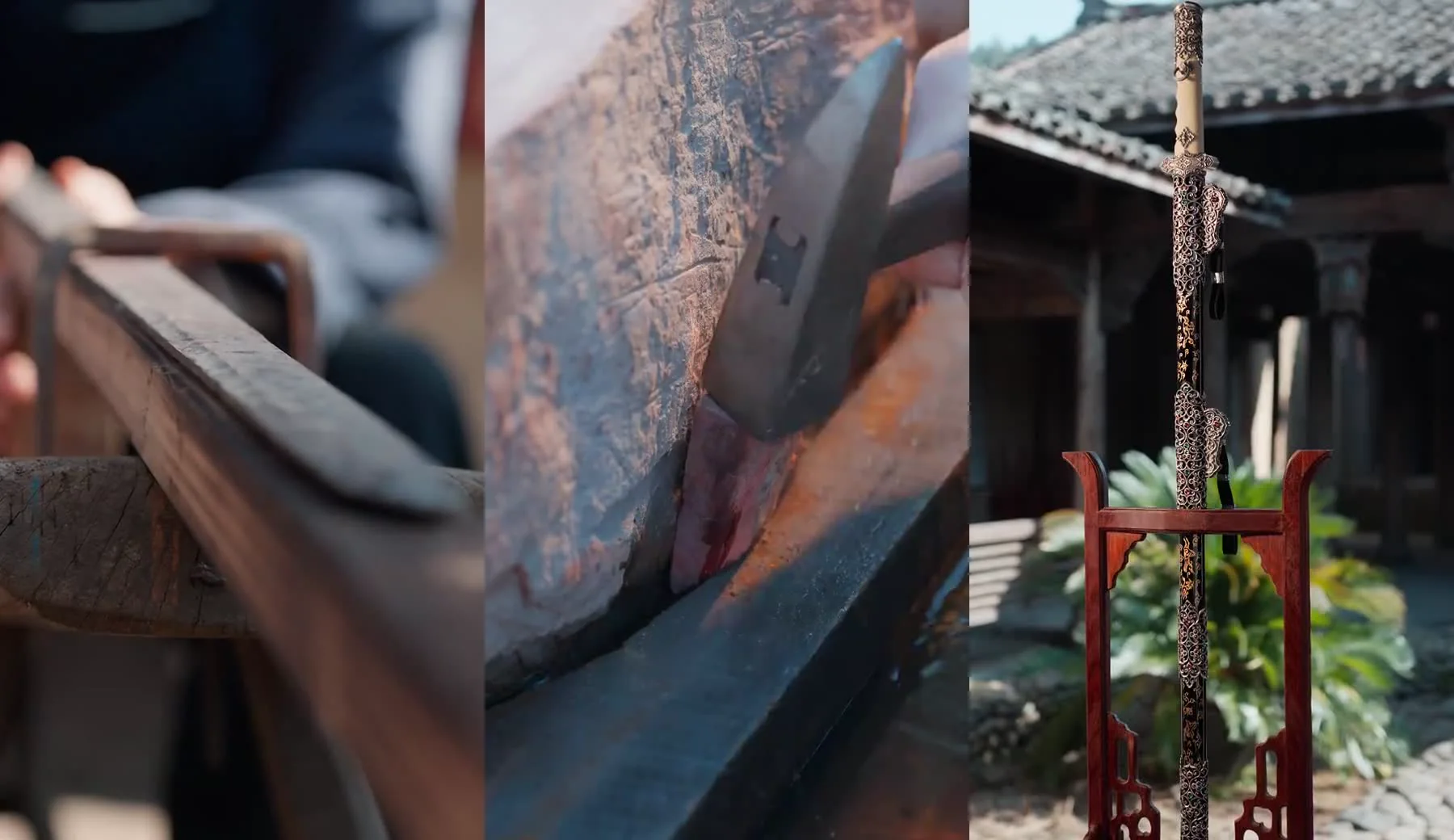
The unfinished surface is the frame I keep returning to. Wuxia teaches us to meet the sword at the instant it leaves the scabbard; the workshop makes us meet resistance before glamour. Hands file, check, correct and repeat until the line looks inevitable. It was never inevitable. That labour is why I reject the lazy “jian equals elegance” shortcut. Elegance is an outcome someone had to manufacture, maintain and then teach the eye to recognise.
Chinese swords are families, not two frozen silhouettes
The distinction between jian and dao is real. The idea that each has one permanent shape is not.
An article in the Metropolitan Museum Journal, Some Notable Sabers of the Qing Dynasty, describes jian as straight, double-edged swords and dao as single-edged blades in multiple shapes. That classification is a useful doorway because it makes room for variety rather than hiding it.
The doorway must not become a prison. A term can continue across centuries while metallurgy, military organization, dress, regional contact, carrying systems and taste change around it. A Qing peidao suspended for a mounted archer, an earlier straight-backed dao, a civilian jian, a paired short weapon and a twentieth-century training implement do not become interchangeable because a search result places them under “Chinese swords.”
This is the first East Moment judgment I want readers to keep: a cultural name preserves continuity, but the object preserves difference. Respect both.
The same principle applies beyond swords. Our Chinese martial arts weapons guide compares staff, spear, jian and dao as different ways of shaping space. This page goes narrower. It owns the problem English search usually leaves unresolved: what the two blade words mean, why translations wobble and why historical object, modern sport implement and screen image cannot be collapsed into one proof.
Jianshu and daoshu are not museum demonstrations
Modern sport wushu keeps the names alive in jianshu and daoshu, but the competition floor asks a different question from the museum case.
The International Wushu Federation's taolu rules list required techniques for the two events. Jianshu includes straight-sword actions translated as thrust, hooking parry, uppercut, pointing, chop, upward tilt, intercept and figure-eight. Daoshu includes its own broadsword vocabulary. The rules are not trying to reconstruct one historical duel. They make movement quality legible and judgeable inside a contemporary sport.
That difference is visible before a routine begins. A competition implement must communicate line and rhythm to judges and spectators. Its response can exaggerate speed and completion. The athlete's body, the event's compulsory content and the scoring system shape what we see. A museum blade answers questions about surviving material and documented provenance. A wushu implement answers questions about modern performance design and control.
Neither is fake. They are real objects doing different jobs.
This is why our wushu guide separates taolu from sanda and both from screen choreography. I will not use a beautiful jianshu routine to claim that an antique sword behaved the same way. I will not use the stiffness and mass of a museum object to dismiss an athlete's timing. Borrowed evidence makes every field less intelligent.
The separate Chinese swordsmanship guide follows the moving body rather than repeating this object comparison. It shows how point, hand, centre, feet, distance and recovery make a sword action readable—and why the frame immediately after the famous frame often tells us more than the blade itself.
The jian does not make a gentleman, and the dao does not make a brute
Chinese storytelling has spent centuries loading blades with social meaning. A jian can be an heirloom, a teacher's gift, a token of recognition, an instrument of justice or the last material link to a broken promise. A dao can belong to a soldier, an outlaw, an executioner, a guard, a rebel or a person whose loyalty is expressed through direct action.
Those associations are part of culture. They are not a personality test manufactured by steel.
I become suspicious the moment an explainer writes “the jian is elegant” and “the dao is fierce” as if the sentence has finished the work. Elegant for whom? Fierce in which scene? A jian drawn in panic can expose immaturity. A dao held still at a doorway can express restraint more powerfully than a fluttering sword routine. A weapon acquires character from relationship, framing and consequence.
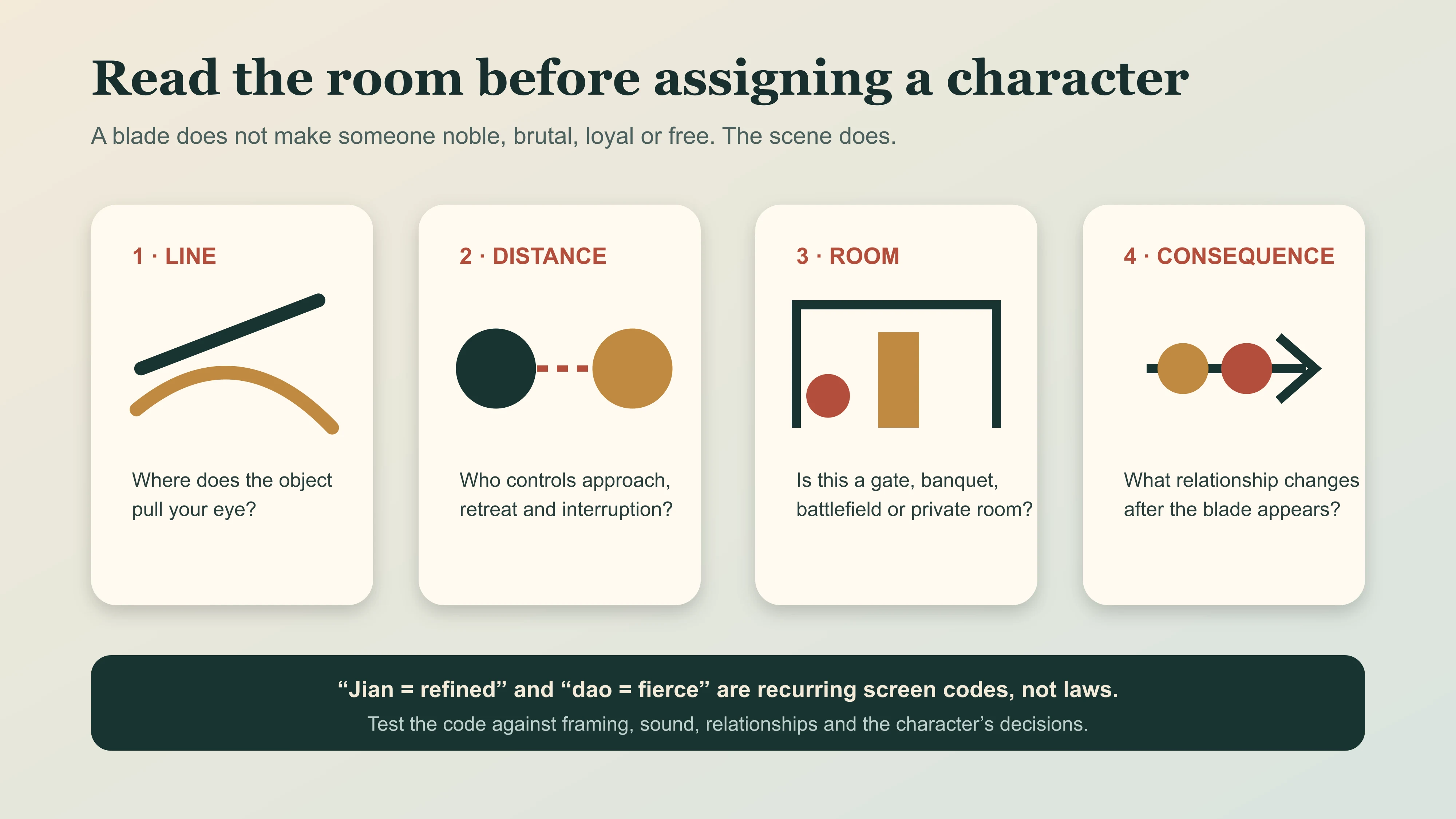
My screen-reading method begins with four questions:
- Line: Where does the blade pull the eye—through a point, an arc, a barrier or a line across the body?
- Distance: Who can approach, who must retreat, and whose intention is interrupted?
- Room: Is this a battlefield, gate, banquet, bedroom, temple, prison or mountain path? Space changes moral pressure.
- Consequence: What relationship changes after the blade appears? If nothing changes, the weapon may be decoration rather than drama.
This is the difference between East Moment and a glossary. A glossary tells you that jian means sword. I want you to feel why a sword laid between two friends can become heavier than the same object swung through fifty anonymous enemies.
Wuxia turns steel into a promise
In wuxia, the weapon often belongs to a moral relationship before it belongs to a hand. It may carry a school, a debt, a family death, a false accusation or the right to speak in a room where nobody listens without force. The blade is therefore not only a tool; it is a portable social history.
That is why the Green Destiny in Crouching Tiger, Hidden Dragon matters. Its value is not exhausted by edge geometry. Possession changes who is believed, who is pursued and who imagines freedom is within reach. When Jen takes up a room full of weapons, the sequence is not a catalogue testing which design wins. It is a character refusing correction again and again until skill, pride and hunger become inseparable.
Our guide to what wuxia means owns the genre's larger moral world. Here I want one narrower insight: a famous jian is memorable because the story makes the object answer for human promises. The sword's straight line may help the camera express precision, but plot gives that line emotional cost.
If a viewer remembers only a graceful silhouette, the scene has been seen but not fully read.
Games make the sword a decision you repeat
Film lets us watch a blade's meaning. Games make us repeat it.
In Where Winds Meet, the sword lives inside movement, timing, terrain, build choices and a player's desire to inhabit wuxia rather than merely observe it. The moonlit image above proves a restrained silhouette and a carefully staged visual world. It cannot prove the object's mass, its historical handling or the outcome of a mechanic we cannot see.
That boundary does not make the image less valuable. It tells us where its value lives. The long diagonal, the open darkness around the body and the controlled posture give the player a fantasy of contained ability. The game is not asking the museum's question, “What object survived?” It is asking, “What kind of person do you become each time you choose this action?”
This also explains why game labels can be historically loose. A weapon category has to communicate role quickly. Reach, animation rhythm, hit response and progression may matter more to design than the exact boundary between two historical subtypes. I enjoy that translation when the game is honest about being a designed world. I reject it only when marketing borrows historical authority it has not earned.
Four images can share a sword and still prove four different things
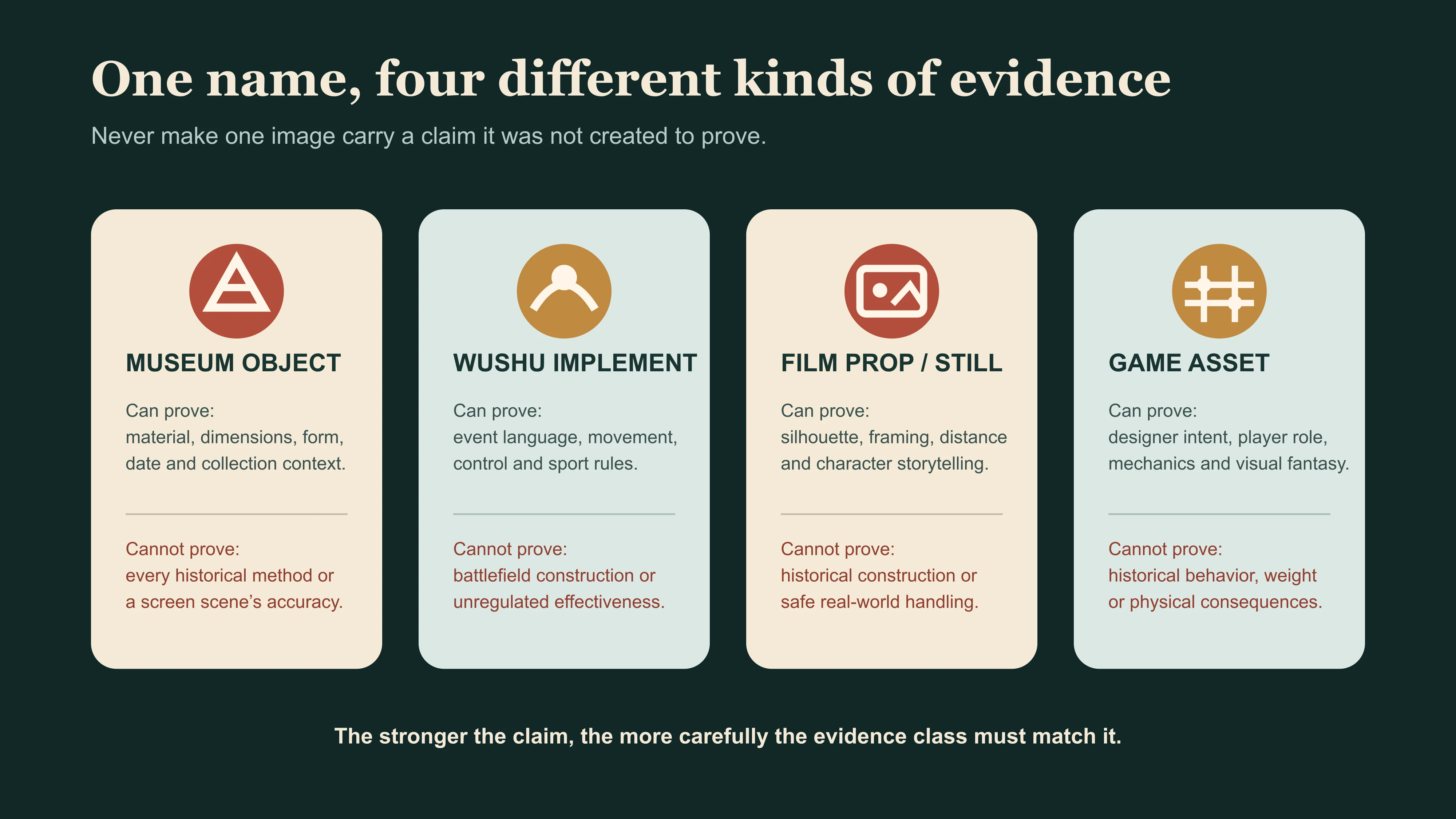
This evidence map is the habit I wish every Chinese-culture site would adopt.
A museum object can establish recorded dimensions, material, form, date range and collection context. A modern wushu implement can show how a contemporary sport makes technique and rhythm visible. A film prop or official still can reveal silhouette, framing, relationship and production design. A game asset can reveal a designer's fantasy, player role and mechanic.
None can silently stand in for the others.
This matters because the internet rewards visual confidence. Put an antique sword beside a dramatic sentence and readers assume the photograph proves the sentence. Put a flexible wushu blade beside a Han-dynasty claim and the eye forgives the century gap. Put a game screenshot under “real Chinese swordsmanship” and fantasy borrows a documentary costume.
I refuse that shortcut. An image should carry evidence, atmosphere or interpretation—and the page should say which one.
How to identify a Chinese sword image without pretending certainty
When someone sends me a blade image and asks “jian or dao?”, I do not start with confidence. I start with visible facts.
Can I see one cutting edge or two? Is the other side a spine? Is the blade straight, curved or too obscured to tell? What kind of point is visible? Are the guard, pommel, grip and scabbard documented as part of the same object? Is the source a museum record, auction listing, film still, training photograph, replica store or concept art?
Then I separate observation from conclusion:
- Observation: The blade is straight and appears symmetrical around a central ridge.
- Supported identification: It is consistent with the jian family.
- Remaining uncertainty: The image alone may not establish date, authenticity, material or intended use.
Or:
- Observation: One sharpened edge and a spine are visible; the blade curves toward the tip.
- Supported identification: It belongs to a dao/saber family.
- Remaining uncertainty: “Broadsword” may be a poor translation, and the precise subtype needs context.
That three-line discipline is stronger than a paragraph of swagger. Expertise is not the speed with which uncertainty disappears. Expertise is knowing exactly which uncertainty remains.
My verdict: geometry begins the answer; context earns it
The jian and dao are not “elegant sword versus brutal sword.” They are different Chinese blade families. The jian is usually straight and double-edged. The dao is single-edged and far more varied than the English word broadsword suggests. Geometry changes the lines available to an object and the lines a camera can emphasize. It does not decide whether a person is cultivated, violent, loyal or free.
History complicates the silhouette. Sport reorganizes it. Wuxia gives it a promise. Film gives it framing. Games give it repetition. A serious page must let those layers touch without pretending they are the same evidence.
Bring one Chinese sword image to East Moment's Moments community. Label it museum object, wushu implement, screen prop or game asset. Identify jian or dao only if the visible edge and source support you. Then write one sentence beginning: “This image proves…” and another beginning: “It still cannot prove…”
That will not produce the loudest sword debate on the internet. It will produce the most honest one.