Kung fu is Chinese, but the word is not the name of one ancient fighting system. It is a Cantonese pronunciation of 功夫 (gongfu): skill built through time, repetition and patient work. The global misunderstanding is also the reason the word became so powerful.
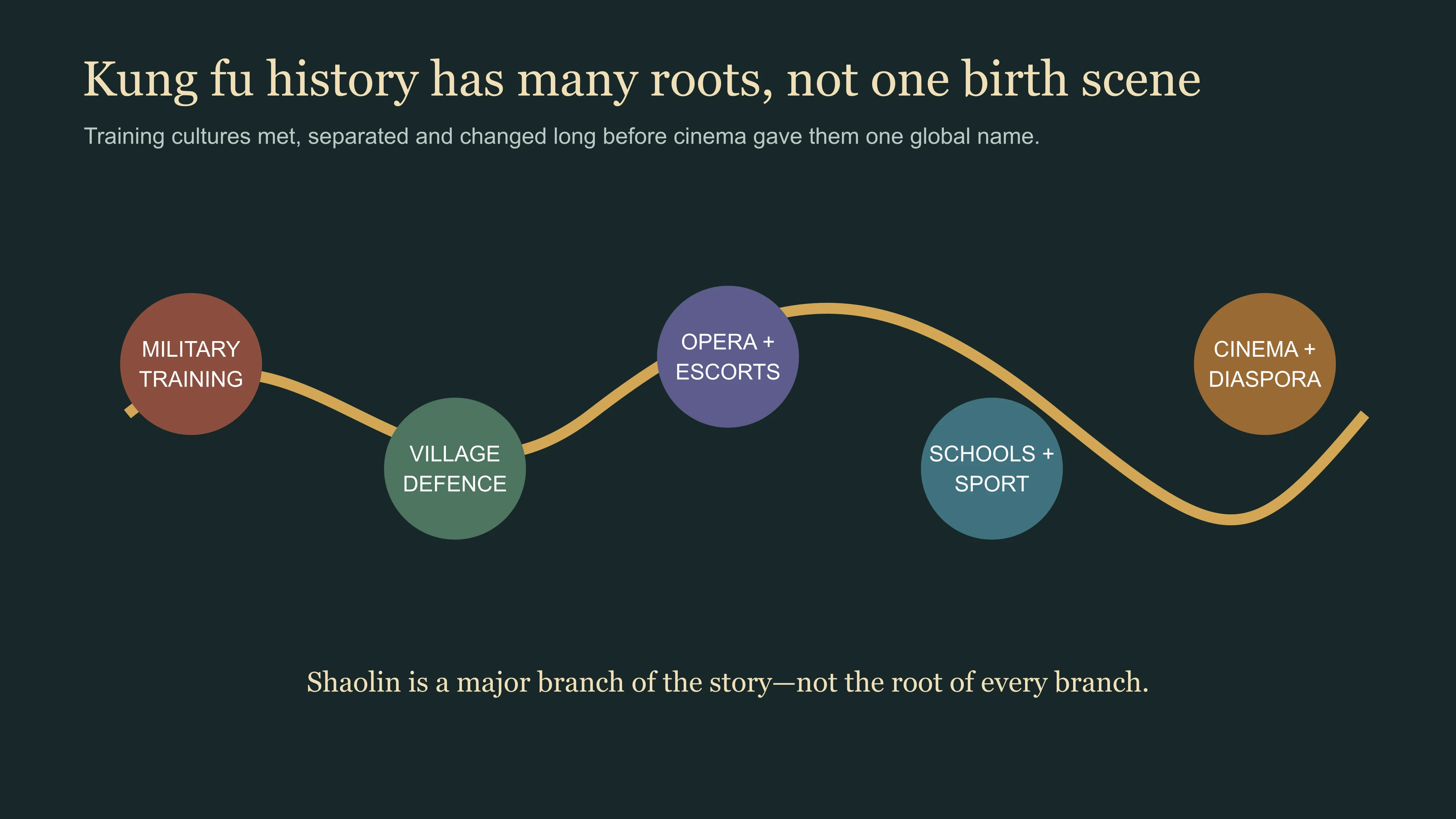
There is no honest straight line from one ancient founder to every modern school. The history is a network of institutions, workers, performers, teachers and media.
Kung fu history starts with a word about earned skill
In Chinese, 功夫 can describe far more than combat. A cook's knife work, a musician's control or a craftsperson's patience can all show gongfu. When English speakers say “kung fu,” they usually mean Chinese martial arts because Hong Kong cinema and diaspora teachers carried that narrower meaning across the world.
That difference matters. It stops us from searching for one secret “original kung fu” and helps us see martial arts as lineages, local practices, training methods and performance cultures that changed over time.
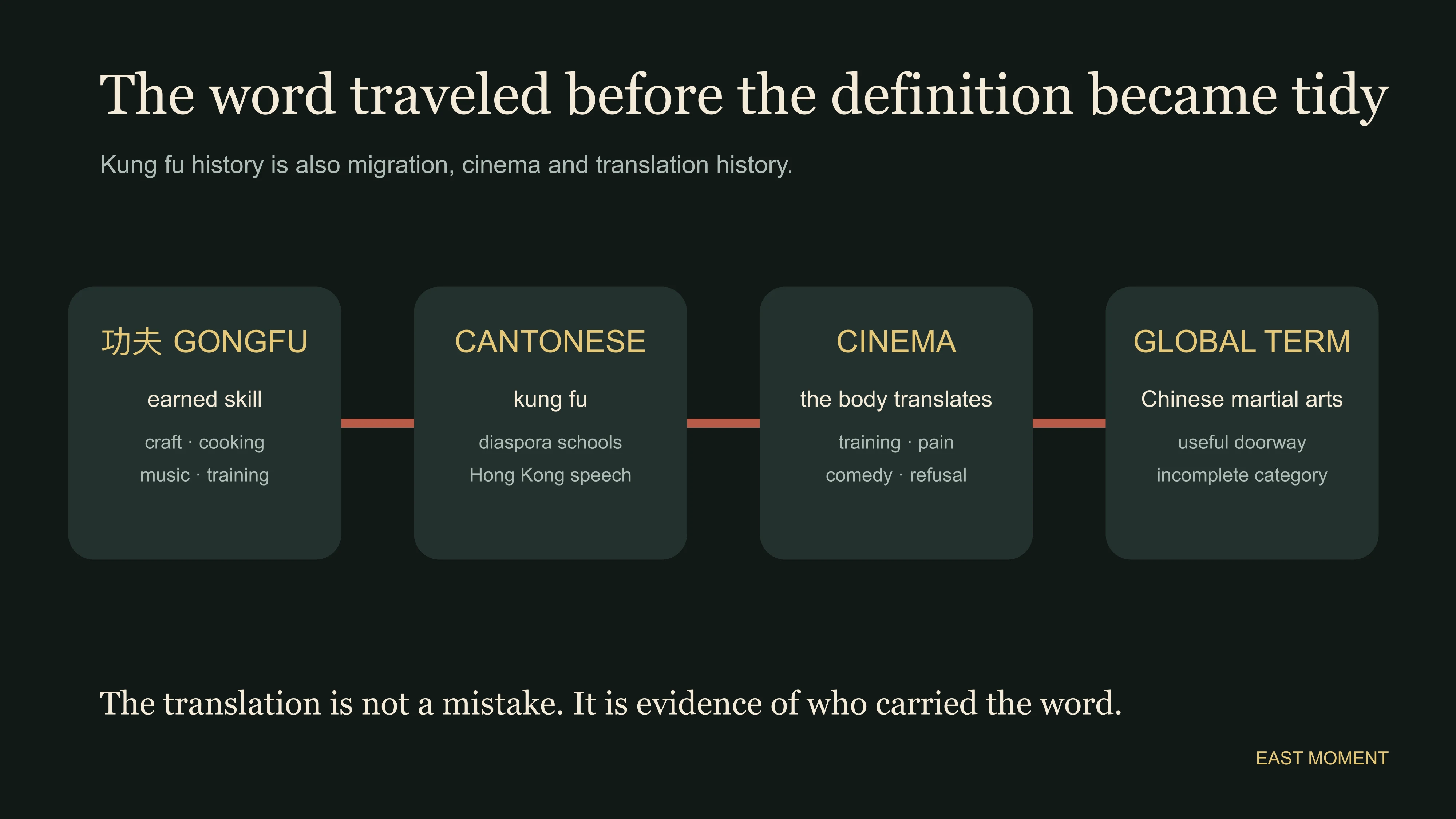
The English term preserves a route: earned skill became Cantonese “kung fu,” bodies translated it through cinema, and the world narrowed it toward Chinese martial arts.
I refuse to call that narrowing a stupid mistake. It records who made the word travel. Hong Kong filmmakers, Cantonese-speaking communities and teachers abroad gave overseas audiences a physical vocabulary before most of them knew the Mandarin pronunciation. The translation is incomplete, but incompleteness can carry history. Correcting “kung fu” back to gongfu without explaining this route erases the people who built the bridge.
The wider Chinese martial arts collection maps the living practices. This page stays with the historical problem: how a broad Chinese idea of earned skill became a global name for many different martial traditions.
Is kung fu Chinese or Japanese?
Kung fu is a Chinese term and the traditions usually called kung fu are Chinese martial arts. Japanese martial arts include karate, judo, aikido and kendo; Korean traditions include taekwondo and others. They influence one another, but the names are not interchangeable.
The confusion usually comes from the English category “martial arts,” which places very different histories on one shelf. Kung fu's Chinese name is gongfu. In Mandarin, 功夫 is pronounced roughly “gong foo”; “kung fu” reflects Cantonese usage popularised internationally through Hong Kong cinema.
There is no single ancient kung fu style
Chinese martial arts developed through military training, village defence, escort work, temple practice, health routines, opera and modern physical education. Some lineages emphasise striking, others wrestling, weapons, forms, breath, internal coordination or sport competition. Their stories are not always consistent, and a later school may claim an ancient origin that cannot be independently proven.
That plurality is not an inconvenience to hide. It is the history. China did not wait for one founder to distribute a finished curriculum. Bodies learned inside armies, households, markets, religious institutions, performance troupes and local associations because each setting had different risks and social needs. A method could be renamed, combined, standardized, forgotten and later reconstructed. The demand for one birthday turns a moving culture into a product launch.
When a lineage says “ancient,” I want the next noun. Is the evidence a surviving manual, a local gazetteer, a temple inscription, an oral genealogy, a teacher's memory or a film repeated until it feels historical? These forms of evidence are not equally secure, yet none becomes intelligent by being thrown away without examination. The honest historian labels the voice before judging its weight.
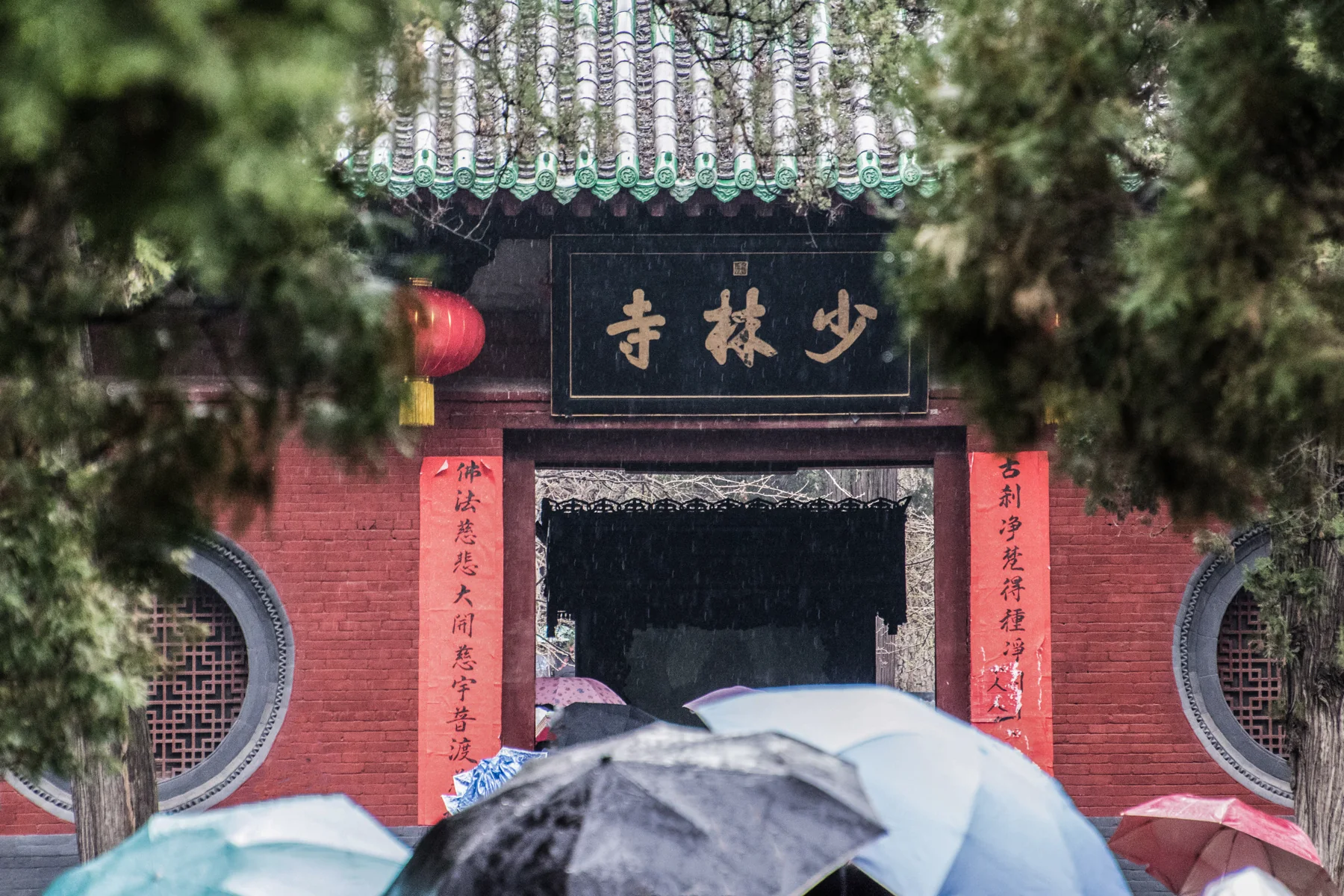
This East Moment archive photograph is the opposite of a founder legend: a wet gate, modern visitors and a temple still being entered in ordinary weather. It proves Shaolin is a material institution with a public life in Dengfeng. It cannot prove that every person behind those umbrellas came for martial arts, or that every Chinese system began here.
What moves me is the crowd at the threshold, not the fantasy of a sealed secret behind it. Kung fu survived because people kept entering real rooms—temples, village halls, schools, opera stages and small studios—and accepted the boredom of repetition. History becomes believable when it has rain, queues and imperfect access. The heroic origin story gives us one dramatic morning; the gate reminds us that continuity is made on thousands of unremarkable days.
That is why the International Wushu Federation is useful for understanding modern sport wushu, while the Shaolin Temple site represents one institutional tradition. Neither source should be treated as a complete history of every Chinese style.
Where Shaolin belongs in the story
Shaolin Temple became globally associated with kung fu through religious history, training narratives, modern demonstrations and film. The association is real; the idea that every Chinese style descends from one monastery is not.
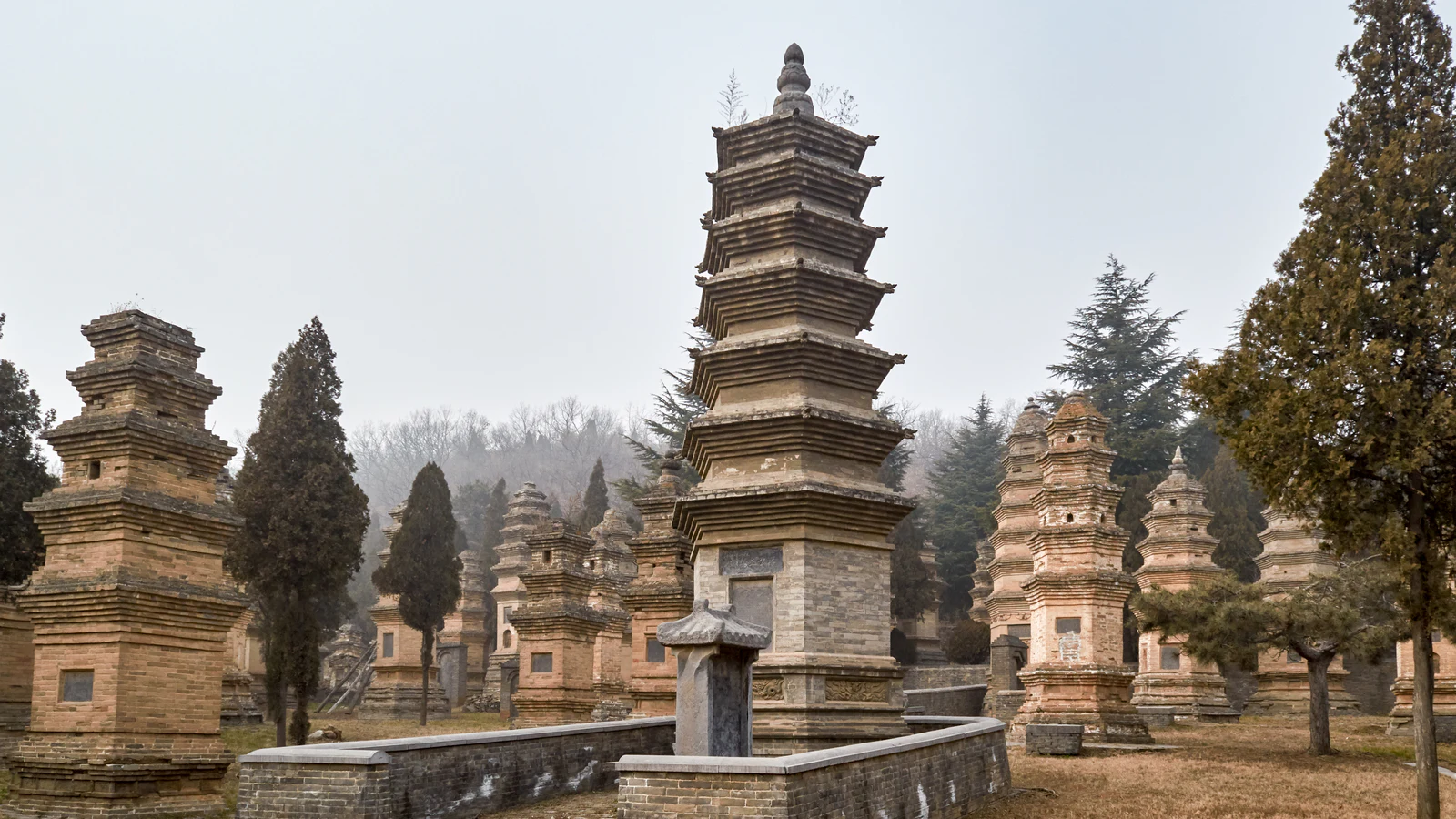
At Songshan, the Pagoda Forest and temple landscape make the relationship between place, ritual and martial memory visible. But a building cannot prove every legend later attached to it. My own preference is to treat Shaolin as a major living tradition and cultural symbol, not a magic certificate stamped on all Chinese martial arts.
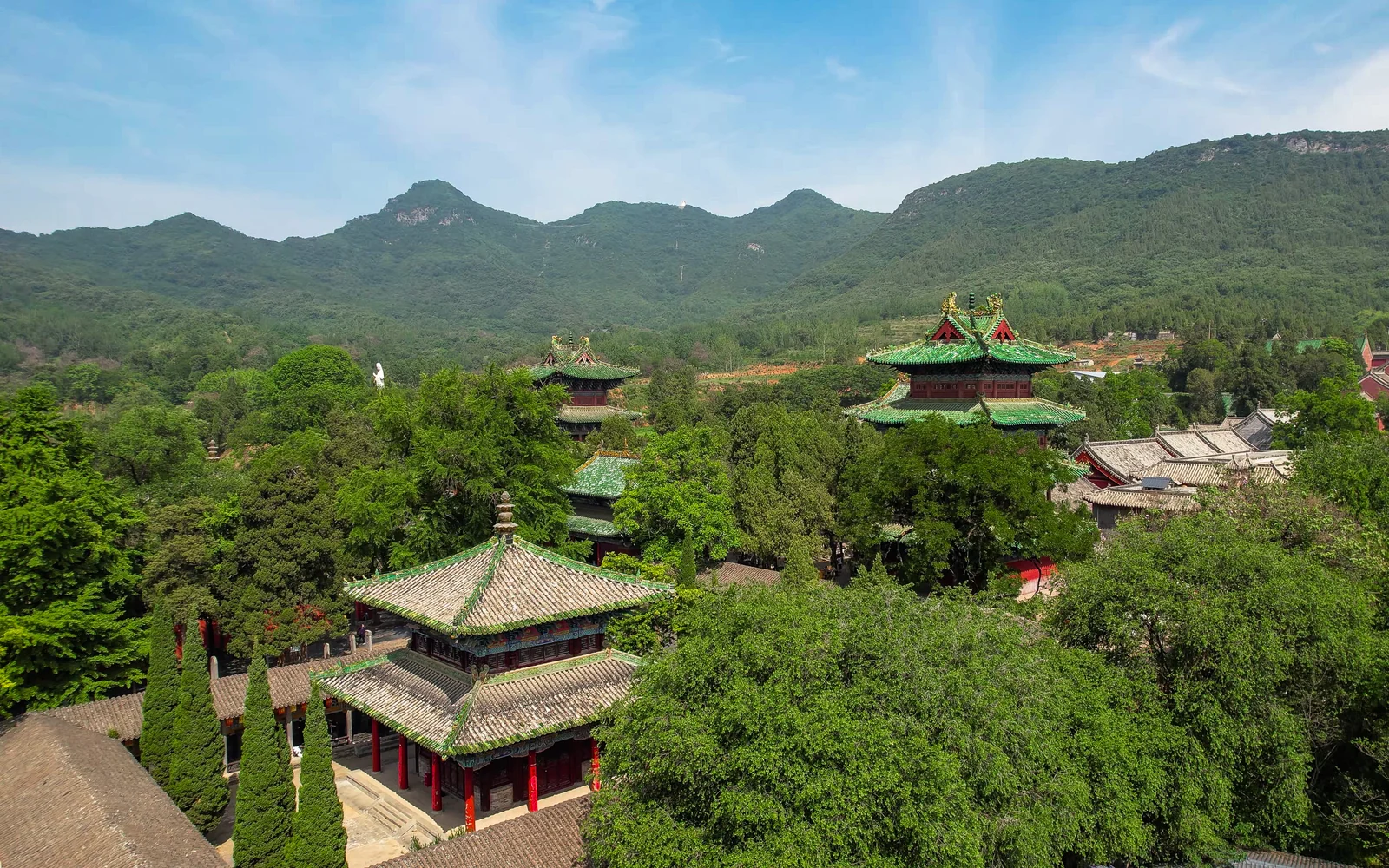
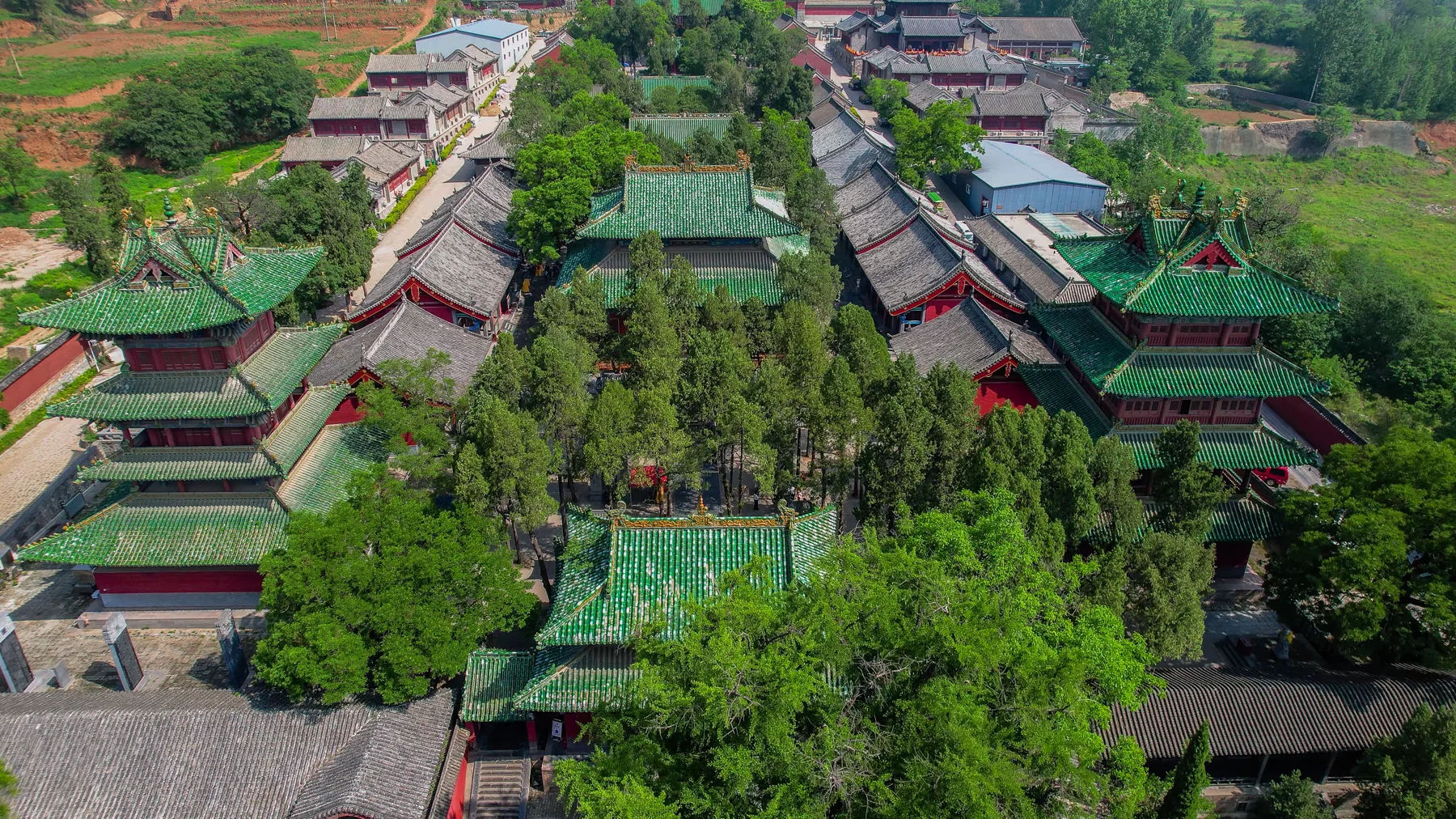
This East Moment archive photograph pulls Shaolin out of the movie close-up. The halls sit inside a much larger mountain landscape, which proves a material institution and place rather than one universal choreography. Roofs and trees cannot certify a lineage, identify what anyone trains or turn every story attached to the temple into documented fact.
Continue to Shaolin kung fu for the monastery's specific role, and kung fu styles for a practical map of different training languages.
Opera, escort work and village practice complicate the temple story
A temple is easy to remember; a distributed training culture is harder to photograph. Chinese martial practices also developed through military service, local security, travelling performers, opera stages, family teaching and commercial escort work. Each setting trained the body for a different problem.
Opera required rhythm, projection and repeatable physical clarity. Village practice could combine ritual, community identity and practical defence. Escort work placed reputation and deterrence beside technique. Modern schools then reorganised older methods for urban students, public demonstrations, physical education and competition.
Opera is especially important because screen audiences often mistake visibility for falseness. A performer had to make direction, character and impact readable across a noisy space. That demand cultivated timing, acrobatics and repeatable phrases that later action cinema could understand immediately. It does not mean opera movement documents a battlefield. It means performance was one of the workshops in which Chinese bodies learned to communicate force publicly.
Escort work exposes a different truth. Technique was only part of security; reputation, route knowledge, negotiation and the ability to discourage conflict also mattered. A romantic duel is easy to film. The daily labor of preventing one is harder. Kung fu history becomes more human when we include the workers whose success sometimes looked like nothing happening.
This does not mean every origin story is false. It means a style's history has to be argued at the level of that style, teacher and document. “Ancient Chinese kung fu” is too large a container to verify anything useful.
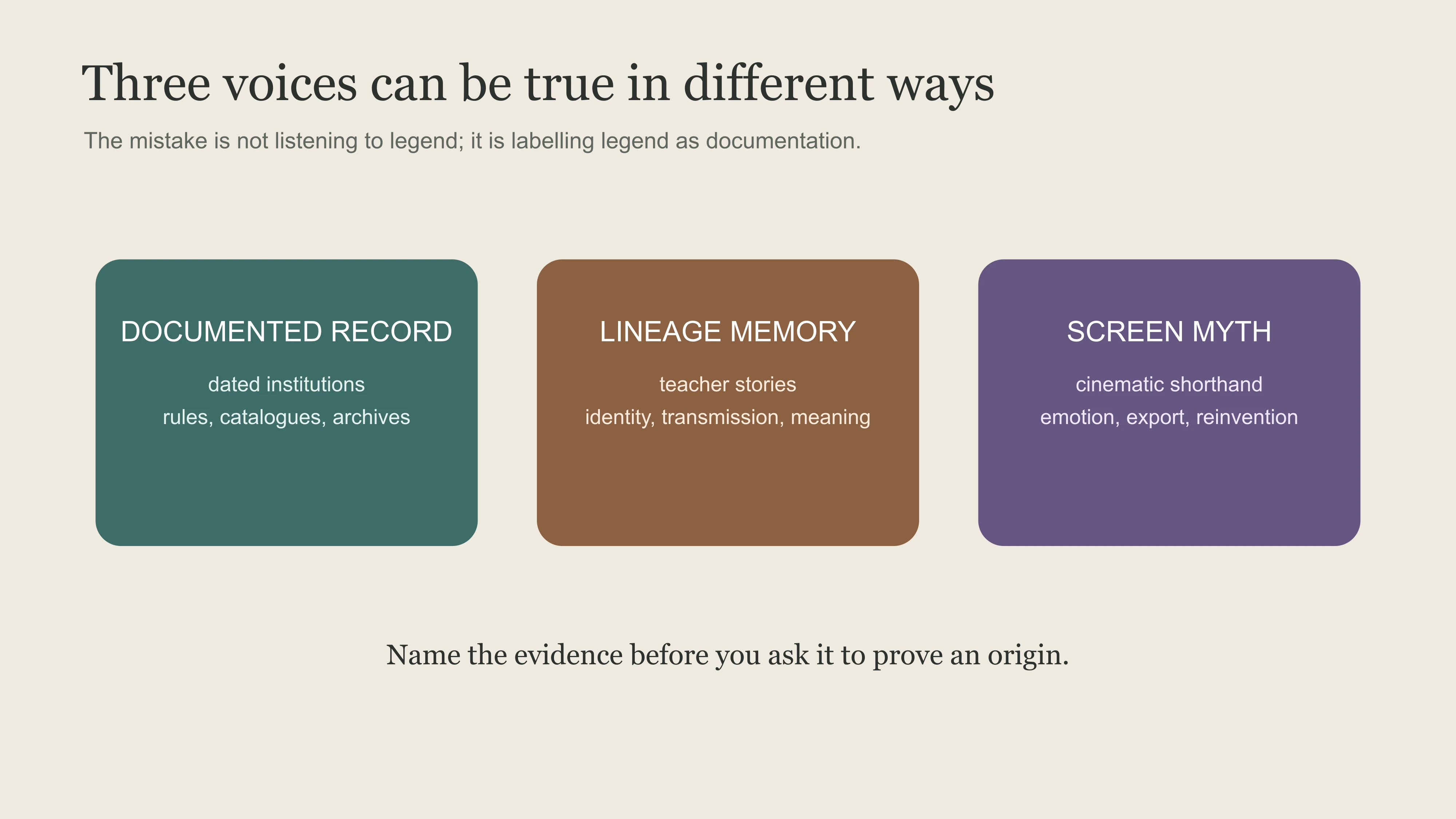
I use this three-part filter because martial history becomes dishonest at both extremes. Treating every lineage memory as a court record is credulous; dismissing every oral tradition because it is not a court record is lazy. The responsible job is to label what kind of evidence is speaking, then refuse to make it carry more certainty than it can bear.
Cinema made kung fu a global emotional vocabulary
Bruce Lee, Hong Kong directors and later Hollywood did more than export fight choreography. They taught international audiences to read a pause, a stance and a training sequence as character development. The kung fu movies route separates five different dramatic languages instead of flattening them into a kick-count ranking. Ip Man turns Wing Chun into a story about dignity under pressure; Kung Fu Hustle turns old movie memories into a ridiculous but sincere love letter to martial-arts cinema.
Cinema also created false memories. A training montage compresses years into minutes. A monastery supplies one clean origin. A named style gives the hero an identity the audience can recognize before the first exchange. Those devices are magnificent storytelling and terrible documentation. I keep both truths together because dismissing the films would ignore how millions first cared, while treating them as archives would insult the complexity they simplified.
The films simplify history, but they also made real questions travel: What is strength for? What does a teacher owe a student? Can technique survive when the world changes?
The twentieth century changed both training and the word
Republican-era modernisation, public associations, state physical education, migration and new media all changed how Chinese martial arts were organised and named. “Wushu” could refer broadly to martial arts, while modern competitive wushu developed standardised routines and institutions of its own.
Migration gave “kung fu” another life. Cantonese-speaking communities, Hong Kong cinema and teachers abroad made the Cantonese pronunciation globally dominant even as Mandarin became the standard language many learners later encountered. The English word therefore preserves a history of movement: people, films and schools travelled before terminology became tidy.
That is not a mistake to correct out of existence. It is evidence. The word tells us which Chinese-speaking networks first made the practice emotionally legible to much of the world.
The word became global by changing shape
I do not treat the global movie meaning of kung fu as simply wrong. It is historically incomplete, but it records a real cultural journey. Cantonese-speaking filmmakers and performers helped make a broad idea of earned skill legible through bodies, training sequences, comedy, pain and moral choice. Overseas audiences then used the term for a family of screen experiences, even when the practices on screen came from different systems.
The responsible correction is additive. Keep the emotional power that made the word travel, then restore distinctions: traditional practice, modern wushu, combat sport, opera movement and action choreography answer different questions. A film can inspire serious study without documenting a complete lineage. A temple can matter profoundly without being the source of every Chinese martial art.
Kung fu history is therefore not a straight line from an ancient monk to a modern movie star. It is a network of teachers, workers, performers, institutions, migrations and media, all giving “skill through effort” a different visible form.
This network changes what “traditional” should mean. Tradition is not a sealed box protected from history; it is the disciplined argument over what deserves to be carried forward. Some schools preserved names while altering teaching. Some modern sports made movement internationally legible while narrowing local purposes. Some films invented scenes that later sent viewers toward real teachers. Continuity and change are not enemies here. They are the two hands holding the same practice.
There is also a human reason the clean origin story survives: beginners want belonging before they have vocabulary. A founder, a mountain and a secret method make a warm entrance. I understand that hunger. I simply refuse to let the entrance become the whole house. The deeper reward is discovering that kung fu was carried by people whose names rarely reach posters—teachers correcting one stance for years, performers repeating dangerous timing, migrants opening schools in unfamiliar streets, families preserving a routine and athletes rebuilding it under new rules.
That history feels less magical only from a distance. Up close, it is more moving. No single revelation kept kung fu alive. Thousands of ordinary decisions did. Whenever someone translated a term, adjusted a lesson for a new student or chose to practice after work, the tradition changed without disappearing. That is the kind of continuity I trust.
The history is plural because the labour was plural, local and stubbornly human.
My verdict
Kung fu history is not a straight line from an ancient temple to a modern film. It is a braided history of Chinese words, regional bodies, institutions, migration, cinema and patient practice.
If you want the clean answer, kung fu is Chinese. If you want the useful answer, learn which style, place, teacher and purpose a person means when they say it. Our Chinese kung fu guide helps you choose that doorway before you go deeper. Then bring that discovery to East Moment's community.