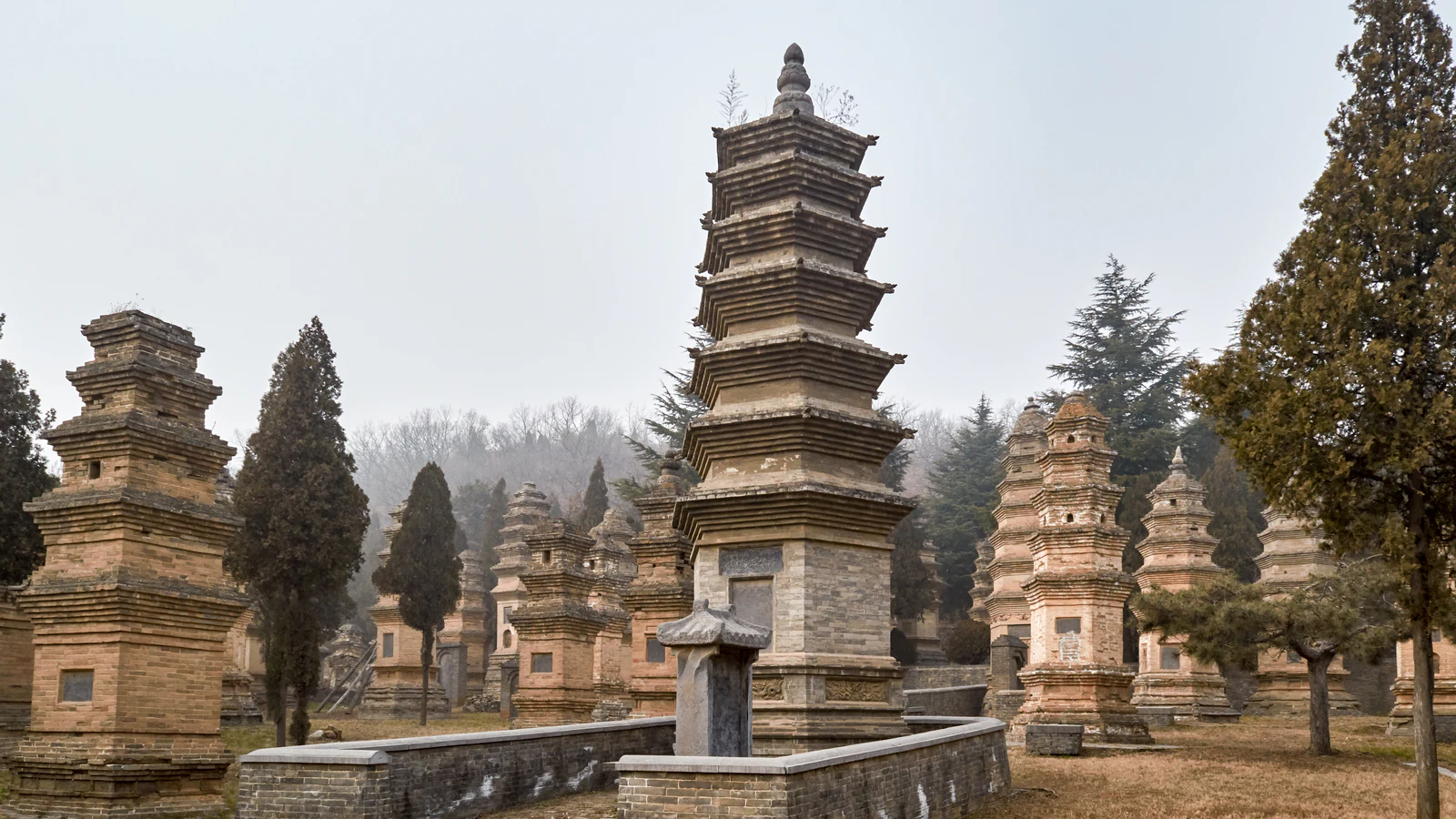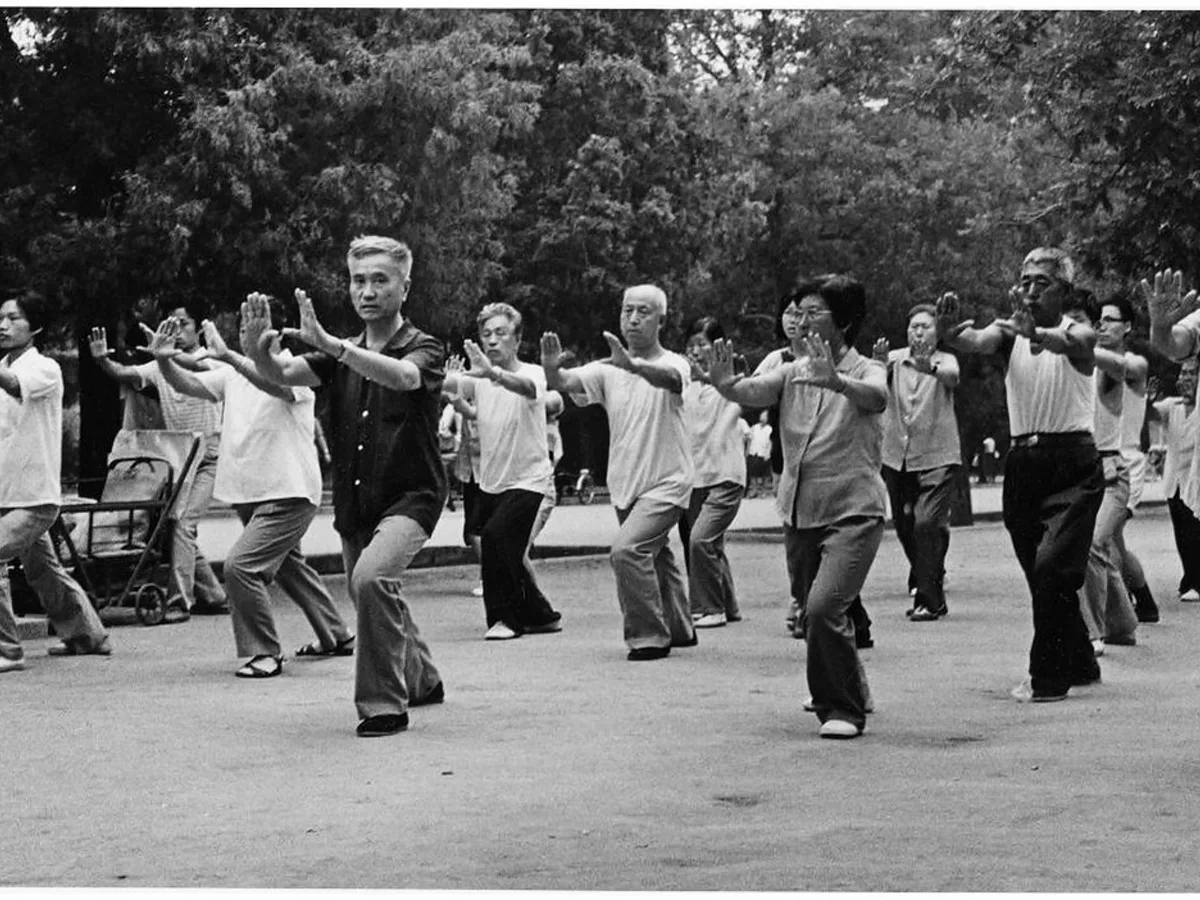
Tai chi is a Chinese martial art built from coordinated movement, posture, attention and trained response. Its full Chinese name is taijiquan. The slow forms familiar in parks are one part of the practice, not proof that the art has forgotten how to move quickly.
Tai chi before the city is fully awake
Morning gives tai chi a kind of honesty. There is no stage lighting, only a public square, a strip of riverside paving or the hard-packed ground beneath old trees. One group moves together. Nearby, someone practices alone and appears to be losing an argument with a sleeve.
From a distance, the movement looks soft. Up close, it is full of decisions: where weight settles, when the waist turns, how the foot receives the ground and whether the shoulders can stop trying to become earrings.
This is the first thing an overseas reader should know. Tai chi is not slow motion for its own sake. Slowness makes structure visible.
What does tai chi mean?
The English spelling tai chi comes from an older romanization of the Chinese term taiji. In modern pinyin, the martial art is written taijiquan: taiji refers to a cosmological idea often translated as “supreme polarity,” while quan means fist or boxing.
“Supreme-polarity boxing” is accurate enough to be memorable and strange enough to require explanation. The name connects martial practice with patterns of change: full and empty, opening and closing, advancing and yielding. It does not mean that every hand position is a mystical diagram.
Tai chi chuan, t'ai chi ch'uan and taijiquan refer to the same broad art through different spelling systems. On East Moment, tai chi serves the common English search term, while taijiquan keeps the Chinese name visible.
Tai chi history is younger and more documented than many legends
Popular stories sometimes give tai chi an ancient Daoist founder and a dramatic moment of inspiration involving animals. Zhang Sanfeng, a legendary Daoist figure, is frequently named. These stories are culturally important, but they are not the same as secure documentary history.
The clearest historical trail leads to Chen family martial practice in Chenjiagou, Henan, during the late imperial period. Chen Wangting, associated with the seventeenth century, is often placed near the beginning of this documented lineage. The art later developed through teachers and families whose names became attached to major styles.
Yang Luchan studied Chen methods and became central to the spread of what developed into Yang-style tai chi. Wu or Hao, Wu and Sun styles emerged through later teachers, exchanges and adaptations. Public teaching, Republican-era physical culture, state sport systems, migration and global wellness movements continued to reshape the art.
The result is neither an unchanged ancient secret nor a recent exercise invention. Tai chi is a historical martial practice that has repeatedly learned new social roles.
The major styles of tai chi
| Style | Historical association | Commonly noticed qualities | Important caution |
|---|---|---|---|
| Chen | Chen family traditions of Chenjiagou | Spiraling actions, varied tempo, lower stances and explosive releases in some forms | Not every Chen class is physically intense or taught the same way |
| Yang | Lineages associated with Yang Luchan and descendants | Broad, even, continuous forms widely taught for public practice | “Soft” does not mean empty of martial structure |
| Wu or Hao | Lineages associated with Wu Yuxiang and Hao Weizhen | Compact frame, subtle balance and close attention to internal coordination | Often confused with the separate Wu style in English |
| Wu | Lineages associated with Wu Quanyou and Wu Jianquan | Inclined postures in some branches, compact movement and close-range method | Appearance varies among branches and teachers |
| Sun | Founded by Sun Lutang | Agile stepping, upright frame and influence from other internal martial arts | It remains a martial system, not merely a gentle senior form |
These labels help people find a school and trace teaching history. They should not become personality quizzes. A careful Yang teacher may feel more demanding than a casual Chen class. The quality of instruction matters more than the mythology of the style name.
Why tai chi is practiced slowly
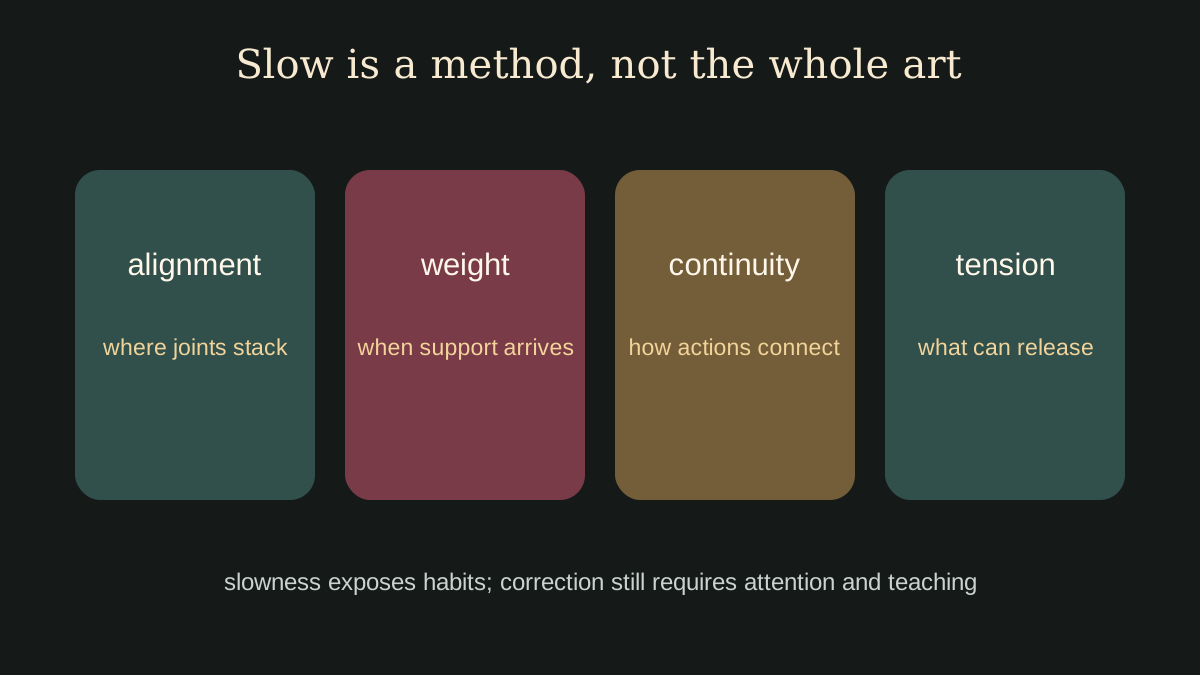
Slow practice gives the body time to reveal habits that speed can hide. A knee collapses inward. Weight arrives before the foot is ready. Breath is held for no useful reason. The upper body performs a heroic drama while the hips quietly refuse to participate.
Moving slowly can develop awareness of alignment, balance, sequencing and tension. It also makes errors repeatable, which is useful only when someone recognizes them. Slow movement is therefore a method, not a guarantee.
I reject the moral halo people place around slowness. Slow is not automatically deep, gentle or correct; it is a diagnostic tempo. It gives a mistake nowhere to hide. A low stance is not an achievement if the knees and back are carrying a pose the feet cannot support, and softness is not limpness. The Chinese idea of song asks unnecessary tension to leave while connection remains. Collapse is easy. Responsive structure is work.
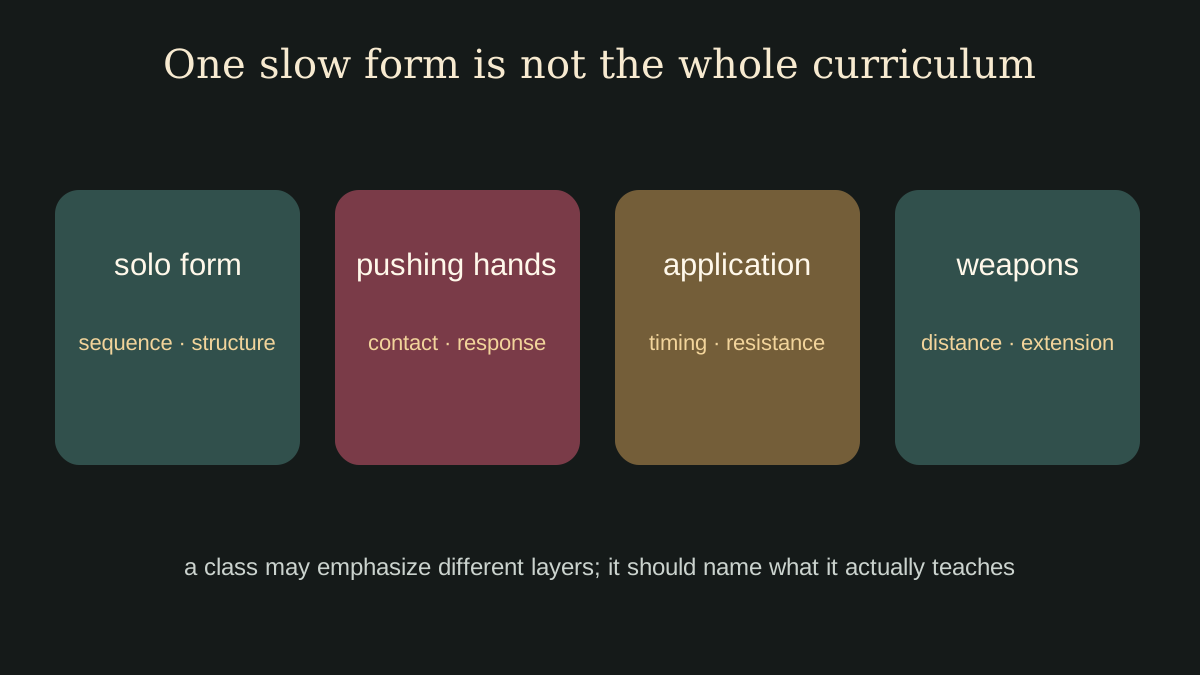
Traditional training may include faster work, explosive power, partner exercises and weapons. The familiar slow solo form is the public face of tai chi because it is visually distinctive and accessible to many bodies. It is not the whole family.
The movement principles behind the form
Different lineages use different language, but several concerns recur.
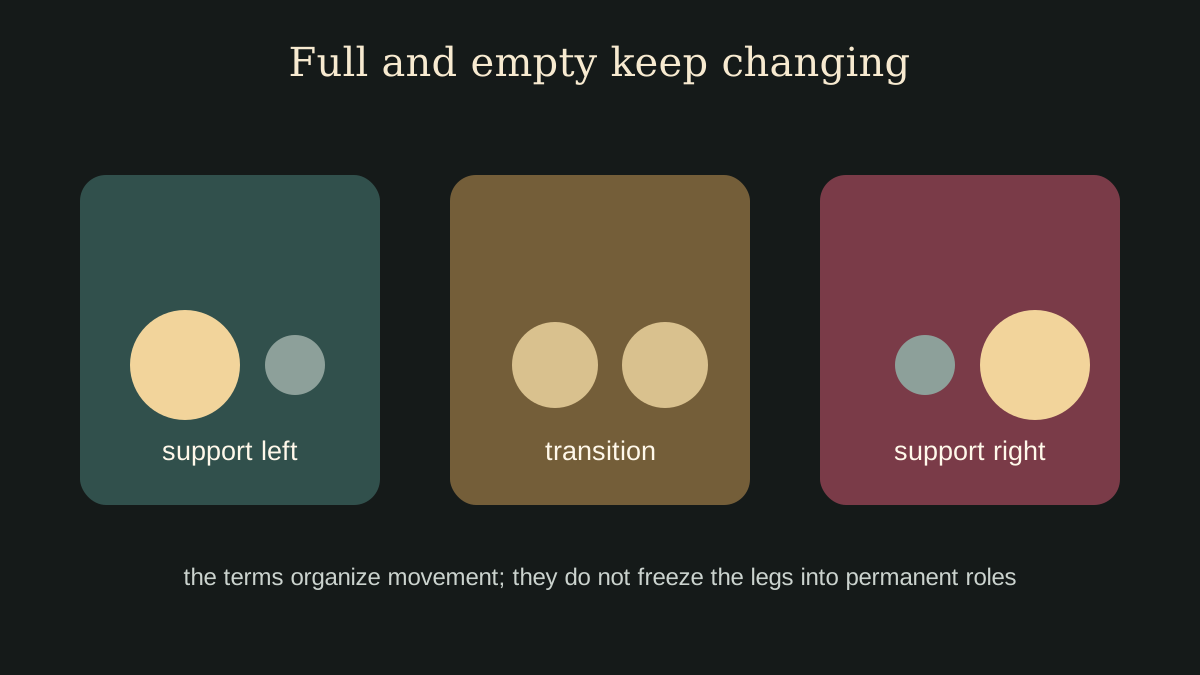
Full and empty
Tai chi training pays close attention to weight distribution. One leg may become more “full” while the other becomes more available to step. The distinction is dynamic, not a frozen pose.
Continuity
Movements connect rather than appearing as isolated gestures. The end of one action prepares the beginning of another. In good practice, continuity does not become vagueness; transitions remain organized.
Relaxation without collapse
The Chinese term song is often translated as relaxation, though it suggests releasing unnecessary tension while preserving connected structure. A collapsed posture is loose, but not usefully so. A rigid posture is strong until it needs to change.
Whole-body coordination
The arms should not behave like two enthusiastic freelancers. Stepping, turning and hand movement are trained as one coordinated event. This integration is part of both martial application and the particular visual calm of the form.
Tai chi is a martial art even when nobody is fighting
Solo sequences preserve patterns that can be interpreted as strikes, deflections, locks, throws and control of balance. Partner work tests timing, distance, sensitivity and structure.
The best-known partner exercise is tuishou, usually translated as pushing hands. Partners maintain contact and learn to sense pressure, yield without losing position and affect the other's balance. Training can range from cooperative pattern practice to competitive exchange.
Martial explanations vary in quality. A movement's poetic name is not proof of combat effectiveness, and a dramatic demonstration may depend on a compliant partner. Honest teaching distinguishes principle, drill, application and free resistance. Visible speed does not decide whether something is martial; tai chi's slower training surface should never be mistaken for the absence of application.
Form, pushing hands, weapons and related practice
| Practice | Main purpose | What a beginner may see | What it is not |
|---|---|---|---|
| Solo form | Coordination, sequence, posture, breath and martial pattern | Slow connected movements performed alone or in groups | The entire art |
| Standing practice | Alignment, attention and structural awareness | Quiet postures held for a period | Doing nothing |
| Pushing hands | Partner sensitivity, balance and trained response | Continuous contact through hands or forearms | A magic test of invisible power |
| Application drills | Explore martial uses of form movements | Repeated partner actions | Automatic proof of self-defense skill |
| Weapons | Extend body method through sword, saber, staff or other tools | Choreographed forms and partner training | Decorative dance by definition |
| Qigong | Broad field of breath, movement and cultivation practices | Repeated exercises or standing work | Simply another name for tai chi |
Tai chi and qigong overlap in many schools, especially in attention, breathing and gentle movement. They are not identical categories. Qigong includes a much wider range of practices, while tai chi retains a specific martial history and style lineage.
Why people practice tai chi today
People come to tai chi for many reasons: martial study, coordination, balance, recreation, cultural connection, competition, performance, quiet attention and the pleasure of moving with others.
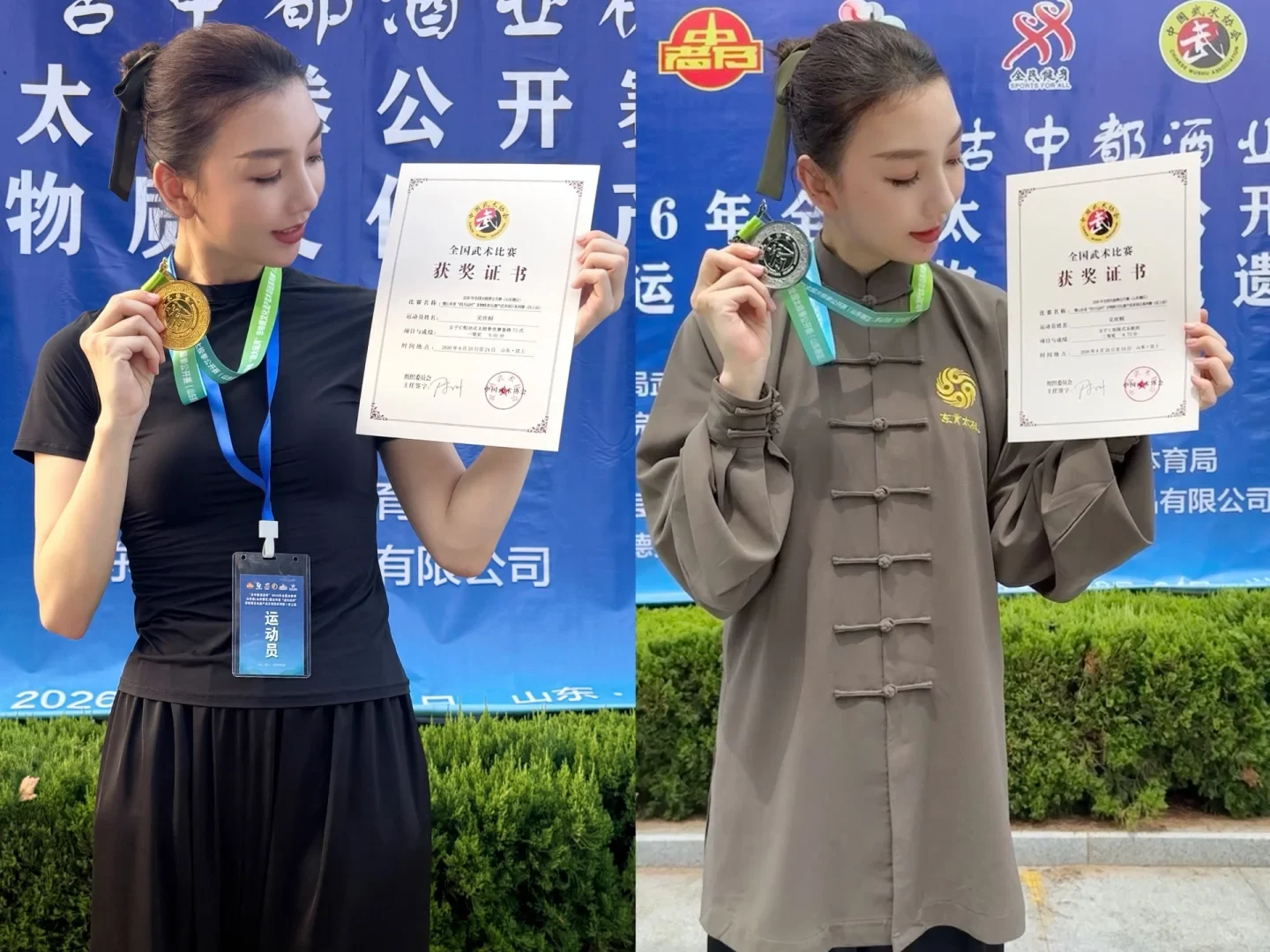
The post behind this photograph records a first tai chi competition and names separate results for a fist event and a sword event. That small detail destroys the idea that tai chi competition is one vague category of slow movement. The image itself proves two people completed a public event and stood together with certificates and medals. It cannot prove the quality of either routine, the judging process or a health result. I value it because the faces show something institutional language misses: a private practice can become a nerve-racking public threshold, then a memory shared with the person beside you.
The practice does not need extravagant promises to remain valuable. A regular class can give shape to a morning, introduce a person to neighbors and make small changes in posture easier to notice. Those are ordinary benefits of sustained practice and community, not cure claims.
The U.S. National Center for Complementary and Integrative Health reports that evidence differs by outcome and population, and explicitly advises readers not to delay medical care because of a complementary practice. That is the boundary this page follows. Tai chi can be meaningful movement, social practice and disciplined attention without being sold as a universal treatment.
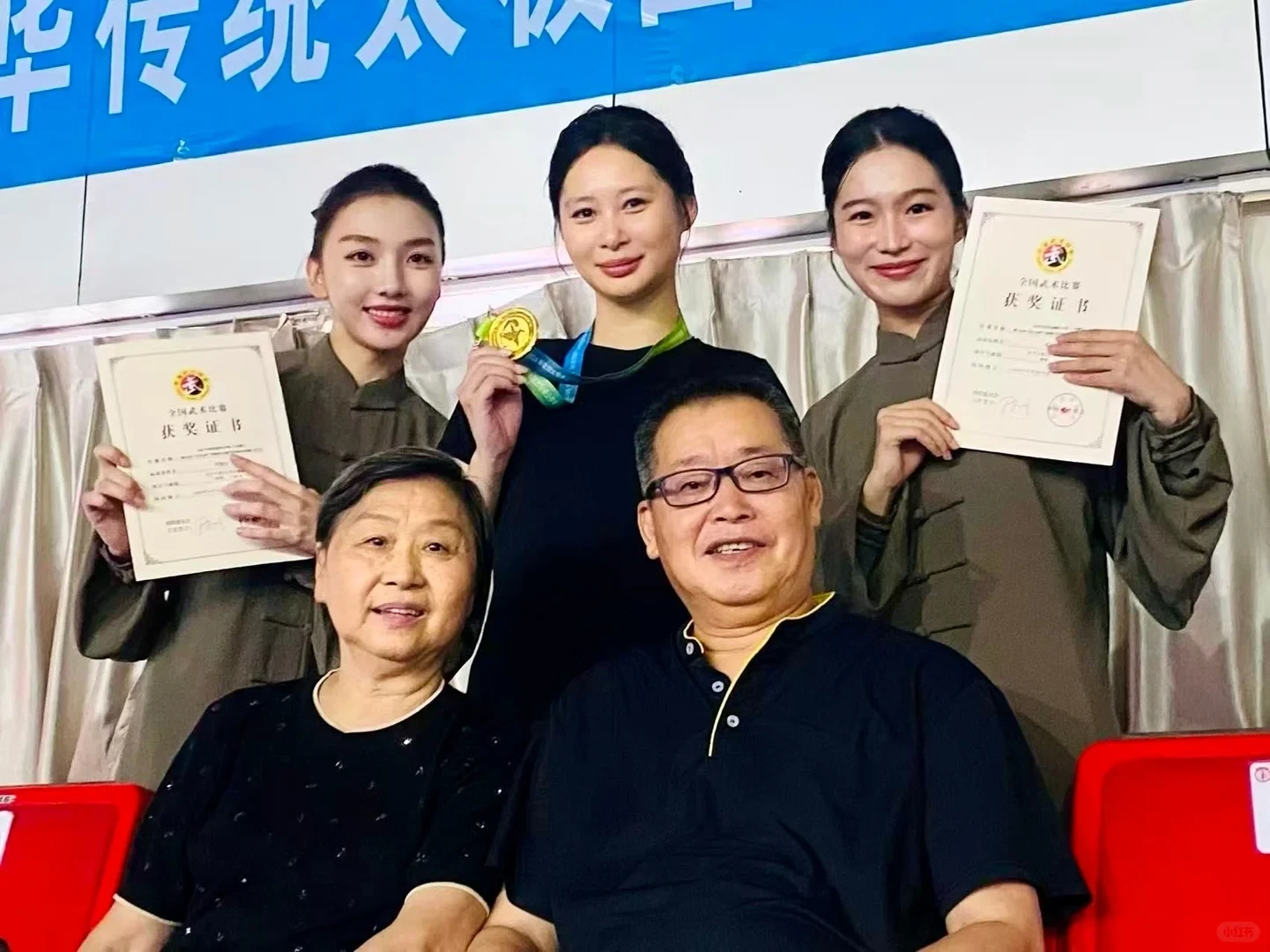
This group photograph is not evidence that tai chi cures loneliness. It shows the simpler, sturdier truth: a practice produces reasons to meet, travel, wait for one another and remember a day together. That social layer is one reason tai chi survives outside specialist schools. People return not because every session reveals a cosmic secret, but because somebody notices when they are absent.
Low speed does not mean zero effort. Beginners should stay within a comfortable range and avoid forcing depth, flexibility or imitation of advanced forms. A good teacher makes the practice more precise without turning discomfort into proof of commitment.
Is tai chi meditation?
Tai chi can be meditative because it asks for sustained attention to movement, breath, posture and changing sensation. Some people experience calm; others experience an intense awareness that they have forgotten which foot is supposed to move.
Calling tai chi “moving meditation” can be helpful, but it can also erase martial training and Chinese history. Meditation describes one quality of practice, not the complete identity of the art.
Tai chi walking is both traditional language and a modern search term
The phrase tai chi walking now attracts enormous online interest. In traditional classes, it may describe controlled stepping drills: transferring weight, placing the foot, maintaining balance and coordinating the body through motion.
Online, the same phrase can refer to indoor walking workouts, weight-loss programs or routines only loosely connected with taijiquan. These may still provide movement, but they should not be presented as ancient practice merely because “tai chi” appears in the title.
This distinction deserves its own future guide. The foundation must come first: readers need to know what tai chi is before deciding whether a trending walking routine belongs inside it.
Tai chi after it traveled
Tai chi moved through Chinese migration, martial networks, universities, community centers, films, public health programs and teachers who settled abroad. In many countries it became one of the most visible Chinese movement traditions.
Travel changed emphasis. Martial training sometimes became less visible while relaxation and accessibility moved forward. Standardized competition forms created another international language. Diaspora teachers balanced lineage loyalty with the practical need to explain Chinese concepts in another vocabulary.
None of these changes automatically makes the practice false. The honest question is what a class claims to teach and whether its method supports that claim.
How to choose a tai chi class
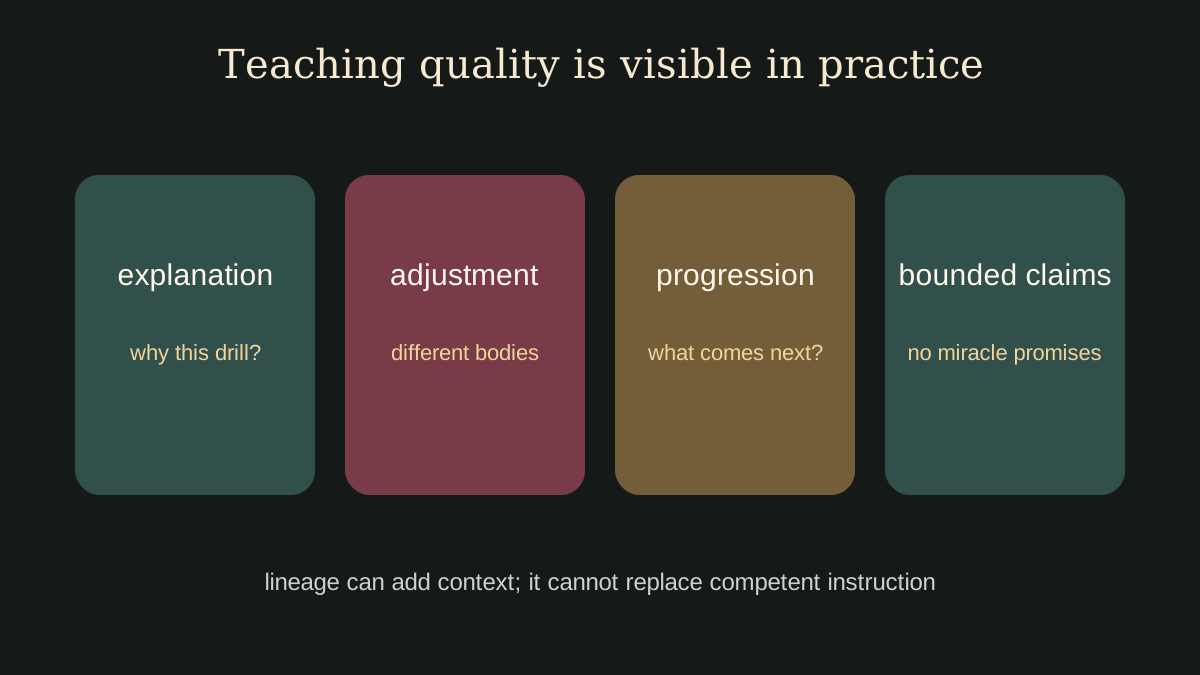
Look for a teacher who can name the style or training approach, explain progression and adjust movement without humiliation. A beginner class should not require pain, extreme flexibility or belief in extravagant powers.
Ask whether the class emphasizes general movement, martial study, competition, rehabilitation or meditation. Observe how the teacher handles different bodies. Tradition should provide depth, not an excuse to ignore safety.
For physical practice, an in-person teacher is usually more useful than copying a long sequence from a screen. Video can introduce vocabulary, but it cannot see your knee.
Stillness is not the absence of work
Tai chi is often photographed at the quietest instant: arms rounded, weight settled, face composed. The image is beautiful and slightly misleading. Inside the posture are accumulated corrections, changing pressure, remembered sequences and the possibility of movement in several directions.
That is why the art continues to travel. It can be martial without shouting, disciplined without appearing hurried and philosophical without requiring every practitioner to become a philosopher before breakfast.
Begin with the Movement and Martial Arts hub, place tai chi beside other Chinese ideas and beliefs or follow it into the wider story of Chinese culture.
To see how the same term moves between martial history, philosophy and fantasy media, continue with XianLore's tai chi meaning and martial-art guide.