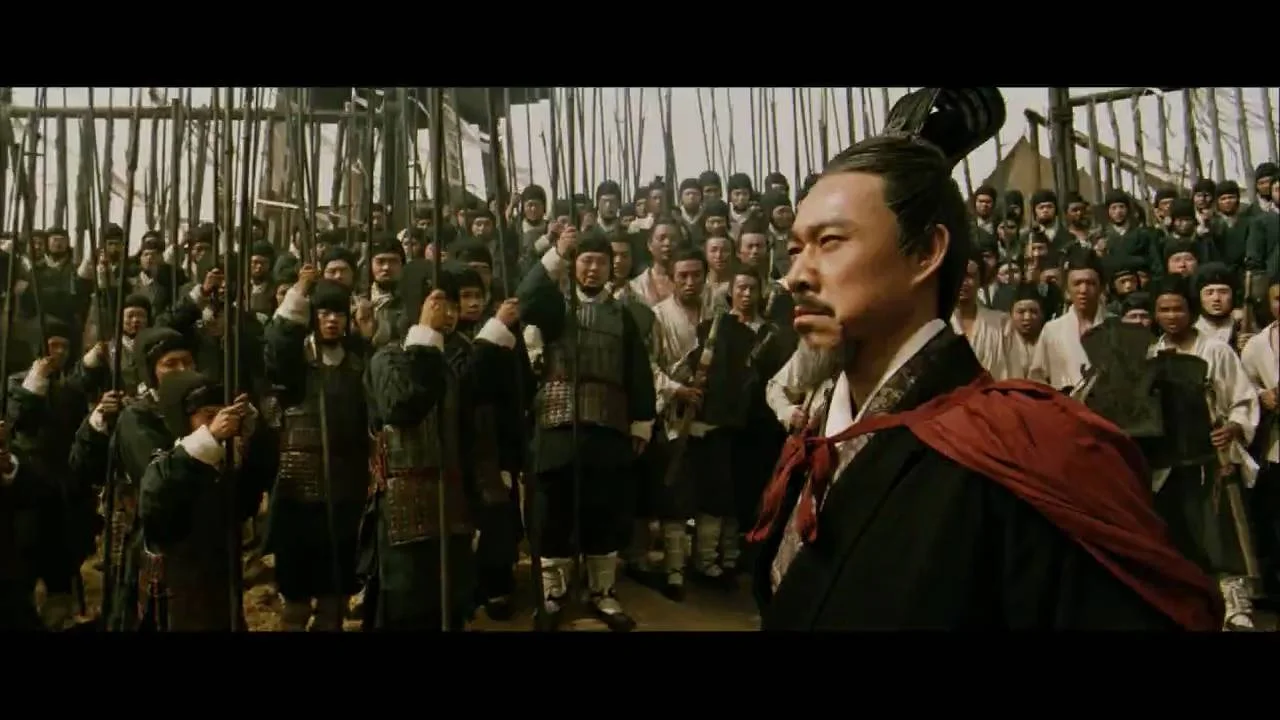
The Red Cliff movie is worth watching because John Woo makes a huge battle understandable without inventing one invincible hero. Boats, wind, disease, terrain, trust and timing all carry part of the victory. Choose the original two-part version if you can: the shorter international cut preserves the main campaign but removes much of the relationship-building that makes the strategy feel earned.
Red Cliff movie in 60 seconds
| Question | Short answer |
|---|---|
| What is it? | John Woo's two-part historical epic about the coalition resisting Cao Cao before and during the Battle of Red Cliffs. |
| Original release | Part I in 2008 and Part II in 2009 in major Asian markets. |
| International version | A single shortened cut of roughly 148 minutes, assembled from a story that originally runs nearly five hours. |
| Main cast | Tony Leung as Zhou Yu, Takeshi Kaneshiro as Zhuge Liang, Zhang Fengyi as Cao Cao, Chang Chen as Sun Quan, Zhao Wei as Sun Shangxiang and Lin Chi-ling as Xiao Qiao. |
| Best version | The two-part cut; choose the international cut only when time is the deciding constraint. |
| Basic plot | Liu Bei and Sun Quan's forces form an uneasy alliance to stop Cao Cao's much larger army at the Yangtze. |
| Ending | The coalition's fire attack breaks Cao Cao's fleet and camp; Cao Cao escapes, and the alliance survives its immediate test. |
| East Moment verdict | One of the clearest large-scale battle films because intelligence moves through a network rather than descending from one genius. |
Magnolia Pictures and Magnet Releasing's free official trailer identifies the international campaign, cast and marketed scale. A trailer cannot prove historical accuracy or replace the missing character time in the shorter cut.
Which Red Cliff version should you watch?
The choice changes the film, not just the evening.
The international cut is efficient. It reaches the alliance, tactics and fire attack quickly. It is useful when a viewer wants one self-contained war epic.
The two-part version gives strategy a social life. Zhou Yu and Zhuge Liang have time to listen, test, tease and recognize one another. Sun Quan's uncertainty develops before command becomes credible. Sun Shangxiang's movement through enemy space feels like risky information work rather than a colorful side mission. Soldiers train long enough for formation to become learned behavior.
Cut those intervals and the same victory begins to look like plot delivery. Keep them and the victory feels built.
That difference matters because Red Cliff is not fundamentally about whose brain has the highest score. It is about whether separate groups can become interoperable before a larger force crushes them.
The longer cut also rescues the film from a trap built by the legend itself. Everyone already knows Zhuge Liang is supposed to be clever, so a compressed version can make each success feel like the fulfillment of a reputation rather than the result of observation. Time lets him be curious, amused and occasionally dependent on knowledge held by somebody else. It lets Zhou Yu lead without being reduced to jealous obstruction. I prefer this pair precisely because neither man's intelligence requires the other man's humiliation.
Variable one: trust begins before the arrows

The most revealing scene is quiet. Zhou Yu and Zhuge Liang play the guqin. They do not exchange a formal contract. Each listens for timing, confidence and concealment.
The “You understand this too?” / “Slightly” rhythm stays alive because it gives Zhou Yu and Zhuge Liang competence without the exhausted routine of one strategist humiliating another.
The film needs this warmth. In many tellings of the Three Kingdoms, Zhou Yu and Zhuge Liang are pushed toward rivalry. Woo lets admiration become operational. When the plan breaks, each man can act without explaining the entire system again.
The Tony Leung profile explains why his relaxed authority matters here. He does not play Zhou Yu as a man terrified that another intelligent person exists.
Variable two: terrain is an active participant

The Yangtze is not a blue background behind heroic faces. Cao Cao's northern forces must operate on water. The allied side understands the local terrain, movement and weather more intimately.
Woo repeatedly converts geography into a question a viewer can answer. Where are the ships? Why are they connected? Which direction can fire travel? What does fog hide? Which route can a messenger use? The film simplifies a complex campaign, but it rarely makes the immediate objective illegible.
This is where Woo's urban action experience scales up. In Hard Boiled, a corridor distributes risk. In Red Cliff, a river does the same work. The John Woo guide follows that directing method across crime films; this page owns the battle and adaptation.
Variable three: disease weakens the fantasy of numerical power
Cao Cao's army appears overwhelming when counted. It becomes fragile when treated as bodies in an unfamiliar environment.
Disease moves through the camp. Cao Cao weaponizes infected corpses, adding cruelty to an already unequal campaign. The alliance must recognize the threat, absorb fear and prevent biological pressure from breaking political trust.
The film's medical explanation should not be treated as a precise reconstruction of an ancient outbreak. Its dramatic function is clear: a large army is also a large logistical organism. Food, water, climate, morale and illness can turn quantity into exposure.
That is a more interesting form of power than “more soldiers win.”
Variable four: information must survive disguise and noise

Woo appears beside his enormous campaign, but the film's best idea is precisely that no single face—not even the director's—can contain the work of an army.
Sun Shangxiang crosses into Cao Cao's camp and turns observation into usable intelligence. Her contribution is not that she becomes a flawless spy. It is that somebody must translate distant movement into a decision the coalition can time.
Signals, maps, messengers, drums and formations matter because information has to pass between people who cannot see the whole field. The viewer is repeatedly shown that a correct idea can still fail if it arrives late or cannot be executed.
I enjoy the Zhou Yu–Zhuge Liang–Zhao Yun strategy group for its social intelligence: nobody owns the victory alone, and competence becomes pleasurable when it circulates.
Sun Shangxiang is the clearest test of whether that principle is real. Her disguise is comic, but the information she gathers is not decorative. She notices formations, routines and vulnerabilities from inside the camp, then has to get those observations back across political and physical boundaries. A strategist who refuses to depend on her evidence would be less brilliant, not more. The film's network works because status does not completely determine whose perception counts.
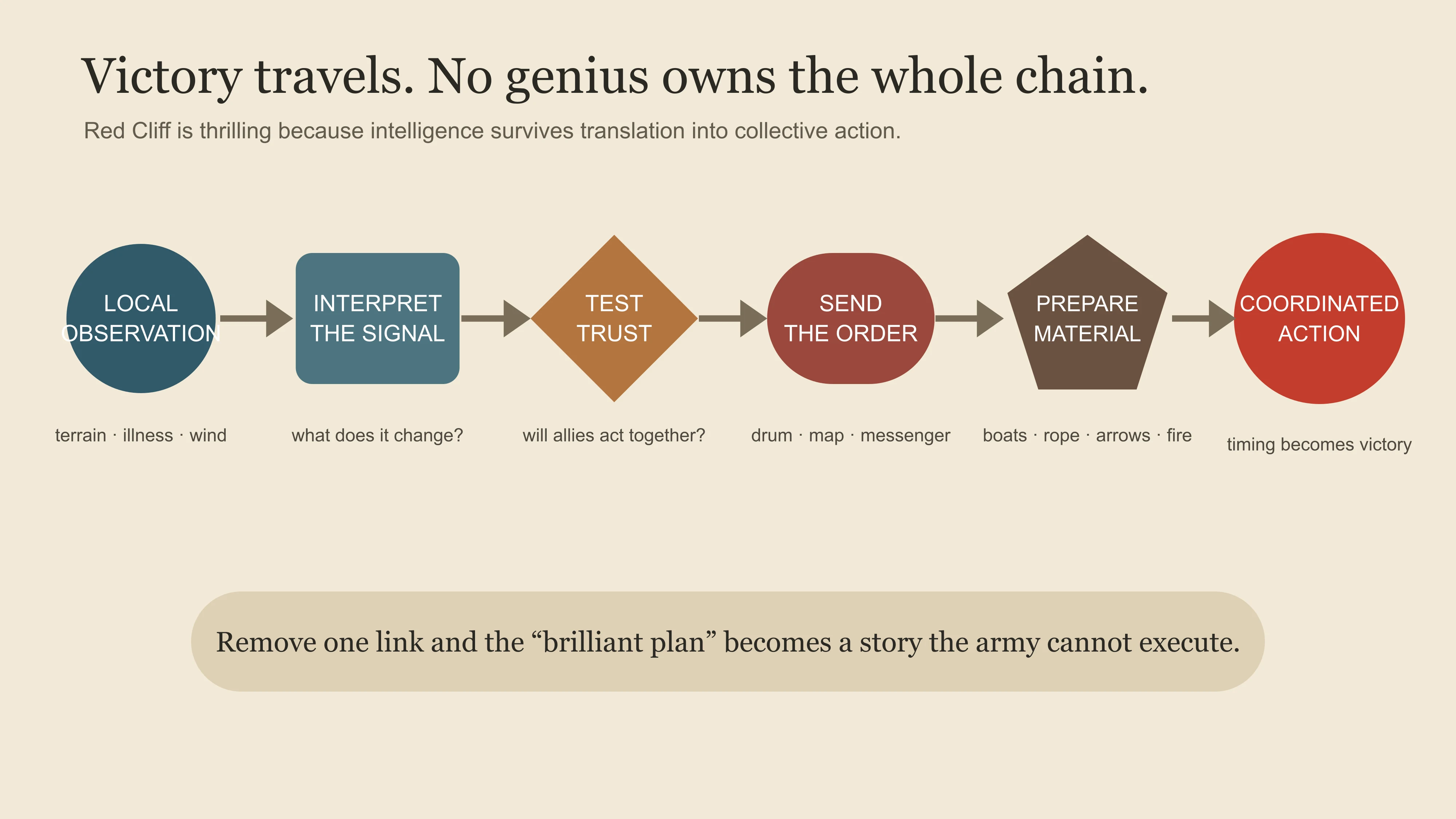
I reject the lazy “Zhuge Liang is the genius, everyone else executes” reading. It destroys what this adaptation does best. Information comes from scouts and embodied risk; interpretation is tested through conversation; material preparation turns an idea into capacity; soldiers and crews make timing real. The film is thrilling because intelligence travels without losing coherence. Hero worship would make the battle smaller.
Variable five: material turns wit into action

Fog does not become useful until there are boats, straw, ropes, crews and an enemy willing to shoot. Fire does not become victory until ships, wind, formation and timing line up.
The famous arrow-gathering sequence is satisfying because intelligence acquires weight. Arrows thud into material. Men pull them free. A joke becomes inventory.
The “ten thousand arrows—you are very generous” joke captures the adaptation's pleasure in turning enemy force into supply. That emotional memory belongs to the film tradition, not proof that the historical incident happened exactly this way.
Variable six: timing is the final weapon
The battle plan depends on a shift in wind. In the novel tradition, Zhuge Liang's relation to the east wind accumulates an aura of near-supernatural mastery. The film enjoys that legend but also distributes the result across weather observation, preparation and coordinated ignition.
The Britannica overview of the Battle of Red Cliffs can orient readers to the historical event and principal political forces. It does not validate every episode from Romance of the Three Kingdoms, later opera and screen adaptations.
Keep three layers separate:
- A major late-Han battle and coalition victory belong to historical inquiry.
- Zhuge Liang borrowing arrows and summoning or predicting the east wind belong strongly to literary and popular narrative traditions.
- John Woo's specific scenes, relationships and action timing belong to this film.
Confusing the layers makes both history and cinema less interesting.
Red Cliff movie ending explained
Major spoilers begin here.
The coalition launches fire ships into Cao Cao's linked fleet as the wind changes. Fire crosses water into the camp. Land forces attack through the confusion, and the network Cao Cao assembled for control becomes a network for spreading disaster.
Zhou Yu, Zhuge Liang and the allied fighters close in on Cao Cao. The film does not end by turning one final sword stroke into the whole meaning of victory. Cao Cao is allowed to retreat after military defeat and moral exposure.
Xiao Qiao's presence matters because Cao Cao's desire has helped personalize a campaign that he dresses in political necessity. Yet the film wisely refuses to make the war only a contest over one woman. Disease, ambition, alliance and logistics have already made the conflict larger.
The ending's best image is not a dead tyrant. It is a system that failed because another system coordinated better.
Cao Cao's defeat is therefore more satisfying than a private revenge ending. His command structure treats people, ships and desire as possessions to be arranged from the center. The coalition remains imperfect, but it survives by letting specialized knowledge move: sailors understand water, scouts understand the camp, commanders understand formations and ordinary crews make the plan physical. Fire exposes the difference between forced connection and trusted coordination. The linked ships spread disaster because they were made rigid; the alliance wins because it can still respond.
Is Red Cliff historically accurate?
No feature film of this scale should be used as a record of exactly what happened in 208-209. Red Cliff combines historical figures and broad conflict with Romance of the Three Kingdoms, later popular memory and cinematic invention.
That does not make accuracy irrelevant. It changes the test.
Ask whether the film clearly distinguishes cause, motive and consequence inside its own adaptation. Ask which character reputations come from later literature. Ask why modern cinema prefers a charming strategist, a humane commander or a visually legible fire plan.
For another film where beauty reorganizes political history, compare Hero (2002). Zhang Yimou makes competing stories carry the argument; Woo makes coordinated bodies carry it.
Why Red Cliff earns its scale
Watch the two-part Red Cliff when you want strategy to feel earned through relationships. Watch the international cut when the alternative is not watching at all.
The film's achievement is not simply scale. Scale is common and often tiring. Its achievement is making six variables readable without reducing the result to one chosen hero. That is why the guqin matters as much as the fire.
Continue through the Chinese movies collection or the broader Chinese film guide for production and adaptation context.
In the comments, trace one decision chain from observation to action. Then take the map to the East Moment community, where readers can compare the two cuts, subtitle choices and other Three Kingdoms adaptations without arguing from memory alone.