Hero (2002) is worth watching as a political argument disguised as a murder mystery. Its red, blue, white and green chapters are not a simple code that reveals one objective past. They show how different storytellers arrange love, loyalty and violence until one death can appear necessary. The beauty is real. So is the pressure that beauty places on your judgment.
Hero 2002 in 60 seconds
| Question | Short answer |
|---|---|
| Director | Zhang Yimou |
| Release | 2002 |
| Main cast | Jet Li, Tony Leung, Maggie Cheung, Chen Daoming, Zhang Ziyi and Donnie Yen |
| Basic plot | A swordsman called Nameless gains an audience with the King of Qin after apparently killing three feared assassins |
| Why the colors change | Each chapter is a constructed account with different motives and emotional rules |
| What “all under heaven” means here | A political idea that unification may outweigh individual grievance |
| East Moment verdict | Essential visual cinema, but strongest when its final argument is examined rather than obeyed |
The free official Miramax trailer verifies the distributed film, cast imagery and spectacular visual language. It is a production source, not proof that the film's politics are historically correct.
The wider Chinese movies collection is the right place to choose a different kind of film. This page has a narrower job: follow how one story changes its moral verdict each time its narrator rearranges the evidence.
What Hero is really about
Nameless arrives at the Qin palace claiming to have defeated Sky, Flying Snow and Broken Sword. Each victory allows him to sit closer to the king. Proximity is the real countdown: the film's stories are buying the assassin physical distance from his target.
The king listens, challenges details and proposes another version. Nameless then offers a more truthful account. Broken Sword's memory introduces yet another layer. The structure turns narration into combat. A person who controls cause and motive can move closer without taking a visible step.
This is why asking “Which color is true?” is less useful than asking who needs this version to be believed, at this moment, by this listener. The film does not uncover evidence like a detective story. It stages persuasion.
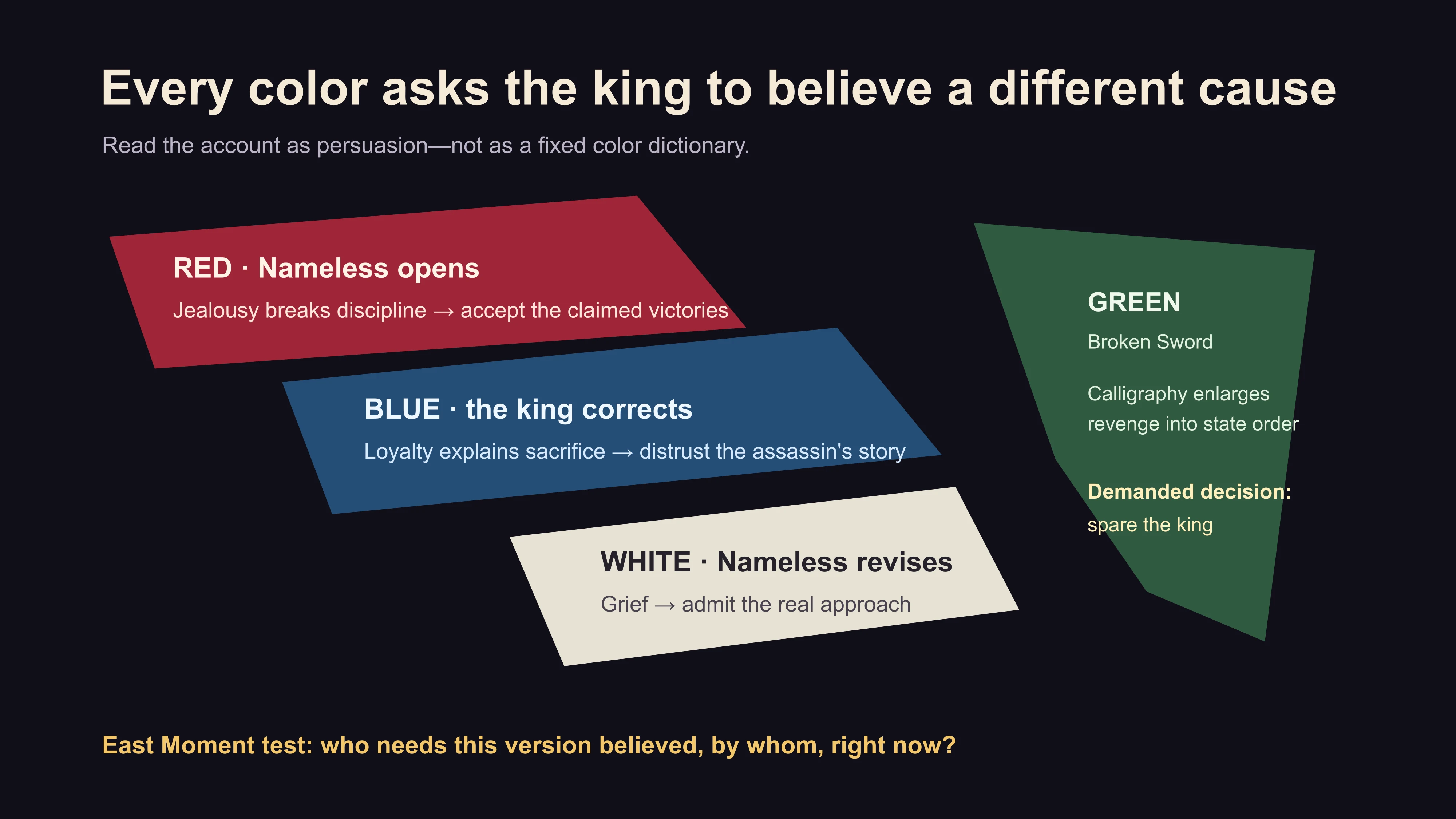
The Hero color meanings are narrative positions
Color does more than identify flashbacks. Each palette makes a different emotional claim possible.
| Color world | Dominant account | What it asks you to believe |
|---|---|---|
| Red | Nameless's first story | Passion and jealousy can break disciplined assassins from within |
| Blue | The king's counter-story | Loyalty and strategic sacrifice explain what jealousy cannot |
| White | Nameless's revised account | Grief is stripped of romantic spectacle as the plan approaches consequence |
| Green | Broken Sword's memory | Intimacy, calligraphy and political change lead him away from assassination |
| Black / Qin court | Present-tense power | Every story must finally pass through the ruler who can authorize its meaning |
Red is not simply “love” and blue is not simply “truth.” If the palette were a fixed dictionary, the film would become a design exercise. Instead, color changes the credibility and moral temperature of similar gestures. A look can read as jealousy in one account and planned sacrifice in another.
The palace floor is a countdown made of distance
The most practical detail in the film is not a sword. It is the measured space between Nameless and the throne.
Every claimed victory earns him permission to sit closer. That reward turns bureaucratic protocol into an assassination mechanism: the king believes he is honoring a useful subject while Nameless is converting credibility into striking range. The stories are not pauses before the action. They are the action that moves his body across the floor.
This changes how the long palace scenes should be watched. Count who controls the account, how much the king accepts and how the physical gap contracts. Nameless must look calm enough to be admitted, impressive enough to be rewarded and limited enough not to trigger immediate defense. Jet Li's stillness is therefore tactical. The scene would fail if he played secrecy as visible tension.
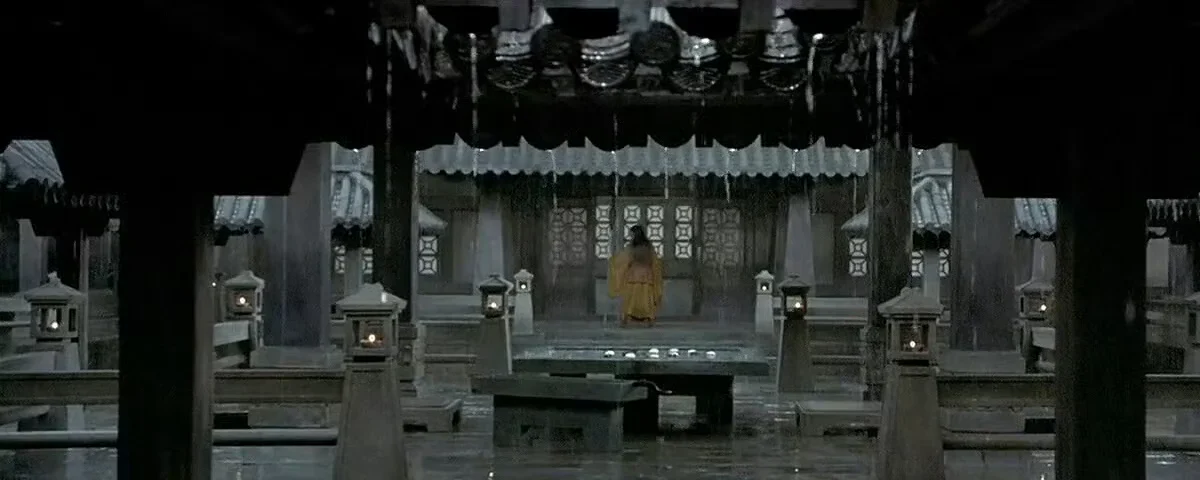
The palace is designed to make one human intention look almost improper. Rain, stone, symmetry and deep shadow leave Nameless visually stranded before he has said a word. I feel the trap before the king names it: the room has already defined private grief as small and state order as permanent. That is not neutral production design. It is political persuasion built into the walking distance. The more beautiful the geometry becomes, the more carefully I have to protect my judgment from it.
Zhang Yimou's director profile follows this method across other films: an object, room or formation becomes a rule before a character speaks. In Hero, architecture does not decorate state power. It calculates how near an individual may come to it.
Calligraphy is the bridge between sword and state
Nameless asks Broken Sword to write the character for “sword.” On the surface, the request helps him study an opponent's technique. Broken Sword argues that swordsmanship and calligraphy share an underlying principle: bodily force becomes disciplined line.
That connection matters because the film keeps enlarging the scale of a mark. A sword stroke can kill one person. Written characters can preserve a school of thought. A standardized script can help a state govern different regions. The king recognizes Broken Sword's insight because it joins artistic form to political order.
The film's famous rain of arrows makes the tension visible. The calligraphy school preserves its strokes while Qin projectiles erase bodies and architecture. Culture and conquest are not presented as clean opposites. The same dream of unified form can protect meaning and justify force.
Readers interested in how martial movement changes across screen traditions should compare the grounded political geometry here with the airborne freedom debate in Crouching Tiger, Hidden Dragon. Neither should be treated as a documentary of combat practice; the Chinese martial arts guide keeps that boundary clear.
“All under heaven” is an argument, not a translation problem
The phrase tianxia (天下) literally joins “under” and “heaven,” but “all under heaven” is useful only if we understand what it does in the scene. Broken Sword has concluded that killing the king may prolong war, while a unified realm could end conflict among the warring states.
Nameless must then compare two scales of suffering: personal and collective. His village, allies and own life give him reason to kill. The imagined peace of a future unified order gives him a reason to stop.
The film makes the second scale visually and emotionally powerful. That does not make it neutral. When one person asks another to sacrifice a concrete life for an abstract future, the abstraction carries the advantage of never having to bleed on screen. Hero partly corrects that imbalance by making Nameless's execution unavoidable, but it still gives political unity the grandeur of calligraphy, architecture and massed bodies. The Tony Leung guide examines how Broken Sword's private change of judgment remains legible inside that monumental scale.
This is the point where viewers should resist two easy reactions. Calling the ending mere propaganda avoids examining why the argument works. Accepting it as timeless wisdom avoids asking who defines peace, who pays first and whether unity could be pursued without the ruler's violence.
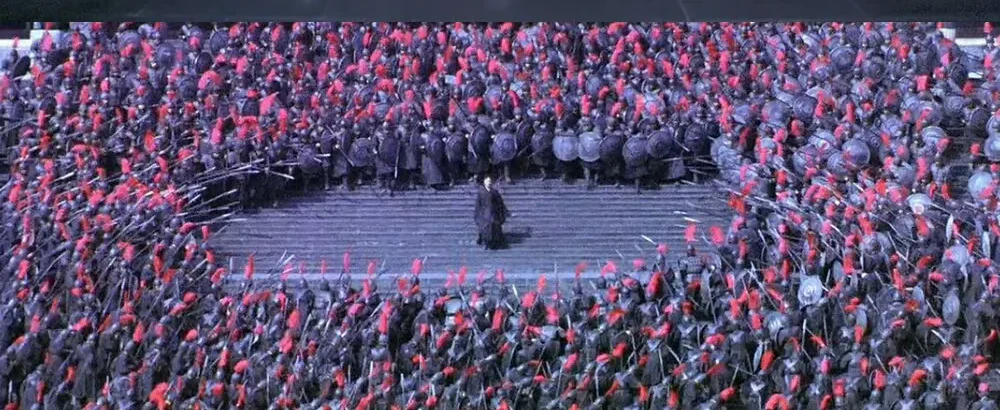
The army image makes the bargain brutally concrete. “All under heaven” sounds limitless, but the frame is built from thousands of nearly interchangeable bodies enclosing one exposed person. The state does not merely possess a better argument; it possesses the architecture, the witnesses and the force that decide which argument survives. I can understand why Nameless changes course without pretending that this imbalance disappears. The scene earns its greatness by making conviction and coercion occupy the same composition.
Hero 2002 ending explained
Major spoilers begin here.
Nameless reaches killing distance. He demonstrates that he could strike but chooses not to assassinate the king after accepting Broken Sword's argument. He turns away, knowing the court may still execute him.
Qin officials insist that law requires punishment. The king hesitates and then authorizes the arrow attack. Nameless dies against the palace gate and receives a hero's funeral. Broken Sword and Flying Snow also die after their disagreement over assassination becomes inseparable from love, trust and loss.
The ending creates two incompatible meanings of “hero.” Nameless is honored by the state because his restraint serves unification. He is also tragic because the same state cannot tolerate the living person who made that choice freely. The funeral converts dissenting agency into approved memory.
My conclusion is clear: Nameless's choice may be sincere, but the state's ceremony is an act of narrative capture. It takes a man who approached the king as an assassin, removes the danger of his continuing judgment and preserves only the sacrifice useful to power.
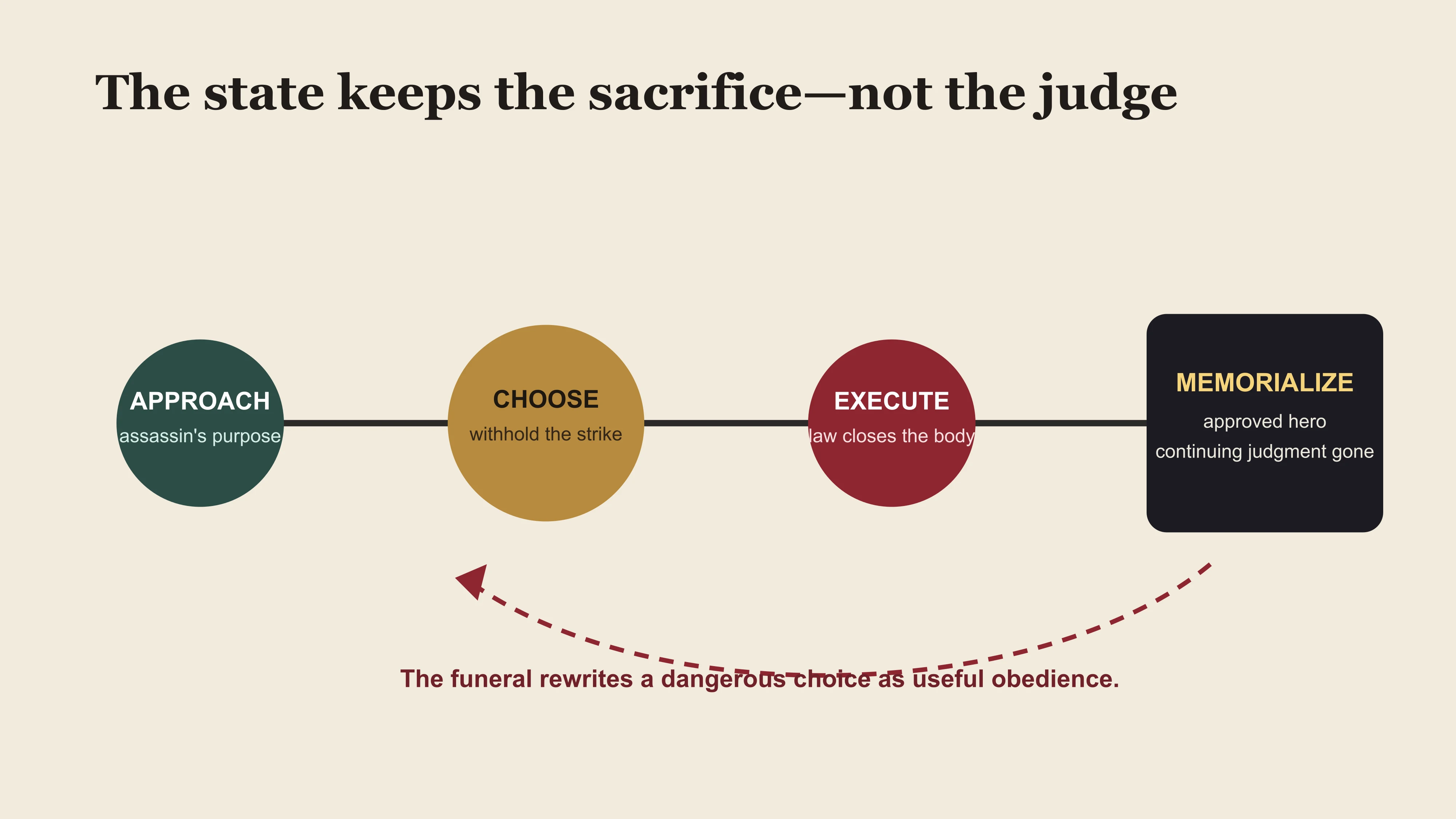
That is why the last title cards and historical horizon do not close the debate. They show the story that prevailed.
What is history and what is invention?
The film uses a ruler associated with the future Qin unification and places fictional assassins inside a stylized Warring States world. It should not be used as a factual reconstruction of one assassination attempt, one political debate or the lived experience of all affected states.
Even “King of Qin” and “first emperor” require chronology: the character is king during the story and becomes the ruler remembered as Qin Shi Huang after unification. The film compresses political philosophy, legend, architecture, costume and action into a modern cinematic argument.
Use the broader Chinese film guide to understand why a Chinese-language production's financing, distribution and international reception cannot be reduced to one national label. For Zhang Yimou's later use of beauty as unreliable evidence, continue to House of Flying Daggers.
Best way to watch Hero
Watch once for the changing stories, then revisit three transitions: when the king rejects Nameless's red account, when white removes the emotional excess of red, and when Broken Sword's calligraphy changes the scale from revenge to political order.
Do not pause to assign every object one symbolic definition. Track the storyteller, listener and desired decision. The color becomes more intelligible when treated as rhetoric.
The Jet Li guide explains how stillness and acceleration shape Nameless beyond the plot. The Donnie Yen guide provides a route into Sky and the film's opening duel without pretending screen choreography is an unedited contest.
The film wins when you keep arguing with it
Hero is visually overwhelming because it makes political reasoning sensuous. Color, fabric, bodies, arrows and written lines turn the question of state power into something a viewer can feel before deciding whether to accept it.
Its highest value is not that it supplies a final answer about unity. It reveals how an answer becomes persuasive. Watch the stories closely enough and the film stops being a monument. It becomes a trial in which the viewer must judge the evidence and the court presenting it.
That is also why I refuse both lazy endpoints. Calling the film propaganda and walking away gives its images too little credit; repeating its idea of sacrifice as wisdom gives those images too much authority. The productive position is uncomfortable: admire the control, identify the emotional bargain and keep asking who receives the promised peace after the visible person has paid for it.
In the comments, do not submit a vote for or against the king. Choose one disputed beat—the red account, the blue correction, the white sacrifice or Broken Sword's green memory—and name the visual fact that made you trust or distrust it. Then take that evidence into the community trial; a second viewing should be able to change the record.