Tony Leung is not great because he has expressive eyes. That shortcut names an effect and hides the work. His defining skill is letting viewers see a character edit a reaction before another person receives it. The first impulse appears, gets assessed and is replaced by something socially safer. Desire, shame, suspicion and humor live inside that tiny interval.
Lijun's first shorthand is still emotional: Tony Leung's melancholy gaze has a magnetism no other actor quite reproduces. But a profile has to go further than admiration. In Infernal Affairs, especially during the rooftop confrontation with Andy Lau, the gaze is not romantic decoration. It belongs to a man calculating identity, exposure and whether the institution he served will ever recognize him. The feeling is inseparable from the problem.
Tony Leung in 60 seconds
| Question | Short answer |
|---|---|
| Full name | Tony Leung Chiu-wai (梁朝偉) |
| Born | June 27, 1962, in Hong Kong |
| Do not confuse with | Tony Leung Ka-fai, a different Hong Kong actor |
| Best first film | In the Mood for Love for the complete restrained instrument |
| Best second film | Chungking Express to see comedy, speed and emotional displacement |
| Essential crime role | Chan Wing-yan in Infernal Affairs |
| Essential wuxia contrast | Broken Sword in Hero |
| East Moment verdict | Watch the reaction before the spoken reply |
If you watch only one, choose In the Mood for Love. If you want to understand the actor rather than the icon, watch Chungking Express immediately afterward. Restraint becomes more meaningful once you see how light, awkward and quick he can be.
Who is Tony Leung Chiu-wai?
Tony Leung Chiu-wai is a Hong Kong actor whose work spans television, comedy, crime, romance, wuxia and international franchise cinema. English searches often shorten his name to Tony Leung. “Chiu-wai” matters because it distinguishes him from Tony Leung Ka-fai, star of films including Election and The Lover.
Leung's career cannot be reduced to Wong Kar Wai, but that collaboration offers the clearest laboratory for his screen behavior. Days of Being Wild, Chungking Express, Happy Together, In the Mood for Love, 2046 and The Grandmaster place related physical control inside different emotional structures.
Best Tony Leung movies by viewing intent
| Your question | Start with | What it reveals |
|---|---|---|
| Why is he considered a great actor? | In the Mood for Love | Reaction, restraint and social performance |
| Can he be funny and loose? | Chungking Express | Comic displacement, speed and tenderness toward objects |
| How does he play divided identity? | Infernal Affairs | Surveillance, fatigue and the cost of performing belonging |
| How does he work inside epic composition? | Hero | Stillness subordinated to color and political narration |
| What happens when intimacy turns destructive? | Happy Together | Need, anger and unequal emotional labor |
| How did Hollywood use him? | Shang-Chi | Paternal authority and romantic grief inside franchise scale |
This route is more useful than ranking every credit. It changes the acting problem each time.
In the Mood for Love makes reaction the event
Chow Mo-wan and Su Li-zhen suspect their spouses are having an affair. They begin by sharing information, then rehearse how the affair may have started. Rehearsal creates emotional permission while both insist they will not become like their spouses.
Leung's performance lives between knowledge and disclosure. Chow receives a detail, lets it register and chooses how much of the reaction may become public. The camera often preserves the interval instead of cutting directly to explanation.
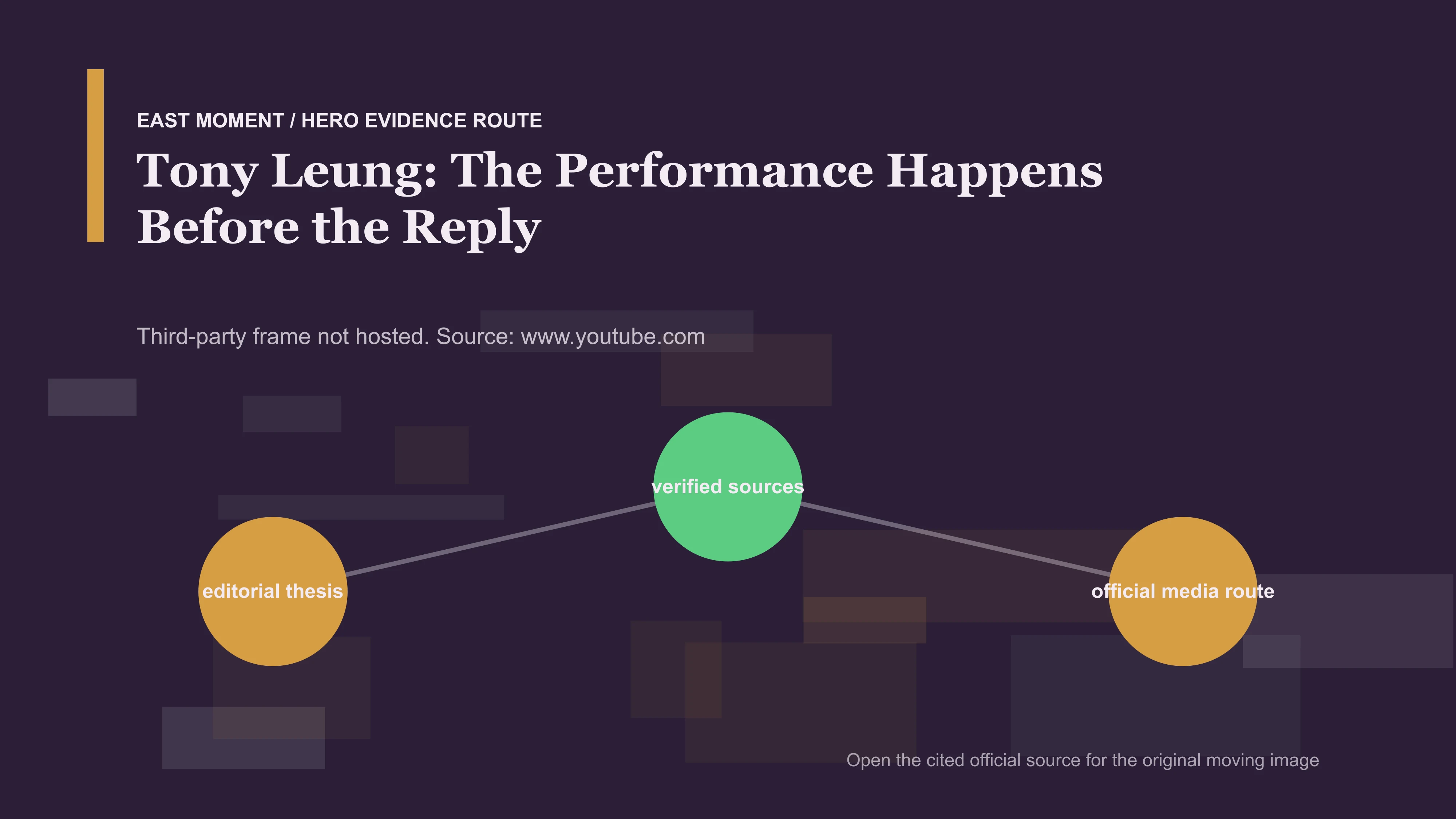
The public press-conference frame shows the collaborators together. The performance itself lives elsewhere: in a rented-room pause where Chow Mo-wan has already felt too much and must decide how little can safely be shown.
TIFF's free 2000 press conference places Leung, Maggie Cheung and Wong Kar Wai in a public production discussion. Use it for context, not to treat retrospective explanation as the only correct reading.
The scene-level In the Mood for Love guide shows how noodles, corridors, rented rooms and returning music restrict choice. Leung's restraint works because the environment gives every disclosure a social cost.
“Acting with his eyes” is incomplete
Look at the whole sequence around the eyes:
- another person changes the available information;
- breath or focus shifts before the face settles;
- the character decides what response the relationship can bear;
- voice and posture deliver the edited version;
- the camera sometimes holds long enough for the rejected response to remain visible.
The eyes attract attention because they are the smallest moving part in a controlled frame. But timing, jaw, shoulders, voice and edit create the effect. Praising only the eyes turns a sequence into a photograph.
His eyes can feel like hooks. I do not simply mean handsome: the gaze can become invasive rather than gentle, helped by facial proportion and prominent lower eyelids. He can seem to look deeply at anything, which is both the joke and the instrument.
The jokes are affection, not acting analysis. Yet the disagreement reveals the real task: viewers perceive different kinds of looking. East Moment's job is to connect that perception to scene mechanics—who holds power, what information has arrived and why the character cannot answer freely.
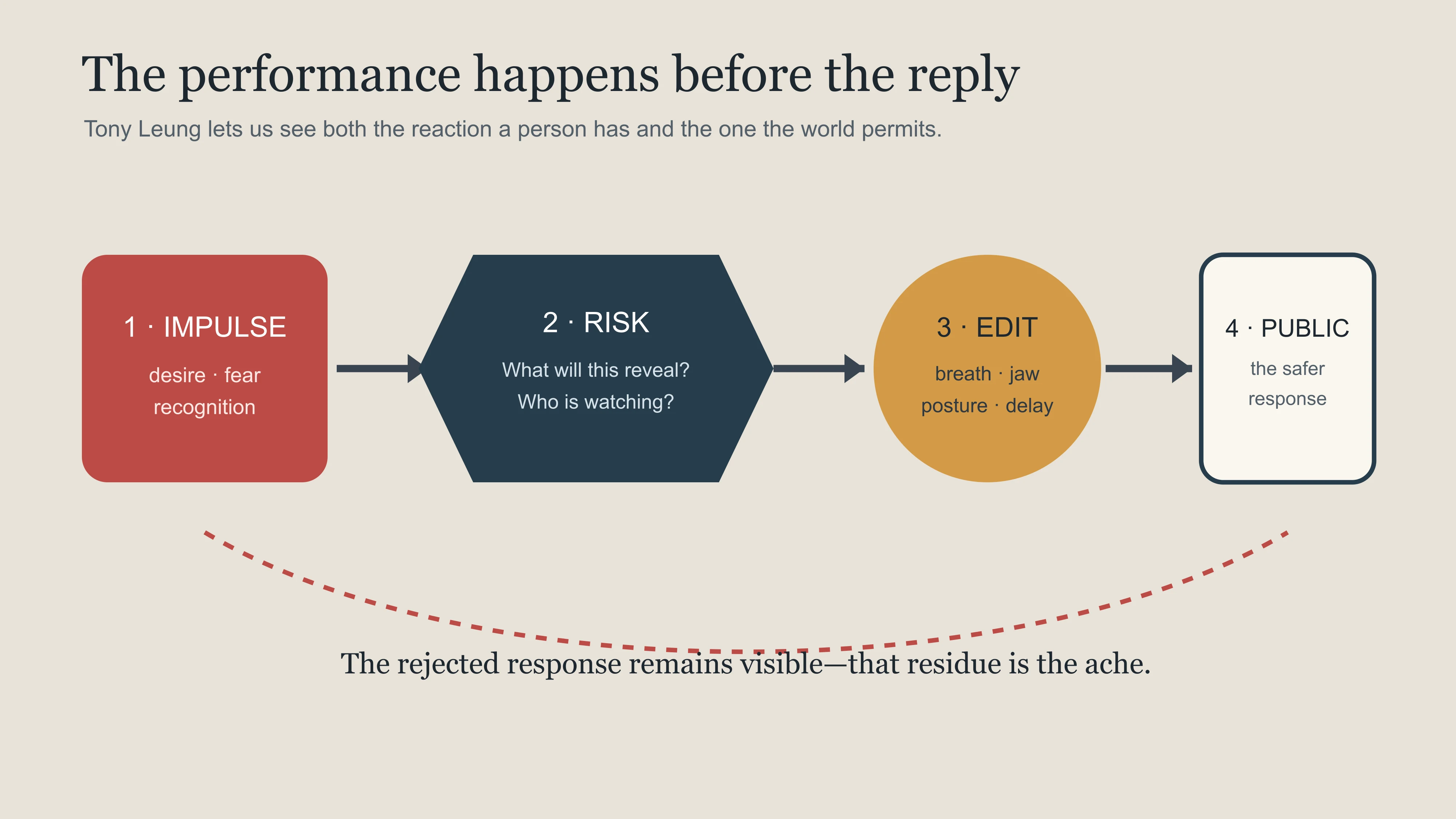
This is why I am impatient with the phrase “his eyes do all the acting.” It sounds like praise, but it erases the labor. The eyes hit us because Leung has disciplined everything around them: breath, jaw, shoulders, timing, distance and voice. The melancholy is not a permanent filter pasted over every role. It is the visible residue of a person deciding what must not escape.
Chungking Express proves restraint is a choice, not a limitation
As Cop 663, Leung talks to a bar of soap, towel and stuffed animals after a breakup. The device is comic because emotion is displaced onto objects. It is also protective: he can describe deterioration without admitting his own.

The performance is lighter and more rhythmically open than Chow Mo-wan. Faye enters his apartment and changes its objects while he fails to read what is happening. A man who can inspect other people's behavior professionally becomes comically unavailable to his own environment.
The Chungking Express guide explains why expiration dates, repeated music and the Midnight Express snack bar make timing concrete. Leung's warmth matters because the film does not ask him to stand outside its playfulness as a prestige actor.
Infernal Affairs turns the edited response into survival
Chan Wing-yan is a police officer living undercover inside a criminal organization. Every reaction can reveal allegiance. The gap between impulse and public reply therefore stops being romantic restraint and becomes occupational survival.

On the rooftop, open sky does not create freedom. Chan Wing-yan is still trapped inside a role that has consumed his legal identity, his sleep and his ability to react without calculation.
The confrontation is one of the Hong Kong crime scenes I never reduce to plot mechanics. Two men face one another above the city, but only one can publicly inhabit the identity he has stolen. Leung's exhaustion makes the injustice land before the dialogue finishes. I do not admire the character because he looks sad; I am angry because the institution asks him to keep performing loyalty after it has failed to return his name.
Leung plays fatigue without abandoning alertness. A tired body still scans rooms, voices and danger. When the character approaches institutional recognition, relief itself becomes risky because it could loosen the performance keeping him alive.
This role is the best proof that his screen language is not synonymous with romance. The same capacity—to let thought happen before speech—changes function under surveillance.
Hero makes private judgment compete with political scale
Broken Sword appears inside contradictory color-coded accounts. Leung must remain legible while Zhang Yimou's fabric, calligraphy, architecture and massed bodies threaten to overpower any individual psychology.
His essential action is a change of judgment: after reaching the Qin palace, Broken Sword abandons assassination and writes the idea of “all under heaven.” Leung gives the shift weight without turning it into a speech contest. The character's control can read as wisdom, surrender or tragic political capture depending on how the viewer judges the argument.
The Hero 2002 guide separates the different narrated worlds and tests the ending rather than accepting its slogan. Leung's performance is valuable because ambiguity remains present inside monumental composition.
Wong Kar Wai does not own the performance
Wong Kar Wai's films created many of Leung's most recognizable images, but director style and actor skill are not interchangeable. Christopher Doyle, Mark Lee Ping Bing, William Chang, Maggie Cheung, editors, music and locations also construct the conditions in which a pause carries meaning.
The planned Wong Kar Wai guide treats the style as a system of timing and collaboration rather than a filter. Leung is the recurring actor best able to make that timing visible at human scale.
A new role tests what remains after the icon
The later public conversation matters because Leung is present as a working actor rather than a frozen image from 2000. A serious career page must ask what new problem his accumulated quiet can solve now.
In Ildikó Enyedi's Silent Friend, that problem is perception rather than concealment. The Venice Film Festival record identifies him as a Hong Kong neuroscientist whose 2020 experiment attempts to register an old ginkgo tree's signals. This is not Chow Mo-wan waiting for a forbidden reply, or Chan Wing-yan screening every reaction for danger. It is a man discovering that his professional instruments may not make another form of life fully available to him.
That shift is exactly what I want from a late-career role. Do not ask an older actor to reproduce the melancholy gaze until it becomes a luxury logo. Give the familiar quiet a different ethical pressure. Here the pause can mean attention without mastery: looking longer does not guarantee possession of what is being observed.
Film at Lincoln Center's 2026 career retrospective connected the new film to five decades of television, Hong Kong New Wave cinema, crime, romance and international work. That span corrects another weak shortcut. Leung did not appear fully formed in a Wong Kar Wai corridor. The lightness of his television and comedy work, the physical danger of John Woo, the divided identity of Infernal Affairs and the later franchise scale all give the quiet its range.
How to watch a Tony Leung scene
- Identify what the character knows before the exchange.
- Find the new information.
- Watch the first physical response.
- Notice the response actually delivered.
- Ask what relationship or institution required the substitution.
Use that sequence on In the Mood for Love, Infernal Affairs and Hero. The acting changes because the reason for editing the self changes.
Tony Leung is precise, not mysterious
Start with In the Mood for Love, then Chungking Express, then Infernal Affairs. Add Hero to see the actor hold private uncertainty inside political spectacle.
Tony Leung's greatness is not mystery. It is precision about social exposure. He lets viewers receive two reactions at once: the one a person has, and the one the world permits them to show.
Continue through the Chinese actors collection and the wider Chinese film guide. In the comments, name the pause and both reactions; the community can compare evidence instead of repeating “his eyes say everything.”