Raise the Red Lantern is not mainly about four women competing for one man's affection. It is about a household that turns ritual into control technology. Lanterns, foot massages, meals and sealed courtyards distribute resources, make favoritism public and recruit the wives to enforce rules that imprison them all. That is why the film feels like horror without needing a supernatural monster.
Raise the Red Lantern in 60 seconds
| Question | Short answer |
|---|---|
| Director | Zhang Yimou |
| Release | 1991 |
| Main performer | Gong Li as Songlian |
| Basic plot | A young educated woman becomes the fourth wife in a wealthy household governed by rigid customs |
| What the lanterns mean | Public favor, access to service and temporary status—not romantic love |
| Why it feels frightening | Repeated ritual makes violence predictable, ordinary and self-enforcing |
| East Moment verdict | Essential; watch the servants, doors and repeated sounds as closely as the wives |
The MUBI film record identifies the 1991 film, Zhang Yimou and the premise of a fourth wife entering a rule-bound household. It is a film record, not evidence that this fictional compound represents every Chinese family or historical marriage.
The Academy's 1992 ceremony record documents the film's nomination in the foreign-language-film category. That recognition establishes its international awards history; it does not explain why the lantern ritual remains so disturbing.
What Raise the Red Lantern is really about
After her father's death, nineteen-year-old Songlian leaves university and enters Master Chen's household as his fourth wife. Each wife occupies a courtyard. When the master chooses where to spend the night, red lanterns are lit there, foot massage and service follow, and household attention shifts toward the selected woman.
At first the ritual appears to give the chosen wife privilege. The hidden cost is that privilege can only exist through visible exclusion. Everyone hears which courtyard receives the massage hammers. Everyone sees where servants carry lanterns. Private intimacy becomes a daily public ranking.
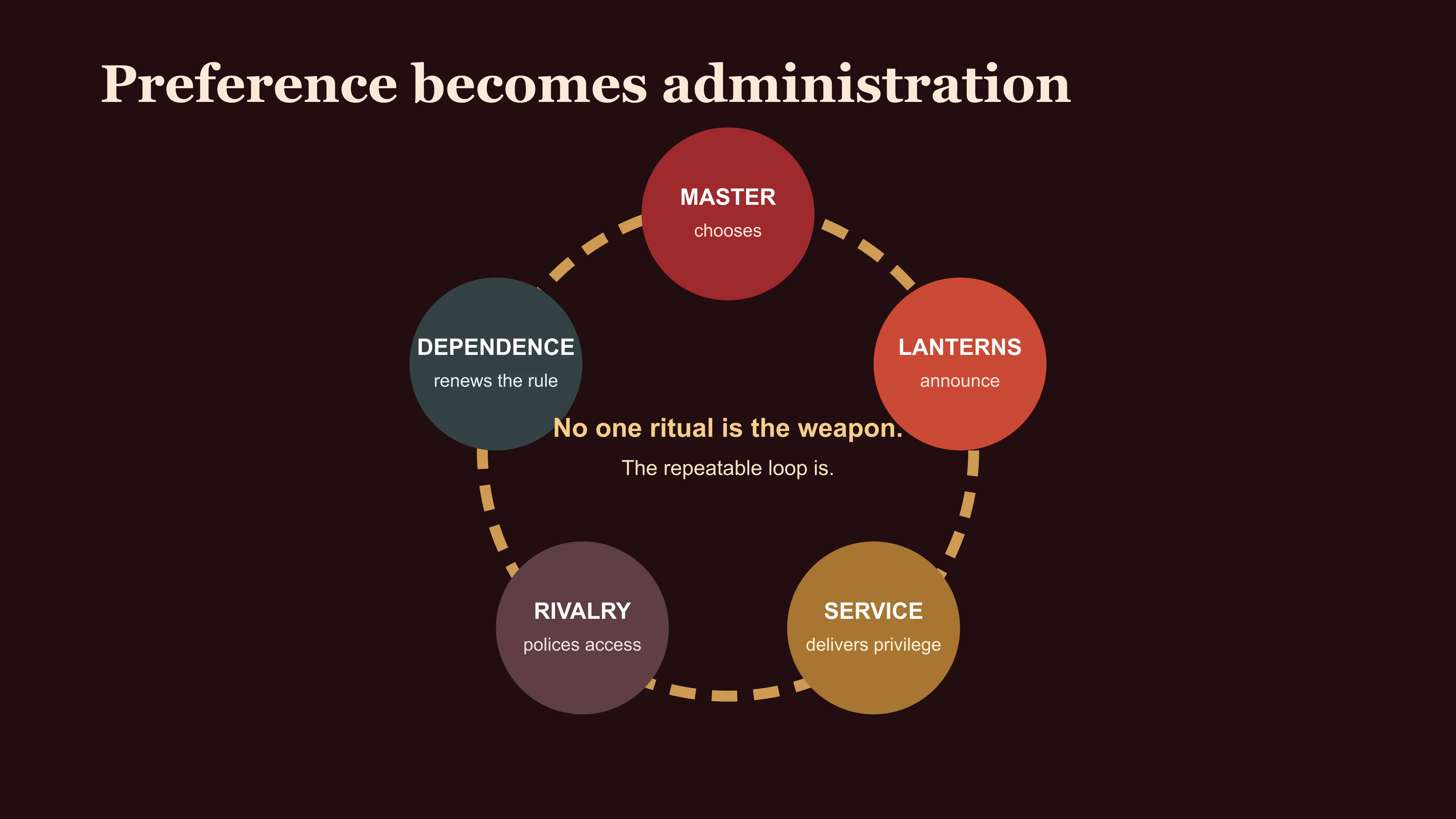
The master rarely needs to issue elaborate commands because architecture, servants and precedent carry power for him. The wives learn to anticipate the system and compete inside it. The ritual succeeds when its prisoners begin managing one another.
I insist on calling this administration rather than jealousy. The household must make reward visible so that each woman reads another woman's light as her own deprivation. I can sympathize with individual choices without pretending the wives designed the machine; the cruelty lies in how efficiently the machine converts fear into unpaid enforcement.
The red lanterns do not mean love
Red can signal celebration, luck or vitality in other Chinese contexts. Treating it as a universal cultural code would flatten the film. Here its meaning comes from repeated use inside one institution.
When lanterns are raised, the chosen courtyard receives:
- the master's overnight presence;
- the foot massage that announces selection through sound;
- greater control over meals and service;
- a temporary rise in household visibility;
- resentment from those denied the same resources.
The lantern is therefore closer to an illuminated status indicator than a love symbol. It translates one man's choice into work performed by a whole staff. Its warm glow makes an administrative system look sensual.
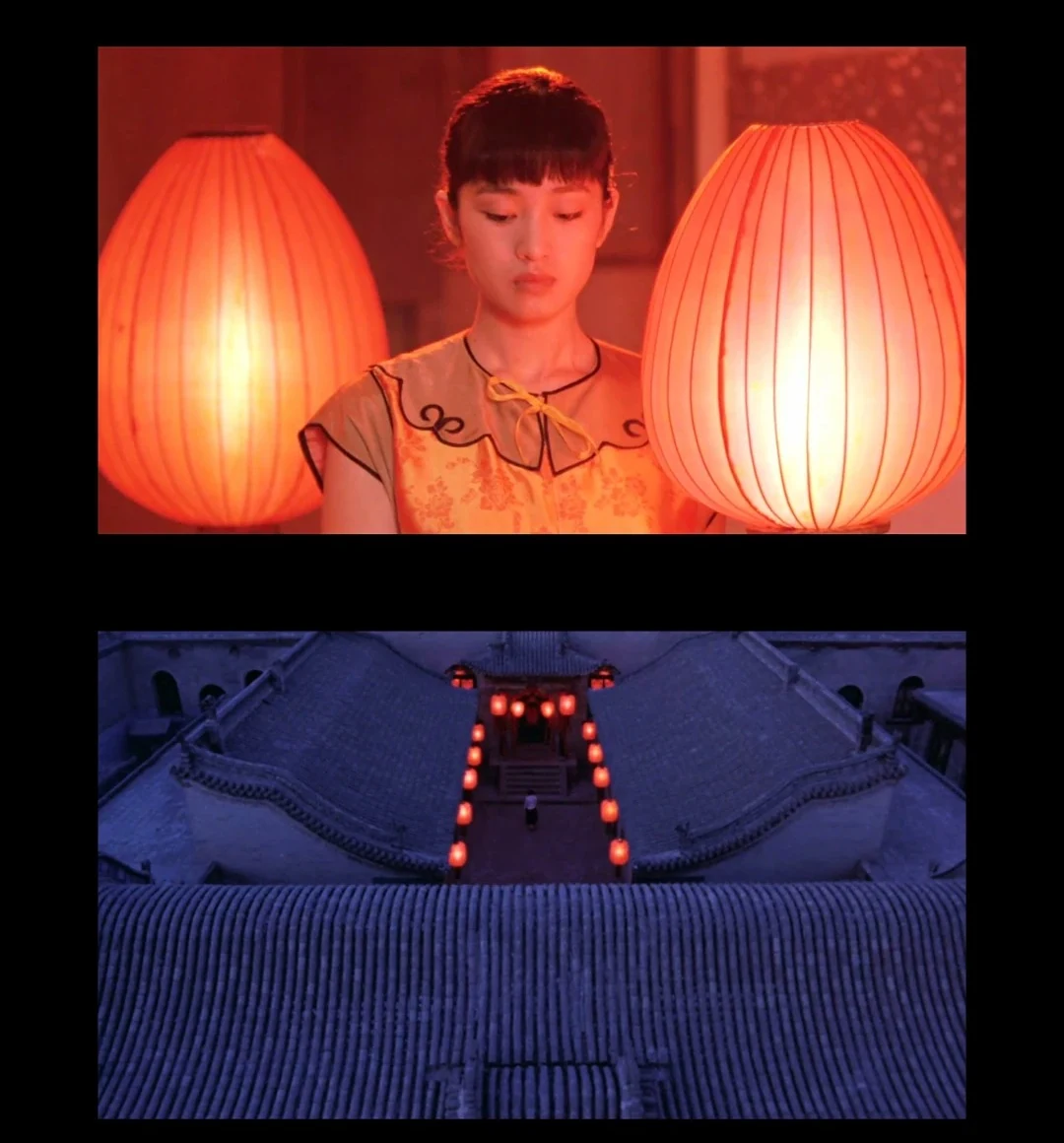
These two views expose the trick. At body level, red light singles Songlian out and makes selection look intimate. From above, the lanterns become a route through a compound: favor is carried, installed and observed. Zhang Yimou makes beauty perform administration. I do not see decorative “Chinese red” here; I see the interface of coercion, warm enough to tempt the prisoner into defending the system that ranks her.
Four courtyards create competition without community
The compound gives each wife territory but not independence. Courtyards separate them enough for secrets and rivalry while keeping them close enough to monitor signs of favor.
Yuru, the first wife, has age and position but limited intimacy. Zhuoyun, the second, performs kindness while understanding manipulation. Meishan, the third, has theatrical force and an extramarital relationship. Songlian enters believing education and intelligence may help her resist humiliation.
Those descriptions are not fixed moral identities. The system rewards each woman for turning survival into strategy. A wife can be victim in one relation and enforcer in another. Even servants are placed inside the same ladder: Yan'er desires the status represented by lanterns and reproduces the hierarchy in secret, while Songlian uses rank against her.
This is why “which wife is good?” is the wrong organizing question. The stronger question is what action becomes rational when access to food, attention, safety and dignity depends on defeating another woman.
The Zhang Yimou profile follows how this object-to-system method changes at larger scales. Here the geometry remains domestic, which makes every shift in service feel painfully close.
The servants are the household's operating system
The wives receive most of the plot, but the servants make the hierarchy run on time. They carry lanterns, announce selection, prepare massage, move meals and transmit information. Their labor turns a private preference into a public fact.
This matters because the system would collapse if every order required Master Chen's personal supervision. Instead, procedure gives power continuity. A servant does not need to approve the ranking to reproduce it; completing the assigned action is enough. Yan'er's secret lanterns show how deeply the sign has entered desire. She does not merely want the master. She wants the visible protocol that tells the whole compound she has been chosen.
Songlian's treatment of Yan'er is therefore one of the film's hardest tests. Songlian is oppressed by rank and still uses rank when it gives her leverage. The film refuses the comfort of a pure victim standing outside the machine. Every person is placed somewhere inside its circulation of service, information and punishment.
The master is powerful because the film withholds his face
Master Chen is often distant, partially seen or visually less important than the system operating around him. This is not an absence of power. It is its mature form.
If the film centered a charismatic villain, viewers could imagine that removing one cruel personality would solve the household. Instead, authority appears through schedules, servants, inherited rules and punishments whose legitimacy is treated as already settled.
His sexual and economic choices initiate the ranking, but other people announce, decorate and defend it. The result is more frightening than one man's temper: a repeatable procedure can continue even when he is outside the frame.
The household resembles a closed interface. Each signal is easy to read; none of the women controls the system producing it. Lantern up. Lantern covered. Massage begins. Meal changes. A human relationship becomes a sequence of status updates.
Why Meishan is the film's brightest figure
Meishan's opera performance, sharper speech and affair give her an expressive life that exceeds the household's assigned role. She is not simply “the free wife.” Her room, voice and risk-taking show both resistance and vulnerability.
Performance gives her a temporary world in which she can control sound and gesture. But unlike the performers in Farewell My Concubine, Meishan does not possess a public stage able to stabilize an artistic identity. Her singing remains inside a compound that can convert transgression into disappearance.
Calling her the only bright color can become sentimental if it ignores how she also competes and wounds. Her importance is more precise: she exposes that personality does not defeat structure. The woman who appears most alive is not therefore safest.
Why the film feels like Chinese horror
No ghost is required. The film creates horror through four devices:
- Repetition: the same lantern and massage ritual returns until viewers can predict the consequences.
- Sound: hammering, commands, footsteps and opera cross walls before characters know the whole event.
- Architecture: fixed courtyards make surveillance and isolation happen at once.
- Institutional euphemism: punishment is treated as rule, custom or illness rather than named violence.
“Chinese horror” can be a useful viewer response, but it is not the film's official genre and should not become a claim that cruelty is culturally unique. The fear comes from recognizable institutional logic: when everybody knows the rule and nobody accepts responsibility for its result.
Raise the Red Lantern ending explained
Major spoilers begin here.
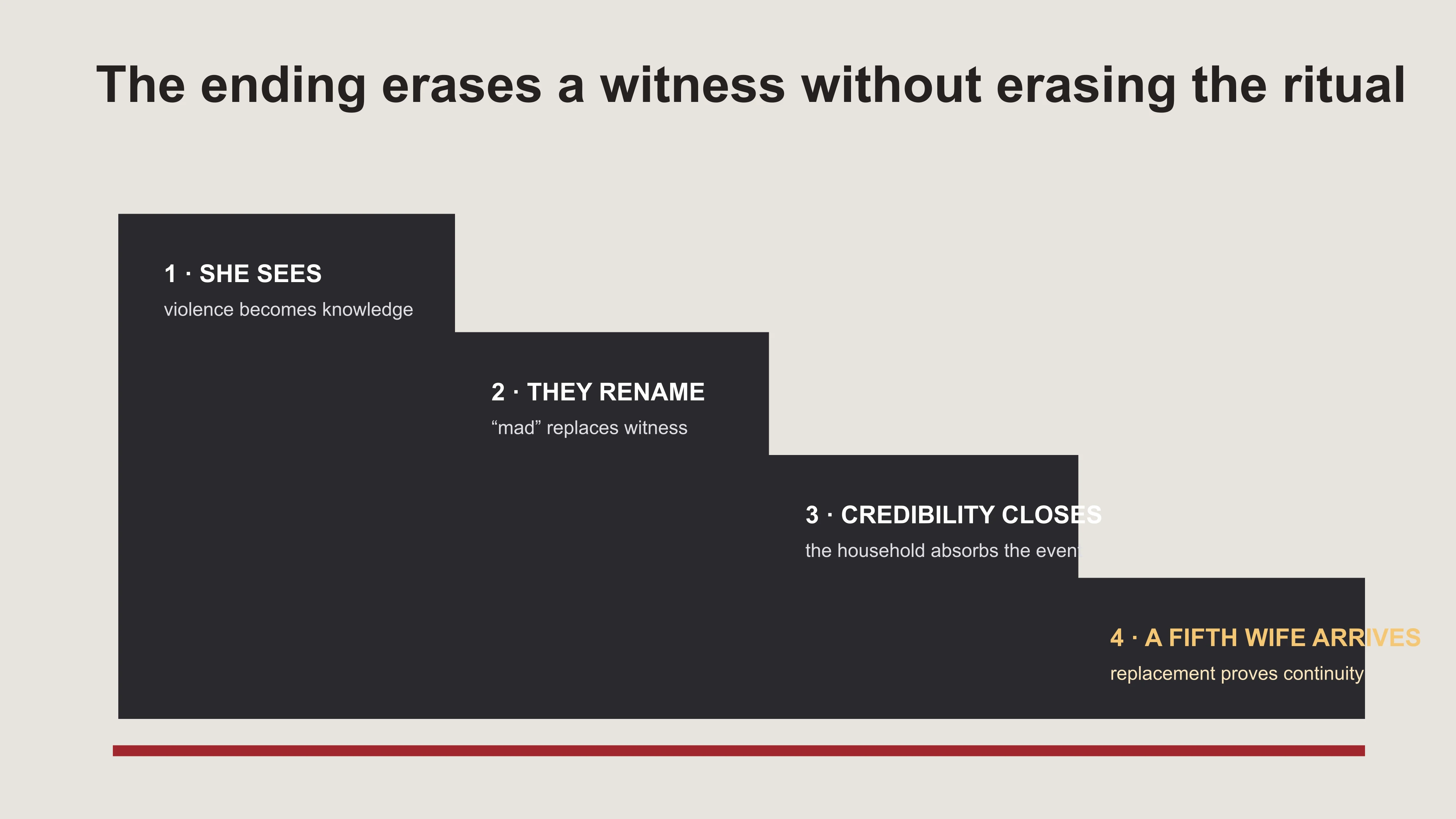
Songlian discovers Meishan's affair and, while drunk, reveals it to Zhuoyun. Meishan is taken to a secluded rooftop room and killed. Songlian witnesses enough to understand what happened, but the household denies or absorbs the event.
Afterward, Songlian wanders the courtyards in an altered state, wearing her old student clothes. The family calls her mad. A fifth wife arrives, and the lantern cycle continues.
The ending should not be reduced to a clinical diagnosis. The film gives us no basis to diagnose Songlian from a distance. “Madness” functions socially: it makes a witness unreliable, removes a competitor from ordinary negotiation and converts knowledge of violence into an individual defect.
Her student clothes matter because they recall a self from before the fourth courtyard. But clothing cannot restore that life. She can repeat her former appearance while remaining physically inside the institution that destroyed her position.
The fifth wife's arrival is the final proof that the system has learned nothing. Replacement is easier than acknowledgment.
Is the movie historically accurate?
The film evokes a wealthy household in Republican-era China, but its compound, customs and narrative are stylized. It adapts a work of fiction and should not be cited as direct evidence that every ritual occurred exactly this way or that all Chinese wives shared one experience.
Historical context can explain why marriage, wealth, servants and patriarchal authority create unequal choices. It cannot turn one designed household into a national survey. The film's power comes from concentration: many forms of control are made visible in one closed space.
The broader Chinese film guide explains why production, adaptation and international circulation matter when reading Chinese-language cinema. Compare Zhang Yimou's later state-scale ritual in Hero (2002): one household and one kingdom use very different beauty to make hierarchy feel inevitable.
The horror is that the ritual still looks beautiful
Raise the Red Lantern remains devastating because no single object is evil. Lanterns are beautiful. Massage can feel pleasurable. Opera can offer release. Courtyards can be architecturally compelling. The system captures those pleasures and turns them into signals of rank.
That is the film's most valuable conclusion: domination becomes durable when it can be experienced as privilege by the person temporarily favored. The ritual does not hide power. It makes power attractive enough to administer.
Continue through the Chinese movies collection or the dedicated Gong Li guide to follow how contained emotion, physical stillness and sudden rupture shape her screen authority.
Raise the Red Lantern makes space rank the women before dialogue does
The compound distributes attention. Lanterns announce who receives service; closed courtyards keep rivalry near; repeated routes turn private desire into public information. Warm light is not comfort. It is a scoreboard.
This is why the film survives beyond its visual reputation. Zhang Yimou and cinematographer Zhao Fei make ritual immediately legible, then show how beauty trains everyone to watch the master's choice. The women are forced to compete inside a rule they did not design.
The limitation matters: the film is an adaptation and a constructed historical drama, not transparent documentation of one universal Chinese household. Use architecture to read the film's power system, not to label every siheyuan oppressive.
Its final cruelty is repetition. A new arrival can occupy the same route because the household preserves ritual more efficiently than memory. Songlian's suffering changes her and fails to change the system. That is why the lanterns remain terrifying after their beauty is familiar.
The camera teaches this before the plot states it. Symmetry keeps restoring order after every private rupture. A person can vanish while the courtyard remains perfectly composed. The visual pleasure is not separate from the violence; it is how the institution makes violence look natural.