Jingdezhen porcelain is not a magic label stamped onto white clay. It is the visible end of a city-sized production intelligence: mines, water routes, workshops, painters, kiln builders, merchants, imperial demands, export orders, failures and people who became frighteningly good at one narrow task. If a seller gives me only the word “Jingdezhen,” I have learned almost nothing about the object.
Jingdezhen porcelain begins with a city, not a vase
Most introductions place a perfect blue-and-white jar at the center and arrange history around it. I would begin outside the glass case—with a mine, a river, a kiln ruin and a lane of workshops. Jingdezhen mattered because it organized all of them into one system.
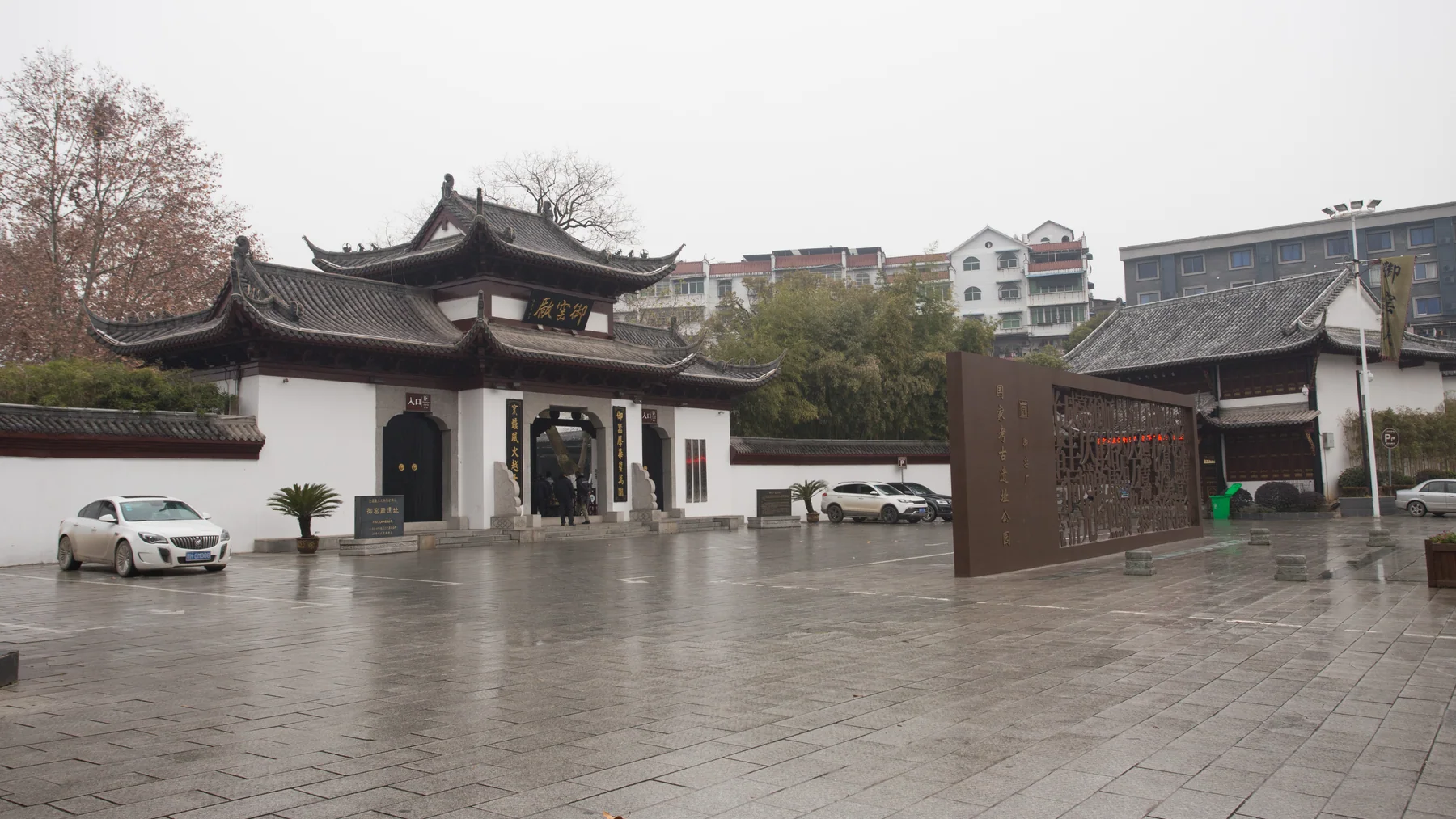
In 2026, the Jingdezhen Handicraft Porcelain Industry Sites were inscribed on UNESCO's World Heritage List. The official description is unusually useful because it refuses to reduce the heritage to masterpieces. Its five component parts preserve raw-material extraction and transport, kiln innovation, workshops, the Imperial Kiln, civilian kilns, guilds and merchant associations. That is the correct scale of the story.

The archaeology looks less glamorous than a vase and tells more truth. Walls, firing structures and working surfaces show that porcelain was made in organized space. The masterpiece is the survivor; the site explains the system that made survival repeatable.
Why did Jingdezhen become the porcelain capital?
No single explanation is enough. Kaolin is important, but “good clay made a great city” is geological determinism. Imperial patronage is important, but emperors did not mine, wash, throw, paint, fire, pack and ship the ware themselves. Trade is important, but demand without technical capacity produces disappointment.
Jingdezhen became dominant because five advantages reinforced one another:
- Material knowledge. Local porcelain stone and kaolin-rich resources supported changing body recipes. The historical “binary formula” strengthened production possibilities, including larger forms, but recipes and terminology varied over time.
- Fuel, water and movement. Forest resources, streams, the Chang River and wider transport connections moved raw materials, fuel, people and fragile finished goods.
- Dense specialization. Clay processors, throwers, trimmers, mold makers, painters, glaze workers, kiln teams, packers and merchants could work within the same production ecology.
- Imperial pressure and failure tolerance. Court orders concentrated standards, money, bureaucracy and technical ambition, while civilian kilns sustained broader markets.
- A habit of answering outsiders. Domestic consumers, Asian trade and later European demand introduced new shapes, decorations, quantities and price levels.
The “seventy-two steps” slogan interests me less than the handoff it describes. Trimming a body and painting a border are different skills; even outlining and filling color can belong to different specialists. Counting stages tells you little until you ask who makes the decision at each one. There is no universal seventy-two-step checklist for every cup sold in the city.
That makes Jingdezhen feel startlingly modern. It connected supply, specialized labor, quality control, design translation and global logistics centuries before those words entered a sourcing deck.
Jingdezhen ceramics are not all the same material—or quality
People search for Jingdezhen ceramics, Jingdezhen pottery and Jingdezhen porcelain as though the phrases were interchangeable. They are useful discovery terms, not precise material conclusions.
Ceramic is the broad family. Pottery is often used loosely for ceramic making. Porcelain describes a vitrified high-fired body with particular material and firing behavior, but even the boundary between porcelain and stoneware is handled differently across Chinese and Western classification traditions.
The city now produces historical reproductions, daily tableware, painted porcelain, sculpture, factory output, student experiments, international studio work, tourist souvenirs and technically ambitious art. Two objects made in Jingdezhen may share geography and almost nothing else.
| Seller's phrase | What it may mean | What you still need |
|---|---|---|
| “Jingdezhen porcelain” | Made, decorated, fired, assembled or merely sold through the city | Workshop, material, process and production date |
| “Handmade” | One or several manual stages | Which stages, by whom, and what was molded or transferred |
| “Hand-painted” | Brush decoration rather than a printed transfer | Whether the whole design or only accents were painted |
| “Imperial style” | A form, mark, palette or motif referencing court ware | Clear modern dating; it does not mean imperial manufacture |
| “Master work” | A commercial honorific or a documented artist attribution | Name, biography, signature comparison and provenance |
| “Antique” | A historical object—or a sales claim | Independent expertise, condition report and ownership history |
My position is blunt: a famous place name is never a quality grade. It raises better questions; it does not answer them.
A spout, a handle and a border ask different things of a maker
Jingdezhen blue and white is usually admired as brushwork. Look again at the entire object.

Follow the ewer's handle down to the body, then the spout back toward the neck. These are meeting points between forms, not brush decoration. Now look at how the blue pattern changes direction across the shoulder. A painter has to work around a volume that the former has already established. That distinction is visible before you know the object's date.
I will not turn an unusual spout into proof of an overseas commission. For that, compare documented objects in the Chinese export porcelain guide, where museum records distinguish a foreign-market order from later foreign additions. A shape invites a question; it does not write its own shipping history.
Blue and white succeeded because it was a complete production language. Outliners, fillers, formers and kiln workers had to coordinate. Cobalt had to behave under glaze and heat. Repeated borders had to turn corners and meet themselves. Export orders had to survive packing and transport. The result looked effortless only after enormous coordination.
Our Chinese blue-and-white porcelain guide owns motif, brush and surface analysis. This page owns the city behind that surface.
Do not confuse a heritage lane with a working studio

A narrow lane makes the scale of the place legible: doors, brick walls and short distances between buildings, rather than one enormous factory entrance. But this photograph records the heritage complex, not a survey of current workshop tenants. Beautiful brickwork is no guarantee that throwing, painting or firing still happens behind a particular door.
Inside a studio, ask a less romantic question: “What happens to the piece after it leaves this room?” A painter who buys a blank and uses a shared kiln can give a perfectly honest answer. The problem begins when a shop sells that arrangement as one master doing everything alone. Outsourcing is not the deception. Hiding the division of work is.
This is where glossy heritage language can become dishonest. “Craftsmanship” sounds noble when the worker disappears. Real porcelain production was physically demanding and economically unequal. Imperial perfection could mean ruthless rejection. Commercial scale could reward specialization while trapping a worker inside one repetitive task. I admire the skill without pretending the labor system was gentle.
The history of Chinese porcelain follows the larger chronology. Jingdezhen's particular achievement was to make workshop density itself into a competitive advantage. Skills did not live only inside individual masters; they lived between neighbors, suppliers, kilns and generations.
A Jingdezhen visit should follow production, not shopping
If you visit only a polished retail street, you will see the ending before the beginning. A stronger route follows the object backward:
- Begin with the Imperial Kiln remains. Learn how archaeology preserves production, kiln structures and discarded shards—not just intact treasures.
- Study historical objects in a serious museum. Compare foot, form, body, glaze and decoration across periods before entering a market.
- Enter a working or demonstrative workshop carefully. Ask which stages happen there and which are outsourced.
- Visit contemporary studios and industrial sites. The city is alive because makers disagree with history, not because they only reproduce it.
- Shop last. By then, city labels and copied reign marks should have lost some power over you.

The covered site makes a crucial point: fragments are evidence. A broken body can reveal material, firing support and workshop waste more honestly than a flawless survivor selected for court use. When I have to choose between a dramatic shop display and a tray of documented shards, I trust the shards to teach me more.
How to judge a contemporary Jingdezhen piece
The how Chinese porcelain is made guide explains the full process. For a buying decision, I use a shorter object-level sequence:
- Read the silhouette before the story. Does the rim, neck, shoulder, belly and foot feel resolved from several angles?
- Inspect the joins. Handles, spouts and sculptural additions reveal finishing discipline.
- Turn it over. The foot can show trimming, body color, glaze boundaries, firing support and later wear.
- Follow the brush around the curve. Does decoration respond to volume, or does it feel pasted onto a blank product?
- Ask what “handmade” covers. A molded body can be hand-painted; a thrown body can carry a transfer; neither is automatically dishonest if described accurately.
- Match quality to use. A tea cup must meet the mouth and hand. A sculptural vessel must hold visual tension. A restaurant order needs repeatability and food-contact documentation.
- Demand provenance for historical claims. A copied reign mark is not a time machine.
My own preference is decisive: I want process to remain visible without becoming fake rustic theater. A brush line may thicken. A glaze may pool. A carefully trimmed foot may show human judgment. Random wobble is not soul; poor finishing does not become culture because a seller says “handmade.”
Two cups can share a skyline and offer completely different value
Imagine two contemporary cups on the same shop shelf. This is a comparison exercise, not a report of a purchase. One uses a molded body with a hand-painted flower; the other is wheel-thrown, trimmed and left under a plain glaze. “Which one is handmade?” is a poor opening question. Both contain manual work. Ask which work you want to pay for.
On the painted cup, follow the flower where the surface turns away: a convincing line has to hold together across that curve. On the plain cup, decoration cannot distract you from a clumsy rim or a foot that makes the body look top-heavy. The plain object may demand more attention, not less. Simplicity leaves fewer places to hide.
For a daily cup, request permission to hold it and feel the balance empty. Ask about capacity and intended use rather than trusting a photograph taken from its most flattering angle. For a gift, request the maker's name and a plain description of the work, so the recipient receives more than a prestigious place name. For a repeat order, compare several pieces and agree which variations are accepted. Those are three different purchases; a single “best Jingdezhen porcelain” ranking cannot serve all of them.
Useful Chinese terms make the conversation more exact: la pi (拉坯) refers to throwing, li pi (利坯) to trimming and refining, and shou hui (手绘) to hand painting. None means “every stage was completed by this seller.” Ask for the verb attached to the person, not just the adjective attached to the cup.
Jingdezhen is also a manufacturing cluster
The city's craft identity and manufacturing identity cannot be separated. Studios rely on clay suppliers, mold makers, brush sellers, decal printers, kiln services, packing workers, photographers, galleries and logistics. Contemporary artists arrive because the surrounding network can translate an idea into material faster than a solitary studio could.
That density is a gift and a risk. It makes experimentation possible. It also makes it easy for an object to pass through several companies while one retailer implies complete authorship. For commercial sourcing, ask who controls the critical process, where each firing occurs, who approves the sample, how color variation is graded and how breakage is tested in packing.
The wider China manufacturing guide covers supplier verification, samples and quality control. Jingdezhen adds a harder layer: cultural value, named authorship and batch consistency do not always point in the same direction.
Contemporary Jingdezhen must be allowed to be contemporary
The city is not valuable because it froze at the best moment of the Ming dynasty. Schools, research institutions, state-factory legacies, private workshops, international residents and young makers have created new forms of ceramic life. The most exciting work does not always look “Chinese” to a tourist trained by blue dragons and red seals.
The UNESCO Creative Cities profile of Jingdezhen recognizes this living craft ecosystem rather than treating the city as a finished archaeological exhibit. That distinction matters: heritage protects accumulated knowledge, while a creative city must still give new makers room to risk failure.
I reject the demand that every young Jingdezhen maker perform antiquity. A city with genuine tradition should be confident enough to produce strange, difficult and even ugly experiments. Otherwise heritage becomes a costume worn for buyers.
At the same time, “contemporary art” is not permission to ignore material discipline. Porcelain still shrinks, warps, cracks and changes under heat. Concept does not negotiate with a badly joined handle. Jingdezhen remains convincing when new ideas submit themselves to old material consequences.
The city's reputation cannot do the cup's job
Jingdezhen deserves its global reputation because it built more than beautiful porcelain. It built an industrial and social memory capable of moving knowledge across centuries. UNESCO's 2026 inscription is strongest when read this way: the heritage lies in the connected mines, kilns, workshops, routes and organizations—not in a brand sticker.
But reputation belongs to the city; quality belongs to the individual object. Hold both truths at once. Learn from the network, then inspect the body, foot, glaze, brushwork, joins, provenance and use.
Bring the piece you looked at twice to Moments. Post its front, side and base, and record what the maker actually said about forming, painting or firing. Keep that answer separate from what you inferred from the surface. Return after your next conversation with the workshop and explain what changed your mind. This is a place to get better at looking and asking, not to certify an antique from three photographs.
Continue through the broader Chinese art collection or return to the Chinese porcelain guide for an object-reading method that works beyond one city.