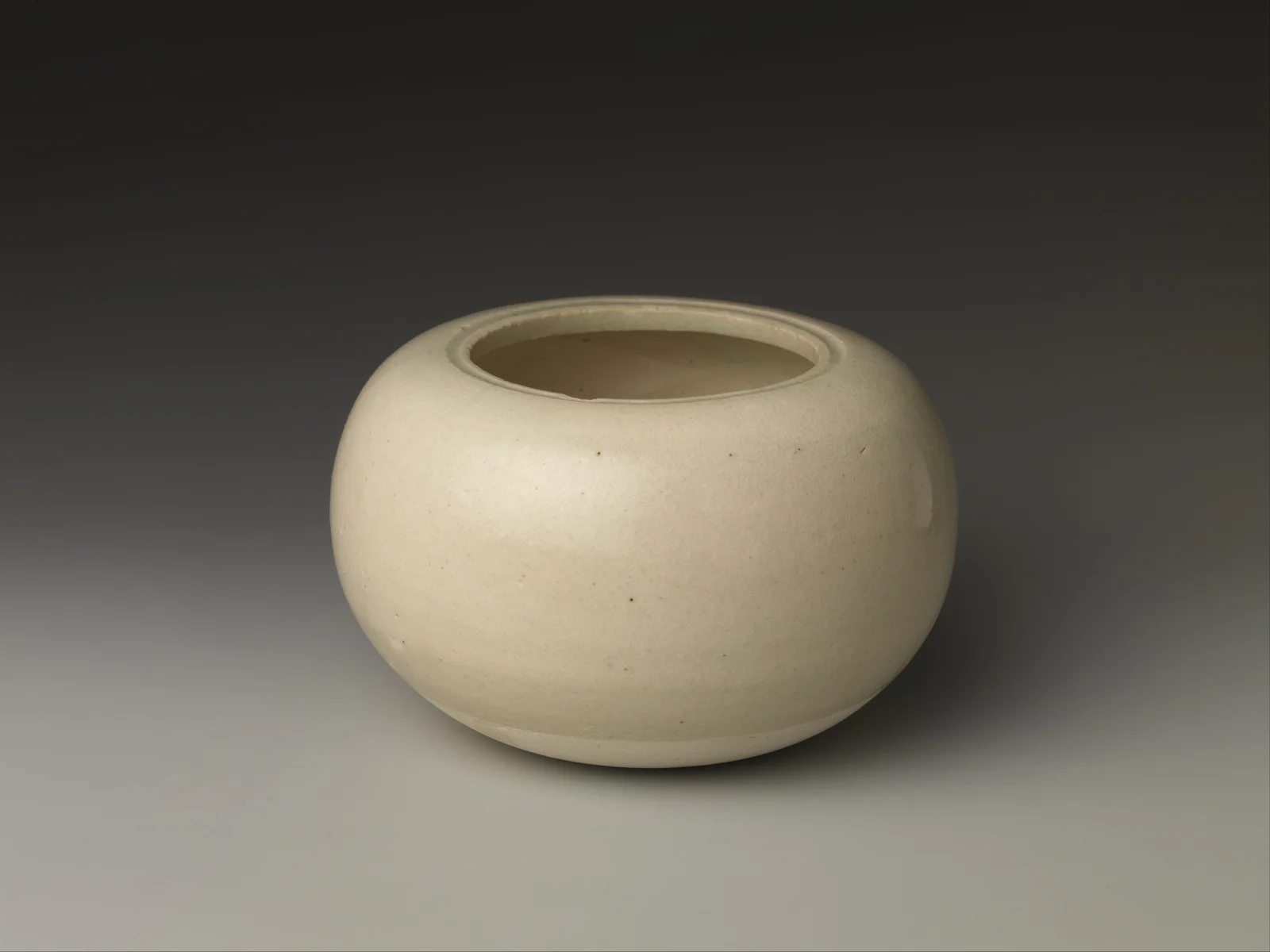
The small white bowl above is seventh-century porcelain, not a modern minimalist design. It comes centuries before the blue-and-white Ming vase most people picture first. That gap is where the history of Chinese porcelain becomes interesting: white bodies developed before cobalt's fourteenth-century expansion; Song kilns explored very different surfaces; Ming and Qing workshops widened the possibilities without making earlier work obsolete.
I reject the version of this history that crowns the most elaborate object as the winner. A quiet bowl is not a failed attempt at a painted vase. Follow the dates, certainly—but ask what each maker wanted the material to do.
History of Chinese porcelain: before the famous white body
Porcelain is often introduced through a blue-and-white Ming vase. That is like beginning the history of photography with a color magazine cover: recognizable, important and much too late.
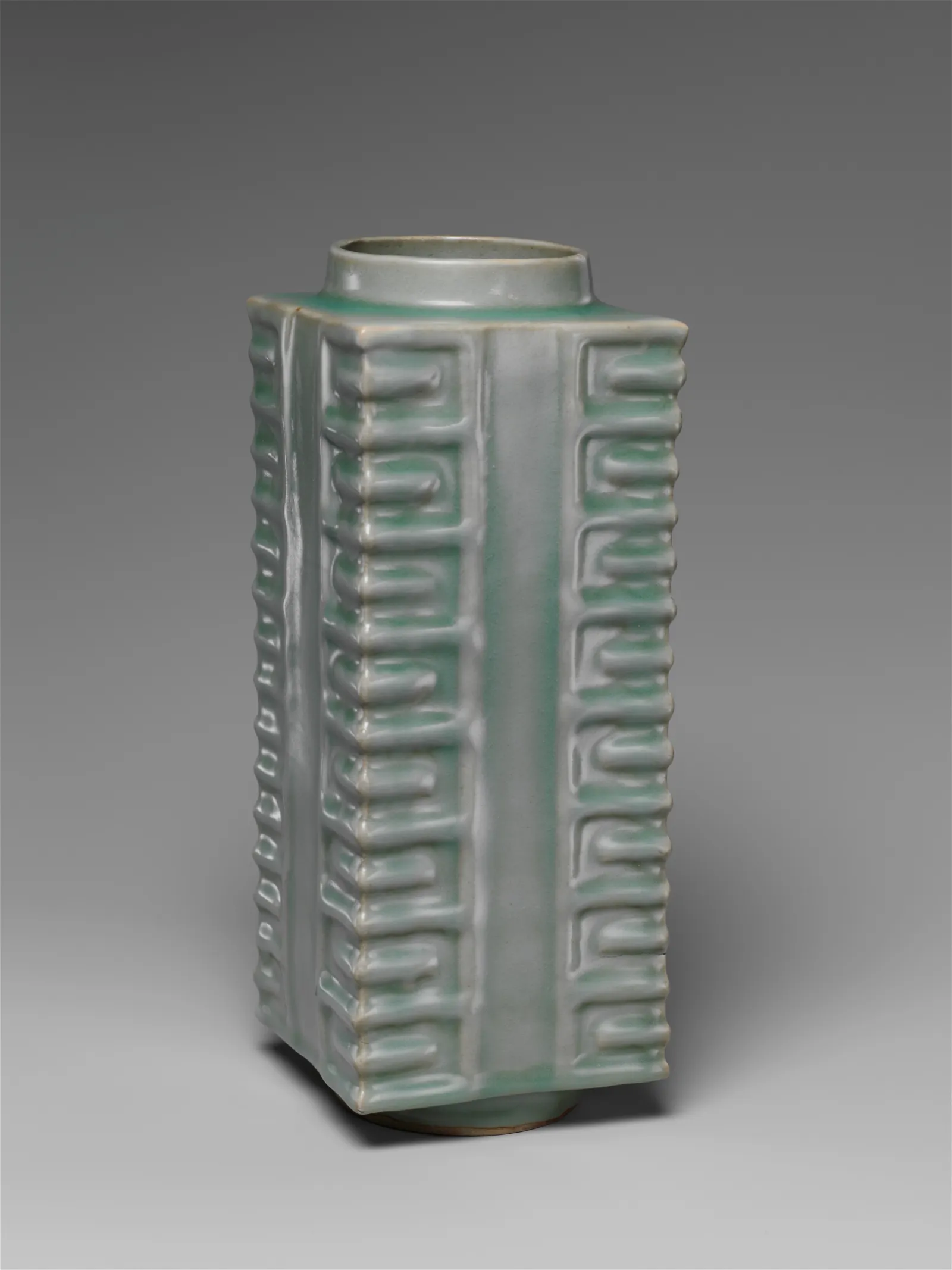
I am suspicious of porcelain histories that make every early bowl audition for a Ming vase. They flatten genuine invention into a waiting room. A Yue celadon body, a Ding basin and a dark Jian tea bowl were not incomplete blue-and-white objects; each solved a different relationship among clay, glaze, light and use.
The history of Chinese porcelain grew from China's wider ceramic intelligence. Potters had already learned to refine bodies, build kilns, control atmosphere and create high-fired wares long before one globally familiar look dominated overseas imagination. There is no honest single invention year that resolves every definition of proto-porcelain, stoneware and mature white porcelain.
The Met's seventh-century bowl, shown at the top, gives us a concrete starting point. Its curatorial account places wider use of refined white-clay porcelain after the late sixth century. The bowl is only 8.3cm high: no monumental scale, no cobalt spectacle, just a rounded wall turning inward to a firm lip. This is already a resolved object, not a sketch for the future. Earlier high-fired traditions still belong in the larger history; the date identifies this white-porcelain stage rather than erasing everything before it.

This celadon bowl is not valuable because it is approaching blue and white. Its green glaze, carved movement and relationship between surface and form express a different idea of refinement. History should not turn every earlier object into an unfinished future.
Heat made the material, but kiln systems made the history
Porcelain depends on a vitrified, high-fired body, but technical definitions shift across languages and ceramic traditions. In China, distinctions among pottery, stoneware and porcelain do not map perfectly onto every Western category.
The important historical unit is not a lone inventor. It is the kiln ecosystem: clay processors, throwers, mold makers, carvers, painters, glaze specialists, setters, fire workers, merchants and people absorbing loss when a firing failed.
The porcelain-making guide returns a finished vessel to these actions. A museum case shows survivors. It does not show warped bodies, fused stacks, fuel, smoke or the judgment required to decide when heat was enough.
That distinction changes the entire chronology. A dynasty can issue an order; it cannot instantly create a clay deposit, rebuild a kiln community or teach a hand to trim a foot. Technique accumulates unevenly. War can scatter workers. Court patronage can concentrate money and failure tolerance. River routes can turn a local ware into a commercial language. The dates below are therefore not shelves. They are pressure points where material, labor and demand changed direction.
| Period or dated anchor | What changed | What did not disappear |
|---|---|---|
| Before the sixth century | Long development of high-fired glazed bodies and kiln control | Distinct pottery traditions, rather than one universal ceramic recipe |
| Sui 581–618; Tang 618–907; Five Dynasties 907–960 | White porcelain and southern celadons circulated alongside other wares | Regional materials and different uses |
| Song 960–1279 | Strong regional specialization in glaze, carving and form | Ordinary production beyond elite taste |
| Yuan 1271–1368; David Vases dated 1351 | Jingdezhen blue and white became an ambitious, mature tradition | White, carved and celadon wares |
| Ming 1368–1644 | Court and commercial production served different scales and customers | Monochrome production beside painted porcelain |
| Qing 1644–1911; Meissen factory founded 1710 | Expanded enamels and historical revivals; European porcelain manufacture added competition | Chinese blue and white and everyday wares |
| Republic from 1912; People's Republic from 1949 | War, factories, institutions and changing production organization | Workshop skills and ongoing reinterpretation of historical models |
The Song and Yuan dates overlap because these dynastic ranges describe political rule, not a single synchronized change at every kiln. Read an object's narrower museum date alongside the period. “Fourteenth century,” “Yuan” and “1351” carry different levels of precision; they are not interchangeable labels.
Song porcelain made restraint technically demanding
Song-period ceramics are often praised as quiet. Quiet should not be confused with easy.

The Ding basin's pale body, controlled rim and carved lotus ask the viewer to notice changes of depth under one restrained surface. The decoration does not sit on top like printed information. It changes how light enters the glaze.
Other Song kiln traditions pursued celadon depth, dark tea-bowl glazes, crackle, opalescence or sharply molded white ware. The so-called Five Great Kilns became a later framework for discussing court-associated refinement, but real production was regionally broader.
This period matters because it proves that Chinese porcelain history is not a march toward maximum decoration. Technical ambition can produce less visual noise.
It also exposes a bias in the modern museum eye. We often call a monochrome bowl “timeless” because the object looks compatible with contemporary minimalism. It was not made outside time. Its exact rim, support marks, glaze behavior and social use belonged to particular workshops and patrons. Admiration becomes shallow when “quiet” is used to erase the difficult historical machinery that created quietness.
For a closer comparison of Ru, Guan, Ge, Ding and Jun, the Five Great Kilns guide separates later prestige language from what objects and kiln evidence can actually support.
Cobalt connected Jingdezhen to a world beyond the kiln
Blue-and-white porcelain became transformative when several systems met: a pale high-fired body, cobalt painting, transparent glaze, Jingdezhen production capacity and trading networks able to carry fragile objects over long distances.
The British Museum's David Vases record provides a particularly useful anchor: an inscription records a 1351 dedication by Zhang Wenjin to a Daoist temple. That is a documented act by a named patron, not a general guess from blue color. It also demonstrates accomplished production by that date, not the invention of blue and white in that year.
I find the dedication more affecting than the usual story of an anonymous “priceless vase.” A patron wanted objects made for a particular setting. The purpose came before the museum category. It brings a human decision into a history too often told as chemistry on one side and emperors on the other.
The blue-and-white porcelain guide follows that visual system closely. Historically, its success also demonstrates that "Chinese tradition" was built through exchange. Imported cobalt, foreign shapes and overseas demand could become part of Chinese workshop intelligence without making the result less Chinese.
This is where simplistic nationalism fails the objects. Porcelain did not become globally powerful by remaining sealed. Chinese workshops absorbed materials, forms and customer demands, then answered them with local bodies, brushwork, kiln control and organization. The result was not cultural dilution. It was confidence strong enough to transform contact.
Ming scale turned variation into an industry
Under the Ming, imperial demand and large Jingdezhen production systems helped make porcelain a concentrated field of technical specialization. Court wares, domestic markets and export orders did not all ask for the same object.
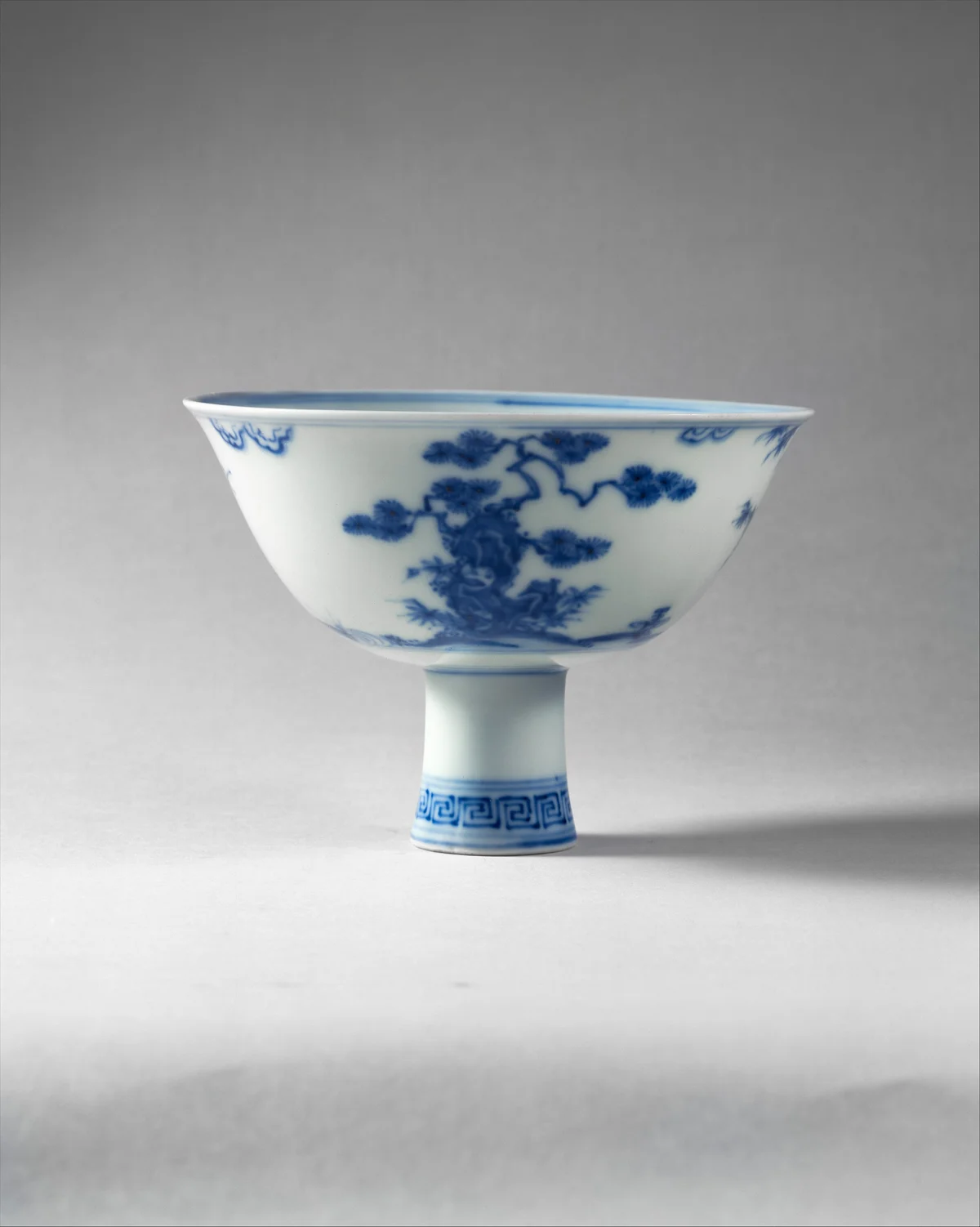
The Met's late-fifteenth-century stem cup belongs to the Chenghua period, 1465–87. Pine, bamboo and plum blossom occupy a raised drinking form rather than a monumental storage jar. At 15.9cm across, it asks for a different kind of looking: how the shallow bowl meets its support and how the decoration circles that compact space. Ming ambition did not always mean making the biggest possible object.
Large Ming bodies demonstrate a historical change in scale and coordination. A vessel had to survive forming and firing; repeated border zones had to stay coherent; a continuous scene had to meet itself around a surface no viewer could see all at once. “Ming porcelain” becomes meaningful only when a period label is translated back into production difficulty.
This is why dynasty labels alone are poor looking tools. "Ming vase" may help with date, but it does not tell us whether an object was imperial, commercial, domestic or exported; carefully controlled or rapidly produced; designed for a Chinese table or a foreign habit.
Export changed both sides of the exchange
Chinese porcelain moved through Asian, Middle Eastern, African, European and later American markets. Foreign consumers ordered familiar shapes, copied Chinese motifs, misunderstood symbols and developed new table practices around imported vessels.
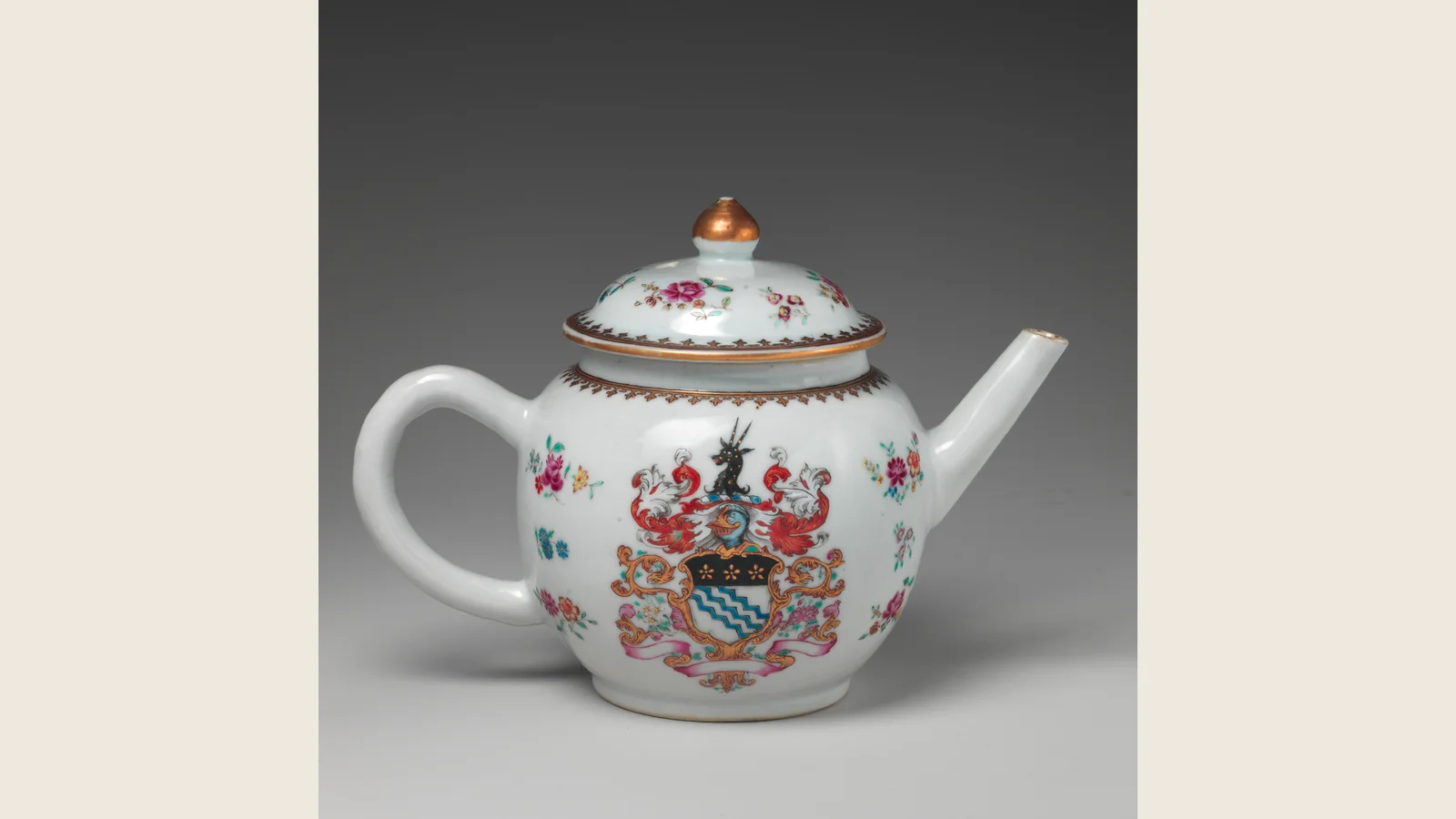
Chinese workshops responded. A ewer might answer a non-Chinese pouring form. A border could be arranged for a foreign plate. Armorial designs could identify overseas patrons. Export was not one-directional cultural influence; it was production listening to demand across distance.
Europe’s effort to reproduce porcelain reveals the material’s power. Meissen records its factory foundation in 1710. That is a European manufacturing milestone, not porcelain's birthday. Chinese and Japanese imports were already objects of desire; European production changed who could supply that demand. The object was admired as more than an image of China. It was a material competitors wanted to make themselves.
The Met's ceramics history places these developments across a larger collection record. East Moment's emphasis is the feedback loop: trade did not merely distribute porcelain; it changed what kilns made next.
The word china becoming an English name for porcelain is often repeated as a charming language fact. I hear something harder inside it: an entire country was compressed into a desired material. That fame created admiration and profit, but it also encouraged foreigners to see China as an aesthetic supplier rather than a society of miners, painters, merchants, kiln workers and users. A serious history must put those people back.
Our Chinese export porcelain guide follows the plates, services, armorial commissions and hybrid forms that make this negotiation visible rather than treating export as a footnote.
Qing color expanded the painted surface
New enamel palettes allowed increasingly varied color over glazed porcelain. Court taste, workshop skill and export demand created objects whose surfaces could behave like gardens, textiles or paintings wrapped around volume.

The vase is visually abundant, but abundance is not the opposite of discipline. Neck, shoulder and body offer different painting zones. Borders manage transition. Birds and flowers must remain readable on a surface that continually turns away.
Later collectors often ranked periods through changing fashion, sometimes treating one dynasty as pure and another as excessive. A better reader asks what technical and social problem the object was designed to solve.
The nineteenth century did not simply end the story
Many porcelain histories grow tired after the Qianlong reign, then jump straight to contemporary studio ceramics. That gap is dishonest. Nineteenth-century political upheaval, foreign competition, changing court resources and the Taiping conflict all affected Jingdezhen and its production networks. Workshops did not become culturally irrelevant because collectors preferred earlier reigns.
The twentieth century brought another set of ruptures: the fall of the Qing, war, industrial manufacture, state-organized factories, research institutions, export programs and later market reform. Skills moved between family workshops, schools, factories and individual studios. Some knowledge was protected; some was standardized; some was lost; some was reinvented under a historical name.
This period matters whenever a seller calls a piece “traditional.” Traditional can mean a surviving local practice, a twentieth-century factory system, a recent revival, a commercial style or a genuine continuation with documented teachers. The word alone proves nothing. History is not a certificate printed beside the price.
The deepest continuity is not a dynasty—it is correction
Porcelain history is full of correction: refine the clay again, change the support, redraw the border, alter the glaze, move the piece in the kiln, answer a new market, revive an old form. The most durable tradition was never perfect repetition. It was the willingness to observe failure and adjust.
That is why the Chinese porcelain overview begins with how an object should be read now, while this page remains chronological. One helps the hand and eye judge a vessel; the other explains why the evidence changed over time. Mixing those jobs creates an article that mentions everything and explains nothing.
Porcelain was handled before it was collected
The word "masterpiece" can erase ordinary life. Porcelain served tea, food, medicine, storage, ritual, export commerce and domestic display. It chipped, stained, broke and was repaired. Many objects were produced in quantity; most makers' names did not travel with them.
That absence matters. The history of Chinese porcelain is frequently narrated through emperors and collector labels because those records survived. The hands that refined clay, painted borders and loaded kilns remain harder to name.
Begin with the broad Chinese porcelain guide, then compare the five objects on this page without asking which is "most Chinese." Ask what each period made newly possible, and which earlier choice still feels convincing to you.
Choose two dated objects for Moments: one earlier, one later. Name the feature that changed and the one that survived. I am especially interested when you prefer the earlier object and can explain why. Return with a third example that upsets the neat sequence. The history of Chinese porcelain becomes richer when we stop confusing chronological order with an order of merit.
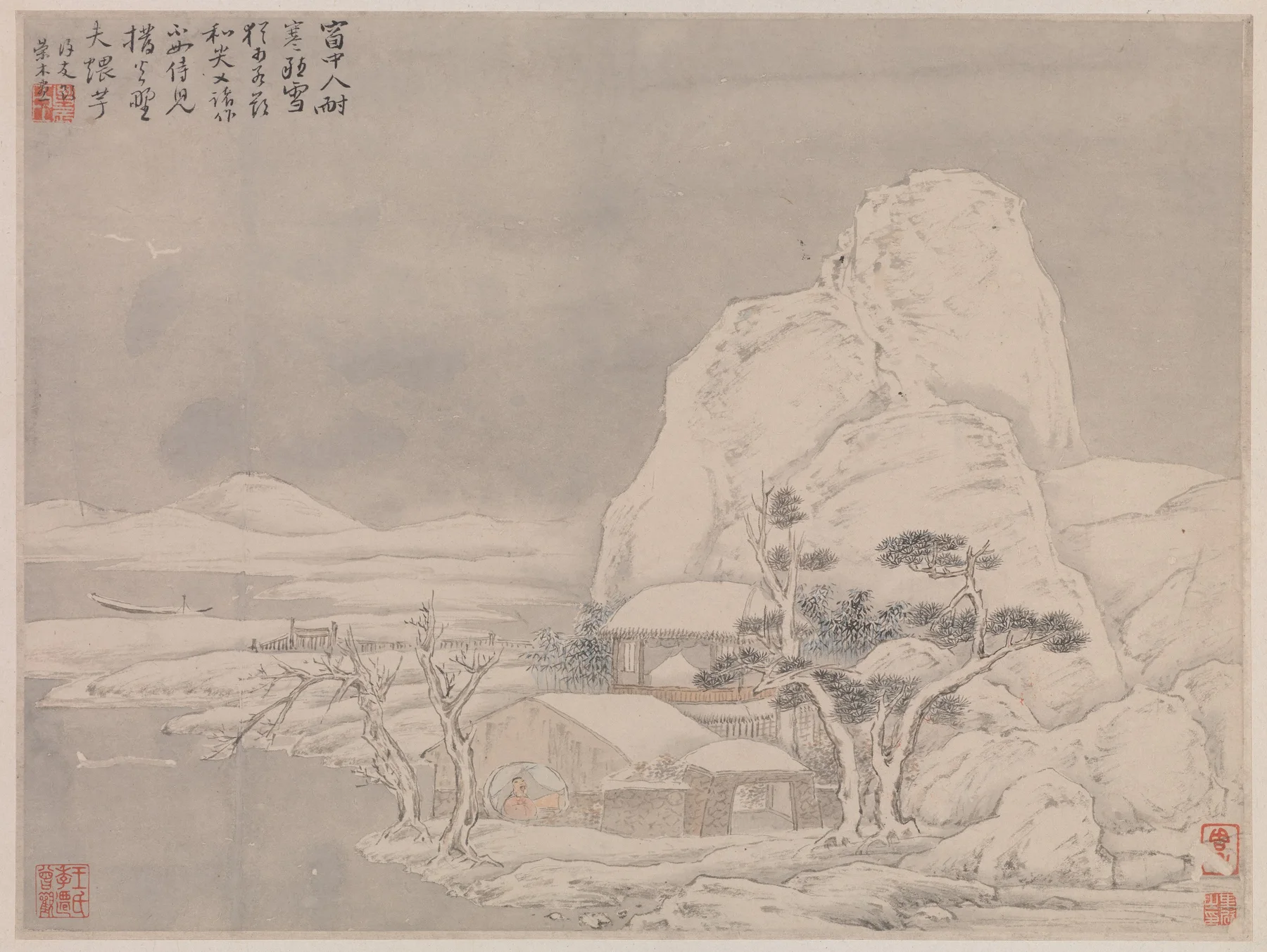
Continue through the wider Chinese art collection when you want to compare porcelain's material history with jade, calligraphy and painting—traditions that preserved memory through entirely different kinds of touch.