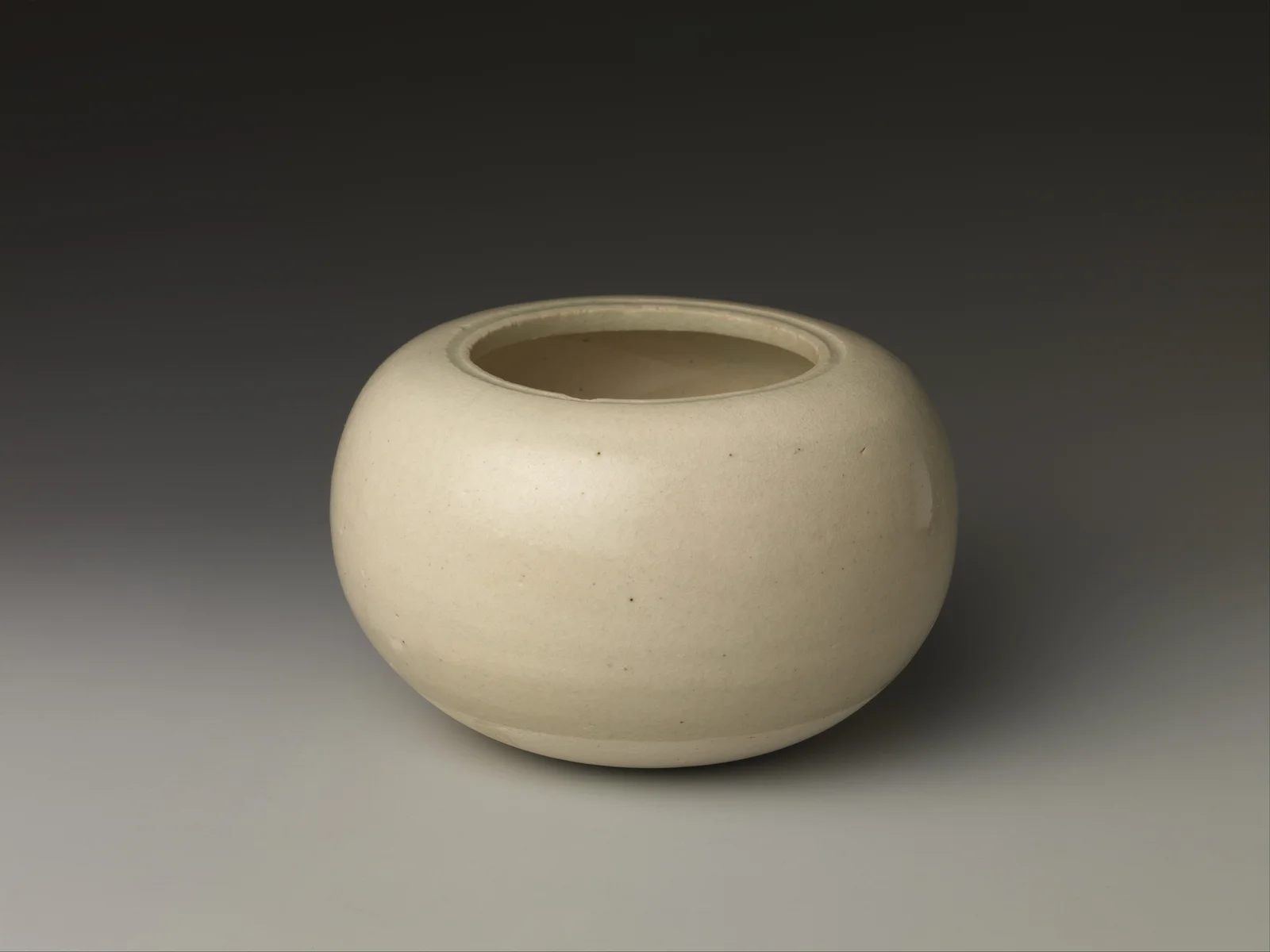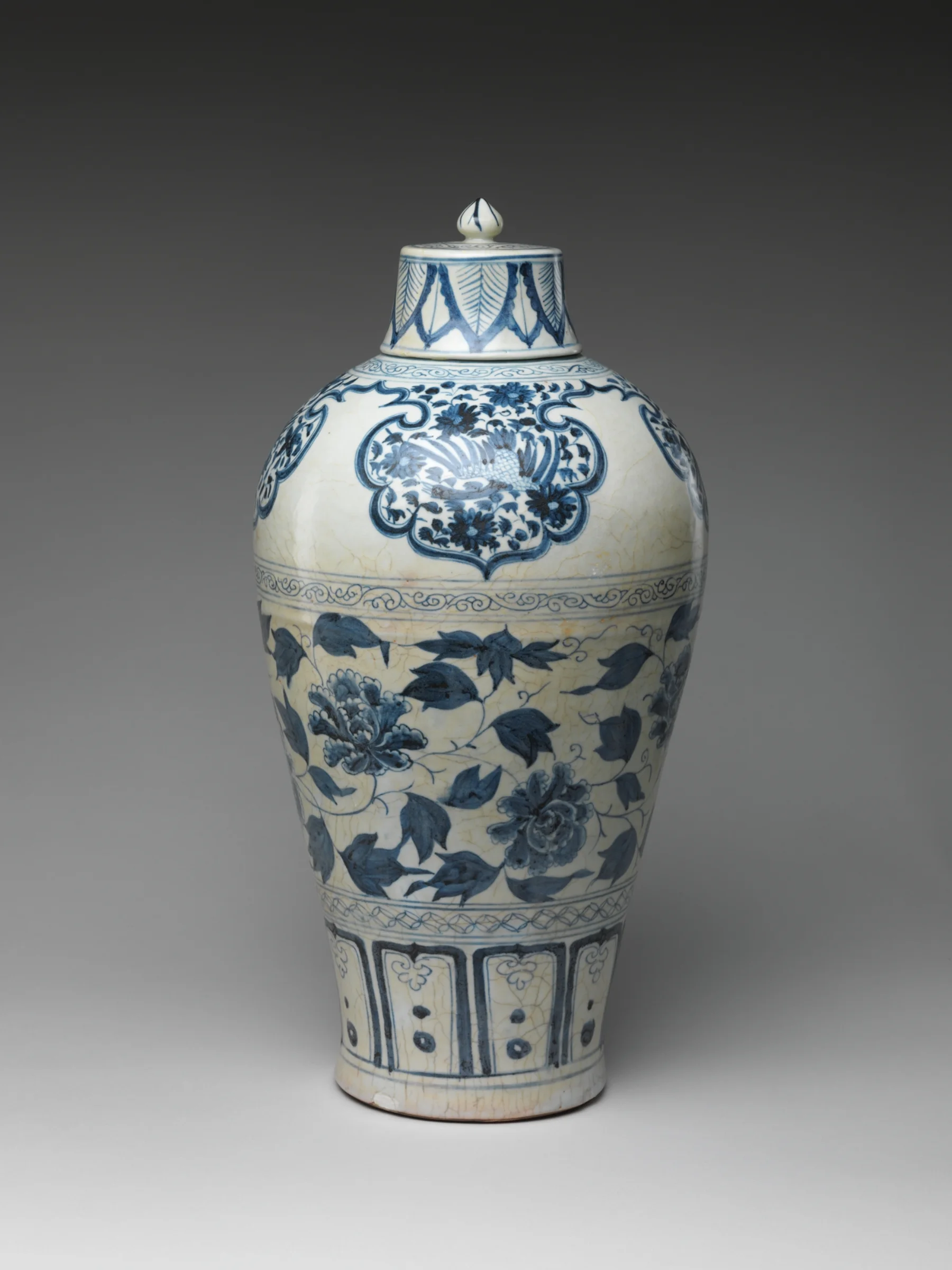
Chinese porcelain is a high-fired, vitrified ceramic whose refined body is usually pale; it can be painted, glazed in one color or made into sculpture. Blue and white is one decorated tradition, not the definition of the material. That distinction is the quickest way out of a very crowded vocabulary.
A shop label can offer you “Jingdezhen,” “celadon,” “Ming style” and “hand-painted” in the same breath. They do not answer the same question. One names a place, another a glaze family, another a historical reference, another a process. I want the object to earn your attention before those words start bidding for it. An ordinary bowl with a generous rim has more to teach than a prestigious name you cannot connect to anything visible.
What is Chinese porcelain?
The body is the fired clay beneath the surface; the glaze is the glassy coating; decoration can be carved, molded, painted beneath that coating or added above it. A porcelain object can bring several of these choices together. Reading those layers separately is more useful than testing a museum object by tapping it. Leave ringing tests to appropriate handling contexts, not gallery visits.
Porcelain belongs within the larger world of Chinese ceramics, which also includes earthenware and stoneware. Overseas writing often treats all Chinese ceramics as porcelain, then imagines all porcelain as blue and white. Both shortcuts hide centuries of invention.
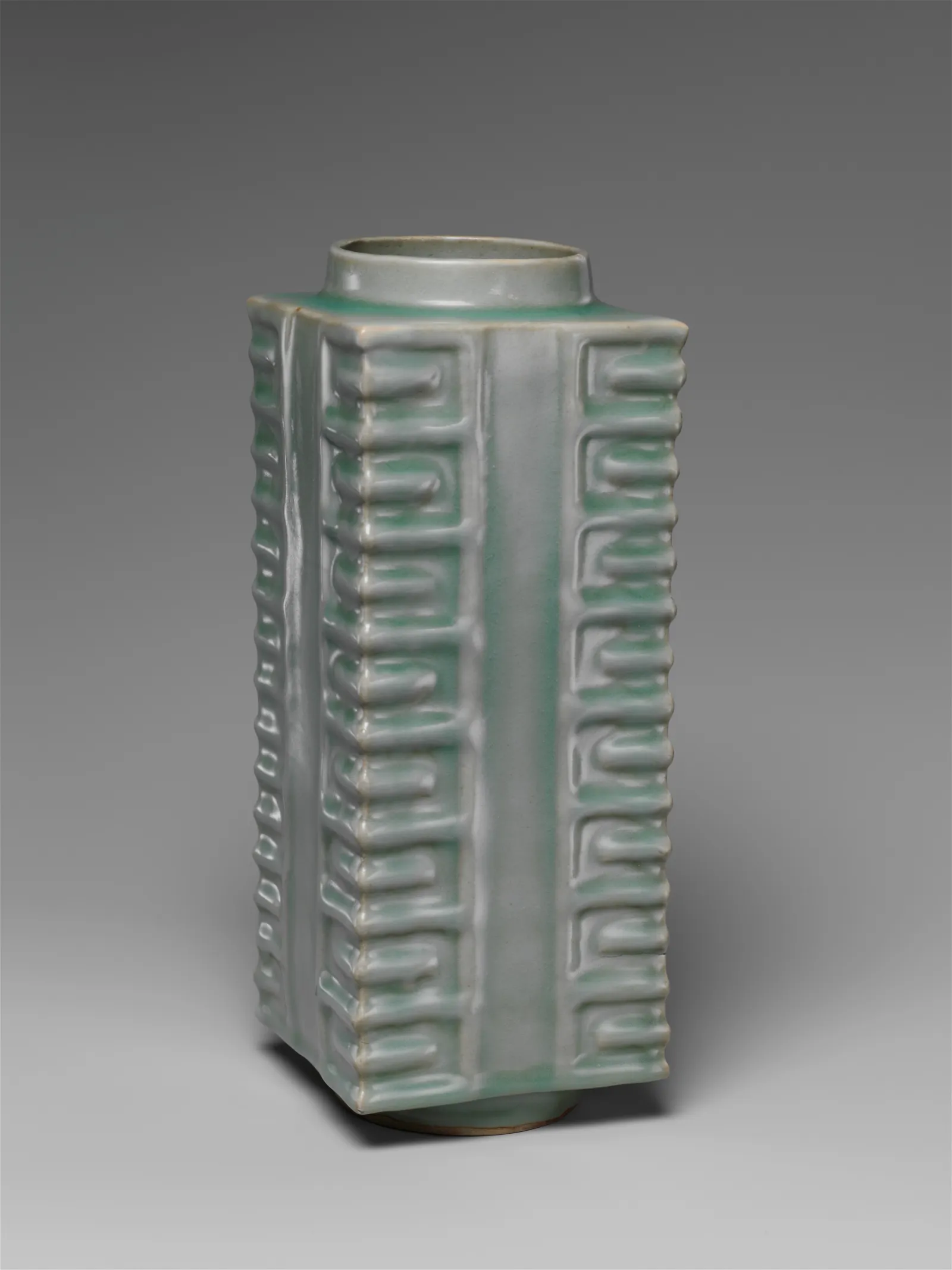
Start with the square green vessel at the top of this page. The Met identifies it as a Southern Song Longquan vase modeled on a much older jade cong. That single object separates four ideas: ceramic material, celadon glaze, a southern kiln tradition and a form borrowed from ancient jade. Its green surface does not make it jade; its ancient-looking shape does not make it Neolithic. I love the audacity of that translation: a stone form becomes a glazed vessel with a different weight, surface and purpose.
Chinese ceramic bodies compared
| Ceramic family | General firing/body character | Chinese examples | What to notice |
|---|---|---|---|
| Earthenware | Lower-fired and more porous | Painted Neolithic pottery, many tomb figures | Body color, slip, pigment and use |
| Stoneware | High-fired, dense and strong | Many celadons, Jian tea bowls | Glaze depth, iron content and firing atmosphere |
| Porcelain | Highly vitrified, often pale and resonant | Dehua white ware, Jingdezhen blue and white | Body refinement, translucency, glaze and foot |
The borders can be debated because Chinese and European classification traditions developed differently. Material evidence matters more than forcing every object into a simple label.

In our contemporary Culture Park photograph, the handled vessel is ceramic; its precise body classification is not established by the display view. What you can judge is the relationship between its broad belly and the upright handles. The small raised details interrupt the purple-red glaze, while the pale lower area lightens the heavy form. This is an object to look around, not a flat patch of desirable color. Follow one handle down into the body and the construction becomes more interesting than the sales adjective.
Porcelain is not simply "clay fired hotter." Makers select and refine raw materials, control particle size, shape the body, formulate glaze and manage a kiln atmosphere capable of turning a fragile dry object into a vitrified one. Every stage affects the next. A beautifully painted surface cannot rescue a body that warps or cracks in firing.
Our visual porcelain-making process guide breaks that system into nine stages and shows why drying, trimming, kiln loading and sorting matter as much as the more photogenic wheel and brush.
Translucency is often presented as the party trick that proves porcelain. It can be useful, but wall thickness, body recipe and glaze all affect what light passes through. Heavy porcelain may show little translucency; thin non-porcelain ware can still play visual games. One clue is not a verdict.
A short history without turning dynasties into shelves
Early Chinese potters developed sophisticated clay preparation, kilns, glazes and high-fired wares long before mature white porcelain became globally famous. Yue and other celadon traditions pursued jade-like surfaces. Northern kilns developed distinct white, black, carved and painted wares.
During the Song period, regional kiln systems produced ceramics of remarkable restraint and variety. Later, Jingdezhen expanded as an exceptional porcelain center. Blue-and-white production matured through Chinese skill and access to cobalt connected to wider trade networks. Ming and Qing imperial, domestic and export markets encouraged enormous technical and visual range.
Dynastic labels help date political periods, but kilns did not wake on the first morning of a new dynasty with entirely different hands. Techniques overlap, revive and travel.
The object also moves at a different speed from the dynasty. A glaze associated with one period may be copied centuries later. An old form may return because collectors admire it. Political change can redirect patronage without instantly replacing workshop knowledge. For dates and securely identified examples, follow the history of Chinese porcelain. Keep this page for the vocabulary and choices that make those examples readable.
Why blue-and-white porcelain traveled so far
Chinese blue-and-white porcelain uses cobalt decoration beneath a transparent glaze. The system protects the painting during use and gives strong contrast against a pale body. Cobalt sources, brushwork, firing and glaze affect whether the blue appears soft, inky, violet or nearly black.
Our dedicated Chinese blue-and-white porcelain guide takes the next step: it uses real museum objects and East Moment's pattern archive to show how borders, roundels, curved surfaces, negative space and global trade turned two colors into a complete design system.
The ware traveled through maritime and overland exchange, answering many markets. Foreign patrons requested shapes and motifs; Chinese workshops interpreted them through local materials and production systems. Imitation followed in the Middle East, Japan and Europe.
Global influence does not make the objects culturally empty. It makes them evidence of conversation.
Export ware was not simply inferior porcelain sent abroad. Workshops produced for different price points and customer briefs, just as makers did for domestic markets. European metal shapes, Islamic vessel forms, coats of arms and unfamiliar scenes could enter Chinese production, then return overseas transformed by local brushwork and kiln practice.
The result complicates the phrase "traditional Chinese design." Some of the most recognizable Chinese porcelain in European collections was made through international demand. Tradition was already negotiating with a global customer.
Important kiln traditions and wares
| Tradition or center | Known for | A beginner should notice |
|---|---|---|
| Jingdezhen | White porcelain, blue and white, imperial and export production | Fine body, painted decoration, workshop specialization |
| Longquan | Celadon traditions | Green glaze, carved or molded surfaces, varied forms |
| Dehua | White porcelain often called blanc de Chine | Creamy white body and sculptural clarity |
| Jian kilns | Dark-glazed tea bowls | Iron-rich glazes with streaks, spots and firing variation |
| Cizhou tradition | Bold painted, carved and slip-decorated stoneware | Graphic energy and everyday market production |
| Yixing | Unglazed stoneware teapots rather than porcelain | Clay texture, form and relationship to tea practice |
This table is an entrance, not a ranking. Chinese ceramic history includes many more kilns, communities and ordinary wares than museum highlights suggest.
For a focused Song-period comparison, the Five Great Kilns guide follows Ru, Guan, Ge, Ding and Jun without incorrectly treating all five as imperial kilns. Ding ware is especially useful here because its ivory-white body, carved decoration and large commercial production system complicate the idea that porcelain history runs straight toward Jingdezhen blue and white.

“Purple” is a hopelessly small word for the contemporary surface above. The shoulder carries a pale interrupted band; below it, red-purple gathers around scattered lighter marks. A catalog swatch would flatten the part I find compelling: the color changes as the form changes. Compare that surface-led pleasure with Jun ware, or the much quieter relationship between glaze and use in Ru ware. Neither discussion requires making this modern photograph into a Song artifact.
Porcelain was made by systems of labor
A finished bowl can encourage the fantasy of one solitary master. Major ceramic production depended on miners, clay processors, throwers, mold makers, painters, glaze workers, kiln loaders, fire managers, merchants and transport labor.
At Jingdezhen, specialization allowed extraordinary scale and consistency. UNESCO's city profile places ceramics at the center of its craft identity. The visible painter is only one contributor: the person who trimmed a stable foot and the person who loaded the kiln affected the same finished bowl. A signature cannot describe the whole division of labor.
Kiln loading was another form of authorship. Objects needed supports, containers or spacing suited to the firing. Position affected heat and atmosphere. A bowl near another object could receive a different result from its apparent twin. Industrial organization did not remove uncertainty; it learned to manage uncertainty at scale.
That labor changes what I admire. A spectacular painted dragon gets the first glance. A rim that remains even around the entire bowl gets the second, because somebody had to make that unshowy part work too. Craft appreciation that notices only the artist with the brush misses much of the achievement.
How to look at Chinese porcelain
Begin with the whole form. Is the vessel balanced? How does the neck meet the shoulder? Then inspect the rim, glaze, foot and underside. Look for wear that matches use, not theatrical damage. Notice whether painted lines vary with a brush or repeat like modern transfer decoration.

Figurative ceramics force the same discipline. A dramatic horse silhouette can seduce before the viewer checks joins, base, glaze, balance or whether the material is even porcelain. I enjoy the energy first, then make myself inspect the construction. Pleasure and evidence are not enemies; evidence simply stops pleasure from becoming a false attribution.
For vases, the dedicated Chinese porcelain vase guide turns that advice into a shape-first method: compare mouth, neck, shoulder, belly and foot before letting a color, pattern or base mark name the object.
For covered forms, the Chinese porcelain jars guide shifts the question from silhouette alone to access: how the mouth, shoulder, lid and enclosed volume work together, and why “ginger jar” is not an automatic history.
For floor vessels, the Chinese porcelain umbrella stand guide tests a different naming trap: a tall vase does not become an historical umbrella stand merely because a modern household puts umbrellas inside it.
For lighting, the Chinese porcelain lamps guide separates the ceramic body's biography from the socket, cord, plug and conversion history. An old vessel and a later electrical system can occupy one object without sharing one date.
For white sculpture, the Chinese Dehua porcelain guide asks how hard fired clay can make a sleeve seem weightless. Its robe details give you a different job from identifying painted motifs: follow the fold and the shadow it creates.
For decoration, the Chinese porcelain patterns guide treats the vessel as a map. It follows scrolls, sprays, panels, medallions, border bands and negative space around the form before assigning a symbolic meaning.
A shallow form needs its own reading too. The Chinese porcelain plates guide follows rim, slope, well, foot, face and reverse so that a circular picture does not hide the three-dimensional vessel carrying it.
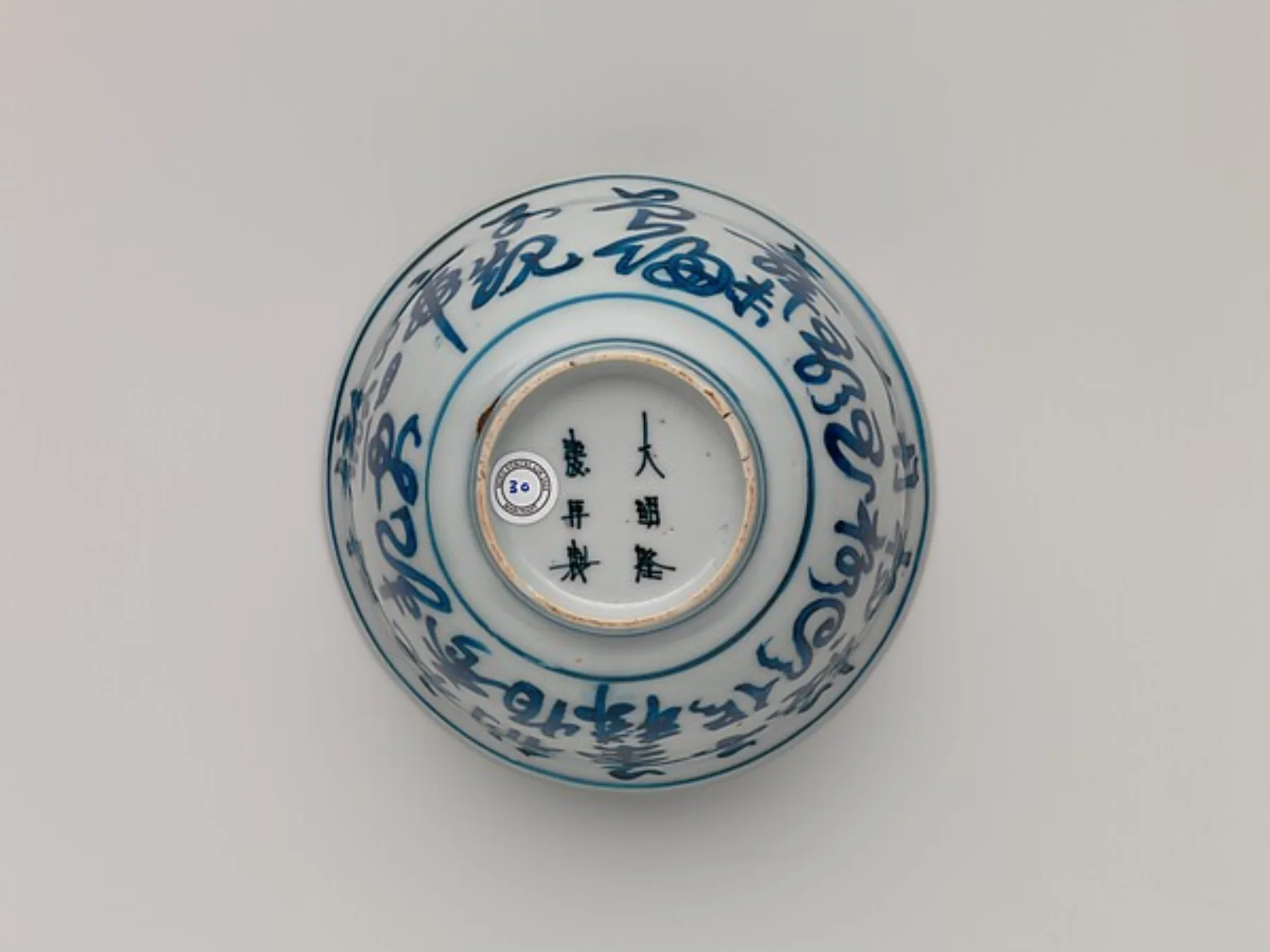
Marks require caution. An imperial reign mark may be genuine to the period, copied later in admiration or added to deceive. Online “mark dictionaries” cannot replace material study and provenance.
Read the underside as part of the object, not a secret password. The foot may show how the piece was trimmed, where glaze stopped, how the body fired and what kind of wear accumulated. Genuine age does not distribute itself as perfectly theatrical dirt.
Decoration also deserves magnification. Hand-painted lines change pressure and speed. Repeated motifs still vary. Transfer-printed or digitally reproduced decoration may show a different kind of regularity. Yet modern makers can paint by hand and historical workshops used repeatable systems, so "irregular equals old" is another shortcut waiting to fail.
Provenance is often less glamorous than a reign mark and more useful. Ownership records, excavation context, old collection labels and comparison with securely dated objects create a chain of evidence. When money is involved, romance should leave room for paperwork.
For valuable objects, consult a qualified specialist. A photograph cannot reliably determine age, authenticity or market value.
Porcelain in tea and daily life
Porcelain entered hands before it entered glass cases. Bowls held food; cups carried tea; jars stored ingredients; export services crossed oceans. The Chinese tea set guide explains why material, cup shape and brewing method affect use. If porcelain is already your chosen material, the porcelain tea set guide tests the less romantic questions that determine whether a service survives daily use: working capacity, pour, rim, glaze, cleaning and food-contact evidence.

The group makes scale and relationship visible. A tall pouring vessel, lidded pot and small cups do not become a coherent tea set merely by sharing a glaze family. Spout, handle, lid, rim and hand reach still have to work together.
A thin white cup can reveal tea color beautifully. A celadon glaze changes the visual temperature of the liquor. An object becomes culturally meaningful through repeated contact, not age alone.
Museum object, family object, design object
A museum label emphasizes date, kiln, material and art history. A family may remember who used the bowl, when it appeared at New Year or why one chipped cup was never discarded. A designer notices proportion, negative space and the transition from foot to wall. None of these readings is automatically complete.
The market often rewards rarity, imperial connection and flawless condition. Daily life may value the opposite: a common bowl that sits well in the hand and survives years of use. Chinese ceramic history needs both. Otherwise the story becomes a palace inventory with everyone else edited out.
For young visitors, the best museum habit is to choose one object and stay longer than the label requires. Trace the silhouette. Imagine the weight. Look for the point where brushwork accelerates. Ask what food, tea, flower or ritual action once completed the form.
Copies are part of the story, not only a problem
Chinese potters repeatedly studied earlier wares. A later copy can express scholarship, imperial taste, technical ambition or commercial deception depending on how it was made and sold. The object itself may be excellent even when it is not from the period its style references.
This distinction matters online, where "replica" and "fake" are often treated as synonyms. A clearly labeled contemporary reproduction can teach form and glaze. A modern object sold as an excavated antique is fraud. Historical revival ware sits in another category again.
Good looking begins by asking what the object claims to be, then comparing that claim with material evidence.
Fire leaves a record no label can fully translate
A small glaze pool near the foot, a cobalt line that thickens at a turn, a nearly invisible warp: porcelain preserves decisions and accidents together. Its beauty is not perfection without labor. It is precision that still allows the fire to speak.
I trust that small firing trace more than a sales page shouting “imperial.”
Continue through the Chinese art guide for painting, calligraphy, jade and other material traditions, or follow porcelain back into everyday use through Chinese tea. For a ceramic object that crosses into furniture, the Chinese porcelain garden stool guide explains how to read drum form, openwork, foot, scale and condition before treating decoration as proof.
Which object would you keep if its impressive label vanished? Tell me which choice earns its place: a rim that feels right, a handle with enough room or a surface you never tire of. Bring that object to Moments, then return after ordinary use and say whether your first reason survived. Chinese porcelain becomes much easier to understand when looking ends in a considered preference, not another memorized name.