A Chinese porcelain garden stool is a drum-shaped ceramic furnishing with a long seating history; modern versions also work as small side tables when their maker and construction support that use. I would choose one for the hand reaching from a chair, not for an empty corner in a photograph. Check the usable top, height and intended job first. “Garden stool” alone guarantees neither a safe seat nor weather resistance.
A Chinese porcelain garden stool belongs beside everyday life
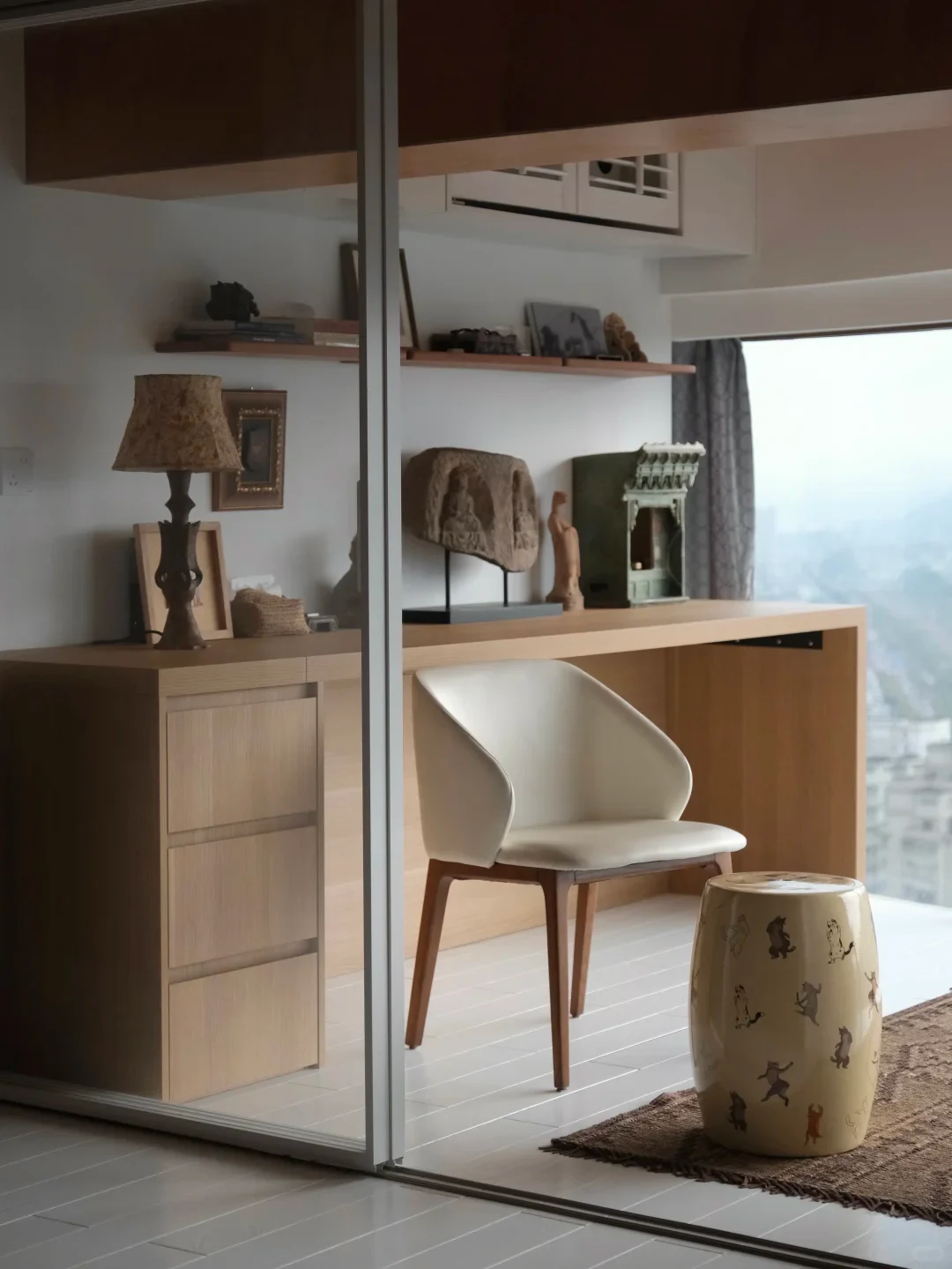
The little cat-painted drum beside the chair above interests me more than a symmetrical showroom pair. Wood, a pale chair shell and patterned ceramic share a small working corner without pretending to come from the same century. The stool does not need an entire Chinese-themed room. It needs one useful relationship.
That is the pleasure I want from this object: a book no longer abandoned on the floor, somewhere to set a drink while talking, a small glazed surface catching the afternoon light. A porcelain stool can bring an old furniture idea into an ordinary apartment without turning the apartment into a stage set. The contemporary example is described as ceramic, not authenticated historical porcelain; the important continuity here is the drum form and its changing household job.
A stool carries a body. A side table carries a cup, lamp or book. A planter contains wet soil and drains water. The same barrel silhouette may be sold for all three jobs, but those jobs do not create the same stresses. Decoration cannot tell you whether the top is level, whether the foot rocks, whether an old hairline runs through an opening, or whether a modern maker intended the piece for seating.
This is why I refuse to begin with dynasty claims. Begin with the object in front of you:
- Top: Is it broad, level and edged in a way that makes sitting plausible?
- Shoulder and bosses: Do raised dots or studs make the drum ancestry legible?
- Waist and openings: Are pierced areas crisp and sound, or are they hiding cracks and restoration?
- Belly: Does the volume feel balanced, or visually top-heavy?
- Foot: Is the base complete, level and appropriate for the floor?
Only after that reading should colour and ornament enter the conversation. Our broader Chinese porcelain guide explains the material family; this page owns a narrower and more practical decision: how to read one hollow ceramic form as furniture.
“Garden stool” is useful English—and an incomplete biography
The Chinese object family is often called zuodun (坐墩), literally a low block or drum-like seat. Other historical and literary names exist, including xiudun—often translated as embroidered stool—because a hard seat could be paired with a textile cushion. The vocabulary changes across materials and periods. I would rather define the useful relationship than pretend one English label maps perfectly onto every Chinese example.
The British Museum makes the most important correction directly. Its Wanli-period porcelain garden seat is catalogued under the conventional English term “garden seat,” yet the museum notes that such seats were made for indoor and outdoor use. It also connects the barrel form to drums whose skins were tightened by nails or pegs, explaining the raised bosses that still appear on ceramic versions.
That changes how I see the object. The bosses are not random dots added to fill a border. The swelling body is not merely a vase with its mouth closed. The top, drum skin, fastenings and hollow volume form one memory of furniture translated into fired clay.
It also releases the stool from a marketing trap. A porcelain garden stool does not need to stand beside bamboo, a pond or a moon gate to remain Chinese. It can sit beside a contemporary armchair, hold a book in a bedroom, or become a small pause in an entryway. The Chinese gardens guide helps us understand framed views, movement and borrowed scenery; it should not become an instruction to costume every stool with a bonsai and a red lantern.
My preferred English is therefore contextual:
- use Chinese porcelain garden stool for the search term and object category;
- use porcelain garden seat when the seating function is central;
- use drum-form porcelain stool when the structure matters;
- use ceramic side table only when that is the intended modern use;
- never use planter merely because the body is hollow.
A Ming garden seat proves that form and firing developed together

Sixteenth-century Jingdezhen garden seat, The Met, 1993.386.33. Raised bands frame the lotus pond; the rounded belly is visibly wider than the sitting surface.
The Met’s garden seat with a lotus pond scene deserves slow looking. Its body is barrel-like but not mechanically cylindrical. The upper and lower bands tighten the silhouette; the middle opens into a watery scene; the top is materially part of the seat rather than a removable slab. The museum records it as sixteenth-century Jingdezhen ware and notes that porcelain versions gained popularity as the ability to fire large ceramic pieces improved.
This is a technical point with emotional force. A large hollow seat asks wet clay to survive drying, decoration, glazing, firing and cooling without losing the relationship between top, belly and foot. The form is furniture, but the risk belongs to ceramics. That tension is what makes the object interesting.
The Met also connects the embossed dots to fastenings for leather or fabric seat covers. Again, the detail is structural memory. When a modern replica keeps the dots but inflates them into shiny ornament, I ask whether the maker still understands what they are doing. Repetition is not the same as inheritance.
Our guide to how Chinese porcelain is made explains why large, enclosed or pierced forms demand control through shaping, drying and firing. But a museum example is not a universal template. A similar silhouette may be porcelain, stoneware, earthenware, resin or cast composite. It may be old, recent, repaired or factory-new. Exact-object evidence must stay attached to the exact object.
Openwork is where beauty and vulnerability meet
Pierced openings make a heavy barrel breathe. They interrupt the belly, release darkness from the hollow interior and create a pattern that changes as you walk around the seat. On a strong example, openwork is not pasted onto a surface; it edits volume.
It is also where I look hardest for damage.
Each opening concentrates edges and corners. A chip may be disguised by dark glaze. A hairline may run from a pierced edge into the body. Old filling or overpaint can smooth an irregular break in a photograph. A hand placed through an opening can turn a decorative void into a dangerous lifting point unless the maker specifically designed it as a grip.
The British Museum’s fahua-type barrel stool gives us an unusually useful comparison. The museum records applied lion masks whose mouths function as grips. That is not permission to carry every pierced stool by its side openings. It is evidence that one exact design integrated handling into the form.
I inspect openwork in four lights:
- Front light reveals glaze colour and overall pattern.
- Raking side light reveals chips, waviness and repaired edges.
- Back light makes openings and blocked repairs easier to read.
- Interior light shows whatever the camera can safely reveal inside the hollow body.
The rule is decisive: an opening is not empty space; it is an exposed edge in a load-bearing ceramic body.
Porcelain, stoneware and majolica cannot be merged by shape
Online listings often use “porcelain,” “ceramic” and “pottery” as though one were the luxury version of another. They are not interchangeable evidence labels. Porcelain is a ceramic material category, not a compliment. Glaze brightness, whiteness in a photograph or a ringing sound cannot safely settle the matter by itself.
A useful counterexample sits in the same museum vocabulary. The British Museum catalogues a nineteenth-century Minton garden seat made in Stoke-on-Trent as lead-glazed earthenware—majolica—not Chinese porcelain. Its form participates in a history of Chinese-inspired garden seats, but the museum record preserves maker, place and material rather than dissolving them into “antique Chinese stool.”
When buying, ask the seller or maker to state:
- claimed body material and the basis for that claim;
- place and date of manufacture, if documented;
- whether the piece is hand-thrown, moulded, assembled or cast;
- how openwork was produced;
- whether enamels or metallic finishes sit above the glaze;
- intended use and any written load guidance;
- repairs, chips, hairlines and restoration.
Our Chinese ceramic glazes guide separates visible glaze behaviour from material and firing claims. The Chinese ceramic marks guide makes the parallel point about inscriptions: a mark is evidence to examine, not a dynasty certificate.
A side table is not automatically a safe seat
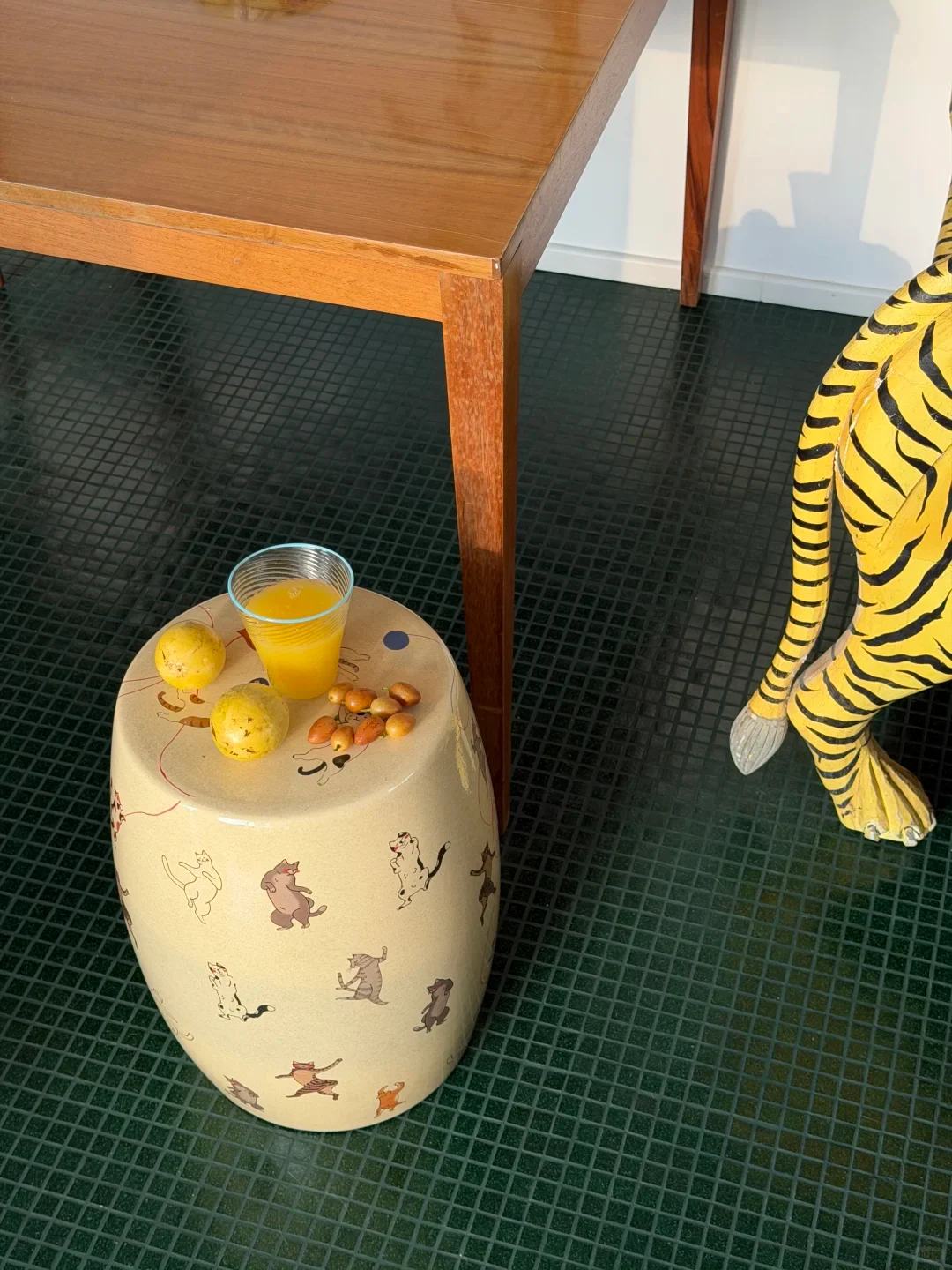
The overhead view answers a question a front photograph cannot: how much of the top remains after a drink is set down? The narrow surface makes this a companion to a chair, not a substitute for a full tea table.
I see one sentence repeated in product copy: “Use it as a stool, side table, plant stand or decorative accent.” Four functions, zero friction. Real rooms are not that forgiving.
As a seat, the consequence of failure is highest. A photograph cannot certify load capacity. An antique object was not delivered with a modern test report, and a repaired opening may matter far more than a beautiful front. Do not sit on an unknown or damaged ceramic stool because the category name says “seat.” Request the contemporary maker’s intended-use and load guidance; for older pieces, treat condition and professional assessment seriously.
As a side table, the load is smaller but stability becomes intimate. Is the top flat enough for a cup? Does a raised medallion make a glass wobble? Is the stool high enough to meet the hand beside the chair? A round glazed top can be slippery, especially under a metal tray.
As a plant stand, water becomes the problem. A closed stool top cannot receive roots. A pot placed above it can trap condensation, stain a porous foot or send water through old cracks. If the object is actually an open jardinière, call it that; do not collapse vessel and seat into the same noun.
As sculpture, function becomes freedom—but scale still matters. A stool placed where nobody can walk around it loses the changing rhythm of its openings. A dramatic object jammed beneath a console becomes expensive clutter.
My verdict: choose one primary job before buying. A secondary use can be welcome, but it must be proven, not promised by a bullet list.
The tea photograph also explains why I dislike the automatic instruction to put a lamp on every garden stool. A drink can be moved with one hand; a broad shade, trailing cord and heavy lamp base create a different arrangement. Our porcelain lamps guide starts with the light and its support. If both objects need their own safety explanation, do not stack them merely because their blues match.
Comfort begins with the top, edge and cushion
Porcelain is hard, cool and unforgiving. That is not a defect; it is a fact the body immediately understands. If you expect long conversation, a hard ceramic seat without a cushion is not heroic authenticity. It is discomfort pretending to be style.
Measure the usable top, not only the widest belly. The Met seat is 36.2 centimetres high, but its recorded top diameter is 24.8 centimetres. Those numbers describe different experiences: height determines how the body meets the seat; top diameter determines how much support the body receives.
Then read the edge. A sharply raised rim may stabilize a tray but press into a sitter. A crowned top may shed rain but feel unstable. A deeply pierced top may be visually exciting and physically unpleasant. A removable cushion can change comfort, protect clothing and reconnect the hard ceramic body with the textile history implied by names such as xiudun.
Do not choose the cushion only by colour. Check that it does not slide, hide damage, trap outdoor moisture or increase the sitting height beyond what works with nearby furniture. The most elegant relationship may be a plain, well-fitted pad that lets the ceramic profile remain visible.
Measure the room before buying the object
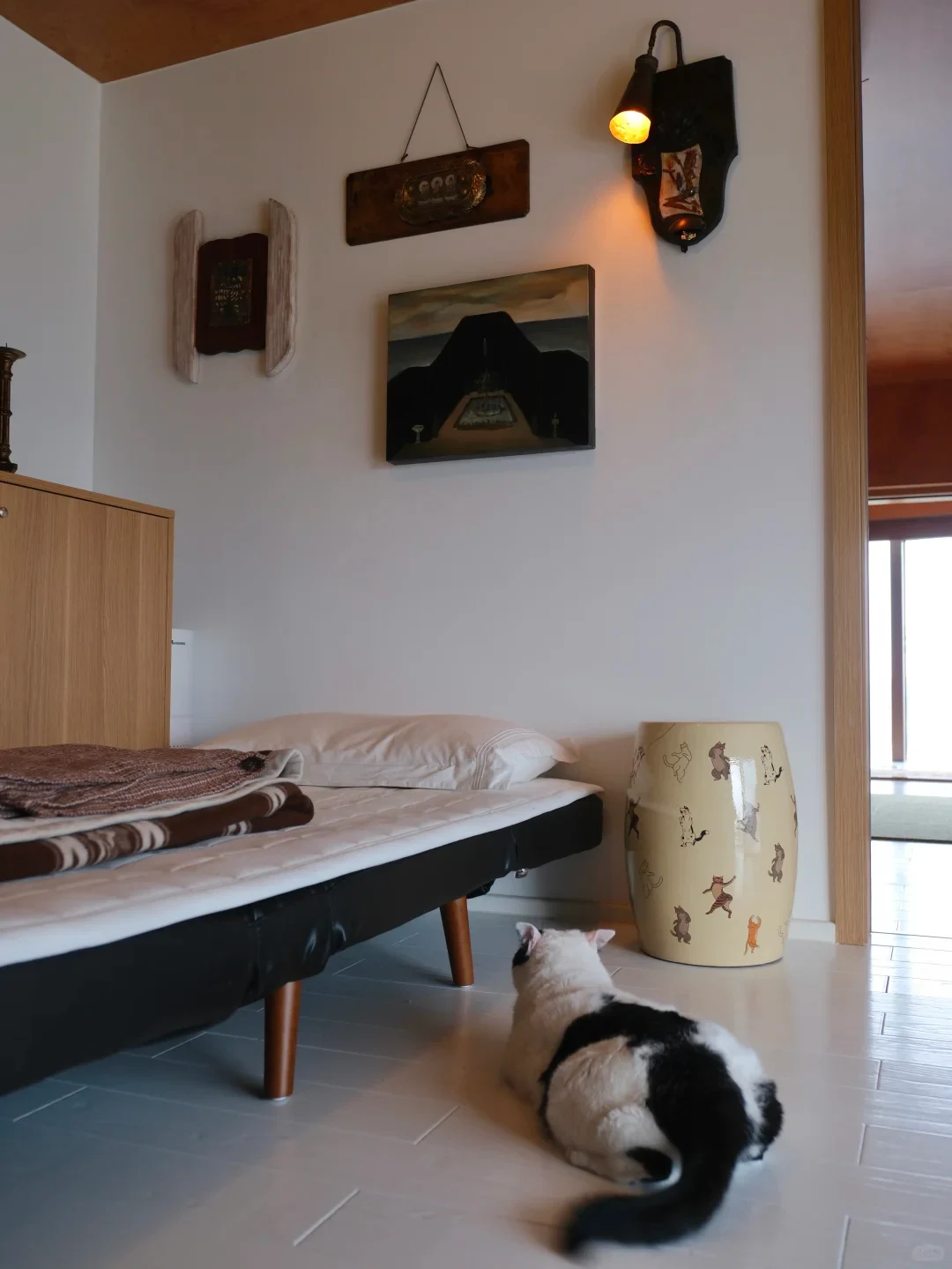
Beside a low bed, the stool has a different height relationship from the desk corner. The bed edge and exposed floor tell us more about reach and circulation than a ruler beside an isolated product.
A stool photographed alone looks monumental or tiny depending on the lens. Room decisions need numbers.
Record the overall height, top diameter, widest body diameter, foot diameter and weight. Then measure the chair arm, sofa seat, bedside height and remaining passage. A stool beside a lounge chair should meet the hand naturally; one beside a sofa should not force the shoulder upward; one in an entryway must not steal the path from bags, children or guests.
Consider a placement problem, not a universal size rule. If the chair arm is much higher than the stool top, a cup may be easy to see but awkward to reach without leaning. Move a cardboard outline through two positions before committing the real ceramic: alongside the arm, then slightly forward. Keep the position where you can reach without twisting and stand without stepping around it. Measure that space, including the widest belly. A narrow foot does not mean a narrow obstacle.
For a bedside role, the right height changes with the bed. The same stool can feel comfortable beside a low guest mattress and frustrating beside a tall bed. I would rather reject a beautiful piece than begin every morning fishing below the mattress for a phone. That is not a failure of Chinese furniture. It is a mismatch between two particular objects.
Weight is not only a shipping concern. A heavy ceramic body can be stable, yet punishing to drag across timber. A light hollow replica can be easy to move, yet easier to knock. Felt pads may protect a floor but can alter stability; adhesive pads can also hide the foot. Decide how the object will be moved before it arrives.
The China manufacturing guide approaches furniture through sourcing and manufacturing. A porcelain stool occupies an unusual border between the furniture and ceramic industries. That makes specification more important, not less: the buyer should ask both furniture questions about use and ceramic questions about body, glaze and firing.
Indoor and outdoor use demand different evidence
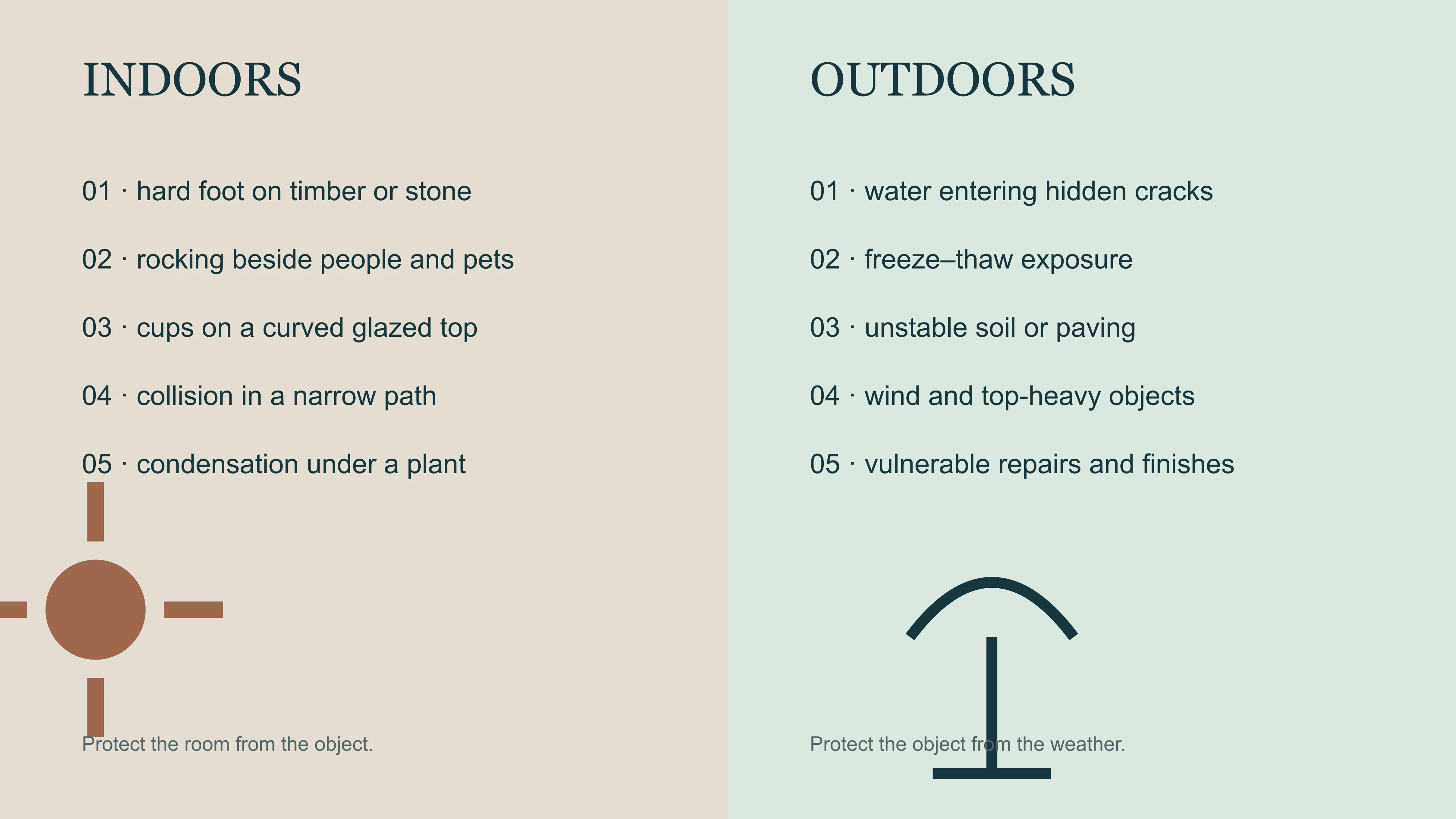
The word “garden” tempts people to believe weather resistance is automatic. It is not.
Indoors, protect the floor and the walking path. Check rocking on the actual surface. Keep a curved top away from an unstable lamp or full wine glass. Do not place a brittle, heavy object where a chair, vacuum, pet or child will strike its pierced edge.
Outdoors, ask the maker for explicit suitability, not a poetic photograph on a terrace. Water can enter cracks and repairs. Repeated freezing and thawing can worsen moisture-related damage. Uneven paving can concentrate pressure on one point of the foot. Wind can turn a plant or tray into leverage. Later overglaze enamels and repairs may weather differently from the underlying body and glaze.
The Canadian Conservation Institute’s ceramic-care guidance explains why firing, porous bodies, surface finishes and previous repairs change an object's response to water. A glossy skin is not an all-weather guarantee. Keep an unassessed historic piece indoors rather than treating a covered patio as a conservation solution.
For contemporary outdoor-rated furniture, follow the maker's seasonal storage instructions. For an old or undocumented seat, preservation comes before the romance of rain on cobalt.
This is where firm language matters: museum history proves that the form lived across indoor and outdoor settings; it does not guarantee that your specific stool can survive your specific climate.
Five photographs are the minimum evidence file
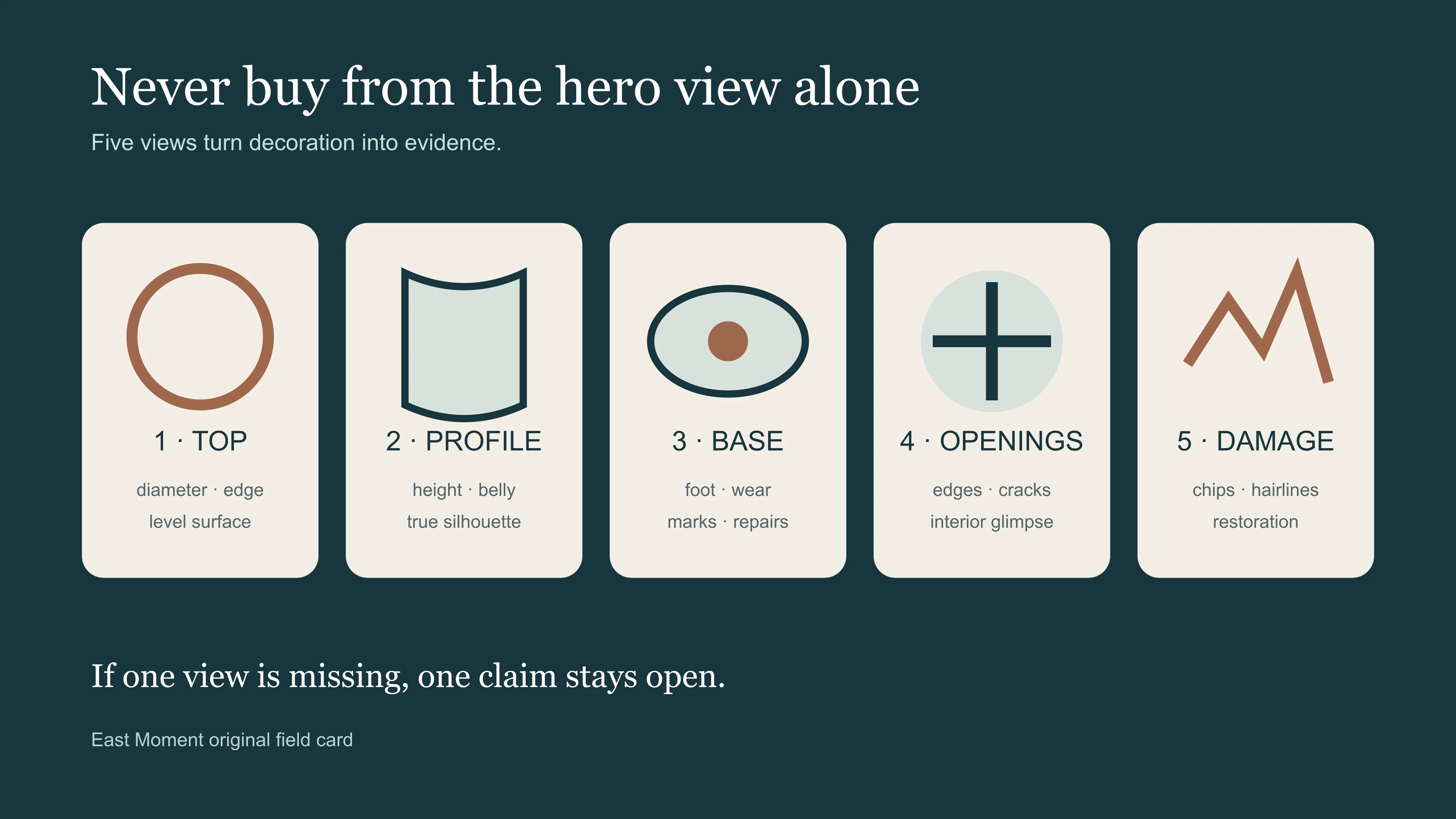
A seller’s hero photograph tells you which side they want you to love. The evidence file shows the sides the object cannot hide.
Request these five views in neutral, sharp light:
- Top: full surface, edge, openings, glaze wear and usable diameter.
- Profile: complete silhouette with a ruler or stated dimensions, not a wide-angle close-up.
- Underside: foot, unglazed areas, labels, marks, grinding, pads, chips and restoration.
- Every opening: exterior and whatever interior view can be photographed safely.
- Every damaged area: close and contextual views, including hairlines, filled losses and overpaint.
Add a short video only for rocking and 360-degree continuity; do not replace sharp stills with compressed moving footage. Ask for weight and a written description of intended use. For pairs, photograph both objects separately. “Matching” can mean same pattern, same mould, similar scale or merely compatible colour.
For an antique Chinese porcelain garden stool, request provenance and old documentation without expecting a photograph to settle age. For a vintage Chinese porcelain garden stool, ask for a real date range and maker evidence. For a new blue-and-white porcelain garden stool, ask how the design wraps around seams, openings and the top—not just for a front pattern shot.
Unknown is an honest answer. “Ming style” is a design description; it is not a Ming date. “Chinese style” is not a country of manufacture. “Porcelain look” is not a material.
The stool should improve the room, not audition for it
I would buy a quieter stool with a complete evidence file before a spectacular one photographed from a single angle. That is not caution replacing pleasure. It is attention making pleasure durable.
The strongest piece does five things at once:
- its silhouette still reads when the pattern disappears;
- its top suits the intended human or household use;
- its openings and foot survive close inspection;
- its material and origin claims remain no larger than the evidence;
- its scale creates a relationship with the room instead of asking the room to become a stage.
I do not need every stool to be old. A well-made contemporary piece can be more useful, more honestly documented and more culturally alive than a dubious “antique” covered in borrowed language. I do not need every Chinese stool to carry dragons or cobalt. Form can hold memory without shouting a symbol.
And I refuse the opposite mistake: treating the object as a generic ceramic cylinder that happens to fit under a lamp. The drum body, bosses, pierced waist and hard fired surface are not packaging around a pattern. They are the argument.
For a Chinese porcelain garden stool, buy the useful relationship before the decorative promise. Keep the drum history, enjoy the painted surface and refuse unsuitable seating. The best corner is the one you use without rehearsing the photograph.
Did moving it actually make the corner better?
Show one before-and-after corner in Moments, using a contemporary piece already suitable for its job. Include the chair or bed and the walking space. Tell us what you can now reach, what you had to remove, or why the stool went back. No sitting experiment is needed.
My question is not “Does this look Chinese enough?” It is “Did the room become easier to live in?” A beautiful object that creates a new obstacle deserves an honest answer.
Come back after a week: has it remained a useful little surface, become a pile of unopened mail, or moved somewhere surprising? That change is worth discussing. The wider Chinese art collection connects this very ordinary domestic decision with the craft and design that made the object possible.