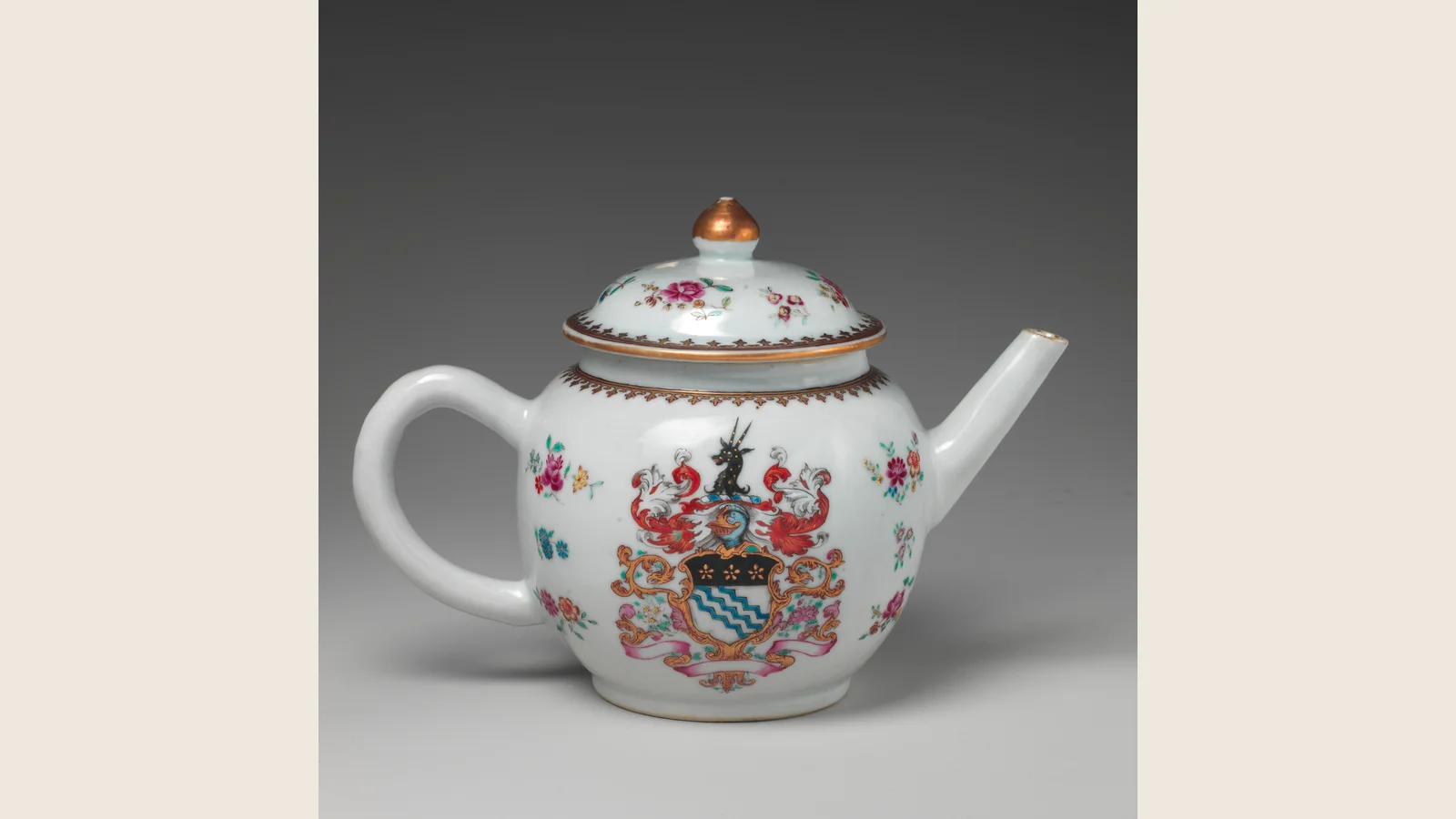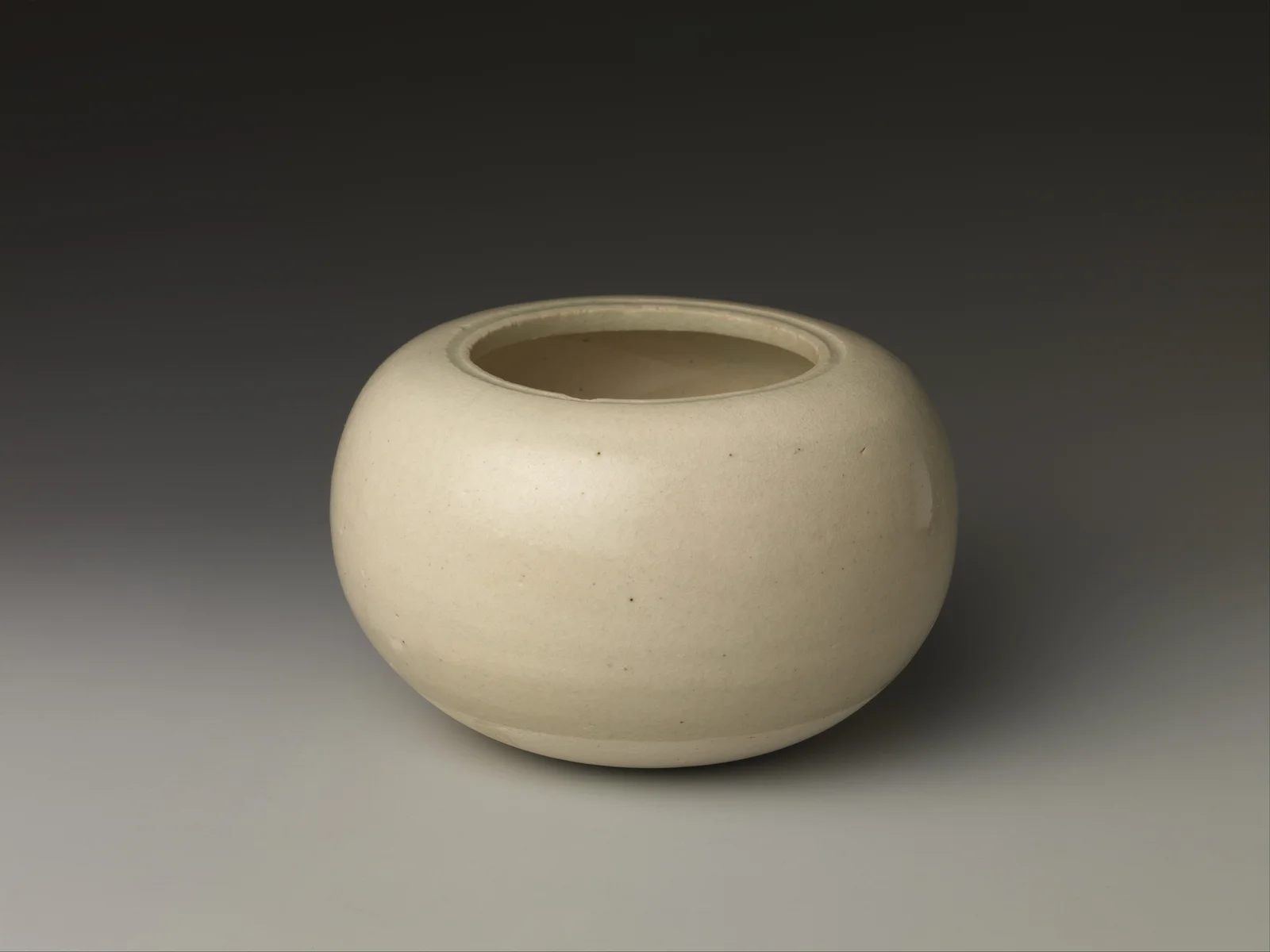
Chinese porcelain lamps combine a ceramic body with a source of light: today that usually means a shaded table lamp, but historic oil lamps and later vase conversions belong to different histories. My first choice for everyday use is a properly documented modern lamp that lights the chair well—not an antique-looking vase with an unexplained cord. Choose the shade, usable light and safe assembly together; assess collectible ceramic bodies separately.
Chinese porcelain lamps should make the evening better
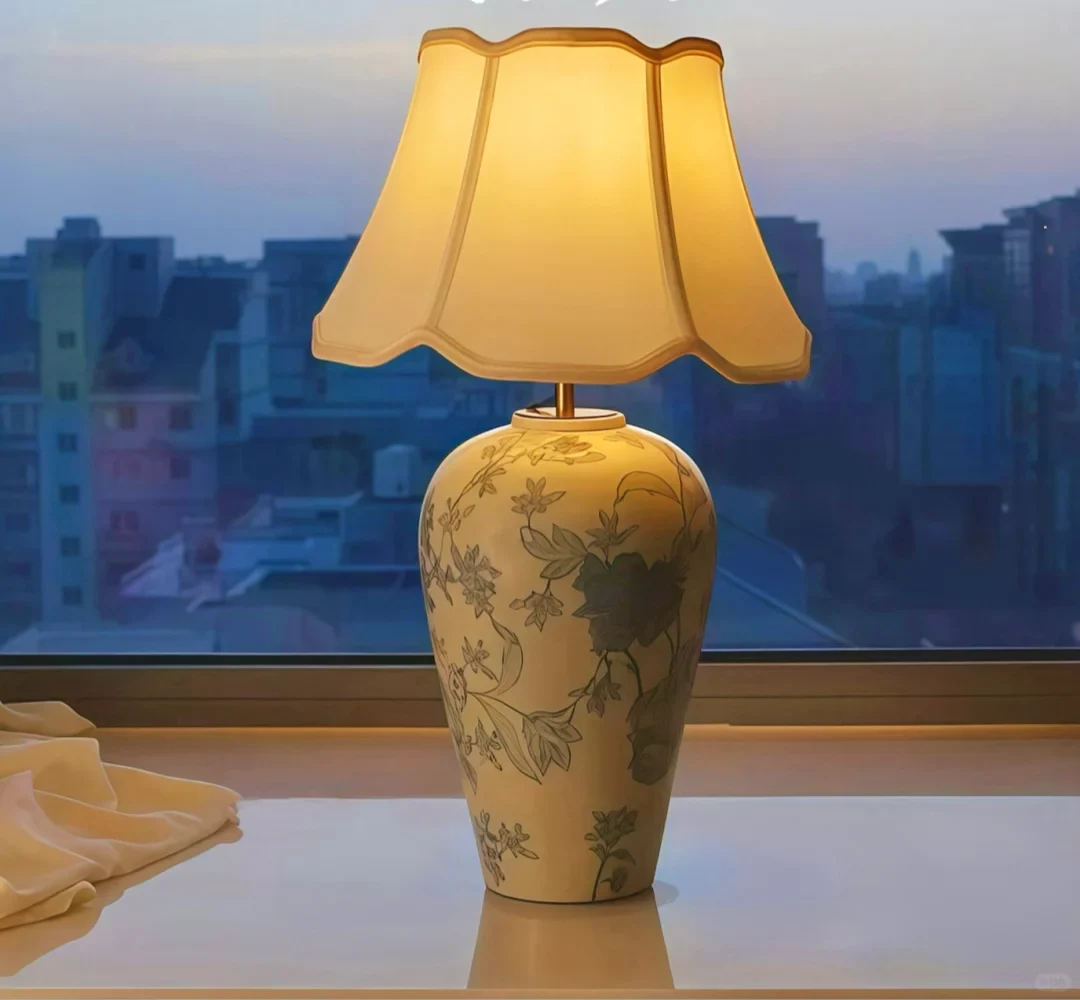
Look at the contrast in the opening photograph: blue evening outside, warm light inside, flowers on the vase no longer reading as cold blue-and-white decoration. The shade changes the mood before anyone has identified a dynasty. That is what I want a lamp to do. It should make a room feel inhabited, not simply certify its owner's taste.
I also want less visual noise. A busy painted body, a heavily patterned shade and an elaborate finial can each be attractive alone and exhausting together. A plain shade often gives the ceramic more presence, not less. In this example the scalloped outline is already a strong gesture; the shade does not need another landscape competing with the flowers below.
The photograph shows a home conversion, not a safety-tested product recommendation. Its useful lesson is visual: the shade gives the light an edge, the pale body reflects a warm cast, and the window provides a cooler contrast. I would take that design question to a properly made lamp, not copy electrical work from a pleasing image.
Before buying, decide whether you want light for reading, soft light across a room or primarily an object to look at. A shade that glows beautifully while leaving a book in shadow has succeeded at the second job and failed at the first. No porcelain pedigree changes that.
A ceramic body and its fittings can belong to different centuries
Most listings tell one smooth story: “antique Chinese porcelain lamp,” followed by a front photograph, a dynasty-shaped adjective and warm light glowing through a silk shade. The sentence feels complete. It is not.
The first biography belongs to the ceramic body. What is the material? What form was it? Was it made as a lamp, a vase, a bottle, a jar or something else? Where are the foot, mouth and marks? Has the base been drilled, covered or repaired? Which claim is supported by an exact museum comparison, provenance or qualified examination?
The second biography belongs to the lighting system. Who fitted the socket and switch? How does the cord leave the body? Is there strain relief? What does the label identify: a single lampholder, a cord set, or the complete assembled lamp? When was the system last reviewed by someone qualified to assess it?
When a seller fuses both biographies into one phrase, age leaks across the boundary. An old bottle becomes an “old lamp.” A modern socket borrows prestige from a crackled glaze. A fresh ceramic body borrows mystery from distressed brass. That is exactly where serious looking must begin.
This page therefore owns a different question from our Chinese porcelain vase guide. That guide reads vase form. Here we decide whether the ceramic was born as lighting, converted later, or assembled recently—and whether the working object in front of us deserves to enter a real home.
“Porcelain lamp” can name four different objects
The search phrase mixes four families that should never be treated as synonyms.
| Object family | Honest description | Evidence that matters | The shortcut I reject |
|---|---|---|---|
| Historical porcelain oil lamp | A purpose-built ceramic vessel for oil, wick and flame | A form that explains fuel, wick, handling and support; exact records and provenance | “Anything old and associated with light is a table lamp” |
| Historic vessel later mounted as a lamp | A bottle, vase or other body given a second lighting life | Original ceramic form, conversion date, drilling, mounts and separate electrical history | “The whole lamp is Ming because the body might be Ming” |
| Modern purpose-built porcelain table lamp | Ceramic body and lighting system designed as one contemporary product | Manufacturer, complete-product label, ratings, stability, dimensions and support | “Modern means culturally empty” |
| Undocumented conversion | An unknown ceramic body fitted with unknown hardware | Missing evidence is the defining fact | “Pretty enough to plug in” |
The distinction is not theoretical. The Smithsonian National Museum of Asian Art catalogues a Southern Song dynasty, twelfth- to thirteenth-century Lamp with attached stand. It is qingbai ware—porcelain under a transparent pale-blue glaze—and only 10 centimetres high. The form is an actual lamp, not a twenty-first-century table lamp and not a vase with a cable through it.
That small object corrects an enormous online mistake: China did make purpose-built porcelain lamps, but their existence does not validate every converted vase sold under the same English keyword.
A Song qingbai lamp changes the whole conversation

Southern Song qingbai “Lamp with attached stand,” Smithsonian S2012.9.3112, 10 × 7.7 cm. The shallow container and attached support belong to a small historical lamp, not a modern vase beneath a shade.
I love this object because it refuses the glamour that search results push toward us. It is compact. The attached stand is not an accessory added to make it “look antique.” The relationship between container and support belongs to the object’s operation.
Read it in this order:
- Function is legible in the form. The vessel is proportioned around oil and flame, not around flowers.
- Scale prevents fantasy. Ten centimetres is not the monumental body imagined by “large antique Chinese porcelain lamp.”
- The catalogue separates what is known. Period, material, dimensions, accession number and provenance status are recorded rather than compressed into a sales adjective.
- The object does not certify a stranger. It teaches a method. It cannot authenticate the lamp in your browser tab.
The history of Chinese porcelain explains how materials and kiln systems developed over long periods. The how Chinese porcelain is made guide follows body preparation, shaping, glazing and firing. Both deepen the ceramic biography. Neither can tell us who drilled a specific base or installed a specific cord.
That second biography still waits.
Converted vase lamps are cultural biographies, not automatically vandalism
Conversion is not one moral category. Some conversions destroyed rare evidence. Some were commissioned by collectors who valued Chinese porcelain but wanted it to live inside a different interior tradition. Some were practical later lives for ordinary or damaged vessels. Some modern “vase lamps” were always designed as lamps and merely borrow vase silhouettes.
The Walters Art Museum records a fifteenth- to sixteenth-century Chinese Longquan Celadon Lamp with French mounts made in the mid-eighteenth century. Its catalogue credits a Chinese ceramicist and a French metalworker. Two makers, two places and two periods occupy one assembled object. That is not a flaw in the record. It is the record’s most interesting fact.
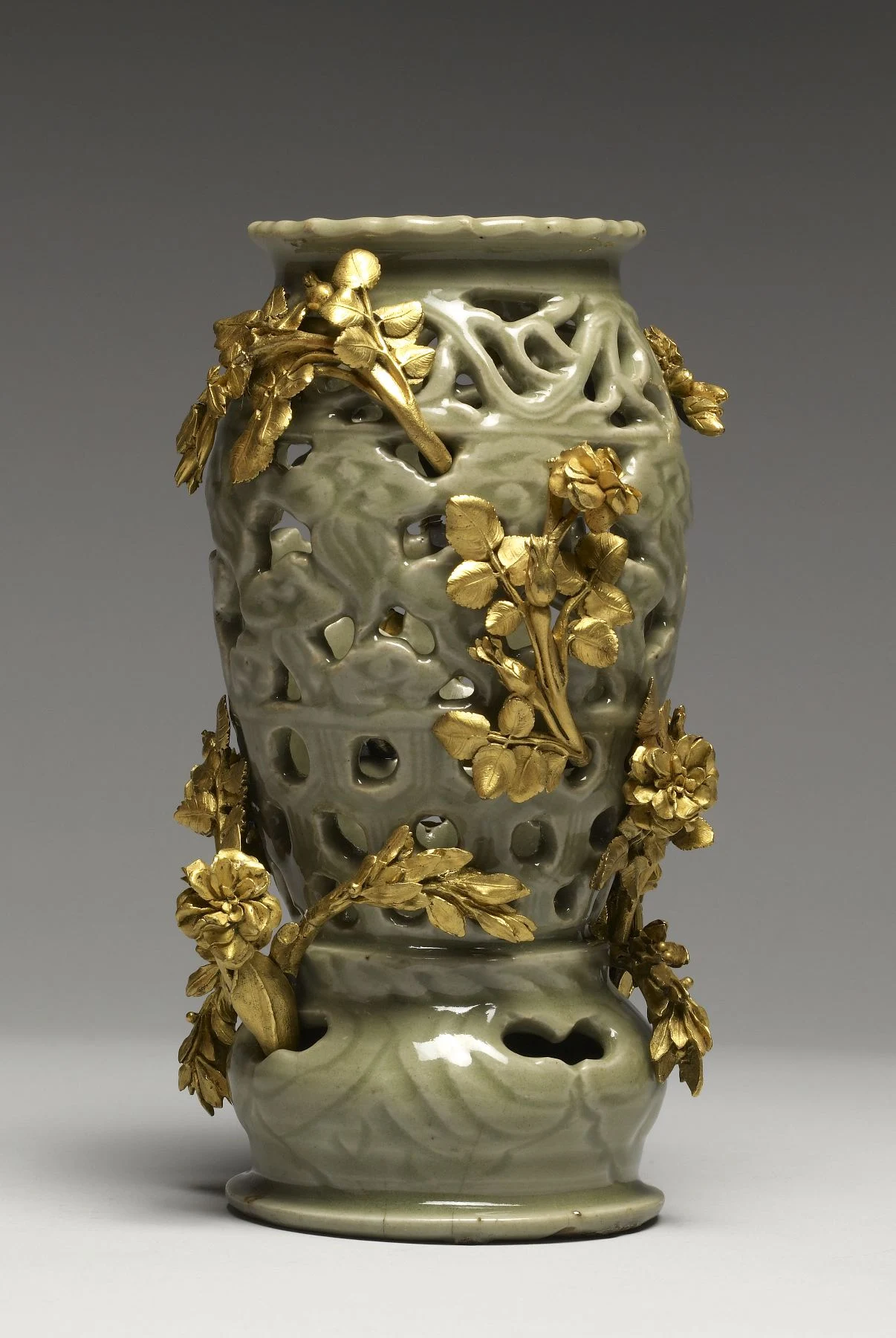
Metal flowers climb across green ceramic instead of matching its carved pattern. Walters Art Museum, 49.1508; photograph, CC BY-SA 3.0, resized to WebP.
This is not an electrical conversion. That matters: “lamp” has a history before sockets. Notice how the curling metal flowers interrupt the pale pierced surface rather than disappearing into it. I find that visible disagreement more interesting than a claim of untouched purity. The metalworker has changed the object without making its ceramic body visually disappear. It is a useful counterpoint to a modern shade hiding a vase's entire neck.
LACMA catalogues a pair of seventeenth-century Chinese blue-and-white square porcelain bottles that were later fitted at the neck with metal lamp mounts. Notice the discipline of the noun: the museum does not let later hardware erase the bottles’ ceramic identity.
This is the language I want marketplace listings to learn:
- “Chinese porcelain bottle, seventeenth century, later mounted as a lamp” is a separated claim.
- “Seventeenth-century Chinese lamp” is a fused claim that may make the lighting function sound original.
- “Antique Chinese-style table lamp” may describe a later lamp inspired by older forms, but it says nothing about Chinese manufacture.
- “Vintage Chinese porcelain lamp” still needs dates for body and fittings, not one floating decade.
My own position is firm but not puritanical: a documented conversion can be a meaningful cross-cultural object. An undocumented conversion is merely a question with a cord.
Before conversion, a vessel owns its mouth, foot and silence

Intact contemporary vessels at the Jun Ceramic Culture Park. Their mouths, narrowing necks and separate feet already make complete silhouettes; a lamp fitting is not a missing part.
This field image carries the page’s most personal conviction. I look at the gourd form, narrow necks, rounded bellies and small feet, and I do not see unfinished lamp bases. I see complete ceramic decisions.
A vase does not need a useful second job to justify its space. Empty porcelain can hold light without containing a bulb. The glaze catches illumination; the shoulder turns shadow; the negative space between vessels becomes part of the room. A beautiful old vase should not have to lose its base to become useful.
That does not mean “never convert anything.” It means the decision must be proportionate to the evidence and significance. Before drilling or permanently mounting a vessel:
- identify the material and form as far as evidence allows;
- photograph mouth, interior, full profile, foot and base;
- record marks, labels, damage and provenance;
- ask whether a reversible external mount can achieve the result;
- have a ceramics specialist assess an object that may be old, rare or structurally vulnerable;
- have the complete lighting assembly designed and reviewed by qualified professionals.
The Chinese ceramic glazes guide is useful here because visual colour alone cannot identify the body or date. The Chinese ceramic marks guide matters because a mark hidden by felt or a wooden base cannot simply be replaced by a seller’s transcription. Photograph evidence before hardware buries it.
Turn the lamp over: the underside is the witness
Most product photographs are staged from eye level because the seller wants the shade glowing and the ceramic body facing forward. The underside receives one dark photograph, if any. I reverse that hierarchy. The base is often the most valuable frame in the listing.
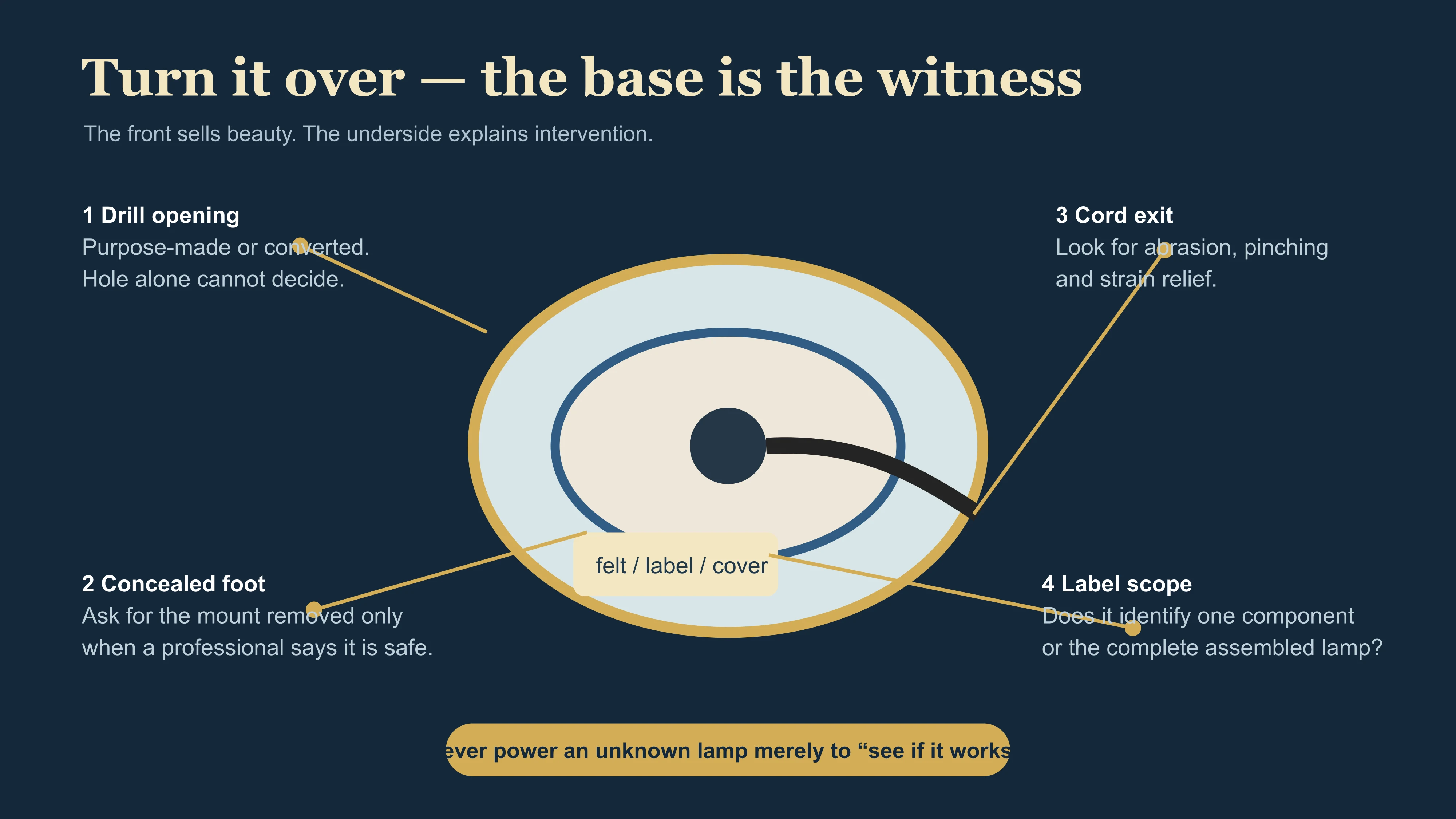
Ask for these views while the lamp is unplugged:
- the complete underside, not a close crop of one label;
- the junction between ceramic, wood or metal mount;
- every drill opening and cord exit;
- the foot ring or as much of it as can be seen without unsafe disassembly;
- felt, adhesive, staples, screws, plugs and replacement patches;
- maker, rating, testing and repair labels in readable focus;
- the cord along its full accessible length and both sides of the plug.
A hole in the base can belong to purpose-made lamp construction or to a later conversion. The hole alone does not establish which. Its finish, relation to the foot and glaze, surviving fittings and documented history need to be read together. Even an established conversion can contain three dates: ceramic manufacture, first lamp mounting and later rewiring.
Wooden stands create another problem. They may improve stability and create a route for the cord, but they can hide the foot, marks, cracks or restoration. Do not force a mount off for photographs. A qualified person should decide whether removal is safe and useful. Better documentation must never become a new source of damage.
Blue-and-white porcelain lamps are patterns wrapped around volume
Blue-and-white lamp bodies succeed when the decoration works around curvature, hardware and shade—not when a flat pattern is pasted onto a generic bulbous form.
The Chinese blue-and-white porcelain guide shows how cobalt brushwork, borders, reserves and negative space travel across curved surfaces. A lamp adds new interruptions: the shade shadows the neck, the socket hides the mouth, a base cuts across the foot, and the cord determines which side can face the room.
For a blue-and-white Chinese porcelain table lamp, inspect four relationships:
Pattern to shoulder. Does the main scene compress awkwardly as the body narrows, or does it breathe with the form?
Pattern to hardware. Does a brass cap slice through the border? Was the mouth widened or ground to accept a mount?
Pattern to pair. For paired lamps, are the scenes mirrored, matched, merely similar or unrelated? Photograph both all the way around.
Blue to actual light. Warm bulbs, cream shades and yellow walls can make cobalt appear softer or greener. Neutral daylight photographs are required before judging colour.
Never date blue-and-white porcelain from “the blue looks old.” Cobalt tone changes with pigment, concentration, firing, glaze, photography and display. Pattern is a visual system; age is an evidence system.
Height creates another naming trap. A tall cylindrical porcelain vessel is not automatically a lamp base, just as it is not automatically an historical umbrella holder. If the object is being sold for floor storage rather than wired lighting, use the Chinese porcelain umbrella stand guide to test opening, reach, stability, drainage and evidence of original function before the room photo decides the name.
Proportion decides whether the lamp lives well in a room
A collector can become so absorbed in the ceramic body that the finished lamp stops working as light. A decorator can do the opposite: chase a perfect silhouette while ignoring an unstable or historically significant vessel. The room forces both stories together.
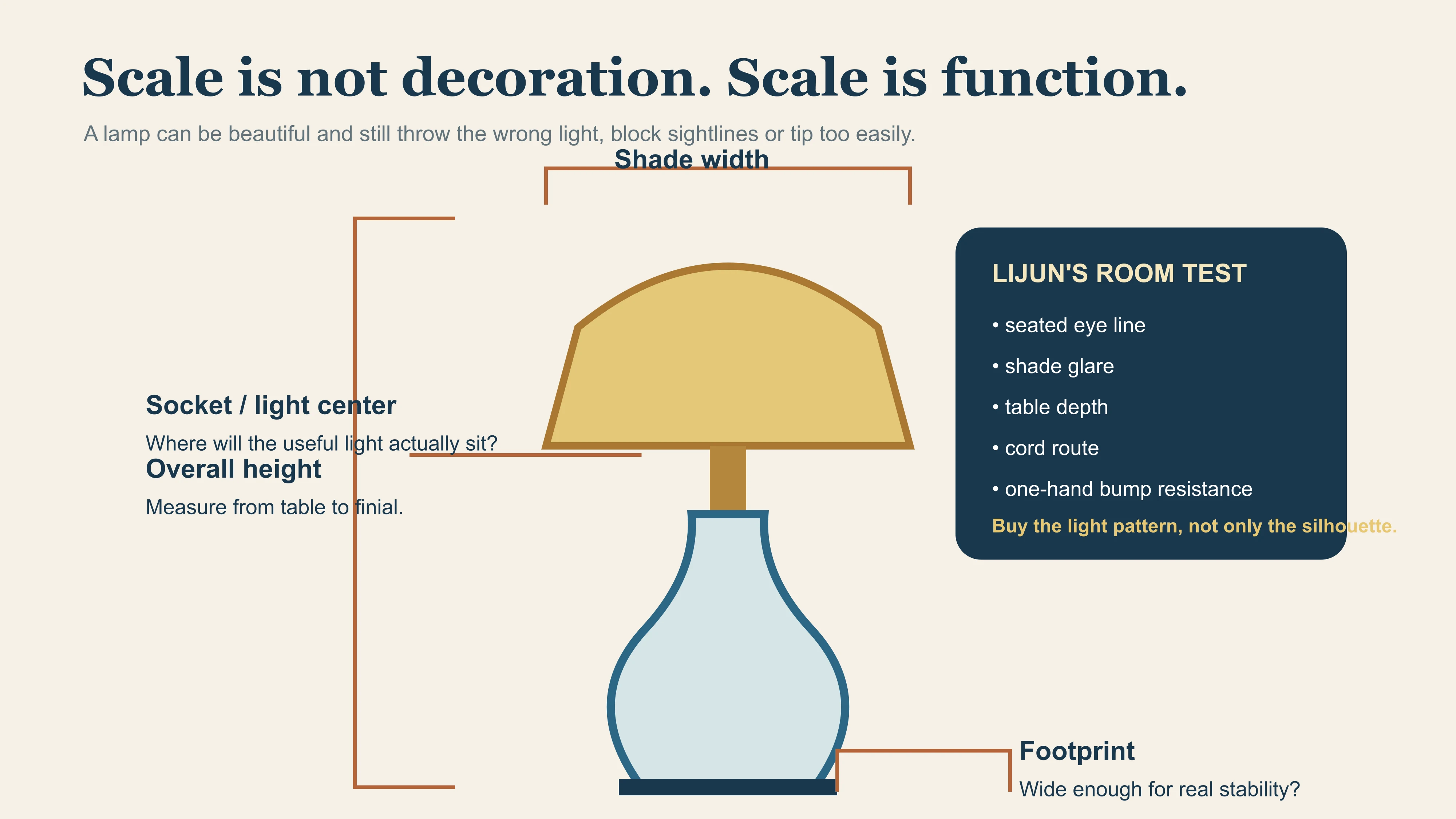
Measure the assembled lamp before buying:
- Overall height from table to finial.
- Ceramic body height and widest diameter. These determine visual mass and table depth.
- Shade width and height. A tiny shade over a broad body can look bottom-heavy; an oversized shade can swallow pattern and block sightlines. Visual balance is not a physical stability test.
- Socket and bulb position. This is where useful light begins, not where the ceramic ends.
- Base footprint. Include every wooden or metal stand and felt pad.
- Cord route. A beautiful lamp with a cord stretched across a walkway is a failed room decision.
Then test the lamp against real life. Sit beside it. Will the bulb glare under the shade? Can two people see across the table? Will a sleeve catch the shade? Can a child or pet nudge the table? Does the base rock? Is the switch reachable without twisting the ceramic body?
My verdict is simple: buy the light pattern, not only the porcelain silhouette. A lamp is successful when the body, shade and room share one centre of gravity—visually and physically.
Two situations make the difference clear. At a reading chair, an exposed bright bulb at seated eye level is irritating even if it looks concealed from a standing product photographer's angle. In a bedroom, a wide shade may soften the wall beautifully but occupy the entire bedside surface. Compare the lamp from the position where it will be used, with the book, glass and alarm clock that will stay beside it.
I do not use a fixed “shade twice the vase width” rule. A narrow-necked bottle and a squat jar distribute their visual weight differently; shade slope and opacity change the result again. Use a compatible shade and bulb within the lamp maker's specifications, then judge illumination and proportion. Never sacrifice required clearances or electrical compatibility for a better silhouette.
If the base is going on a ceramic garden stool, the support question comes first. A crowned or pierced top is not automatically a table; a cord across the route to the chair defeats the whole arrangement. I prefer a stable conventional side table to a precarious porcelain-on-porcelain display.
Electrical evidence must belong to the complete lamp
This section is not a rewiring tutorial. Unknown electrical equipment should stay unplugged until it is assessed by a qualified lamp or electrical professional. Turning it on is not a diagnostic method.
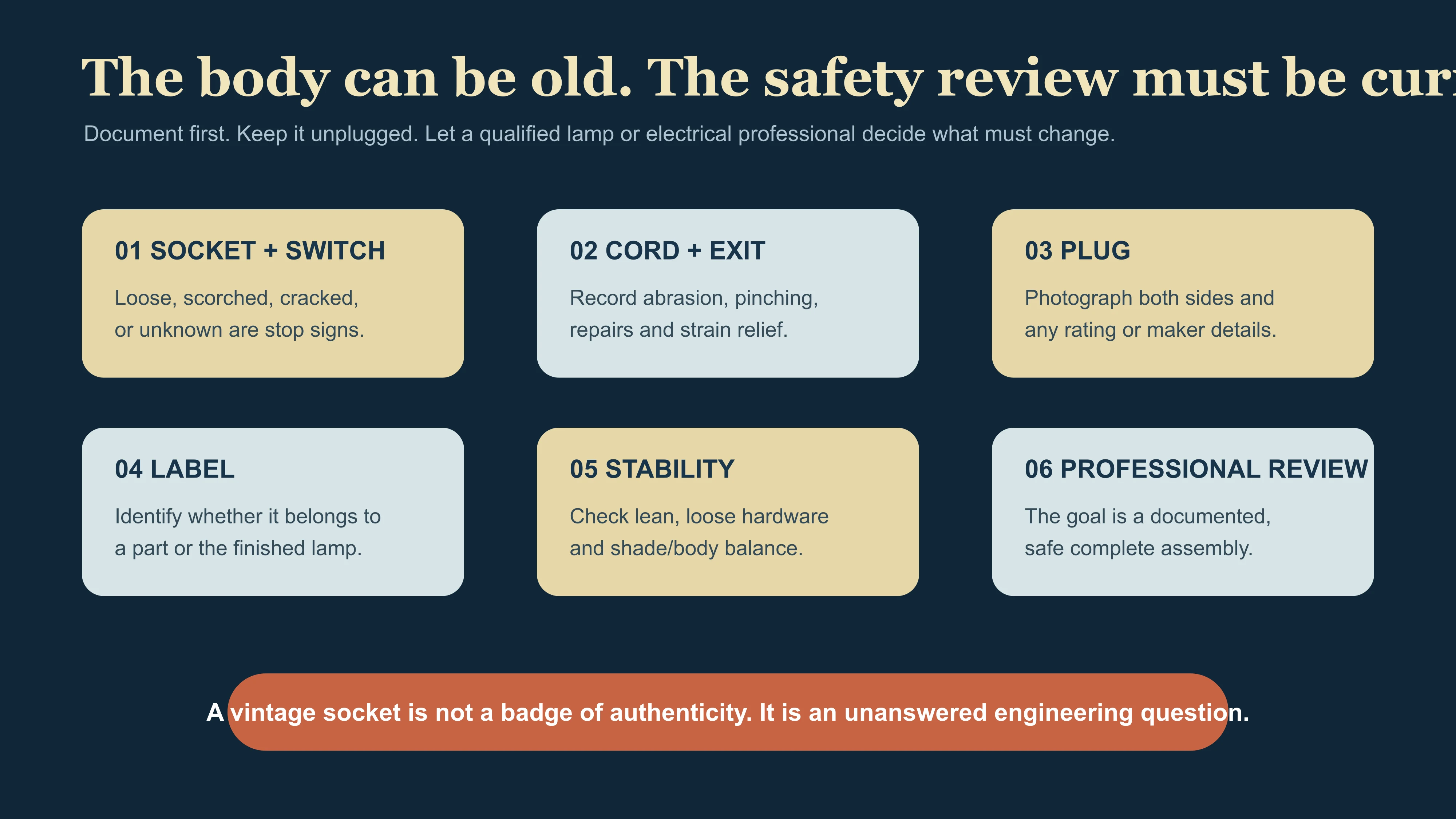
For a working lamp in the United States, ask what recognized laboratory evaluated the complete assembled product, which mark and standard apply, and whether the label belongs to the finished lamp or only one component. OSHA’s official UL scope of recognition includes UL 153 for portable electric lamps, alongside standards covering lampholders and other components.
That fact needs a boundary. OSHA’s NRTL program is built around workplace product-safety recognition; it is not a magic sentence proving that every residential vintage lamp is currently safe or that every lamp legally requires one specific mark in every context. A legitimate component mark also does not certify the complete assembly around it.
I want six documented zones:
- socket and switch condition;
- cord insulation and repairs;
- cord exit and strain relief;
- plug condition and ratings;
- stability of hardware, harp, shade and finial;
- labels that can be traced to their actual scope.
Scorching, brittleness, exposed conductor, a loose socket, improvised tape, a pinched cord, uncertain grounding, or a plug that becomes hot are not “vintage details.” They are reasons to stop. The safest version of an “antique lamp” may be an old ceramic body with a professionally designed, documented modern electrical system. Rewiring can reduce the age of the hardware while increasing the honesty of the working object.
Antique and vintage listings need a two-column evidence file
Do not ask a seller, “Is it authentic?” That invites one answer to cover ten separate claims. Ask for a two-column file.
| Ceramic-body record | Lighting-system record |
|---|---|
| Material description and basis | Socket type and condition |
| Original form and possible function | Switch location and operation |
| Measurements and weight | Cord, plug and strain relief |
| Mouth, interior, foot and base | Manufacturer and rating labels |
| Marks and exact photographs | Date and author of conversion or rewiring |
| Chips, hairlines, repairs and drilling | Qualified review or service documentation |
| Provenance and old photographs | Scope of any testing/listing mark |
An honest seller may not know everything. “Unknown” is acceptable. A decorative story pretending to close every gap is not.
For antique Chinese porcelain lamps, separate age of body, mounts and wiring. For vintage Chinese porcelain lamps, request an actual manufacturing or conversion range. For a Chinese vase lamp, state whether “vase” describes a functional vessel converted later or merely the body’s silhouette. For a modern Chinese porcelain table lamp, ask who manufactured the finished lamp and what after-sales documentation exists.
Never use one copied reign mark to leap across material, date, factory, conversion and value. Our Chinese export porcelain guide explains how Chinese forms travelled and answered overseas demand. Cross-cultural movement is expected. It does not make every later mount original or every European-style lamp body an antique export commission.
My buying verdict: choose the biography you can defend
I divide buyers into four honest groups.
You need reliable everyday light. Choose a modern purpose-built lamp with a documented complete assembly, stable footprint, useful shade and replaceable support. Cultural depth can live in glaze, form, craft and maker—not in dangerous ambiguity.
You want a converted older ceramic body. Buy only when the ceramic and electrical histories are clearly separated. Demand photographs before and after restoration if available. Let a qualified professional assess the working system.
You collect Chinese ceramics. Preserve the vessel first. A lamp conversion is optional and may be irreversible. If the body could be rare, old or vulnerable, stop before drilling, grinding or hiding the base.
You inherited a family lamp. Keep the family story exactly as family history: where it stood, who used it, when the shade changed, who remembered it glowing. Then investigate manufacture and conversion independently. Affection is real evidence of meaning; it is not laboratory evidence of age.
This is where East Moment must sound different from a catalogue. I am not neutral about the object’s future. I would rather live with one empty, intact vase than a damaged vase forced to perform usefulness. But I would also choose a beautifully documented conversion over a fake purity story. Objects can have second lives. They must not have blurred biographies.
Show the light from the chair, not the sales angle
For Chinese porcelain lamps, ceramic history and ordinary comfort should strengthen each other. I want to notice the painting in daylight and enjoy the light after dark, without either experience borrowing a false claim from the other.
Share two photographs in Moments of an already safely functioning lamp: daylight and ordinary evening use, ideally from the same seat. What changes—the blue, the wall, the visible bulb, your desire to stay and read? Do not energize unknown or damaged equipment for this exercise.
If you later choose a compatible shade or move the lamp to a better support, add the result. The revealing picture may be the one where a beautiful lamp stopped glaring into someone's eyes. The Chinese art collection offers the next path into glaze, painting and intact vessels; this discussion brings those details back to the room where you actually live.