A Chinese porcelain umbrella stand can be a purpose-made holder or a tall vessel given a later household job. For daily use, choose a sound modern stand intended for wet umbrellas, with a reachable opening, stable base and removable drip container. I want a doorway that welcomes someone home in the rain, not a beautiful object everyone is frightened to touch. Collectible old vessels belong to a different buying decision.
A Chinese porcelain umbrella stand must work on a wet evening
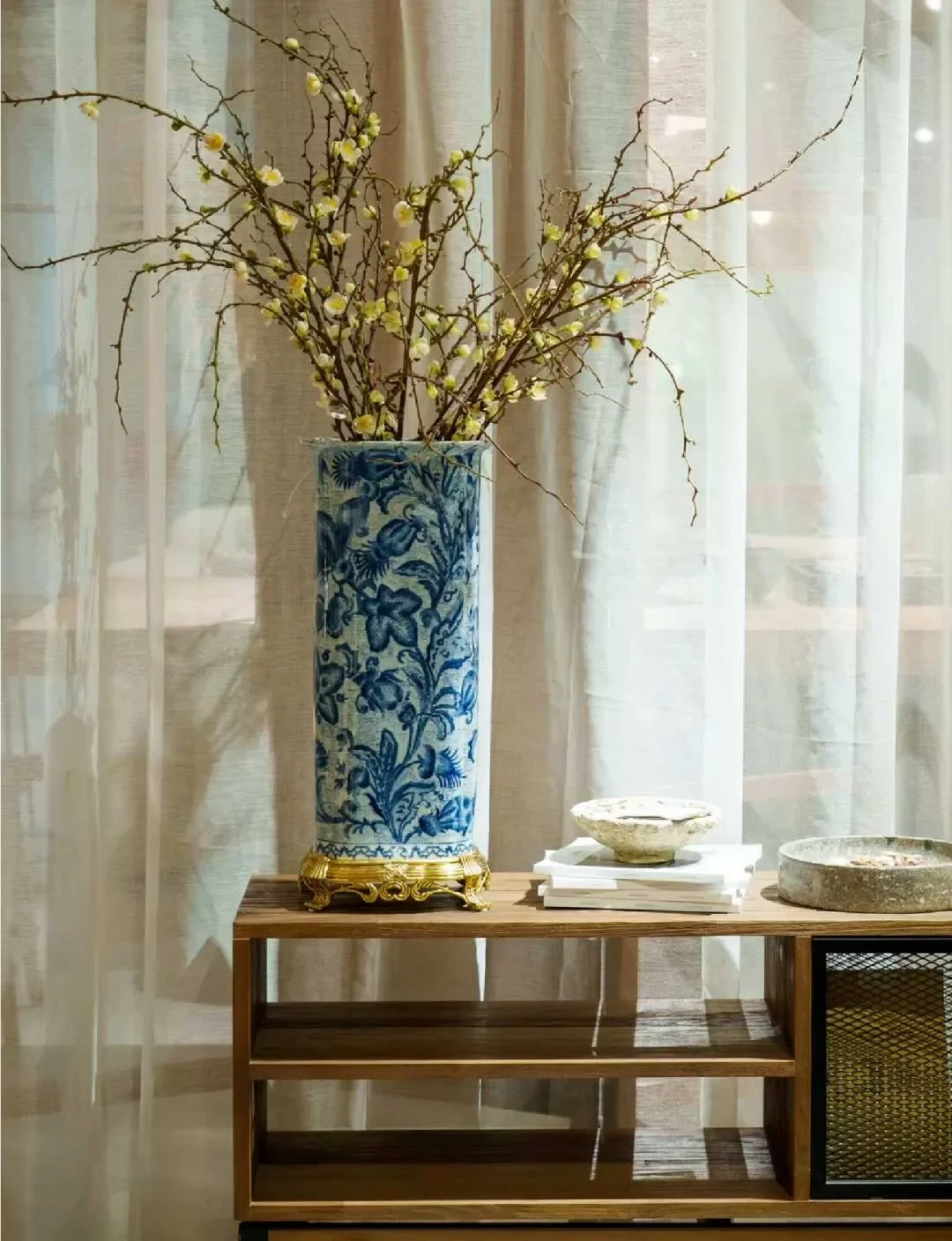
The blue-and-white cylinder above looks wonderful with branches against a window. But its elevated display position tells us nothing about how it would work beside a door. An arrangement for looking and an arrangement for arriving home are different jobs. For the second, picture one hand on the door, the other carrying shopping, and an umbrella that has not politely stopped dripping. That is the moment the design has to serve.
Start with the umbrellas you actually own. A deep cylinder may suit a long stick umbrella while swallowing a compact folding one. The short umbrella then sits out of sight near the wet base; retrieving it becomes a reach into a dark vessel. A separate removable basket or a hook outside the ceramic can solve that mismatch better than buying a taller, grander cylinder. Neither a high price nor a dragon pattern fixes the wrong opening.
Then follow the door's swing and the body's movement. A stand behind an opening door becomes an impact target. One just inside the clear route can catch shopping bags or trouser legs. I favour a position beside the arrival path, not inside it, with room to lift a long handle without scraping a wall picture. Measure the widest body and the handles above it, not only the footprint on the floor.
For a family that mainly uses compact umbrellas, an open rack may simply be the better choice. I will not recommend porcelain at the expense of a functioning entrance. The ceramic option earns its place when beauty and that particular household's habits agree.
When a jar takes the umbrella job
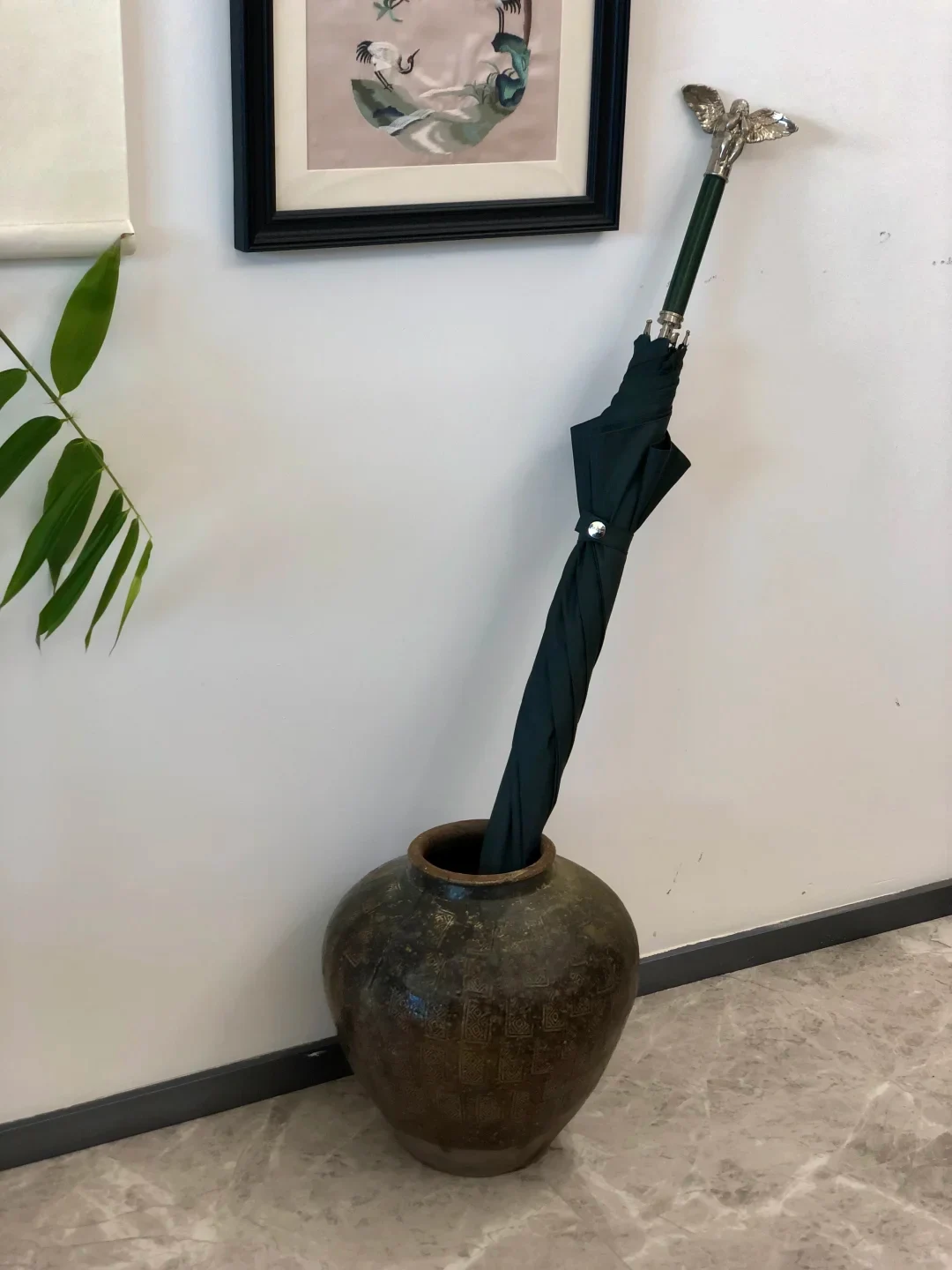
A rounded jar receives a long umbrella beneath a framed picture. Notice the narrow mouth, the handle's height and the broad belly close to the wall: each affects use differently.
I understand the appeal immediately. The dark rounded jar feels quieter here than an obvious plastic storage bucket; the umbrella's long line becomes part of the corner. I also see the compromise. A wide belly does not create a wide opening, and one umbrella leaning into the rim tells us little about capacity or water management. The material is described as ceramic, not verified porcelain. This is a real example of household reuse, not proof of an antique umbrella-stand type.
That distinction does not spoil the room. It makes the choice more intelligent. A modern vessel suitable for such use can acquire a second job; an unidentified old pot should not be recruited just because its colour matches the picture frame.
Rain comes through the doorway before scholarship does. Someone folds a wet umbrella, sees an empty blue-and-white cylinder and drops it in. The object now works as an umbrella holder. Ten years later a photograph appears online, and the caption quietly changes from “tall vase used by the family for umbrellas” to “antique Chinese porcelain umbrella stand.” Present use has swallowed origin.
I refuse that shortcut because it makes every attractive floor vessel less interesting, not more. A tall vase may have been made to hold flowers or command a room. A hat stand may have supported formal headwear and released fragrance through pierced walls. A large vessel may have acquired an umbrella job only after entering a modern house. A documented umbrella stand may still have been catalogued with a second possible use. These are not pedantic differences. They are the object’s biography.
The best institutional example preserves the ambiguity instead of hiding it. The Asian Civilisations Museum records a nineteenth-century Chinese porcelain object as Vase/Umbrella Stand. It is 62 centimetres high and 23.3 centimetres in diameter, decorated with phoenixes, peonies and plum blossoms, and associated with Peranakan use. The record says it was probably used as an umbrella stand, or possibly as a scroll holder. That “probably” is honest. It is stronger than a confident marketplace title because it tells us exactly where the evidence stops.
The ordinary question “where do I put the umbrella?” therefore leads to a much better historical question: what was this vessel doing before it reached the doorway?
Umbrella stand, tall vase, hat stand or scroll holder?
Search results flatten these names into synonyms because all four objects can look vertical in a cropped photograph. They are not synonyms.
| Label | What the label should mean | What to look for | The mistake I will not accept |
|---|---|---|---|
| Umbrella stand | An object documented or clearly constructed for receiving umbrellas | Usable mouth, accessible depth, stable base, practical scale, moisture strategy, provenance or reliable record | “It is tall, therefore it was made for umbrellas” |
| Tall vase | A vessel whose form belongs to flower, display or another vase tradition | Mouth, neck, shoulder, belly, foot and an interior consistent with the form | “It holds an umbrella, therefore it is an umbrella stand” |
| Hat stand | A support for a hat or crown; some examples also functioned as perfumers | Rounded or supporting top, pierced chamber, removable parts, much smaller scale in documented examples | “A Chinese cylindrical stand is automatically an umbrella stand” |
| Scroll holder | A vessel or container associated with rolled scrolls | Diameter, interior, abrasion, documented context and dry use | “Every open floor cylinder with paper inside was made for scrolls” |
| Repurposed vessel | An older or modern vessel given a new household job | Evidence of present use, perhaps wear or a liner, but no automatic original-function claim | “Long use by one family rewrites original identity” |
The Chinese porcelain vase guide reads mouth, neck, shoulder, belly and foot before naming a vase shape. The Chinese porcelain jars guide begins with access, lid and enclosed volume. This page owns a different decision: whether “umbrella stand” describes documented origin, plausible construction, later use or merely an SEO-friendly seller label.
Hat stands prove that the word “stand” is not enough
The most useful counterexample is a real porcelain hat stand. The National Palace Museum in Taipei records a Qianlong-period porcelain hatstand with green clouds and dragons. It is 22.6 centimetres high, with a rounded upper body that supported a crown; the top could be removed, aromatic material placed inside, and fragrance released through pierced walls.
The Calouste Gulbenkian Museum records another eighteenth-century hat stand at 27 centimetres high. Its catalogue calls the object guan xun—a hat-perfumer—and describes an openwork flower through which perfume could escape from an inner chamber.
These examples destroy a lazy translation. “Stand” does not mean “tall floor container.” The job can be support rather than storage. The openings can serve fragrance rather than drainage. A 22.6-centimetre crown support and a 62-centimetre vase/umbrella stand occupy completely different relationships with the body and room.
Even museum labels can preserve debate. The British Museum catalogues a pair of early-sixteenth-century Jingdezhen porcelain objects as hat-stands, yet its curator’s comments discuss competing suggestions including vases, perfumers, pen holders and flower containers. The holes themselves complicate the hat-stand interpretation. That is how serious object reading sounds: exact record, precise observation, open question.
Certainty is not professionalism. Well-bounded uncertainty is professionalism.
A real vessel makes the naming problem physical

A contemporary display vessel at the Jun Ceramic Culture Park: flared mouth, projecting handles and a swelling body. It is not a purpose-made umbrella holder in this photograph.
In a white-background listing, I might see only colour and height. In the room, the vessel pushes back. The mouth flares. The body expands. Handles interrupt the outline. The glaze changes under display light. It is not a neutral tube waiting for an English product label.
This is why I want photographs from several heights. A low view can exaggerate monumentality. A close crop can erase the base. A top-down photograph can reveal the opening while hiding how easily the body might tip. A room view supplies scale but may distort colour. No photograph is useless; no single photograph is enough.
The field image also carries a boundary that matters across this site: glaze appearance does not identify the ceramic body. A luminous surface may tempt a seller to call an object porcelain, Jun ware or antique. The Chinese ceramic glazes guide separates body, glaze and firing evidence; the how Chinese porcelain is made guide explains why surface colour alone cannot certify material or process.
Measure five things before discussing age
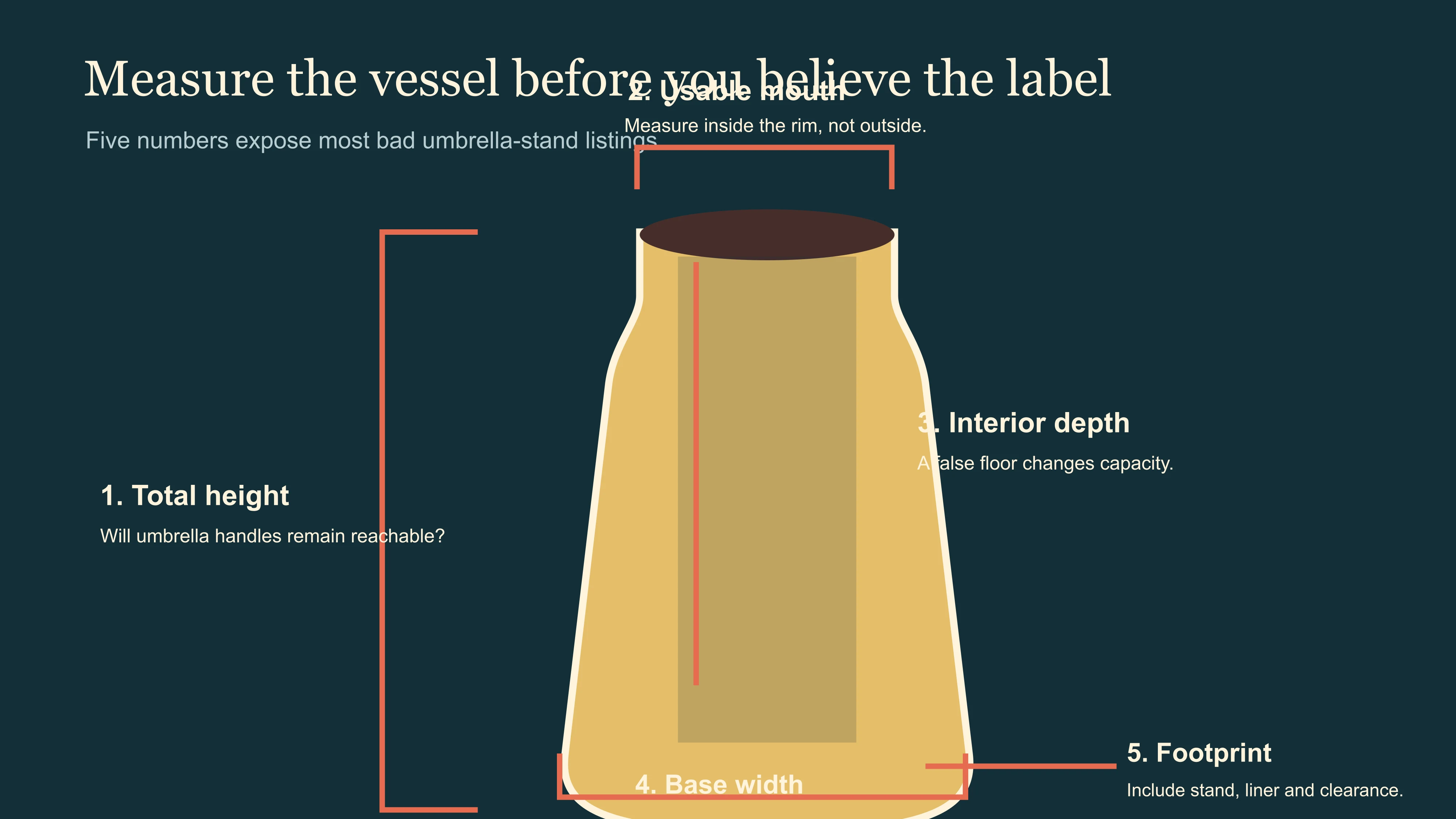
A seller who supplies twelve decorative close-ups but no measurements has not documented an umbrella stand. Ask for five numbers:
- Total height. Can full-size umbrella handles remain reachable, or will shorter umbrellas disappear inside?
- Usable mouth width. Measure the internal opening, not the widest outside edge. A heavy rolled rim or narrow neck can steal several useful centimetres.
- Interior depth. A false floor, thick base or narrowing shoulder changes capacity. A flashlight view and a measured stick are more useful than guessing from exterior height.
- Base width. The relationship between mouth, body and base affects stability when umbrellas lean outward.
- Actual floor footprint. Include a liner, saucer, stand, felt pads and enough clearance to remove an umbrella without hitting the wall, mirror or artwork.
The 62-by-23.3-centimetre museum object is a reference point for one accessioned vessel, not a universal standard. I would never convert it into “all authentic Chinese umbrella stands are around 62 centimetres.” Documented objects give us comparison, not a counterfeit ruler.
Weight matters too, but a number alone is incomplete. Ask whether the weight is concentrated low or high, whether the base sits flat, whether a separate wooden stand changes the centre of gravity, and whether an old repair weakens the body. A wide, heavy-looking vessel can still rock on an uneven foot. A slimmer modern stand can be stable if the base and load were designed together.
The evidence ladder stops a seller label from becoming history
I rank claims in five levels.
At the bottom is present use: the vessel holds umbrellas now. One step up is the seller label: useful for finding listings, weak as proof. Physical construction is stronger because mouth, interior, base, drainage and wear can support or contradict the claimed job. An exact object record adds accession history, measurements, material description and accountable cataloguing. A qualified physical examination is needed when the claim moves into date, attribution, repair, authenticity or value.
Notice what is missing: the base mark does not leap straight to the top. The Chinese ceramic marks guide explains why a reign mark can be contemporary, commemorative, copied, apocryphal or modern. A mark is evidence only when body, form, glaze, decoration, construction, condition and provenance agree.
The same applies to pattern. Blue-and-white dragons, birds, flowers or landscapes can help describe an object, but decoration does not prove umbrella-stand function. The Chinese porcelain patterns guide owns that visual grammar. Here, a phoenix or peony can be read as imagery while function remains a separate question.
An umbrella can become the most misleading provenance story in the room
The Chinese University of Hong Kong tells a wonderful, painful object story. A large Qing vase covered with repeated shou characters—76.1 centimetres high—was reportedly used as an umbrella stand for decades before its significance was recognized and the object authenticated. The university’s account, “Long Live the Majestic Vase,” is not evidence that every hallway vessel is a lost masterpiece. It proves the opposite point: later household use can conceal original identity.
I can almost hear the dangerous sales pitch writing itself: “Maybe this one is also a forgotten treasure.” No. A memorable story is not transferable provenance. That vase has its own documented path and specialist assessment. Your object needs its own.
Still, the story changes how I look at a wet umbrella leaning against an old vessel. Repurposing is not automatically disrespectful; homes give objects new lives. But use creates risk. Metal tips can strike the interior. Trapped water can stain liners and floors. Repeated pressure can exploit an old hairline. A wooden stand may hide the base. Household familiarity can make a vulnerable object feel tougher than it is.
My position is definite: if an object may be historically or financially significant, stop using it as an umbrella stand until it has been properly examined. A new purpose is optional. Damage is not.
The mouth tells you whether the object welcomes umbrellas or merely tolerates them

The faceted mouth and projecting handles make access a real design question. Neither the broad exterior nor the polished glaze tells us how easily objects pass through this opening.
Look at the mouth before admiring the body. A rolled lip can be comfortable against umbrella shafts but reduce capacity. A thin chipped rim can catch fabric or scratch a handle. A narrow neck may force umbrellas into one tight bundle, shifting the load outward. An angular opening may create specific pressure points. Projecting handles or applied decoration can be struck when an umbrella is removed in a hurry.
Then photograph the interior. I want to see:
- the full depth under neutral light;
- whether glaze continues inside;
- a removable liner, false bottom or trapped debris;
- cracks, old fill, staining or rough areas where water can collect;
- any hole, plug or drainage arrangement;
- the transition between wall and base.
Do not pour water into an unassessed antique to “test” it. Do not scrub an old interior because a dark deposit looks ugly. Cleaning can remove evidence, expose a repair or create a new stain. For a modern stand sold for working use, demand care instructions and a clear moisture strategy. For an old or uncertain object, choose preservation over improvisation.
The doorway test must happen before the first storm
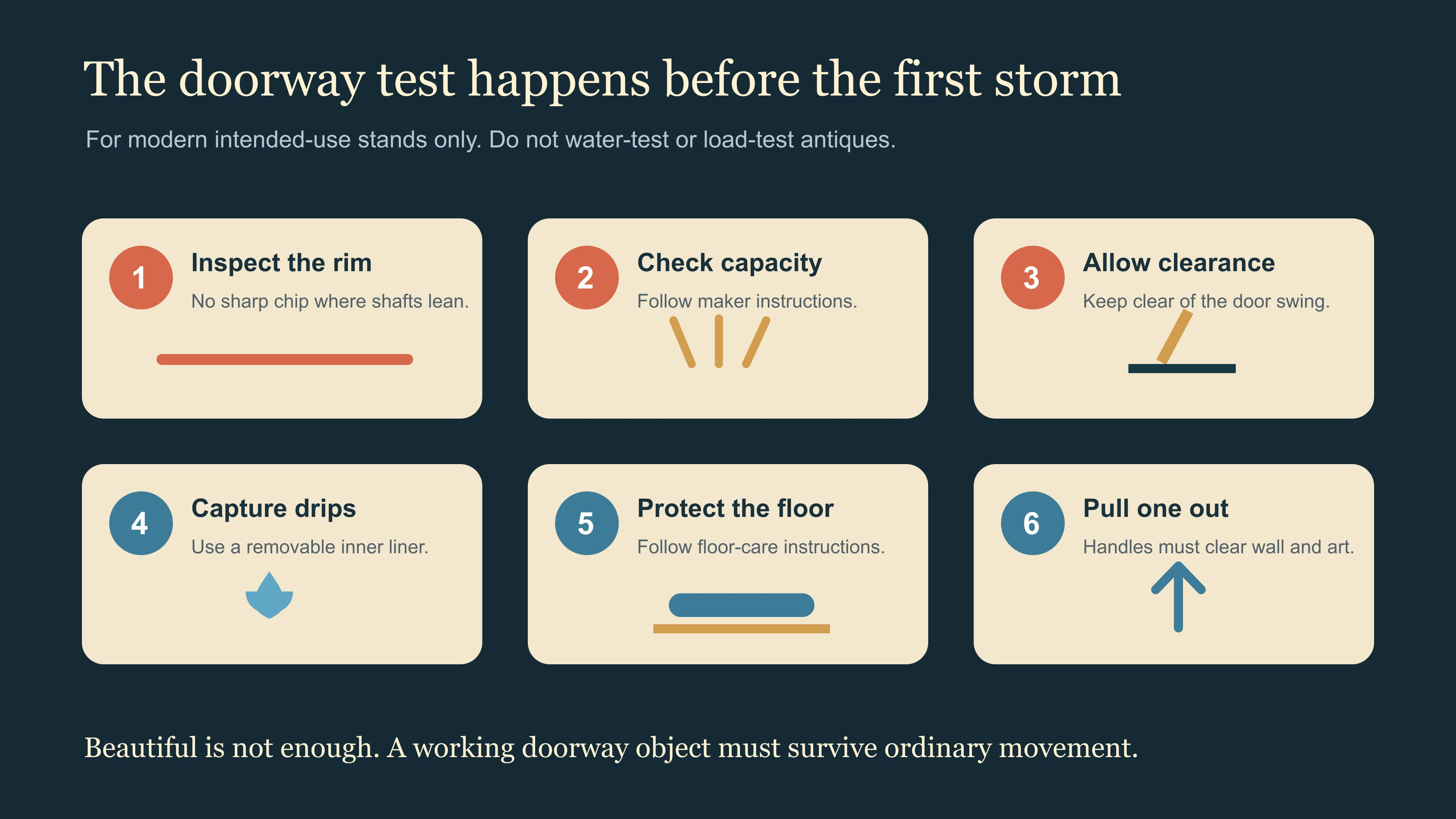
This is my practical test for a modern, structurally sound stand intended for umbrellas—not for an antique or fragile vessel.
Inspect the rim in good light without running a finger over possible chips. Follow the maker's setup and capacity instructions, including the supplied liner and floor protection. If normal intended use makes a new stand rock or shift, stop using it and contact the seller; do not improvise a weight or leaning test. The doorway is not the place to negotiate with gravity.
Next, solve moisture before introducing it. Use a removable inner liner or drip container that can be lifted and cleaned. Protect wood, stone and grout beneath the vessel. Keep standing water away from an unknown ceramic body, old repair, wooden stand or metal fitting. Make sure the tallest handle clears nearby frames and the shortest umbrella remains retrievable.
For older ceramics, the Canadian Conservation Institute explains why water, porous bodies and vulnerable finishes need individual attention. A liner is not permission to put an antique into wet service: condensation, handling and a forgotten overflow still reach the object. The simplest protection can be keeping that vessel out of the rainy-day routine altogether.
The object should pass six ordinary-life questions:
- Does the rim protect rather than damage umbrella shafts and fabric?
- Does the stand remain stable with one umbrella and with several leaning in different directions?
- Can drips be captured and emptied without moving the ceramic body?
- Can the floor beneath it be inspected and dried?
- Can one umbrella be removed without pulling the others forward?
- Can a hurried guest understand how to use it without a museum guard’s instructions?
That last question is my favourite. A functional doorway object must survive normal human behaviour. If it needs everyone to move slowly, distribute weight perfectly and remember a hidden crack, it is an exhibit pretending to be furniture.
“Antique,” “vintage” and “blue and white” answer different questions
These words often arrive in one listing title, but they do different jobs.
Antique is an age claim and needs evidence. Vintage is usually a looser market-age description and still needs an honest date range. Blue and white describes a visual and technical family, not function or age. Chinese can refer to place of manufacture, cultural style, export market or seller category; the listing must say which. Porcelain is a material claim, not a synonym for every glazed ceramic.
For a serious listing, request:
- overall front, back and both sides;
- mouth from above with a ruler across the usable opening;
- full interior under even light;
- base and entire foot, with any stand removed if safe;
- close views of every chip, hairline, repair, drill hole and stain;
- height, mouth width, base width, weight and interior depth;
- provenance documents, invoices and old photographs kept in sequence;
- a written statement of whether “umbrella stand” describes original documentation or current intended use.
If a seller refuses to distinguish those last two, walk away. The object may still be beautiful, but the story is being sold faster than the evidence.
The history of Chinese porcelain can place materials and production in a longer timeline, while the Chinese export porcelain guide handles the movement of forms and commissions across markets. Neither page can authenticate a marketplace object from photographs, and neither can this one.
Choose for the life you actually have
There are four honest buying situations.
You need a working family umbrella stand. Buy a modern object explicitly designed for wet umbrellas. Prioritize stability, liner, cleanable interior, replacement support and safe floor contact. Historical romance is less important than surviving Monday morning.
You want a decorative floor vessel. Buy it as a vessel. Let it hold dry branches, remain empty or simply occupy space. Do not force an umbrella job onto a narrow neck because the search result used that phrase.
You collect older Chinese ceramics. Pause at identification. Preserve labels and provenance. Photograph first; clean later, if a qualified conservator agrees. Do not let everyday use become a destructive authenticity experiment.
You already use a family vessel for umbrellas. Separate the two stories. Record how long your family has used it that way, because that is real household history. Then investigate original function independently. A later life is not fake; it simply should not impersonate the first life.
That separation is emotionally important. I do not want scholarship to erase a family memory, and I do not want a family memory to become a false dynasty claim. An object can hold both stories if we label them honestly.
Let the doorway be ordinary; let the object be understood
A Chinese porcelain umbrella stand should save a small amount of trouble every time someone comes home. If you have to fish for a folding umbrella, wipe a puddle under a treasured vase or warn every visitor about a fragile rim, the purchase has failed its everyday job, however impressive the blue-and-white decoration.
So my verdict is simple:
- Call it a documented umbrella stand when the record supports that use.
- Call it a vase/umbrella stand when an accountable catalogue preserves both possibilities.
- Call it a tall vase used as an umbrella stand when present use is known but original function is not.
- Call it a porcelain hat stand only when its form and documentation support that different job.
- Call it unidentified when the evidence is still thin. That word is not a failure. It is the beginning of honest looking.
Continue through the broader Chinese porcelain guide for material and historical context, compare object families in Chinese porcelain plates, and return to the Chinese Art hub when you want the whole ceramics cluster rather than one doorway object.
Tell us in Moments what happens after rain at your entrance. Long handles, folding umbrellas, a crowded family doorstep or a narrow apartment passage: name the actual problem and show the arrangement that solved it. Keep old ceramics out of staged load and water tests. After the next wet week, add whether the change still works. I am especially interested in the unglamorous correction—a separate basket, a moved hook, a vessel allowed to remain empty—that finally made coming home easier.