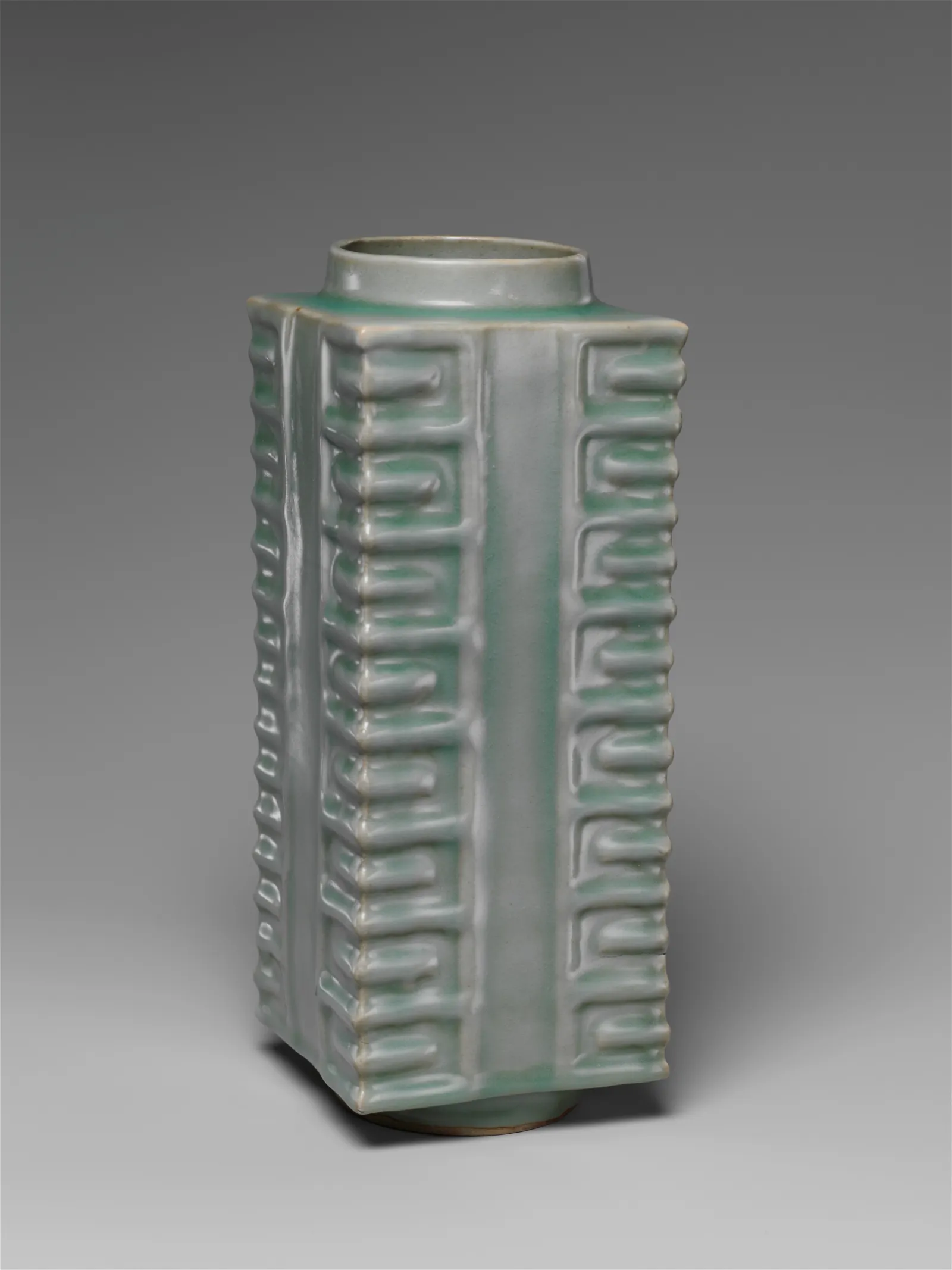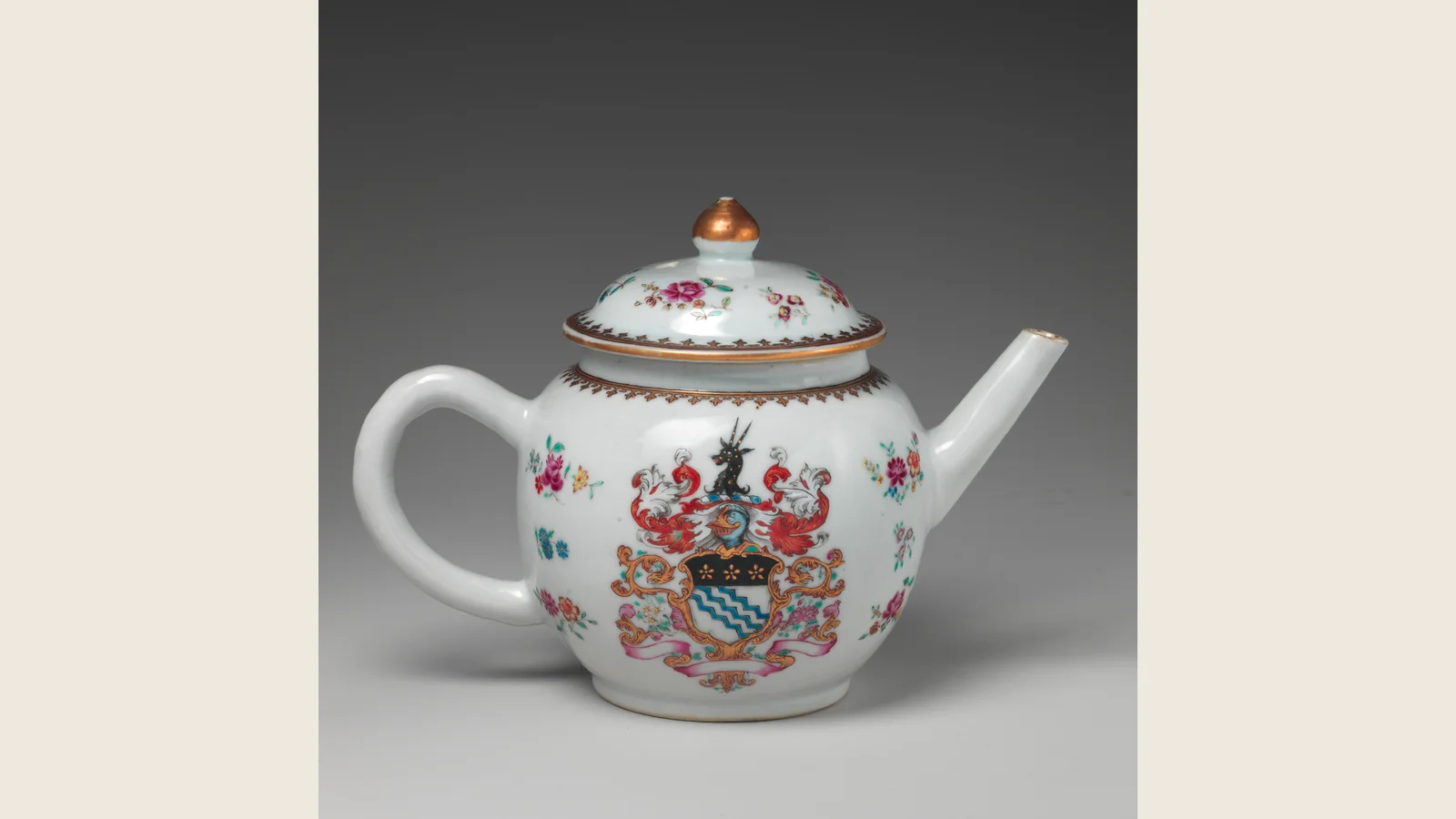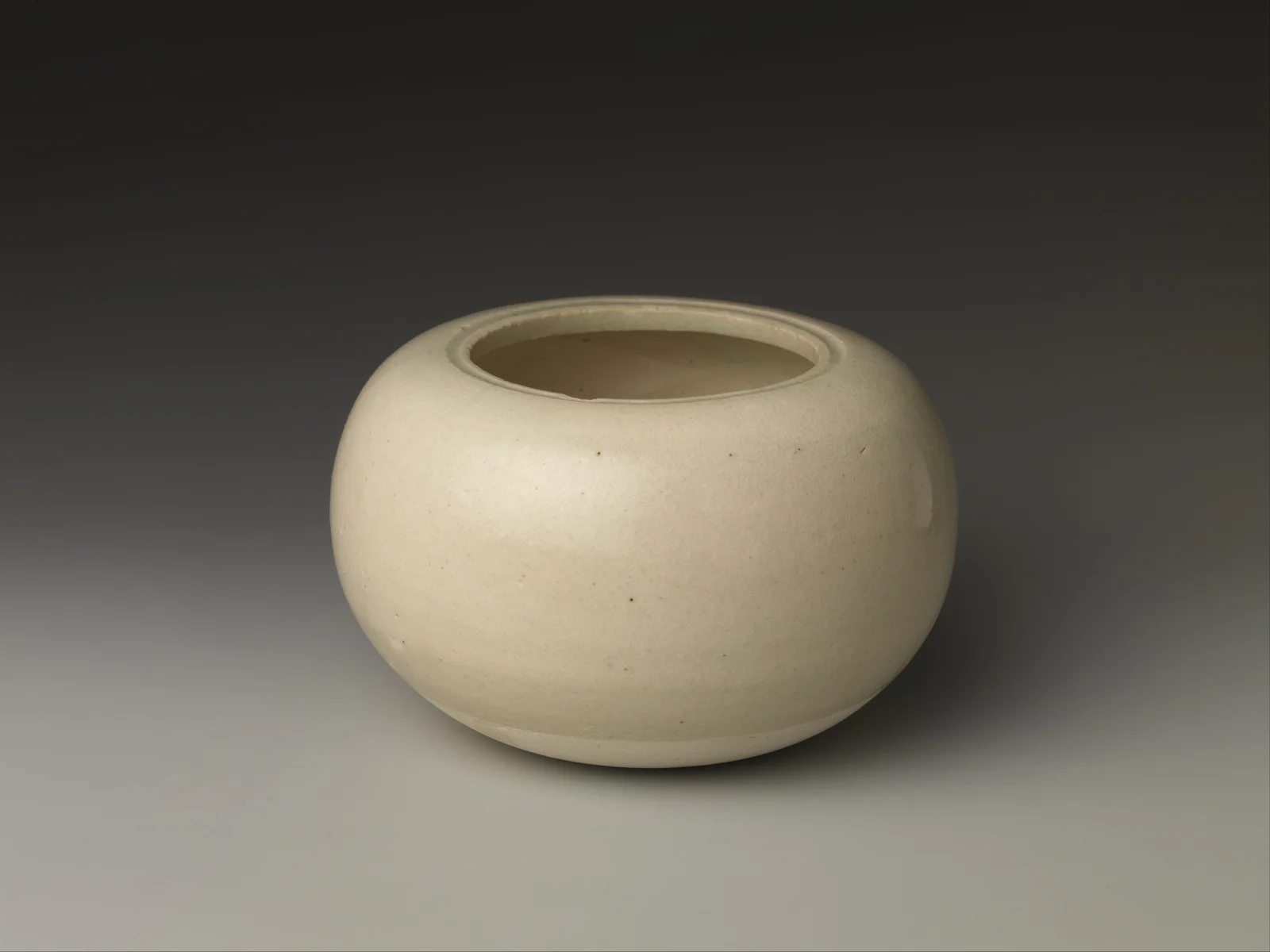
Chinese ceramic and porcelain marks can name a reign, a workshop, a hall or a wish. To read one, establish the writing direction, transcribe the characters and separate their meaning from the object's date. I want you to leave able to read something—not merely frightened of getting it wrong. The mistake is not being curious about the base. It is letting six characters erase everything above them.
Chinese ceramic marks are clues, not certificates
The urge is understandable. You turn a vessel over, find a few Chinese characters, and suddenly the bottom seems more important than the whole object. A reign mark, a studio name, an auspicious inscription or a collector's label can feel decisive because it is compact and legible.
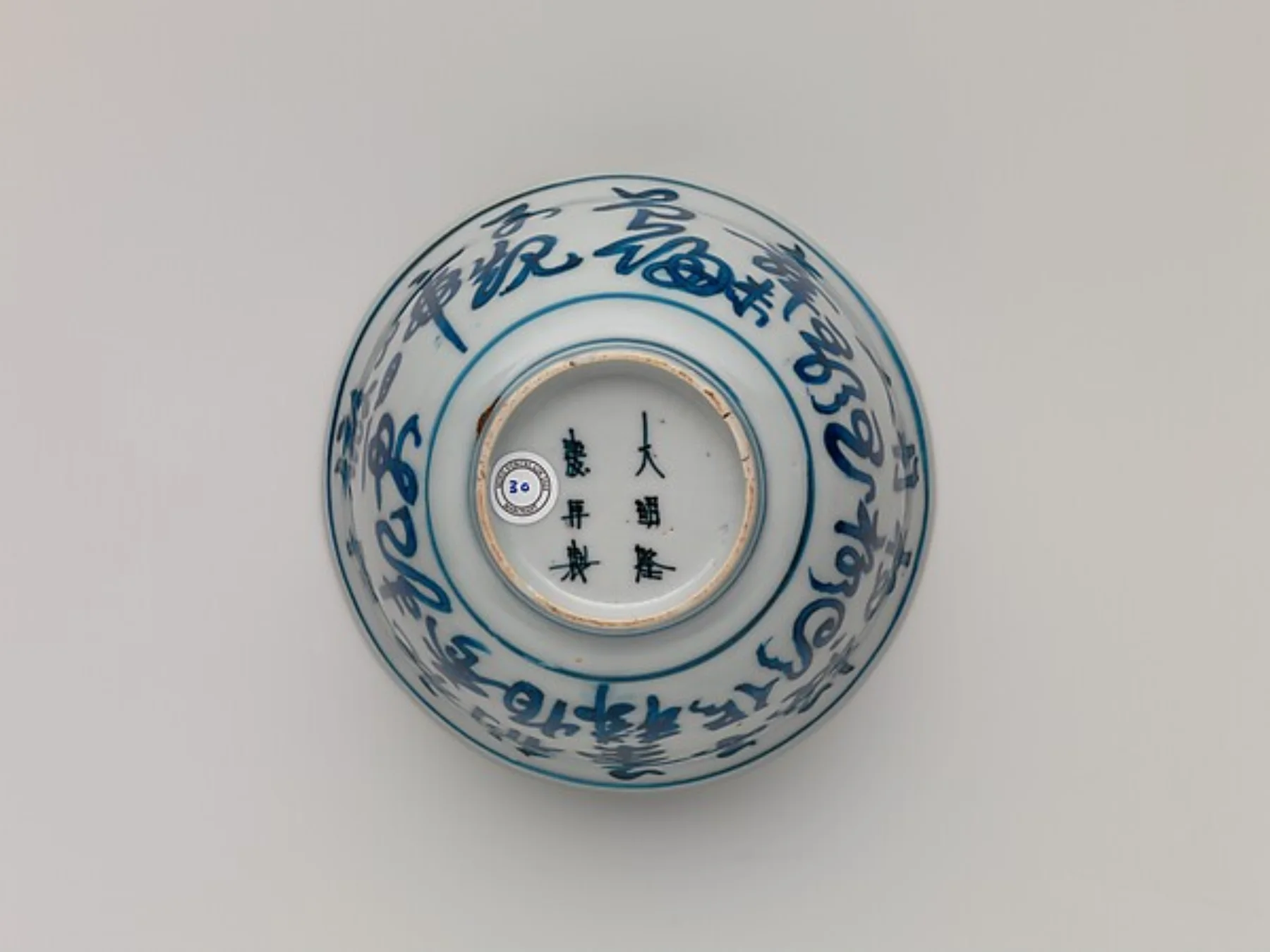
But a mark only says something useful when it is read with the rest of the piece. Museum catalogues do this patiently: they record the object’s material, form, technique, dimensions, period, collection history and markings together. The Met’s Longqing bowl record, for example, does not let its six characters do all the work. It identifies a blue-and-white Jingdezhen bowl, gives its date, material and dimensions, and supplies the mark as one part of a documented object.
The base is worth studying because it concentrates evidence: the foot, exposed porcelain body, glaze boundary, support marks, wear and inscription can meet in one small circle. It is not worth worshipping. A sharp photograph of a base can tell us what is visibly there; it cannot by itself certify an unseen object, an age, a kiln or a market value.
Start here: read the six characters in the photograph
The cover photograph gives us an actual inscription to work with: 大明隆慶年製, Da Ming Longqing nian zhi. Read the right column downward first—大, 明, 隆—then the left column—慶, 年, 製. Do not read straight across the two columns as if they were English lines. The reign name crosses the column break.
| Part of the inscription | Reading | Job in the sentence |
|---|---|---|
| 大明 | Da Ming | Great Ming, the dynasty |
| 隆慶 | Longqing | The reign name, not the potter's signature |
| 年製 | Nian zhi | Made during the named reign |
Read together, the words mean “made during the Longqing reign of the Great Ming.” The Met attributes this particular bowl to that reign, 1567–72. Those are two separate pieces of information: the characters make a statement; the catalogue assigns the object a period. Keep both when making a note.
Notice the small round numbered sticker beside the writing. It occupies the same base but is not a seventh character or part of the painted reign formula. Your transcription should leave it out; your object photograph should leave it in. That distinction sounds small until a tightly cropped image turns several different additions into one supposed maker's mark.
For another base, begin with an upright, uncropped photograph. Count the characters, copy the visible shapes, and leave a question mark for anything unreadable. A phone's text recognition can propose a reading, but check it against the strokes rather than accepting a fluent sentence. A blurred character does not become clear because software recognizes a familiar emperor's name.
Four characters, six characters, regular script and seal script
The Christie's reign-mark guide illustrates both common lengths and scripts. In a four-character reign formula, the dynasty may be omitted, leaving reign name plus nian zhi. That does not make every four-character inscription a reign mark: a blessing can also occupy four characters.
Regular script, kaishu, is generally easier to compare with ordinary printed characters. Seal script, zhuanshu, can appear compact and angular. “Seal script” describes the writing style; it does not establish that a stamp pressed it into the surface. Likewise, a neat square shape is not a factory signature by definition. Record script and application separately: painted, incised or impressed, where these are visible.
I would rather receive a photograph labelled “six characters, possibly seal script, reading uncertain” than a polished translation assembled from a barely similar internet image. The first leaves room to learn. The second quietly turns a resemblance into a fact.
What does a blue circle around a Chinese porcelain mark mean?
Usually, less than the search phrase promises. Blue single or double rings can frame characters, motifs or empty space. They are part of the painted layout, not a built-in age test. On the Longqing bowl above, thin blue lines encircle the foot and the six-character inscription sits inside that field. The useful evidence is the documented combination: the Met records the complete bowl, its Jingdezhen porcelain body, decoration, mark and 1567–72 attribution together.
If another base also has a blue circle, you have found one comparable feature—not the same object history. Record whether the ring is single or double, hand-drawn or mechanically even, under or over the glaze where that can be established, and whether it surrounds characters, a symbol or nothing. Then return to the vessel. “Blue circle” belongs in the observation column; dynasty, workshop and date remain questions.
Read the object before you read the characters
My first rule is deliberately unfashionable: look at the piece upright before you flip it over. The front is not decoration hiding the “real” information below. It tells you what sort of question the base must answer.
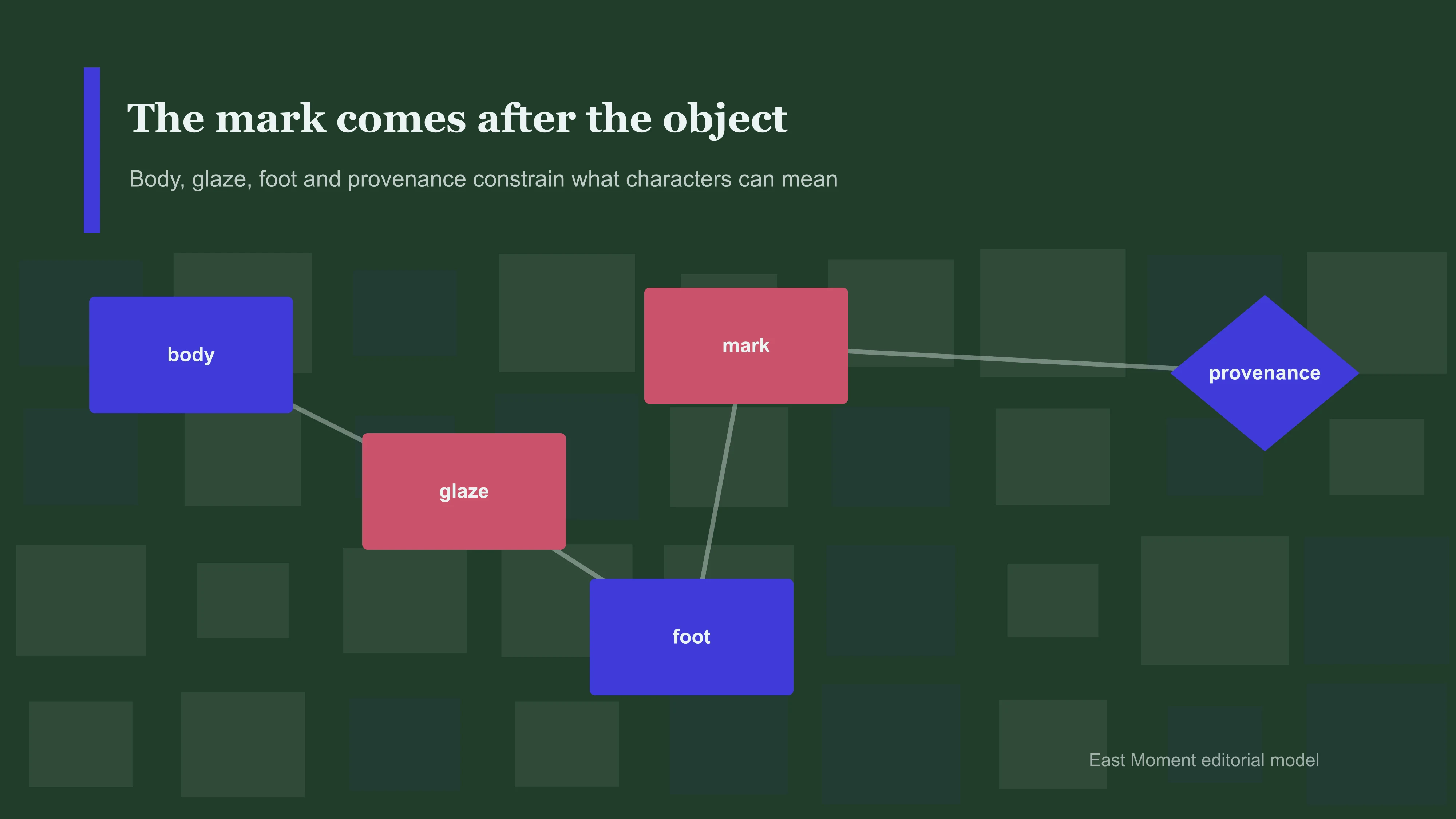
| Look at | Ask | Do not jump to |
|---|---|---|
| Form | Is this a bowl, dish, jar, cup or later decorative shape—and do its proportions make sense together? | A dynasty or value from silhouette alone |
| Body and foot | What does the exposed material, trimming and glaze stop reveal? | Age from dirt, roughness or a “ring” when tapped |
| Surface | How do brushwork, glaze, enamel, carving or moulding relate to the form? | Authenticity from one color or motif |
| Mark | Is it a reign mark, a hall mark, a maker's mark, a dedication or another inscription? | That every named reign is the date of manufacture |
| History of ownership | Is there an invoice, old label, collection record, excavation context or publication? | That a modern story is provenance |
This order protects attention. The mark must make sense with the object rather than becoming a costume placed on its underside.
A reign mark names a reference point—not automatically a date
Many widely recognised Chinese porcelain marks name a dynasty and emperor’s reign. A familiar example is a six-character formula that can be translated along the lines of “made in the Great Ming, Xuande reign.” On securely documented objects, the mark can be part of a strong identification.
That does not mean that every object bearing those characters was made during that reign. Later workshops could copy earlier marks in admiration, revival, convention or deception. In catalogue language, an apocryphal reign mark refers to an earlier reign rather than dating the manufacture. It is not automatically evidence of an attempt to deceive. The deception would lie in presenting a later object as something it is not.

The Jiajing jar in the Met collection has incised decoration overpainted in enamels. The rounded vessel, its crowded decoration and its base belong to one investigation. Keep this upright view beside the underside below: the red writing will become much more interesting than a simple date label.
Four kinds of marks that need different questions
Reign marks
These can reference an emperor and dynasty. They may be written, incised, moulded, painted under glaze or otherwise applied. Their script style, placement, method and relationship to the vessel are all part of the question. “Six characters in a double ring” is an observation, not an appraisal.
Hall marks and auspicious phrases
Some marks name a hall, studio, poetic sentiment, blessing or ideal rather than a reign. A base inscription may also be a wish for longevity, honor, good fortune or a dedication. It can enrich a reader’s sense of an object’s social life without establishing who made it or when.
Workshop and maker marks
Modern ceramics can carry a potter’s, workshop’s or factory’s mark. The most useful support for these is direct documentation: a maker’s own record, a dated exhibition catalogue, an invoice, a publication or an institutional collection listing. A matching image found on a marketplace page is only a lead until its chain of information is clear.
Labels, stickers and inventory numbers
The most honest marks may not be made in the kiln at all. Museum inventory numbers, old dealer labels, customs stickers, auction tags and collection labels can help reconstruct a later history. They can also be moved, misread or added. Preserve them in photographs, but do not turn an adhesive label into a passport through time.
The underside is an argument made by the maker

The conspicuous red characters read 長命富貴, chang ming fu gui: a wish for long life, wealth and honor. The Met records this enamel inscription over an incised reign mark. A single base therefore carries two different kinds of writing. If you identify only the bright red phrase and stop, you have read the blessing while missing the reign inscription underneath it.
That is the detail I love here. An object can speak administratively and emotionally in the same small space: a reign reference and a wish for a good life. Not every piece of writing is trying to answer our modern question, “How old is this?” Some of it addresses what people wanted from living.
I linger on the foot because it keeps the object from becoming flat. Here you can often see where glaze stops, how a vessel sat in firing, the color of the body, the confidence of the trimming and the practical edge that met a shelf or table. None of those features works as a magic test. Together, they form a physical argument about how the object was made.
This is also where copies can be instructive rather than merely disappointing. A later piece with an earlier reign mark may reveal a period’s admiration for an older aesthetic. That is a different cultural story, but still a story. The problem begins only when the object is sold as a certainty it cannot support.
What can a red Chinese porcelain mark mean?
Color does not define the category. A red mark may be an overglaze reign reference, a workshop or factory name, an auspicious phrase, a later addition or something else. On this Jiajing jar, the visible red characters do not name Jiajing at all: 長命富貴 is the wish “long life, wealth and honor,” while the Met records an incised reign mark beneath it. Calling every red inscription a “maker's hallmark” would collapse two different layers of writing into one.
Photograph red marks before rubbing, cleaning or enhancing them. Note whether the color sits above the glaze and whether the characters look brushed, stamped or printed, but keep those as observations. A red square, circle or seal-like arrangement is not a reliable date by itself. The question is still what the words say, how they were applied and whether the whole object supports the same history.
The Chinese porcelain guide gives the wider material vocabulary—body, glaze, firing and kiln systems—needed to read that argument. The blue-and-white guide narrows the lens to brushwork, cobalt and decorated porcelain. Neither page turns a visual clue into an authentication service.
For a closer physical comparison, use Chinese ceramic glazes to separate the coating from decoration, and porcelain patterns to follow a border or inscription around the vessel. The base is one viewing position, not the whole subject.
What a good record does that an internet verdict cannot
A reliable object record names its limits. It distinguishes a date from a date range, an established kiln attribution from a tentative one, and an observed inscription from an interpretation. It also makes room for repairs, later alterations and provenance gaps.
In the UBC Museum of Anthropology's estate-sale vase case, curator Fuyubi Nakamura reads a Qianlong mark but judges the vessel likely mid- to late-twentieth century from its style and marking. The reading is not discarded; its role changes. It identifies a historical reference on a later object. That is a much better lesson than a chart promising to date everything with the same six characters.
How should you read 20th-century Chinese porcelain marks?
Begin by dropping the assumption that a twentieth-century mark must look industrial. The Met's pair of Jingdezhen vases is catalogued to the 1930s–40s and painted in overglaze black and red enamels. Its landscape, calligraphy and animal-head handles ask to be read as a whole object, not as anonymous decoration waiting for a backstamp to rescue it.
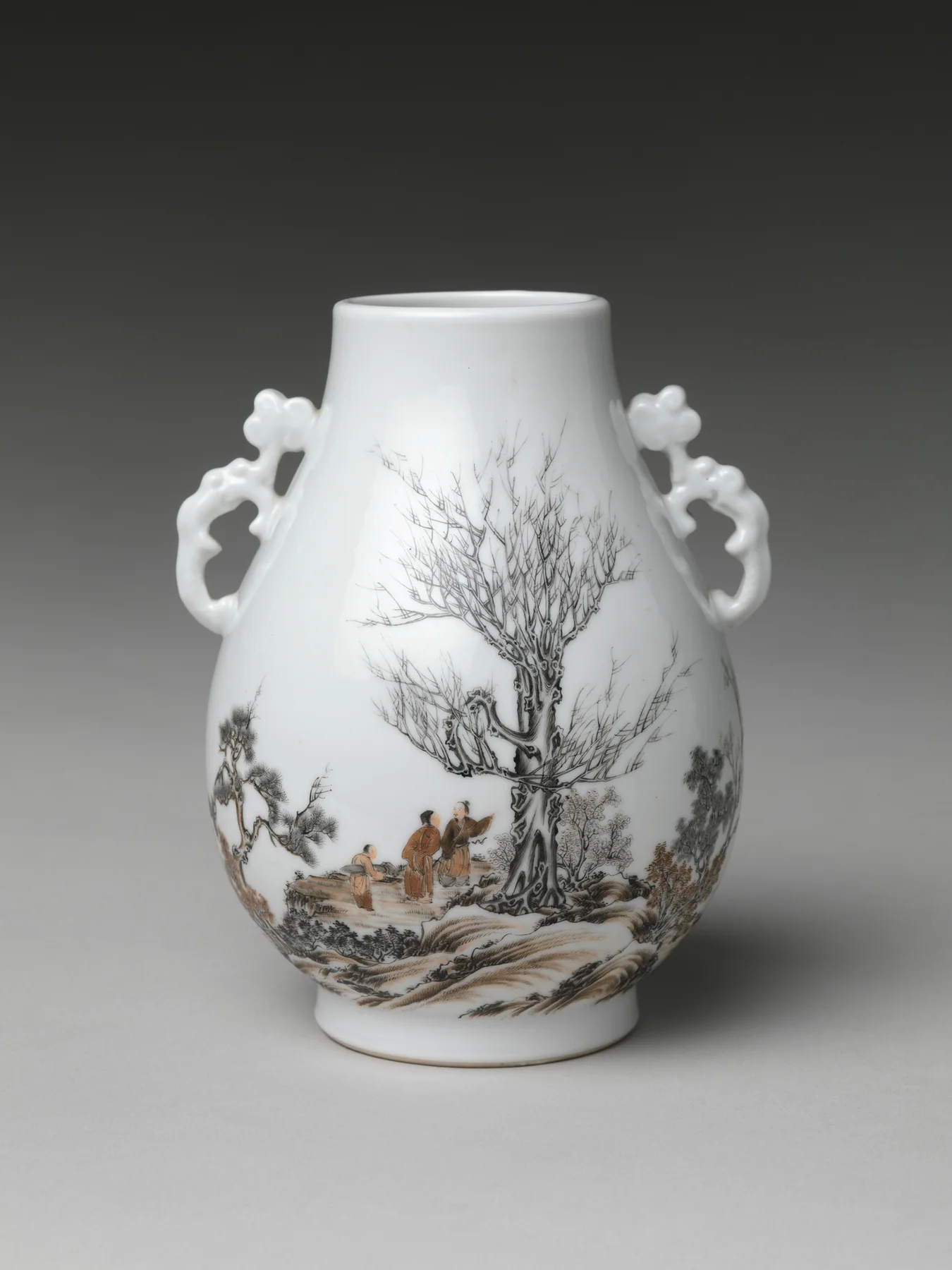
Turn the same vase over and the apparent shortcut returns. The blue seal-style inscription reads 洪憲年製, Hongxian nian zhi. Yet the museum does not catalogue the vase to the brief era named by those characters; it dates the object to the 1930s–40s. The mark is real evidence of what the base says. It is not a self-validating production date.
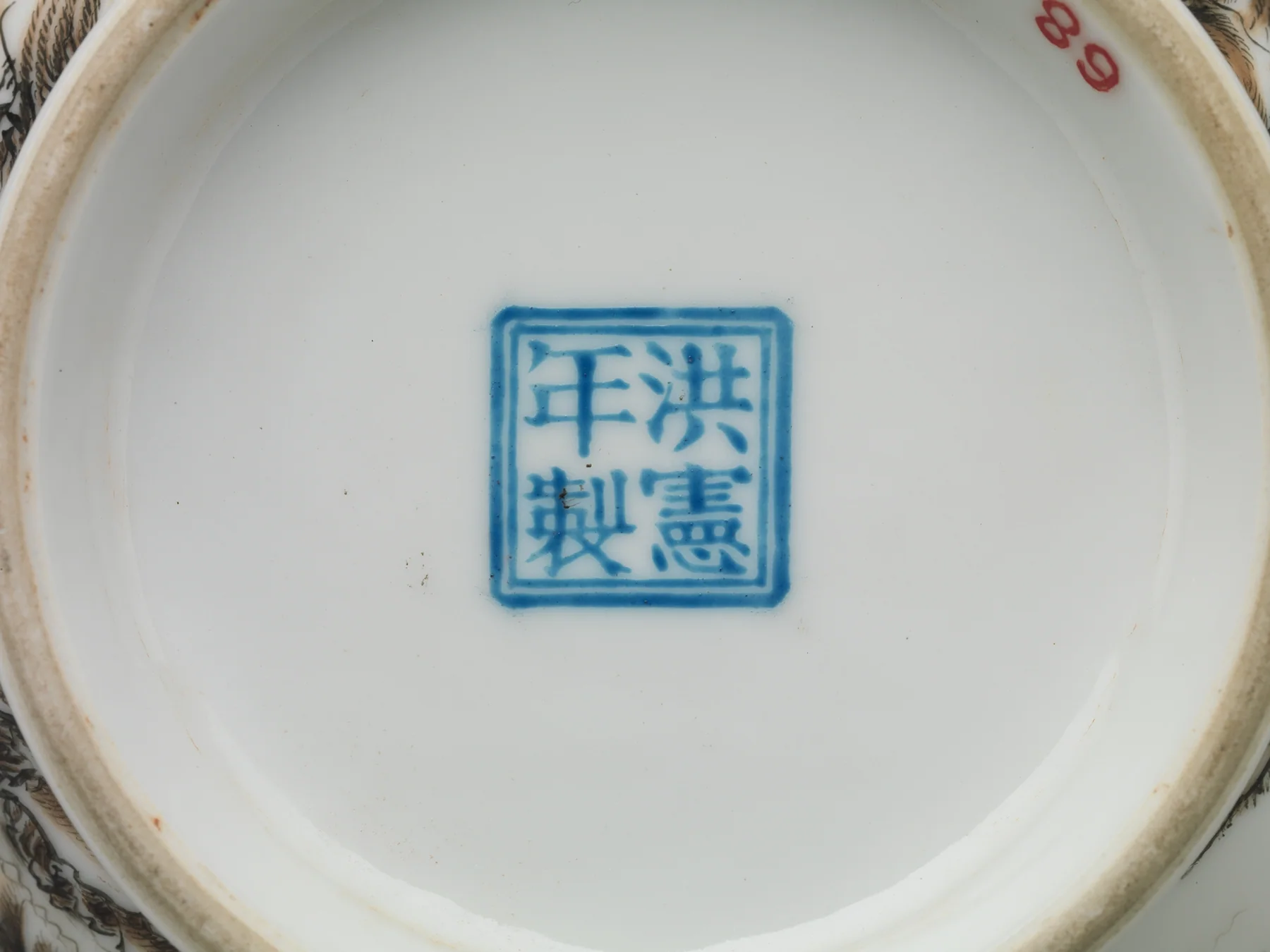
That is the boundary to carry into factory marks, workshop seals, hall names and export backstamps. First transcribe the visible wording. Next record whether it is painted, impressed, incised, transferred or printed, without guessing when the method is unclear. Then look for a dated catalogue, maker archive, invoice, packaging or institutional record that connects the name to a production window. A matching marketplace thumbnail is not documentation; a neat English backstamp is not automatically more informative than Chinese characters.
“Twentieth century” is also too broad to function as an identification. A Republican-period studio vessel, a later factory product and a new object carrying a revival reign mark can all produce very different questions. Preserve the distinction between what the inscription claims, what the object looks like and what an external record can actually date.
Compare the wording carefully: “Qianlong mark” records an inscription; “Qianlong mark and period” also attributes manufacture to that reign. If a listing contains only the first phrase, do not supply the second yourself. Ask where the production date is stated and what supports it. A seller's omission is not your invitation to invent a more exciting history.
For a consequential purchase, sale, insurance, inheritance or export question, stop at the boundary of a web guide. Keep high-resolution images of the entire object—front, back, interior, foot and mark—plus measurements, weight where relevant, any paperwork, repair history and ownership records. Then speak to an appropriately qualified specialist or auction-house department. No online reply, including this page, can responsibly turn partial photographs into an authentication or valuation.
Make a three-photo record before asking about a mark
The best first move is not to post the inscription alone and wait for a dynasty name. I would make three photographs before asking anyone for help. First, photograph the object upright in soft, even light, so its proportion and decoration can be read. Next, photograph the base straight on: include the foot, glaze boundary and mark in the same frame. Finally, take a close image of the characters or impressed stamp, but keep one wider frame beside it. Add height, diameter and any repair or sticker to the note.
That small discipline changes the conversation. Instead of “what is this mark worth?”, the useful question becomes “does this inscription, technique and shape belong together?” A person who knows the object well can then give a more precise next step: compare a museum record, identify a modern factory name, document an old label or seek a specialist examination. It also respects an object that turns out to be later, repaired or ordinary. Looking carefully is not a consolation prize; it is the actual skill that collecting asks for, before any price, story or dynasty name enters the room.
The most useful thing a mark can teach you is patience

The mark becomes more interesting when it stops being a treasure-hunt answer. It asks you to notice scale, the turn of a foot, a blue line that continues around a curve, a repair that changes the object’s life, and the long travel between a kiln, a table, a collection and a screen.
Chinese ceramic marks reward reading, not guessing. Start with Chinese ceramics or the broader Chinese Art collection if the material vocabulary is unfamiliar. Then bring one base and a tentative transcription to Moments. Leave unreadable characters as question marks. Return with a clearer image or a corrected reading and keep the original attempt beside it. Learning that one character is a blessing rather than an emperor can change the entire conversation.