Two plates can have the same diameter and offer very different amounts of room for dinner. Chinese porcelain plates need to be read through the rim, slope and central well as well as the painted design. I love a beautiful border. I will not let it choose my serving plate before I know where the food can go.
Chinese porcelain plates are shallow vessels, not flat pictures
For Chinese porcelain plates, distinguish three decisions immediately: identifying an old object, choosing a piece to display, and buying modern ware to eat from. They share a vocabulary of rim, well and foot, but they do not ask the same question. The most compelling painted scene is not automatically the most useful dinner plate, and historical tableware is not automatically appropriate for present-day food contact.
I read the plate in the opposite direction. First I ask what kind of shallow vessel is in front of me. How broad is the rim? How steeply does the interior descend? Is the centre flat, gently rounded or deeply recessed? What happens at the edge and underneath? Only after those physical questions do I read the decoration, mark and market story.
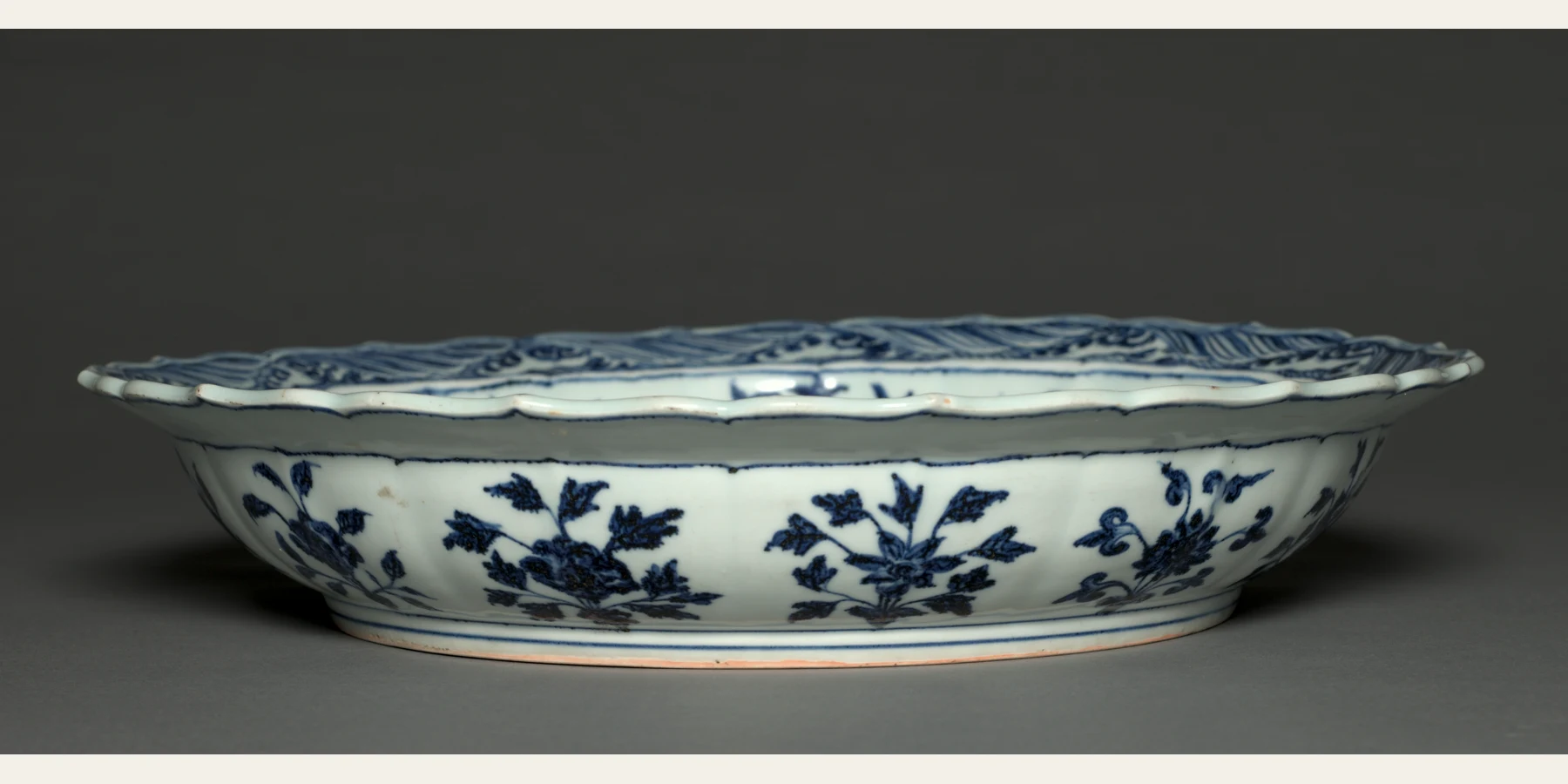
The hero object makes the point without a diagram. The Cleveland Museum of Art records this Yongle-period plate with grapes and floral sprays as Jingdezhen porcelain with underglaze-blue decoration, made in 1403–24. It is 43.2 centimetres across and 7.7 centimetres high. Seven-point-seven centimetres is not a footnote: it is the evidence that “plate” does not mean a two-dimensional disc.
That low viewpoint changes everything. The centre is no longer the only destination. The slope becomes a visible transition; the rim projects; the foot raises the object; the painted design has to live across surfaces that face the viewer at different angles.
The museum associates this type of large platter principally with export to southeastern and western Asia, while noting a comparable Xuande-marked find at the Jingdezhen imperial kilns. The distinction matters: international exchange was not limited to later European dinner services. Even the opening object of this page refuses to stay inside that narrow story.
Plate, dish, saucer dish and charger are overlapping labels
English is less tidy here than online catalogues suggest. Museums may call one object a plate and a closely related form a dish. Auction catalogues add saucer dish, soup plate and charger. Historical Chinese terms, workshop habits, export orders and modern tableware conventions do not collapse into one permanent English size chart.
I therefore do not use a rigid rule such as “anything over 30 centimetres is a charger.” Size helps, but profile, depth, service context and the institution’s own cataloguing decision matter too.
The six museum objects on this page show the range:
- The Yongle plate is 43.2 centimetres in diameter and 7.7 centimetres high.
- A Kangxi-period dish with dragons is 24.8 centimetres across.
- A Yongzheng-period plate with the Isle of the Immortals is 21.2 centimetres across.
- A late-Ming plate with phoenix and peonies is 47.3 centimetres across and 9.7 centimetres high.
- A Yongzheng-reign Fishermen Plate is about 21 centimetres across.
- A circa-1750 Chinese export charger is 36.3 centimetres across.
The words are useful when attached to exact records. They become unreliable when detached and turned into universal thresholds. If a seller calls an object a saucer dish, ask for its height and side profile. If a catalogue calls it a charger, ask whether that term comes from documented service use, established collection cataloguing or simply impressive diameter.
A real display reminds me that categories begin in space

Open bowls and closed vessels share a culture-park display. From this angle, the wide bowls disclose their interiors while the upright forms conceal theirs: the view you choose changes what you can understand.
In a real display, object categories do not arrive as isolated white-background circles. An open bowl sits near a bottle; a small cup can look broad because it is closer to the camera; a rounded jar may hide behind the edge of a shelf. Scale and depth become relational.
That is what I want a porcelain-plate page to preserve. A top-down image is excellent for reading a central pattern, but poor at showing whether the interior is nearly flat or bowl-like. A side view can reveal depth while hiding the centre. A three-quarter view lets face and profile negotiate with each other. No single photograph is the object.
The same caution applies to material. A glossy pale body may be porcelain, stoneware or another ceramic body. Display lighting can make a glaze look whiter, bluer or more translucent than it is. The broad Chinese porcelain guide explains the material history; this page stays with the shallow form and the evidence needed to understand it.
Map the rim, slope, well and foot before naming the pattern
A plate can be read like a small landscape. The vocabulary is not perfect across every period and catalogue, but it helps us describe rather than guess.
- The rim is the outer boundary. It may be narrow, broad, flat, everted, lobed, bracketed or gently rounded.
- The cavetto is the sloping transition between rim and centre on many dishes and plates. In plain language, I often call it the slope.
- The well is the central interior field. It may receive food, a medallion, a scene or an apparently empty area that makes the border breathe.
- The edge is where chips, fritting, glaze loss and old restorations often become visible.
- The reverse can carry secondary decoration, kiln traces, collector labels, marks and evidence of mounting.
- The foot ring lifts and stabilizes the plate. Its shape, finish and condition deserve a photograph, but none of those features authenticates the object by itself.
This map changes how decoration reads. A flower in the well is a focal event. The same flower repeated around the rim becomes rhythm. A wave band on the cavetto can pull the eye inward or make the centre feel farther away. A border that appears perfectly circular in a photograph may actually climb or dip with the potting.
The Chinese porcelain patterns guide owns the larger grammar of scrolls, sprays, panels, medallions and negative space. On a plate, that grammar becomes especially clear because circular zones are visible at once—yet the zones are still not flat.
Colour names should not erase technique

The Cleveland Museum records this dish with dragons, pomegranates and peaches as Jingdezhen porcelain of the Kangxi mark and period, 1662–1722. Its medium is more specific than “colourful porcelain”: incised and enamel decoration, identified as susancai ware.
This matters because colour is the first thing many listings sell and the last thing they explain. “Green dragon plate” can be a useful search phrase, but it does not tell us whether the lines are painted, incised, moulded or combined; whether colour sits under or over the glaze; or which details come from later restoration.
The dragons are the quiet surprise. The museum explains that they are incised beneath the painted fruit and flower sprays. The strong green, yellow and purplish-brown enamels catch the first glance; the lightly drawn dragons demand a closer one. This is a reason to look twice, not just a reason to learn another color name.
Look at how little quiet space the dragon dish leaves. The bodies and foliage occupy the circular field rather than sitting as a small isolated emblem. I enjoy that density when examining the object closely. On a crowded table, I would give such a design a different job from a nearly plain plate: a single visual accent rather than a competing pattern beneath every dish. That preference does not turn susancai into a modern tableware specification; it explains what the composition asks of its surroundings.
One plate can combine underglaze blue and overglaze enamels

The Plate with Isle of the Immortals is recorded as Jingdezhen porcelain of the Yongzheng mark and reign, 1723–35. The museum identifies underglaze cobalt blue together with overglaze enamels. Its 21.2-centimetre diameter brings us close to the scale of a familiar modern table plate, but visual familiarity is not proof of identical use.
I like this object because it refuses a one-label reading. Calling it “blue and white” would omit the overglaze colour; calling it “famille rose” without following the museum record would flatten a layered technique into a market category. The blue-and-white porcelain guide explains cobalt beneath a transparent glaze, while the ceramic glazes guide helps separate body, glaze and later surface events.
The pavilion is not merely an attractive island house. The museum reads cranes carrying sticks above the sea pavilion as the longevity wish haiwu tianchou (海屋添籌). That gives a small visual detail a human purpose: more years for someone. I prefer this specific reading to calling every picturesque Chinese landscape “mystical.” The birds and what they carry do the work.
Scale changes how a decorated plate behaves

The museum’s Plate with Phoenix and Peonies is dated to the late 1500s or early 1600s and attributed in the record to Southern Fujian. It is catalogued as porcelain with underglaze-blue decoration, “Swatow” ware. At 47.3 centimetres across and 9.7 centimetres high, it occupies space very differently from the 21.2-centimetre Isle of the Immortals plate.
Large diameter changes more than drama. The painter has a wider centre and longer circumference to organize. Repeated rim motifs must survive a larger rhythm. Handling, storage and display require more support. A photograph cropped to the circle can conceal all of that.
Notice the geographical trap: the record says Southern Fujian while retaining the familiar ware name “Swatow.” Do not silently replace the recorded production region with the city suggested by the label. The object connects to a wider trading vocabulary, not a simple equation between a market name and a kiln address.
The useful lesson here is simpler and stronger: record diameter and height together. A 47-centimetre object described only as “large” leaves the reader unable to compare it with a serving plate, charger, basin-like form or another museum example.
Fishermen interrupt the fantasy that porcelain is only imperial

The Cleveland Museum dates this Fishermen Plate to about 1730, during the Yongzheng reign, and records famille rose overglaze-enamel decoration on Jingdezhen porcelain. The record gives a diameter of about 21 centimetres.
The museum identifies fishermen with nets and a creel and connects the theme with Ming and Qing painting. That is a more interesting starting point than another imperial-dragon shortcut. Work, water and ordinary bodies become material for a finely painted vessel. I am drawn to the activity: people have something to do inside this little circle.
Follow the figures out toward the rim rather than stopping in the centre. The border carries related activity, giving the eye another place to go when the central scene has been read. On a vertical photograph, everything is available at once. At an actual table, the rim and interior meet the viewer at different angles. The potter and painter are organizing a vessel, not designing a flat poster.
This is where I resist the phrase “Chinese-style decorative plate.” It often removes the exact geography, workshop network, technique, order and audience that made an object specific. The history of Chinese porcelain and Chinese export porcelain guide supply those broader timelines. Here, the plate remains an exact accessioned object with a measurable body.
A French affair, painted onto a Chinese charger

The museum calls this circa-1750 Chinese export porcelain object a Charger and records its diameter as 36.3 centimetres. But size is the less surprising part. A Chinese factory adapted a French print for a European market; the scene comes from a La Fontaine fable about a barrel-maker's wife and her lover while her husband works.
There is no coat of arms in the centre of this plate. There is an intimate encounter. The scrolling border gives it a decorous frame while the picture supplies something much less decorous. This is precisely why I dislike reducing Chinese export porcelain to a tasteful blue-and-white aesthetic. Workshops also translated jokes, desires and stories travelling in the other direction.
The Chinese export porcelain guide follows those exchanges in more detail. Here, look at the division of space: a small, close encounter sits inside a broad ceremonial-looking border. It offers a different pleasure from the fishermen spread across their plate. Similar material, different audience and narrative rhythm. Neither deserves to be flattened into “traditional Chinese decoration.”
The reverse is half the object
A front-only listing is incomplete. Turn the plate over and photograph the entire reverse before zooming into the mark. I want to see how the foot relates to the diameter, whether glaze covers the back, whether decoration continues, and whether labels, mounts or repairs interrupt the surface.
Then make close views of:
- the complete foot ring and the area inside it;
- any mark at a scale that shows brushwork and surrounding surface;
- collector, dealer, customs or museum labels without removing them;
- rim chips, hairlines, staple repairs, filled losses and overpaint;
- hanging hardware, adhesive pads or abrasion caused by a stand;
- glaze pooling, kiln grit or firing features described without turning them into a date certificate.
The Chinese ceramic marks guide explains the central problem: a reign mark can be contemporary, commemorative, copied, apocryphal or modern. It is one piece of evidence. The body, decoration, construction, condition, provenance and comparison material still have to agree.
Do not clean away an old label because it looks untidy. A fragile paper label may preserve collection history that is harder to replace than the temporary satisfaction of a clean base. Ask a qualified conservator before removing adhesive, metal mounts or old restoration from a potentially significant object.
For dinner, measure the well as well as the diameter
The historical examples above teach the eye; the following choices concern modern porcelain explicitly intended for food use. Start with the dish you plan to serve. A shallow, broad centre gives pieces room to sit beside one another. A deeper interior contains more liquid. A large rim takes up table space even when the usable centre is small. There is no contradiction in admiring one plate and choosing another for dinner.
Here is a simple comparison you can make with plates you already own. Put two similar-diameter plates side by side and measure the flat or gently rounded central area inside the slope. In a hypothetical pair of 27-centimetre plates, one might have an 18-centimetre centre and the other a 22-centimetre centre. Those numbers are an illustration, not museum measurements. The second gives a much broader area before food reaches the rising sides, despite fitting roughly the same cupboard space.
For a shared dish, also look at reach. Will the nearest diner have to lean across a high arrangement to take a piece? Does the plate leave room for bowls and smaller dishes? Does sauce collect in an accessible well or run onto a broad, nearly flat border? A plate chosen for an isolated overhead photograph can become irritating when several people sit around it.
My choice for a colourful shared meal is usually a quieter plate with a clearly usable centre. The food supplies enough visual activity. But a plain meal or one carefully selected serving dish can make a decorated rim enjoyable rather than distracting. I do not want every table reduced to anonymous white circles; I want the pattern to contribute instead of fight for attention.
Before buying a whole modern service, try one plate with the food and storage arrangement you actually use. Check the manufacturer's use and care instructions, the cabinet depth and how the foot sits when stacked. A plate that looks generous in the shop can be awkward in a small cupboard. None of these questions makes porcelain less beautiful. They let its beauty survive an ordinary evening.
A displayed plate still has a back and a weight
Historical porcelain survived into the present under conditions its makers did not anticipate. An object that resembles a dinner plate is not automatically suitable for modern food contact. Old repairs, metal staples, degraded overglaze decoration, unknown residues and uncertain materials can all matter.
For serving food, choose modern ware whose maker or manufacturer explicitly documents intended food-contact use and care. Keep unidentified or historic pieces for assessed display rather than assuming they are dinner-ready because the glaze looks intact.
Display creates another set of risks. A plate stand should support the object stably without concentrating pressure on a fragile rim or scratching the glaze. Hanging hardware must not be improvised around an irreplaceable object. Sunlight, unstable shelves, vibration, pets, children and crowded arrangements are practical parts of connoisseurship because a beautiful attribution cannot protect a falling plate.
The emotional temptation is understandable: a circular image wants to become wall art. But the plate deserves to remain a vessel in our thinking even when it is displayed upright. Its reverse, weight, depth and edge still exist.
Buying an old plate: ask about what the stand hides
A plate photographed on a stand can conceal damage at its lower rim. Ask for the object without that obstruction, both faces, a true side profile and close views of any repair. The seller should provide diameter, overall height and a written condition account, not just “good for age.” Keep old labels and ownership documents with the record.
If the price depends on a period or export attribution, ask who made that attribution and on what evidence. “Qing-style” describes resemblance; a Qianlong mark records an inscription. Neither alone establishes a manufacturing date. That is the point at which a qualified physical examination matters more than collecting additional similar-looking pictures online.
Read the vessel, then the image, then the record
Chinese porcelain plates reward slower looking because their apparent simplicity is constructed. The rim contains. The slope connects. The well focuses. The foot lifts. Decoration uses those zones, and later owners add wear, repairs, labels and new display habits.
For a Chinese porcelain plate to earn its place, decide what you want from it. Read a historical painting closely. Give a large dish sufficient support. Choose a modern serving plate around the food and the people reaching for it. The picture in the middle is only one of those pleasures.
Continue through the Chinese art collection for related forms and techniques. In East Moment's community, compare two modern food-use plates for one specific dish: show their centres and profiles, and name your choice. Return after the meal with what worked or got in the way. A beautiful table is worth showing; an explanation of why it worked is worth passing on.