Buy Junshan Yinzhen tea for traceable origin and successful yellowing, not for a glass full of dancing buds. Needle shape, golden liquor,
Silver Needle, an imperial story and the promise ofthree rises and three fallscannot authenticate a batch. I would rather begin with a transparent, less expensive yellow bud tea and learn what menhuang contributes; pay the Junshan premium only when the records and the second infusion both justify it.
Junshan Yinzhen tea is yellow tea, not white Silver Needle
Junshan Yinzhen is a fine bud yellow tea associated with Junshan and Yueyang beside Dongting Lake in Hunan. Start with the yellow tea family guide before comparing premium packets. Its English name, Junshan Silver Needle, causes a predictable problem: Baihao Yinzhen is also sold as Silver Needle, but it is white tea from a different origin and processing system.
The Chinese name resolves the ambiguity:
| Listing name | Tea family | Processing hinge | First evidence request |
|---|---|---|---|
Junshan Yinzhen / 君山银针 |
Yellow tea | Fixing followed by controlled yellowing stages | Exact production area, producer, harvest year and yellow-tea process description |
Baihao Yinzhen / 白毫银针 |
White tea | Withering and drying without yellow-tea menhuang | Fujian origin claim, bud standard and production record |
Silver Needle alone |
Ambiguous | Not stated | Chinese name and tea category before purchase |
| Needle-shaped green bud tea | Green tea | Fixing aims to retain a clearer green-tea profile | Honest product name and production origin |
If a seller cannot name the tea family in Chinese, stop. I reject the idea that a luxury translation can substitute for product identity.
The standard defines yellow tea, not your packet
China's official standards record lists GB/T 21726-2018, Yellow Tea as current, released on February 6, 2018 and implemented on June 1, 2018. It establishes yellow tea as a product category. It does not certify an unknown online listing as Junshan Yinzhen or prove that its buds came from a specific place.
Keep three claims separate:
| Claim | What it establishes when supported | What it does not establish |
|---|---|---|
Yellow tea |
Category and processing identity | Junshan origin |
Yueyang or Hunan yellow tea |
Wider regional association | Production on Junshan or identity as Junshan Yinzhen |
Junshan Yinzhen |
A specific product and origin claim | Truth of that claim without batch evidence |
Yueyang government reporting is useful evidence that yellow tea and Junshan Yinzhen matter to the contemporary regional industry. It is promotional regional evidence, not independent tasting criticism and not authentication for a retail packet.
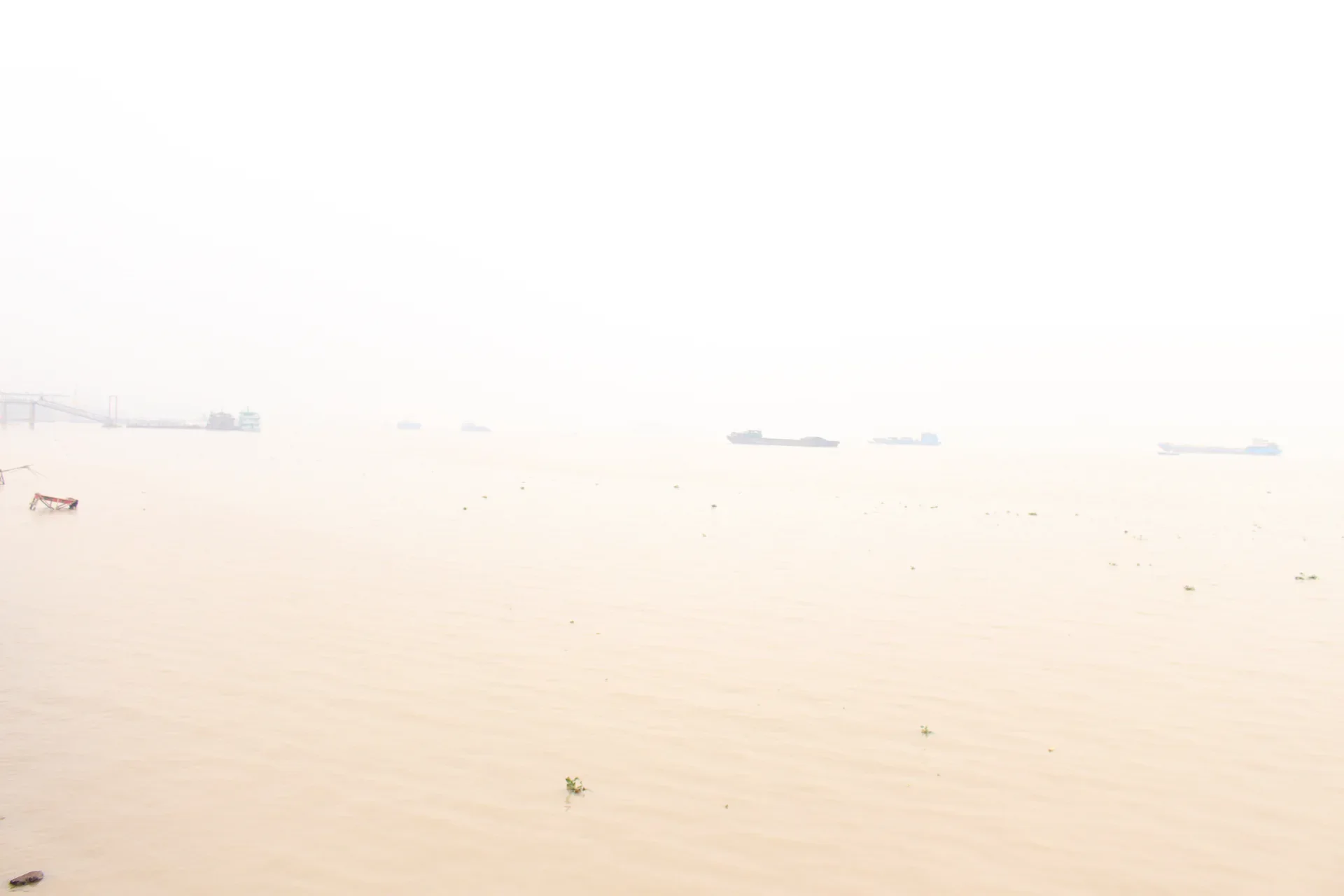
Dongting Lake at Yueyang, Hunan. The image establishes the regional landscape, not a tea garden or the origin of a packet. Photograph by Huangdan2060, CC BY 3.0, via Wikimedia Commons.
Menhuang is the product difference worth paying for
Yellow tea is often described as green tea with one extra step. That phrase is convenient but incomplete. After heat fixing reduces enzyme activity, warm leaf is held under managed moisture and heat through stages commonly called menhuang, translated as sealed, smothered or sweltered yellowing. Wrapping, resting, reheating and drying schedules vary by tea and workshop.
Peer-reviewed reviews describe changes in color, aroma, taste compounds and processing chemistry during yellow-tea manufacture. They support a distinct category; they do not supply one universal menhuang recipe that every producer must disclose.
| Process stage | Intended contribution | Failure direction a drinker may notice |
|---|---|---|
| Fine plucking | Tender, intact material for a bud-focused style | Uneven extraction from mixed maturity or breakage |
| Heat fixing | Controls raw-leaf enzyme activity and transforms fresh-field character | Raw harshness if inadequate; scorch if excessive |
| Moist-heat yellowing stages | Moves the profile away from sharp greenness toward mellower grain, sweet vegetal or warm aromas | Sour, dull or stale impressions if moisture and heat are poorly managed |
| Drying and sorting | Stabilizes the finished tea and organizes the lot | Residual moisture, excessive baked character or rapid storage decline |
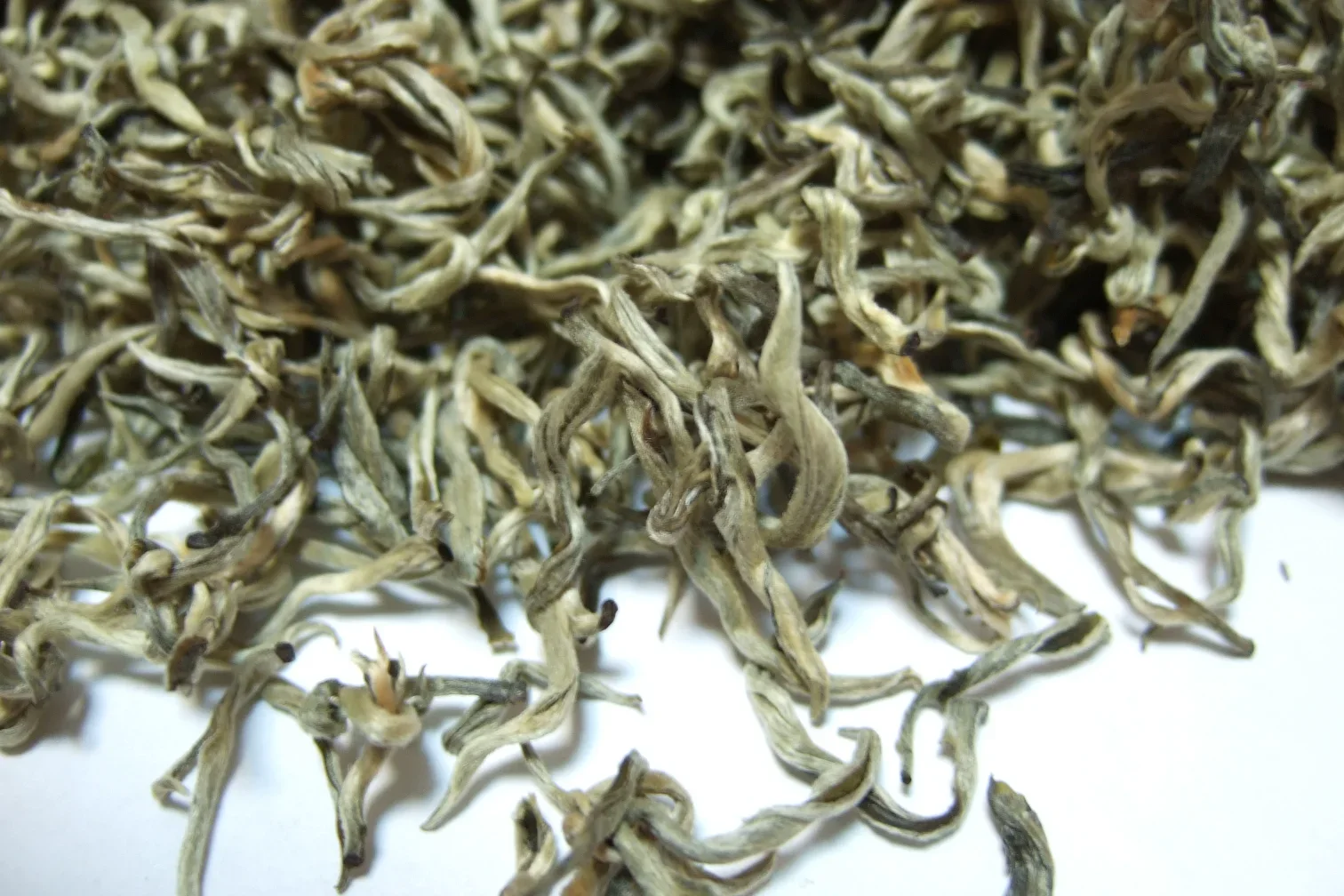
This archive file identifies yellow tea from Hunan Province. It is valuable category evidence but does not identify the lot as Junshan Yinzhen. Photograph by Whiteness, CC BY-SA 4.0, via Wikimedia Commons.
The buying question is therefore not Are the buds yellow enough? It is Does the seller identify a yellow-tea process, and does the cup show a coherent mellow transformation rather than raw greenness, flat age or heavy roast? The mistake is paying for the color of the noun while ignoring the work done to the leaf.
Dry buds can reject a claim, but they cannot prove one
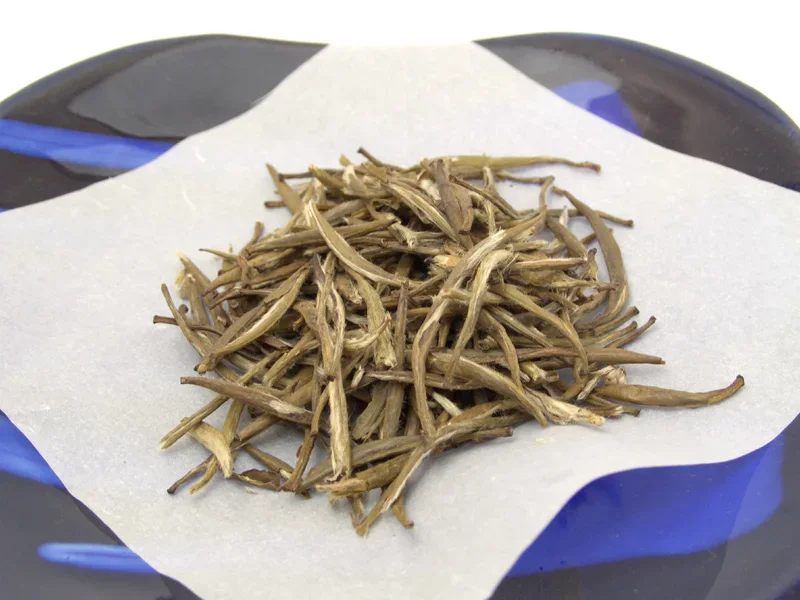
This archive item is identified as Junshan Yinzhen. It documents this sample, not a universal ideal or another seller's batch. Photograph by Commonsenses, CC BY-SA 3.0, via Wikimedia Commons.
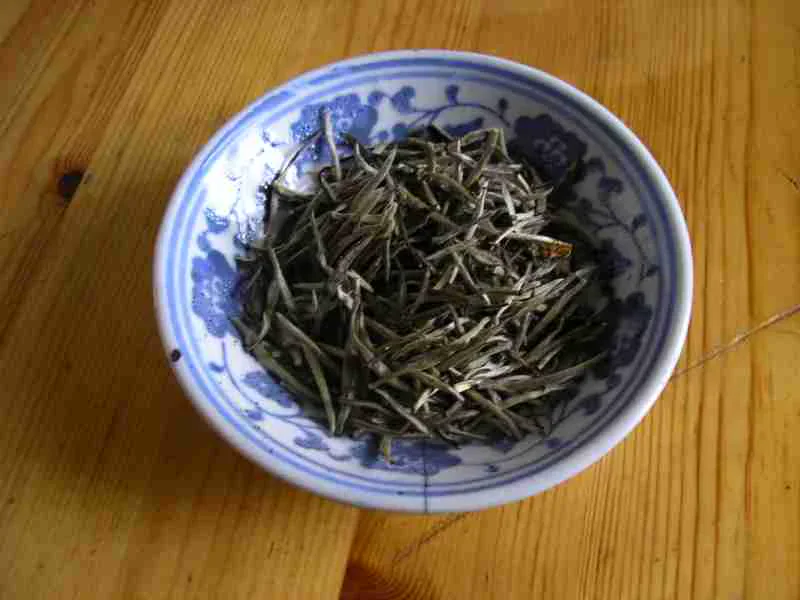
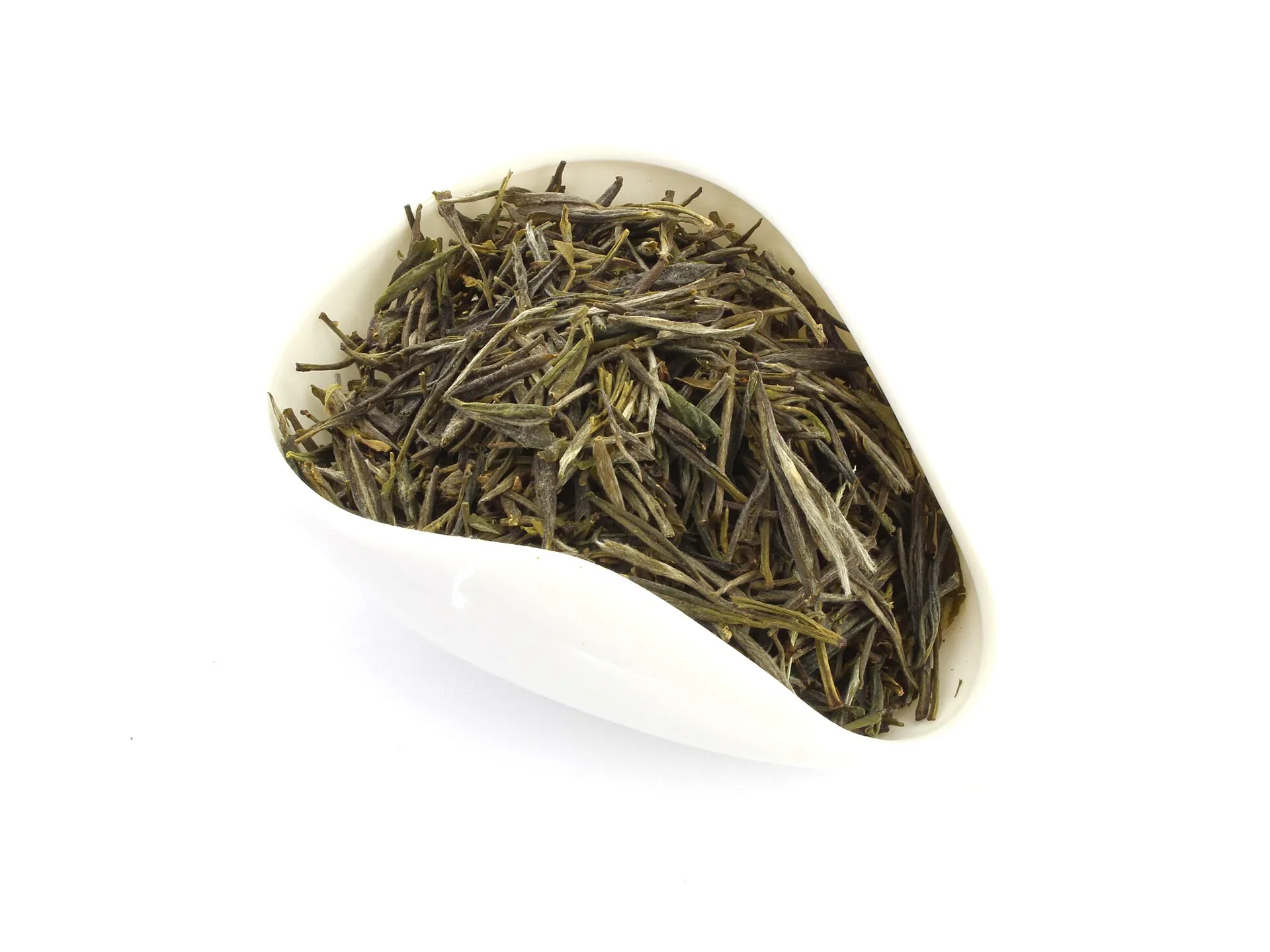
The Commons record calls this material Yinzhen but gives limited provenance. It can show needle-like form; it cannot tell us whether the tea is Junshan yellow tea, Baihao Yinzhen white tea or another needle-shaped product.
Inspect a current batch in neutral light.
| Observation | Useful question | Stop before claiming |
|---|---|---|
| Mostly whole, narrow buds | Does the lot broadly match its bud-focused description? | Junshan origin or grade |
| Fine down | Is tender material present? | Freshness, authenticity or superiority |
| Yellow-green, olive or straw variation | Is the lot coherent and free of obvious damage? | Successful menhuang from color alone |
| Broken tips and dust | Should contact time be reduced? | Counterfeiting by itself |
| Sweet grain, corn, hay, chestnut or soft vegetal aroma | Does the dry aroma appear clean and plausible? | Origin or added-aroma absence |
| Must, damp paper, sourness or stale oil | Is storage compromised? | The exact production failure |
A photograph can reveal a mismatch between a seller's whole buds claim and a broken lot. It cannot diagnose dye, prove harvest timing or certify a place. I use dry-leaf photographs to reject an obvious mismatch, never to invent provenance. Record the dry leaf, package, invoice and seller claim together; an isolated beauty image loses the evidence chain.
Run a fixed two-infusion yellow-tea test
The first infusion shows opening aroma and how quickly compact buds hydrate. The second infusion is the value test. It should still carry recognizable sweetness, body and a mellow yellow-tea direction rather than becoming warm colored water.
Use this East Moment household comparison baseline. It is not a national standard, a laboratory protocol or a claim that every Junshan Yinzhen reaches its best cup at these numbers. If the mechanics of dose, working volume and full decanting are unfamiliar, open the Chinese tea brewing guide before blaming the leaf.
- Measure 3.0 g of tea for 150 ml of working vessel volume.
- Use neutral porcelain and fully decant between infusions.
- Begin with 85 C / 185 F water.
- Infuse for 60 seconds, then 75 seconds.
- If useful, make a third infusion at 105 seconds.
- Start timing when water first touches the buds and include pouring time.
- Taste each cup hot, warm and nearly cool.
- Hold water, dose, vessel and pouring speed constant between samples.
| Checkpoint | A useful result | Warning sign |
|---|---|---|
| Infusion 1, hot | Clean steam without must, perfume or scorched odor | Strong aroma that disappears before entering the liquor |
| Infusion 1, warm | Sweet grain, soft vegetal, corn, hay, melon or chestnut direction with some body | Sharp raw greenness, sourness or hollow sweetness |
| Infusion 2, warm | The same flavor family remains with a clean finish | Abrupt collapse into thin colored water |
| Nearly cool | Sweet or clean return without damp-paper odor | Storage faults become clearer as heat fades |
| Opened material | Broad agreement with the seller's bud standard | Large leaves, stems or fragments unexplained by the listing |
Do not call a tea fake because its flavor is not corn-like or because a bud sinks. Sensory notes are resemblances, not identity tests. A convincing cup still needs origin evidence; strong documentation still needs a convincing cup.
Diagnose bitter, thin, grassy or stale tea one variable at a time
Bitterness and brewing mistakes matter because they are the failures a drinker meets immediately. I insist on controlled adjustment, not one recipe shouted more confidently.
| Result at the baseline | First controlled change | Interpretation after repeating the same infusion |
|---|---|---|
| Bitter or rough | Shorten contact by 15 seconds | Improvement points to excessive time |
| Still rough at shorter time | Lower water to 80 C / 176 F | Improvement shows the sample needs gentler heat in this setup |
| Thin but clean | Increase dose to 3.5 g | Improvement points to dose; no improvement questions freshness or value |
| Very grassy and sharp | Keep the baseline, then taste warm and cool | Persistence may indicate style, incomplete transformation or a green-tea-like product; it does not prove which |
| Flat and straw-like | Repeat with known water from a newly opened portion | Persistence is a freshness or value warning |
| Sour, musty or damp | Repeat once with clean porcelain and known water | Persistence is a rejection signal; do not try to wash it away |
| Heavy roast covers everything | Lower water by 5 C once | If the cup stays hollow, the premium is unsupported |
Change one variable per repeat. Reducing leaf, temperature and time together may create a drinkable cup, but it cannot teach you what failed.
The buds' movement is physics, not authentication
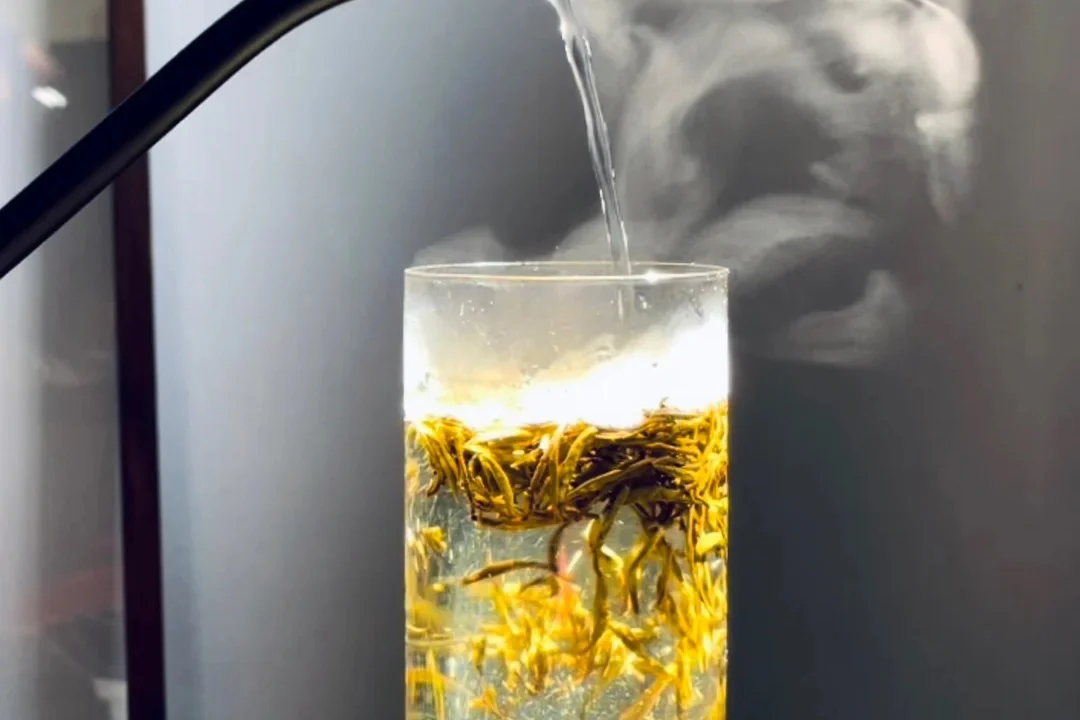
The authorized real hero photograph comes from a creator-described Junshan Yinzhen infusion. It shows hot water entering a tall glass, with some buds near the surface and others at different depths. It does not show a controlled experiment, prove three rises and three falls or independently authenticate the tea's origin.
Dry leaf contains air. Bud surfaces wet unevenly. Pouring creates currents, and water enters different pieces at different rates, changing buoyancy. Vessel shape and pour direction change the display. A bud that stands upright is visually interesting; it is not a geographic certificate.
I enjoy the dance in a glass; I simply refuse to let choreography impersonate provenance. Use a glass when observation is part of the pleasure. Use a fully decanting vessel when comparison matters. Never reject a sound tea solely because it failed to perform a retail choreography.
Glass brewing is for drinking, not ranking samples
For one everyday glass, begin with 2.5-3.0 g per 250 ml at 80-85 C / 176-185 F. Taste at about 2 minutes rather than waiting for every bud to sink. Drink down to roughly one-third and refill once if the cup remains clean and structured.
Do not seal delicate yellow tea in a hot vacuum mug for hours and then attribute a cooked, flat cup to the cultivar. If a thermos is necessary, reduce leaf, lower the starting temperature and test a short holding period first.
An automatic rinse is unnecessary for a clean, traceable sample and removes the opening evidence in a comparison. A fast rinse also cannot repair poor storage or doubtful hygiene. If you prefer one, record it and treat every comparison sample the same way.
Compare Junshan Yinzhen with white and green bud teas
This image is cataloged as Chinese Huang Ya yellow tea in a gaiwan. It shows dry material and vessel scale, not a brewed Junshan Yinzhen lot. Photograph by KirillK, CC0, via Wikimedia Commons.
| Choice | Buy it when | Main confusion to avoid | Controlled comparison question |
|---|---|---|---|
| Junshan Yinzhen | You want traceable Junshan provenance and a refined bud expression of yellowing | Paying for dance, legend or needle shape | Does the mellow structure remain in infusion two? |
| Mengding Huangya or another transparent yellow bud tea | You want to understand yellow-tea processing before paying a rare-origin premium | Treating every yellow bud tea as a lesser imitation | Can you taste a coherent yellow-tea direction at a fairer price? |
| Baihao Yinzhen | You want a white-tea bud style shaped by withering and drying | Buying from the English words Silver Needle alone |
Does the seller clearly identify white tea, origin and bud standard? |
| Tender green tea | You want a clearer fixed-green profile | Mistaking yellowish liquor or older leaf for yellow tea | Is the category stated, and does the processing account match? |
Do not compare these teas by forcing all of them into one supposedly optimal recipe. First use one fixed baseline to reveal differences, then adjust each tea separately and record the change.
Ask eight questions before paying the Junshan premium
- Is the product explicitly
君山银针yellow tea, not merelySilver Needle? - What exact production area is claimed: Junshan, wider Yueyang or only Hunan?
- Who produced, packed and sold this batch?
- What are the harvest year, packing date and claimed bud standard?
- How does the producer describe its yellowing stages without revealing proprietary details?
- Are the dry-leaf and opened-leaf photographs from this batch?
- Can you buy enough for two controlled sessions before purchasing a tin?
- What evidence and cup difference justify the price over a transparent yellow bud tea?
Reject the premium when every answer returns to imperial tribute, tea king, rare island, perfect gold or three rises and three falls. Those phrases can carry cultural or visual meaning. None joins the packet to a production chain.
Legend is not traceability
Stories connect Junshan Yinzhen with tribute, emperors, Tang figures and Princess Wencheng. They belong to the tea's cultural reception, but retellings often combine periods and lack contemporary records. Treat them as legends unless a source supports a narrower historical statement.
A legend can enrich the cup without authenticating it. The invoice, batch label, producer and production record answer today's buying question; a princess story does not.
Storage, price and health boundaries
Store Junshan Yinzhen sealed, cool, dry, dark and away from spices and perfume. Divide a large purchase into a working packet and reserve packet. It is normally bought for freshness; darker age is not automatic value.
There is no honest universal price threshold that separates authentic Junshan Yinzhen from imitation across harvests, grades, package sizes and markets. Compare price per gram, traceability and satisfying infusions. A high price can make an unsupported story more expensive without making it true.
Junshan Yinzhen contains caffeine. Yellow color does not make it caffeine-free or medically gentle. This guide does not present it as a detox, weight-loss aid or disease treatment.
The buying verdict
For a first purchase, choose a sample whose seller clearly distinguishes yellow tea, wider Hunan or Yueyang context and the specific Junshan claim. Run 3.0 g / 150 ml / 85 C at 60 and 75 seconds. Keep it when the first cup is clean, the second retains sweetness and body, and the cooled material broadly agrees with the stated bud standard.
If a less expensive transparent yellow bud tea teaches the process more clearly, buy that first. Pay the Junshan premium only when provenance and repeated cup quality make a difference you can defend. The buds may rise, stand or sink; your buying standard should not move with them.