Chinese green tea is defined by early heat fixing that limits enzymatic oxidation, not by bright color or one flavor. Buy it in this order: a dated batch with credible storage, an exact tea and production area, then a leaf form that matches the description. Freshness evidence outranks prestige because no famous name can restore aroma already lost to warm or repeatedly opened storage.
Chinese green tea: freshness is the first quality filter
Longjing, Biluochun, Huangshan Maofeng, Xinyang Maojian, Lu'an Guapian and gunpowder tea share a processing family, not one taste or one shape. Flat, curled, slender, broad and pellet-rolled leaves can all be Chinese green tea.
The family-level buying decision is therefore simple:
| Evidence order | What to request | Why it comes here |
|---|---|---|
| 1 | Harvest or production year, packing date and storage account | Green-tea aroma can be lost before a prestigious label matters |
| 2 | Exact tea name and production area | A shape word or famous English name does not prove origin |
| 3 | Leaf standard and finished form | Shape helps predict handling and brewing, but not authenticity alone |
| 4 | A small representative sample | The cup can confirm coherence between claim, material and storage |
| 5 | Grade, picking term and awards | These matter only after the first four fields are legible |
My rule is firm: a clearly dated small bag is a better first purchase than a large “imperial” tin with no storage history. The first teaches you something. The second asks you to buy a story before seeing the evidence.
I distrust green-tea shopping that begins with a velvet box. I want the packet date, storage history and exact leaf in front of me before the seller performs prestige. I would rather brew a modest, traceable spring lot twice than admire an anonymous “premium” tin once. The best purchase is the one you can test again, and that matters because freshness disappears while branding remains perfectly photogenic.
Green tea begins when fresh leaf meets controlled heat
Fresh Camellia sinensis leaf is not born green tea. After picking, the maker chooses an early heating stage commonly called fixing or shaqing. Heat reduces enzyme activity and turns the leaf away from the substantial oxidation used for black tea. Shaping and drying then create the finished form.
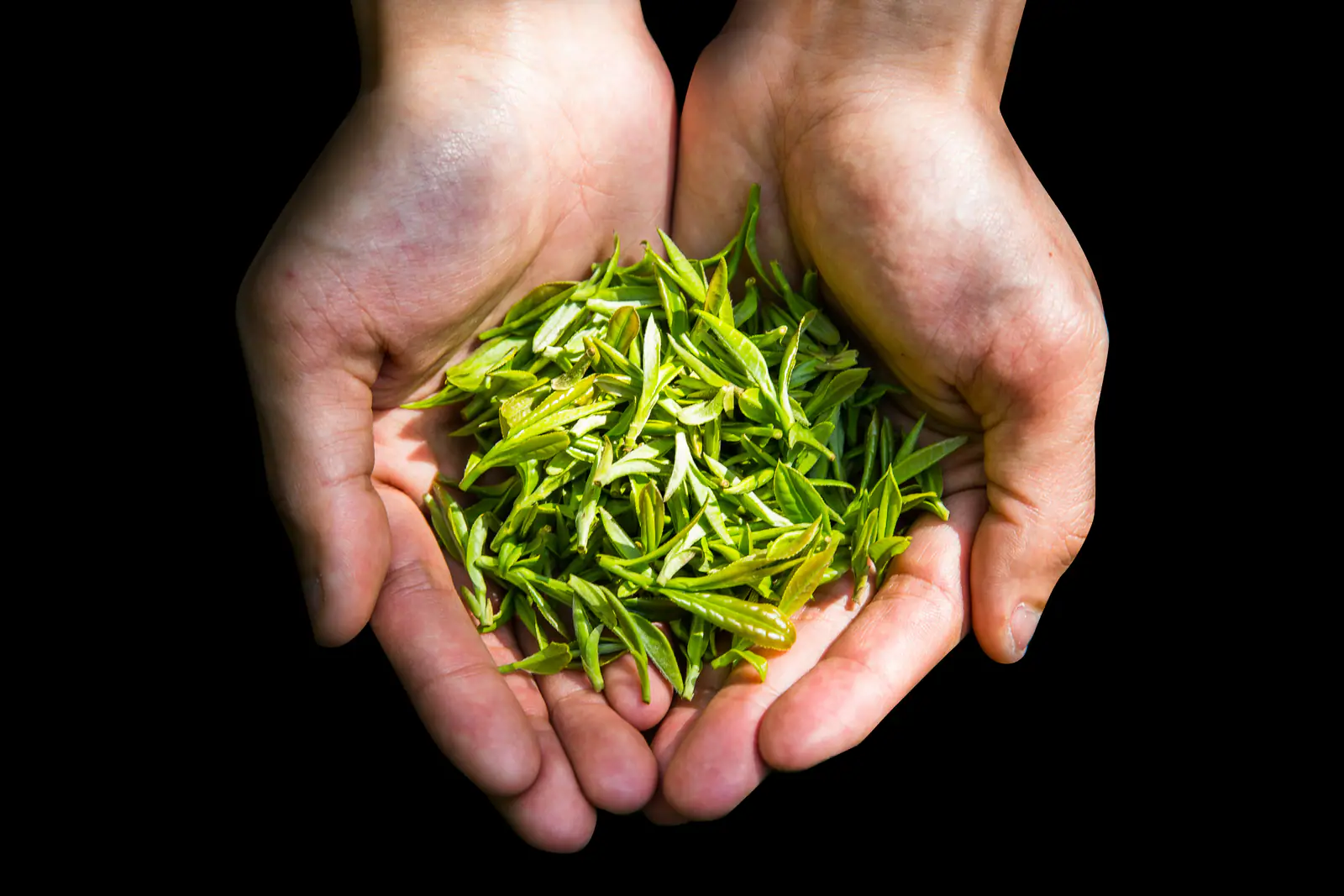
The image shows fresh material, not a finished category. A tea garden can supply leaf for more than one processing direction; the sequence after harvest creates green tea.
| Stage | Maker's decision | What the drinker may later notice | Boundary |
|---|---|---|---|
| Picking | Bud, leaf maturity and uniformity | Tenderness, body and visual consistency | Early picking does not guarantee skill or origin |
| Initial spreading or withering where used | Time, airflow and moisture loss | Handling resilience and aroma direction | Not every green tea follows one identical rest |
| Fixing | Heat source, temperature, duration and movement | Cooked, toasted, bean-like, chestnut-like or fresher aromatic directions | One aroma word cannot identify a tea |
| Shaping | Flatten, curl, twist, roll or leave broader | Dry-leaf form, breakage and how water reaches the leaf | Shape is not an origin certificate |
| Drying | Final moisture reduction and heat management | Stability, roast impression and storage tolerance | Dry-looking leaf can still have been stored badly |
UNESCO's record of traditional Chinese tea processing places the work inside a wider system of ecological knowledge, hand skills and community practice. A process table is useful because it identifies decisions, but it cannot reduce every workshop to one factory diagram.

Choose by leaf form before choosing a brewing recipe
Leaf form is not a quality ranking. It tells you how the tea occupies the vessel and how quickly water can reach broken edges or compact surfaces.
Flat leaf: read the claim before admiring the shape

Longjing is the famous flat Chinese green tea, but flatness alone cannot establish Longjing, Hangzhou or West Lake origin. The protected product has a geographic and production framework; a heated press can imitate a visible outline more easily than a seller can document a batch.
China's published Longjing geographical-indication standard is the useful institutional boundary here. It does not grade the pleasure in your cup, but it proves why a generic flat leaf and a documented Longjing claim are not equivalent.
Flat tender leaf often works well in glass or porcelain. Begin gently, then raise temperature only if the cup remains thin and closed. Follow the dedicated Longjing tea guide for its narrower origin, harvest and buying evidence.
Fine curled leaf: leave room for expansion
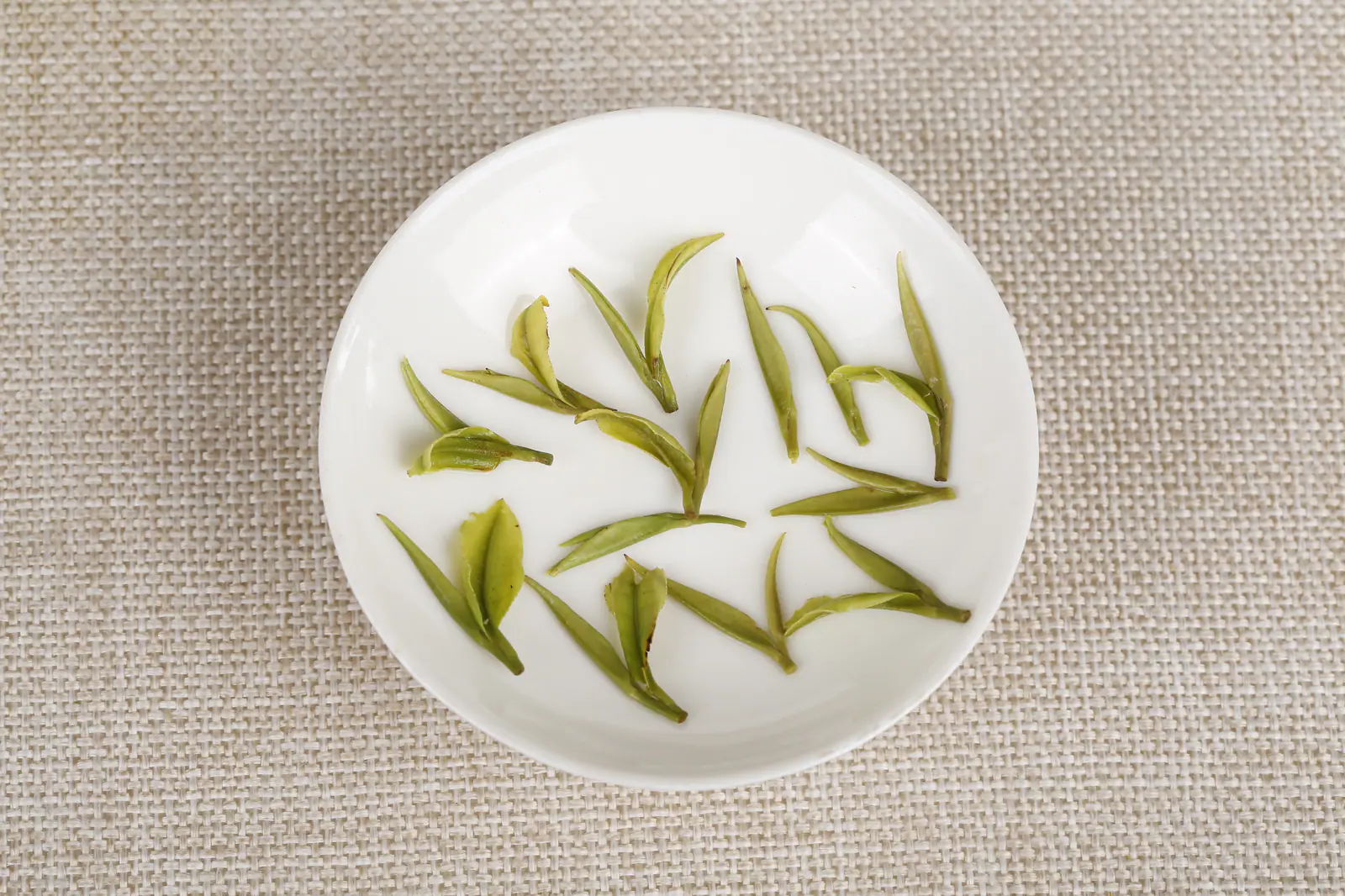
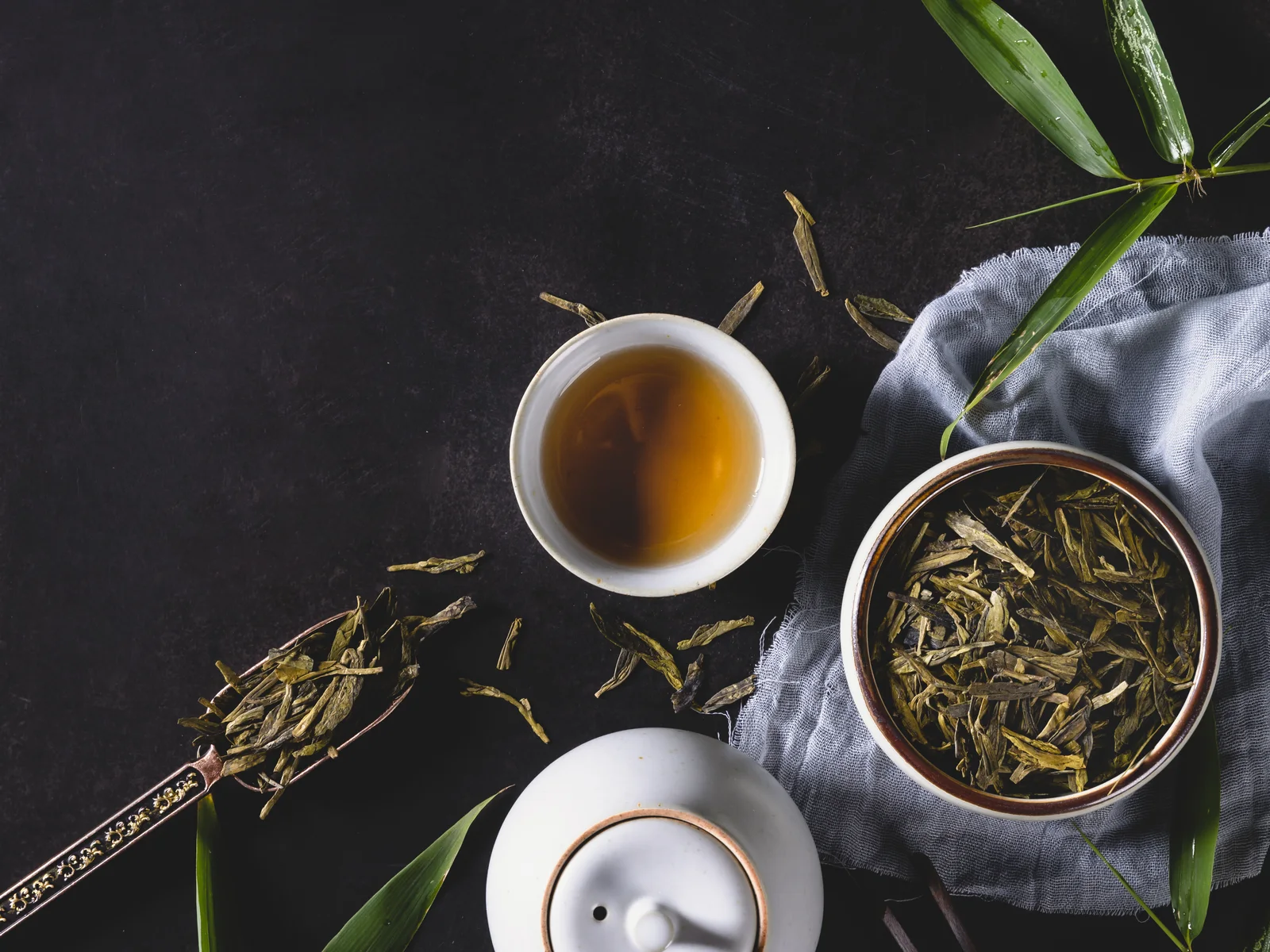
This is an opened-leaf view, not proof of the original dry curl. Once water has released the roll, the leaf can help you inspect tenderness, breakage and picking consistency, but it cannot reconstruct the packet's dry form. Photograph or examine both states when comparing a purchase.
Biluochun is associated with a fine curled form and a protected Dongting production identity. Curl, visible down and a floral or fruit-like aroma do not independently prove that origin. A crowded spoon can also make a small dose look larger than it is, so weigh the first comparison.
Use a roomy glass or glazed vessel and avoid turning the leaf into a compact layer under a violent pour. The Biluochun tea guide separates protected origin, fruit-aroma language and curl-based lookalikes.
Slender bud-and-leaf forms: inspect uniformity, not perfection

Huangshan Maofeng and several maojian or “hair-tip” teas can show slender buds and leaves. Fine material may brew quickly; larger, more mature leaf may offer more body. A perfect-looking batch is not automatically better than one whose picked material is slightly varied but cleanly processed.
The Huangshan Maofeng guide owns the specific Huangshan origin and product evidence. This family page uses the photograph to show form, not to authenticate another seller's tea.
Broad leaves and rolled pellets: different jobs, not lesser tea
Lu'an Guapian is known for leaf material rather than a bud-heavy appearance. Chinese gunpowder green tea is rolled into compact pellets and has a long export presence. Both correct the idea that premium green tea must look like tiny spring buds.
Broader leaf needs physical room; a pellet needs time and water to open. Rolled tea can tolerate a warmer start than very tender material, but broken pellets can extract harshly. Ask for exact origin and production date rather than assuming “gunpowder” names one standardized flavor.
A practical map of Chinese green tea styles
| Tea or form | Strong association | Visual direction | Start here | What the label does not prove |
|---|---|---|---|---|
| Longjing | Zhejiang; narrower protected areas within the wider name | Flat leaf | Glass or gaiwan, moderate heat | West Lake origin, hand making or early harvest |
| Biluochun | Dongting area near Lake Tai, Jiangsu | Fine curled leaf | Roomy glass, gentle contact | Dongting origin or fruit-tree aroma |
| Huangshan Maofeng | Huangshan, Anhui | Slender bud and leaf | Glass or porcelain, short first test | Exact production area or grade |
| Xinyang Maojian | Xinyang, Henan | Fine, tight, pointed leaf | Moderate heat; watch briskness | Uniform taste across producers |
| Lu'an Guapian | Lu'an, Anhui | Broader leaf without a bud-led ideal | Give leaf space and adequate heat | That mature leaf is inferior |
| Gunpowder green tea | Multiple Chinese production and export contexts | Rolled pellet | Let pellets open; decant if broken | One origin, one cultivar or one quality level |
Sensory words are orientation, never authentication. Chestnut, bean, orchid, fruit and toasted grain can help a drinker describe a cup, but none proves place, cultivar or grade.
Freshness evidence has a ladder
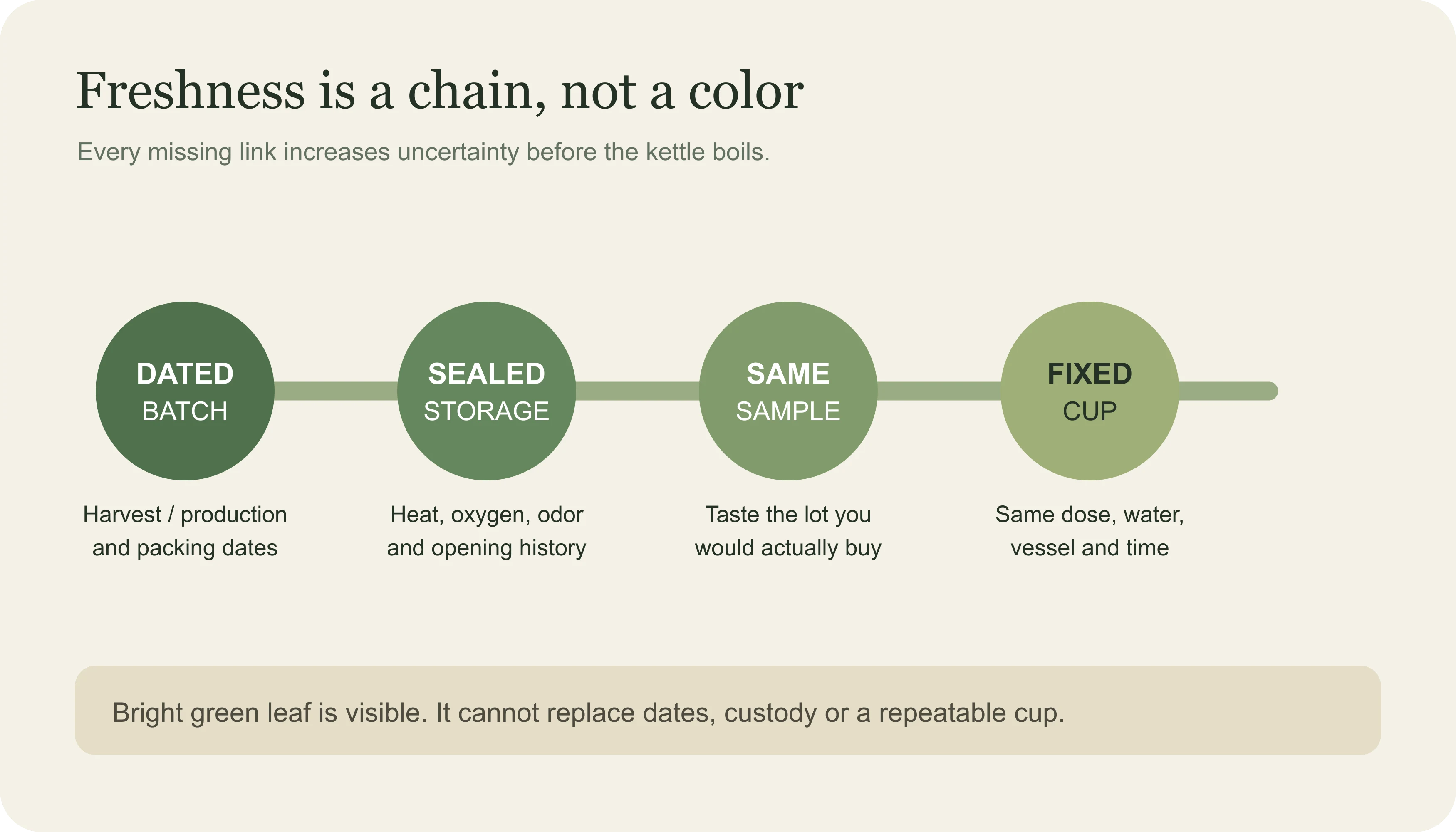
“New season” is not a storage record. A package can carry a recent year and still have crossed hot warehouses, open retail bins or repeated temperature changes.
Use this evidence ladder from strongest to weakest:
| Evidence | What it establishes | What remains unknown |
|---|---|---|
| Sealed original packet with harvest/production and packing dates plus storage record | A traceable timeline and claimed handling | Whether the sensory result suits you |
| Seller identifies batch, arrival date and cold or controlled storage | A coherent custody account | Conditions before the seller received it |
| Small sample from the same opened packet you will buy | Current aroma and cup behavior | Long-term consistency after opening |
| Bright dry leaf and strong packet aroma | A present visual and smell | Origin, date, storage history and durability |
| “Fresh,” “pre-Qingming,” “first picking,” “imperial” | A marketing or timing claim | Almost every fact needed to judge the batch |
Color belongs low on the ladder. Natural green teas range from yellow-green to darker olive. Saturated green may be attractive, but it cannot prove freshness and may distract from stale aroma or coarse extraction.
Run a two-condition storage comparison
Published research has measured storage-linked aroma deterioration and developed methods to monitor green-tea freshness. A household cannot reproduce that laboratory work, but it can run a disciplined comparison instead of arguing from memory.
Set up the samples
- Open one fresh packet and immediately divide two equal 5 g samples into identical small opaque airtight packets.
- Remove similar headspace and seal both at the same time.
- Label the packets on the bottom as A and B so the brewer can taste them blind later.
- Keep A in a stable dark cupboard. Keep B refrigerated away from strong odors.
- Leave both undisturbed for 14 days. This tests storage temperature under one household setup; it does not establish a universal expiration date.
Brew without creating a second experiment
Bring the refrigerated packet to room temperature while still sealed before opening. Brew equal leaf mass, water, temperature, volume, vessel and time. Compare dry aroma, liquor aroma after cooling, texture, bitterness, finish and opened-leaf odor.
| Record | A | B |
|---|---|---|
| Dry aroma intensity, 0-5 | ||
| Liquor aroma after 3 minutes, 0-5 | ||
| Texture and sweetness | ||
| Stale, papery or absorbed odor | ||
| Which sample would you drink again? |
Do not write the expected answer before tasting. If the samples seem identical, record that result. A null result is more useful than inventing a dramatic difference.
For daily storage, divide a larger purchase into small sealed portions. Keep the working packet separate so the full supply is not opened every morning. Refrigeration only helps when packaging controls moisture and odor; opening a cold packet immediately invites condensation.
Use temperature as a controlled question
A 2025 Longjing study compared 70, 80, 90 and 100°C under a four-minute protocol with a trained nine-person panel. Its results show that temperature changes the sensory outcome; they do not make one temperature correct for every Chinese green tea or every brewing method.
Run a simpler three-cup screen:
| Variable | Hold constant |
|---|---|
| Tea | One batch, 3 g per cup |
| Water | Same source, 150 ml |
| Vessel | Three identical glazed cups or glasses |
| Time | 90 seconds, then separate leaf from liquor |
| Temperature | Change only this: 75°C, 85°C and 95°C |
Taste after the cups cool to a similar comfortable temperature. Record texture first, then aroma, bitterness and finish. The coolest cup may protect tenderness but feel thin; the hottest may reveal body or expose coarseness. The useful temperature is the one that gives this batch the best balance, not the number repeated most often online.
This is an East Moment comparison protocol. It is deliberately shorter than the published Longjing study and does not claim to reproduce its trained-panel result.
Glass and gaiwan answer different questions

Glass brewing is continuous immersion. The tea changes while you drink; a refill changes temperature, concentration and ratio again. It works for desks, conversation and observing leaf expansion. Refill before only a dense, concentrated bottom layer remains.
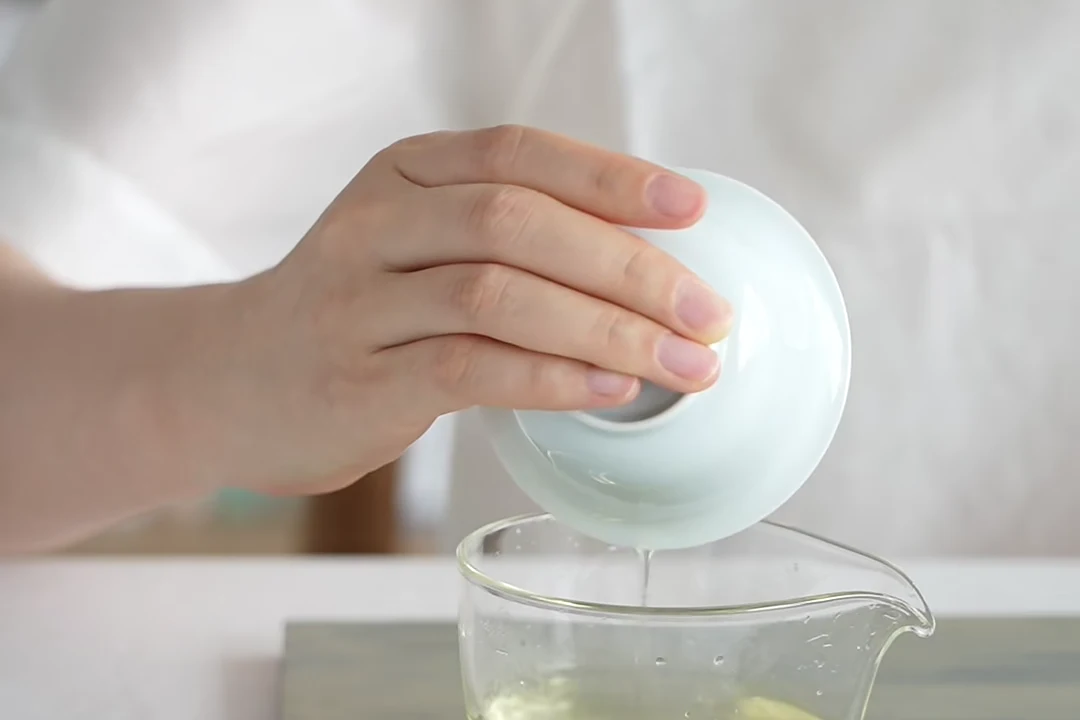
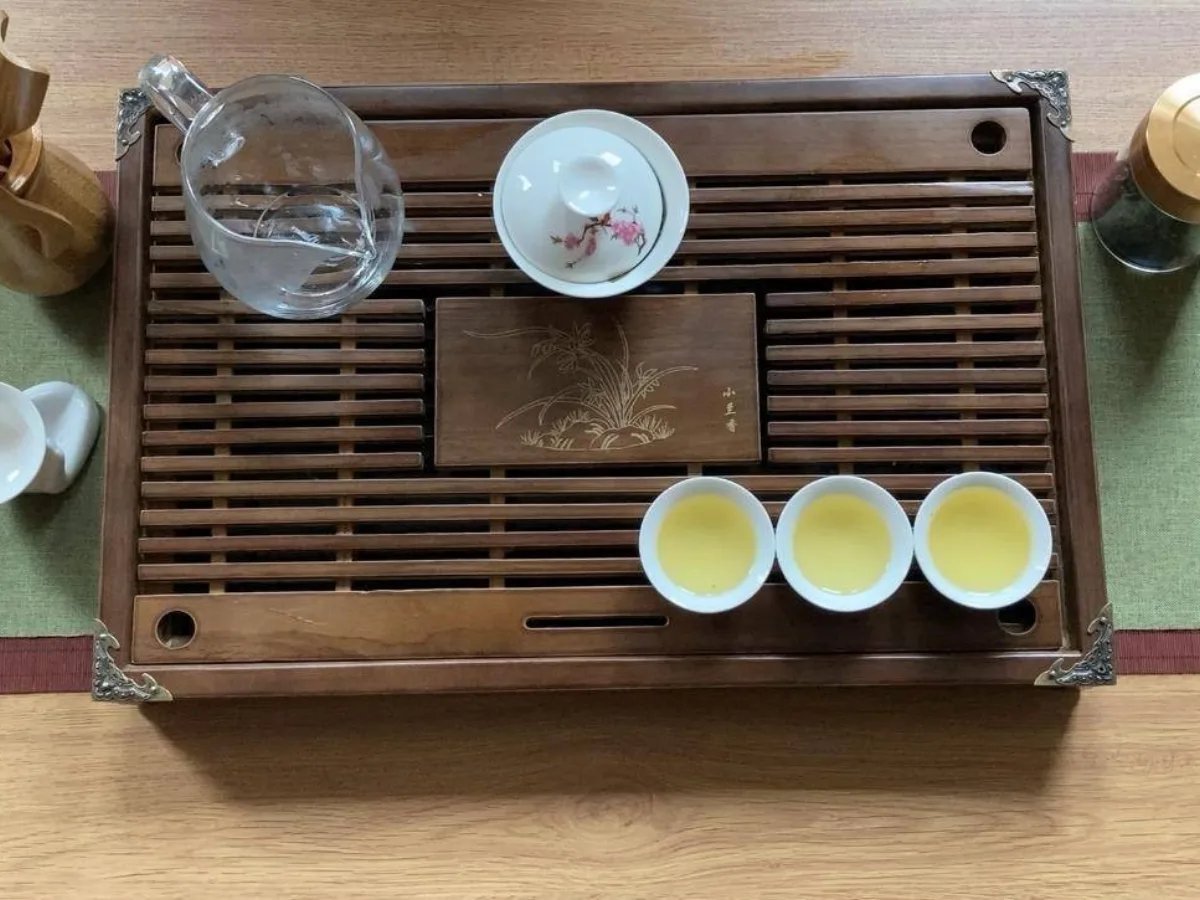
A gaiwan gives infusions clearer boundaries because the liquor can be fully decanted. Use it when comparing time, water or successive cups. It is not automatically more authentic, and glass is not automatically careless.
Choose the vessel by the question:
| Question | Better starting tool |
|---|---|
| How does the leaf open over time? | Clear glass |
| Which temperature produces the best balance? | Identical cups or gaiwan with full decant |
| How does the tea change across infusions? | Gaiwan |
| Do I want tea beside me during work? | Glass or larger glazed cup |
Diagnose the cup before replacing the tea
Change one variable, brew again and record the result.
| Symptom | First likely checks | Change one thing next |
|---|---|---|
| Harsh before aroma appears | Water too hot, long contact, excess leaf, broken particles | Lower temperature by 10°C or shorten time |
| Thin and silent | Water too cool, too little leaf, stale tea, unsuitable water | Raise temperature by 10°C before adding leaf |
| Cooked vegetable impression | Heat too high or leaf held hot too long | Cool water and decant fully |
| Strong dry aroma, dull liquor | Hard or odor-heavy water; exhausted packet aroma | Repeat with neutral water |
| First glass pleasant, bottom bitter | Continuous immersion concentrated the remaining liquor | Refill earlier or use a gaiwan |
| Papery or absorbed odor | Warm, oxygen-rich or odor-exposed storage | Compare against a sealed reference packet |
Opened leaf can reveal breakage, mixed maturity and whether rolled material expanded. It cannot authenticate a famous origin. Smell the empty cup and cooled leaf; top notes that disappear instantly may be less useful than a clean finish that remains.
Chinese and Japanese green tea are not one national contest
Many Japanese green teas are steam-fixed; many Chinese green teas use pan, drum or other dry-heating systems. Both statements describe broad tendencies with exceptions. Cultivar, shading, harvest, rolling, drying, storage and brewing continue to matter after the fixing method.
The intelligent comparison is specific: Longjing against sencha for shaping and fixing, or a shaded Japanese tea against a Chinese spring bud tea for material and growing practice. “Which country makes better green tea?” produces nationalism, not understanding.
Buying rejection tests
Reject or pause when:
- “2026 new tea” appears without harvest/production date or storage information.
- “West Lake,” “Dongting” or “Huangshan” appears without a specific production-area claim.
- Bright color is presented as proof of freshness.
- “Pre-Qingming” or “first picking” replaces cultivar, leaf standard and batch details.
- A precise grade or award has no issuing body, year or lot connection.
- The seller refuses a small representative sample but pushes a large prestige tin.
- Last year's tea is discounted without stating how it was sealed and stored.
- “Premium Chinese green tea” is the complete product identity.
The best first purchase is not the rarest tea. It is the batch whose name, date, custody and cup agree strongly enough that you can make the second brew more intelligent than the first.
A three-question green-tea decision
Before choosing a Chinese green tea, answer these in order:
- Do I want a named regional experience or a dependable daily cup? If the former, require a specific origin claim; if the latter, freshness and storage may matter more than prestige.
- Will I drink it quickly enough for its form? Tender curled or flat spring teas reward careful storage and short contact; rolled pellets and broader leaves need room and time to open.
- Can I repeat the test? A small dated packet, a measured dose and one controlled comparison teach more than a large gift tin with no batch information.
This is why the page refuses a single “best Chinese green tea.” Longjing, Biluochun, Huangshan Maofeng, Xinyang Maojian, Lu'an Guapian and gunpowder answer different decisions. The useful ranking is the one that survives your next cup, not the one that wins a photograph.
Health claims do not belong in the quality test
Chinese green tea contains caffeine and many studied compounds. This guide does not promise detoxification, weight loss, cancer prevention or treatment. A green-tea family name cannot tell an individual how much caffeine reaches one cup; leaf, dose, water and extraction all matter.
Compare green tea with the other types of Chinese tea or return to the green-tea collection for its full style map. Use the measured Chinese tea brewing guide or learn how a gaiwan changes control. Then continue to Longjing, Biluochun or Huangshan Maofeng without asking this family page to authenticate a specific product.