Buy Huangshan Maofeng tea only when origin evidence and the cup agree. The words
Mingqian,special grade,one bud and one leaf, visible down and orchid aroma can describe a batch, but none proves protected Huangshan origin or value by itself. For most buyers, a transparent mid-priced batch that stays sweet and coherent through infusion two is a better purchase than a perfect-looking early tea that becomes scented water.
Huangshan Maofeng tea is a protected origin, not a leaf shape
Huangshan Maofeng is a green tea associated with the protected Huangshan production area in Anhui. Mao points to fine hair or down on tender material, and feng evokes a peak-like tip. Those words help explain the name; they do not authenticate a packet.
Use the Chinese green tea collection for category comparison. This page owns the narrower buying decision: whether a Huangshan Maofeng batch has the regional evidence and second-infusion performance needed to justify its name and price.
The official Chinese standards record for GB/T 19460-2008, Product of Geographical Indication - Huangshan Maofeng Tea establishes a named product framework. A tea made elsewhere can still have slender, downy buds and may be honestly sold as a maofeng-style green tea. It should not borrow Huangshan without evidence for that geographical claim.
Use this three-level name check:
| Label wording | What it claims | What to request |
|---|---|---|
Huangshan Maofeng |
The protected regional product | Producer, production area, harvest year and traceable packing information |
| A named Huangshan county or village | A more specific place within the wider claim | Evidence connecting this batch to that place, not just a landscape photograph |
Mao Feng or Maofeng-style green tea |
A leaf or market style | Honest country and production origin; do not assume Huangshan |
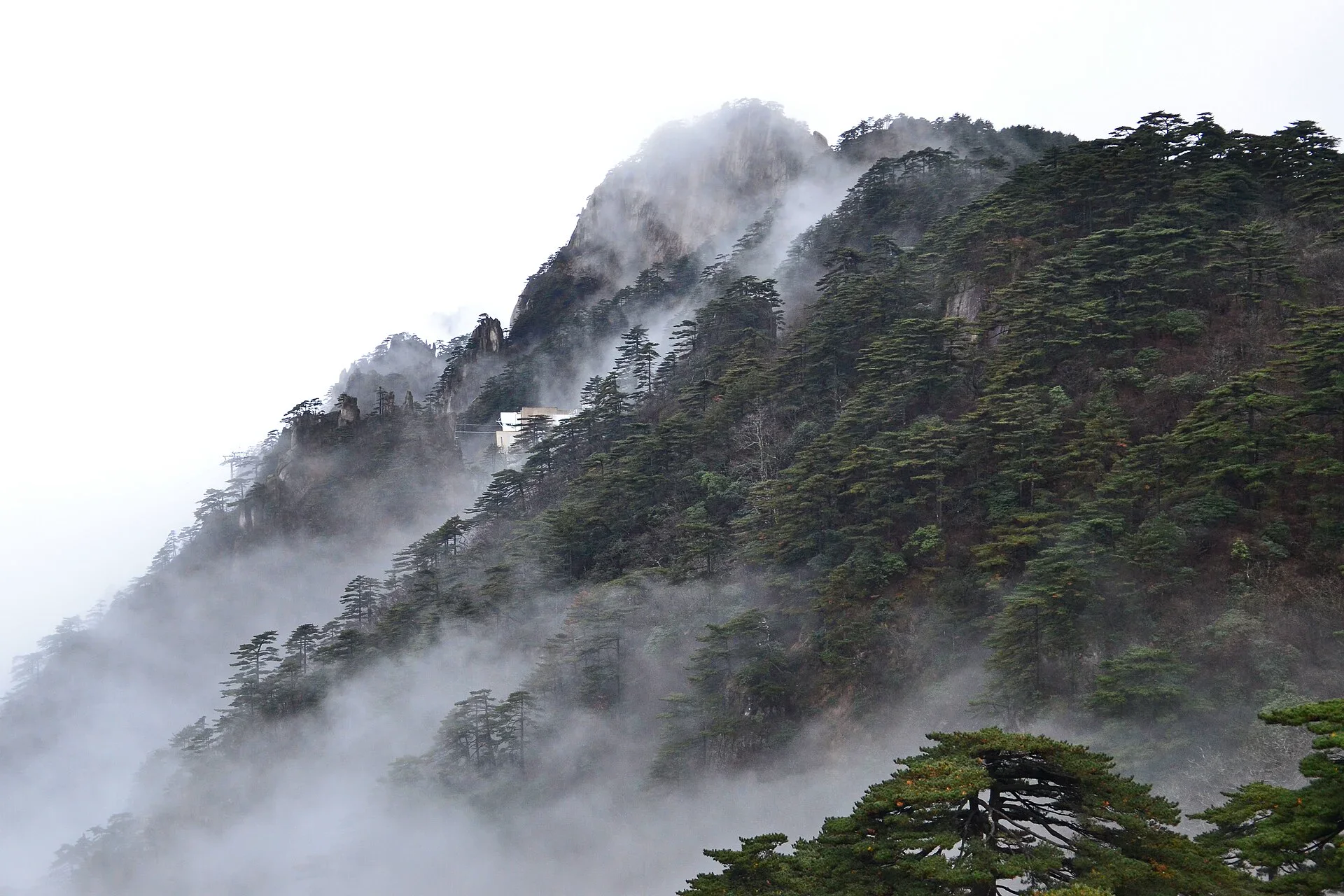
A scenic box is not traceability. Huangshan's granite peaks and cloud are culturally meaningful, but they cannot identify the garden behind a retail tea.
This photograph documents the Huangshan scenic landscape, not a tea garden or the origin of a packet. The protected production region includes lived and working geography beyond the iconic summit image.
Choose a batch, not a prestige word
Retail labels often combine harvest timing, picking standard, appearance and a seller's grade. Separate them before comparing prices.
| Claim | Useful meaning when defined | What it cannot decide alone |
|---|---|---|
Mingqian |
Seller claims harvest before Qingming | Exact date, freshness, origin or better taste for you |
Guyu or spring tea |
A seasonal position | Low quality, coarse material or inferior craft |
Special grade, grade one |
A grade inside a stated system | Equivalence between two sellers |
One bud and one leaf |
A picking description | Whole-batch uniformity until the opened leaf is checked |
Orchid aroma |
A sensory direction | Added-aroma absence, origin or universal quality |
| Visible white down | Tender hairy material in the photographed sample | Huangshan origin, harvest date or chemical quality |
The best value is not automatically the earliest or smallest leaf. Very tender material can be fragrant and refined, but it can also be light. A slightly later bud-and-leaf batch may offer more body and a better everyday second infusion. Buy the cup you want rather than the most ceremonial adjective.
Read dry leaf for condition and consistency
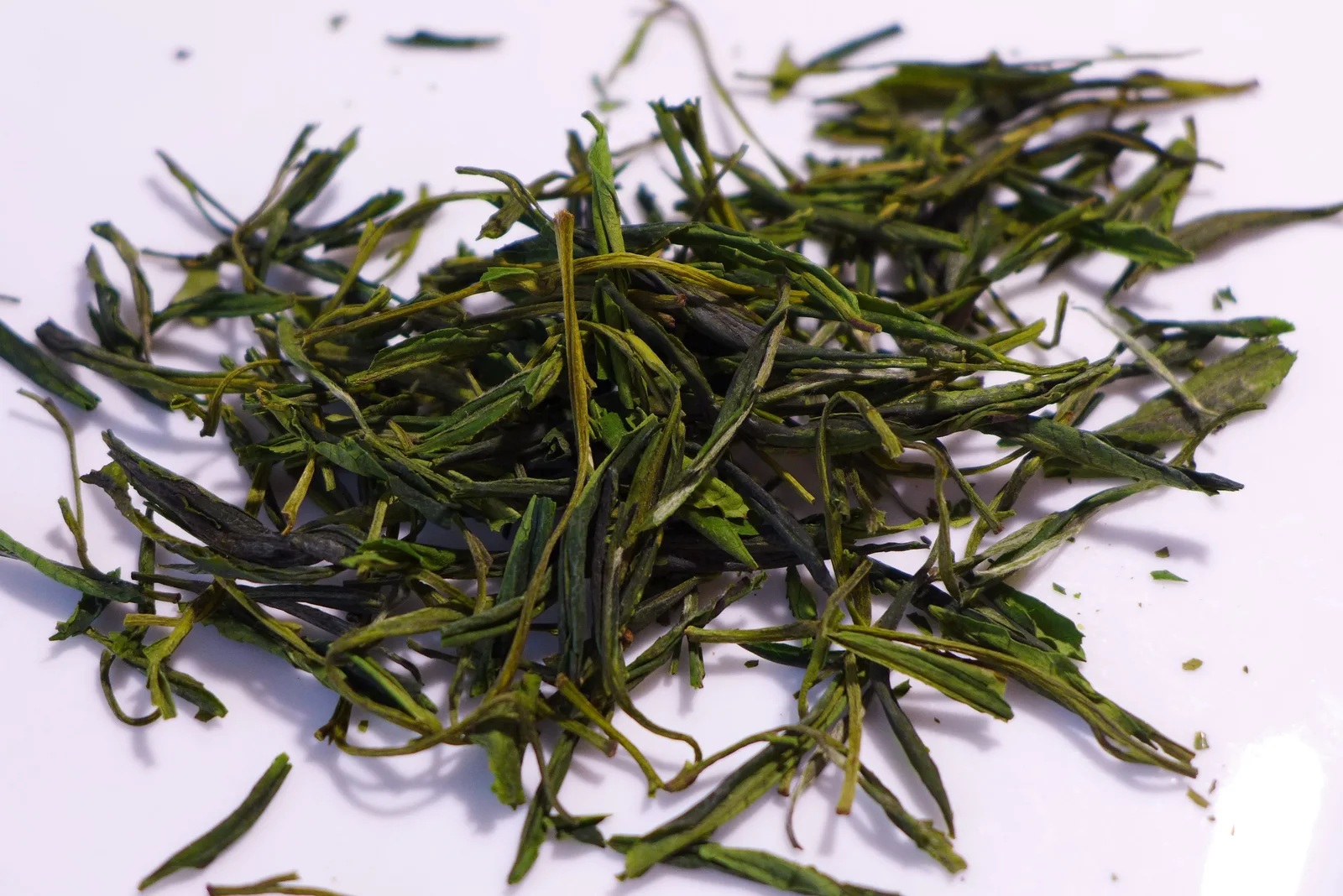
This identified archive photograph shows one Huangshan Maofeng sample. Its mix of slender buds, young leaves, darker pieces and small fragments is useful precisely because real tea is not a row of identical green needles.
Spread 3-5 g on a white plate in neutral light and record only what you can see and smell.
| Observation | Useful question | Stop before claiming |
|---|---|---|
| Bud-to-leaf mix | Does it broadly match the seller's picking description? | Grade or origin from appearance |
| Particle size | Will small fragments extract faster than whole pieces? | Hand processing or poor quality |
| Fine down | Is tender material visibly present? | Authenticity or freshness |
| Bright, olive or darker green variation | Is the lot reasonably coherent and clean? | Harvest date from color |
| Dust and broken tips | Should the first infusion be shortened? | That every broken batch is defective |
| Dry aroma | Is it clean, muted, stale, perfumed or smoky? | A named village or cultivar |
Reject damp, musty, perfumed or obviously foreign odors before debating grade. Photograph the dry leaf now and the fully opened material later in the same light. That pair is more informative than a beauty shot taken under different lighting.
A real sample shows what a photograph can and cannot prove
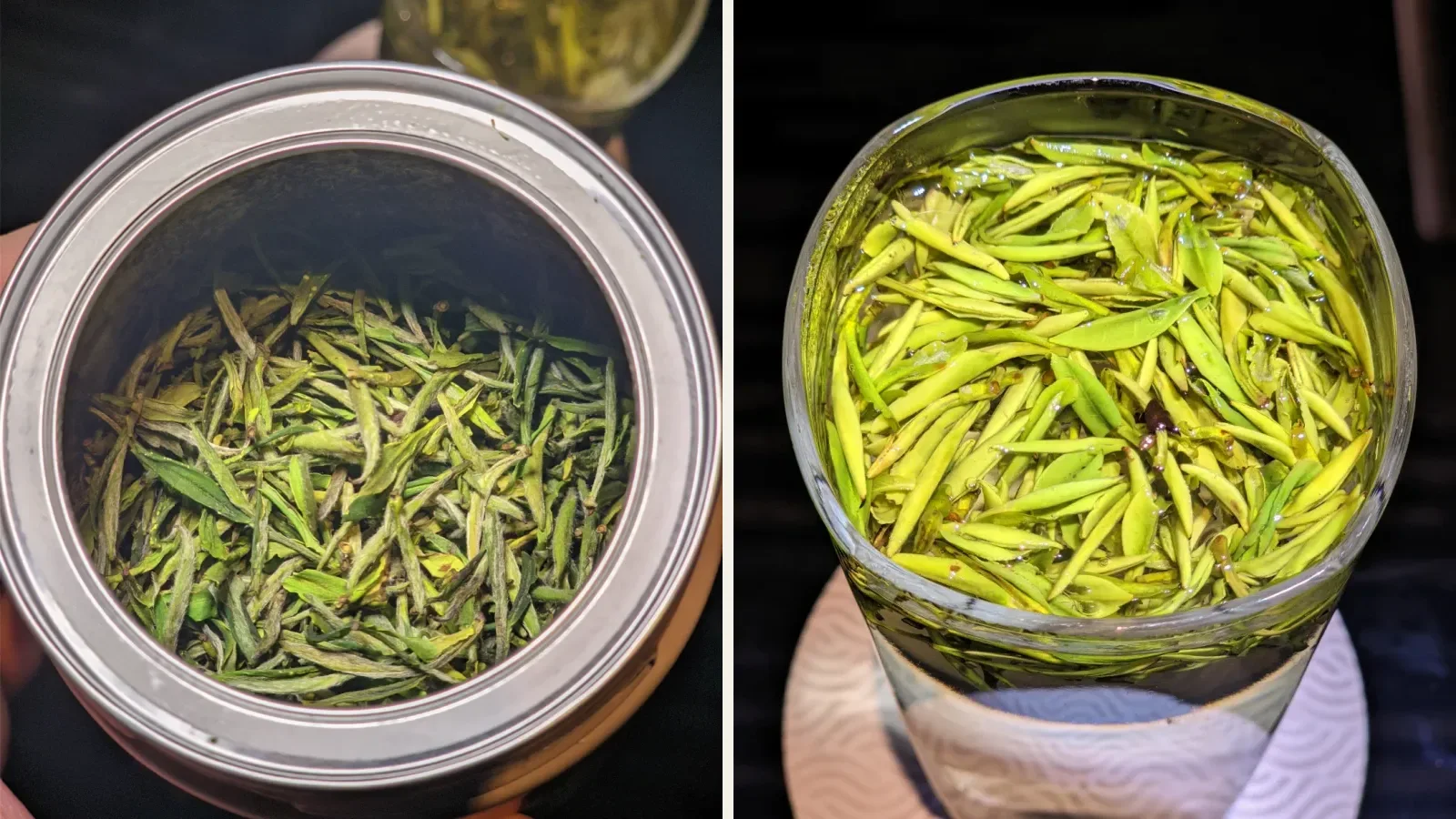
This is first-person evidence, not an East Moment controlled test. The dose, vessel capacity and temperature were approximate, the batch claim was not independently audited, and preference is personal. The photographs do establish something valuable: one consumer kept dry leaf, glass behavior and opened material in the same record instead of asking a packet or mountain picture to carry the argument.
Use that discipline, not that person's verdict. Your tea may open, extract and fade differently.
Run a controlled two-infusion value test
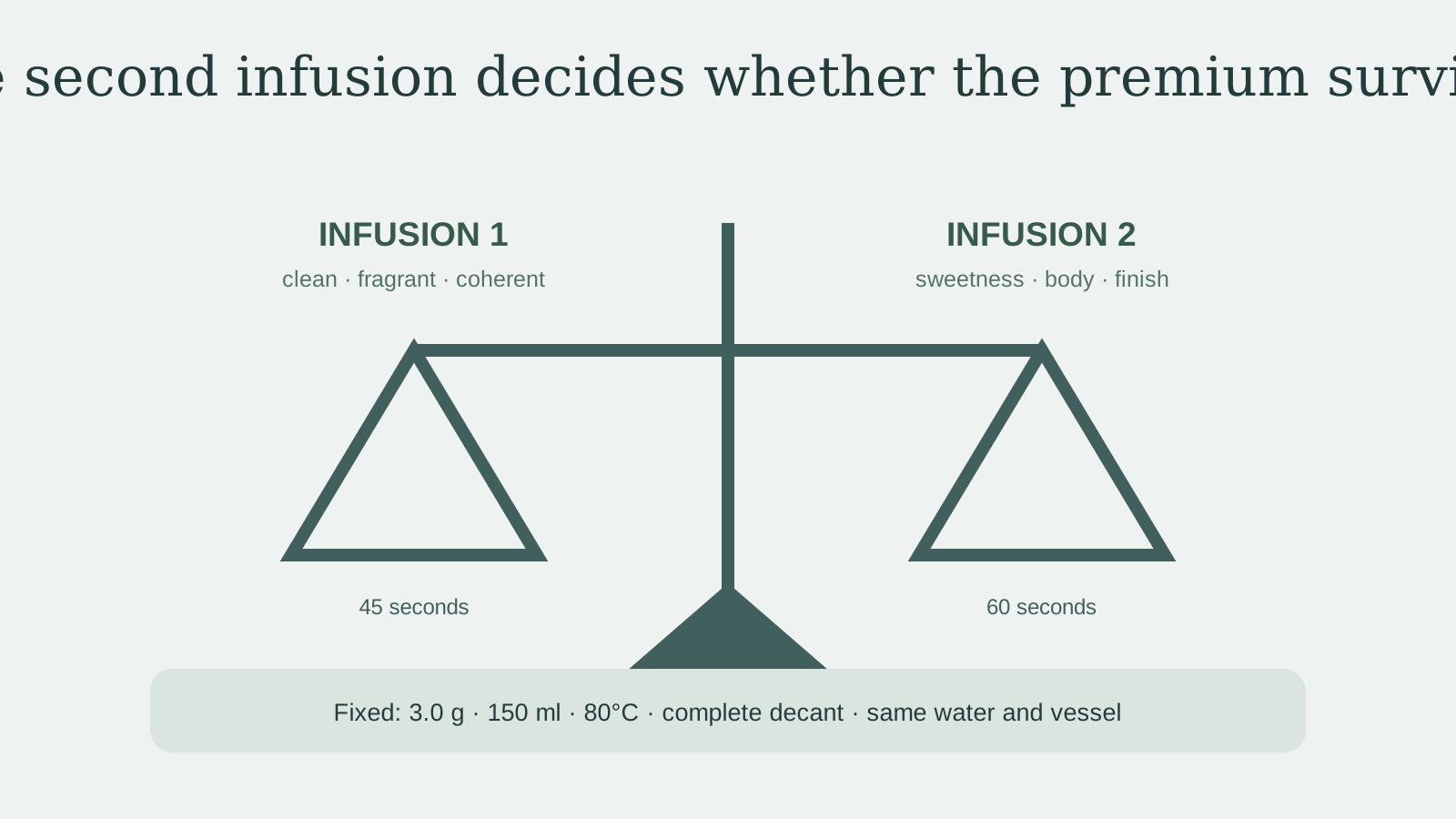
The second infusion is the purchasing test. Infusion one shows freshness and opening aroma; infusion two shows whether the leaf has enough sweetness, body and clean finish to justify its price. A third infusion is optional evidence, not a moral requirement for delicate green tea.
Use this East Moment household protocol for comparing samples. It is not a national standard and does not reproduce the social-media session above.
- Measure 3.0 g of tea and 150 ml of working vessel volume.
- Begin with 80 C / 176 F water.
- Infuse for 45 seconds, then decant completely.
- Make infusion two at 60 seconds with the same water temperature.
- If useful, make infusion three at 90 seconds.
- Taste each cup hot, warm and nearly cool.
- Keep water, vessel, dose, timing convention and pouring speed constant between samples.
Start timing when water first touches the leaf. Stop timing only when the vessel is empty, not when pouring begins. If your pour takes 12 seconds, that contact belongs to the extraction.
| Checkpoint | A useful result | Failure signal |
|---|---|---|
| Infusion 1, hot | Clean green, floral, sweet-grain or lightly roasted direction | Perfume, must, smoke or harsh rawness |
| Infusion 1, warm | Aroma enters the liquor instead of floating above it | Strong nose but hollow center |
| Infusion 2, warm | Recognizable sweetness and body remain | Colored water or abrupt roughness |
| Nearly cool | Finish stays clean without stale hay or sourness | Storage odor becomes clearer as heat fades |
| Opened leaf | Material broadly matches the seller's picking description | The description cannot account for the visible leaf |
Do not rank two teas when dose, vessel size or water temperature changed. A controlled modest setup is more useful than elaborate equipment with unrecorded variables.
Diagnose a weak, bitter or flat cup one variable at a time
Huangshan Maofeng tastes light can describe style, under-dosing, stale storage or a poor-value batch. It is not a complete diagnosis.
| Result | First controlled change | Buying interpretation |
|---|---|---|
| Thin from infusion one but clean | Add 0.5 g while holding time and temperature | Improvement points to dose; no improvement questions freshness or value |
| Bitter or rough | Shorten contact by 10 seconds | Improvement points to extraction pressure |
| Still rough at shorter time | Lower water from 80 C to 75 C | Improvement shows this sample needs gentler heat in this setup |
| Strong fragrance, little taste | Keep the baseline and judge infusion two warm | Persistent hollowness is not refinement |
| Sweet first cup, weak third cup | Judge whether cup two was still satisfying | A delicate green tea need not win an endurance contest |
| Musty, sour or cupboard-like nearly cool | Repeat once with known water and a clean vessel | Persistence is a storage warning; stop buying more |
| Dull after opening a new packet | Compare a freshly opened portion with the working packet | A storage difference matters more than grade language |
Change one variable, repeat the same infusion number and write down the result. Lowering temperature, shortening time and reducing leaf simultaneously teaches nothing.
Use a glass for observation, not authentication
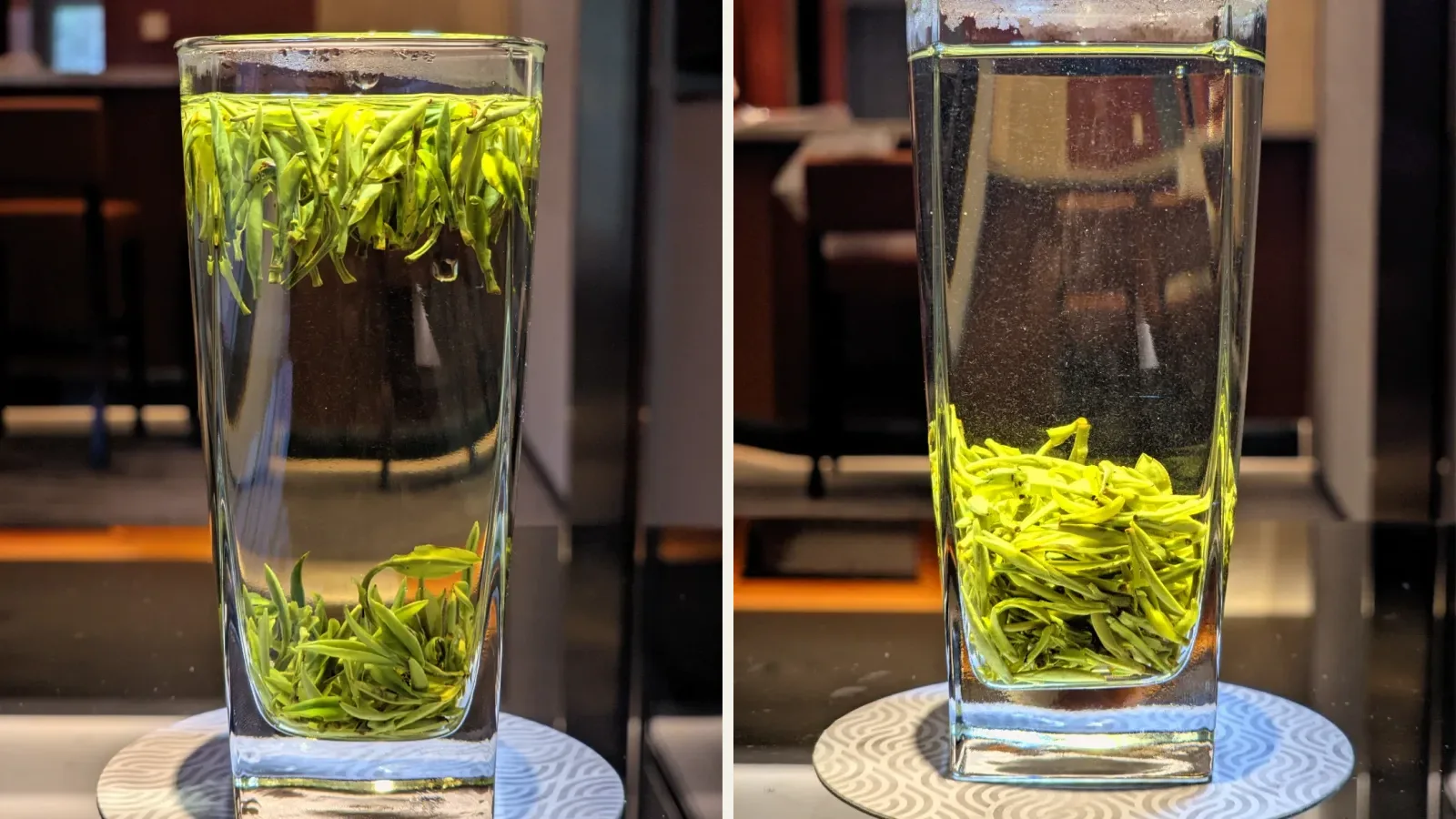
These two photographs come from the same authorized consumer post. They show leaf distributed near the top and bottom of a tall glass in two views. They do not supply an exact elapsed time, prove a tea dance, measure liquor color or authenticate origin.
For an office glass, begin with 2.5 g per 250 ml at 80-85 C / 176-185 F. Wait about 2 minutes, taste, drink down to roughly one-third and refill once. This is a practical continuous-glass starting point, not a controlled sample-ranking method. Use the decanted protocol above when you need a fair comparison.
Do not seal hot green tea in a vacuum mug for hours and then blame the cultivar for a cooked, flat cup. A covered vessel changes heat retention and aroma exposure. If a thermos is necessary, reduce leaf, lower the starting temperature and test a short holding time before committing a full day.
Grade research does not turn a shopper photograph into a laboratory
A 2022 Food Chemistry study combined sensory evaluation with LC-MS metabolomics across six grades of Huangshan Maofeng. The researchers evaluated bitterness, astringency and sweet aftertaste. In those samples, total polyphenol and flavonoid contents did not show a significant simple correlation with grade, while more detailed metabolomic differences separated the samples into groups.
The useful buying lesson is narrow: grade is not one visible or chemical dial, and more polyphenols is not a complete quality argument. The paper does not prove that retail grades are meaningless, that every producer uses the same ladder or that a consumer can reproduce laboratory grouping at home.
A separate 2020 open-access study classified its Huangshan Maofeng grade samples by combining ultraviolet spectra, color-difference measurements and statistical models. That method is evidence against casual photo authentication, not evidence for it. If researchers needed instruments and a defined sample set, a seller's saturated green photograph cannot prove grade, origin or freshness.
Ask seven questions before paying a spring premium
- Is this claimed as protected Huangshan Maofeng or only Maofeng-style green tea?
- Which production area, producer and harvest year are recorded?
- What does
Mingqian,special gradeor another grade mean on this seller's listing? - What picking standard is claimed, and is there a current batch-level dry-leaf photograph?
- When was the tea packed, and how was it stored before sale?
- Can the seller show fully opened leaf from this batch rather than only dry-leaf glamour shots?
- What does the price buy beyond early-date, down or scenic-mountain language?
Reject the premium when every answer returns to earlier, greener, more down or looks like a sparrow tongue. Those features can matter, but none completes origin, freshness, processing and cup quality.
Compare Huangshan Maofeng with Longjing and Biluochun
| Tea | First buying question | Form clue | Value test |
|---|---|---|---|
| Longjing | Is the claimed production area stated precisely? | Flat pressed leaf | Freshness and clean toasted-green structure across a controlled temperature test |
| Biluochun | Is Dongting a protected-origin claim or only a spiral style? |
Fine curled leaf with visible down | Aroma must enter the liquor and survive cooling |
| Huangshan Maofeng | Does protected origin evidence accompany the batch? | Slender bud-and-leaf form, often downy | Infusion two must retain sweetness, body and a clean finish |
These are three regional product systems, not a prestige ranking. Flatness, curl and slender tips describe form; they do not let one tea impersonate another.
Storage and health boundaries
Keep Huangshan Maofeng sealed, dark, dry and away from perfume, cooking odors and repeated warm-cool cycles. Divide a large purchase into a working packet and a reserve packet. Refrigeration can help a well-sealed reserve remain cool, but condensation can damage tea when a cold packet is repeatedly opened before reaching room temperature.
Huangshan Maofeng contains caffeine. It is not a treatment for weight, blood pressure, digestion or detoxification. Anyone who is pregnant, caffeine-sensitive or managing a medical condition should consider total daily caffeine and use qualified health guidance.
The buying verdict
For a first Huangshan Maofeng, choose a traceable current-harvest batch whose seller defines origin, grade and picking standard. Then test 3.0 g / 150 ml / 80 C at 45 and 60 seconds. Keep it when the first infusion is clean and the second still carries sweetness, body and a coherent finish.
Pay more for a demonstrable improvement in the cup, not for a greener photograph, a smaller bud or the word Mingqian alone. The strongest Huangshan Maofeng purchase is not the tea that looks most like a mountain legend. It is the batch whose name, material and second infusion tell the same story.
Compare that result with the broader Chinese green tea guide and publish the exact second-infusion evidence in China Moments. A useful tasting note lets another reader reproduce the result; prestige language does not.