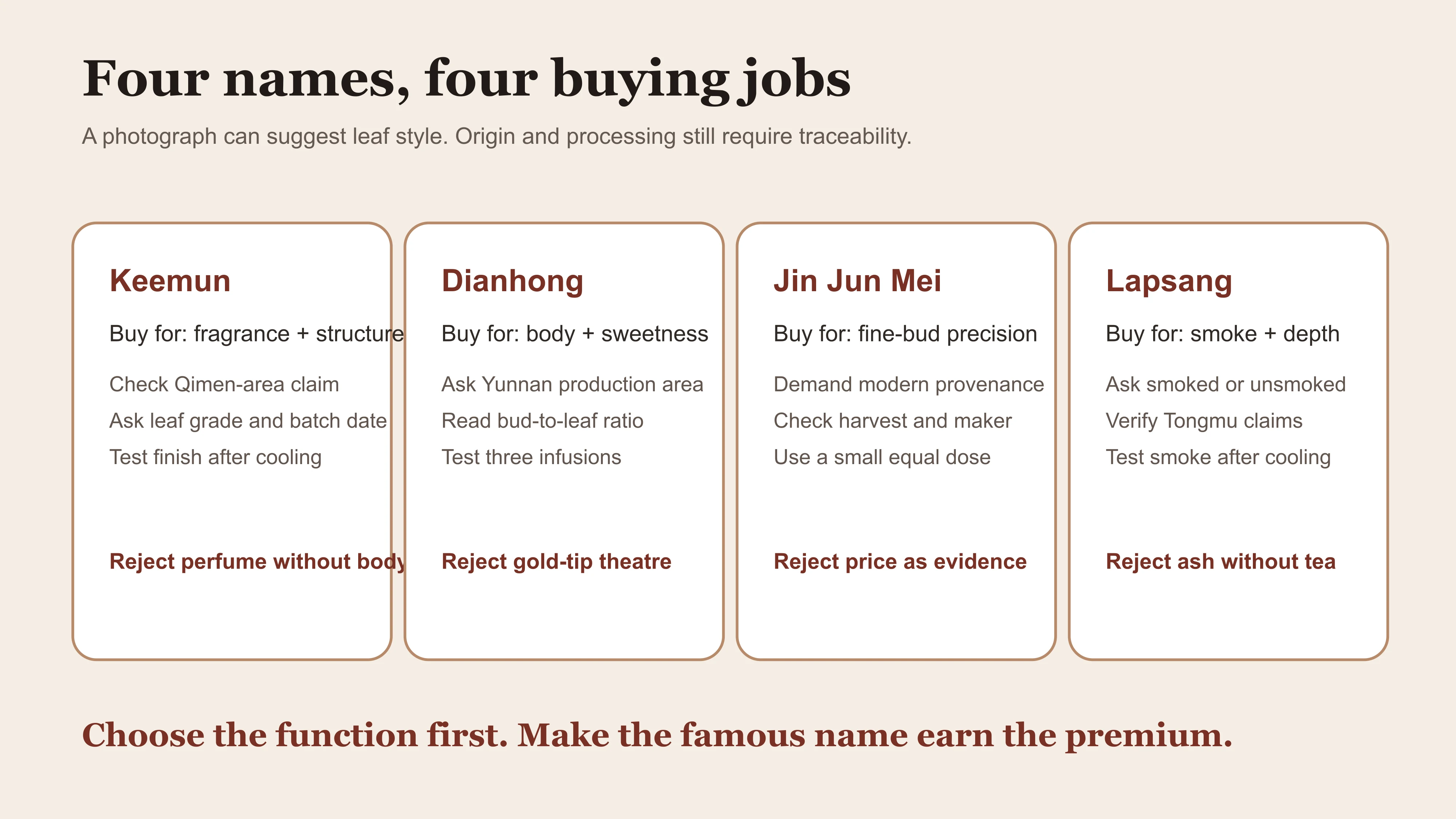
Chinese black tea is called hong cha, or red tea, in Chinese. Do not buy it from a universal ranking. Choose by the job you want the tea to do: Keemun for fine fragrance and briskness, Dianhong for body and malt, Jin Jun Mei for bud-focused sweetness only when origin is traceable, and Lapsang Souchong for fruit-and-smoke tension with the smoke level stated. Four small samples reveal more than one prestigious tin.
Chinese black tea: choose a function before a famous name
The words “Chinese black tea” cover different raw materials, regional histories, leaf forms and markets. A ranking that declares one tea superior usually hides the brewing method, batch and price behind a neat list.
Use this decision map instead:
| What you want | Best first route | What the tea must still prove | Immediate rejection |
|---|---|---|---|
| Fine floral-fruit fragrance with a composed finish | Keemun | Aroma remains connected to liquor, briskness and finish as the cup cools | “Keemun aroma” used as origin proof without Qimen traceability |
| Broad body, malt and an easy breakfast or milk-tea base | Dianhong | Strength stays sweet and clean rather than turning baked, sour or blunt | Golden tips or “ancient tree” language used as the whole quality argument |
| Tender-bud sweetness and a lighter luxury style | Jin Jun Mei | Batch origin, producer and bud standard justify the premium | Generic gold-and-black buds sold as rare Tongmu material |
| Longan-like fruit, wood and optional pine smoke | Lapsang Souchong | Tea structure remains after the smoke arrives | Smoke intensity treated as authenticity or quality |
My first-purchase recommendation is 20-30 g of Keemun, Dianhong and either smoked or unsmoked Lapsang Souchong. Add Jin Jun Mei only when the seller can explain where the batch was made and what the name means on that packet. This is not a prestige ladder. It is a contrast set.
Why black tea is red tea in Chinese
English names the dark finished leaf. Chinese names the reddish liquor: hong cha literally means red tea. The translation matters because hei cha, literally dark or black tea, is a different post-processed family. Pu-erh is not simply black tea under another English label.
| Term | Literal cue | Tea family meant | Common mistake |
|---|---|---|---|
| Hong cha (红茶) | Red liquor | The family English calls black tea | Translated as an herbal “red tea” because the leaf is not considered |
| Black tea | Dark dry leaf | English-market name for hong cha | Confused with Chinese hei cha |
| Hei cha (黑茶) | Dark processed tea | A separate post-processed category | Treated as a synonym for Keemun or Dianhong |
The two names reveal different viewing habits, not different teas. Use “Chinese black tea” when speaking English and remember hong cha when buying or discussing it in China.
Black tea is controlled oxidation, not abandoned leaf
The UNESCO record of China's traditional tea-processing knowledge places tea making inside living regional systems of skill, work and social practice. That matters here: oxidation is not a poetic accident, and the finished category cannot be judged from red liquor alone.
I do not trust a black-tea description that becomes more precise about honey, flowers and mountain mist while becoming less precise about leaf, batch and processing. My rule is blunt: the seller's romance must survive the wet leaf and the cooling cup.
Tea trade writing often calls the key stage “fermentation.” In modern biochemical terms, the central transformation is mainly enzyme-driven oxidation after rolling or disruption, not the microbial post-fermentation associated with dark tea. The older industry word remains common, so a good source should explain which process it means.
China's official GB/T 13738.2-2017 record defines the national category of congou black tea; GB/T 13738.3-2012 separately defines souchong black tea. The standards confirm that Chinese black tea contains more than one technical route.
| Stage | Maker's decision | What may change in the cup | What a shopper cannot infer from color |
|---|---|---|---|
| Withering | Time, airflow, temperature and target water loss | Leaf flexibility and aroma precursors | Exact cultivar, region or quality |
| Rolling or disruption | Pressure, duration and final leaf form | Oxidation access, extraction speed and broken-leaf proportion | That fine particles are automatically inferior |
| Oxidation | Leaf temperature, humidity, depth and time | Red color, fruit, malt, briskness and body | That the darkest leaf is the most complete |
| Drying | Heat, duration and endpoint moisture | Aroma retention, baked character and stability | That strong dry fragrance will survive water |
| Sorting and finishing | Whole, broken, bud-rich or blended presentation | Brewing speed, consistency and intended use | Protected origin or ancient-tree material |
Research on Yunnan congou shows that oxidation temperature and time change tea pigments and color attributes. Comparative aroma research across representative Chinese black teas also finds different key odorant patterns. The practical conclusion is firm: “fully oxidized” is a family shorthand, not a recipe and not a promise that every black tea should taste the same.
Read leaf form before reading tasting poetry

Dry leaf can answer physical questions. It cannot authenticate the seller's story.
| What you can see | Brewing consequence | What it does not prove |
|---|---|---|
| Fine intact twists | Moderate opening and extraction; use a fast complete pour in a small vessel | Qimen origin or a particular Keemun grade |
| Many golden hairs or buds | Tender material may extract quickly and show a softer body | Tongmu, ancient trees or automatic superiority |
| Large dark strips | Needs enough vessel width and circulation | Yunnan large-leaf identity without a batch record |
| Broken leaf and dust | Fast, strong extraction; useful for milk or a large pot when clean | Low quality merely because the leaf is not photogenic |
| Very black, glossy or heavily aromatic leaf | A visible finish and strong dry aroma | Correct oxidation, fresh storage or added-flavor status |
This is why whole leaf is not always “better.” A beautiful bud tea can vanish under milk. A clean broken congou can make a more useful breakfast cup. Fitness for purpose is a quality decision.
Four regional styles, four different evidence tests
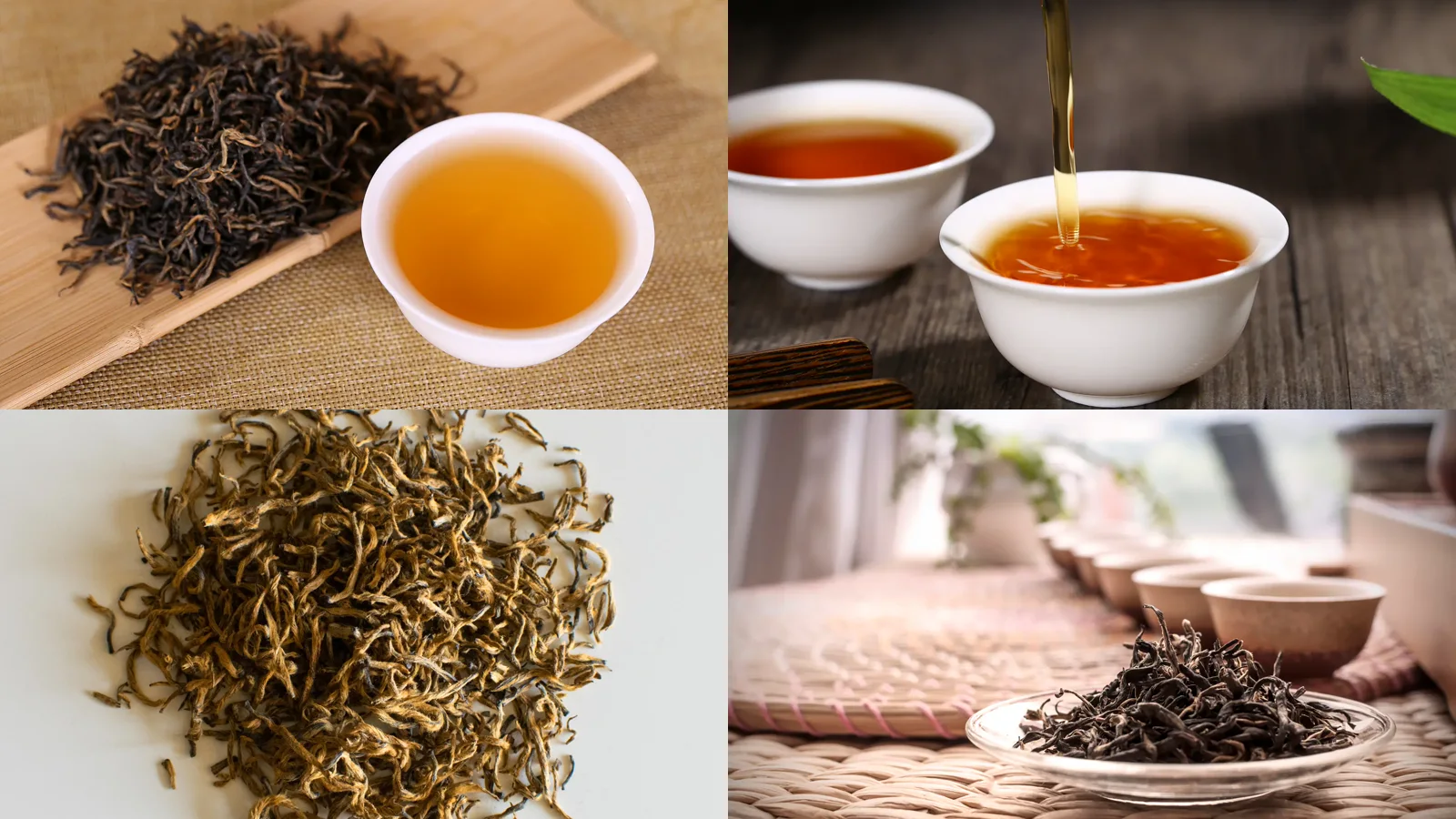
The hero combines four authorized visual records. They were not photographed under the same lighting, brewed with the same water or sampled from one controlled set. The collage demonstrates visible variation; it does not rank the teas or authenticate a region.
Keemun: fragrance needs structure
Keemun is the established English name for Qimen black tea from Anhui. The current DB34/T 1086-2026 gives a place-specific quality framework for the geographical-indication product, while the wider congou standard covers the technical family.
Descriptions such as rose, fruit, cocoa or “Keemun fragrance” organize attention; they are not certificates. Test whether the perfume has enough liquor beneath it. A good sample should remain coherent when warm and nearly cool, not collapse after one aromatic inhale.
Ask the seller whether “Keemun” means traceable Qimen product, a Keemun-style congou or a blend containing Keemun. Export grade letters describe sorting systems; they do not independently prove origin.
Dianhong: buy body, not a gold-tip photograph
Dianhong means Yunnan red tea. The family is strongly associated with Yunnan large-leaf material and includes dark twisted, broken and bud-rich market styles. Yunnan's DB53/T 1351-2025 provides a current technical code for congou black-tea processing.
Gold or orange hairs often indicate tender downy material transformed during black-tea making. More gold can mean more buds. It cannot prove Fengqing, old trees, wild material or a better cup.
The most useful Dianhong question is not “How golden is it?” but “Does the body stay sweet and clean as it cools?” Sweet-potato or baked-root descriptions occur often in market tasting language, but one aroma word cannot diagnose processing by itself. Sourness, flat baked character and roughness must be tested under controlled brewing before blaming the region.
Jin Jun Mei: modern value requires modern traceability
GH/T 1118-2015 defines Jin Jun Mei as a product category. Independent scholarship places its value-making and creativity in the modern Wuyi tea economy rather than an invented imperial past.
Tender buds and gold-black color explain why the tea photographs well and costs more to pick. They do not prove Tongmu. Before paying a premium, ask for producer, production area, harvest year, bud standard and whether the seller is making a protected-origin, product-style or brand claim.
Modernity is not a defect. Vague provenance at a luxury price is.
Lapsang Souchong: smoke is a setting, not a score
GB/T 13738.3-2012 recognizes souchong black tea as its own national category. Retail language still varies: “Lapsang Souchong,” “Zhengshan Xiaozhong,” smoked, lightly smoked and unsmoked may overlap without functioning as perfect synonyms.
Laboratory comparison has distinguished Lapsang Souchong from pine-smoked Lapsang Souchong. That supports a crucial buying rule: smoke is a process direction, not the entire identity of the base tea. Ask for origin, smoke level and method separately.
Harsh ash, chemical flatness or smoke that erases fruit and sweetness is not made better by being louder. A good smoked tea still has tea underneath it.
Compare the four without turning the test into a ranking
| Route | Leaf tendency | Useful sensory question | Best first use | Main claim boundary |
|---|---|---|---|---|
| Keemun | Fine dark twists; grades vary | Does fragrance remain integrated with briskness and finish? | Plain tasting, lighter breakfast cup, fragrance comparison | Qimen origin needs traceability beyond the English name |
| Dianhong | Dark leaf to bud-rich gold styles | Does broad body remain sweet rather than baked or rough? | Plain, breakfast, or a structured milk-tea base | Gold does not prove Fengqing, old trees or grade |
| Jin Jun Mei | Tender bud emphasis | Does delicacy have texture and endurance behind the price? | Plain tasting in a neutral porcelain vessel | Golden buds do not prove Tongmu |
| Lapsang Souchong | Dark strips; smoke level varies | Can fruit, wood and sweetness survive the smoke? | Plain, food pairing or a deliberately smoky cup | Smoke does not prove protected origin or authenticity |
Liquor color becomes useful only when water, dose, vessel, time, temperature and lighting are held constant. It cannot establish region or price.
Run one fixed-variable comparison
This household protocol is designed to compare samples, not reproduce a laboratory sensory panel.
Hold these variables constant
- Use four clearly labeled samples and the same white porcelain vessel for each.
- Weigh 3.0 g per 150 ml of working water.
- Use the same water at 95°C.
- Start timing when water first contacts the leaf.
- Steep for 3 minutes, then decant completely.
- Use identical cups and taste each tea hot, warm and nearly cool.
- Do not add milk or sugar until the plain comparison is recorded.
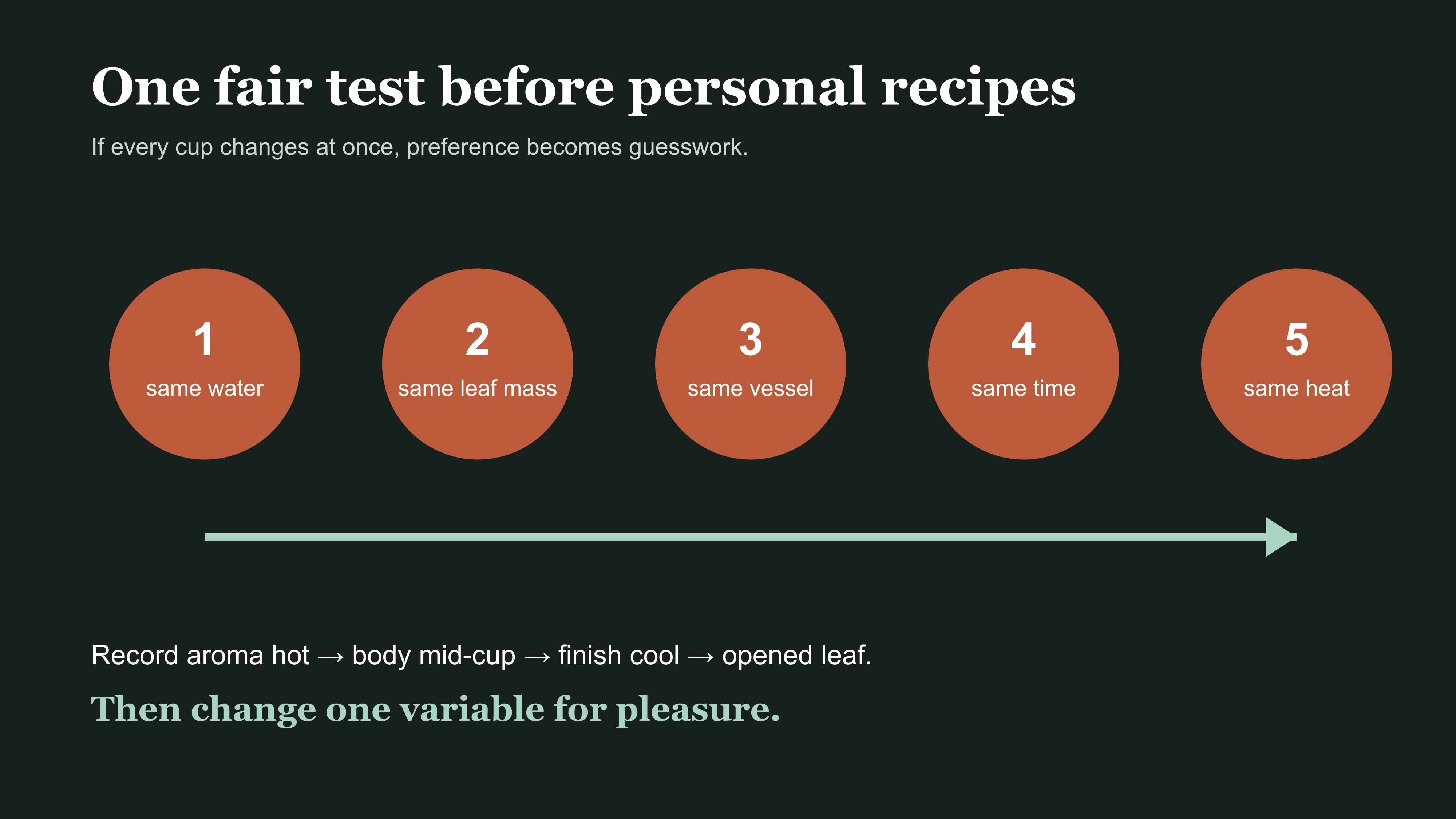
| Checkpoint | Record this | Why it matters |
|---|---|---|
| Warmed dry leaf | Intensity, freshness and whether smoke or perfume dominates | Separates packet impact from cup performance |
| First hot sip | Aroma entry, briskness and body | Shows immediate extraction, but heat can hide roughness |
| Warm cup | Fruit, malt, floral, baked, woody or smoky direction | The easiest point for comparing integration |
| Nearly cool cup | Sourness, drying texture, sweetness and finish | Weak structure and rough extraction become harder to hide |
| Opened leaf | Breakage, evenness and resilient or disintegrating texture | Helps explain extraction without authenticating origin |
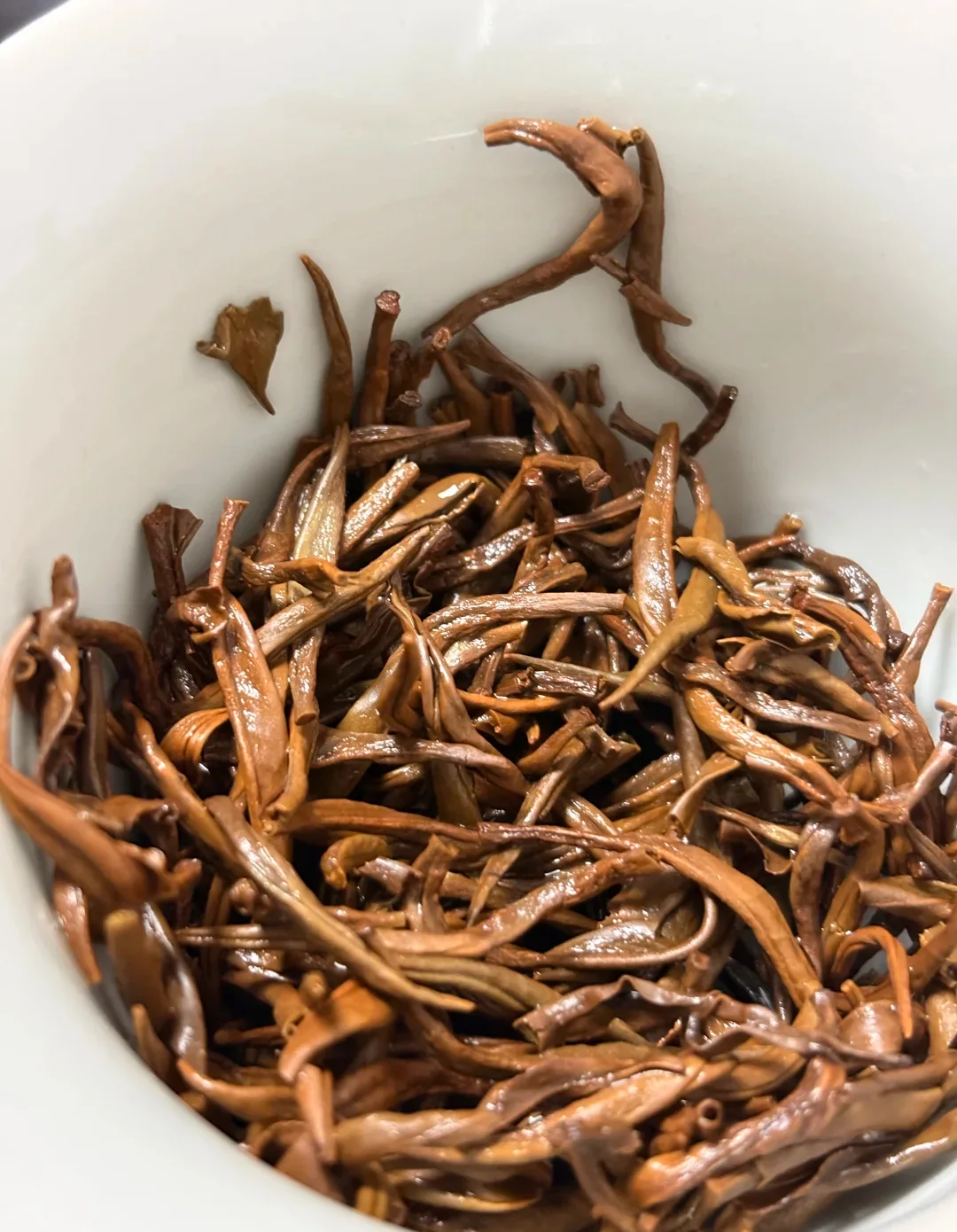
Once the leaf is wet, the glamour disappears—and that is useful. This bowl exposes stem length, broken pieces and uneven opening far better than a gold-lit dry-leaf photograph. It does not prove that the tea is Jin Jun Mei, Tongmu material or even one of the four named styles above. I use it as a post-brew inspection record: pair what the eye can see with what happened in the hot, warm and cool cups, then decide whether the seller's story still holds.
For a second round, use the same leaves and 4 minutes at 95°C. This does not rank endurance as universal quality; it shows whether the first cup used everything or whether structure remains.
Diagnose the cup before blaming the tea name
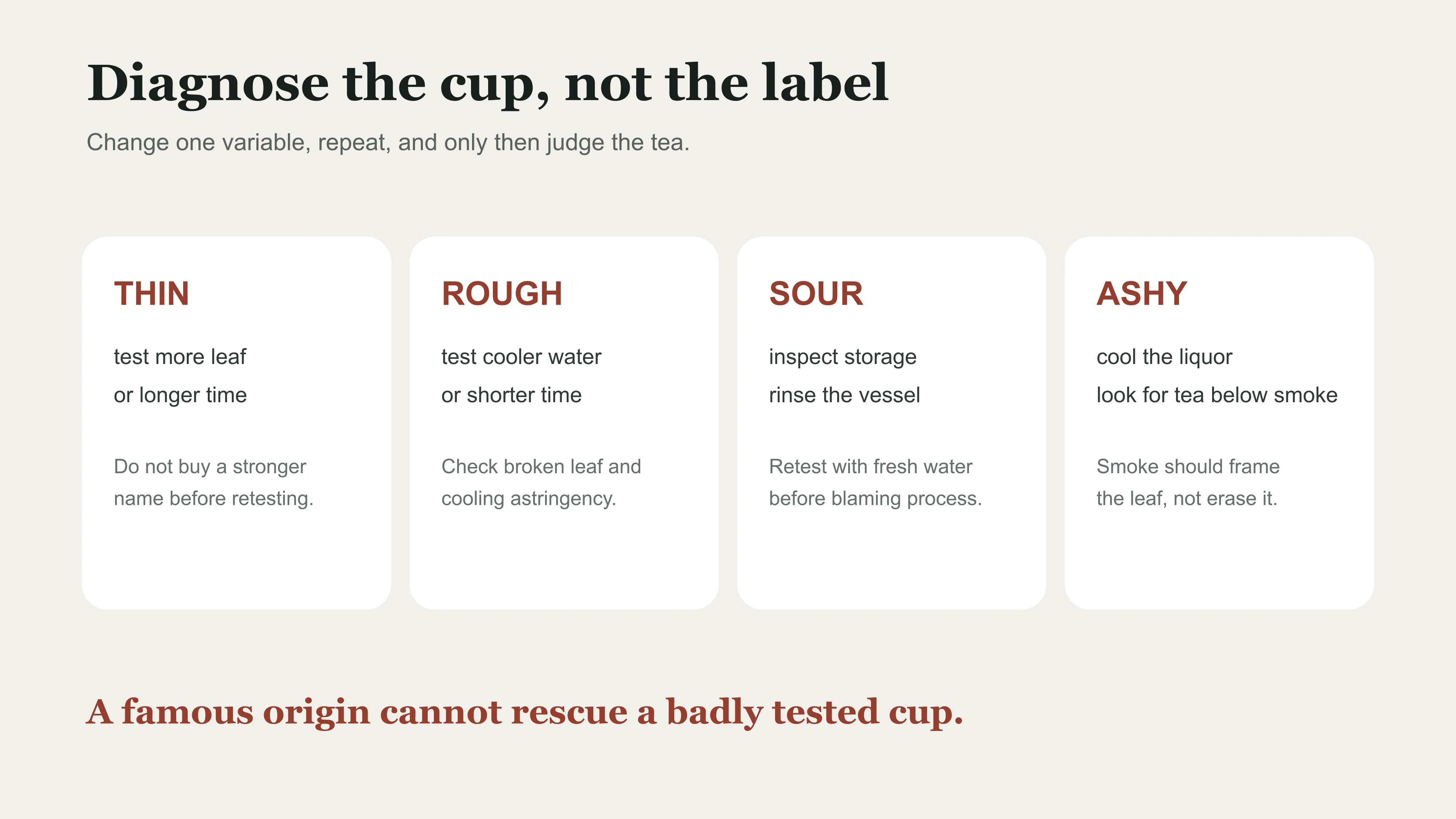
| Symptom | First controlled correction | What to investigate if it remains |
|---|---|---|
| Thin liquor with attractive dry aroma | Add 0.3-0.5 g next session before extending time heavily | Stale storage, sprayed aroma, overly delicate grade or a tea unsuited to the intended use |
| Rough or mouth-drying | Shorten contact time; check broken-leaf proportion; then test 90°C | Leaf damage, very brisk style, hard water or processing roughness |
| Sour as the cup cools | Brew the same dose slightly shorter and compare water | Storage, processing, water chemistry or a batch-specific fault; do not diagnose from one cup |
| Flat sweet-potato or baked note | Reduce time and test with fresh neutral water | Heavy drying, storage loss or a style you simply do not prefer |
| Smoke covers everything | Use less leaf or a shorter infusion once | Crude smoke, stale base tea or a product designed for a different market/use |
| Cloudy liquor | Compare hot and cool cups; inspect fine particles | Cooling, concentration, water chemistry or breakage rather than an automatic quality failure |
Change one variable at a time. If dose, temperature and time all move together, the second cup teaches nothing.
Brew for the leaf and the job
For a large plain cup, begin with 3 g per 250 ml, 90-95°C water and 2-3 minutes. For a stronger breakfast or milk-ready cup, use more leaf or a broken-leaf style rather than stewing a delicate whole-leaf tea until it becomes woody.
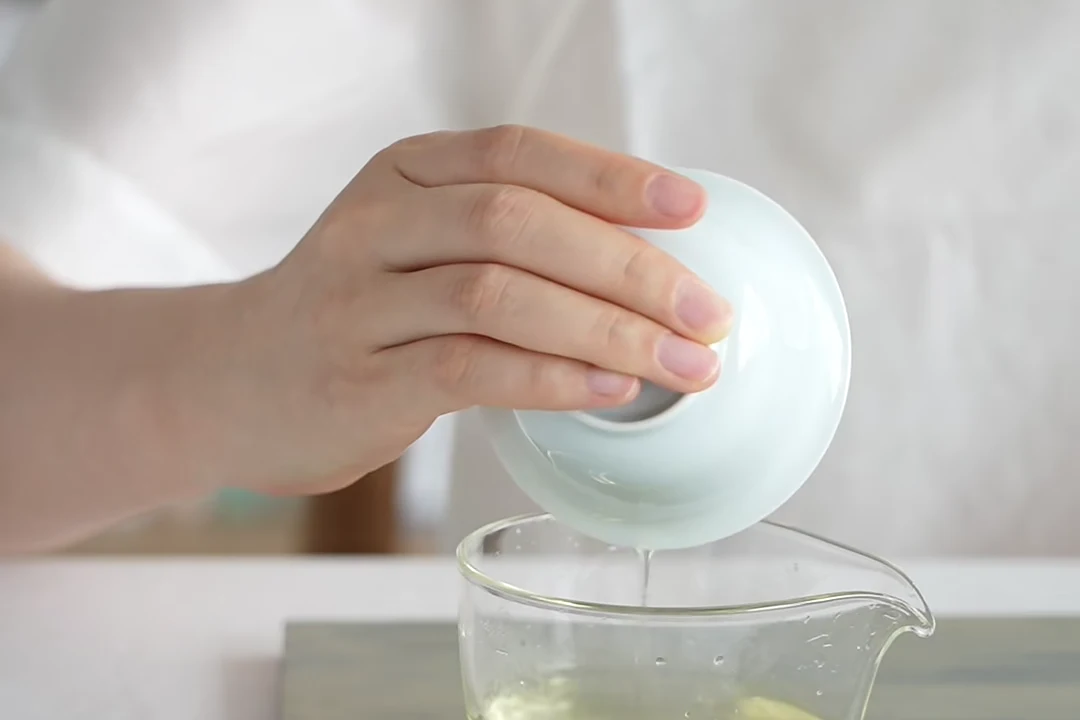
For a measured gaiwan, begin around 5 g per 100 ml, 90-95°C and a 12-15 second first infusion, timed until the vessel is completely empty. Fine buds and broken leaf may need less heat or time; sturdy dark twists can accept hotter water.
These are starting points. The broader Chinese tea brewing guide owns the correction system across tea families. This page owns the earlier choice: which Chinese black tea suits the cup you want.
Make the seller answer seven questions
- What exactly does the product name claim: tea family, product style, protected place or brand?
- Where was this batch produced, and what record supports that statement?
- What are the harvest year and packing date?
- Is the leaf whole, broken, blended or strongly bud-focused?
- For Lapsang Souchong, is it smoked, lightly smoked or unsmoked, and how?
- For Jin Jun Mei, what justifies the name and premium beyond golden appearance?
- Can you buy a 20-30 g sample from the same batch?
Reject a seller who answers every question with a legend, aroma adjective or price. Traceability does not need to be romantic.
What a photograph can and cannot prove
| A photograph may support | It cannot establish by itself |
|---|---|
| Leaf length, breakage, visible buds, liquor color and service context | Cultivar, protected origin, tree age, harvest year or processing quality |
| Whether a pictured sample looks whole, broken or bud-rich | That the delivered packet matches the pictured batch |
| A relative color comparison under one documented setup | A cross-page ranking made under different water, light and exposure |
| A complete pouring or tasting action | Exact temperature, dose and time unless those variables were recorded |
This boundary is why social-media engagement is useful for discovering buyer questions and visual language, while standards, scholarship, batch records and controlled tasting verify the answer.
The final buying rule
Chinese black tea should not be reduced to red liquor, golden tips, a smoky reputation or a “top ten” list. Choose the role first, demand evidence for the name, then test the tea at three temperatures.
Start with Keemun, Dianhong and one Lapsang Souchong. Add Jin Jun Mei when its provenance earns the price. The best sample is not the darkest, most golden or most expensive. It is the one whose aroma, body and finish still agree after the cup cools.
Continue through the black-tea family collection and all six types of Chinese tea, or bring your own comparative notes into the East Moment community.