Buy Jin Jun Mei tea only when the seller's origin claim, bud standard and the structure of infusions two and three agree. Gold tips, sweetness, the translation
Golden Eyebrow, a Tongmu story and a high price cannot authenticate a batch. For a first purchase, choose transparent records and a satisfying second cup over the darkest box, the most gold leaf or the largest price.
Jin Jun Mei tea: modern tea, not an ancient tribute legend
Jin Jun Mei is a black tea developed in the Wuyi black-tea tradition and widely associated with Tongmu, Fujian, in 2005. That makes it culturally serious but historically recent. A modern origin is not a defect; pretending the tea is an ancient imperial secret is.
Anthropologists Jean DeBernardi and Junhong Ma treat Jin Jun Mei as a modern creation in which history, creativity and value were actively made. Their 2022 peer-reviewed study is a useful correction to retail stories that flatten the tea into either timeless folklore or one heroic invention scene. Commercial accounts commonly connect the development to Jiang Yuanxun and a team working in Tongmu, but one brand narrative should not be mistaken for the complete social history.
The name is often translated as Golden Eyebrow: jin means gold and mei means eyebrow. Commercial explanations of jun vary. The translation helps a buyer recognize the name; it is not a grading rule and says nothing about the provenance of an unknown packet.
Separate the product name from the origin claim
The official record for GH/T 1118-2015, Jin Jun Mei lists a current product standard released on December 30, 2015 and implemented on June 1, 2016. The record identifies the National Tea Standardization Technical Committee and drafting organizations that include tea institutions, Fujian Agriculture and Forestry University and a Tongmu-linked producer.
That record establishes that Jin Jun Mei is a defined product category. It does not authenticate a retailer's batch, prove Tongmu origin from a front label or turn every gold-tipped black tea into Jin Jun Mei.
Use three separate evidence questions:
| Claim on the listing | What it actually asks you to believe | Evidence to request |
|---|---|---|
Jin Jun Mei |
The tea is sold as the defined product | Producer, batch or packing record and a specific product description |
Wuyi or Wuyishan |
A broad regional association | Where the leaf was grown and where it was processed |
Tongmu or a more specific place |
A narrow, premium provenance | Batch-level traceability connecting this tea to that place |
A standard number, a place photograph and a producer's trademark answer different questions. Do not let one stand in for the others.
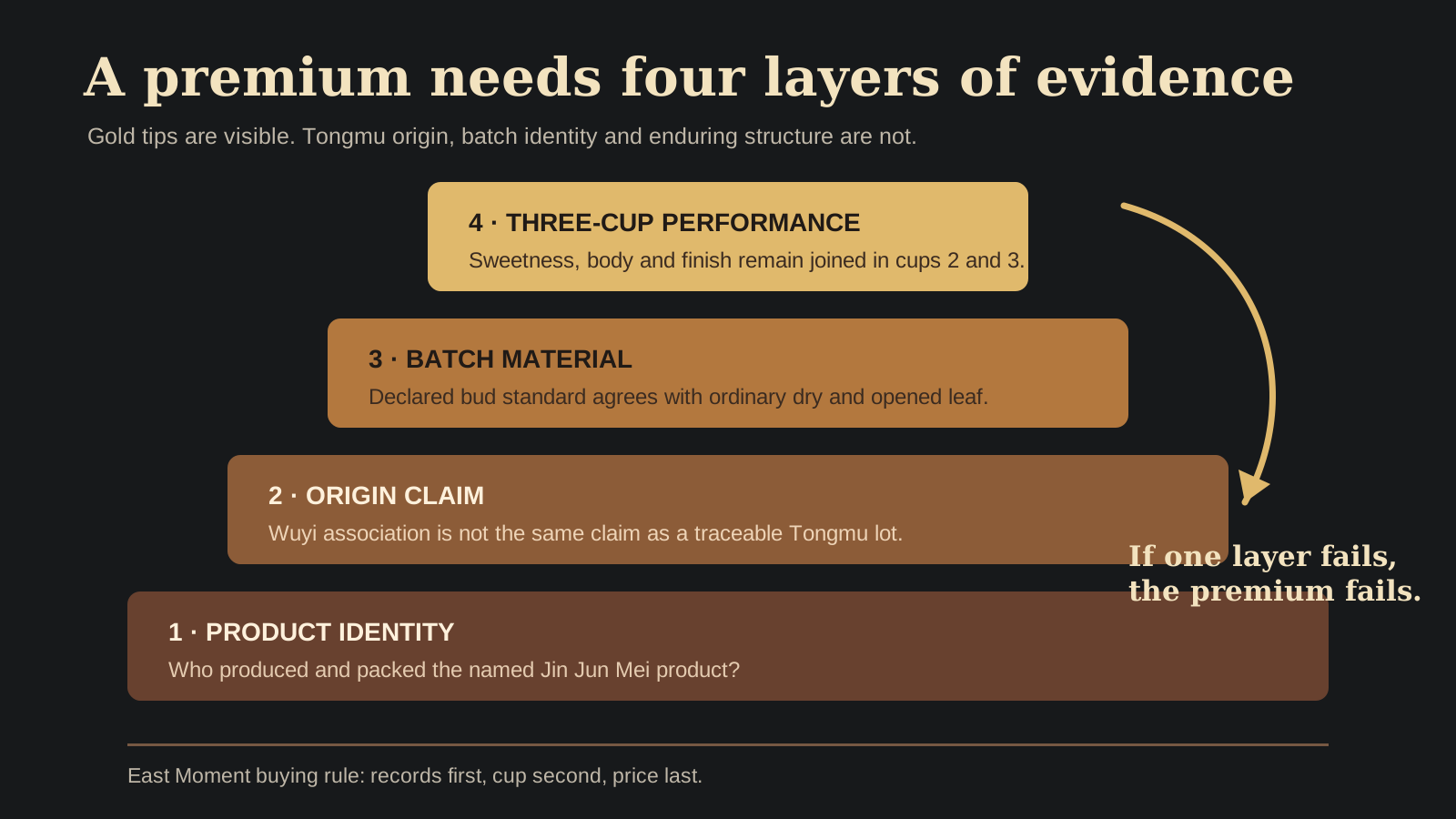
This is the order I trust. I do not start with the price and work backward until the tea sounds rare. I start with what the product is, narrow the place claim, inspect the batch and then ask cups two and three to justify paying more. If one layer collapses, the premium collapses with it.
Gold tips are appearance, not authentication
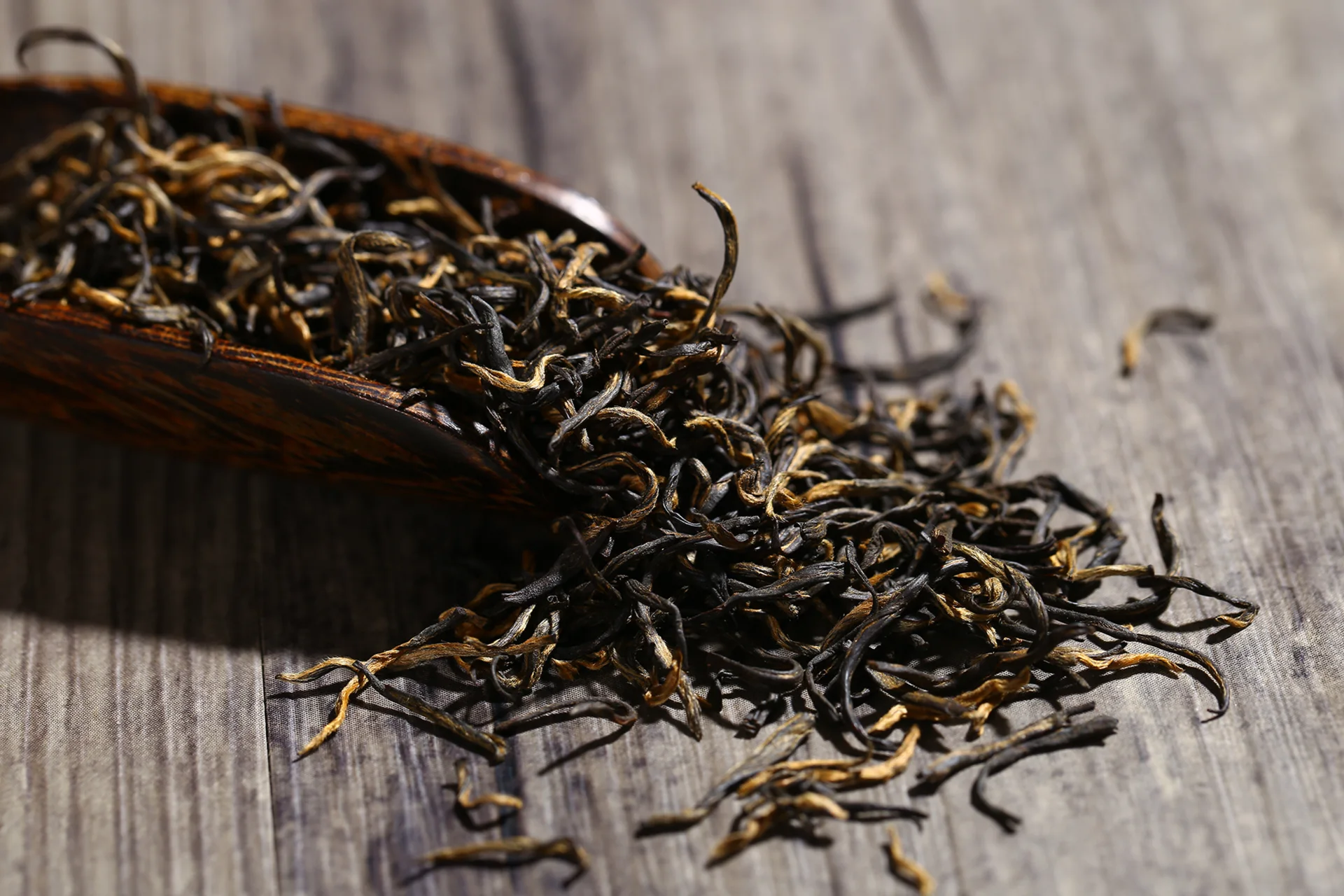
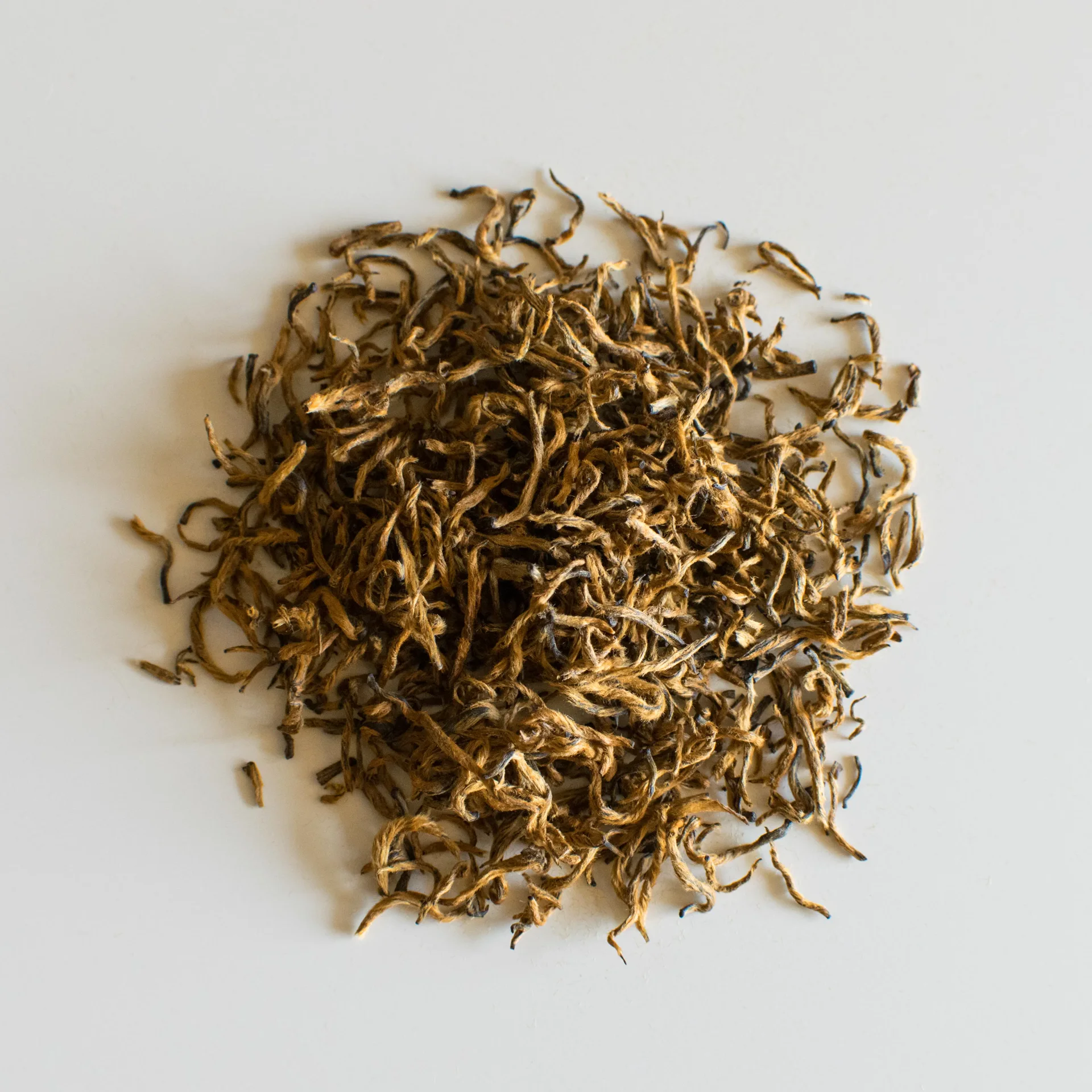
This authorized archive photograph deliberately shows an unidentified gold-tipped black tea, not a verified Jin Jun Mei sample. It resembles the visual language used to sell Jin Jun Mei: dark slender pieces, bright gold material and a luxury-ready surface. That resemblance proves the central buying problem. Many black teas can photograph this way.
Dry leaf can help you assess condition and whether a batch broadly resembles its own description. Spread a small amount on a white plate in neutral light and record only what is observable.
| What you see or smell | Useful interpretation | What it cannot prove |
|---|---|---|
| Dark and gold material together | Visible color distribution in this sample | Tongmu origin, cultivar or quality |
| Mostly slender bud-like pieces | Broad agreement with a bud-focused description | Harvest date or geographic identity |
| Mixed sizes or fragments | Extraction may be less even or faster | Counterfeiting by itself |
| Clean honey, fruit, grain or cocoa direction | A plausible black-tea aroma vocabulary | Natural aroma, origin or grade from smell alone |
| Must, damp cardboard or stale oil | Possible storage or cleanliness problem | The exact point where damage occurred |
| Unusually loud, simple sweetness or perfume | A reason to compare the liquor carefully | Added sugar, color or flavoring without testing |
Do not diagnose dyed, sugar-fried, perfumed or fake from a saturated phone photograph. Lighting, white balance, compression and seller editing change color. A photograph can justify a question; it cannot replace laboratory analysis or supply-chain records.
Judge the tea across three infusions
The first infusion is easy to sell: it concentrates opening aroma and rewards attractive leaf. Infusions two and three are the value test. A worthwhile batch should keep a coherent relationship between sweetness, body, aroma and finish after the first aromatic display has passed.
Use this East Moment household comparison protocol when ranking samples. It is a reproducible starting point, not a national standard and not a claim that every Jin Jun Mei reaches its best cup at these settings.
- Measure 4.0 g of tea for 100 ml of working vessel volume.
- Use a porcelain gaiwan or another neutral, fully decanting vessel.
- Begin with 95 C / 203 F water.
- Infuse for 15 seconds, 20 seconds and 30 seconds.
- Start timing when water first touches the leaf; include pouring time in total contact.
- Decant completely after every infusion.
- Taste each cup hot, warm and nearly cool.
- Keep water, dose, vessel, timing and pouring speed constant between samples.
| Checkpoint | Keep looking for | Warning sign |
|---|---|---|
| Infusion 1, warm | Clean fruit, honey, grain, cocoa or floral direction integrated with the liquor | Strong nose over a watery center |
| Infusion 2, warm | Sweetness remains, body becomes clear and the finish closes cleanly | Aroma collapses or roughness replaces flavor |
| Infusion 3, warm | A recognizable continuation rather than unrelated colored water | Thinness, sourness or a hollow perfumed impression |
| Nearly cool | Sweet or clean aftertaste without cupboard odor | Must, stale oil or sweetness that feels detached from the tea |
| Opened leaf | Material broadly agrees with the seller's bud description | The visible material cannot account for the listing |
This protocol produces comparable observations, not authentication. A tea can brew beautifully without coming from Tongmu. A traceable Tongmu tea can also be stale, poorly stored or simply not worth its price to you.
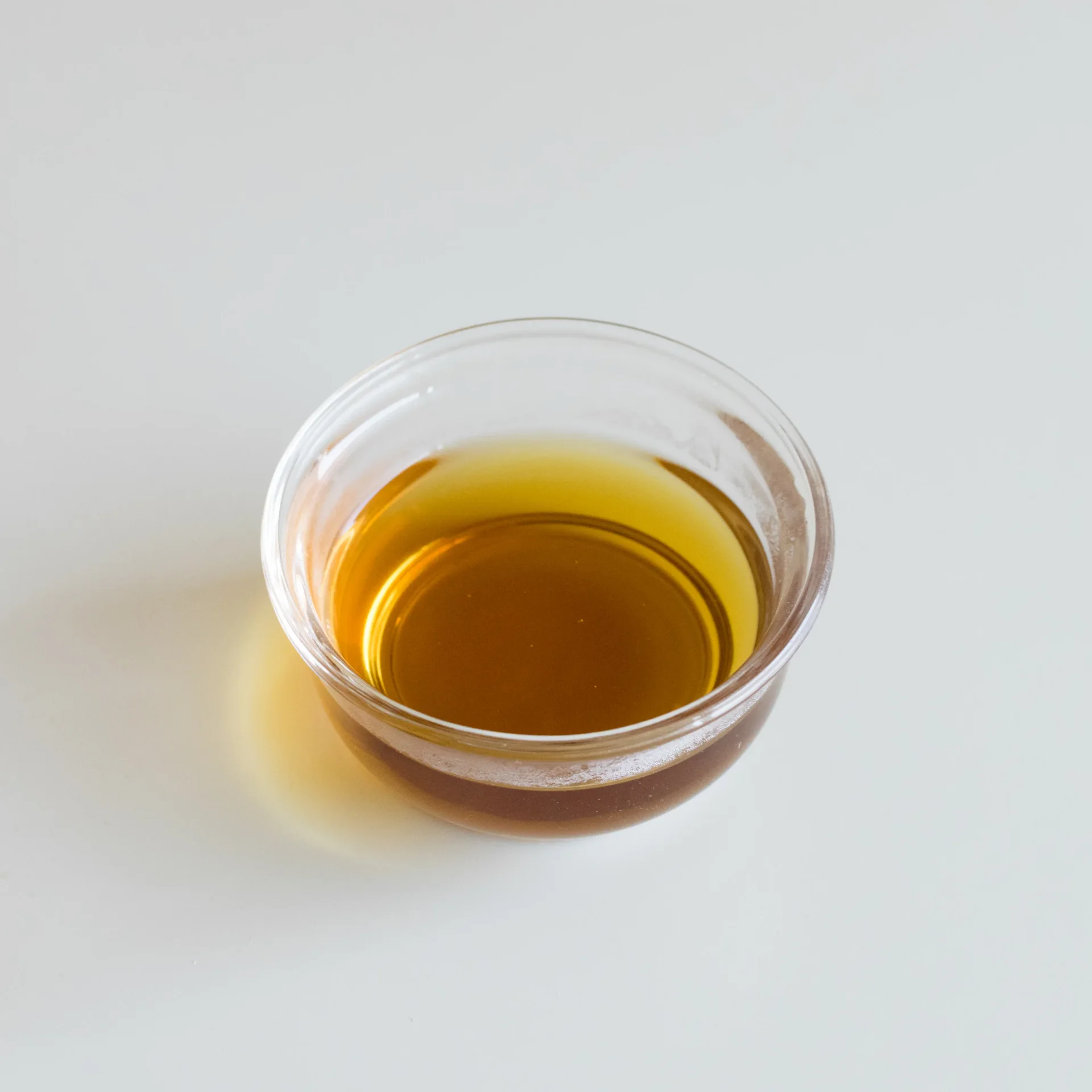
The second infusion of the same documented Jin Jun Mei sample harvested in Tongmu in April 2019. The amber color describes this cup only; it cannot prove origin, grade or quality. Photograph by Difference engine, CC BY-SA 4.0, via Wikimedia Commons.
Diagnose the cup one variable at a time
Jin Jun Mei tastes bitter is a result, not a diagnosis. Repeat the same infusion number and change only one variable.
| Result at the baseline | First controlled change | What the repeat tells you |
|---|---|---|
| Bitter or rough | Shorten each infusion by 5 seconds | Improvement points to excessive contact time |
| Still rough at shorter time | Lower water to 90 C / 194 F | Improvement shows this sample needs gentler heat in this setup |
| Thin but clean | Increase dose to 4.5 g, holding temperature and time | Improvement points to dose; no improvement questions value or freshness |
| Fragrant but hollow | Keep the baseline and taste infusion two warm | Persistent emptiness is not delicacy |
| Sweet but strangely simple | Repeat with known neutral water and clean porcelain | Persistence justifies questions, not an additive accusation |
| Good first cup, abrupt collapse in cup two | Repeat once with an exact complete decant | If it repeats, do not pay a durability premium |
| Musty or oily nearly cool | Repeat with known water and a clean vessel | Persistence is a rejection signal regardless of origin story |
Do not lower temperature, reduce leaf and shorten time in the same repeat. That may rescue a drink, but it does not identify the cause.
Do not automatically discard the first infusion
A clean, traceable black tea does not require an automatic rinse before tasting. A quick wash also cannot repair questionable hygiene, poor storage or an unknown production chain. If the purpose is comparison, discarding the first infusion removes useful evidence and adds another uncontrolled variable.
If you prefer a rinse for personal service, record it and apply the same rinse to every comparison sample. Do not present that preference as proof of cleanliness or authenticity.
Inspect opened leaf without asking it to name a village
Spread the cooled material on a white plate so stems, buds, leaves, fragments and processing consistency are visible. Photograph the ordinary material, not a hand-selected perfect cluster.
Compare the opened leaf with the seller's exact wording. If the listing promised a bud-focused product but the cooled material is dominated by large leaves and stems, ask the seller to explain the mismatch. If the material broadly agrees, that supports the description only. Leaf color, tenderness or uniformity still cannot name Tongmu, determine price or prove that nothing was added.
Keep four records together: the listing claim, invoice or batch label, dry-leaf photograph and cooled opened-leaf photograph. This modest evidence packet is more useful than memory, packaging or a screenshot detached from the seller and date.
Choose Jin Jun Mei, Zhengshan Xiaozhong or Dianhong by purpose
These teas overlap in honey, fruit, malt and warm-aroma language. The useful difference is not a universal prestige ranking; it is what you want the cup and purchase to do.
| Tea | Best reason to choose it | Typical buying risk | First value test |
|---|---|---|---|
| Jin Jun Mei | You want a refined, bud-focused modern Wuyi black-tea expression | Paying for gold appearance and Tongmu storytelling without traceability | Infusions two and three retain integrated sweetness and body |
| Zhengshan Xiaozhong | You want the older Wuyi black-tea lineage, smoked or unsmoked according to the batch | Assuming every example is heavily pine-smoked or from a protected core area | Seller defines origin and smoking method; the cup remains coherent |
| Dianhong | You want Yunnan black-tea structure, malt and often a more forgiving everyday cup | Treating gold tips or ancient tree language as proof |
Intended use and three infusions justify the price |
For a first Chinese black tea, Dianhong or a transparent Zhengshan Xiaozhong may deliver more flavor per unit of price. Choose Jin Jun Mei when its particular refinement and evidence survive comparison, not because the category is automatically superior.
The Chinese black tea collection keeps those category and brewing differences together; this page owns the narrower Jin Jun Mei premium decision.
Use a mug or thermos with less leaf
For a 250 ml mug, begin with 2.5-3.0 g, water around 90-95 C / 194-203 F, and taste at 2 minutes. Remove or strain the leaf when the balance is right. This is a drinking method, not the controlled ranking protocol above.
For a vacuum mug, prolonged high heat and continuous contact can make a bud-focused black tea rough or flat. Begin with roughly 1.5 g per 300 ml, use water near 90 C, and test a short holding period before committing a full day. If you mainly need strong tea that tolerates milk, sugar or hours of heat, premium Jin Jun Mei is usually the wrong purchase.
Ask seven questions before paying the premium
- Is this claimed as Jin Jun Mei product, Wuyi tea, Tongmu-origin tea or all three?
- Which producer, harvest year and batch or packing record support those claims?
- What plucking or bud standard does this specific batch claim?
- Can the seller show current-batch dry and fully opened leaf, not a reused promotional photograph?
- How was the tea stored after production and after opening its bulk package?
- What does the higher price buy beyond more visible gold, smaller pieces or rarer-sounding geography?
- Can you buy a sample large enough for two controlled sessions before buying a tin?
Reject a premium when the answers return only to all gold, sweet without brewing, ancient tribute, an exact enormous bud count or you can tell from the photo. None joins the package to a verified production chain.
Price cannot authenticate Jin Jun Mei
There is no honest universal price threshold that separates real from fake Jin Jun Mei across harvests, producers, grades, package sizes and markets. A low price can make a rare-origin claim implausible; a high price can merely make an unsupported story expensive.
Compare price per gram, not tin price. Then compare what is documented, how many satisfying infusions your fixed protocol produces and whether the improvement matters beside a transparent alternative. Price becomes meaningful only after product identity, batch evidence and cup performance have been separated.
Storage and health boundaries
Keep Jin Jun Mei sealed, dry, dark and away from spices, perfume and repeated humidity. Divide a large purchase into a working packet and a reserve so the whole supply is not opened daily. Reject mustiness rather than trying to wash it away.
Jin Jun Mei contains caffeine. Bud-focused tea is not caffeine-free, and golden does not mean medicinal. This guide does not present the tea as a detox, weight-loss or disease-treatment product. Anyone limiting caffeine should consider dose, infusion practice and total daily intake.
The buying verdict
For a first Jin Jun Mei, buy a sample from a seller who distinguishes the product name, Wuyi association and specific Tongmu claim. Run 4.0 g / 100 ml / 95 C at 15, 20 and 30 seconds. Keep it when infusion two still has integrated sweetness and body, infusion three remains recognizably connected, and the cooled leaf broadly agrees with the stated bud standard.
Do not pay more because the leaf is more gold, the liquor is more amber or the story is older. Pay more only when the records are stronger and the repeated cup is better. The best Jin Jun Mei purchase is the batch whose provenance claim, material and second and third infusions tell the same defensible story.