Buy Lapsang Souchong by three separate claims: origin, leaf or product type, and smoke process. Smoke is not proof of Tongmu origin and it is not a quality score. A good smoked tea must still show fruit, body and sweetness after the first aroma fades; a good unsmoked tea must have structure without borrowing smoke as drama.
Lapsang Souchong tea: the 60-second answer
Lapsang Souchong is the established English trade name associated with Fujian's Zhengshan Xiaozhong black-tea tradition. Retail use is inconsistent: one shop may reserve Lapsang for strongly smoked export tea, while another uses it as the English name for smoked and unsmoked products alike.
Do not solve that naming problem by trusting the front of the packet. Ask three independent questions:
| Claim | Useful seller answer | What the answer still does not prove |
|---|---|---|
| Origin | Tongmu, a named wider Wuyi area, elsewhere in Fujian or another stated source | Quality, old trees or a core-area harvest without traceability |
| Leaf or product | Zhengshan Xiaozhong, whole-leaf souchong, broken export grade or a disclosed blend | Tongmu origin merely because souchong appears on the label |
| Smoke process | Unsmoked, restrained smoke or assertive smoke; fuel and stage stated | Traditionality, origin or superiority from smoke intensity |
For a first purchase, choose a small sample from a seller who can answer all three. If the description offers only authentic pine smoke, it has described an aroma effect, not the tea.
Lapsang Souchong and Zhengshan Xiaozhong are close, not perfectly interchangeable
Zhengshan distinguishes the recognized original-mountain context from waishan, or outside-mountain production. Xiaozhong reached English through older trade romanization as souchong. Lapsang Souchong then developed its own export identity, especially around smoke.
That history explains why a universal translation rule fails. It does not excuse vague selling. The correct product description should pair the name with origin and process: Tongmu Zhengshan Xiaozhong, unsmoked, for example, communicates more than either English or Chinese name alone.
China's official record for GB/T 13738.3-2012, Black Tea - Part 3: Souchong Black Tea establishes a national technical category. It does not authenticate a packet's Tongmu claim, and the word souchong does not prove pine smoking.
Smoked and unsmoked are process directions, not quality grades
An unsmoked Zhengshan Xiaozhong may emphasize longan-like fruit, honey, malt, flowers and warm wood. A restrained-smoke version can frame those notes and then recede. An assertive-smoke tea puts resin, hearth and wood first and may suit milk, food pairing or cooking.
None of those styles wins automatically. The decisive question is whether the process leaves a complete black tea underneath it.
| Style | What should remain after the opening aroma | Typical failure |
|---|---|---|
| Unsmoked | Body, ripe or dried fruit, sweetness and a clean finish | Thin sweetness with no middle or finish |
| Restrained smoke | Fruit and body become clearer by infusions two and three | Smoke vanishes and exposes weak base tea |
| Assertive smoke | Smoke stays recognizable while liquor remains full and clean | Ash, tar or dryness explains the whole cup |
Longan, pine, honey and wood are sensory comparisons, not ingredients and not origin tests. An unsmoked tea is not automatically more Chinese or more authentic; smoked export history is still part of this tea's history.
What a controlled smoking study actually found
A 2025 open-access study made five black teas from the same Jinmudan cultivar material at Fujian Agriculture and Forestry University. The base treatment was held broadly consistent while smoking was changed: no smoke, smoke during withering, smoke during fermentation, smoke during drying, and a traditional souchong treatment. Five expert evaluators assessed 3 grams in 150 milliliters of boiling water for 5 minutes, repeating the evaluation three times.
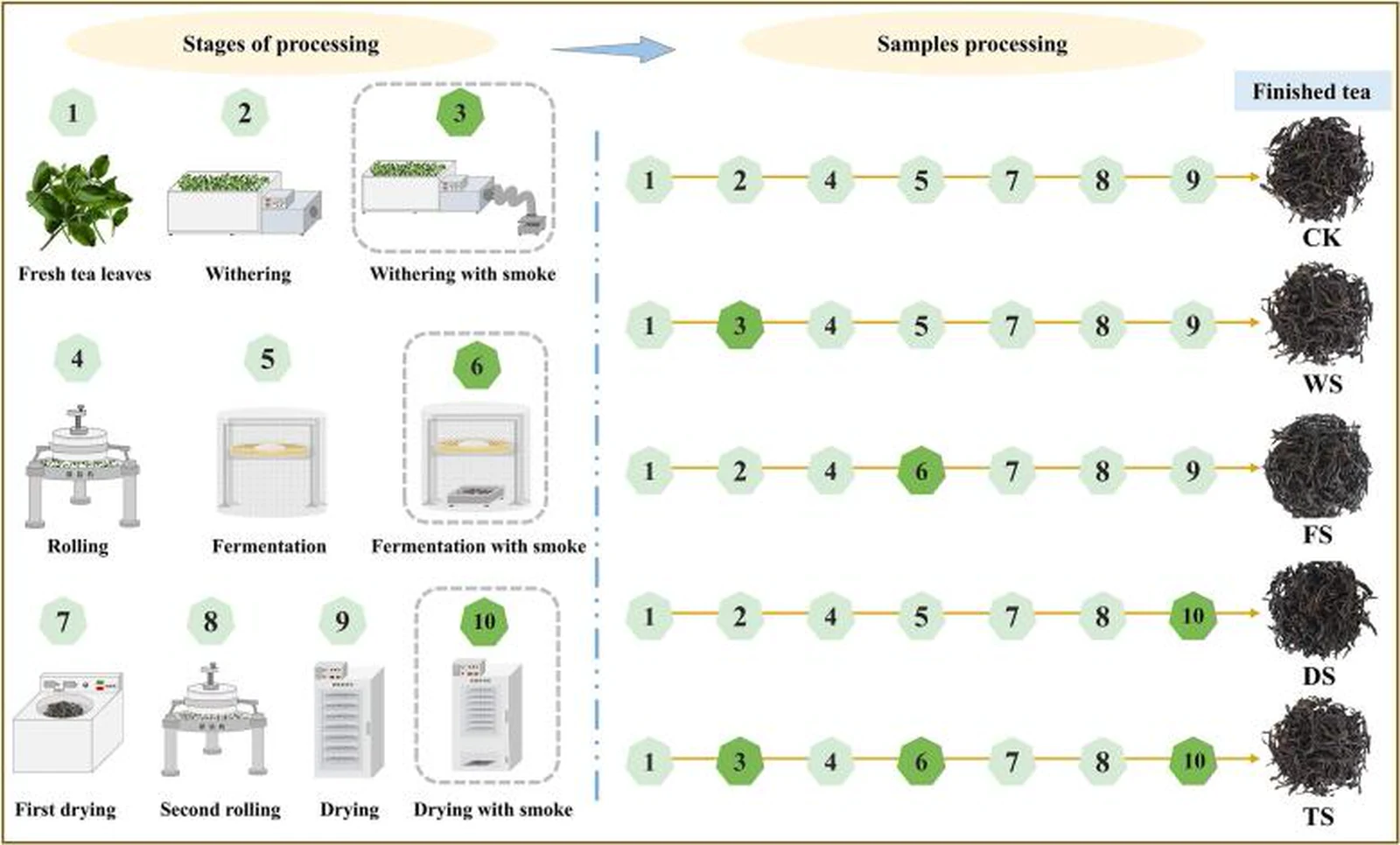
In this experiment, withering- and fermentation-stage smoke were weak, the traditional treatment was judged excessively smoky, and the drying-stage treatment received the best overall sensory assessment. The chemical analysis detected 69 volatile compounds; the drying-stage sample had the highest total volatile and phenolic content in this five-sample set.
This is valuable because it demonstrates that when smoke enters the process changes the cup. It does not prove that every producer should smoke at drying, that one fuel system represents all Tongmu practice, or that laboratory Jinmudan samples can rank unknown retail teas. The authors explicitly called for comparison with Tongmu Village Lapsang Souchong. Treat the result as process evidence, not a universal recipe.
The older 2005 comparative study of Lapsang Souchong and smoked Lapsang Souchong also supports a narrower point: a base tea and its smoked expression can be analytically distinguished. Smoke is a process variable, not the tea's entire identity.
A real building is context, not chain of custody
Traditional narratives often connect smoking to multi-level wooden structures commonly called qinglou. A familiar origin legend says interrupted processing forced villagers to dry tea over pine fire and foreign merchants liked the result. Versions change the soldiers, date and sequence, so the interruption story should remain a trade legend, not verified batch history.
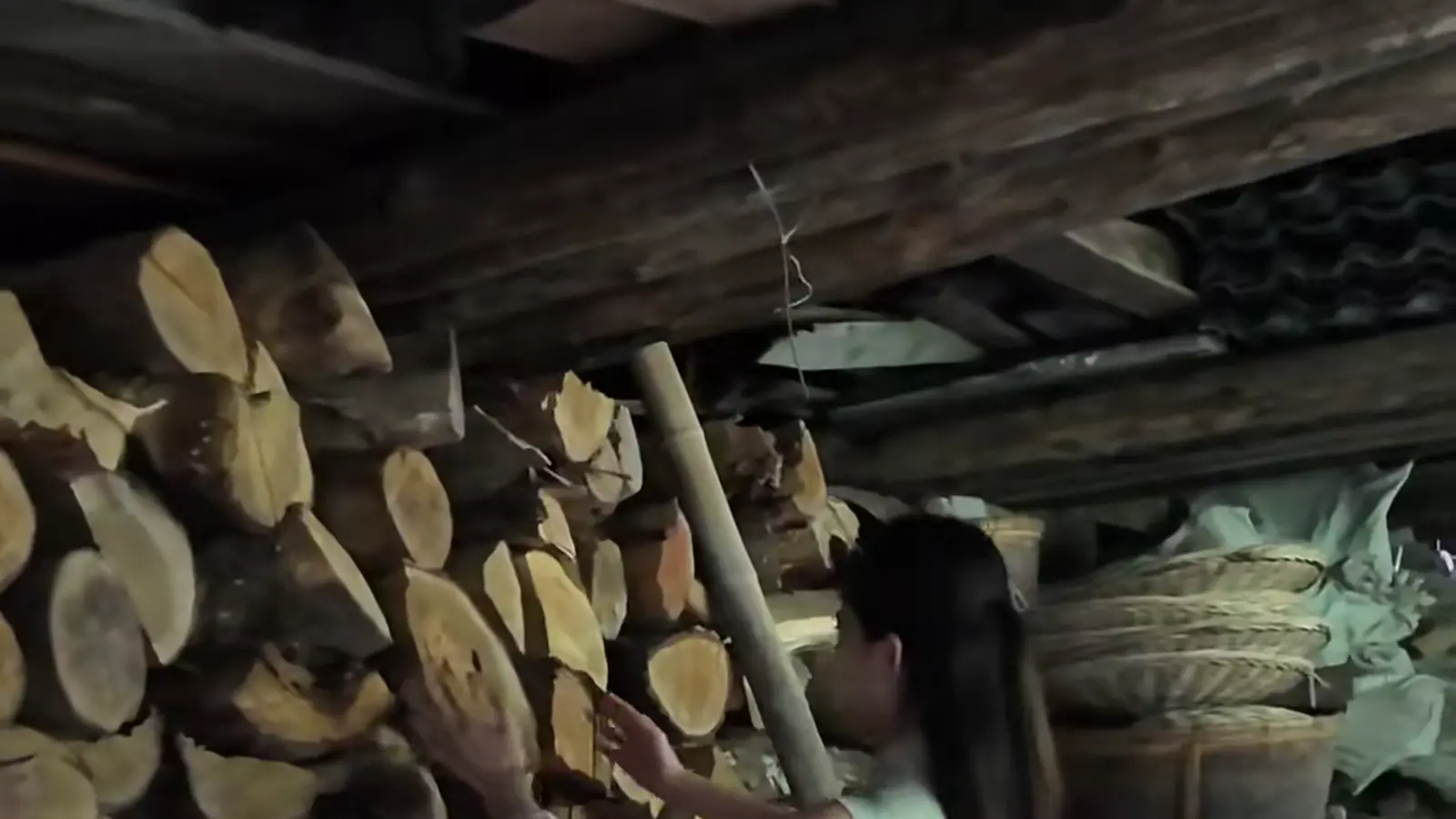
The authorized field video behind this frame shows a wooden building and stored cut wood in Tongmu context. The image cannot identify the wood species, prove that a visible batch was smoked there, or authenticate a product. It is more useful than a generic misty-mountain photograph because it shows physical infrastructure, but it remains contextual evidence.
Run one controlled smoked-versus-unsmoked comparison
Comparing a smoky tea brewed strong with an unsmoked tea brewed gently proves only that the sessions were different. Use the same porcelain gaiwan, water, working volume, dose and timing.
Start with 5.0 grams per 100 milliliters, water at 95°C / 203°F, and three complete decants at 12, 18 and 30 seconds. Count from the beginning of the water pour and note when the decant finishes. If one tea is heavily broken, record that difference rather than silently changing its recipe.
Read each infusion at three temperatures:
| Checkpoint | What it reveals | Pass | Reject or retest |
|---|---|---|---|
| Hot aroma | Volatile smoke, fruit and storage odor | Smoke is clear but not acrid or perfumed | Chemical flavor, ashtray or stale cupboard odor |
| Warm liquor | Body, sweetness and integration | Tea has weight after the aroma settles | Fragrant steam over thin liquor |
| Nearly cool liquor | Roughness, sourness and returning sweetness | Clean finish; fruit or malt becomes clearer | Persistent sourness, tar, numb dryness or dirty smoke |
| Infusion two | Whether base tea can carry the process | Smoke makes room for body and changing aroma | First-infusion spectacle followed by collapse |
| Infusion three | Continuity and finish | Structure remains even as smoke recedes | Hot water, wood and bitterness with no recovery |
This is a repeatable editorial starting protocol, not a claim that every Lapsang reaches its peak at 12 seconds. Change one variable in the next session. If you alter dose, temperature and time together, you cannot diagnose the cause.
Diagnose the failure before changing the recipe
| Symptom | Most likely possibilities | Next controlled move |
|---|---|---|
| Ashtray or tar | Excessive or dirty smoke, stale storage, contaminated vessel | Retest in clean porcelain with the same ratio; reject if it persists warm and cool |
| Powerful nose, watery middle | Surface smoke over weak base tea or under-dosing | Increase dose by 0.5 gram next session; reject if body still disappears |
| Dry throat from round one | Too much broken leaf, long contact or processing fault | Shorten contact before lowering temperature; reject persistent dryness |
| Smoke disappears immediately | Light treatment, old/open storage or aroma-only product | Check infusion two for fruit and body; disappearance alone is not failure |
| Sour when nearly cool | Water, vessel, storage or processing problem | Repeat with fresh water and a neutral vessel; reject persistent sourness |
| Clean fruit remains after smoke fades | Integrated process and sound base tea | Keep the ratio; compare finish and continuity rather than seeking more smoke |
Do not use dark liquor as a quality meter. Cup depth, lighting, dose, broken leaf and time all change color. Smell the cooled spent leaf for stale smoke or sourness and note whether it opened evenly, but do not infer Tongmu origin, cultivar or grade from appearance.
Grade data does not turn aroma into a home laboratory
A 2024 open-access study compared three standard-defined Lapsang Souchong grades sourced through the Wuyishan Market Supervision Bureau and Tea Industry Association. Ten qualified tasters scored appearance, liquor color, aroma, taste and spent leaf under GB/T 23776-2018. Their weighted totals were 94.30, 85.05 and 76.26 for super, first and second grade samples.
The useful lesson is not that a consumer can smell one compound and announce a grade. The samples came from a defined standard system, and the study combined trained sensory work with an electronic nose and chromatography. One smoky volatile was relatively high in the lower-scoring second-grade sample, reinforcing this page's practical rule: more smoke did not equal the higher sensory score in that sample set.
That finding cannot grade an unknown packet, and the three samples are not a market-wide survey. Use it to reject smoke volume as a shortcut, not to replace traceability.
Jin Jun Mei is not premium Lapsang by another name
Jin Jun Mei and Zhengshan Xiaozhong share Tongmu associations, but they are not two price tiers of one identical product. Jin Jun Mei emphasizes tender spring buds and a different product specification; souchong traditionally uses more developed leaf material and may include smoked expressions.
The overlap makes misleading upselling easy. From the home of Jin Jun Mei does not define a Lapsang lot, and golden tips do not convert generic black tea into Jin Jun Mei. Ask what was picked, where it was made and which product standard the seller is claiming.
For broader comparison, Keemun can show floral, cocoa and wine-like directions without pine smoking, while Dianhong often emphasizes malt, honey and large-leaf material. Those comparisons help locate preference; they do not create a universal ranking.
Ask seven questions, then apply five rejection rules
Ask the seller:
- What exact origin is claimed for this lot? Tongmu, wider Wuyi, elsewhere in Fujian or another source?
- What does the product name mean here? Zhengshan Xiaozhong, Lapsang Souchong, broken export grade or blend?
- Is it unsmoked, restrained-smoke or assertive-smoke?
- If smoked, what fuel and at which processing stage?
- What leaf standard or picking description is used?
- What are the harvest and production dates?
- How was the finished tea sealed and stored?
Reject or downgrade the offer when:
- smoke is presented as proof of Tongmu origin;
traditionalappears without any process, fuel or batch detail;- a core-origin premium has no traceability beyond landscape photographs;
- the seller will not distinguish smoke process from added flavor;
- dark liquor or overwhelming aroma is presented as the quality score.
For a first purchase, buy two 15-25 gram samples at a similar price: one clearly described unsmoked tea and one clearly described smoked tea. The purpose is not to choose a permanent winner. It is to learn whether the label's three claims survive the same brewing conditions.
The final rule
Lapsang Souchong deserves better than the question How smoky is it? Smoke can be historic, technically sophisticated and delicious, but it remains one treatment applied to a black tea with material, origin and structure of its own.
If the smoke becomes more interesting as it recedes - revealing fruit, body, sweetness and a clean finish - it is serving the tea. If the smoke is the only evidence, the only flavor and the entire sales argument, it is hiding the tea.
Continue through the Chinese black tea collection, review the Chinese tea brewing guide or return to Chinese tea culture.