To brew Pu-erh tea well, follow the leaf's current state, not the age printed on its wrapper. Identify raw or ripe, weigh a representative flake, count water contact through the complete pour, and wait until a compressed center opens before calling the tea weak. Start with 5 grams per 100 milliliters, about 95-100°C / 203-212°F water and an 8-15 second first infusion.
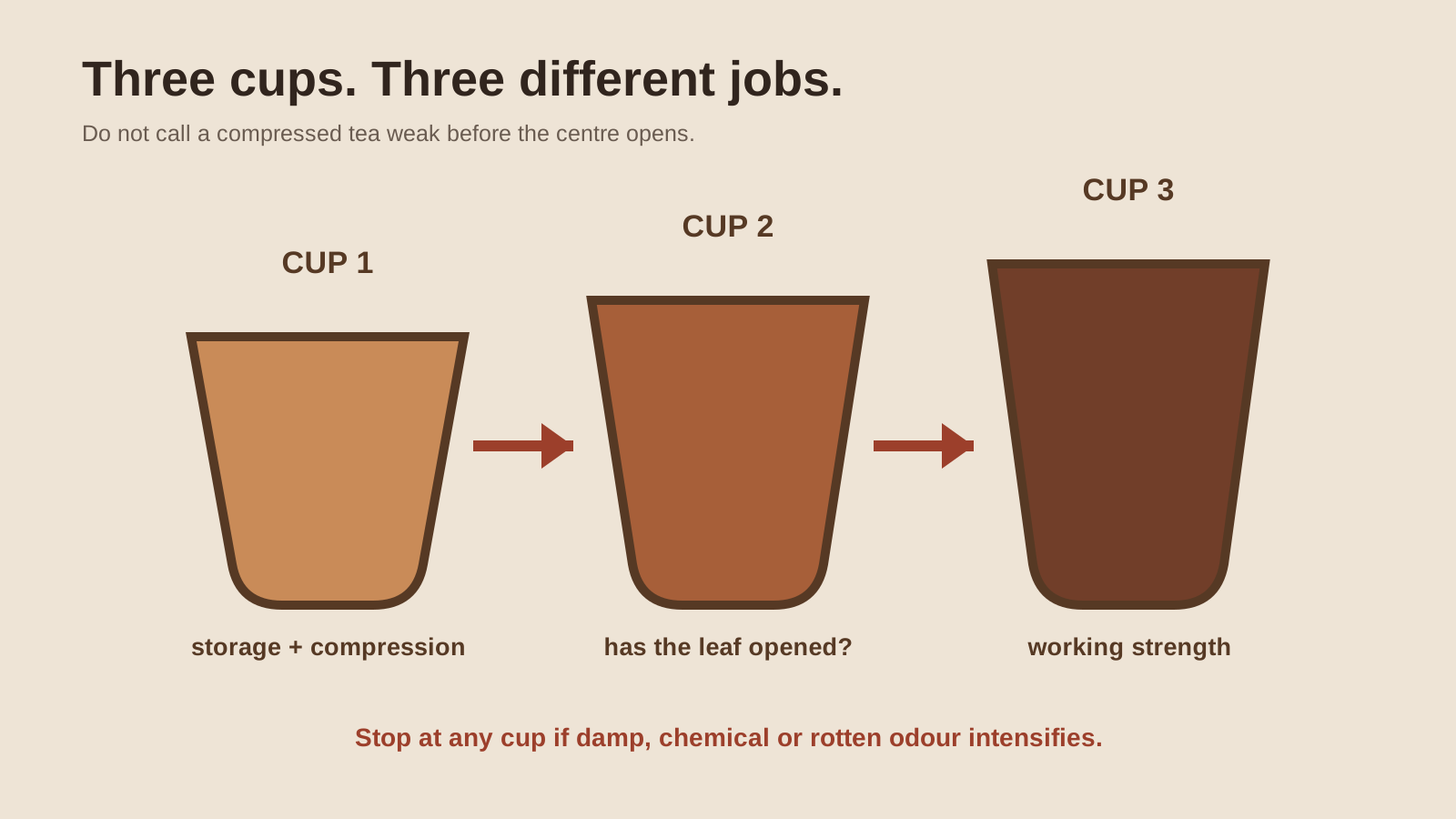
My fixed rule is this: cup one diagnoses storage and compression, cup two shows whether the leaf is opening, and cup three is the first fair strength judgment. A rinse can wake a clean flake. It cannot repair mold, dirty storage or poor fermentation.
I reject the performance of judging a Pu-erh cake from one heroic dark pour. I believe the best brewer is the person willing to admit that the first pale cup may only mean the center is still dry. I insist on waiting for the leaf before adding time, because the mistake is to punish a closed flake until it opens into bitterness. I would rather lose one unimpressive infusion than bury the tea under an early overcorrection. For me, that patience matters because Pu-erh exposes whether we are reading the material or merely defending the story on its wrapper.
How to brew Pu erh tea: the five-minute setup
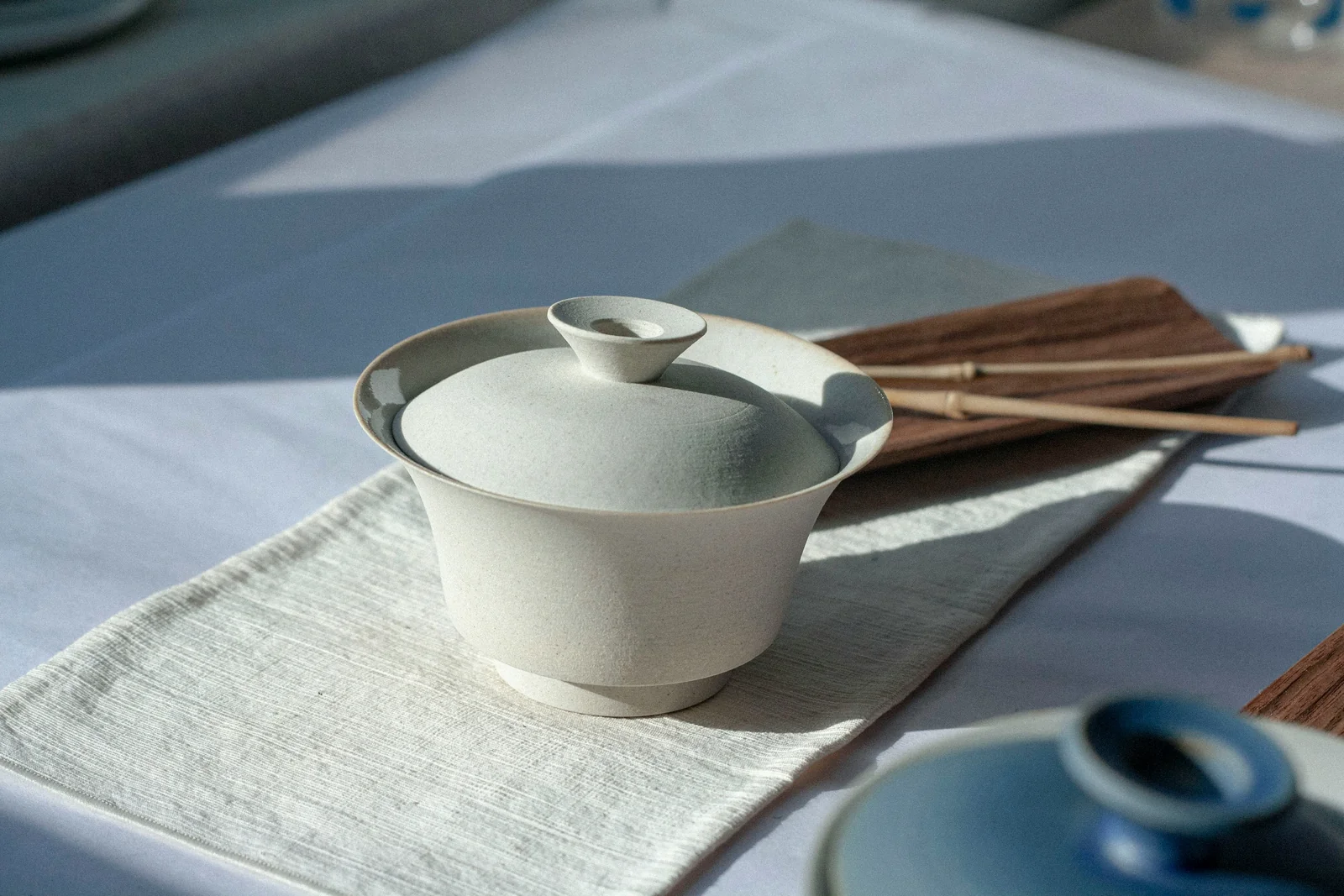
Use a neutral porcelain gaiwan or glazed small pot, a scale, a kettle, a pitcher and cups. Measure the vessel's working volume by filling it to the level you actually use and weighing that water; one gram of room-temperature water is close enough to one milliliter for household setup.
This guide follows raw and ripe as separate processing routes consistent with China's official GB/T 22111-2008 Pu-erh tea record; that definition does not prescribe one household brewing recipe.
Then record five facts before brewing:
- Raw sheng or ripe shou.
- Loose, intact flake, tight chunk or broken material.
- Leaf weight and working water volume.
- Water temperature.
- Whether you rinsed and how long the leaf rested afterward.
These details explain more than “2012 cake” or “ancient tree.” The complete Pu-erh guide owns buying, storage and provenance decisions; this page owns the brewing test.
This measured session belongs to the wider Chinese tea-practice collection, where vessel volume, complete decanting and one-variable correction matter more than ceremonial theatre.
Choose a baseline by leaf state
The following numbers are East Moment household starting points, not national standards or the only correct recipes.
| Tea in front of you | Leaf | Water | First infusion | Read before changing |
|---|---|---|---|---|
| Young raw Pu-erh, intact | 5 g / 100 ml | 95°C / 203°F | 8-10 sec | Does bitterness carry aroma and a clean finish? |
| Stored raw Pu-erh, intact | 5 g / 100 ml | 98°C / 208°F | 10-12 sec | Does storage aroma clear as the leaf opens? |
| Ripe Pu-erh, intact or loose | 5 g / 100 ml | 100°C / 212°F | 10-15 sec | Is the cup dark and clean rather than muddy or fishy? |
| Tight compressed flake | Match raw or ripe | Match raw or ripe | Same short start | Rest after rinsing; do not force the closed center with a long steep |
| Broken or dusty material | 4-4.5 g / 100 ml | Match raw or ripe | 5-8 sec | Fast extraction may be physical breakage, not “stronger quality” |
The important distinction is state, not prestige. A tight old cake and loose young tea do not release at the same speed. Neither does an intact flake and the crumbs at the bottom of a sample bag.
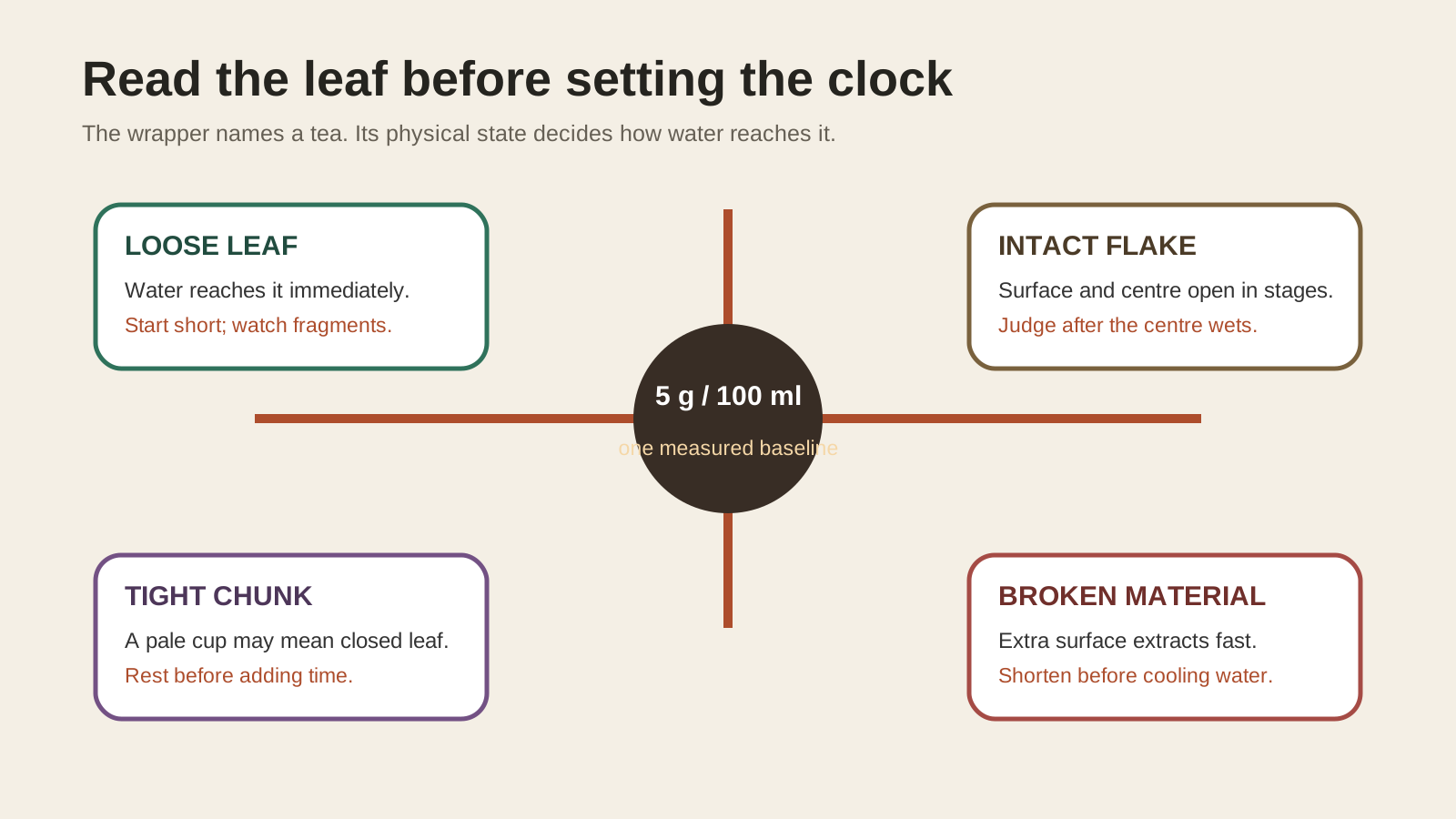
The map prevents one common error: treating a pale first cup from a closed chunk as proof that the tea is weak. Leaf state is a physical diagnosis; it says nothing by itself about origin, age or quality.
Open a compressed cake without making dust
Put the cake on a stable board or tray. Never hold it in your palm while pushing a tea pick toward your fingers.
- Inspect the front, back and edge for a natural layered entry point.
- Keep the supporting hand behind the tool's direction of travel.
- Slide a tea pick or dull tea knife between layers from the side, almost parallel to the cake face.
- Wiggle gently and lift a broad flake instead of levering straight upward.
- Take material from both surface and interior when you need a representative test.
The goal is not a beautiful geometric chunk. The goal is intact mixed material that represents the cake. Crushing increases surface area, makes early infusions run faster and can create bitterness or muddy ripe liquor that the intact cake would not produce.
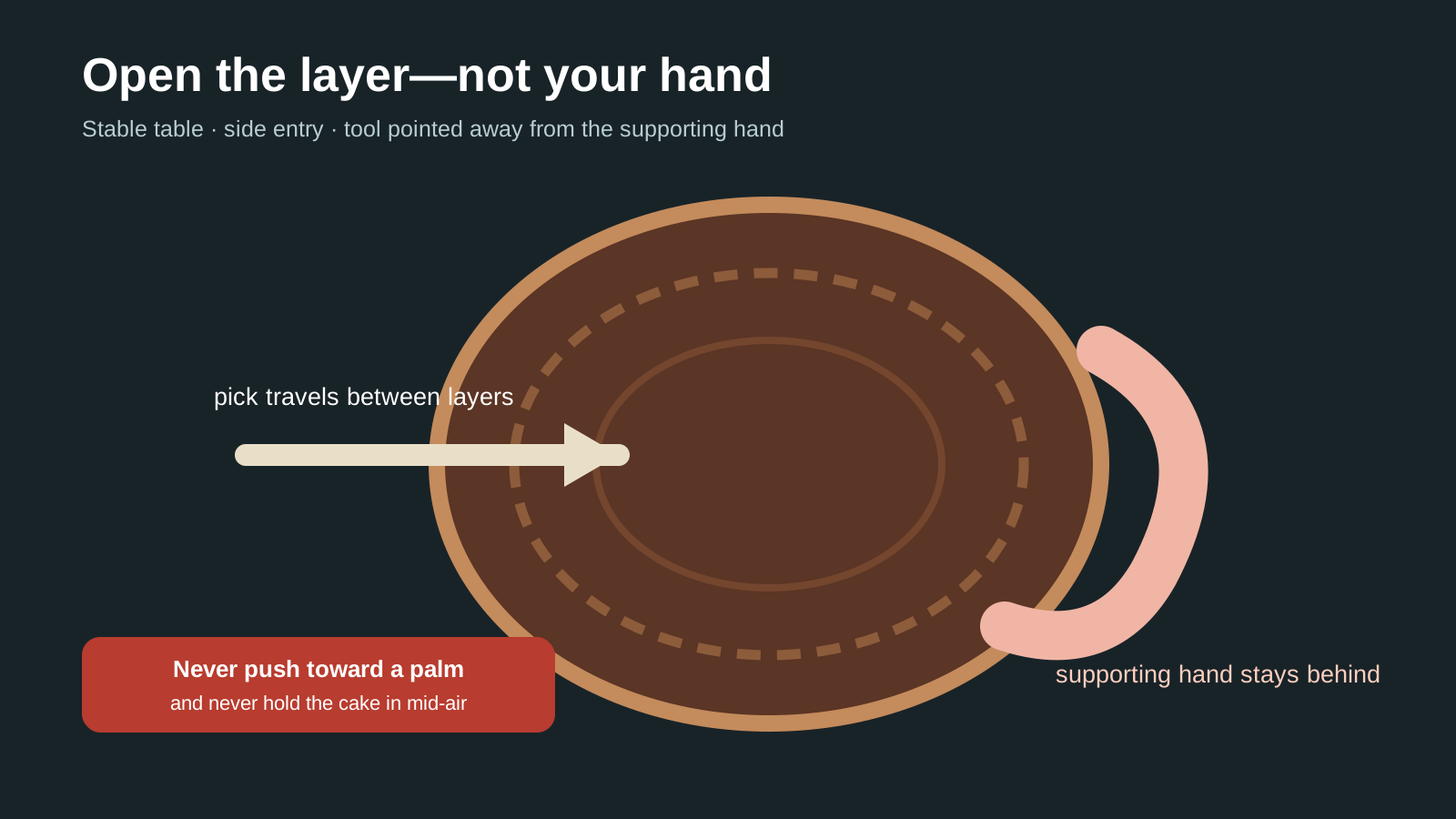
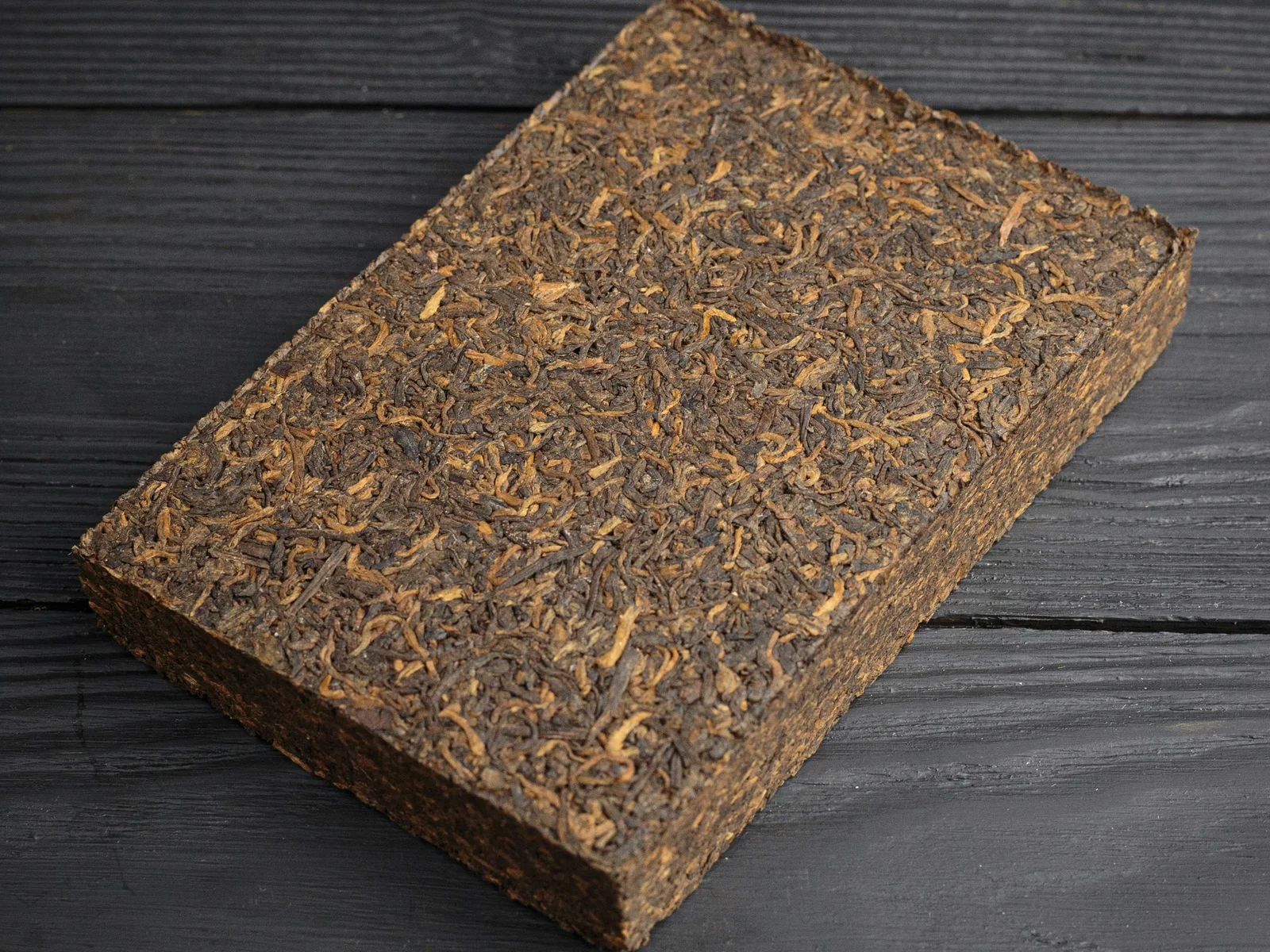
If the attractive face and newly opened interior look very different, record the difference. A blend is not automatically dishonest, but a surface photograph is not a complete sample.
Weigh the flake, not the wrapper
For a 100-milliliter working volume, begin with 5.0 grams. Select a flake that includes both outside and interior material. Do not fill out the number with loose dust simply because the scale says 4.7 grams; crumbs behave differently from intact leaf.
If your gaiwan holds 80 milliliters at the real pouring level, the equivalent starting dose is 4 grams. If it holds 120 milliliters, use 6 grams. Calculate from working water, not the vessel's advertised name.
| Working volume | Starting leaf at 1:20 | Practical note |
|---|---|---|
| 80 ml | 4.0 g | Useful for one drinker and expensive samples |
| 100 ml | 5.0 g | The reference point used in this guide |
| 120 ml | 6.0 g | Leaves less room for error with fast broken material |
| 150 ml | 7.5 g | Better shared; pouring time becomes a larger part of contact |
The number is a repeatable household baseline, not a statement that every photographed cake was weighed in this session. Measure the leaf in front of you rather than estimating from a chunk's apparent size.
Rinse only when it has a job
A rinse is optional. Give it one of three jobs: remove loose surface dust, warm the leaf or start opening a compressed flake.
For a clean intact flake, pour hot water, cover the leaf and decant in about 3-5 seconds. Then let a tight piece rest for 30-60 seconds in the warm vessel. That pause often opens the outer layers more effectively than turning the first drinkable infusion into a one-minute extraction.
Do not rinse automatically twice. Loose young raw Pu-erh may need no rinse. Dusty or tightly compressed ripe tea may justify one. A second rinse is a choice only when the first did not wet the center and you accept losing some aroma.
Most important: a rinse does not sterilize unsafe tea. Visible growth, persistent mildew, sewage-like odor, fuel, perfume or an aroma that makes you recoil is a stop signal. Brewing advice cannot identify microorganisms or certify safety from a photograph.
Count contact until the vessel is empty
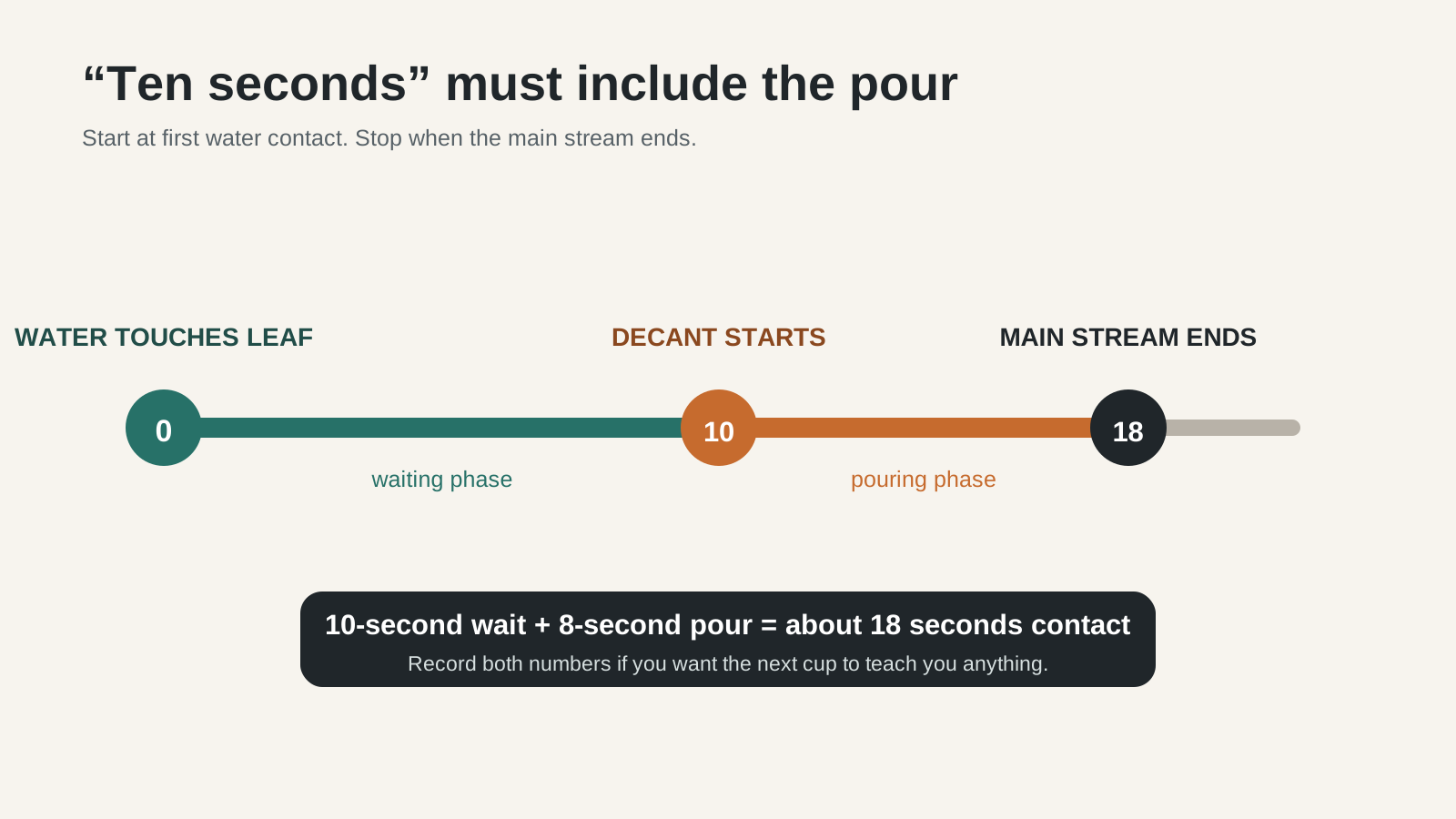
“Ten seconds” is meaningless unless you define when it starts and stops.
- Contact starts when water first touches the leaf.
- Decant starts when liquor begins leaving the vessel.
- Contact ends when the main stream has stopped and the leaf is no longer sitting in a hidden pool.
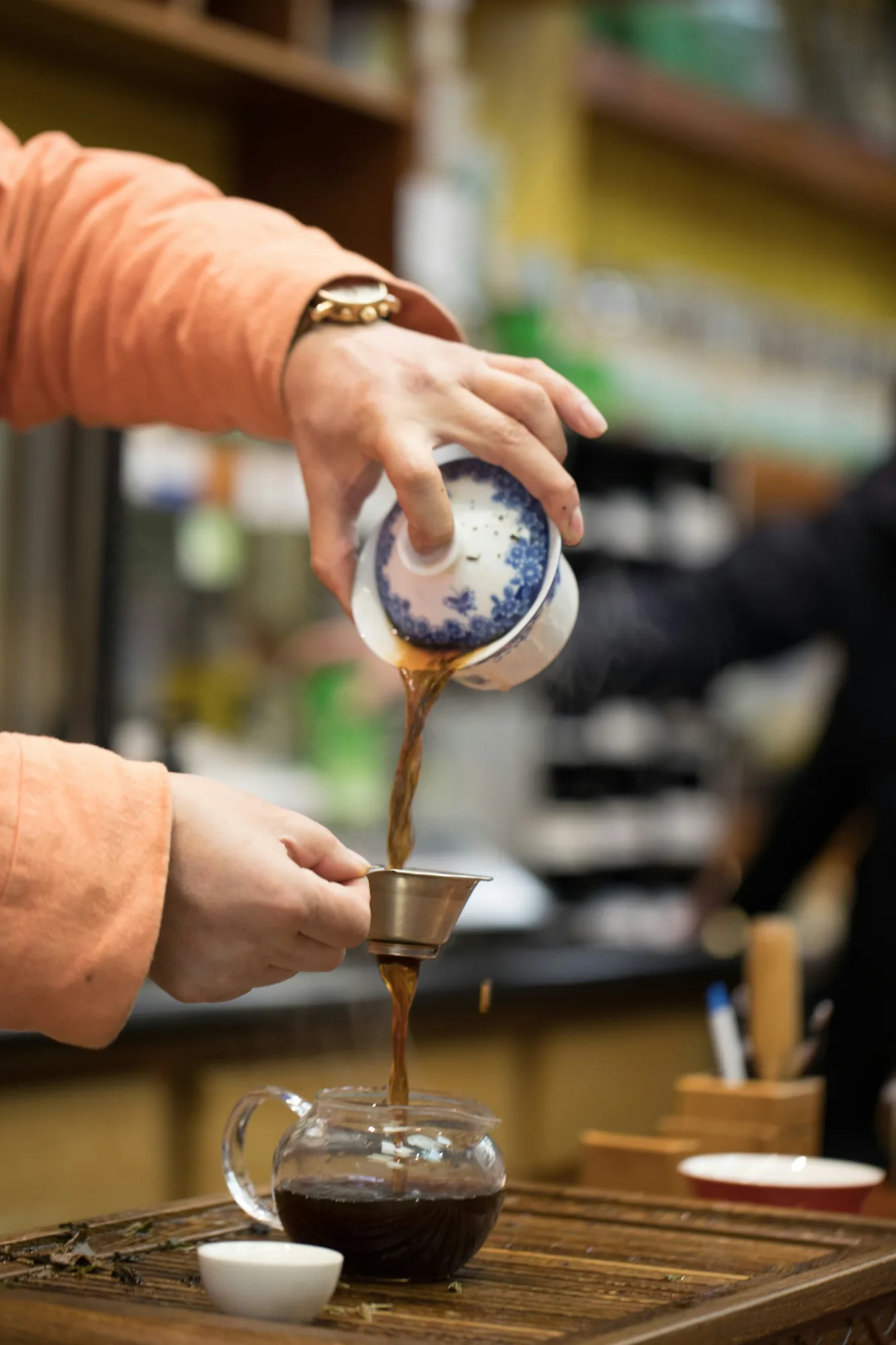
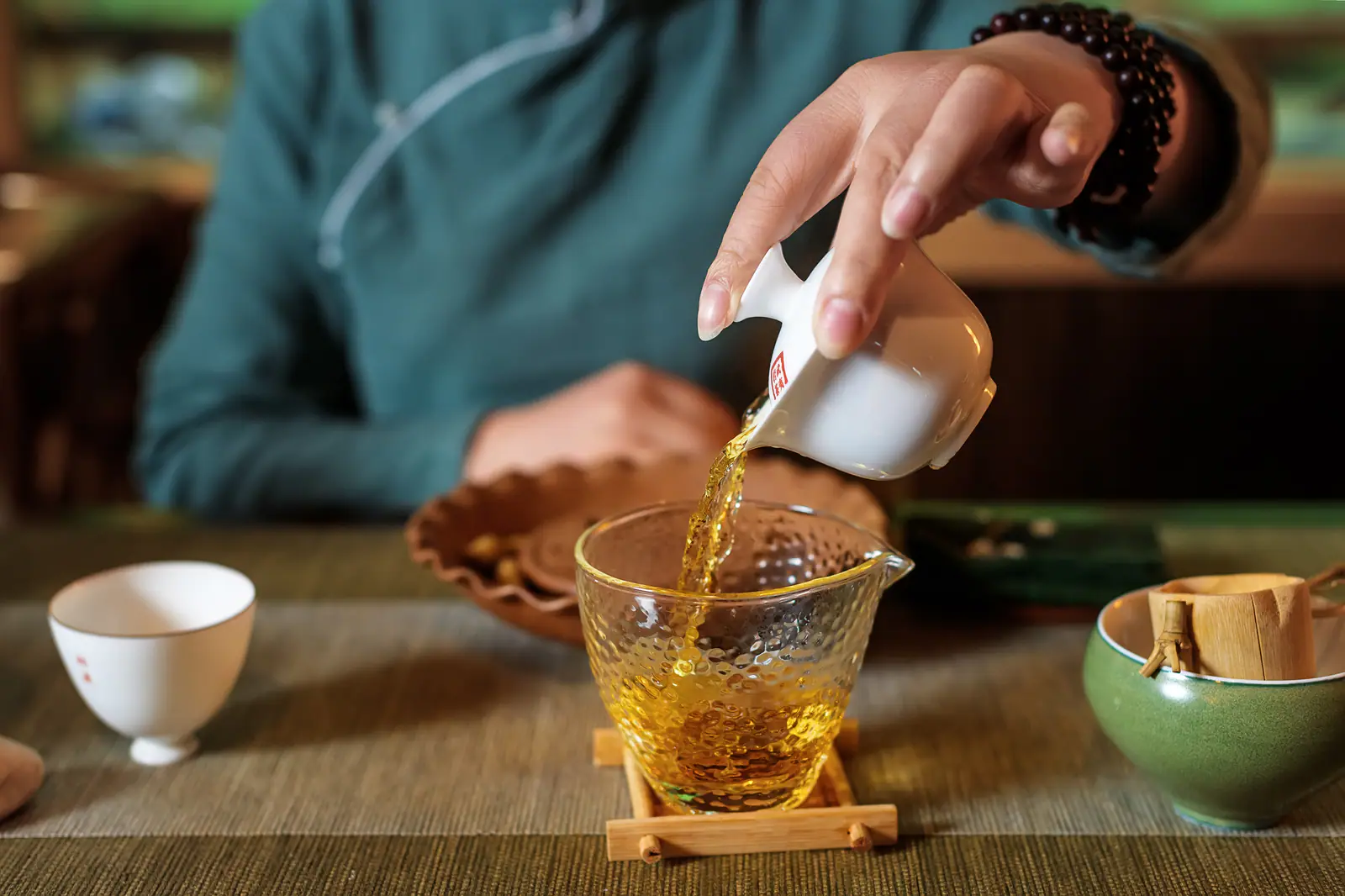
This real pour shows the action that matters: the brewer keeps decanting until the main stream has finished, instead of leaving a hidden infusion behind. It demonstrates service mechanics, not the identity of the leaf inside the gaiwan or a universal target color for Pu-erh.
A ten-second wait followed by an eight-second pour is closer to eighteen seconds of changing extraction than a ten-second total contact. This matters especially with a large pot, a narrow filter or broken leaf.
Tilt until the vessel is substantially empty. Liquor left beneath the leaf continues brewing and makes the next round seem unpredictably harsh. Complete decanting is the most important repeatable action in this guide.
The photograph shows the separate serving step, not proof that a brewing vessel was drained completely. Check the brewer itself for a hidden pool before starting the next infusion.
Use three infusions as a diagnostic sequence
Do not expect three cups to do the same job.
| Infusion | Main question | Continue when | Correct or stop when |
|---|---|---|---|
| One | Is storage or fermentation aroma acceptable? | A closed, dusty or rough note begins to clear | Repellent damp, chemical or rotten odor intensifies with heat |
| Two | Has the compressed flake started to open? | Edges loosen and liquor gains structure | The center remains dry; add rest before adding time |
| Three | What is the tea's working strength? | Aroma, body and finish form a coherent cup | Bitterness, mud or thinness still dominates after the leaf is open |
Smell the warm dry leaf, the first wet leaf and the cooled wet leaf. Pleasant top notes can hide storage character while hot; cooling can make sour, dirty-cloth or perfume-like odors easier to notice.
A 2026 peer-reviewed sensory study built a Pu-erh flavor wheel from 52 varied samples and identified 44 representative descriptors. Its real lesson for a home brewer is not that every tea should match a fixed vocabulary. It is that Pu-erh is too varied for “earthy” to function as a complete quality judgment.
Fix young raw Pu-erh without silencing it
Young raw Pu-erh can be bitter and astringent. The goal is not to erase those qualities; it is to keep them proportionate to aroma, body and the sweetness or clarity that follows.
| Result | Change next | Keep fixed |
|---|---|---|
| Aromatic but punishing | Shorten total contact by 3-5 sec | Dose, water and vessel |
| Still harsh after a fast complete pour | Lower water by about 3-5°C | Dose and vessel |
| Thin, green and hollow | Raise water first | Dose and time |
| Good first cups, rough later | Shorten again when the leaf fully opens | Temperature and dose |
| Numbing or unpleasant throat response | Stop the session | Do not reinterpret discomfort as prestige |
Time is the first adjustment because it is easiest to isolate. Lowering temperature too far may remove aroma while leaving the cup structurally empty.
Fix ripe Pu-erh without excusing dirtiness
Ripe Pu-erh should tolerate near-boiling water. Dark color is expected; opaque mud and persistent fishiness are not quality requirements.
| Result | Most likely brewing issue | Next action |
|---|---|---|
| Muddy, heavy liquor | Broken leaf, excess dose or incomplete pour | Shorten first; use less leaf next session if needed |
| Weak first two rounds | Tight center not yet wet | Rest after rinse; keep early pours short |
| Dark but flat | Water too cool or stale sample | Try fresh water at boiling before adding leaf |
| Fishy note fades quickly | Possible transient fermentation/storage character | Continue only if the cup becomes clean and appealing |
| Fishy, sour or dirty-cloth odor persists | Tea condition, not a timing puzzle | Stop and compare another sample |
A 2024 review describes ripe Pu-erh pile fermentation as an interaction among microbial communities, moisture, heat, oxygen and chemical change. That supports treating ripe tea as its own production route. It does not let a brewer identify a microbe from aroma or excuse every off-odor as “authentic fermentation.”
Separate compression failure from weak tea
This is the mistake most likely to waste a good cake. A tight flake gives a pale first cup, so the brewer doubles infusion time. The center then opens during cup two and releases everything at once.
Use this sequence instead:
- Keep the first infusion short.
- Inspect whether the flake center is still dry or rigid.
- Rest the warm leaf for 30-60 seconds.
- Repeat the same short contact once.
- Increase time only after the center is wet and the cup remains thin.
The first weak cup may be a hydration problem. The third weak cup from fully opened leaf is a strength problem. Those require different corrections.
Storage faults are not brewing faults
Two cakes can look similarly dark and behave differently in hot water.
A 2025 raw Pu-erh study found sensory and volatile differences among same-manufacturer samples with reported storage times from 7 to 21 years. This supports the narrow statement that storage can change aroma. It does not provide a smell-based clock for dating an unknown cake.
| Signal | Brewing response | Evidence limit |
|---|---|---|
| Slight closed or papery first cup that clears | Continue the three-cup test | Does not prove clean long-term storage |
| Foreign smoke or perfume | Air a small sample briefly, then retest once | Cannot identify where odor transfer occurred |
| Persistent damp cardboard or cellar odor | Stop and reject the sample | Cannot identify a microorganism |
| Visible active growth or wet damage | Do not brew | A screen image cannot certify safety |
| Dark liquor | Judge aroma, mouthfeel and finish | Does not prove ripe style or age alone |
Do not boil harder, rinse longer or switch to a seasoned clay pot to hide a result you would otherwise reject.
Mug and large-pot method
For a single longer infusion, use 3 grams per 250 milliliters. Start around 90-95°C for young raw Pu-erh and 95-100°C for ripe or stored raw Pu-erh. Taste at two minutes and remove the leaf between 2 and 4 minutes.
A basket infuser is more controllable than leaving the leaf in a travel mug all afternoon. If the cup is too strong, remove the leaf sooner. Adding hot water afterward changes concentration but cannot undo compounds already extracted.
Large pots magnify pour time. If 150 milliliters takes twelve seconds to drain, shorten the waiting phase rather than pretending the pour does not count.
Keep one six-line record
You do not need poetic tasting language. Write:
- Raw or ripe; producer and batch if known.
- Loose, flaked, tight or broken.
- Leaf weight and measured working volume.
- Water temperature and source.
- Rinse, rest, contact and pour times.
- The first infusion that felt balanced.
Then add one failure sentence: cup three became rough after the center opened, fishy aroma remained when cool, or fully opened leaf stayed thin. That sentence determines the next controlled change.
The repeatable Pu-erh method
For an unfamiliar clean Pu-erh, use a neutral 100-milliliter vessel, 5 grams of representative leaf and water appropriate to raw or ripe style. Rinse only for a defined reason, rest tight compression, make a short complete pour and reserve judgment until the third infusion.
Adjust time first, temperature second and dose in the next session. Stop when the tea's condition is unacceptable. Brewing is a diagnostic tool, not a rescue ritual.
Share a useful brewing record in China Moments with the stated raw or ripe style, leaf weight, working volume, the flake before and after opening, three liquor colors and the cooled wet leaf. That gives another reader evidence they can actually compare.