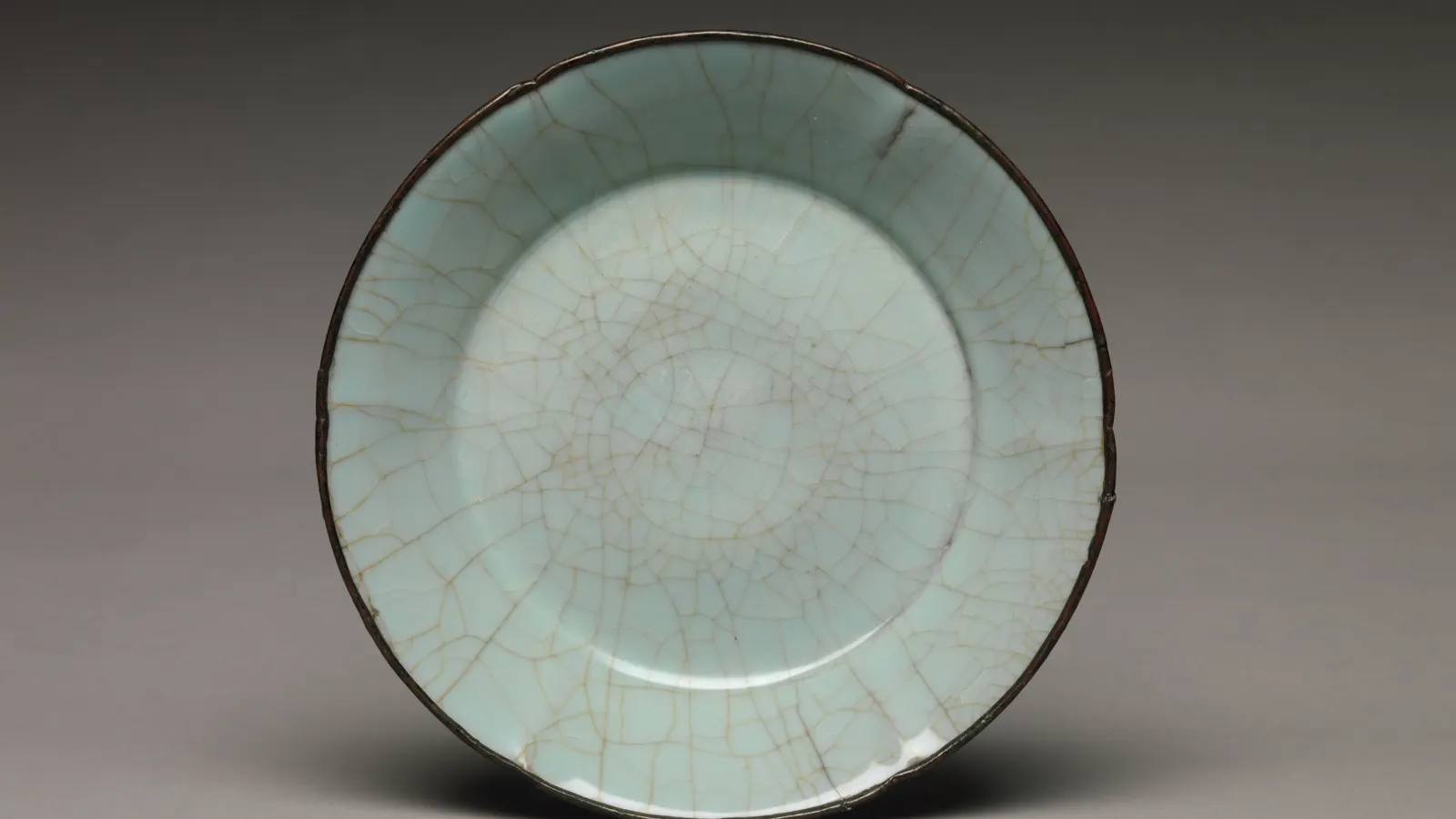
The cracks are the first thing you notice in Guan ware. They should not be the last. I am drawn to the dark clay appearing beneath a pale rim: the potter has made two materials work together without hiding their difference. Follow that edge and a supposedly simple green vase becomes much more demanding than a crackle pattern.
What is Guan ware?
Guan ware is “official ware,” most closely associated with ceramic production for the Southern Song court after it established its capital at Lin’an, present-day Hangzhou, in the twelfth century. Surviving and attributed pieces are known for restrained forms, thick celadon glazes, prominent crackle and bodies that may appear dark at exposed rims or feet.
That definition needs precision. Guan is a functional and institutional term, not one modern factory brand with a single recipe. Historical texts refer to official kiln production, archaeology has identified kiln remains around Hangzhou, and museums preserve objects classified through material, form, provenance and connoisseurial history. Those bodies of evidence overlap, but not always perfectly.
The interesting part is not merely that the court wanted ceramics. It is how political dislocation became material culture. After the Northern Song lost its northern capital, the Southern Song court rebuilt ceremonial life in the south. Official ceramics helped create continuity while working with new local conditions and kiln knowledge.
The dark edge explains more than the loudest crack
| Feature | What to notice | Why it matters |
|---|---|---|
| Glaze | Thick, blue-green, gray-green or softly opaque celadon surface | Depth changes how light enters the object and softens its form |
| Crackle | Networks of different scales and darkness | The glaze records material tension; later staining can heighten visibility |
| Body | Often dark or iron-rich, especially visible at unglazed areas | A darker body changes the optical effect beneath pale glaze |
| Form | Restrained bowls, dishes, bottles and archaic-inspired ritual forms | Court taste could connect new production with older ceremonial authority |
| Foot and rim | Exposed body or thinner glaze may create darker edges | Edge contrast belongs to the body-glaze relationship, not painted outlining |
No row is an authentication test. Guan-inspired crackled celadons have been made for centuries.
The Southern Song court had to rebuild an atmosphere
In 1127, the Northern Song political order collapsed under military pressure, and the court eventually established its capital in Lin’an. A capital is not recreated by moving officials alone. Rituals, spaces, objects, supply systems and standards of taste all have to be rebuilt.
Official ceramic production belonged to that process. Vessels could serve ceremonial, display and courtly functions while translating earlier material prestige into a new southern environment. Some forms refer back to ancient bronze ritual vessels, but clay and glaze do not simply imitate bronze. They transform weight, surface and color.
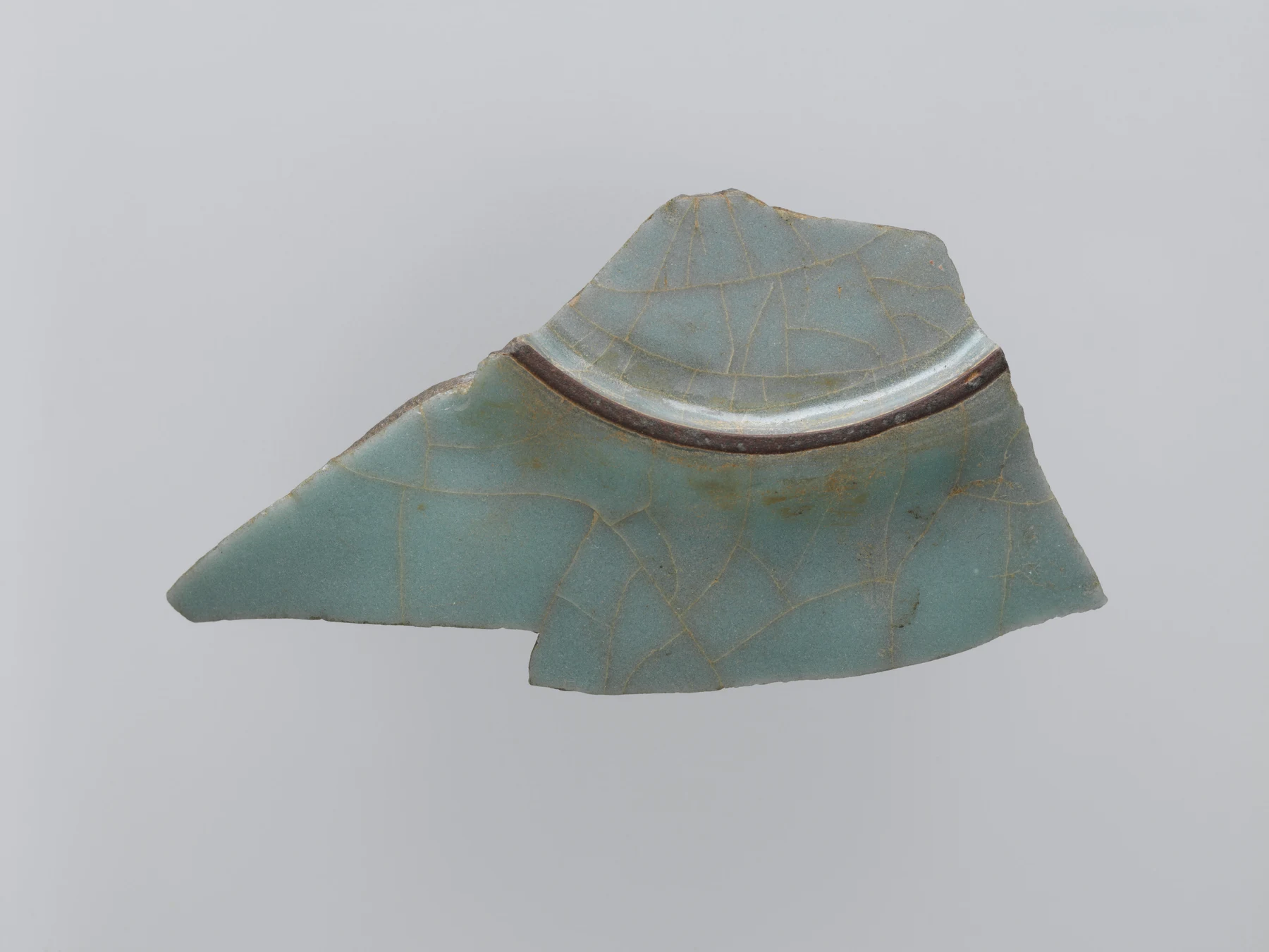
Guan ware sherd, The Metropolitan Museum of Art, Open Access. The surviving curve crosses the foot ring, exposing parts normally hidden when a bowl stands upright.
The fragment gives you an underside without asking you to imagine one. A pale glaze field meets the raised arc of a foot; the broken boundary reveals the wall as a material thickness rather than a silhouette. Its museum record identifies Guan ware and a Song period attribution, but does not supply an excavation site or say it was a kiln reject. I will not turn an interesting break into an invented archaeological discovery. What earns the photograph its place is the visible junction of body, glaze and support.
This is why Guan ware should not be described as a pale aesthetic floating above history. Its calmness emerged from a period of rupture. The court’s desire for continuity met potters’ knowledge of local bodies, glazes, kilns and firing conditions.
Crackle is a physical event before it becomes a visual language
Glaze and ceramic body expand in heat and contract during cooling. If the glaze wants to contract more than the body beneath it permits, it can be left in tension and fracture into a network of fine lines. The important difference is contraction, not simply that one material cools faster. A glaze crack is not automatically a crack through the clay wall. Other damage may coexist, so the network alone tells you neither that the vessel is broken nor that it is safe to use.
That explanation can sound mechanical until you look. Crackle changes scale around curves. Lines meet, stop, branch and frame islands of glaze. Dark material may enter the cracks and make one network more legible. Some surfaces show more than one apparent scale of crackle.
The common phrase “gold thread and iron wire” is often used around double crackle effects, especially in discussions that cross into Ge ware. It is evocative but dangerous when treated as a universal identification formula. Crack darkness depends on treatment, age, staining, condition and photography. A catchy phrase cannot resolve an attribution.
Thick glaze makes color feel spatial
Guan celadon is not merely green coating. A thick glaze can contain bubbles, particles and zones of differing opacity. Light enters, scatters and returns through that structure. The body beneath also matters: a darker clay can cool and deepen the appearance of a pale glaze.
At the rim, glaze may thin and allow the body to show more strongly. At the foot, exposed clay can create a dark boundary. Collectors sometimes summarize this with poetic edge descriptions. The better habit is to observe where the effect occurs and what material relationship might produce it.
The glaze can also soften a form. A sharp ridge under thick glass becomes less graphic. A carved or raised line can catch deeper color where glaze gathers. Surface and silhouette are therefore not separate design departments.
The form carries political memory
Some Guan forms echo ancient ritual bronzes: vases with squared sections, tubular handles, ridges or proportions associated with older ceremonial objects. The reference gave the Southern Song court a way to connect present practice with an authoritative past.
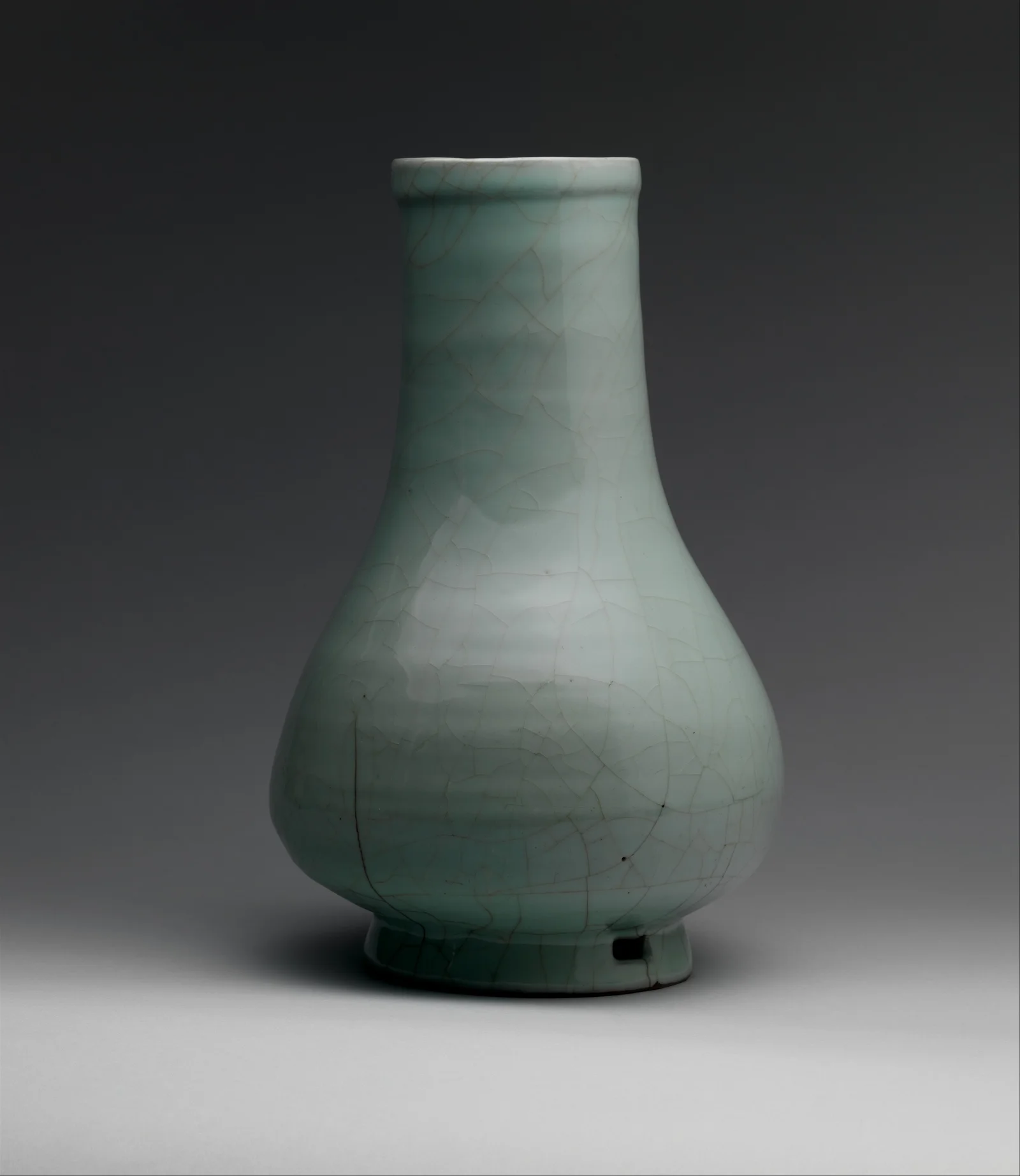
Guan ware vase, twelfth–thirteenth century, The Metropolitan Museum of Art, Open Access. Follow the change from the narrow neck into the rounded body before comparing the cracks.
Yet the ceramic object is not a cheap bronze substitute. Glaze replaces metallic reflection with depth. Crackle introduces time and instability. A heavy bronze form translated into ceramic can become visually lighter or more vulnerable.
Not every Guan vase has tubular handles or an unmistakable bronze prototype. This full profile matters precisely because a cropped photograph of its lower neck cannot answer what kind of vessel it is. Here the widening shoulder controls how much of the glaze meets the light. A dense crop makes cracks look like the whole design; the complete object restores the relationship between narrow neck, broad body and supporting foot.
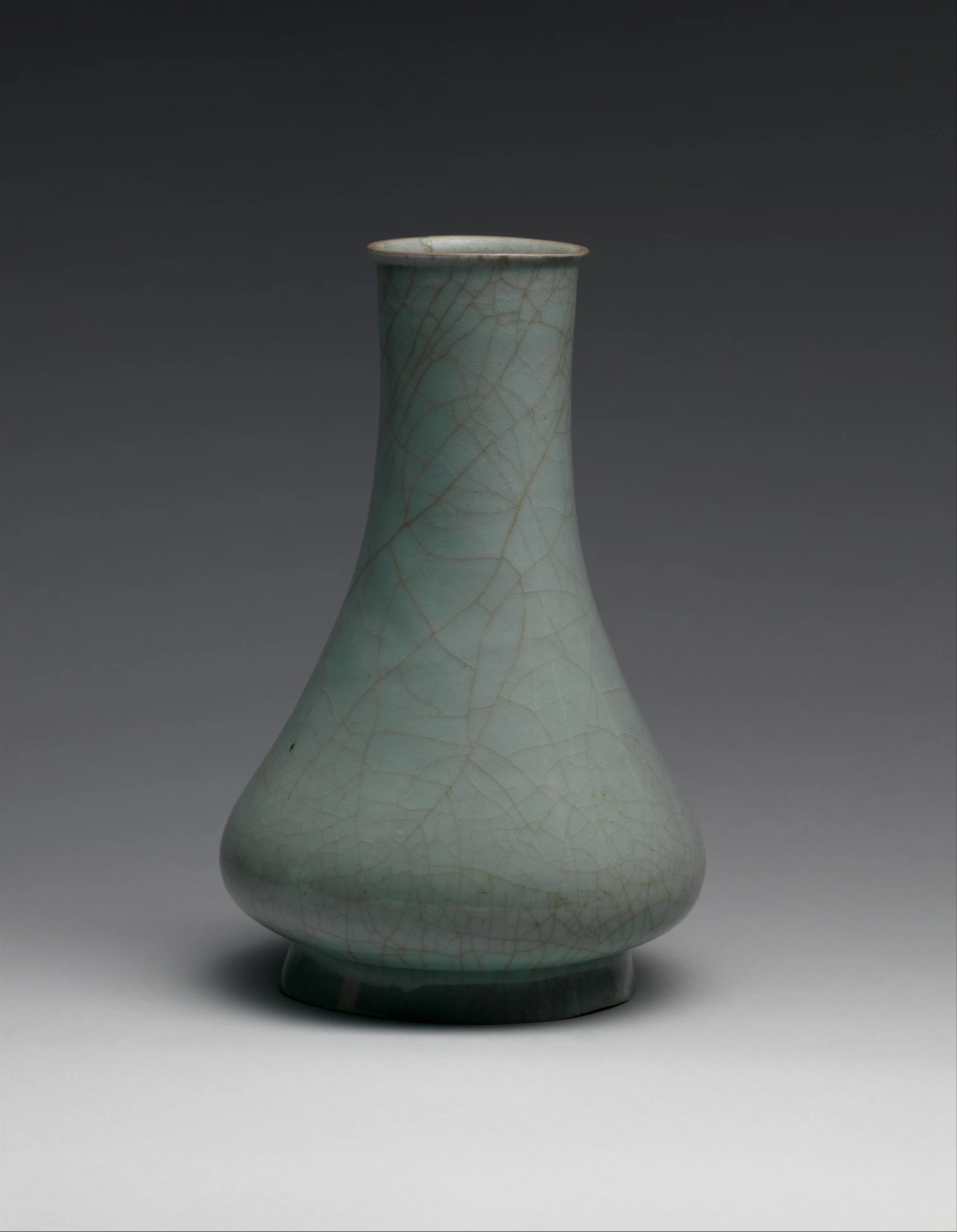
Guan ware vase, twelfth–thirteenth century, The Metropolitan Museum of Art, Open Access. The long neck makes glaze thickness, edge darkening and the scale of crackle easier to compare from top to foot.
Guan and Ru represent different moments of court ceramics
Ru ware is linked to the Northern Song court and production in Henan. Guan ware belongs to the Southern Song court’s reestablishment in the lower Yangtze region. Both can favor restrained forms and celadon surfaces, but their histories, bodies, glaze structures and visual effects should not be collapsed into one “imperial blue-green” category.
Ru often feels lighter and more tightly calibrated. Guan can feel denser, with thicker glaze and crackle carrying more visual weight. That is a viewing tendency, not an absolute rule. Secure objects should lead the comparison, not a color chart built from online thumbnails.
The transition also shows that court taste is portable but never frictionless. A patron can request continuity; materials and workshops answer in their own language.
Guan and Ge cannot be separated by crackle alone
The visual overlap between Guan and Ge is one of the fastest routes to overconfidence. Both names can be attached to thick crackled glazes, muted colors and darkened fissures. Later collectors, revivals and market labels further complicate the field.
The historical difference is more useful than a visual trick. Guan has a comparatively strong relationship with Southern Song official production and kiln archaeology around Hangzhou. Ge is a less stable category whose identity, date range and kiln location remain disputed.
If a seller offers a one-line rule such as “large crackle equals Guan, double crackle equals Ge,” treat it as a warning. Museum attribution is not solved by wallpaper pattern recognition.
“Official kiln” does not always mean this ware
The Chinese word guan (官) travels far beyond these Song vessels. In a discussion of Ming or Qing ceramics, guanyao can refer to official or imperial production in a different period and place. An imperial Jingdezhen bowl is not therefore Southern Song Guan ware. English labels collapse the two meanings easily because both contain “official.” Keep the date, production location and specific ceramic category together.
This matters when you compare the muted Guan vase here with the blue-and-white court vessels in the Jingdezhen porcelain guide. Both belong in a history of court patronage. Their bodies, decoration and workshop histories are not interchangeable. Guan as a particular ware is narrower than official manufacture as an institution.
Court production can also distort survival. Objects valued by later collectors are more likely to be preserved, repaired, catalogued and moved into museums. They then become visually representative of an era whose ordinary ceramic life was much larger.
Crackle also carries different values in different ceramic traditions. In a modern production specification, unwanted crazing can be a defect; in a historical Guan object, the same broad physical phenomenon may be part of the surface people cherish. Admiring one does not require accepting the other. I would not use museum prestige to excuse a new vessel that fails its maker's stated purpose.
How to look closely at Guan ware
First read the silhouette. Does the vessel feel derived from a ritual form, a daily-use form or a shape designed to present glaze? Notice the transition between neck, shoulder, belly and foot.
Then let your eye move beneath the crackle. Is the glaze transparent, cloudy or opalescent? Does color deepen where it pools? Can you see bubbles or areas of varied thickness? Crackle is the most obvious signal, which is precisely why it can distract from the rest of the object.
Study the edge. A dark rim may result from thinner glaze over a dark body. The foot can show body color, trimming and firing support. Wear and restoration may alter what appears original.
Finally, read the museum label for attribution language and date. “Guan ware,” “Guan-type,” “Southern Song,” “Yuan” and “later imitation” mark different claims.
What is commonly misidentified as Guan ware?
Later imperial workshops deliberately revived Song glazes. Regional kilns produced related celadons. Modern makers recreate crackled surfaces with considerable skill. Artificial staining can darken crack lines quickly, and photography can exaggerate contrast.
Common errors include:
- calling any gray-green crackled vessel Guan;
- assuming dark crack lines prove great age;
- treating an archaic shape as evidence of Southern Song manufacture;
- ignoring a museum’s “type” or “style” qualifier;
- believing flaws must indicate hand production and therefore antiquity.
A modern Guan-inspired vase can be an honest, accomplished work. Historical attribution is a separate question.
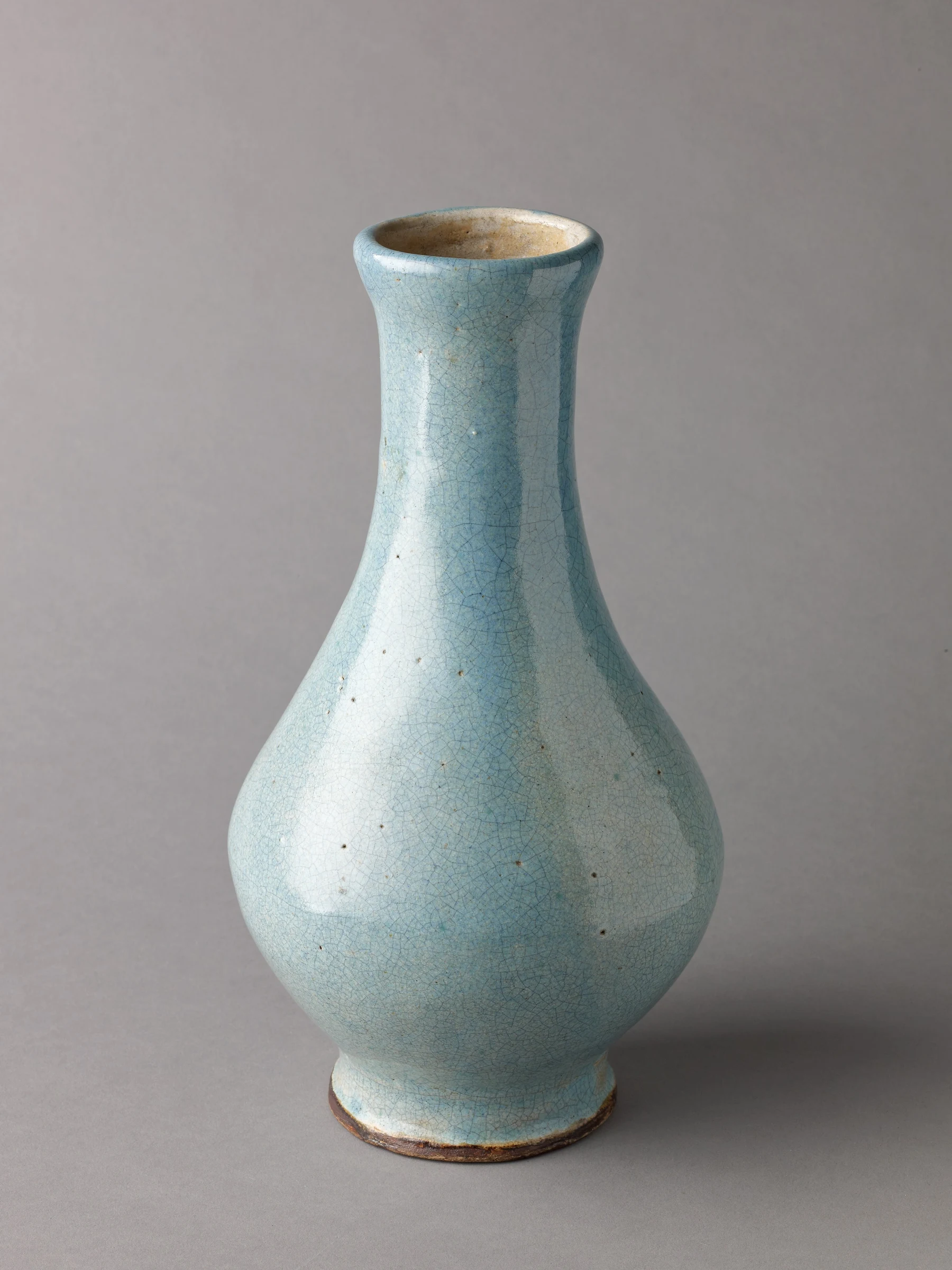
Pyriform vase, sixteenth–seventeenth century, possibly imitating Song Guan ware. The Metropolitan Museum of Art, Open Access. A later revival is not visually worthless and not automatically a forgery; it is evidence that Guan had become a style makers could deliberately quote.
This later vase forces a better question than “real or fake?” What did a Ming potter retain from the Song model, and what changed? The profile, glaze behavior and crackle can carry memory without sharing the original production date. Calling every later response a fake erases ceramic history; calling it original Song erases evidence. Both are lazy.
Put the surface beside its workshop geography
For a visitor in Hangzhou, this subject has a physical continuation beyond the display case. The city's official cultural guide connects the Southern Song Guan Kiln Museum with Jiaotanxia and Laohudong. That connection is valuable because it returns court ceramics to a place of manufacture. Read the difference between an excavated production site, a reconstructed explanation of a kiln and a finished vessel selected for display. Those are three different things to learn from.
Do not plan a visit solely to photograph the most complete pot. Look for an explanation of kiln furniture, body preparation and rejected material, and ask how a displayed fragment is linked to its findspot. The complete vase tells you what survived; archaeological context explains how a workshop produced a range of outcomes. The Hangzhou city guide then returns that southern-capital history to the city's wider geography. Check the museum's current visitor information before making a special journey; this is a looking route, not a fixed opening-hours promise.
Crackle can continue to change, absorb material or be altered by cleaning and restoration. The surface we see now is not always identical to the surface that left the kiln.
I reject the fantasy that age simply decorated Guan ware for us. Time can deepen the surface, but it can also confuse it. I want the dark edge, pooled glaze and vessel profile to carry as much authority as the most photogenic crack.
For an object whose date matters, provenance, technical examination and comparison with excavated material must do the work. A beautiful fracture is a reason to look more carefully, not a certificate.
The surface keeps the memory of pressure
Guan ware turns a technical relationship into a way of seeing. The glaze does not hide what happened during cooling. It records stress and makes that stress visually productive.
That is why the ware feels deeper than “beautiful crackle.” Its surfaces connect court reconstruction, archaic memory, local materials, kiln control and the unstable life of glass on clay.
Continue with the Five Great Kilns of Song China, compare the disputed history of Ge ware, or step back into the larger field of Chinese ceramics.
For Moments, make an edge-to-foot Guan sequence: one front view, one rim or side detail and one exposed-body or foot view. Return when new sherds and underside photographs expose what the polished front view concealed.