I like the unruly lines in Ge ware. I dislike how quickly they become a sales pitch: two colors of crackle, therefore Song, therefore precious. A surface can be beautiful without that story being true. This guide keeps the pleasure of looking and the responsibility of naming together, using actual objects rather than a chart that promises instant identification.
What is Ge ware?
Ge ware is a celebrated Chinese ceramic category associated with thick, muted glazes and strong networks of crackle. It appears in the traditional Five Great Kilns of Song China alongside Ru, Guan, Ding and Jun.
Unlike a modern product with a documented factory and launch date, Ge ware cannot be tied with universal agreement to one excavated kiln site and one securely bounded group of Song objects. Historical references appeared and evolved over time. Later collectors organized surviving pieces. Museums inherited and revised attributions. Technical studies have identified different material groups. Archaeology has proposed relationships, especially around the Longquan region, without making every old label fall neatly into place.
The honest definition therefore includes uncertainty: Ge ware is both a visual ceramic tradition and a historical classification problem. That does not make every object carrying the name equally uncertain. A securely dated eighteenth-century Ge-type vase can be straightforward to catalogue even while the origins of the classic transmitted group remain disputed.
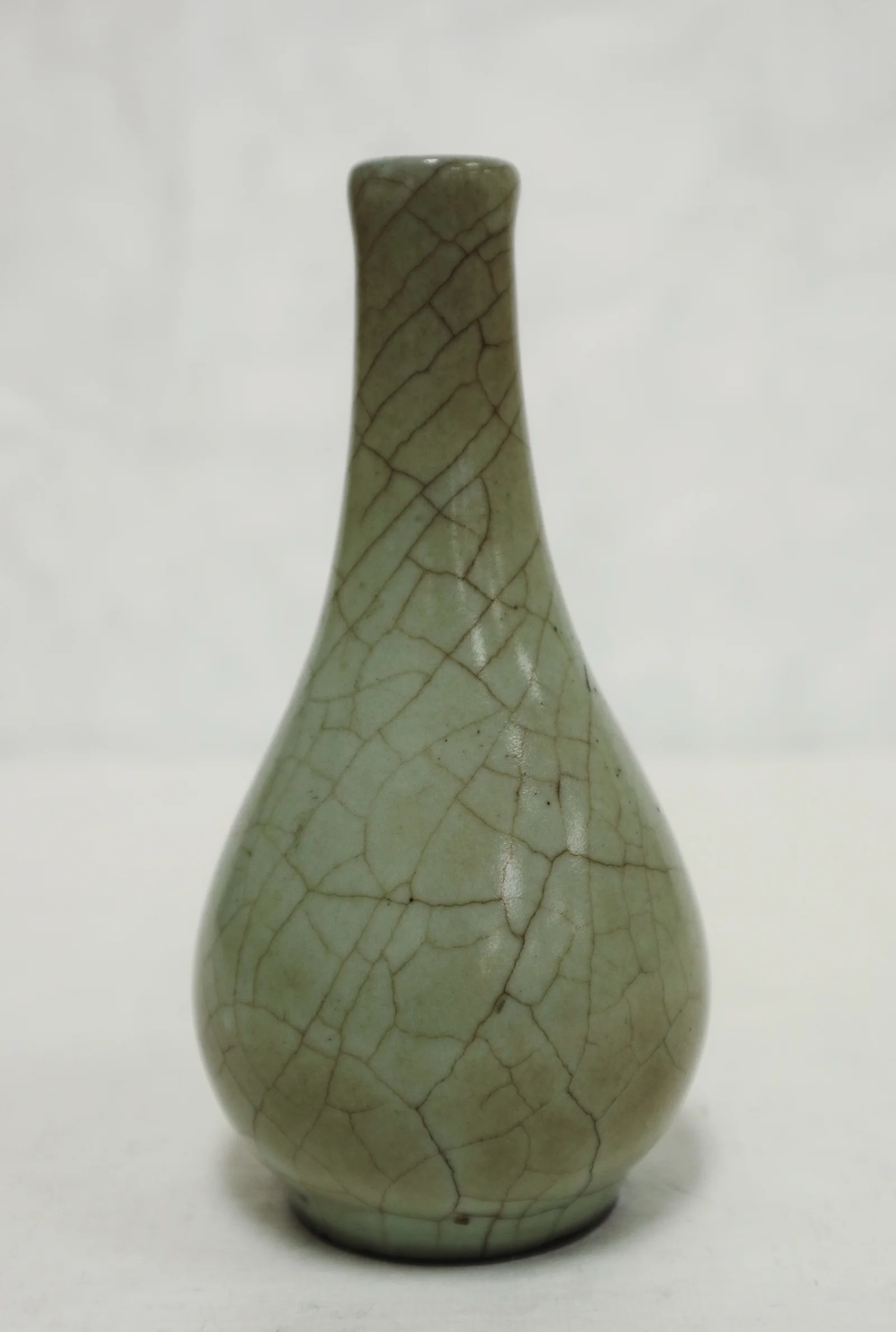
Vase catalogued as Ge ware, with a Song period attribution, The Metropolitan Museum of Art. At 14 cm high, this is a small vessel, not the monumental vase a tightly cropped surface photograph might suggest.
Three records, three different historical claims
| Object in this guide | Museum classification | What the distinction changes |
|---|---|---|
| Small vase, Met 42.198 | Porcelaneous stoneware, Ge ware; Song period attribution | The catalogue places it within the historical category; it does not give a named excavated kiln |
| Miniature meiping, Met 14.40.7 | Eighteenth-century Jingdezhen porcelain with Ge-type glaze | A later workshop is responding to the surface tradition, not claiming to be its Song origin |
| Tubular-handle vase, Met 1993.386.27 | Nineteenth-century Jingdezhen porcelain with Ge-type glaze | An archaic-looking form and crackle do not make the object medieval |
Read those differences before comparing the colors. The first object is not dismissed because the category is debated; the later two are not promoted to Song because they resemble it. Dates and materials make the comparison useful.
The crackle is visually clear; its history is not
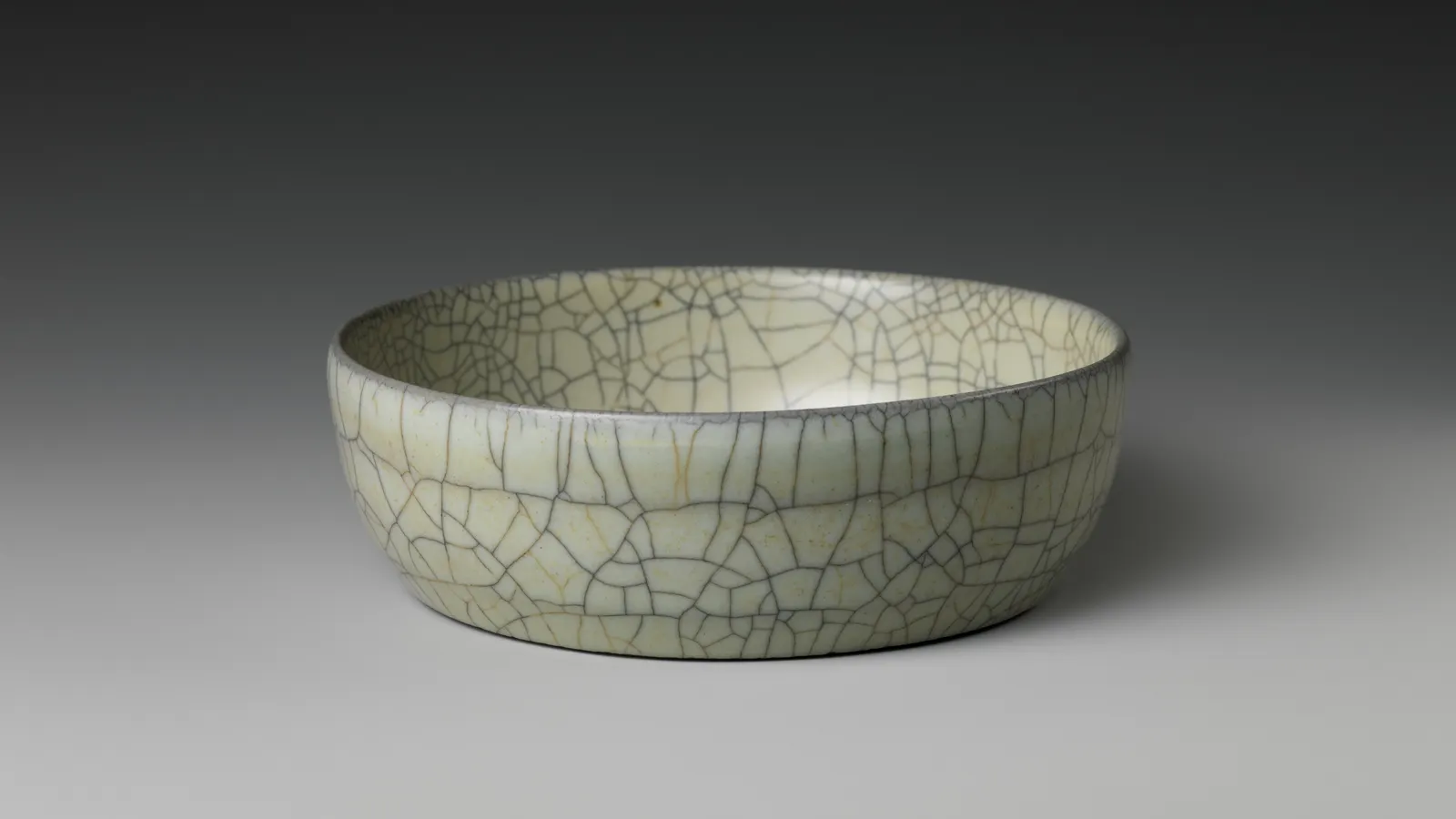
Ge ware is strongly associated with crackle: lines created when glaze and ceramic body respond differently during cooling. The network can be broad, fine, dark, warm brown or layered in appearance.
Collectors often use the phrase “gold thread and iron wire” for a combination of finer warm-toned lines and stronger dark lines. It is a powerful visual metaphor. It is also one of the easiest phrases to misuse.
Cracks can absorb staining. Makers can deliberately emphasize them. Cleaning, burial, handling and restoration can change their appearance. Jīnsī tiěxiàn (金丝铁线) means gold threads and iron wires: it describes a contrast between finer warm-toned lines and stronger dark ones. It does not mean that metallic gold and iron have been inlaid into the glaze. Nor does every Ge-type surface need to show two equally conspicuous networks.
The Palace Museum's Yongzheng-period vase imitating Ge glaze makes that last point concrete: its discussion includes imitations with combined large and small crackle and examples using one scale. A convenient mnemonic has become much narrower than the objects. I would rather keep the range of surfaces than force every vessel to pass a slogan.
Look past the line pattern. How thick is the glaze? How does it pool? What happens at the rim and foot? Does the crackle support the form or visually overwhelm it? The object contains more information than its most marketable feature.
Why the uncertainty became the story
Ceramic categories are produced by several systems at once.
Texts preserve names, but authors may write long after the objects they describe. Collectors group pieces through comparison and inherited taste. Archaeologists excavate kiln remains and wasters tied to place. Scientists analyze clay bodies, glaze chemistry and firing structure. The Chinese distinction between chuánshì (传世, transmitted through collections) and chūtǔ (出土, excavated) is therefore useful. A transmitted object's collection history and an excavated object's recorded findspot answer different questions.
Even “excavated” needs a second question: from where? A vessel deposited in a tomb establishes a place of use or burial, not necessarily the location of the kiln that made it. A manufacturing site with wasters gives a different kind of reference group. This is why finding a related crackled bowl somewhere in Zhejiang does not, by itself, settle the origin of everything collectors once called Ge.
Ideally, all five systems point to the same answer. Ge ware demonstrates what happens when they do not.
The category gained extraordinary cultural stability. “Ge” became a name collectors recognized and later potters deliberately revived. The Palace Museum's Ge ware exhibition explicitly frames the unresolved origin of transmitted Ge as a research problem. That is a more precise question than “was Ge real?” The objects exist; the disputed step is joining a historical name and a surviving group to a securely demonstrated production history.
That should make us cautious, not cynical. Uncertainty does not mean “anything could be Ge.” It means every claim needs to state which evidence supports it.
A family legend is not archaeological coordinates
One well-known tradition connects Ge and Di wares with an older and younger brother, often related to Longquan ceramic production. Ge means elder brother, while di means younger brother. The story is memorable and has shaped popular explanation.
It should not be treated as a GPS pin. Legends can preserve cultural memory, explain names or legitimize later categories without functioning as contemporary production records. The existence of a compelling story does not remove the need for excavated evidence.
This is a broader lesson in Chinese material culture. Etymology, legend, later connoisseurship and archaeology are different source types. Good writing lets them meet without forcing them to become identical.
Ge and Guan: the comparison that causes trouble
Guan ware and Ge ware both appear with thick crackled glazes, muted color and darkened fissures. Internet guides often promise a quick separation: one crack size versus another, one rim color versus another.
The stronger distinction is historical. Guan has a comparatively secure institutional relationship with Southern Song official production around Hangzhou. Ge is the more contested category. Visually similar objects may also have been classified differently across collections and periods.
This does not make visual comparison useless. It changes its purpose. Use the eye to ask how objects relate; do not use one surface pattern to declare a kiln attribution.
The vase is also a history of classification
Some objects now catalogued as Ge or Ge-type have moved through changing dates and names. A museum record may retain an established ware label while noting technical or chronological qualification.
Return to the little vase pictured near the opening. Its rounded body rises into a narrow neck; the lines have to be read across that curved volume, not as a flat sample of glaze. Its recorded height is only 14 cm. A neck-only crop erases both the scale and the relationship of mouth to body—the very information needed to compare it with a later meiping.
Now read the record separately. The Met gives the period as Song and the medium as porcelaneous stoneware, Ge ware. That is the museum's attribution. The record is not an excavation report, and I have not found a documented sequence of changed labels for this particular vase. Do not invent one just because the wider history is contested. A serious comparison preserves what the record actually says and asks which additional evidence supports it.
The label is not outside the object’s history. It is one more layer added by collecting.
Later Ge-type ware is not a footnote; it proves the label had power
Once “Ge” became a prestigious visual category, later makers could quote it. That afterlife is crucial. A category does not need a securely located original kiln to exert pressure on later design. It only needs enough cultural authority for patrons, workshops and cataloguers to recognize the reference.
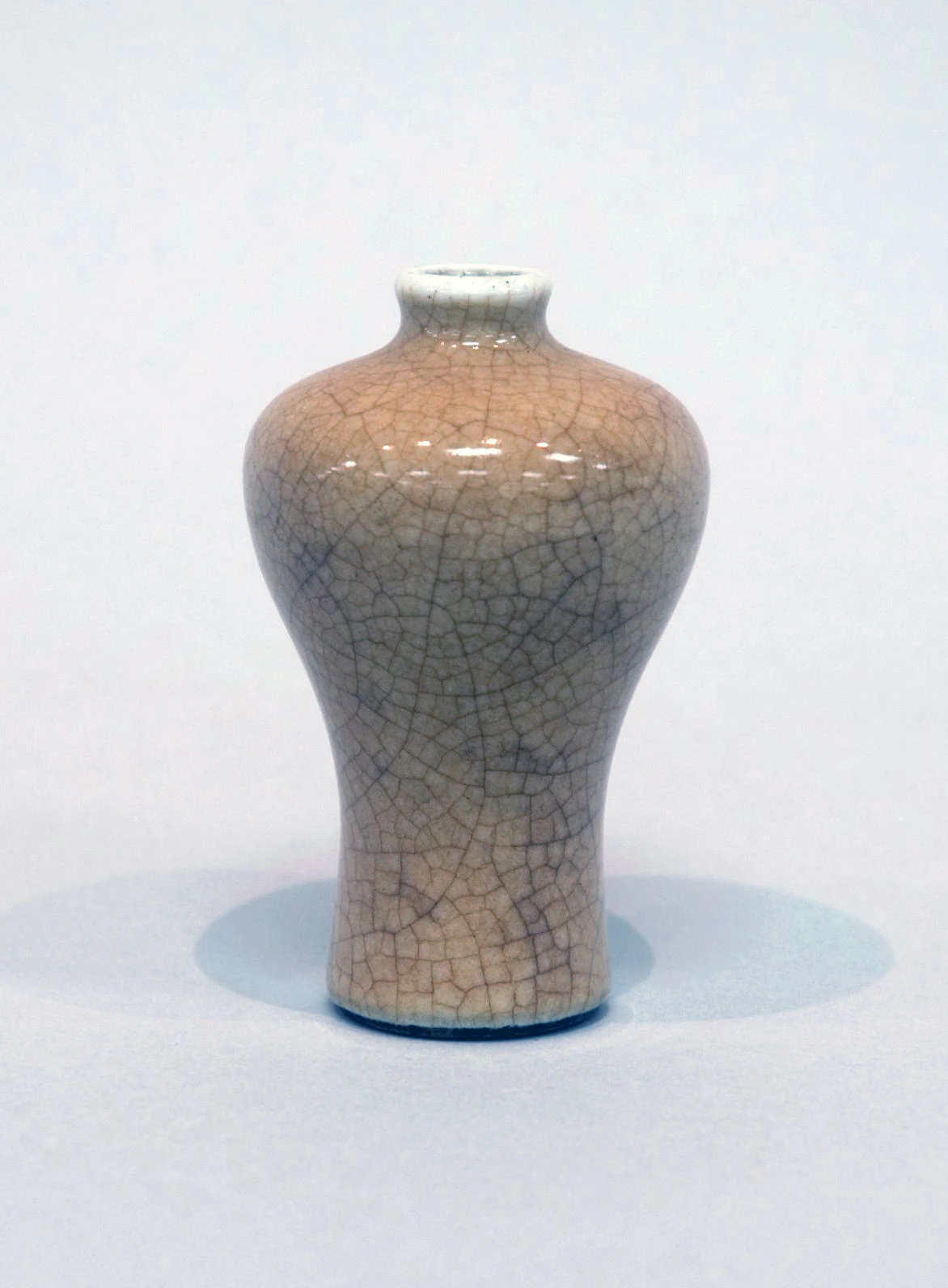
Miniature meiping vase, eighteenth century, Ge-type glaze. The Metropolitan Museum of Art, Open Access. Its small scale and later date make it a response to the category, not proof of a Song kiln.
The miniature is just 8.6 cm high. Its swollen shoulder, tapering body and tiny mouth condense the meiping silhouette into a small object. The Met identifies Jingdezhen porcelain, a specific later production context. This is where the history reconnects with Jingdezhen's workshops: a famous Song-associated appearance could become part of a much later ceramic repertoire.
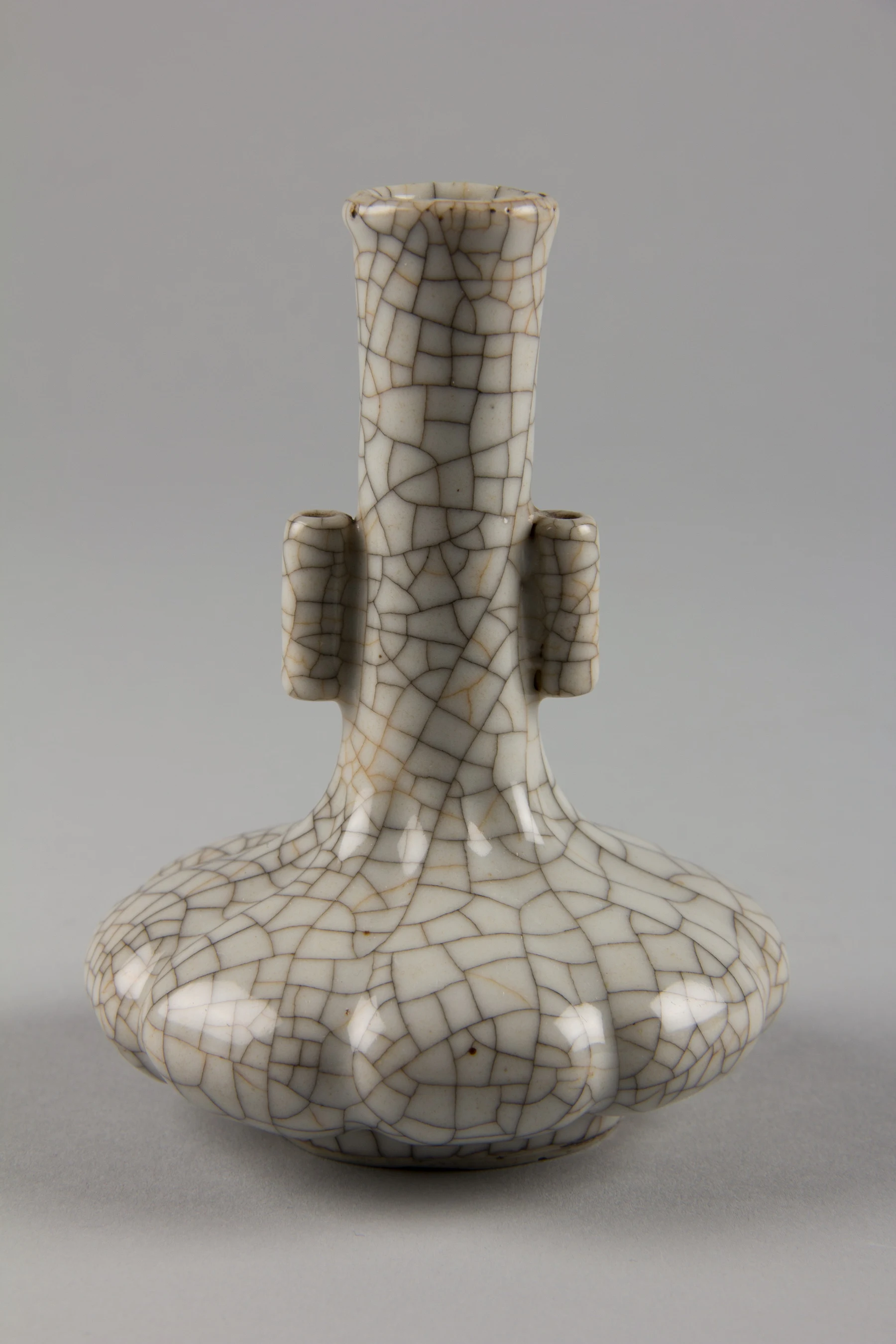
Long-neck vase with tubular handles, nineteenth century, Ge-type crackled glaze. The Metropolitan Museum of Art, Open Access. Archaic form and famous crackle are being consciously assembled centuries after the Song.
I find these later objects intellectually cleaner than a dubious “Song Ge” sales claim. They admit that style travels. They let us compare what was remembered—muted glaze, crackle, archaic silhouette—with what changed in body, workshop and historical purpose. Revival is not a failed original. It is a separate creative act that becomes dishonest only when the label hides the date.
What Ge ware teaches about museum language
Small catalogue words carry large amounts of uncertainty.
“Ge ware” can sound definitive. “Ge-type” may signal a relationship without committing to the classic category. “Attributed to” marks a judgment rather than an excavated fact. A date written as “13th–14th century” differs from “Southern Song.” A question mark is not institutional weakness; it is visible method.
Young readers are often told to distrust uncertainty online. In serious museum work, the reverse is frequently true. A qualified label may be more trustworthy because it shows where evidence ends.
How to look closely without pretending to solve it
Begin with form. Is the object a washer, dish, bottle or archaic-inspired vase? Does the silhouette feel compressed, vertical or heavy? A crackle photograph can flatten the vessel into texture; restore its volume in your mind.
Next inspect the glaze beneath the lines. Notice opacity, pooling, bubbles, surface gloss and color shifts. Then examine the crackle at different scales. Are there two visually distinct networks, or has contrast in the photograph created that impression?
At the rim and foot, look for exposed body and the way glaze ends. Read the catalogue’s material description. Stoneware, porcelaneous stoneware and other terms may reflect different classification systems and technical observations.
Finally, compare several securely catalogued objects rather than memorizing one hero image. Variation is part of the evidence.
When a revival becomes a misleading claim
Later Chinese kilns produced crackled glazes inspired by admired Song traditions. Qing imperial workshops made sophisticated archaising ceramics. Modern studios can deliberately create multiple crackle networks and stain them for contrast.
Typical misidentifications include:
- calling every two-tone crackle “gold thread and iron wire” and therefore Ge;
- assuming muted gray glaze indicates great age;
- presenting a later revival as a fake rather than first establishing what it claims to be;
- treating collector inscriptions or fitted boxes as proof of production date;
- assigning a kiln from online color alone.
The distinction among historic Ge, Ge-type, later revival, modern interpretation and deceptive forgery is essential. They are not one moral or material category. Imagine a newly made vase offered as “contemporary Ge-inspired porcelain”: that is a style claim. Describe the same vase as “excavated Song Ge” and the seller has added claims about age and provenance requiring entirely different evidence. The crackle did not change between those sentences. The representation did.
Authentication becomes harder when the category itself is debated
Authentication usually asks whether an object belongs to a known historical group. Ge ware adds another problem: scholars continue to debate how that group should be defined.
Technical study can compare body composition, glaze layers, bubbles, mineral inclusions and firing behavior. Provenance can establish where an object was documented. Archaeology can create secure place-based reference material. None of these should be replaced by a crackle chart.
This page cannot authenticate or value an object. A high-value claim needs specialist examination, transparent provenance and an explanation of which definition of Ge ware is being used.
Why Ge ware belongs in the Five Great Kilns
At first, Ge may appear to weaken the famous group because its identity is not as clean as a beginner expects. I think it strengthens it.
I insist on leaving that uncertainty visible. A confident label is pleasant to read, but pleasant certainty is not the same as knowledge. Ge ware matters because it teaches us to enjoy the object while keeping the historical claim open to revision.
Ru ware teaches restraint. Guan teaches the material intelligence of crackle. Ding teaches production scale and graphic white porcelain. Jun teaches glaze physics and color. Ge teaches how history itself is made: through texts, objects, excavations, laboratories, collectors and revisions.
That is not a side lesson. It is the only way to engage responsibly with any famous ceramic category.
A category can be powerful without being simple
Ge ware asks for an unusual form of attention. Enjoy the surface, but keep the label visible. Let the crackle be beautiful without demanding that beauty settle every historical question.
The most interesting answer is not always a confident identification. Sometimes it is a better account of why confidence remains limited.
Continue with the Five Great Kilns comparison, the more institutionally grounded history of Guan ware, and the broader systems behind Chinese ceramics.
Which would you choose to keep looking at: the small transmitted vase or one of the clearly dated Jingdezhen revivals—and does knowing the date change your attraction? Give a visible reason before invoking rarity.
On Moments, bring one museum object and its actual catalogue wording. Say which part of the name describes its appearance and which part makes a historical claim. If you later find a documented revision, add the dated record to the same contribution. That gives us something real to return to, without pretending a label has changed when it has not.