Crane symbolism in Chinese culture includes longevity, transcendence, dignity, fidelity and high civil rank—but no crane means all of those things at once. A crane beside pine and rock can make a birthday wish; a crane among clouds can enter the world of Daoist immortals; a crane on a square court badge once made official hierarchy visible; a crane listening to a scholar's music creates intimacy rather than power. The companions, action, object and institution finish the meaning.
Crane symbolism begins with the world around the bird
The first mistake is easy to make. You see a white bird with a red crown and long black legs, search “crane meaning,” and receive one polished answer: longevity.
That answer is not false. It is simply too small.
When I look at a Chinese crane image, I do not start by asking what the crane “stands for.” I ask where the painter has allowed it to stand. Is it ankle-deep in a wetland? Alone in a scholar's garden? Flying through clouds toward an immortal? Facing a red sun inside a square rank badge? Beside pine, peaches or lingzhi on a birthday object?
Each setting changes the bird's work.
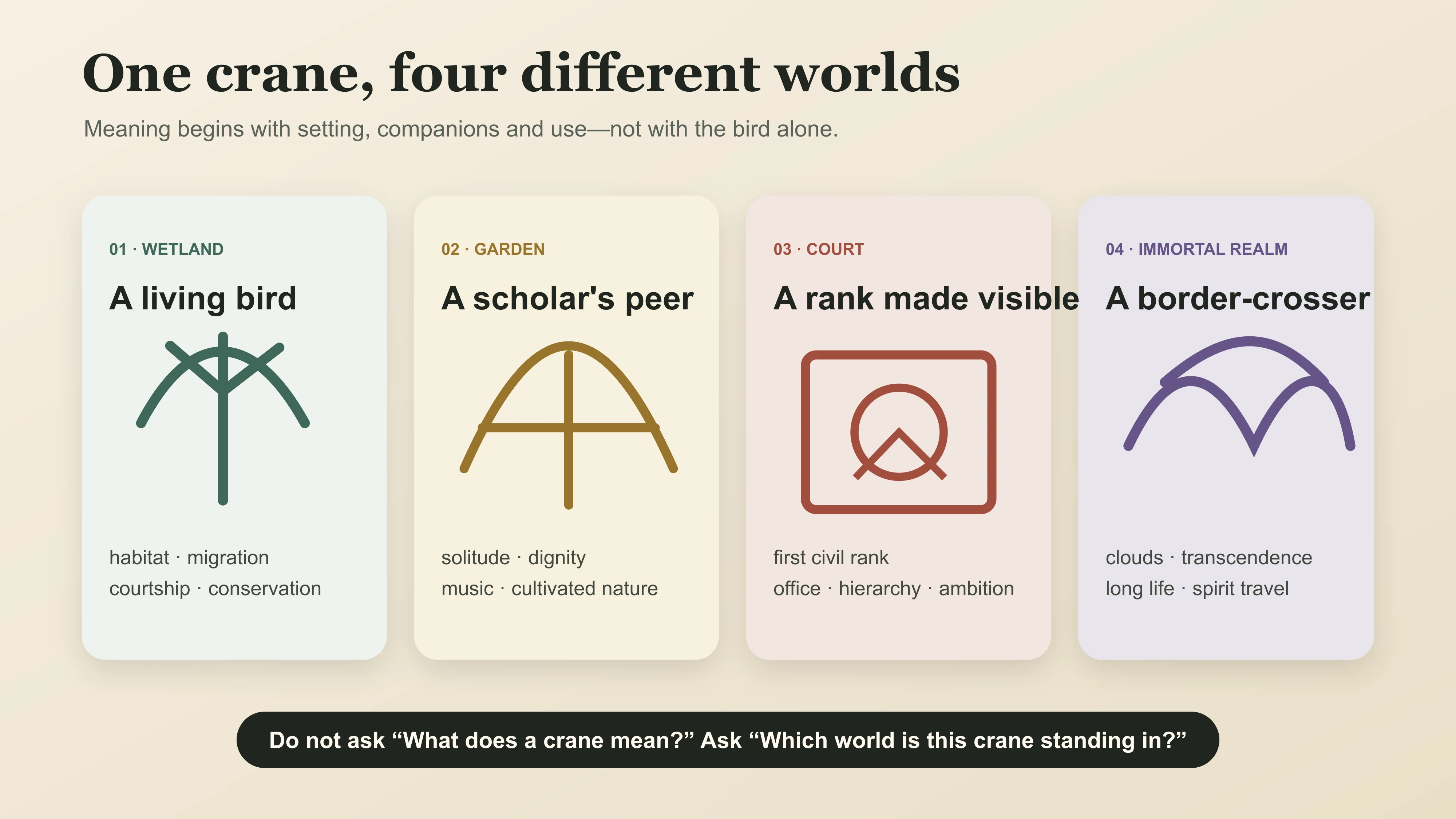
My view is definite: the Chinese crane is not a sticker labeled “long life.” It is a border-crosser. Its long legs join earth and water; its wings move between ground and sky; its whiteness can evoke age without weakness; its call travels farther than its body. That physical presence made the crane useful to poets, court designers, Daoist storytellers and families offering birthday wishes—but they did not all use it for the same reason.
First identify the bird: crane, heron, egret and stork are not synonyms
Symbolism built on a wrong bird is still wrong.
The Smithsonian describes the red-crowned crane (Grus japonensis) as a very large, highly aquatic crane with a white body, black face and neck, black secondary and tertiary feathers, long dark legs and exposed red skin on the crown. The species lives across northeastern China, southeastern Russia, Mongolia, the Korean peninsula and Japan. That geography already warns us against treating it as the private symbol of one modern nation.
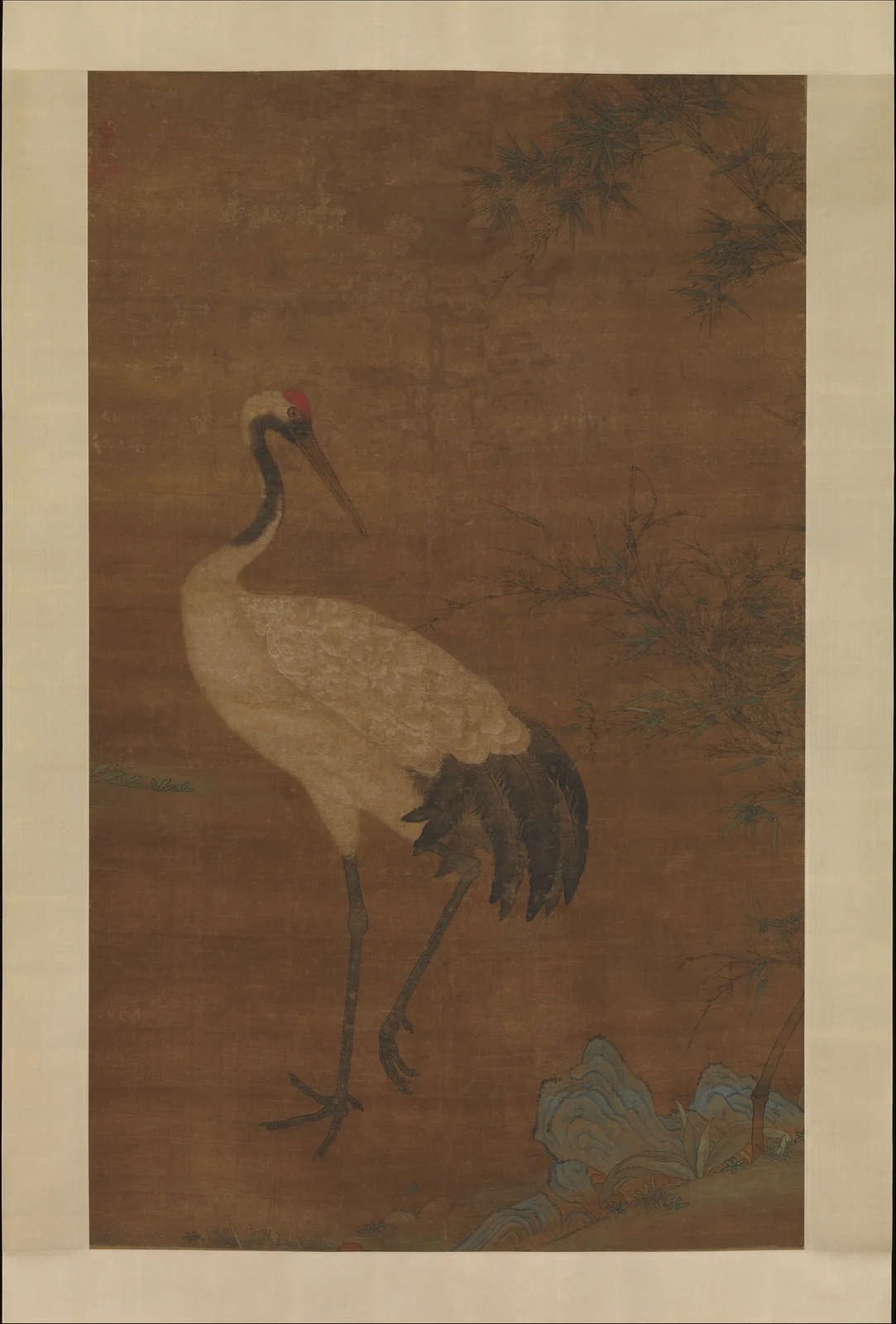
The Met's Crane in a bamboo grove identifies the painted bird as a Manchurian crane through its distinctive red forehead. It is an unusually naturalistic image: the crane has stopped mid-step because bamboo brushed its tail. The bird is not floating like a logo. It is alert, slightly awkward and alive.
But not every long-necked white bird in Chinese art is a red-crowned crane. Egrets and herons also appear in paintings and rebuses. Storks can share the long legs and extended neck. Stylization, damage and a distant photograph can erase the field marks that would separate them.
Use visible anatomy cautiously:
- A red crown, black neck and black inner wing feathers support a red-crowned crane identification.
- A crane normally flies with its neck extended; herons and egrets usually retract the neck into an S-shape.
- Long legs alone prove almost nothing.
- A red spot painted on an old textile may be symbolic emphasis, later repair or color shift rather than zoological precision.
- A museum title can identify the intended subject even when the maker simplified the bird.
I would rather write “a crane-like auspicious bird” than turn one blurry wing into a confident species claim. Precision does not make an article colder. It makes wonder durable.
Why the crane became a longevity symbol—and why “it lives 1,000 years” is not biology
Chinese art often gives the crane an impossibly long life. That is symbolic time, not a wildlife fact sheet.
The Met's essay on longevity in Chinese art explains several layers behind the association. Cranes served as conveyances for immortals; their white feathers could recall the white hair of old age; paired cranes could allude to an elderly couple. None of those layers requires the living bird to survive for a millennium.
The actual lifespan of wild red-crowned cranes is not well documented. Smithsonian data gives a median age of about fifteen years for birds in human care. The distance between fifteen years and the poetic “thousand-year crane” is not an embarrassing factual error to hide. It is the exact distance in which culture works.
When a family hangs a pine-and-crane painting for an elder's birthday, they are not publishing an ornithology paper. They are stretching ordinary biological time into a wish: remain upright, remain visible, remain with us.
That wish becomes stronger because the crane does not look heavy. A tortoise carries longevity close to the ground; a crane makes longevity rise. Its body is thin, its legs almost implausible, yet it stands. For me, that is why crane longevity feels different from a generic promise to “live long.” It imagines old age with lightness and dignity.
Pine and crane do not repeat one meaning—they reinforce it differently
The formula commonly called 松鹤延年 joins pine and crane in a wish for prolonged life. A weak reading says both symbols mean longevity, therefore the picture means “double longevity.” A better reading asks what each contributes.
Pine contributes rooted endurance. It remains green through winter, bends under weather and grows out of rock. The crane contributes movement, alertness and the possibility of ascent. Rock contributes permanence. Together they produce a life that is both grounded and capable of rising.

The Met identifies Chen Zhaofeng's Crane, pine, and rock as a late nineteenth-century court work whose three central elements all carry longevity associations, making it suitable for an imperial birthday. That institutional setting matters. “Suitable for a birthday” is not the same as “every crane-and-pine image was a birthday commission,” but it shows the formula operating inside a real ceremonial need.
The painting was made as four hanging scrolls and later remounted in Japan as a folding screen. Even the object's biography crosses borders. The Chinese motif does not become Japanese simply because the mounting changed, and the Japanese remounting is not meaningless packaging. Material history can carry more than one cultural moment at once.
Our plum blossom meaning guide explains another cold-season virtue: the plum blooms while the world still looks bare. Pine survives winter; plum announces change; crane lifts the composition into living movement. A phrase like “long life” cannot replace those different visual experiences.
Peaches and lingzhi turn longevity into abundance

In the eighteenth-century scroll Cranes, peach tree, and China rose, cranes appear with peaches, lingzhi fungus, bamboo and yueji rose. The Met identifies the cranes, peaches and lingzhi as symbols of longevity or immortality.
This is not redundant decoration. It is accumulated pressure.
The peach adds ripeness and the legendary fruit of immortality. Lingzhi introduces a rare fungus with long associations to numinous life. Bamboo supplies upright flexibility. Blooming China rose keeps time cycling. The cranes inhabit this abundance rather than explain it alone.
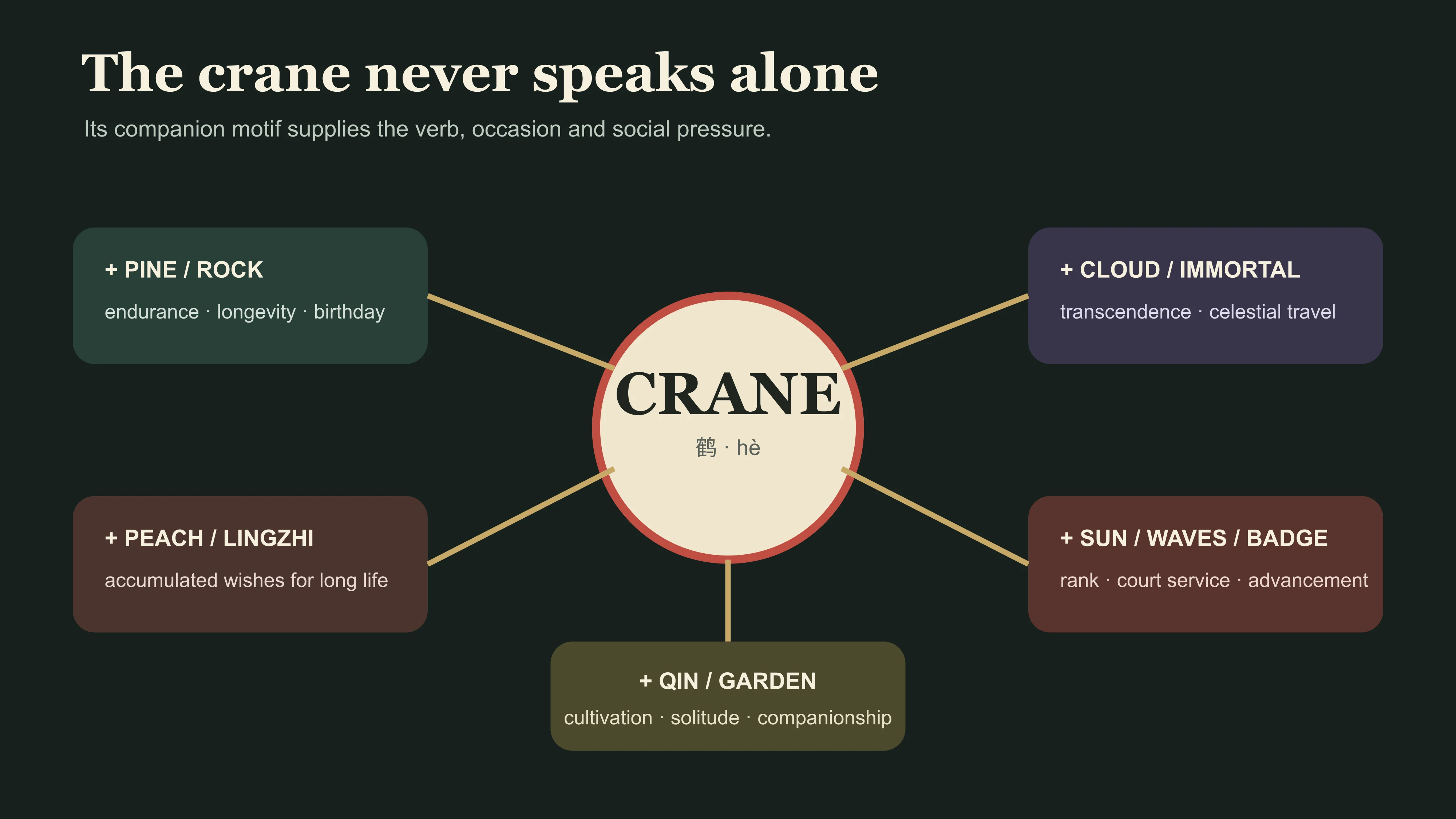
I read such a work as a family wish that refuses to stay modest. It does not ask only for more years. It asks for years surrounded by health, seasonal renewal, honorable character and people who remain present. Dense auspicious painting is emotionally crowded because real love is crowded. When an elder matters, one symbol never feels enough.
This is also why a modern tattoo composed from isolated internet icons can feel empty. The old works do not win through the number of “lucky symbols.” They win through relationships: which bird faces which branch, where empty air remains, whether one crane watches while another bends to feed.
Clouds and immortals move the crane beyond ordinary lifespan
Calling the bird 仙鹤—immortal crane or transcendent crane—does more than make it elegant. It places the crane inside a Daoist imaginative geography where humans, deities, mountains, clouds and transformed beings can cross states.

The Met's nephrite mountain scene centers on a Daoist deity, attendant, pines and several cranes. The material matters. Hard pale jade has been carved into air, foliage, robes and wings. Immortality is not stated as a sentence; it is made into a mountain small enough to possess.
The crane here is neither pet nor rank insignia. It belongs to a realm where bodies travel differently. In early funerary and Daoist imagery, cranes could carry souls or immortals. That upward association helps explain why a flying crane among clouds feels more transcendent than the same bird feeding beside reeds.
But “crane means the soul goes to heaven” is still too absolute. A cloud may be decorative. A flying bird may simply fill the upper register. A crane beside a named immortal has stronger evidence than a single bird on an undocumented vase.
This is where our phoenix symbolism guide offers a useful contrast. The fenghuang often arrives as a sign of ordered virtue and extraordinary rule; the crane more often travels between the cultivated human world and a realm beyond it. Both fly, but they do not carry the same political or spiritual grammar.
In a scholar's garden, the crane becomes company rather than escape

The Met's sixteenth-century Playing the zither for a crane shows a man performing music for his pet crane beneath a paulownia tree. The garden is a designed microcosm: rocks stand in for mountains, a pond for an ocean, foliage for a forest.
I love this image because nothing spectacular happens. No official kneels before an emperor. No immortal cuts through clouds. One person plays; one bird listens—or at least remains nearby.
The crane becomes a test of attention. A cultivated life is not proven by owning rare things or reciting symbols. It is proven by the ability to create a world quiet enough for music, water, rock, tree and animal to coexist.
The painting also complicates our modern desire to call every solitary crane “lonely.” Solitude in a scholar garden can be chosen, refined and companionable. The crane does not necessarily represent isolation; it may represent the kind of company that does not interrupt thought.
This is the East Moment difference I want to protect. A generic page sees crane, outputs longevity and leaves. I see a musician offering his private art to a bird that cannot flatter him. That changes the image from a definition into a moral question: would you still make something beautiful if your only audience could not praise you?
A crane on a rank badge is not generic good luck
The square badge on the front and back of an official robe—called a 补子 (bǔzi)—made hierarchy visible before a person spoke. Birds marked civil officials; animals marked military ranks; species differentiated status.

The Met records this late seventeenth- or early eighteenth-century crane rank badge in silk and metallic thread. Its crane does not wander through a private garden. It occupies a square institutional field, faces the solar disk and rises above waves and rock. Every element directs attention toward court service.
In Ming and Qing systems, the crane marked the highest civil rank. A British Museum record for a Qing civilian door-god print makes the social meaning explicit: the figures' crane badges signify the highest rank in the civil service. This was ambition made wearable.
That power changes the emotion of the bird. Long life may remain available in the larger cultural background, but the badge primarily tells viewers where its wearer stands in a bureaucracy. It can evoke achievement, examination success, service, access and prestige—and also the inequality of a ranked order.
I will not romanticize the badge as pure “noble character.” Office was never only virtue. It was salary, family mobility, proximity to power, responsibility, competition and risk. The crane's clean white body gave hierarchy an elegant face, but elegance does not erase politics.
This matters when somebody buys a vintage-style crane patch today. They may think they are wearing a free spiritual bird while actually borrowing an old bureaucratic emblem. That is not forbidden. It is simply more interesting when acknowledged.
A woman's crane robe proves auspicious dress and official rank are not the same thing

The Met's woman's robe decorated with crane medallions provides a perfect counterexample to the official badge. Each roundel contains a red-crowned crane carrying lingzhi, surrounded by bottle gourds and bats. The museum describes a garment glowing with auspicious meaning for a special occasion.
Round medallions across a robe are not automatically square rank badges. The wearer, cut, placement, supporting motifs and occasion change the function. The crane can carry long-life wishes across the moving body without assigning the woman a civil-service rank.
The robe also joins this page to our bat symbolism guide. Bats contribute blessing through the 蝠/fú and 福/fú sound connection; the crane and lingzhi extend the wish toward longevity. The surface works like a chorus in which different voices arrive at the same celebration from different directions.
When the wearer walks, the roundels disappear into folds and reappear. That motion matters. Auspicious dress is not a static poster wrapped around a person. The blessing breaks, bends and reforms with the body.
Paired cranes can suggest fidelity, but “eternal love” is not automatic
Crane pairs are often sold as symbols of lifelong marriage. The association is plausible: cranes form enduring pair bonds, perform coordinated courtship displays and raise young together. Chinese longevity imagery can also use a pair to evoke an elderly couple.
But two birds do not automatically make a wedding promise.
They may balance a composition, inhabit one landscape, represent an elderly pair, or simply show the social behavior of the species. A pair with peaches, lingzhi and birthday inscriptions leans toward longevity. A pair on a wedding textile may support marital fidelity. A pair on a natural-history image may not function as a rebus at all.
The British Museum's dish with two cranes places them beside pine, bamboo and flowering plum—the Three Friends of Winter. Its record describes cranes as emblems of long life while the plants contribute stability, scholar integrity, purity and leadership. The pair participates in a larger ethical landscape.
So if you choose paired cranes for a wedding gift, say what you mean. “May we remain attentive to each other through long years” is stronger than “cranes mean eternal love.” One is a human promise using a cultural image. The other outsources the relationship to a symbol.
Chinese, Japanese and Korean crane traditions overlap without becoming identical
The red-crowned crane crosses national borders. So do paintings, court systems, religious ideas, artists and objects. East Asian crane traditions therefore share forms and meanings—especially longevity, fidelity, cultivated dignity and rank—without becoming one undifferentiated “Asian symbolism.”
Shen Quan's painting style influenced Japanese artists after his stay in Nagasaki. The Chinese crane-and-pine screen on this page was later remounted in Japan. Korean court dress adopted and transformed rank-badge systems derived partly from Ming precedent. Japanese cranes appear on wedding textiles, screens, family crests, New Year images and the thousand-crane practice.
The correct response is neither “China invented everything” nor “all Asian cultures mean the same thing.” Influence is a relationship, not ownership of every later image.
When identifying a crane object, record:
- where it was made, not only where it is now kept;
- the artist's training and movement;
- the object's original form and later remounting;
- local terms, ceremony and rank rules;
- whether a modern seller has flattened several traditions into one product description.
A Japanese kimono with cranes is not Chinese because cranes existed in Chinese art first. A Chinese kesi robe is not Japanese because its surface resembles a kimono pattern. A Korean rank badge is not a Chinese badge merely because the institutional idea travelled. Cultural literacy begins where resemblance stops being enough.
The living crane prevents symbolism from becoming decorative consumption
The red-crowned crane is not only an ancient image. It is a living wetland bird whose habitat is being lost and degraded.
The Smithsonian identifies wetland conversion and development as central threats and describes the species as one of the rarest cranes. Migratory populations rely on breeding and wintering grounds across political boundaries. A bird celebrated for transcending the earth remains physically dependent on marshes, tidal flats, rice paddies, rivers and shallow water.
That contradiction matters to me more than another list of lucky meanings. We can print immortal cranes on wallpaper while making it harder for real cranes to survive one generation. A culture page that ignores that fact turns reverence into décor.
The living bird does not cancel the symbol. It disciplines it. If crane imagery makes us feel dignity, fidelity or long life, the modern test is whether we can extend those values to habitat, patient conservation and the people whose livelihoods meet those wetlands.
I do not want “crane energy.” I want cranes.
Crane tattoos should choose a specific world, not a vague Asian mood
A crane tattoo can carry longevity, recovery, fidelity, solitude, freedom, family memory, official ambition or ecological commitment. The design becomes stronger when it chooses.
Ask these questions before settling on a composition:
- Is the bird anatomically a red-crowned crane, another crane species or a deliberately stylized crane?
- Is its neck extended correctly in flight?
- Does pine make the design a long-life wish?
- Do clouds place it near an immortal realm?
- Do waves, a sun disk and a square frame accidentally reproduce rank-badge grammar?
- Does a pair represent a real relationship, or was symmetry the only reason?
- Are you borrowing a Chinese, Japanese or Korean visual source, and can you name it?
- Is the tattoo about long life, or about living lightly while time remains?
Avoid combining every auspicious object because each one sounds positive. A crane, dragon, phoenix, koi, lotus, yin-yang sign, red sun and random characters do not become profound through accumulation. They become a crowded search-history collage.
One crane turning because bamboo touched its tail can say more. It can mean alertness: I want a long life, but I refuse to sleep through it.
Tattoo hygiene, pigment safety, placement and healing require qualified professional guidance. Cultural interpretation cannot replace medical or studio advice.
Crane imagery cannot authenticate, date or value an object
A crane motif does not prove:
- that a painting is Chinese rather than Japanese or Korean;
- that a white long-legged bird is a red-crowned crane;
- that two cranes were made for a wedding;
- that pine and crane always form the exact title 松鹤延年;
- that a round crane medallion is an official rank badge;
- that a square crane patch belonged to a first-rank official;
- that an old-looking badge is genuinely Ming or Qing;
- that red thread, gold thread or kesi technique proves imperial ownership;
- that the original owner believed literally in immortality;
- that the image guarantees longevity, fidelity or promotion;
- that symbolic importance determines market value.
Materials, weave structure, pigments, mounting, inscriptions, wear, provenance and institutional records must be examined separately. Our Chinese jade guide and Chinese porcelain patterns guide apply the same rule: a recognizable motif can begin an investigation, never finish authentication.
Use six questions to read any Chinese crane image
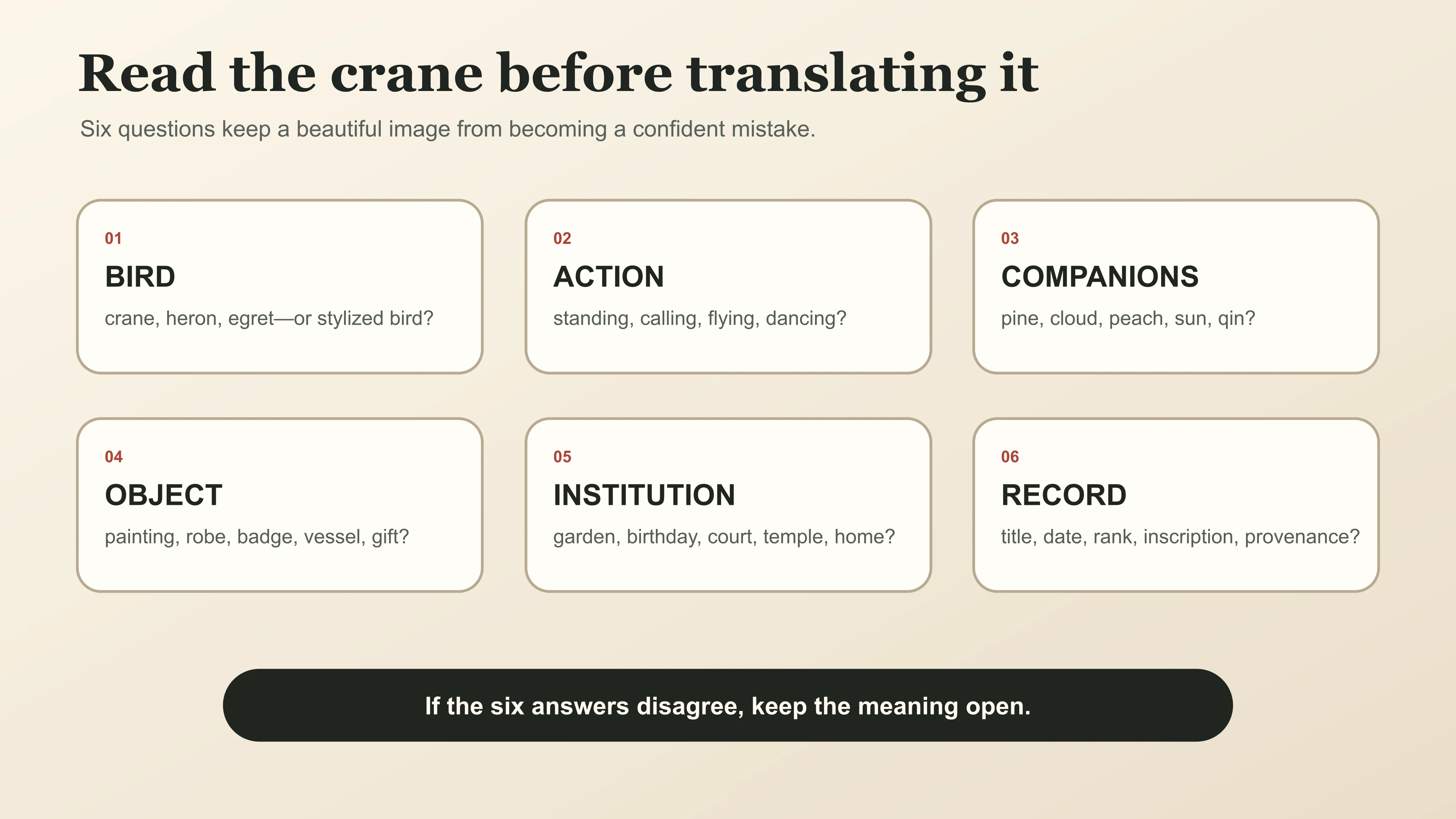
When somebody sends me a crane image, I use this order:
- Bird: Which visible features support crane, and which species claims remain uncertain?
- Action: Is it standing, feeding, calling, dancing, turning, flying or carrying something?
- Companions: Pine, rock, bamboo, peach, lingzhi, clouds, waves, sun, immortal, scholar or mate?
- Object: Painting, robe, rank badge, porcelain, jade carving, birthday gift, logo or tattoo?
- Institution: Wetland, scholar garden, court bureaucracy, household celebration, temple, diaspora home or modern studio?
- Record: What do the title, date, inscription, artist, material, provenance and reliable institution actually permit us to say?
This order prevents the symbol dictionary from speaking before the object. A crane facing a sun on a court badge belongs to a different system from a crane listening to qin music. A crane beside pine on a birthday screen does different emotional labor from a living crane feeding in a threatened marsh.
The larger Chinese symbols collection teaches this relational grammar across bats, fish, flowers, mythical birds and colors. Once you learn it, “meaning” stops being a label under a picture. It becomes an argument you can test.
My verdict: the crane does not promise more years—it asks what height those years will reach
I understand why longevity became the easiest answer. The crane's pale body and upward flight make old age look graceful. Pine, peach and lingzhi can intensify that wish until an entire surface seems to plead for time.
But the crane is most powerful when it refuses to remain a birthday cliché.
In a wetland, it is a vulnerable living animal. In a garden, it is a scholar's quiet companion. In a rank badge, it carries ambition and hierarchy. Beside an immortal, it crosses the border of ordinary life. On a robe, it lets blessing move with the body.
That is why my final reading is not “the crane means long life.” It is this: the crane asks whether a long life can remain upright, attentive and capable of rising.
Bring one complete crane image to Moments. Place it in one world—wetland, scholar garden, official court or immortal realm—and point to the visible detail that makes your choice defensible. Rescue one crane from the word “longevity,” then let the actual image speak.