Bat symbolism in Chinese culture is usually auspicious because the word for bat, 蝠 (fú), sounds like 福 (fú), blessing or good fortune. But a bat is only the first syllable of the design. Five bats can invoke the Five Blessings; bats around a longevity character join fortune with long life; bats with peaches intensify a birthday wish; red bats can create another sound-based phrase. Count, direction, companions, object and occasion decide the full meaning.
Bat symbolism begins with sound, not with the animal's face
The first Chinese bat I learned to read did not look friendly. Its ears were sharp, its body was reduced to a knot, and its wings opened like two dark fans. If I had judged it by expression, I would have called it ominous.
Chinese decorative language asks us to listen before we react.
The Chinese word 蝙蝠 (biānfú) ends with 蝠 (fú). The word 福—blessing, good fortune—is also pronounced fú. They are different written characters and different things, but the shared sound lets the animal stand in for the blessing. A bat painted on porcelain can therefore make spoken language visible.
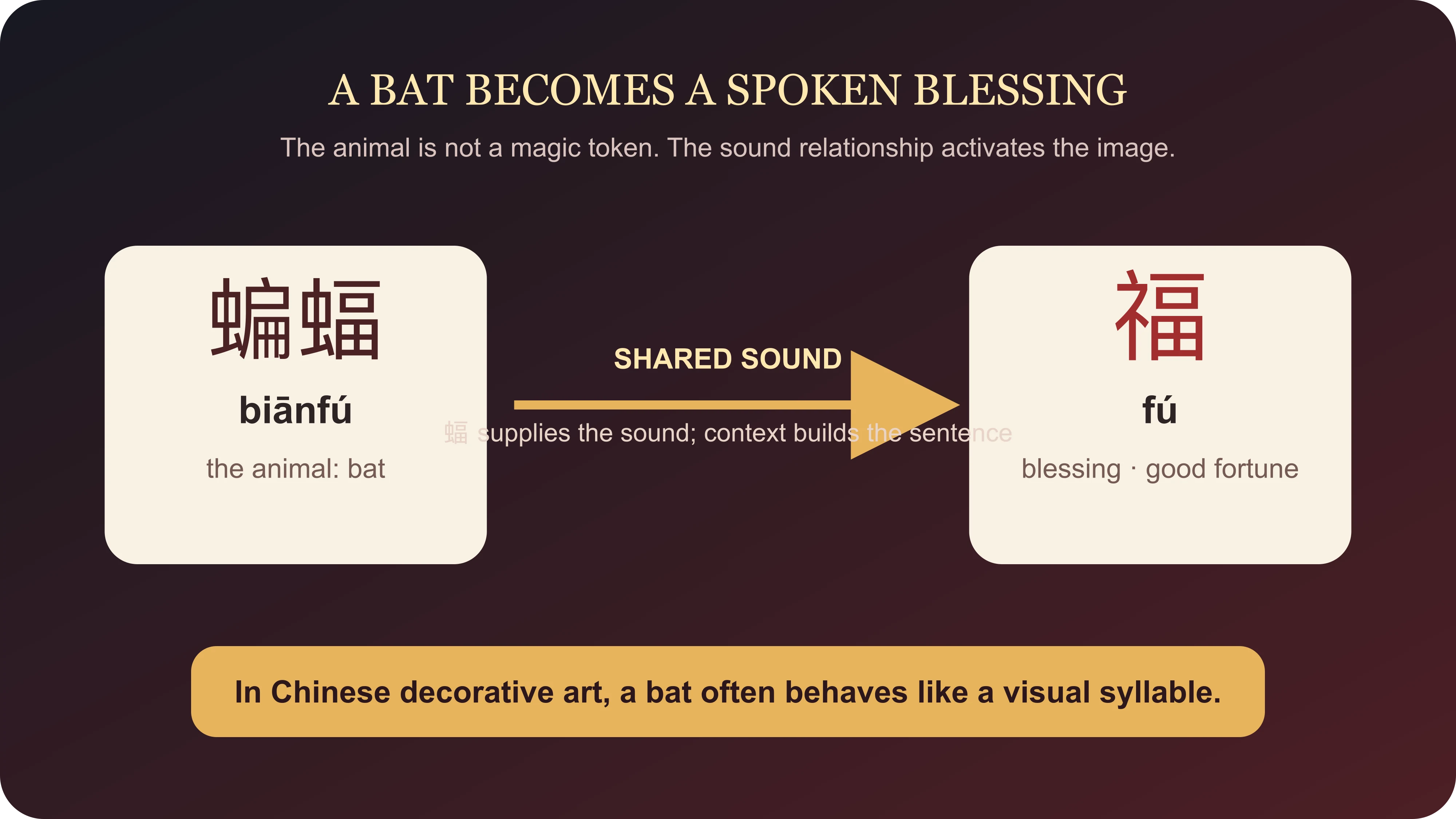
This is the most important answer on the page, and it is still incomplete. A bat does not carry one universal packet called “luck.” It behaves like a visual syllable. Put it beside a longevity character and the sentence becomes fortune plus long life. Multiply it to five and the image can invoke the Five Blessings. Add peaches, clouds, waves, a scepter or a specific gift occasion and the sentence changes again.
My view is firm: a Chinese bat is not lucky because it looks lucky. It became auspicious because language taught generations of viewers to hear a picture.
The Chinese bat is not the opposite of a “Western evil bat”
Many museum labels help overseas viewers by contrasting auspicious Chinese bats with negative Western associations. The contrast is useful, but it becomes crude if we turn it into “China loves bats; the West fears them.”
Bats occupy many Western stories, artworks, ecosystems and modern identities. They can signal night, secrecy, fear, Halloween, Gothic beauty, ecological value or superhero power. Chinese people also encounter real bats as animals, not only as blessings. An actual bat entering a home is not automatically treated like a lucky porcelain motif.
The difference is narrower and more interesting: late imperial Chinese decorative art developed an unusually productive linguistic reason to use the bat auspiciously. The Met's Qianlong-period brush box explains the contrast directly: bats fly over waves because fú can mean both bat and fortune. The animal's shape becomes reusable because its name participates in the design.
This protects us from two bad readings:
- “All bat imagery everywhere means darkness.”
- “All Chinese people regard every real bat as a blessing.”
Neither statement respects context. The first erases Chinese wordplay; the second mistakes an artistic system for a universal personal reaction.
A bat on porcelain is a word placed on a curved surface
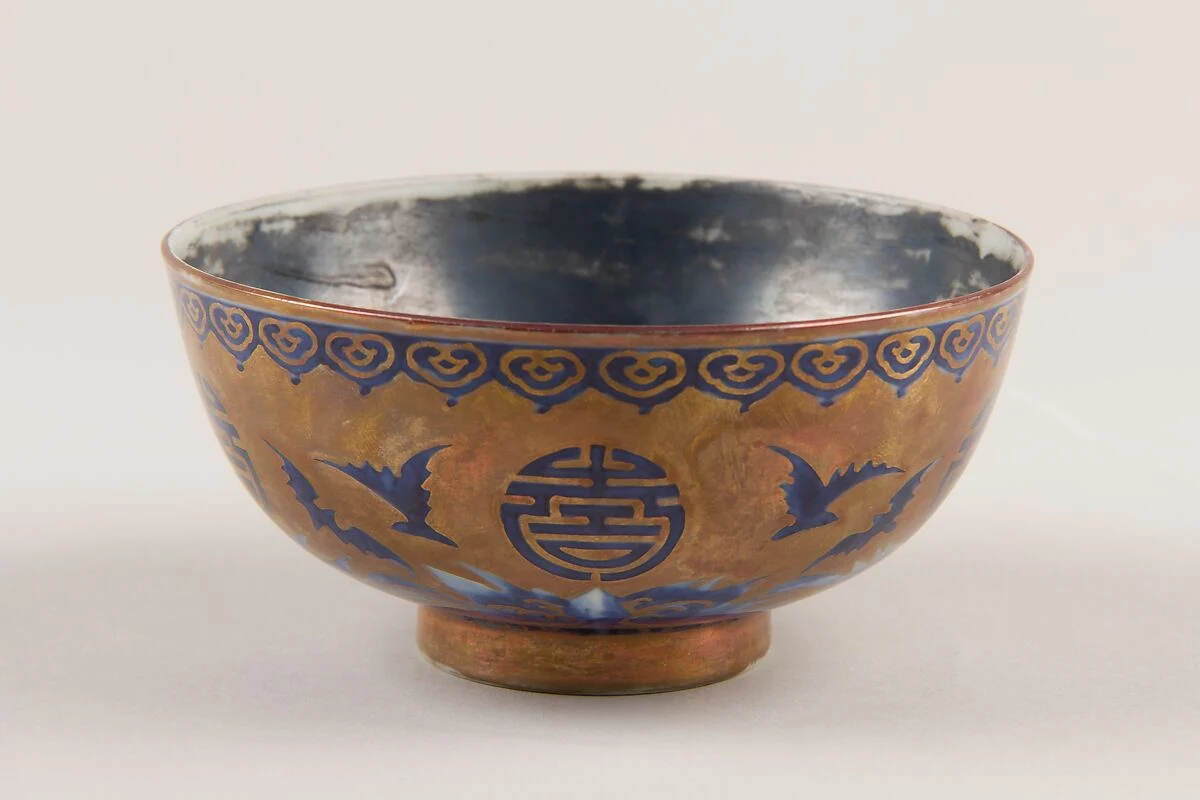
The Metropolitan Museum of Art records this Yongzheng-period bowl as porcelain painted with underglaze cobalt, gilding and silvering. Blue bats move between gold longevity medallions. The bowl is small enough to fit in two hands, but its message must be recovered by turning it.
That curvature matters. A photograph shows only part of the bat count. One animal may disappear around the side; a second image may reveal another medallion. If I count two bats in one front view and declare “paired love,” I have allowed the camera crop to invent the meaning.
The bowl also shows why our Chinese porcelain patterns guide treats designs as actions rather than stickers. The bats fly between medallions. The round bowl makes that flight repeat. Gold catches light while cobalt remains stable beneath the glaze. Meaning is not only in the named motifs; it is in their pace around the vessel.
On blue-and-white porcelain, a bat may be reduced to a few cobalt strokes. Recognition depends on wing rhythm and placement rather than furry realism. The painter is not failing to draw a zoological bat. The painter is making the sound fú travel efficiently across ceramic space.
Five bats mean the Five Blessings—not five identical wishes
The phrase 五蝠 (wǔ fú, five bats) sounds like 五福 (wǔ fú, Five Blessings). The number is not decorative padding. It activates a named moral and social idea with roots in the Hongfan chapter traditionally associated with the Book of Documents.
The Palace Museum's record for a yellow-ground cup with Five Bats Supporting Longevity lists the Five Blessings as long life, wealth, health and peace, love or cultivation of virtue, and a natural completion of one's allotted life. English translations vary, especially for the final blessing, but the structure is clear: this is a vision of a life made whole.
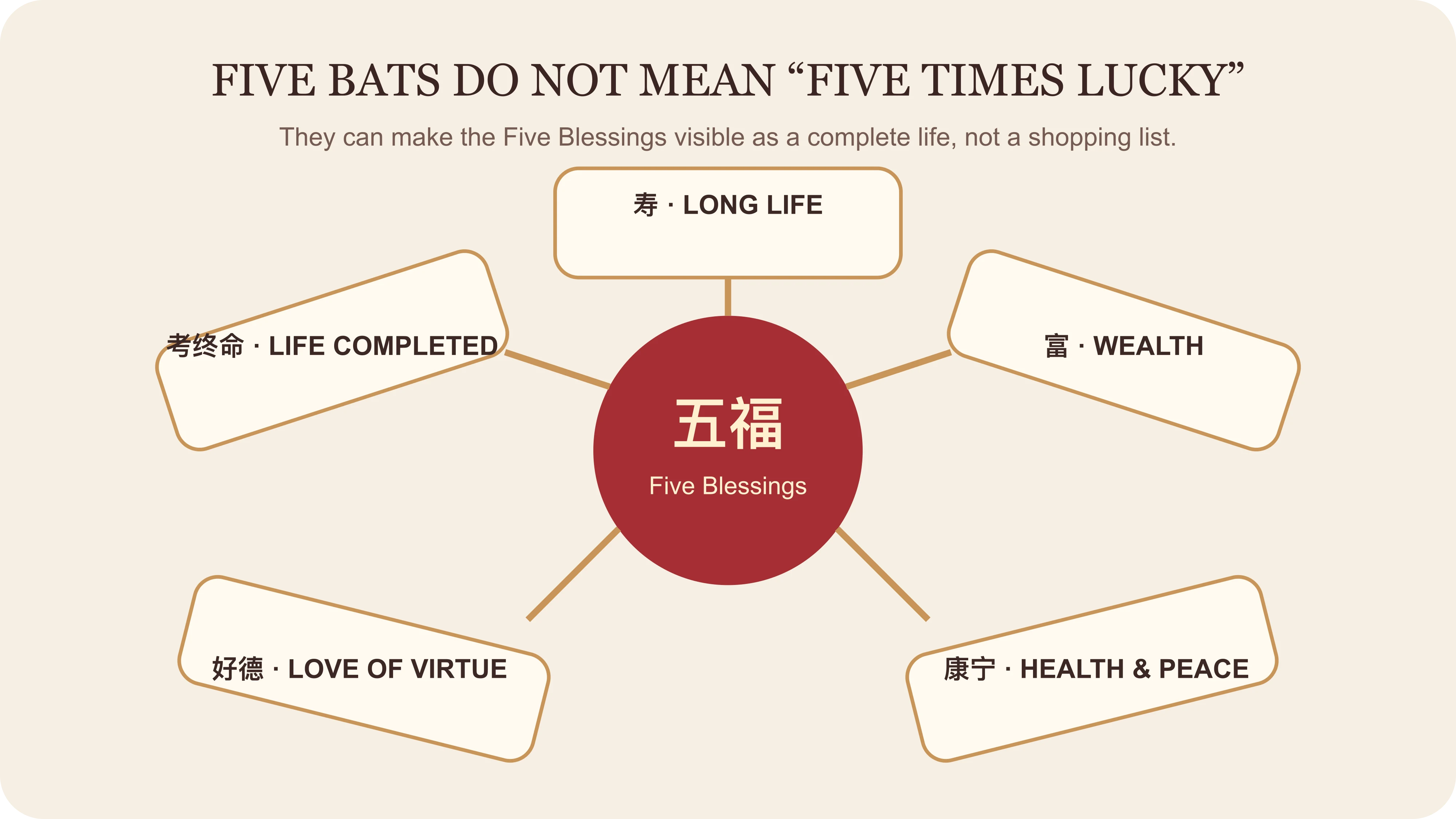
The fifth blessing is the one that gives the set emotional depth. Modern lists often soften it into “peaceful death” or omit it because it sounds uncomfortable. The older idea does not pretend death disappears. It asks that life reach its proper completion rather than be violently cut short.
That changes the image for me. Five bats are not five casino chips stacked on good fortune. They hold together duration, material sufficiency, bodily peace, ethical character and an ending that does not betray the life before it.
The British Museum's five-bat bowl makes the pun physical: the porcelain vessel itself is moulded into five bats. The museum identifies the five animals as the Five Blessings and lists the same cluster of long life, health, wealth, virtue and natural completion. Here the count is not hidden around a painted surface. The bowl's body has become the rebus.
Four bats around a shou character can still complete the idea
This is where counting becomes more sophisticated. Five literal bats can mean Five Blessings, but not every “Five Blessings” design needs five separately visible animals.
In some compositions, four bats surround a central 寿 (shòu, longevity) character. The center supplies longevity while the surrounding bats provide fortune and the remaining visual structure. The complete design can be read as Five Blessings Supporting Longevity or as fortune gathering around long life, depending on the documented object and naming tradition.
The difference matters because online sellers often count carelessly. A cropped front view may show four bats while the fifth is on the back. A genuine four-bat-plus-shou design may be mislabeled as “missing one bat.” A stylized cloud may be mistaken for another animal.
Use this sequence:
- Photograph the complete circumference or both faces.
- Count identifiable bats, not every wing-like flourish.
- Locate the central character or peach.
- Check whether the object title names 五蝠捧寿, 福寿 or another formula.
- Keep the interpretation provisional if the back, lid or base is absent.
This is not pedantry. The count is grammar.
Bats around shou turn a written character into an event

The Met records this nineteenth-century girdle set as silk and metallic-thread work with bats and the character for longevity. It is not a flat poster. The components would hang, move and separate across a body.
That movement changes the blessing. A shou character can sit still. Bats make fortune approach it from several directions. As the wearer walks, the visual sentence breaks apart and reforms. Good fortune is no longer a noun stamped once on cloth; it becomes arrival and circulation.
The design also reveals how bodily placement matters. On clothing, a bat can sit at the collar, shoulder, hem, sleeve or accessory. Each position changes scale and visibility. A tiny bat repeated at an edge acts like a continuous protective border. A large central bat makes a statement before the face is noticed. Bats circling shou turn the body into the center of a longevity wish.
This is the same relational method used in our phoenix symbolism guide. A phoenix changes gender and political force beside a dragon; a bat changes sentence beside shou, peaches, clouds or waves. Chinese symbolism is strongest when we stop asking “What does this one thing mean?” and start asking “What is this thing being made to do here?”
Peaches do not repeat the bat—they extend it

The Met's Yongzheng-period dish with peaches and bats uses overglaze enamels to create naturalistic ripening fruit. The peaches occupy weighty branches; the bats are small, red and airborne. One motif has mass and season. The other supplies sound and motion.
Peaches have long-standing associations with longevity and immortality in Chinese visual culture. Bat plus peach therefore does not mean “two kinds of luck.” It joins fortune with long life. On a birthday object, that combination becomes especially precise.
I love the imbalance in this dish. The peaches are so full they seem to pull the branch downward. The bats barely touch the white ground. A heavy life and a light blessing share one surface. If both motifs were rendered at equal scale, the sentence would feel like a logo. Their difference makes it breathe.
The Palace Museum's peach-shaped gourd box with bat and longevity motifs makes the same logic three-dimensional: the container itself becomes a peach while a bat occupies its surface. Shape, motif and use cooperate. You cannot explain that object by pointing to the bat alone.
Red bats add another sound without erasing the first one
Red bat designs are often read through another wordplay. 红蝠 (hóng fú, red bat) can evoke phrases such as 洪福 (hóng fú, immense or overflowing blessing). When red bats appear among clouds or in celebratory designs, the composition may be described as 洪福齐天—vast blessing reaching heaven.
The Palace Museum's research on decorative mechanisms in Canton enamel clocks documents moving red bats whose color and name supported this “vast blessing” reading. The important point is not that every red bat has one compulsory title. It is that color can add sound to sound: hóng joins fú.
That makes color meaningful in a very different way from a generic palette chart. Red does not simply equal passion. It activates a phrase because the language, object and courtly context are already prepared for it.
I would still refuse to label every red wing as 洪福齐天. The bat must be identifiable, and the object or composition should support the phrase. A modern red bat tattoo can borrow the reading intentionally; a damaged red mark on a vase cannot prove it by color alone.
A textile can hide the bat inside abundance

The Met identifies this late eighteenth-century velvet as a Chinese textile with bats, butterflies, peonies and peaches. The title alone reads like an inventory. The textile is more difficult and more alive.
The viewer has to separate one body from another inside dense repetition. Bat wings compete with butterfly wings. Peony petals echo peach leaves. Negative space becomes as important as motif recognition. This is why a low-resolution screenshot is poor evidence: compression turns different creatures into the same brown blur.
Each companion contributes a different possibility—fortune, longevity, wealth, seasonal beauty, doubling or pleasure—but the textile does not become valuable by maximizing the number of dictionary definitions. It becomes valuable because a maker coordinated them without destroying rhythm.
This is also where I hear real domestic feeling. People do not wish for one abstract “luck.” They want an elderly relative to remain at the table, a household to have enough, a child to grow safely, work to bring dignity, and celebrations to return next year. Dense auspicious textiles make that crowded hope visible.
Our plum blossom meaning guide takes the opposite visual route: bare branch and cold air create value through restraint. The bat textile creates value through accumulation. Both are Chinese, and neither can stand in for the whole culture.
Small everyday cases prove auspicious art was handled, not only displayed

The Met records these three late-Qing embroidered cases as holders for a ring, cards and a watch. Bats share the surfaces with flowers and attributes of the Eight Daoist Immortals.
This is one of my favorite pieces of evidence because it brings symbolism down from the throne room. A ring was placed inside. Cards were taken out. A watch turned time into something carried against the body. Threads wore at the edges.
Auspicious design becomes more human when it meets use. The bat is not only a message shown to guests; it is touched during small acts. The case can wish fortune over whatever it protects without becoming a magical guarantee.
That distinction matters today. A phone case printed with bats can continue the same intimacy. It can be chosen because the user enjoys the pun, inherited the motif, or simply likes the shape. We do not need to claim supernatural protection to acknowledge that carrying a blessing can change how an ordinary object feels.
Placement tells us whether fortune surrounds, descends or travels

The Met's table valance with an autumn garden separates its imagery into registers. The large lower scene contains plants, rocks, water and birds. Along the upper overhang, attributes of the Eight Daoist Immortals appear among clouds and bats; a central bat holds a canopy.
The bat's meaning is strengthened by position. It occupies the threshold between tabletop and hanging garden. It moves along the border and presides over the center. A viewer seated near the table would experience the motif below eye level, not as a distant wall emblem.
Direction can tempt over-interpretation. An upside-down bat is often explained through another pun: “upside down” (dào) sounds like “arrived” (dào), so fortune has arrived. That reading can be legitimate in a documented composition, especially when paired with text or a recognized title. But real bats also hang upside down, and decorative animals rotate to fit borders. Orientation alone is not proof.
Before declaring 福到, ask whether the design emphasizes descent or arrival, whether other symbols confirm it, and whether the object record uses that phrase. A bat fitted head-down into a narrow corner may be geometry rather than a complete rebus.
A 2005 red envelope proves the bat did not remain in the Qing court
The British Museum preserves a Chinese New Year money envelope acquired in London in 2005. Its design combines a large 福 character, five bats, firecrackers, oranges, peonies, gold ingots and additional wishes. The museum records that it was given to one of a Chinese family's grandchildren.
This object closes the distance between museum and life. The five-bat pun survives on inexpensive printed paper, inside a diaspora family, in the hand-to-hand ritual of giving money to a child. It is not a dead imperial code waiting for an expert. It remains legible because sound, image, occasion and relationship still meet.
The envelope also demonstrates why our Chinese New Year guide refuses to treat festival symbols as isolated decorations. The message is carried by an action: an older person gives, a younger person receives, the envelope is opened, the cash is counted, and the printed blessing becomes part of a memory.
I can remember red envelopes being inspected long after the money mattered. Children compare designs, adults save a beautiful one, and a folded corner records the pocket it traveled in. Symbolism lasts because people handle it.
Bat tattoos must decide whether the sound survives outside Chinese
A bat tattoo can carry many honest meanings: night, transformation, ecological care, fear conquered, Gothic identity, Batman, family fortune or the Five Blessings. The problem begins only when one private choice is advertised as a universal ancient rule.
For a Chinese bat tattoo, ask:
- Is the bat meant to be read as 蝠/fú, or only as a Western nocturnal animal?
- Will a 福 or 寿 character make the wordplay visible to the intended audience?
- Are there five bats because the wearer genuinely wants the Five Blessings?
- Do peaches, clouds, waves or a border create a fuller sentence?
- Is the bat stylized from a documented textile or porcelain object, or copied from an unattributed graphic?
- Does the wearer want blessing, long life, family continuity—or merely an attractive wing shape?
A single black bat can be personally meaningful without looking “traditionally Chinese.” A five-bat design can invoke the Five Blessings without promising that those blessings will occur. A bat around shou can honor an elder without turning the wearer's body into an antique reproduction.
The best tattoo caption names both layers: “I chose five Chinese bats for the Five Blessings, and I made the fifth one imperfect because a complete life still contains damage.” That sentence is personal, culturally grounded and impossible for a generic symbol chart to manufacture.
Tattoo hygiene, pigment safety, placement and aftercare require a qualified professional. Cultural interpretation cannot replace health advice.
Bat symbolism does not authenticate or price an object
Bats are common across Qing and later decorative arts. That popularity makes them useful for understanding visual language and useless as a stand-alone authenticity test.
A bat motif does not prove:
- that an object is Qing dynasty rather than a later reproduction;
- that five partial wing shapes are five complete bats;
- that a shou character and four bats have one fixed catalog title;
- that red enamel automatically means 洪福齐天;
- that an upside-down bat always means “fortune has arrived”;
- that a porcelain bowl was made for an emperor;
- that a textile was worn rather than made for display or sale;
- that a modern owner believes in supernatural luck;
- that a bat tattoo carries Chinese meaning without the wearer's intent;
- that a motif determines monetary value.
Marks, materials, firing, construction, provenance, wear and institutional records require separate examination. Our article on koi fish meaning uses the same discipline: identifying a “lucky” motif never replaces identifying the actual animal or object.
Use six questions to read any Chinese bat design
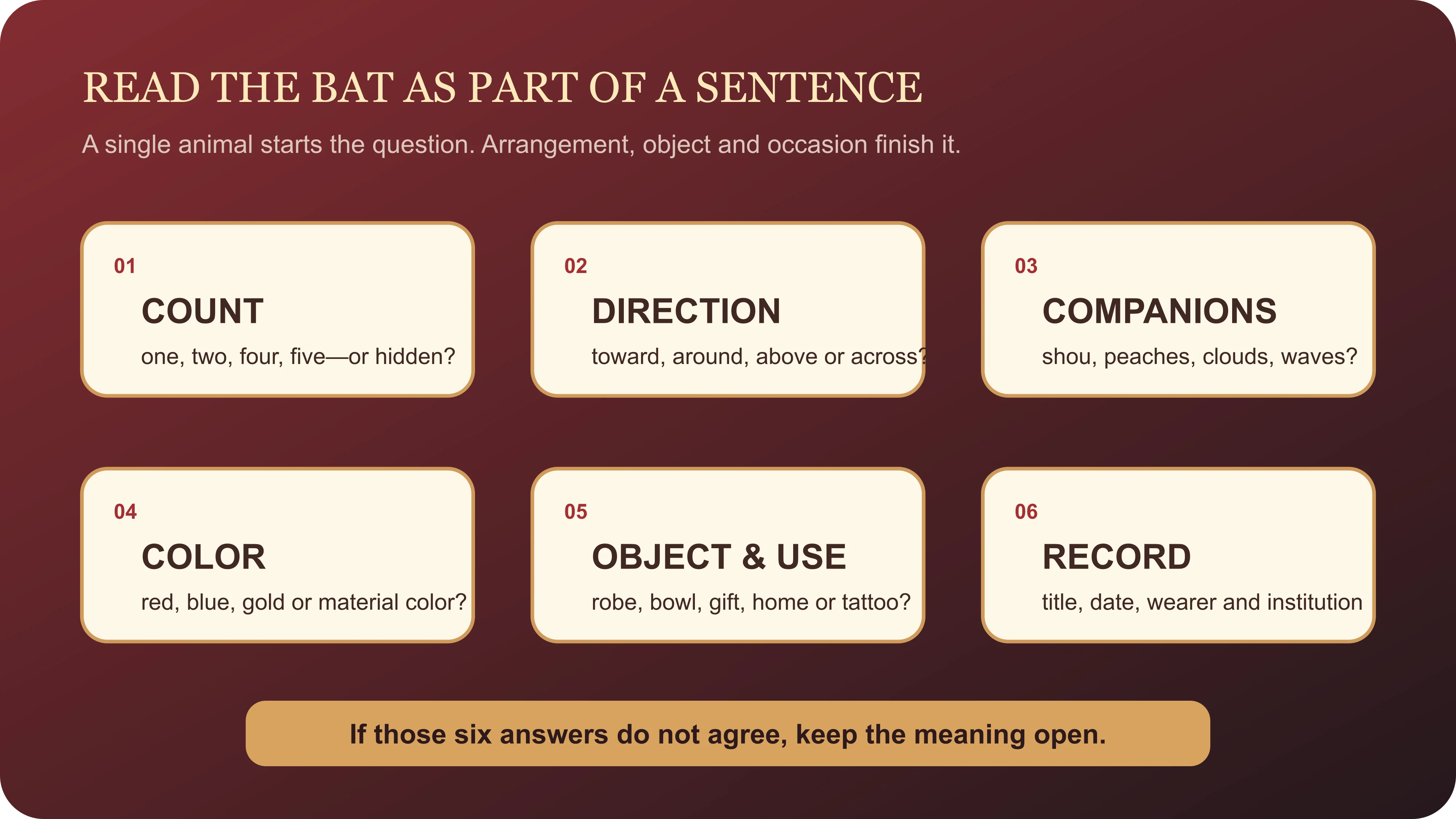
When someone sends me a bat image, I use this order:
- Count: How many complete bats are visible? Is the full circumference, back or lid shown?
- Direction: Do they fly toward a center, circle a border, descend, rise or simply alternate?
- Companions: Is there a shou character, peach, cloud, wave, peony, canopy, coin, bottle or Daoist attribute?
- Color: Does red, cobalt, gold, carving or natural material add another sound or status layer?
- Object and occasion: Is this a bowl, robe, birthday gift, table hanging, New Year envelope, phone case or tattoo?
- Record: What do the title, date, owner history, inscription and reliable institution permit us to claim?
The method turns a motif into a sentence without pretending every sentence has one translation. If three bats are visible and the rest of the vessel is missing, say three are visible. If the catalog says “bats and peaches,” do not upgrade it to an imperial birthday commission without evidence.
The larger Chinese symbols collection teaches this relational grammar across animals, flowers, colors and numbers. Once you learn it, a museum stops looking like shelves of repeated good-luck signs. Every surface begins to speak differently.
My verdict: the bat proves that language can rescue an image
The bat does not win beauty contests. It does something better.
Its wings cross borders between fear and blessing. Its spoken name lets an animal enter porcelain, silk, lacquer, clothing, birthday gifts and a child's red envelope. Five bats can hold an entire philosophy of a complete life. One small bat beside a peach can join fortune to longevity without writing a sentence.
I do not think Chinese bat imagery teaches us to deny darkness. It teaches us that appearance never has the final word. A creature can look strange, live at night and still become the carrier of a family's most generous wish.
That is the meaning I would keep: good fortune is not painted as a smiling face. Sometimes it arrives with sharp ears and wings.
Bring one complete bat object, textile or tattoo to Moments. Count the animals, name the companions and write the blessing as a visual sentence. Do not guess its price or dynasty. Make the image readable enough that another person can disagree with evidence.