Chinese jade includes stone made into ritual objects, clothing ornaments, intimate carvings and jewelry—not one green material with one fixed meaning. I care more about a carved child's posture or a piece someone has kept for years than an unsupported claim of imperial ownership. Understand the stone and its use first. A personal attachment does not become less real because the pedigree is ordinary.
Chinese jade begins with material resistance
Jade is difficult to understand through a color chart. In Chinese material culture, the word can refer to different stones and historically changing categories; nephrite and jadeite are not interchangeable materials, and a pale surface can hide a dense working history.
The square exterior and circular opening of a cong make an immediate physical demand: the maker must control the outside and the bore together. Unlike soft clay, which can be pushed into a wall, jade must be worked by removing material. A missed cut cannot simply be kneaded back into the block. That contrast with Chinese ceramics makes the patience inside a plain-looking surface easier to appreciate.
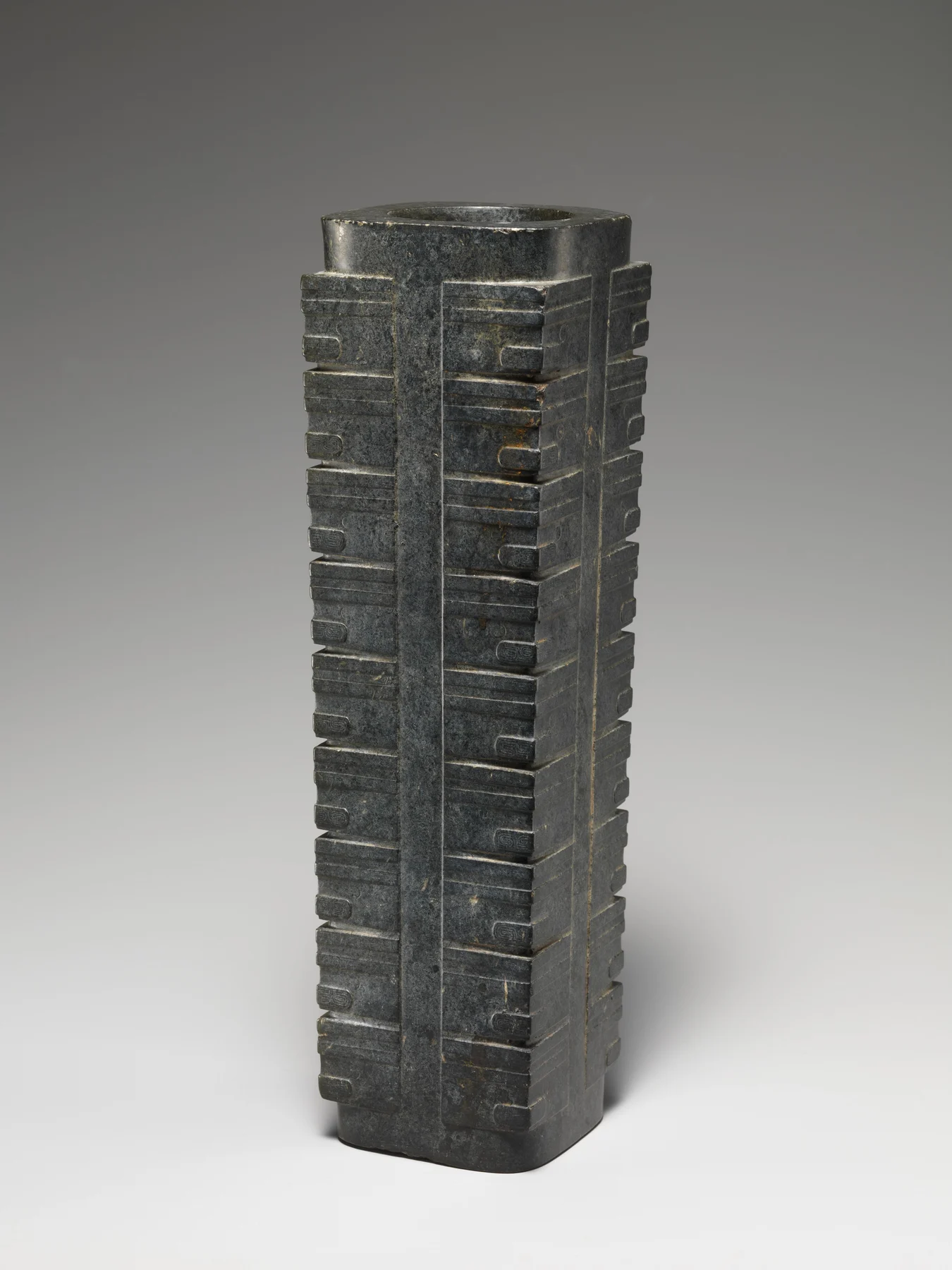
This particular Met cong is dated to about 2400 BCE and stands 25.4 centimetres high. The museum identifies nephrite and Liangzhu culture. Small masks sit at its corners; the whole structure narrows toward the bottom. Compare that deliberate geometry with a modern pendant before giving both the same “protection” caption. They are not asking a body to do the same thing.
Jade is a category, not a shade of green
The Gemological Institute of America explains that modern gemology uses “jade” as a generic term for nephrite, jadeite and, under specified conditions, green omphacite. That sentence is more useful than a hundred color charts. It explains why “looks like jade” is not a material identification and why the Chinese cultural history of yu cannot be squeezed into one modern mineral label without qualification.
Nephrite dominates much of the long archaeological and court history discussed on this page. Jadeite entered Chinese elite taste on a different timetable and can appear in colors far beyond the green that advertising has trained buyers to expect. The materials have different structures and require gemological identification; neither a photograph nor a poetic seller description can settle the question.
I insist on this distinction because green has become a shortcut that rewards bad looking. Pale cream, brown-veined, white and mottled objects can carry extraordinary workmanship. Meanwhile a saturated green photograph may be overlit, treated, another stone or impossible to judge from the screen. Color is a visible property. “Natural jadeite,” “old nephrite” and “imperial” are claims.
Chinese jade meaning changes with object, period and touch
Search results often say jade represents purity, virtue, protection and immortality. These associations have real histories, but the sentence becomes empty when it is pasted beneath every pendant and bowl.
Ask four more specific questions:
- What is the object? A cong, bi, pendant, belt hook, burial ornament, vessel or modern jewelry piece?
- Who handled it? A ritual specialist, court patron, mourner, collector, tourist or contemporary wearer?
- What does the form require? A hole, suspension point, polished edge, carved face or surface meant to be touched?
- What is the source of the meaning? A dated object record, a text, a later collector's label, a shop description or a modern fantasy design?
The questions feel slower than a list of “jade meanings.” They produce a more honest answer. A symbol travels, and its destination changes what it can do.
An affectionate family explanation is another kind of meaning. If somebody gives a pendant with a wish for your safety, that wish is part of the gift, not a laboratory result. I would not strip away the tenderness to sound sophisticated. I would reject a sales pitch that uses the same tenderness to demand a premium for an unverified story. Those are very different judgments.
The bi disk is an argument made from a hole
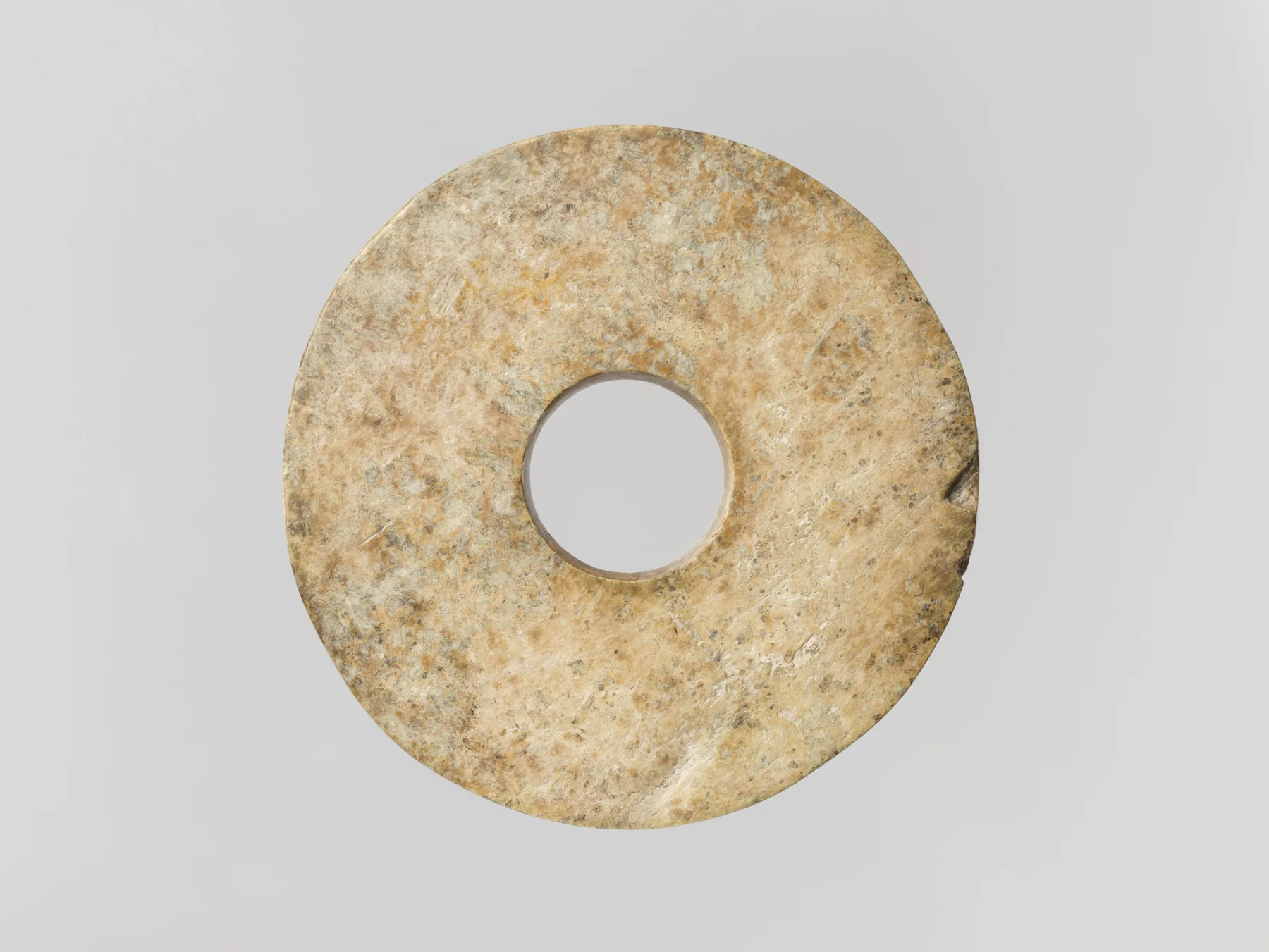
The bi disk is visually simple: a flat circular form with a central opening. That simplicity is deceptive. The hole controls the object's balance, the rim controls the hand's relationship to it, and the choice of jade turns a small geometry into a serious labor problem.
The Met identifies this annular disk as Chinese, mid-third millennium BCE, and made from nephrite jade. Its quiet face is a useful challenge to the urge to measure workmanship by how much decoration has been added. The continuous ring and controlled thickness are already the work. There is no need to fill every available surface with a creature.
When I look at a bi, I notice the controlled emptiness before I reach for the word “heaven.” The opening is not a blank space waiting for a caption. It is part of the object's balance, manufacture and visual authority. Interpretation should begin there.
Animal masks show how carving can stay unresolved
Another jade disk in the Met collection combines granulation and animal-mask decoration. Its surface does not behave like a modern illustration with one clean character waiting to be named.

The museum record names granulation and animal masks. Move your attention from the raised pattern to the spaces between it: repetition makes the surface active without changing the disk's basic outline. I enjoy the difference from the plain bi. One asks the eye to settle; the other keeps it moving. Neither needs an invented account of what its maker privately believed.
That uncertainty is part of the pleasure. A good object does not surrender every answer immediately. It gives the eye enough evidence to ask a better question.
Jade cong is not a magic cylinder
The cong is frequently described online as a ritual object connected to heaven and earth, or as a mysterious ancient symbol whose exact meaning has been lost. The first description can be a useful hypothesis; the second often turns missing evidence into atmosphere.
Start with what the body shows: a square outer profile, a circular inner space, repeated faces and a material that rewards patient abrasion. Then separate three layers:
- What the object record identifies: material, date range, form, find or collection history.
- What comparison suggests: recurring motifs, related forms and patterns across sites or periods.
- What remains open: the exact ritual action, the maker's intention and the meaning for every person who encountered it.
This method also protects jade from being flattened into “ancient Chinese spirituality.” Objects were made, moved, buried, collected, displayed and sometimes misidentified. Their afterlife is part of the history.
Tang belt plaques make jade part of a moving body

The Met dates this set of decorative belt plaques to the seventh or early eighth century. It makes a useful counterweight to the heavy, self-contained geometry of cong and bi. These pieces were designed as a set attached to another material. Their spacing, repeated scale and orientation only become complete around a belt and a moving body.
That changes the meaning of carving. One plaque can be admired as a small object, but the ensemble creates rhythm across clothing and announces status in motion. Holes, backs and attachment logic matter as much as the polished front. A photograph isolated on white can make the set look like several miniature artworks; the original design problem was relational—stone, textile, metal fittings, body and social visibility had to cooperate.
That difference is exactly why Chinese symbols and Chinese jade need separate pages. The symbol guide follows motifs across contexts. This page asks what a resistant material and an object's physical job force a motif to do.
Qing jade proves that “Chinese jade” is not one ancient mood

The Met's eighteenth-century boy with water buffalo belongs to a different viewing world. It is figural, intimate and narrative. The stone's pale body becomes animal mass, bent leg, child's posture and a small relationship between two living beings. If you bring only the vocabulary of tomb ritual to this carving, you will miss its humor and tenderness.

The basin dated 1774 makes another demand. Here the achievement is volume: a hard material has been hollowed into usable-looking space, balanced on a foot and polished so the surface appears effortless. Effortlessness is the illusion. Every thin wall contains decisions about hidden flaws, thickness, symmetry and the possibility of catastrophic loss.
Put the cong, decorated bi, buffalo carving and basin beside one another and the category finally expands. Chinese jade can organize ritual geometry, bodily ornament, miniature narrative and courtly technical display. Any page that gives all four objects the same “purity and protection” caption has erased the art in order to preserve a slogan.
Chinese jade jewelry is not judged by color alone
For a contemporary buyer, the search usually shifts from “what did this mean?” to “is this good jade?” That is a different intent and deserves practical caution.
Color, translucency, polish, texture, weight and carving can all matter, but a photograph or shop adjective cannot establish species, treatment, provenance or value. “Imperial green,” “old jade” and “natural” are claims that require documentation, not a mood created by lighting.
My basic inspection order is:
- Read the silhouette and thickness before admiring the color.
- Look at edges, drilled holes and recesses where finishing decisions remain visible.
- Ask what material name is actually being used: nephrite, jadeite, another stone or an unverified trade label.
- Treat age, imperial history and investment language as claims requiring independent evidence.
- Buy the object you can understand and live with, not the story that makes you feel hurried.
This is cultural and visual guidance, not an authenticity appraisal or investment recommendation.
One piece of trade language deserves translating properly: A, B and C are treatment descriptions, not a school report for beauty. In the jadeite classification commonly used in this market, B refers to bleaching and polymer impregnation; C refers to dyeing. The GIA buyer's guide explains treatment and the role of laboratory reports. An A label is not an automatic promise of fine carving, intense color, a prestigious source or a sensible price.
Imagine a modest pendant with appealing proportions beside a large, expensive carving whose seller repeats “A grade” instead of answering questions about the object. I would not let the letter choose for me. First establish the material and disclosed treatment, then decide whether the carving deserves your attention. Those are different decisions. A report identifying stone does not supply a lost ownership history, and a loving family history does not identify a mineral.
The piece you would keep without the impressive story
This is my test for the emotional part of jade: remove the boast, not the object. Suppose the pendant is not imperial, the bracelet did not belong to a famous person, and the little buffalo has no heroic investment story. Does a particular curve, gesture or association still make you want to keep it?
The boy and buffalo above make my answer easy. Their relationship gives the carving warmth before anyone supplies a superlative. The child's small body and the animal's larger mass belong together; tenderness is a visible arrangement, not a mystical substance hidden inside the stone. That is the kind of close attention I want a jade page to earn.
For a family object, the answer can also be a remembered giver or an ordinary habit. Tell that memory at its actual scale. “My aunt wore this” is a complete human reason to care; it does not need to become “this protected generations.” Keep the affection and lose the inflation. An honest small story will outlast a grand borrowed one.
A different material makes the line differently
In cloisonne, a maker adds metal partitions to contain colored enamel. Jade's carved line comes from material removed. Compare the two when a tiny contour catches your eye: one bends wire around an intended shape; the other works into an existing stone. The finished elegance conceals opposite kinds of decisions.
Jade becomes clearer when it is compared with other objects rather than isolated as a national essence. The parent Chinese art guide gives the larger material-and-use method. A Chinese folding fan reveals a different relationship between hand, movement and social display. The Chinese symbols guide explains why the same motif can change with period and occasion. East Moment stays with the visible object, the documented record and the feeling of looking; a generic mythology link would only blur that task.
The East Moment verdict: respect the stone enough to leave room for doubt
The strongest Chinese jade pages do not promise a secret dictionary. They teach the reader how to see: material before color, form before slogan, record before legend, and use before a universal meaning.
The cong asks us to feel labor and unresolved purpose. The bi disk turns a hole into structure, ritual possibility and visual restraint. The animal-mask disk shows how much can remain alive between pattern and identification. Modern jade jewelry adds a practical test: can a beautiful object survive honest questions about material and claim?
That is the value of Chinese jade for me: hands and bodies give the stone a life that “green and precious” never describes. Would you keep a piece if it had no impressive pedigree? Tell us which gesture, worn edge or personal association makes your answer yes or no. Then share the detail you would keep in Moments, using your own memory or a clearly identified museum object. Return for another reader's interpretation of the carving. There can be more to see without a more expensive story to tell.