Cloisonne should be read from the wire cells outward, not judged by blue-and-gold shine. The color attracts the eye, but the construction explains the object: metal partitions divide the surface into cells, and enamel fills those cells. That logic gives a viewer something concrete to inspect before using words such as “fine,” “old” or “valuable.”
Cloisonne is glass held in a metal drawing
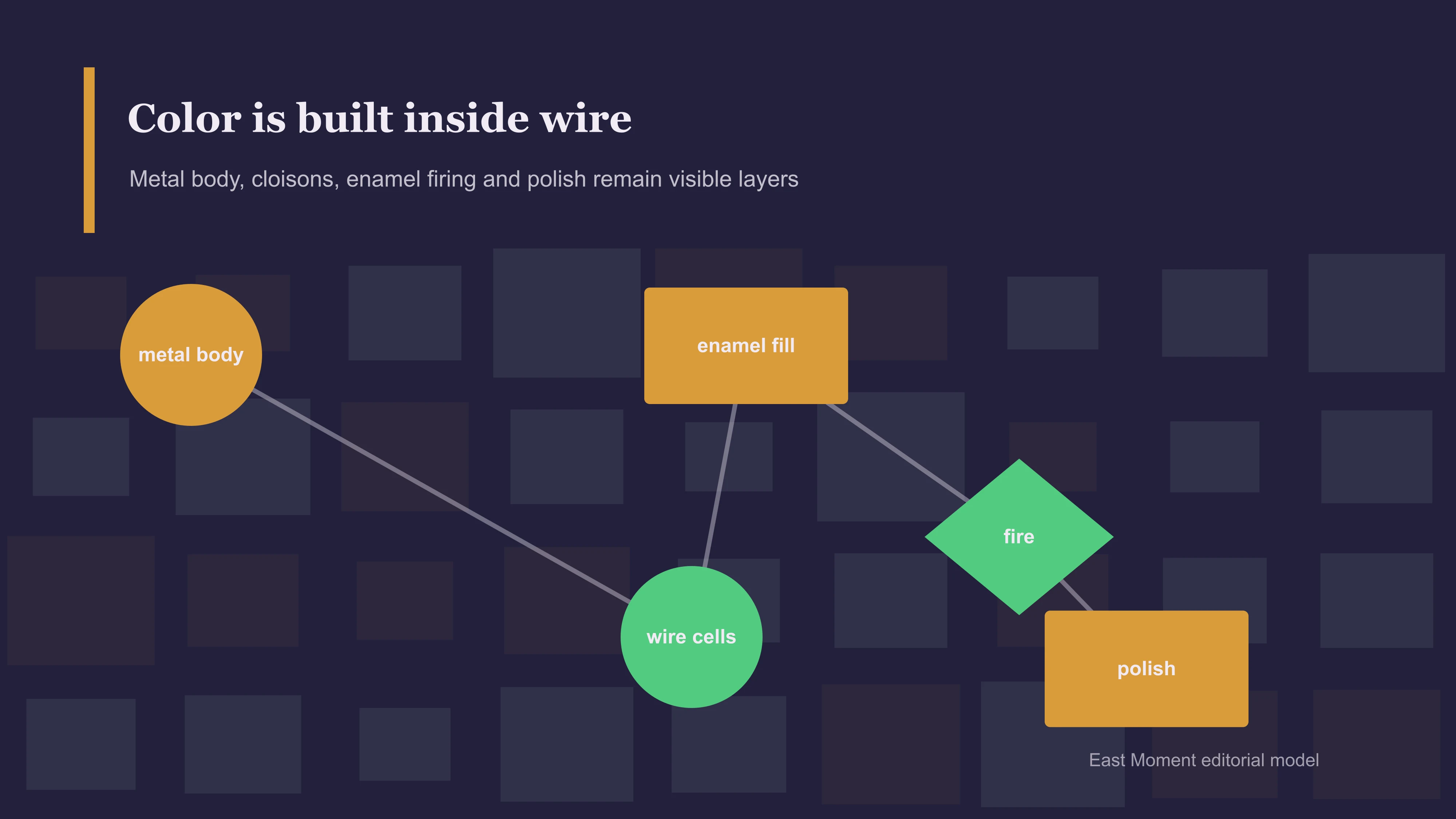
In cloisonne, the visible surface is not one painted picture on a flat body. Metal wires or strips create boundaries, enamel is placed into the separated areas, and the object is fired and polished into a continuous surface. The exact workshop sequence, materials and finishing choices can vary; the point is that the cell network is part of the object’s structure.
The Metropolitan Museum of Art identifies this late-sixteenth- to early-seventeenth-century pilgrim bottle as cloisonne enamel on gilt copper. Its broad, flattened body gives the decoration a generous face; the narrow neck compresses it. The same line must work at two very different scales.

I dislike the lazy dismissal of this craft as an expensive blue souvenir. I also dislike the opposite reflex: calling every crowded surface a masterpiece because it took time. The bottle gives us a better argument. Follow the metal line around a flower. Does it merely enclose a patch of color, or does its curve make the petal feel alive? That is where craft becomes design.
The English word is often written cloisonné, with an accent, and pronounced roughly “kloy-zuh-NAY.” The Chinese technical name, tóngtāi qiāsī fǎláng (铜胎掐丝珐琅), is wonderfully practical: copper body, shaped wire, enamel. The familiar name jǐngtàilán (景泰蓝) does not mean that every example is blue or that every vessel dates from the Jingtai reign.
Why an unfinished vase is worth your attention
You can admire a finished surface without realizing how much it conceals. Gold-colored outlines and a polished field appear to arrive together. They did not. The metal body, partition network and enamel filling solve separate problems, and each step constrains the next.
China's intangible-heritage account of the Beijing Enamel Factory describes six principal operations: forming the body, shaping and attaching the wires, filling enamel, firing, grinding and gilding. Diǎnlán (点蓝) names the filling operation, not an instruction to use blue alone. Its account also describes shading within petals rather than treating every compartment as a flat block of color.
The body supplies the volume. Wires must follow it closely instead of floating above a curve. Enamel then occupies the spaces. Firing and filling recur because the fired enamel settles below the desired level; the final surface has to be worked back so the metal and enamel can be read together. The Met's technical explanation makes clear why a single pour-and-polish story misses the repeated work.
Now look at the bare sample vase below. There is no elaborate enamel picture to distract you: its rounded body, shoulder and long neck have to work as a shape before the decoration arrives. A sample is not an inferior finished object. It exposes a stage that a successful finish normally hides. I would rather spend five minutes understanding that copper form than rush past twenty polished vases and remember only turquoise.
A flower has to survive the shoulder of the bottle
The hard design question is what happens when a pattern leaves a broad surface and meets a tight curve. A flower that reads clearly on paper can become cramped at a shoulder. A border that looks regular from the front must still meet itself around the back.
Give the silhouette a moment without the colors
Begin at a distance. Read the vessel as a body: bottle, bowl, vase, box or architectural ornament. The pattern should not be treated as a flat image pasted onto an anonymous shape. Curvature changes how cells stretch, repeat and meet at the shoulder, neck or foot.
The Met pilgrim bottle is useful because the full silhouette comes before the detail. It tells you where the visual pressure accumulates and whether the motif is working with the body rather than hiding it.
Follow one stem instead of counting the flowers
Move closer. The wires create a rhythm of compartments. They can outline flowers, clouds, geometric bands or animals, but they also reveal how the maker managed space. Look for joins, changes in scale and the way a line turns around a curve.
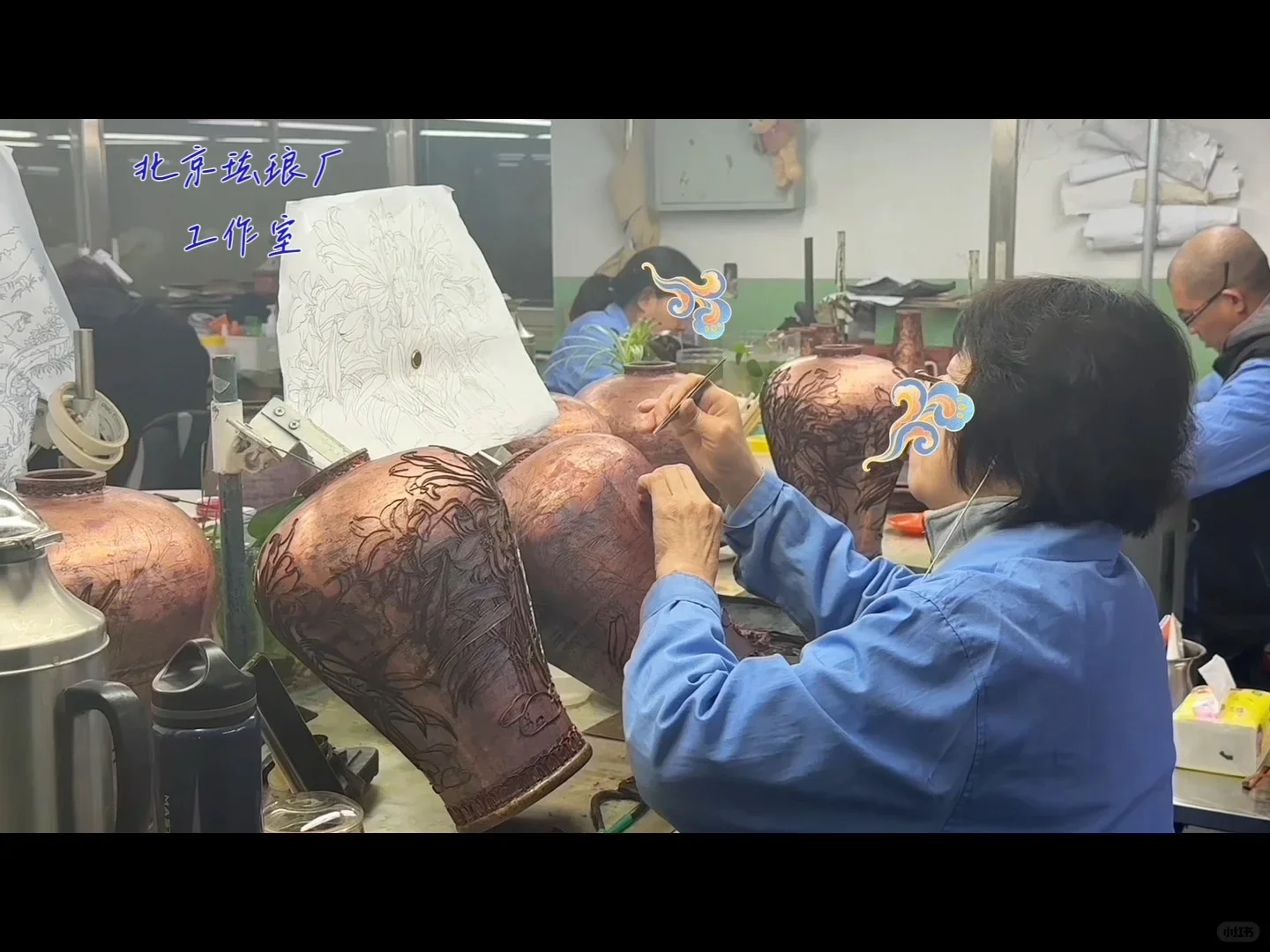
The museum's late-nineteenth-century sample vase, made in China, shows the bare body rather than a finished compartment network. Compare the shoulder with the wire-covered copper vessels in the workshop photograph at the top. There, floral drawings stand beside the work: a pattern must be translated from paper onto volume, one curve at a time.

Yellow enamel before the flower
Only after form and cell rhythm should you read the surface. Look for losses, cracks, uneven polish, repaired areas and places where the metal boundary is visible in a way the object’s construction explains. A flaw is not automatically proof of age. A perfect surface is not automatically proof of recent manufacture.
The yellow fragment from a cloisonne sample set removes the pressure to admire a complete vessel. Its broken-looking faces show a material sample rather than a flower or a network of wires. Enamel color exists as material before it becomes decoration.

Return to the finished bottle and look at the small cells where several lines converge. A designer can create elaborate boundaries and still make the meeting point clumsy. Conversely, a broad, uncluttered field can give a flower room to breathe. “More wires” is no more a guarantee of better design than “more notes” guarantees better music.
Is it enamel on copper, porcelain, or a craft-kit imitation?
A blue-and-gold vase can lead you into the wrong gallery. The color is not the material. In a porcelain vase, a fired ceramic body carries the decoration. In copper-body cloisonne, the support is metal and the visible partitions belong to the enameling technique. They share heat and glassy surfaces, not the same construction.
Three distinctions prevent most of the confusion:
| Name | Where the design comes from | Useful viewing clue |
|---|---|---|
| Cloisonne enamel | Added metal partitions divide the enamel | Follow the compartment network over the vessel's curve |
| Painted enamel | Painted decoration rather than a network of added partitions | Study the brush-defined motif; a gold-painted line is not automatically a wire |
| Porcelain decoration | Decoration on or under glaze on a ceramic body | Read the exposed ceramic at the foot and the relationship between glaze and painting |
Our Chinese ceramics guide explains the last row through clay and firing. It is the right next stop if you came here wondering whether cloisonne belongs to pottery. It does not become porcelain merely because a seller uses the word “vase.”
Contemporary hands-on classes create another vocabulary problem. A project with bent wire and colored filling can teach patience, line control and composition. That does not by itself establish that the filling is vitreous enamel fired onto copper. Before booking a workshop or describing a finished craft piece, ask a concrete question: is the color fired glass enamel, or a filling that sets without kiln firing? Enjoy either honestly; do not assign one process the technical achievement of the other.
This matters more than policing a hobbyist's language. If the making process disappears, so does the skill you were hoping to appreciate. A carefully bent wire is already worth looking at. It needs no borrowed firing story.
The strongest colors are not the strongest evidence
Blue, turquoise, red and gilt metal are strongly associated with Chinese cloisonne in overseas search results. That association is useful for finding objects, but it is a weak basis for judging them. Color can be copied, changed by lighting or chosen for a contemporary object that has no historical relationship to a museum piece.
My rule is blunt: never use “it looks like old cloisonne” as a conclusion. Use it as the beginning of a question about body, cells, surface, provenance and condition.
The historical name tempts another shortcut. The Met documents Chinese cloisonne before the Jingtai reign, with securely dated Xuande examples and earlier written references. So a name containing “Jingtai” cannot function as an age stamp. Modern work can belong to the Chinese craft tradition without pretending to be a Ming survivor.
Does a crowded surface have to look old-fashioned?
No. But I refuse to defend ornament just because it is traditional. A dense design succeeds when you can still follow its movement: a stem carries the eye into a flower, a border contains the field, and an area of quieter color stops every part shouting at once. If the silhouette disappears under undirected detail, the design has a problem, however difficult it was to make.
This is why close views change the conversation. From across a room, a vase can register as a solid mass of blue and gold. Up close, the line has turns, junctions and decisions. You are no longer choosing whether you like an abstract category called “traditional luxury.” You are judging this particular leaf and the way it fits this particular shoulder.
The reversal—from dismissing the shine to noticing the decisions underneath—is the part I care about. It rescues the craft from both souvenir contempt and automatic reverence. Admiration earned by one well-shaped petal is more convincing than a paragraph announcing centuries of cultural glory.
What a photograph can and cannot help you buy
Images are excellent for first-pass comparison. They can help you notice whether a vessel has a coherent silhouette, whether the wires remain legible at the curve and whether the surface carries visible losses or repairs.
Images cannot prove an object’s date, workshop, metal composition, restoration history or market value. Before buying, ask for provenance, dimensions, condition disclosure, clear photographs of the foot and rim, and a return policy. If the seller offers an age claim without a chain of custody or independent examination, treat the claim as unverified.
For example, imagine choosing between two contemporary pieces. One has a dramatic gilded pattern but the photograph hides the back and foot. The other has a simpler pattern with clear views of its construction and disclosed condition. I would inspect the second first. That is a decision about available information and design, not a claim that simplicity costs less or proves authenticity.
Ask whether a noticeable depression is an intentional part of the object, missing enamel, or a repaired area. Ask for a neutral-light close-up rather than a filter that makes every blue electric. Do not rub a museum object, scrape a wire, or conduct a destructive home test to satisfy curiosity. A seller's condition report and specialist examination can answer questions that a thumbnail cannot.
A three-minute cloisonne inspection
Use this sequence when viewing a museum image, a shop listing or a photograph from a collection:
- Read the silhouette without zooming in.
- Trace one wire boundary around a curve.
- Check whether the enamel cells remain visually separate.
- Inspect the rim, foot and transitions where wear or repair may show.
- Write down what is visible and what still requires provenance or expert examination.
The last step is the discipline. “I can see” and “I know” are different statements.
Where to go next
Compare the wire-controlled outlines with Jun ware, where glaze movement can soften or interrupt a boundary. Then look at Chinese jade: a carved contour is worked out of stone rather than built by attaching wire. Those three ways of producing a line—adding, firing and carving—are more revealing than sorting every beautiful Chinese object by color.
The Chinese art collection continues that comparison across materials. Here, choose one tiny bend in a flower, wing or cloud and tell us what would disappear if it became straight. You do not need to own a valuable object to make a good observation.
The line is what I would take home
Cloisonne is not difficult because the colors are mysterious. It is difficult because a beautiful surface invites a fast conclusion. Slow down. Read the body, follow the boundaries and separate what the photograph proves from what only provenance or examination can prove.
If you want to contribute, bring a whole-object view and a wire detail to Moments. Trace the same line in both images and explain its job. Come back for another reader's route through the pattern: the part you treated as a background divider may be the stem holding the whole flower together. That is a discussion worth having after the shine has worn off the first impression.