Foo dog meaning begins with one correction: a “foo dog” is a Chinese guardian lion, not a dog. Its central work is to mark and defend a threshold. Yet the meaning does not live inside one statue by itself. It emerges from a pair, the objects beneath their paws, the direction they face, the doorway they frame, the material they are made from and the historical world that put them there. A lion at a sixth-century tomb, a stone pair outside a government gate and a porcelain “dog of Fo” on a European mantel are related objects—not identical sentences.
Foo dog meaning begins with the animal everyone names incorrectly
I understand why “foo dog” survives. It is short, memorable and useful when you are trying to search in English. But I will not build an interpretation on a mistaken animal.
The Chinese creature is a lion: 狮子 (shīzi). In English, “Chinese guardian lion,” “stone lion” and sometimes shishi are more accurate names. “Foo dog,” “fu dog” and the older collecting phrase “dog of Fo” belong to the history of translation, trade and Western collecting. They tell us how the object was received abroad; they do not turn its mane, paws and leonine body into a domestic dog.
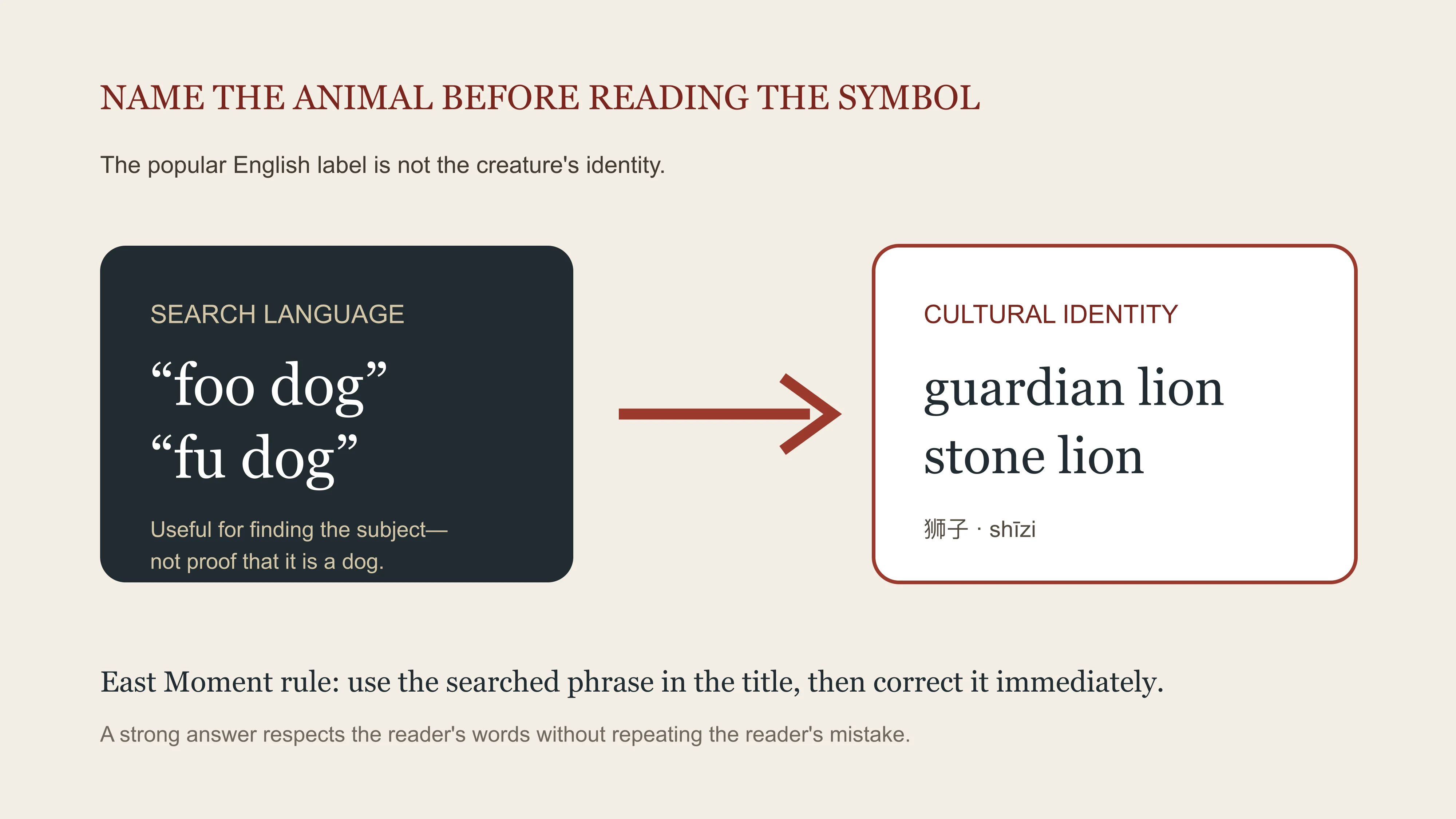
My rule is simple: respect the word that brought the reader here, then correct it immediately. Calling the figure a lion is not pedantry. It reconnects the object to Buddhist visual culture, court authority, tomb protection and a long Chinese sculptural history that disappears when everything becomes a cute pair of “lucky dogs.”
This is also the first answer to “fu dog meaning.” The spelling variant does not create a second symbol. Both searches normally point to the same family of guardian-lion images.
Why Chinese guardian lions do not look like natural lions
Many people reach the same honest objection: if this is a lion, why does it have curls like a perm, bulging eyes, a short muzzle and a body that sometimes looks halfway between a mastiff and a dragon?
Because Chinese guardian lions were never wildlife portraits.
Lions were not ordinary animals encountered in most Chinese landscapes. Their forms arrived through long-distance contact, tribute, imported animals, stories, Buddhist imagery and objects moving across Central and South Asia. Makers translated an animal associated with distant power into local stone, bronze, ceramic, textile and architectural languages. Repetition then made certain features more important than zoological accuracy: the expanding mane, heavy chest, open jaws, tense forelegs and alert eyes had to project force from a gate or tomb, often from far below the viewer.
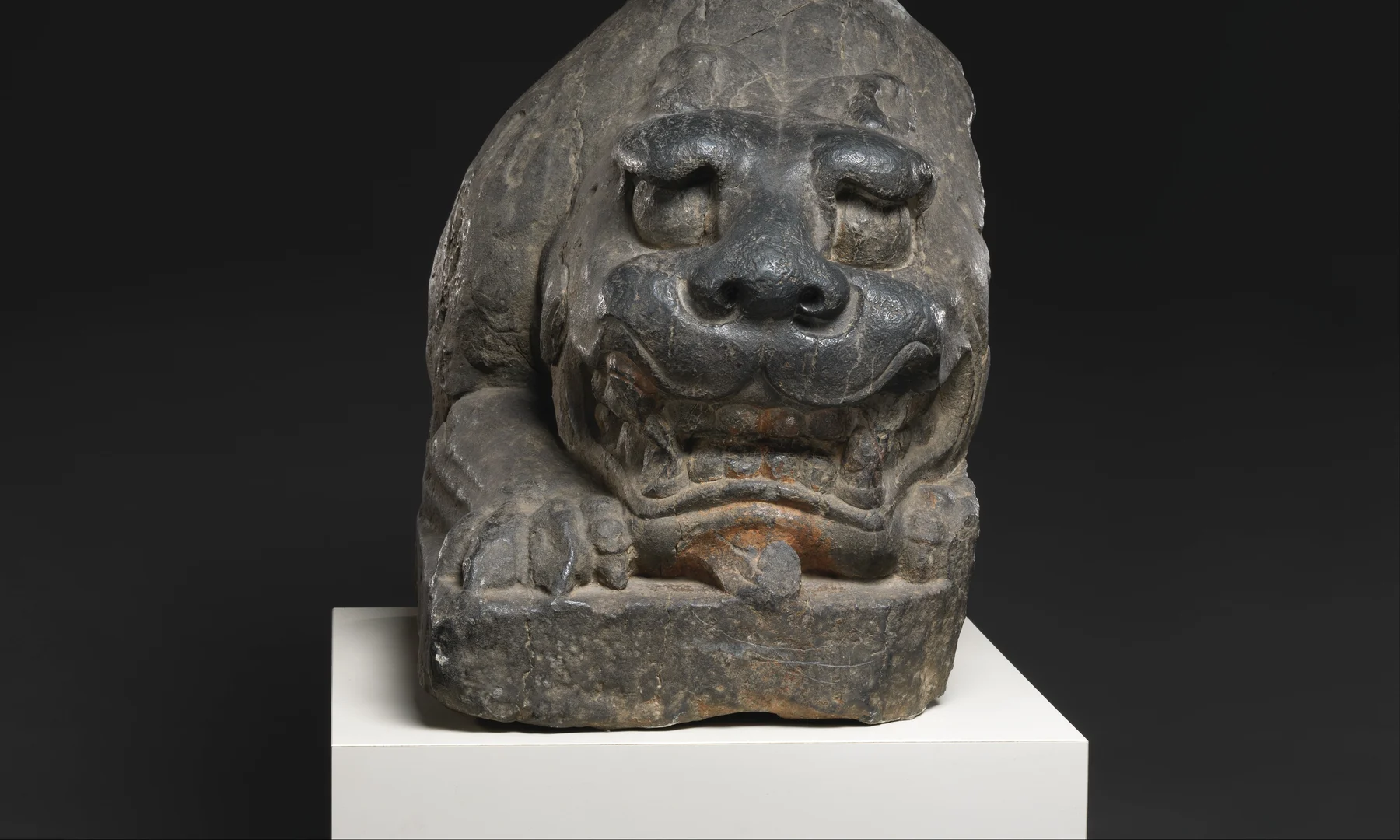
The Met's mid-sixth-century Northern Qi guardian lion is one of a pair. The museum explains that guardian-lion pairs protected tombs in China and became increasingly prevalent as lion imagery spread through northern Buddhist cave temples in the fifth and sixth centuries. This lion was not carved to convince a zoologist. Its job was to hold an inner funerary boundary.
The stylization is not evidence that the maker had “never seen a lion and guessed badly.” That joke is too easy. Artistic forms are not failed photographs. A curled mane can catch shadow; a compact body can survive stone carving; a frontal stare can command an approaching viewer; an exaggerated paw can make weight visible. The maker shaped presence, not merely anatomy.
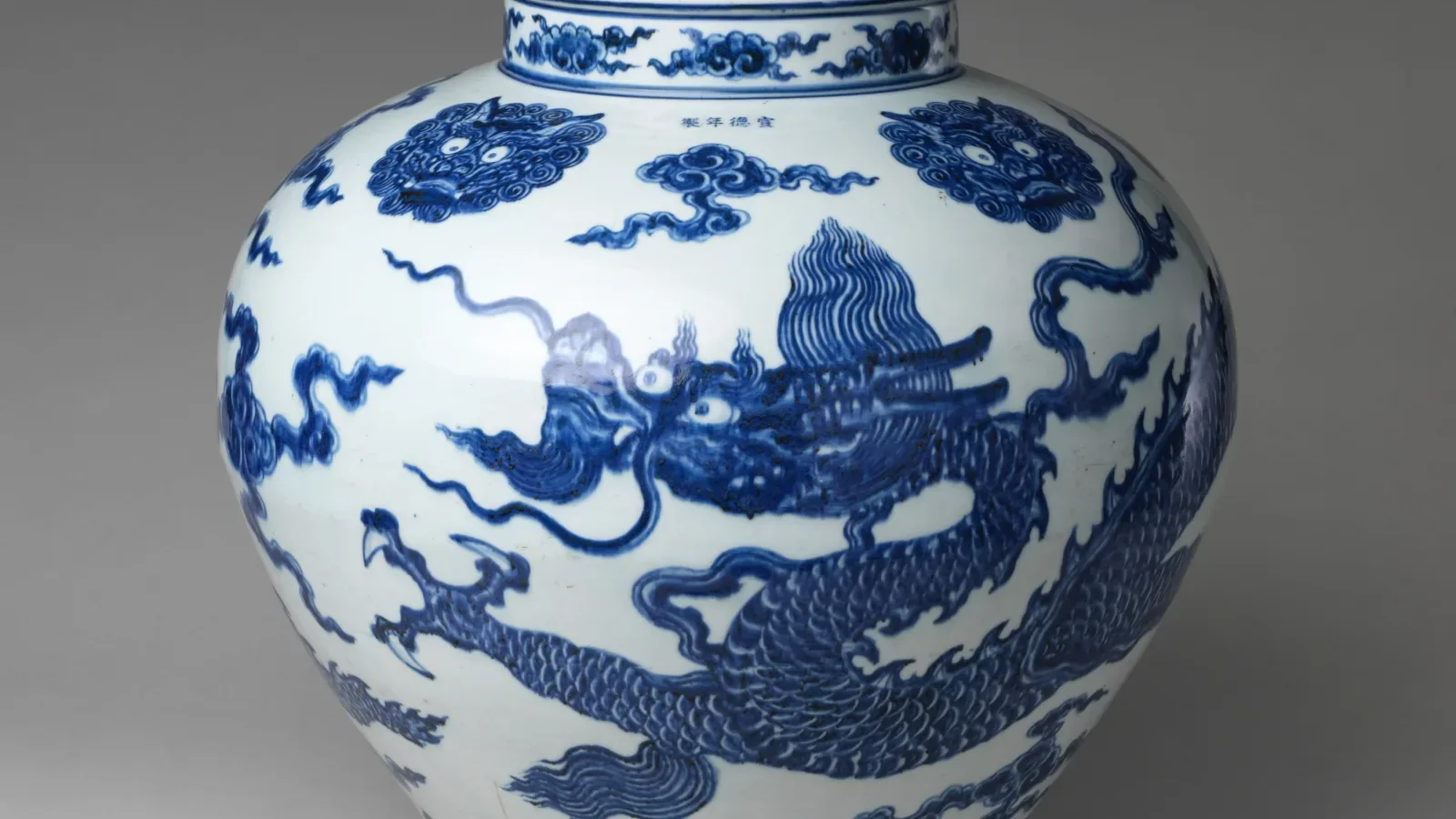
Our Chinese dragon guide asks a similar discipline of the eye. A culturally made creature does not become meaningless because it refuses naturalism. The question is what the form was designed to do.
The oldest meaning on this page is not “wealth”—it is controlled protection
Online shops usually begin with prosperity. The archaeological record asks us to begin deeper: with protection, authority and the management of dangerous boundaries.
The Northern Qi pair documented by the Met defended the innermost chamber of a tomb. That location matters. These lions did not sit beside a cash register and promise sales. They stood between the dead and intrusion, between an ordered funerary interior and whatever threatened it from outside.

As lions appeared in Buddhist settings, their strength could support sacred authority. As they moved into palace, government, temple and elite residential architecture, their bodies made hierarchy visible before a visitor crossed the door. Protection and power became inseparable: the right to guard a monumental entrance also declared who possessed the entrance.
This is my central view: a guardian lion does not merely repel; it announces that a line matters. The lion says there is an outside and an inside, a before and an after, an ordinary street and a controlled space. That is why the doorway is not background scenery. It is half the meaning.
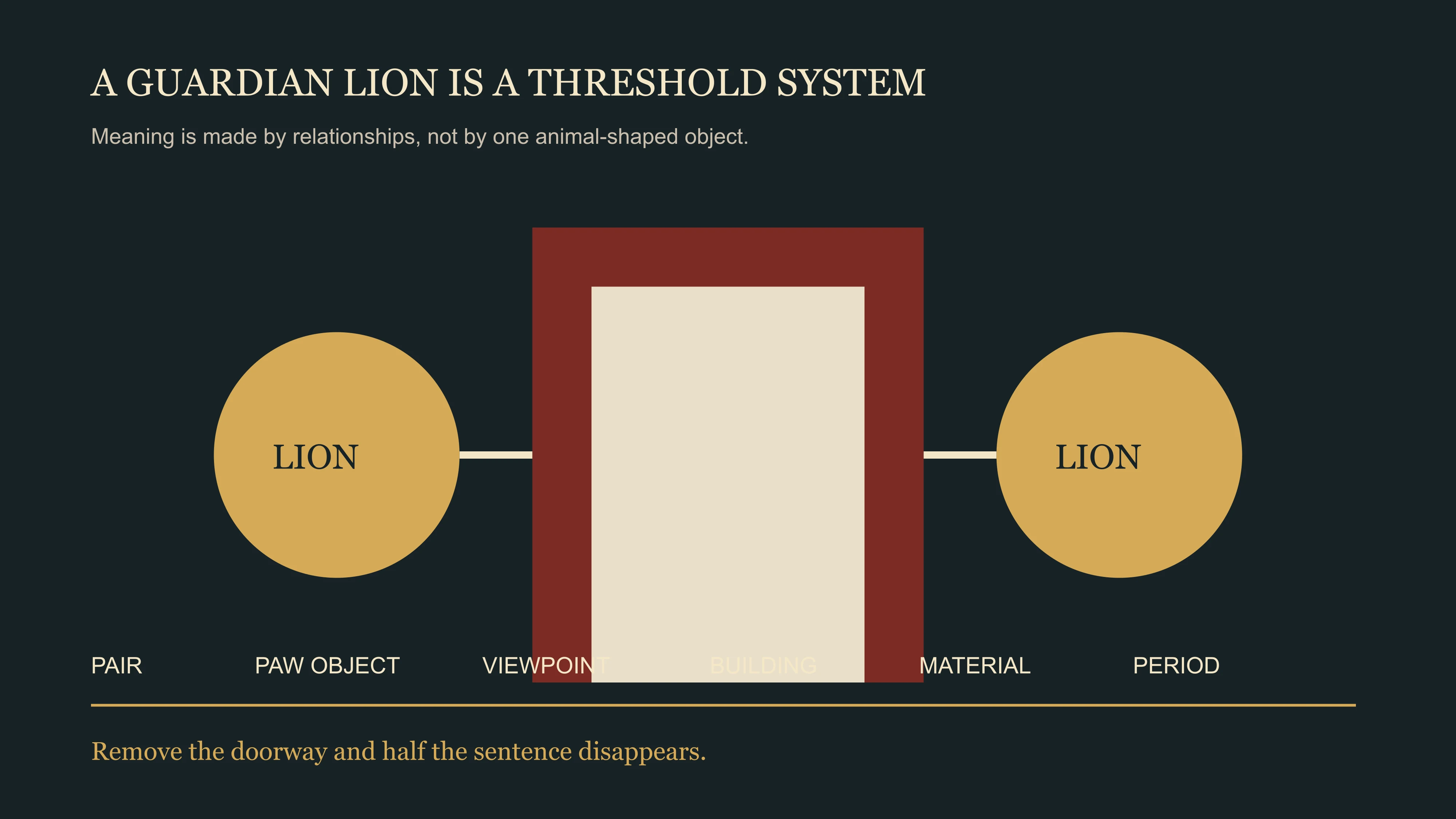
The same logic runs through Chinese architecture: gates, screen walls, courtyards, axes and changes in elevation make relationships legible. Lions intensify one moment in that sequence—the act of crossing.
A pair is not two copies; it is one sentence divided across a doorway
A single lion in a museum display can be magnificent, but a guardian pair in its original entrance has grammar.
The two bodies balance a central opening. They create symmetry, but they also create tension: each occupies one side, each watches the approach, and the empty passage between them becomes charged. The viewer must pass through the relation they establish.
That is why I resist decorating with two identical lions chosen only because they match. Traditional pairs may share scale and style, yet their paw objects, sexed identities, mouth details or poses can differ. The difference is not a manufacturing flaw. It lets the pair express complementary responsibilities.
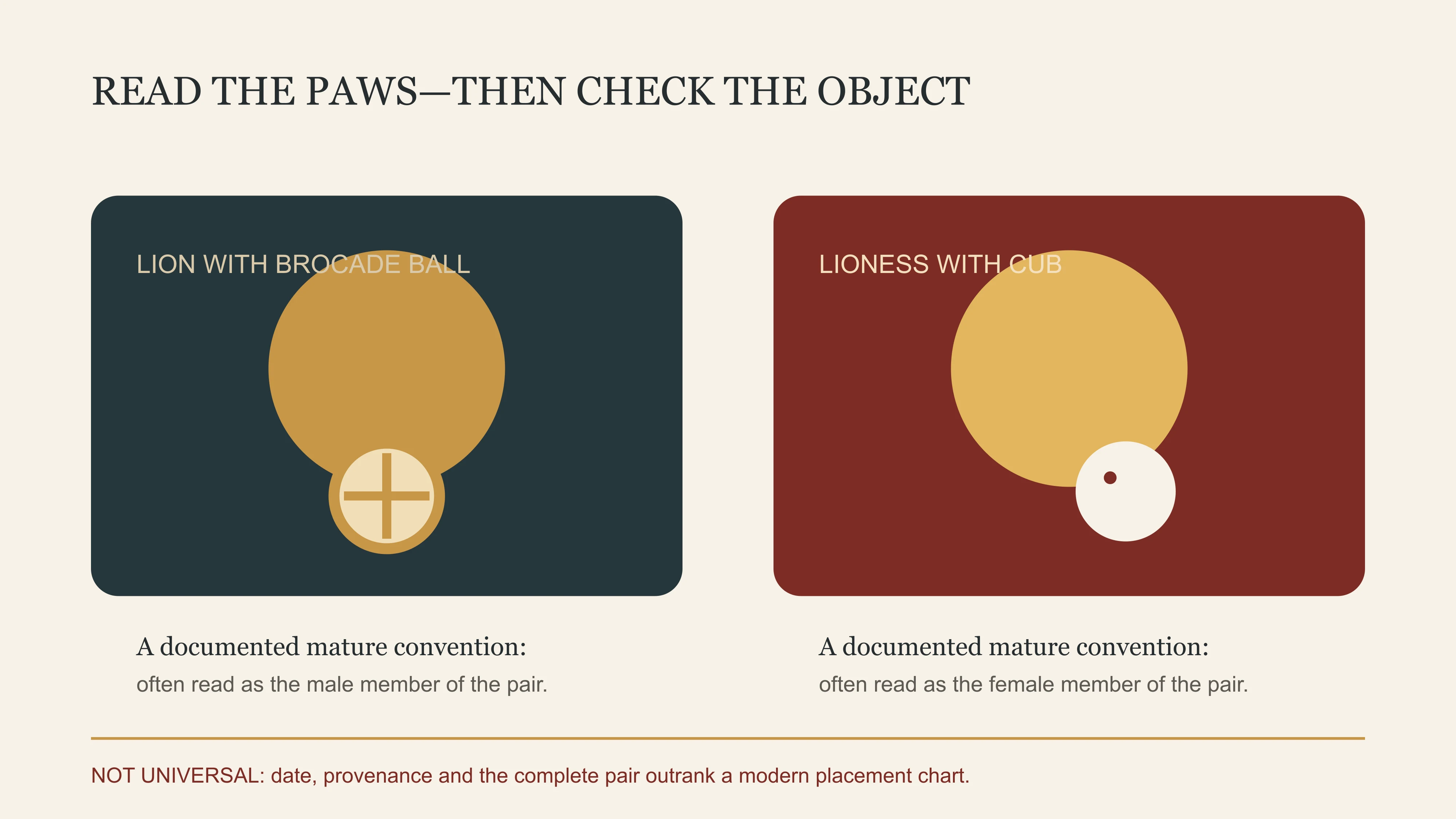
The British Museum records a late-Ming pair in which the lioness holds a cub beneath one paw while the lion rests a paw on a brocade ball. This is strong object evidence for the familiar formula. It does not prove that every Chinese lion pair in every century followed it.
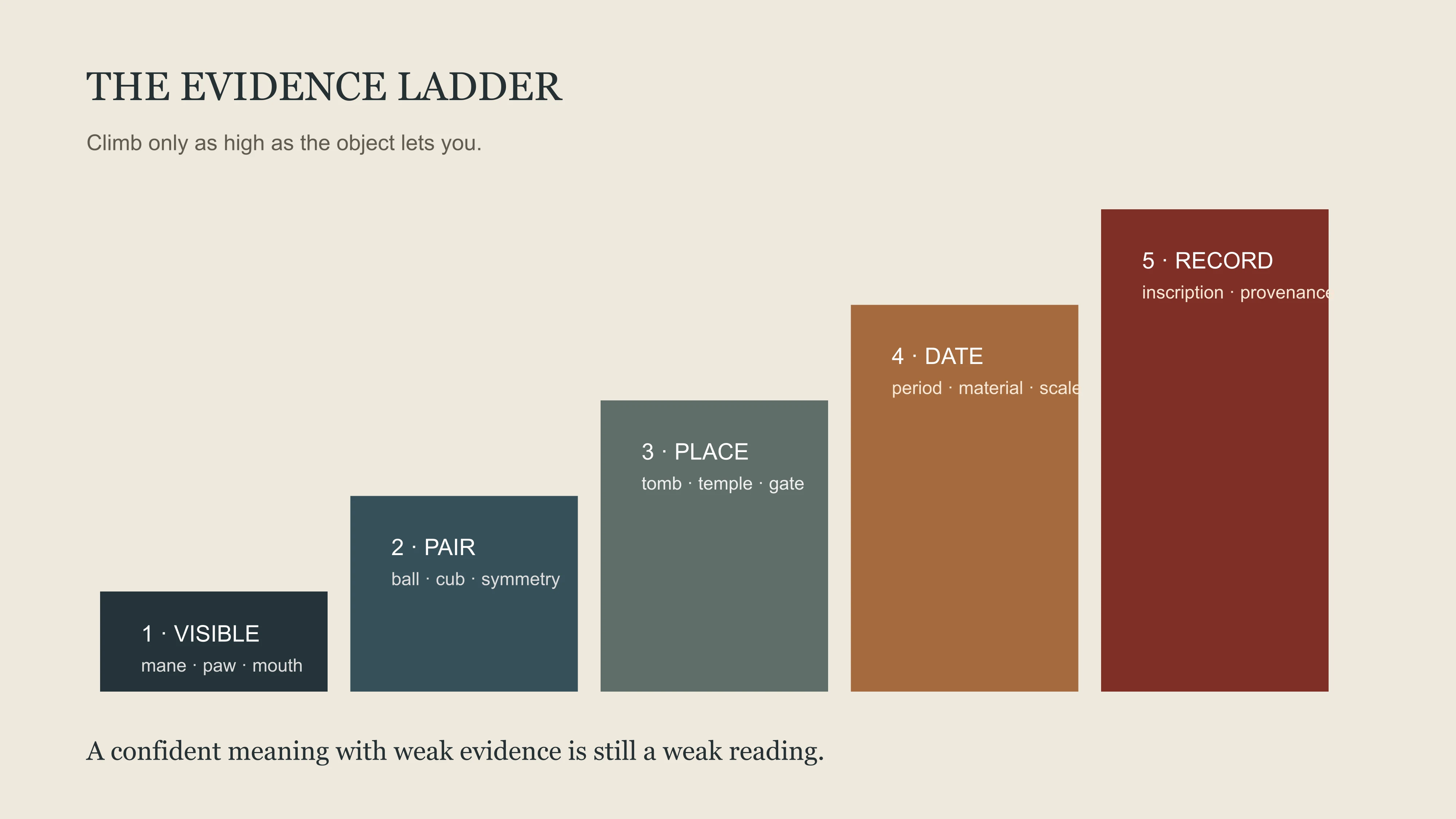
The safest reading order is:
- Confirm that two figures were actually made or installed as a pair.
- Look beneath each front paw instead of assuming sex from the face.
- Record the building's left and right as well as the viewer's left and right.
- Check date, region, material and institutional setting.
- Only then interpret the pair.
This order feels slower than a placement infographic. It is also how you stop one copied rule from erasing a thousand years of different objects.
The ball and cub are not random props
In mature paired formulas, the male lion is commonly shown with a decorated or brocade ball, while the lioness appears with a cub. The ball and cub distinguish the pair and turn each paw into a small theatre of power.
The cub gives the lioness a relationship rather than an accessory. She restrains, shelters or plays with a smaller life. Modern explanations often reduce this to “protection of family.” That is understandable, but the image can carry more: continuity, lineage, nurture under authority and the transmission of a guarded world.
The ball can evoke mastery, play, order and controlled force. It is often carved with patterned bands, sometimes with a smaller moving ball inside an openwork sphere. In export porcelain and small decorative objects, that technical play became part of the attraction.
But I will not automatically call the ball “the globe” and claim the male rules the world. That explanation circulates widely because it sounds grand. Unless a particular object's record, inscription or historical context supports a cosmic reading, it is safer to call it what the object shows: a brocade or embroidered ball within a paired convention.
The Met's eighteenth-century jade group of a lion and cubs proves another useful point. Cub imagery can exist beyond monumental door pairs and can become an intimate, tactile composition in precious material.

Scale changes emotion. A stone paw over a cub at a gate can look commanding. A jade adult curling among cubs can feel crowded, playful and warm. “Guardian lion meaning” must leave room for that change.
Male left and female right: the viewpoint trap
The most repeated placement rule is also the easiest to miscommunicate: male on the left, female on the right. Left from where?
Traditional architectural directions are often stated from the building or principal occupant looking outward. A visitor standing in the street and facing the entrance sees those sides reversed. Many online diagrams silently switch viewpoints, then accuse every real doorway of being wrong.
I do not want readers memorizing a sentence without a camera position. Use this method instead:
- Stand outside and photograph the complete entrance.
- Mark “viewer facing building.”
- Walk inside or mentally rotate the plan and mark “building looking outward.”
- Identify the ball and cub from visible details.
- Record the actual installation before declaring a rule broken.
Even then, do not use one convention to date, authenticate or condemn a pair. Lions can be moved, replaced, mismatched, restored or installed by modern owners following different instructions. A photograph proves the present arrangement, not necessarily the original one.
This is where real street observation is better than a polished symbol chart. Chinese entrances are lived spaces. Scooters lean against plinths, delivery signs block one paw, new security doors replace old timber leaves, and a lion carved for one building can be moved to another. The imperfect scene tells us how the symbol survives.
Open and closed mouths do not automatically mean yin and yang in China
Another seductive formula says one lion's mouth is open and the other's closed, representing the first and last sounds, breathing, yin and yang, or the beginning and end of existence.
Pairs with different mouths certainly exist. The mistake is assuming one explanation belongs universally to Chinese guardian lions.
The open-mouth/closed-mouth a-un formula is especially well documented for Japanese komainu shrine guardians. The British Museum's record for a Japanese komainu explains the pair through the open “a” and closed “un” sounds. That evidence belongs to the Japanese object in front of us. It should not be copied backward onto every Chinese stone lion simply because the forms are related.
Chinese, Japanese and Korean guardian traditions have exchanged shapes and religious meanings across centuries, but relationship is not sameness. “Asian foo dog” is not a useful origin label. Identify country, period, material, location and local term before merging traditions.
Our phoenix symbolism guide makes the same boundary clear: visual kinship across East Asia is a reason to compare carefully, not permission to erase names and histories.
Architecture decides whether the lion guards, pivots, decorates or performs status
The Palace Museum's stone-lion door pillow dated 1087 is one of my favorite corrections to the free-standing-lion stereotype. The carved stone was part of a functional door assembly: a structural component supporting the pivot also carried a guardian lion and peony ornament.
That object does several jobs at once. It bears weight, receives repeated movement, marks the entrance, wards the boundary in cultural terms and adds a prosperity-associated flower. Function and symbol occupy the same stone.
This is why a lion removed from architecture loses evidence. Without the gate, we may not know:
- whether it faced a tomb, temple, palace, office, residence or garden;
- whether it stood at the outer entrance or an inner threshold;
- whether people approached it frontally or passed beside it;
- whether its scale was commanding or intimate;
- whether it belonged to an axial pair;
- whether later rebuilding changed its position.
The Chinese gardens guide shows how framed views and winding movement can control encounter without monumental force. A guardian-lion gate does the opposite: it compresses meaning into a frontal confrontation. Both are spatial writing, but one whispers and the other plants its paws.
Material changes the lion's voice
Stone gives the guardian lion weight, weather and public presence. Bronze can tighten the body into portable force. Ceramic makes the form repeatable, colorful and exportable. Jade turns it intimate and precious. Textile lets lions move with the wearer or animate an interior.
The Met's eighth-century gilt-bronze lion is small enough to occupy a very different world from the limestone tomb guardians. The same leonine compression remains—raised chest, tense legs, broad head—but the gleam of gilded bronze makes power portable.

A sixth-century seated bronze lion is even more compact. Its body does not need a doorway to feel alert. The pose concentrates readiness into the front of the chest.

When lion imagery enters porcelain, it joins the history explored in our Chinese porcelain patterns guide. A British Museum Kangxi pair shows a lioness with cub and lion with a movable brocade ball; the museum notes that such porcelain figures became popular in eighteenth-century Europe as “dogs of fo.” The foreign name is therefore part of the object's afterlife—collectors translated an unfamiliar guardian into a category they could market and display.
That does not make the export history fake. It makes it layered. The European mantel and the Chinese threshold are two chapters in one object's reception, but they should not be collapsed into one original meaning.
Lions can leave the gate and enter clothing, vessels and domestic display
An early eighteenth-century Chinese woman's informal robe carries garden roundels populated with lions. Here the animals do not stand rigidly at a gate. They enter a textile garden, bend with the body and become part of a luxurious moving surface.

This matters because “guardian” can become too narrow. Lions could signal force, status, sacred association, playfulness and exotic energy across different media. A lion chasing a brocade ball on cloth is not architecturally guarding the wearer's ribs. Motifs keep family resemblance while changing jobs.
The same shift happens on vessels. A Chinese cloisonné vase with lions turns the animal into surface, handle and ornamental rhythm. The vessel asks to be circled and viewed closely; a gate lion asks to be approached and passed.

This is the difference between symbol and sticker. A sticker remains the same wherever it is pasted. A real cultural motif negotiates with material, scale, function and audience.
Does a foo dog mean protection, prosperity or power?
All three meanings can appear, but they do not arrive with equal evidence in every object.
Protection is the strongest starting point for a pair guarding a tomb or entrance. The lion's force is assigned to a boundary.
Power and status become stronger when monumental lions frame a palace, government office, elite residence or institutional gate. The pair does not only guard the owner; it makes the owner's authority visible.
Prosperity can enter through associated motifs, auspicious wordplay, elite display and later popular interpretation. The peony on the Palace Museum door pillow strengthens a wealth-and-honor layer. A seller calling every resin lion a “wealth cure,” however, is making a commercial promise rather than reading historical evidence.
Family continuity becomes plausible where cub imagery is visible. Again, the cub supports the reading; the species alone does not.
Buddhist authority is important in the deeper history of the lion image. Lions flank sacred spaces and thrones, and the lion's roar became a metaphor for the force of Buddhist teaching. But a modern bank entrance with stone lions is not automatically a Buddhist installation.
My verdict is firm: the best single definition is “paired lion guardians that make a threshold important.” Protection, power, prosperity, lineage and sacred authority branch from that core according to evidence.
What a guardian lion image cannot prove
A photograph can show material clues, damage, paw objects, mouth, pose, scale and current placement. It cannot by itself prove:
- that the pair is ancient rather than recently carved;
- that it remains in its original location;
- that the owner follows one specific religious or feng shui belief;
- that the ball means the world;
- that one orientation is historically original;
- that the object will protect a home or improve finances;
- that a dealer's dynasty, material or price claim is correct.
I am strict here because certainty is cheap online. “Always,” “must” and “guarantees” make a paragraph sound confident while the object sits silently beneath it. Real confidence knows where evidence ends.
This page gives cultural and visual interpretation, not antique authentication. If material, date and value matter, provenance, condition, tool marks, stone or ceramic analysis and qualified object examination matter more than motif recognition.
Foo dog tattoos and home décor should choose a real idea
A guardian-lion tattoo becomes stronger when it stops trying to mean every lucky thing at once.
Choose the relationship you actually want:
- a pair across the body for threshold and balance;
- a lion with cub for fierce care and continuity;
- a lion with brocade ball for disciplined force or play;
- a weathered stone lion for endurance and public memory;
- a Buddhist lion for sacred authority, only if that context is genuinely part of your intention;
- one inherited doorway as a portrait of family place rather than a generic symbol.
Do not mix a Chinese ball-and-cub pair, Japanese a-un mouths, Tibetan snow-lion colors and a random “feng shui wealth” caption, then call the result traditional. A personal design may combine traditions, but it must name the combination honestly.
For home décor, ask what threshold you are marking. A small ceramic pair on a shelf does not perform like two monumental stone bodies outside a gate. That is not a failure. The shelf pair can hold memory, humor, family story or admiration for Chinese craft. Just do not buy supernatural certainty packaged as an interior accessory.
If you are travelling in China, use our travel hub to notice lions in context rather than collecting isolated façade photos. Step back. Include the building, street, plinth, door and both animals. The complete scene will teach you more than a close-up of one dramatic face.
How to read any Chinese guardian lion in six questions
When I meet a lion pair, I use six questions:
- What is it? Lion, lioness, cub, another guardian animal—or an uncertain hybrid label from a seller?
- Where is its partner? Was it made as a pair, and is the pair still complete?
- What is beneath each paw? Ball, cub, platform, ribbon, nothing visible or later damage?
- Which viewpoint defines left and right? Viewer facing inward or building looking outward?
- What threshold or object carries it? Tomb, temple, palace, office, home, door component, robe, vessel or export ornament?
- What evidence dates and locates it? Inscription, excavation, museum provenance, architectural record, material or only resemblance?
The first three questions describe. The next two interpret. The last one controls confidence. That sequence is the difference between seeing and projecting.
My conclusion: the lion guards a relationship, not a promise
The phrase “foo dog meaning” sounds as if one hidden definition waits inside the statue. It does not.
The lion guards a relationship: outside and inside, visitor and owner, ordinary space and controlled space, danger and order, parent and cub, paired bodies and the opening between them. Its cultural force comes from making those relationships visible.
That is why the best guardian lions feel alive even after centuries. Their eyes are too large, their manes too curled, their paws too deliberate—and none of that is an accident. They are not failed lions and certainly not mysterious dogs. They are architecture learning to bare its teeth.
Do one thing before buying a replica or copying a placement rule: stand at one real doorway and read the complete pair. Photograph both lions, the door, the street and the paw details. Post it in Moments with the building type and your exact viewpoint. We are building a living atlas of Chinese thresholds, one defensible observation at a time. The wider Chinese symbols guide gives you the same evidence-first method for dragons, phoenixes, flowers, fish and auspicious wordplay.