My verdict: Tianmen Mountain is not a collection of daredevil attractions. It is one continuous vertical journey from the streets of Zhangjiajie to a hole in the mountain. Route A, B or C decides the direction of that journey. Choose with your knees, fear of heights and weather in mind—not because a stranger called one line “the best.”
Tianmen Mountain works only when you choose the direction before the sights
For most first-time visitors, Route A is my default: take the long cable car from Zhangjiajie city to the summit, cross a selected section of the mountaintop, descend toward Tianmen Cave, then return through the lower transport system. The opening is magnificent because the city does not disappear at once. It shrinks below you until roads, apartment blocks and fields become a map.
But A is not automatically right. Choose Route B if walking down steep stairs hurts your knees more than climbing them, or if you want the long cable-car descent as the final scene. Choose Route C when the big city-to-summit cableway is unavailable or genuinely wrong for your fear of heights. C repeats more of the lower transport and sacrifices the mountain’s most revealing transition, yet an honest compromise is better than spending half a day terrified.
| Your real priority | Start with | Why |
|---|---|---|
| First visit and the strongest city-to-mountain reveal | Route A | The long cableway becomes the opening chapter; the 999 steps are generally approached downward if you choose to walk them |
| Knees dislike steep descent, or you want the long cableway as the finale | Route B | The mountain unfolds upward and the big cableway returns you to the city |
| Serious cable-car anxiety or limited A/B availability | Route C | It uses the shorter mountain-side system in both directions and avoids making the long cableway compulsory |
| Poor visibility and a tight schedule | Whichever official route is operating cleanly | On a fog-heavy day, reducing transfers and queues matters more than collecting route labels |
The route names are operational products, not permanent laws of nature. Maintenance, ice, wind, capacity and seasonal closures can alter what each ticket includes. The Hunan culture and tourism authority’s route guide explains the A/B/C transport logic, but you must still read the current checkout description before paying. Never build a 2026 day around a screenshot of an old ticket page.
Stop confusing Tianmen Mountain with Zhangjiajie National Forest Park
This mistake ruins more itineraries than the glass walkway ever could. Tianmen Mountain is beside central Zhangjiajie in Yongding District. Wulingyuan and Zhangjiajie National Forest Park are a separate landscape, ticket system and travel base. The first is a steep one-day vertical circuit centered on cableways, cliff paths and Tianmen Cave. The second is the much larger sandstone-pillar world associated with Yuanjiajie, Tianzi Mountain and the “Avatar mountains.”
If a hotel, driver or tour page uses “Zhangjiajie” without naming the gate, ask for the Chinese address. A room near the Tianmen cableway station may be useful for this page’s itinerary and inconvenient for an early Wulingyuan start. The two places belong in the same trip, not in the same afternoon.
The Hunan Forestry Bureau’s park profile identifies Tianmen Mountain as Zhangjiajie’s second national forest park and places it close to the city. That geography is the key. Tianmen is not remote wilderness reached after hours of scenic-road transfers; it rises immediately behind ordinary urban life.

This is why I would not hide Tianmen at the end of a generic “top ten Zhangjiajie attractions” list. Its meaning lies in the seam between city and mountain. You can eat breakfast near a railway station and, not long afterward, stand above a cliff line where the city looks impossibly flat.
Route A or Route B is really a decision about sequence
Online arguments often treat A and B like rival teams. That is noise. They connect broadly similar mountain elements in opposite directions. The correct question is: which movement should begin your day, and which physical demand should come later?
Route A: let the long cableway explain the mountain first
Route A normally starts at the lower cableway station in Zhangjiajie city. The long ascent is not dead transport time. It shows the relationship among streets, farmland, the lower road and the sudden limestone wall. Official park material records a cableway of roughly 7.45 kilometers with about 1,277 meters of vertical difference. Those numbers sound promotional until the ground drops away under the cabin; then they become spatial evidence.

At the summit, do not immediately sprint toward the first glass sign. Let the cableway arrival settle. Find the current map, confirm which ridge paths and escalators are open, and decide how much summit walking remains realistic after queues. Route A’s advantage is narrative clarity: city, summit, cliff, cave, lower mountain, city again.
Its physical catch is descent. If the 999-step stairway is open and you choose to walk it, A generally places you above Tianmen Cave and sends you down. Descending can be more punishing than climbing for people with knee pain, poor balance or a fear of looking into steep space. Assisted alternatives may operate, but inclusions and separate charges can change. Confirm them before assuming the staircase is mandatory or free to bypass.
Route B: climb toward the cave, save the long descent for last
Route B usually begins with a shuttle toward the mountain gate and the shorter Tianmen Cave cableway. You encounter the cave and mountain-side system before reaching the summit, then finish by riding the long cableway down to central Zhangjiajie.
I would choose B for two kinds of traveler. The first actively wants to climb the famous stairs rather than look down them. The second wants the wide cable-car descent as the day’s final release. B can also make the summit feel earned, because the journey builds from the mountain’s lower wall toward the ridge.
The tradeoff is obvious and often ignored: 999 steep steps are not a decorative photograph. They are uneven in feeling, exposed to weather and crowded at popular times. A strong hiker may enjoy the rhythm. A family trying to prove something to a child or older relative can turn the same section into needless pressure. No photograph is worth making another person feel like the slow problem in the group.
Route C: the compromise people insult too quickly
Route C usually uses the shorter Tianmen Cave cableway and mountain transport in both directions. You may repeat part of the approach and miss the long city cableway. That makes it weaker as a complete first-time story, so I would not select it casually.
Yet C has a valid audience. Fear of heights is not a character flaw, and the long cableway is not a minor chairlift. When A and B are sold out or temporarily unavailable, C may also preserve the cave and summit rather than losing the entire day. The honest way to sell C is not “almost the same.” It is: you keep the mountain and give up its best transition. Decide whether that exchange works for you.
The 999 steps are a body test, not a courage test
Tianmen Cave is the visual anchor—a monumental opening through the mountain wall—but the staircase changes how people behave around it. From below, the stairs look like a ceremonial line pointing into the sky. From above, they can look brutally steep. Neither view tells you how your knees will respond after several hours of standing, queueing and summit walking.

Use a simple rule:
- Walk up only if your breathing, balance and legs are already comfortable that day.
- Walk down only if you control steep descent well and do not freeze when the drop is visible.
- Use the available assisted route when pain, age, rain, crowding or fear turns the stairs into a bad gamble.
- Split the group if necessary and agree on the exact meeting point before anyone moves.
There is no prize for reaching the cave with shaking legs. The mountain will not respect you more. Good travel judgment is the ability to keep a famous object in proportion to the people beside you.

The cave itself is more powerful from changing distances than from one centered portrait. See it first as a cut in the cliff, then as an opening above the staircase, then as a frame around light and sky. That sequence reveals scale. A single ultra-wide phone photograph often makes the cave look smaller and the stairs flatter than they feel.
The glass walkway is five minutes; the cableway changes the scale
Search results make the glass walkway look like the star because fear is easy to thumbnail. I disagree. The glass is punctuation. The cableway, cliff path and cave form the sentence.
A glass section can be fun when visibility is clear and the crowd keeps moving. It can also become a shoe-cover queue followed by several rushed photographs. Hunan’s 2025 official response to an overseas family notes that glass-walkway access is a separate non-transport item under market pricing rather than automatically part of every ticket benefit. Treat it as optional, check current access, and do not let a small extra attraction control the whole route.
The ordinary cliff path often gives more time to understand the mountain. A solid deck does not remove exposure: the valley remains beside you, trees emerge from cracks and the railing traces the edge for much longer than a glass panel. Walk slowly enough to notice how the rock wall changes the sound of voices and wind. That is a mountain experience. Staring down through a transparent floor for a selfie is only one sensation.

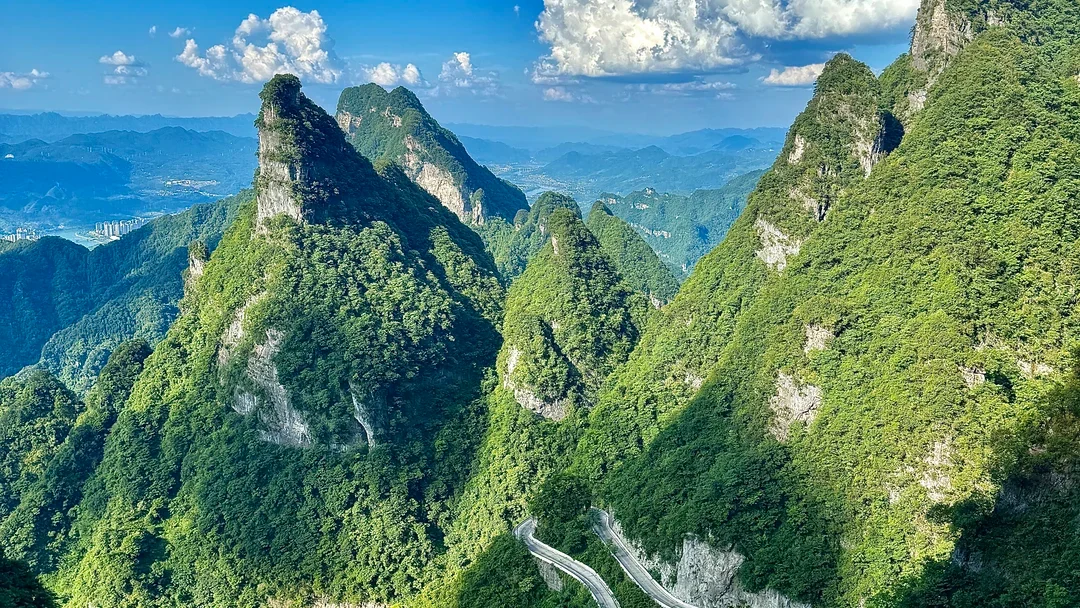
The winding road below matters for the same reason. It turns elevation into something the eye can count. Cableways erase distance efficiently; switchbacks confess how much mountain lies between two points. You do not need to ride every road segment to understand it, but seeing its repeated bends makes the summit’s height legible.
Fog can ruin the view without ruining Tianmen Mountain
I will not romanticize every gray day. If you came to see distant ridges and the city spread below, dense fog can erase the view you paid and traveled for. “Misty atmosphere” is not a complete refund for zero visibility.
But fog is not automatically failure. Tianmen Cave can appear and disappear inside moving cloud; wet railings, dark forest and voices without visible bodies create a completely different mountain. The key is expectation. If panoramic distance is your non-negotiable goal, use the clearest forecast window and keep another Zhangjiajie day flexible. If atmosphere matters too, accept that the mountain may trade breadth for mystery.
Weather also changes safety and operations. Wind, lightning, ice and heavy rain can affect cableways, escalators, roads and exposed walkways. A timetable cannot overrule a closure. The official response for international visitors describes Tianmen as complex mountain terrain served by cableways and escalators; that is a reminder that the attractions are also regulated transport equipment. Obey staff instructions immediately.
What to carry without turning the day into an expedition
Wear shoes with real grip. Bring a light rain layer even when the city starts bright, and add warmth outside summer because the summit can feel different from the streets below. Carry water and a compact snack, but do not pack as if there are no services anywhere on the route. The heavier the bag, the more every stair and queue matters.
Keep passports or accepted identification accessible because timed, real-name admission rules are common at major Chinese attractions. Save the Chinese names of the cableway station and your hotel offline. Battery drain accelerates when a phone is used for maps, translation, photography and ticket codes all day; a small power bank is practical.
A Tianmen Mountain ticket is a route contract
Do not compare tickets only by headline price. Read the selected line, entry window, cableway direction, shuttle segment, included escalators, child procedure, cancellation terms and collection instructions. A cheaper resale listing that obscures those details is not a bargain.
Book early for busy weekends and Chinese public holidays. More importantly, arrive for the time printed on your booking rather than the opening time mentioned in an unrelated guide. Route inventory is capacity-controlled, and waiting at the wrong station can destroy the advantage of an early slot.
| Before payment, verify | Why it matters |
|---|---|
| A, B or C and the written transport sequence | The same mountain can begin at different stations and move in opposite directions |
| Entry time and accepted identity document | A valid ticket may still belong to a specific admission window |
| Status of Tianmen Cave, the stairs and exposed walkways | Ice, maintenance or weather can remove a promised-looking section |
| What requires a separate payment | Glass walkway, optional summit transport or assisted stair alternatives may not share one rule |
| Final shuttle or cableway time | Missing the last connection is not solved by walking down an arbitrary road |
| Accessibility and child procedures | Mountain terrain and special equipment create rules that a city attraction does not have |
Avoid exact prices copied from social posts, including otherwise useful ones. They age immediately and may mix adult, concession, insurance or reseller fees. The official booking interface on your date is the price source that matters.
One day is enough if you refuse the completion fantasy
Tianmen Mountain fits one full day. It does not fit a rushed half-day plus Wulingyuan plus an evening train unless the goal is to remember transfers. Protect the day from a second major mountain attraction.
My practical sequence is simple:
- Before leaving the hotel: check weather, operation notices, ticket line and entry station.
- At entry: confirm the return sequence with staff instead of relying only on yesterday’s screenshot.
- On the first cableway: watch the city-to-mountain transition; do not spend the whole ride editing photos.
- At the summit: choose one coherent ridge circuit and one optional extension. Skip anything that threatens the cave connection or final descent.
- At Tianmen Cave: decide between stairs and assisted movement with the body you have now, not the body imagined during booking.
- After returning to the city: leave time for food and recovery. Do not schedule a fragile connection immediately after a weather-dependent mountain system.
Two choices improve the day more than any secret viewpoint. Start early enough to absorb a queue, and stop adding summit detours when attention is already gone. The worst Tianmen itinerary is not C line or a foggy day. It is a day in which every person keeps moving because nobody is allowed to say, “We have seen enough.”
Use the Zhangjiajie travel guide to place this one-day mountain circuit beside two Wulingyuan days and choose the correct sleeping base. For a broader route through the country, the Travel to China hub connects transport, seasons and regional planning. If Zhangjiajie is part of a longer inland journey, travel to Chongqing offers a radically different vertical city experience. Travelers connecting through Hunan’s capital can also read the Changsha culture guide and decide whether the city’s street-level energy deserves more than a transfer night; the Changsha food guide is the practical continuation once mountain snacks stop being enough.
My final Tianmen Mountain rule
Choose A for the strongest first reveal, B when the direction suits your body better, and C when fear or operations make it the honest route. Then stop treating the itinerary as a courage contest.
Tianmen Mountain stays in memory because it rearranges scale: city becomes pattern, road becomes thread, cliff becomes wall and sky becomes an opening inside rock. The glass floor may produce the loudest ten seconds. The complete vertical journey produces the day.