Changsha (长沙) is not interesting because it stays awake later than other Chinese cities. It is interesting because history, appetite and entertainment remain unusually public. A Han tomb exposes the texture of private life; an academy places argument inside a mountain landscape; Orange Isle turns a river into political memory; breakfast shops and late-night tables keep strangers within speaking distance. My Changsha judgment is blunt: the city’s real attraction is participation, not nightlife. It keeps asking people to look, eat, answer, remember and join in.
This is one city chapter inside East Moment's wider Chinese culture map. The map supplies the national connections; this page stays with the public spaces through which Changsha makes memory visible.
Changsha culture guide: begin with five public stages
| Question | Short answer |
|---|---|
| Why visit? | For Mawangdui, Yuelu Academy, Hunan food, Xiang River landscapes, modern media culture and a dense late-night city center |
| Ideal first stay | Four days, including one full museum day and one slower west-bank day |
| Best first base | Near a metro line between the central commercial area and a convenient Xiang River crossing |
| Essential experiences | Give Hunan Museum real time, walk Yuelu Academy and mountain, eat a rice-noodle breakfast, cross the river and compare daytime Changsha with its night economy |
| What makes it different? | Archaeology, education, revolutionary memory, media production and food all operate as forms of public storytelling |
| Main planning trap | Arriving only for stinky tofu and nightlife, or treating reconstructed riverfront architecture as ancient survival |
Choose the Changsha you want to meet
| If you care most about | Build your days around | Add this contrast |
|---|---|---|
| Archaeology | Hunan Museum and Changsha Museum | Compare Mawangdui's elite tomb world with the longer regional timeline |
| Intellectual history | Yuelu Academy and Hunan University | Notice how an old institution functions inside a modern campus and tourist district |
| Twentieth-century China | Orange Isle, memorial sites and wartime history | Separate historical evidence from later monumental landscapes |
| Food | Rice noodles, small snacks and one regional Hunan dinner | Use the Changsha food guide instead of ordering only viral dishes |
| Media and youth culture | Malanshan, commercial districts, bookstores and live events | Compare produced entertainment with ordinary student and neighborhood life |
| Architecture | Temple gates, academy courts, museums and modern riverfront structures | Ask which buildings survive, which were restored and which are new interpretations |
Mawangdui turns the Han dynasty into physical life
The Mawangdui tombs, excavated in Changsha in the 1970s, are among the city's most important cultural anchors. Tomb 1 contained the exceptionally preserved body of Xin Zhui, commonly known as Lady Dai, along with lacquerware, textiles, food remains and other burial objects. The wider tomb group also produced manuscripts and maps that changed scholarship on early imperial China. I reject the habit of rushing past those daily-life objects to stare only at preservation as spectacle; food, clothing, medicine and manuscripts are the reason one life can reopen an entire social world. The Hunan Museum's official English site is the correct place to verify current collections and visitor information before treating any online image as an object record.
Hunan Museum presents these objects as a connected burial world. Do not rush directly to the body. Silk paintings, food vessels, cosmetics, clothing, medical texts and household objects show how status, health, the afterlife and daily comfort were imagined together.
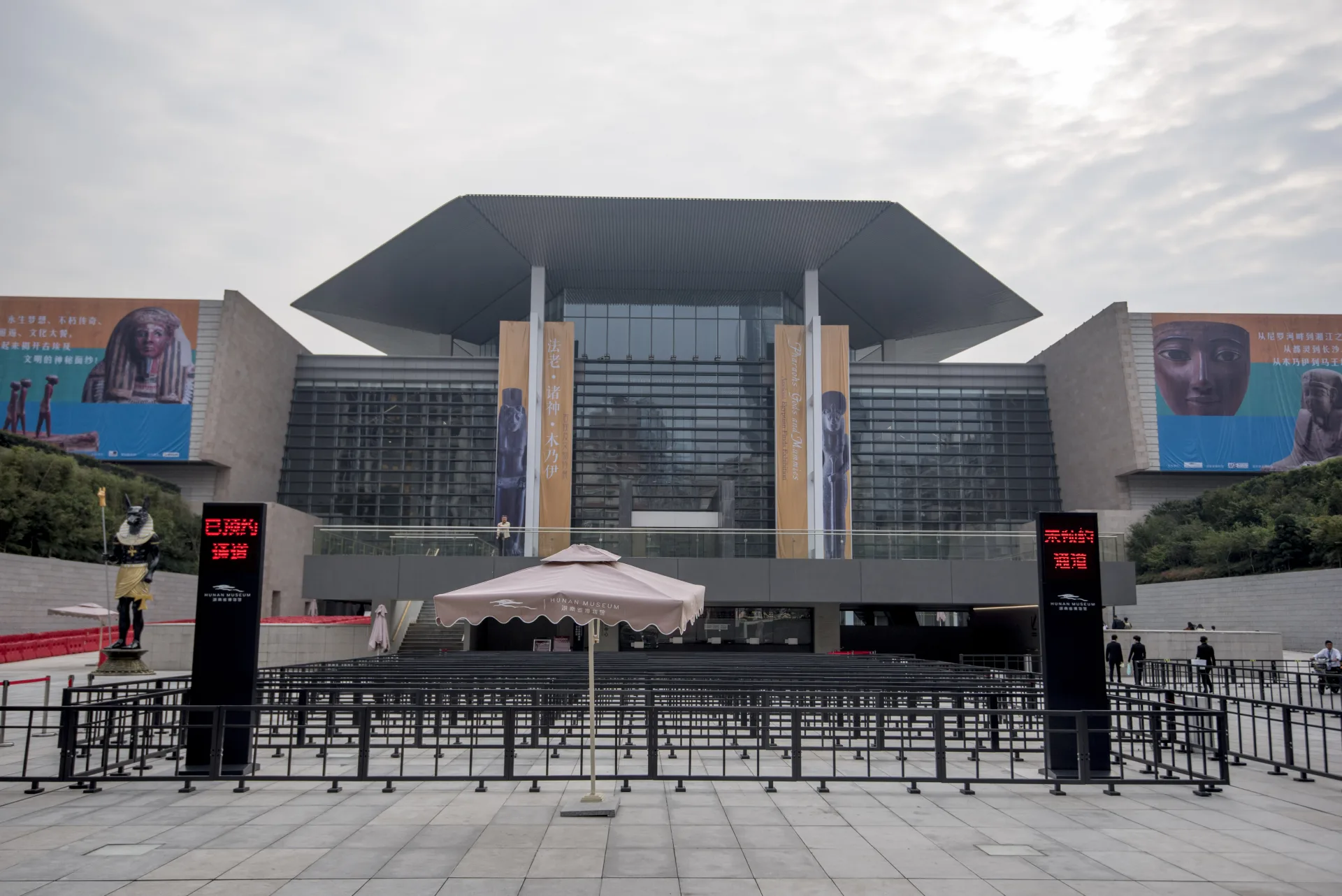
Hunan Museum in Changsha. Photograph by Siyuwj, CC BY-SA 4.0, via Wikimedia Commons. License record.
| Object or evidence | What it can reveal | Common mistake |
|---|---|---|
| Silk funeral banner | Cosmology, status and ritual imagery | Treating every figure as self-explanatory symbolism |
| Lacquerware | Elite dining, craft specialization and long-distance resources | Seeing decoration without production labor |
| Food remains | Ingredients, preservation and burial preparation | Assuming tomb food equals an ordinary Han meal |
| Medical manuscripts | Early knowledge systems and bodily practice | Reading ancient terminology as modern clinical advice |
| Maps and texts | Administration, geography and intellectual life | Calling every manuscript the world's first example without qualification |
| Xin Zhui's body | Burial conditions, health evidence and conservation science | Turning a person into a spectacle detached from the tomb context |
The most respectful visit restores the individual to her historical environment. Conservation displays may change, so consult current Hunan Museum information before planning a single-object trip.
Yuelu Academy connects learning to place
Yuelu Academy traces its institutional history to the Northern Song period. It became part of a long tradition of scholarship and is now associated with Hunan University. The visible complex includes buildings renewed across later periods; it is not an untouched campus from 976.
The academy's importance lies in continuity through change: teaching, printing, ritual, examination culture, political argument and modern higher education have all shaped the site.
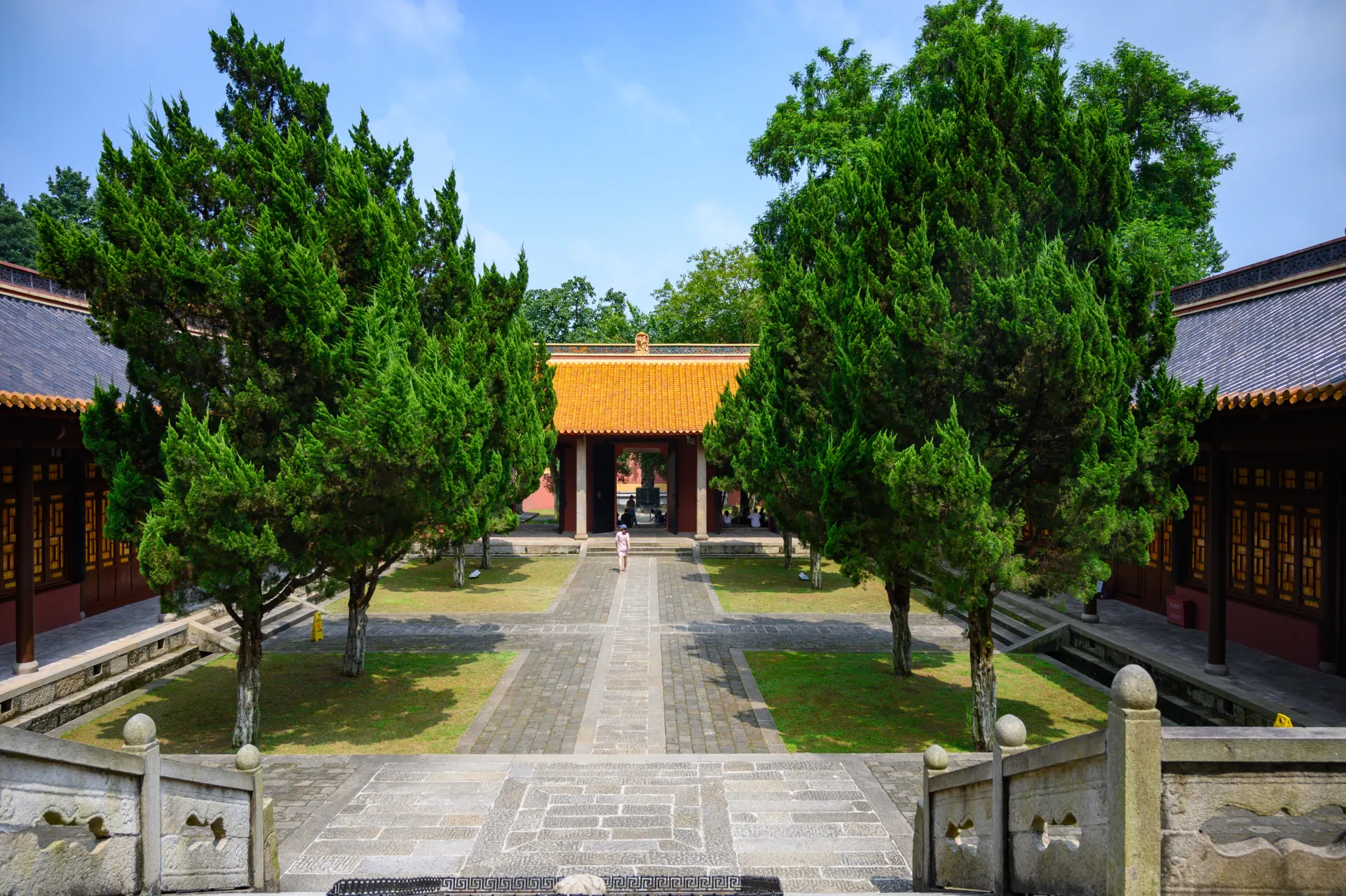
A courtyard inside Yuelu Academy. Photograph by xiquinhosilva, CC BY 2.0, via Wikimedia Commons. License record.
| Read the academy through | Look for | Ask |
|---|---|---|
| Spatial hierarchy | Gates, courts, lecture halls and shrines | Who could enter each space, and for what purpose? |
| Inscriptions | Calligraphy, names and institutional memory | Which text is original, copied, restored or newly displayed? |
| Landscape | Mountain, trees, paths and water | How does the environment support an image of study and retreat? |
| Modern campus | Students, research buildings and public circulation | How does heritage operate inside a living university? |
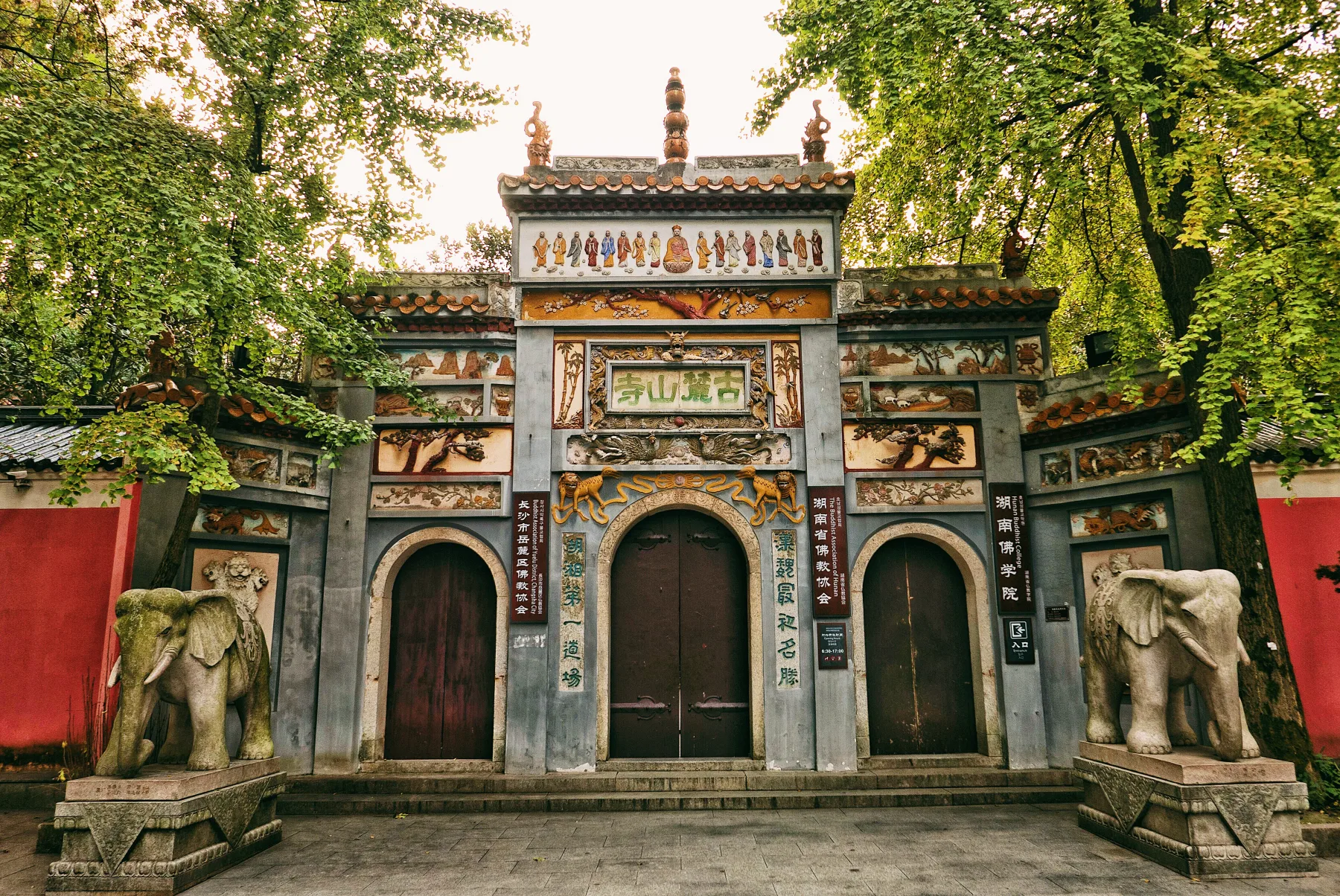
Nearby Ancient Lushan Temple adds Buddhist institutional history to the mountain. Its name and long lineage should not make every visible roof ancient.
Orange Isle and Juzizhou Head define Changsha's river identity
The Xiang River divides and connects Changsha, while Orange Isle (Juzizhou, 橘子洲) occupies the river itself. The long island is not simply a park placed beside the city. It forms a central viewing platform between Yuelu Mountain and the university district on the west bank and Changsha's commercial skyline on the east.
The phrase Juzizhou Head (Juzizhou Tou, 橘子洲头) carries more meaning than a literal location at the end of the island. It is widely recognized through Mao Zedong's 1925 poem Qinyuanchun: Changsha, which opens in autumn beside the north-flowing Xiang River and turns the landscape into a question about history, youth and political agency. For many Chinese visitors, the name therefore evokes a line of poetry before it describes a sightseeing stop.
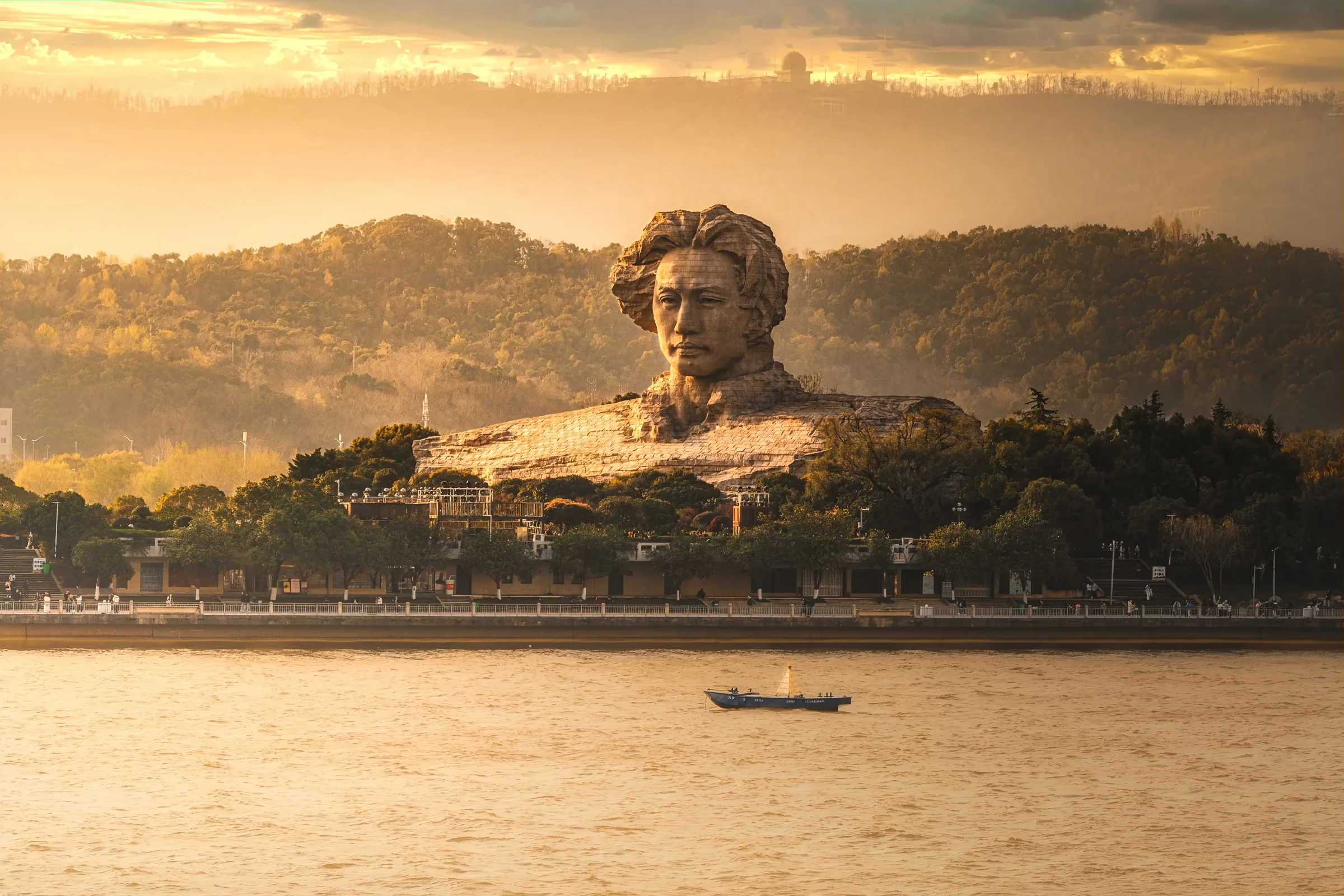
The monumental portrait of young Mao near the island's southern end gives that literary and revolutionary memory a physical form. The sculpture is a twenty-first-century memorial landscape, not a surviving object from Mao's student years. Its scale reveals how contemporary Changsha stages historical memory for a national public.
| Read Orange Isle through | What to notice | Why it matters |
|---|---|---|
| River geography | Water on both sides, Yuelu Mountain to the west and the modern center to the east | The island makes Changsha's historical and contemporary districts visible together |
| Poetry | The words Juzizhou Tou and the autumn Xiang River setting | A physical place became one of modern China's most recognizable poetic landscapes |
| Youth and revolution | The young-Mao image rather than an older state portrait | The site emphasizes ambition, formation and political awakening |
| Monument building | Enlarged facial features, landscape-scale stonework and carefully framed approaches | Public memory here is designed, recent and monumental rather than archaeological |
| Everyday city life | Walkers, families, river traffic and changing skyline views | The island remains part of lived Changsha, not only a ceremonial backdrop |
For international visitors, Orange Isle works best as a slow river walk rather than a single sculpture photograph. Look west toward the academy and university landscape, then east toward the commercial city. That comparison explains Changsha more clearly than treating Juzizhou Head as an isolated political monument. Check current access, shuttle and crowd-control arrangements before visiting, especially during major holidays or severe weather.
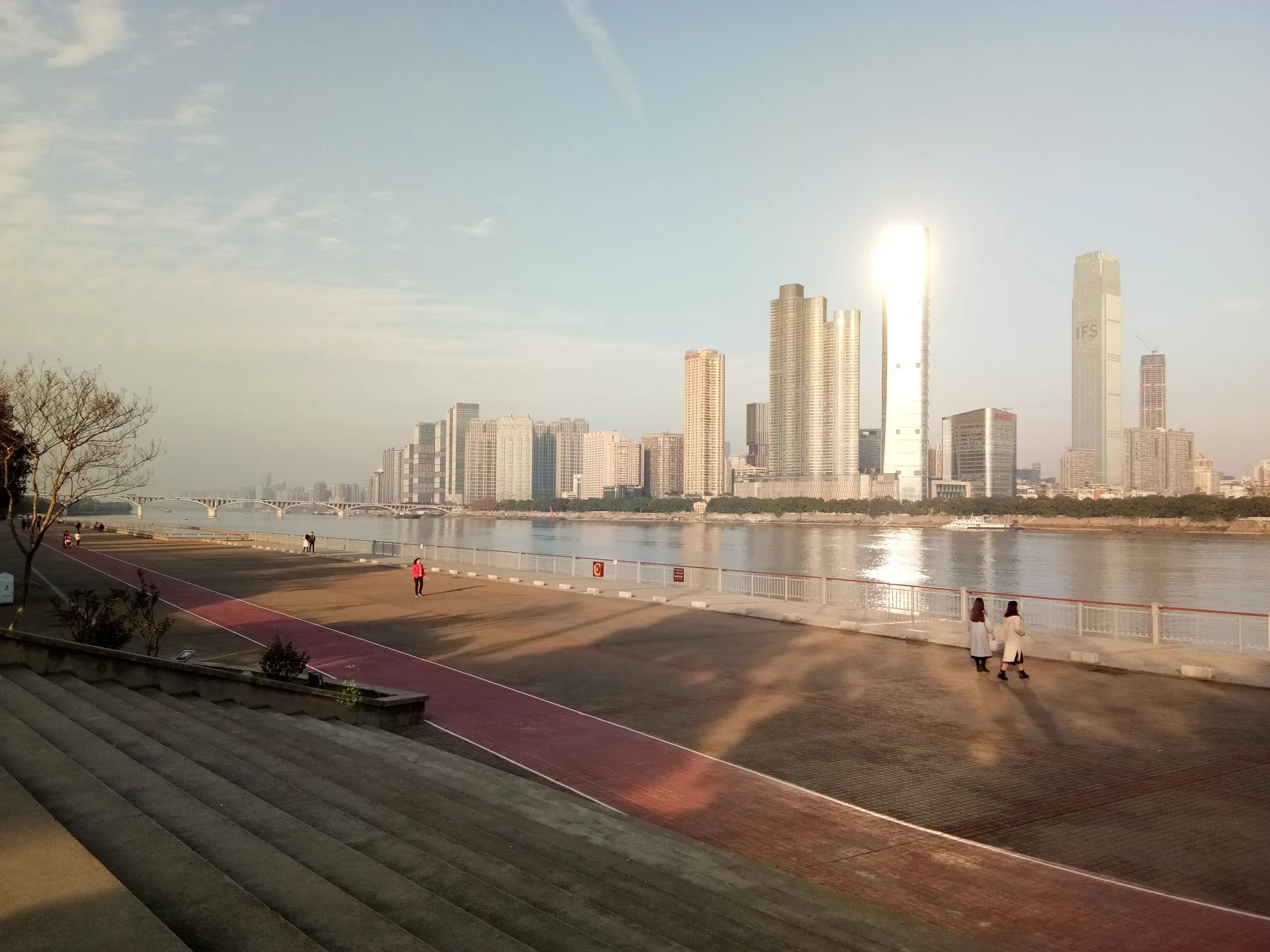
The Xiang River and central Changsha seen from Orange Isle. Photograph by এম আবু সাঈদ, CC BY-SA 4.0, via Wikimedia Commons. License record.
Du Fu's final journeys through Hunan also shape the riverfront memory landscape. The present Du Fu River Pavilion is modern.
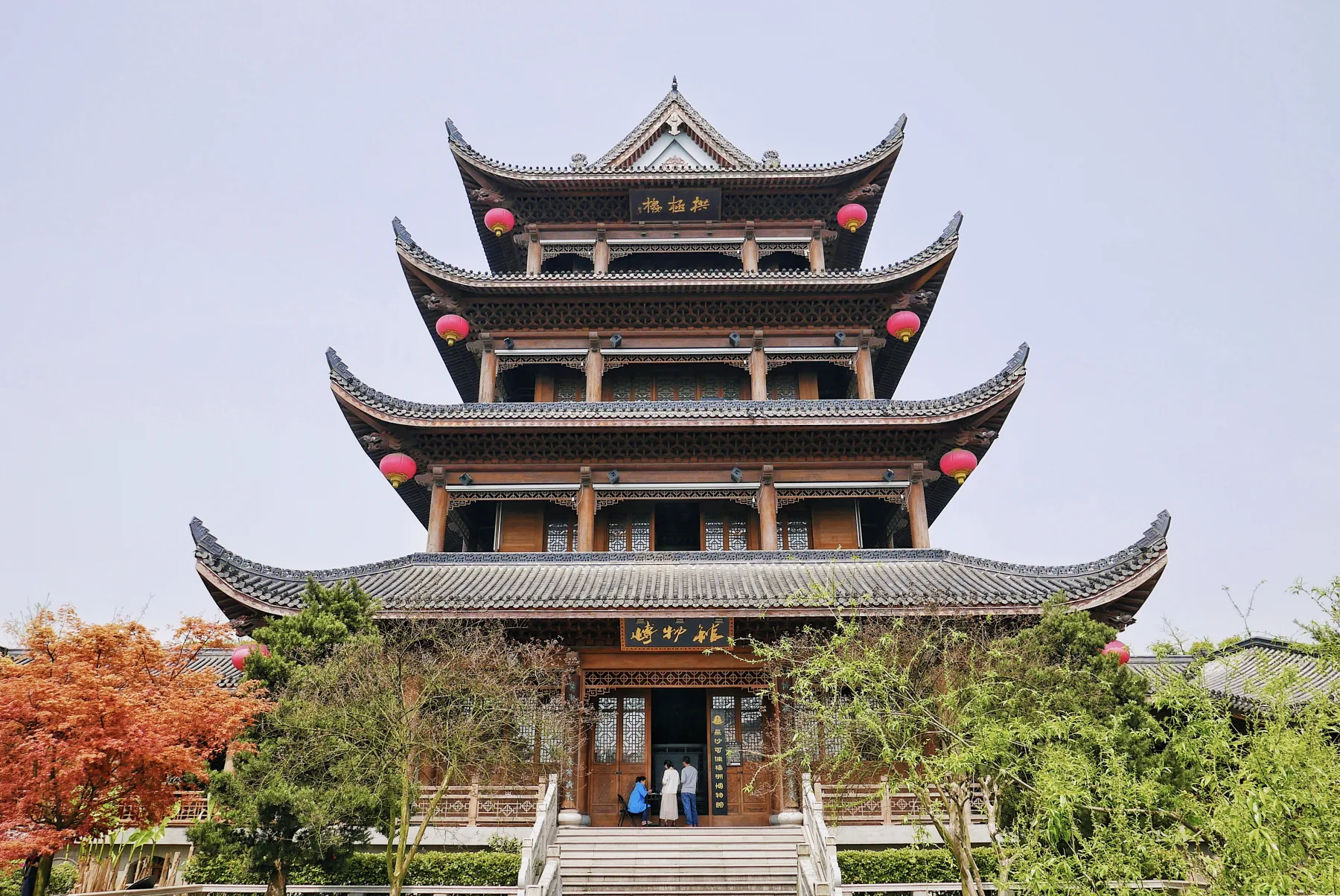
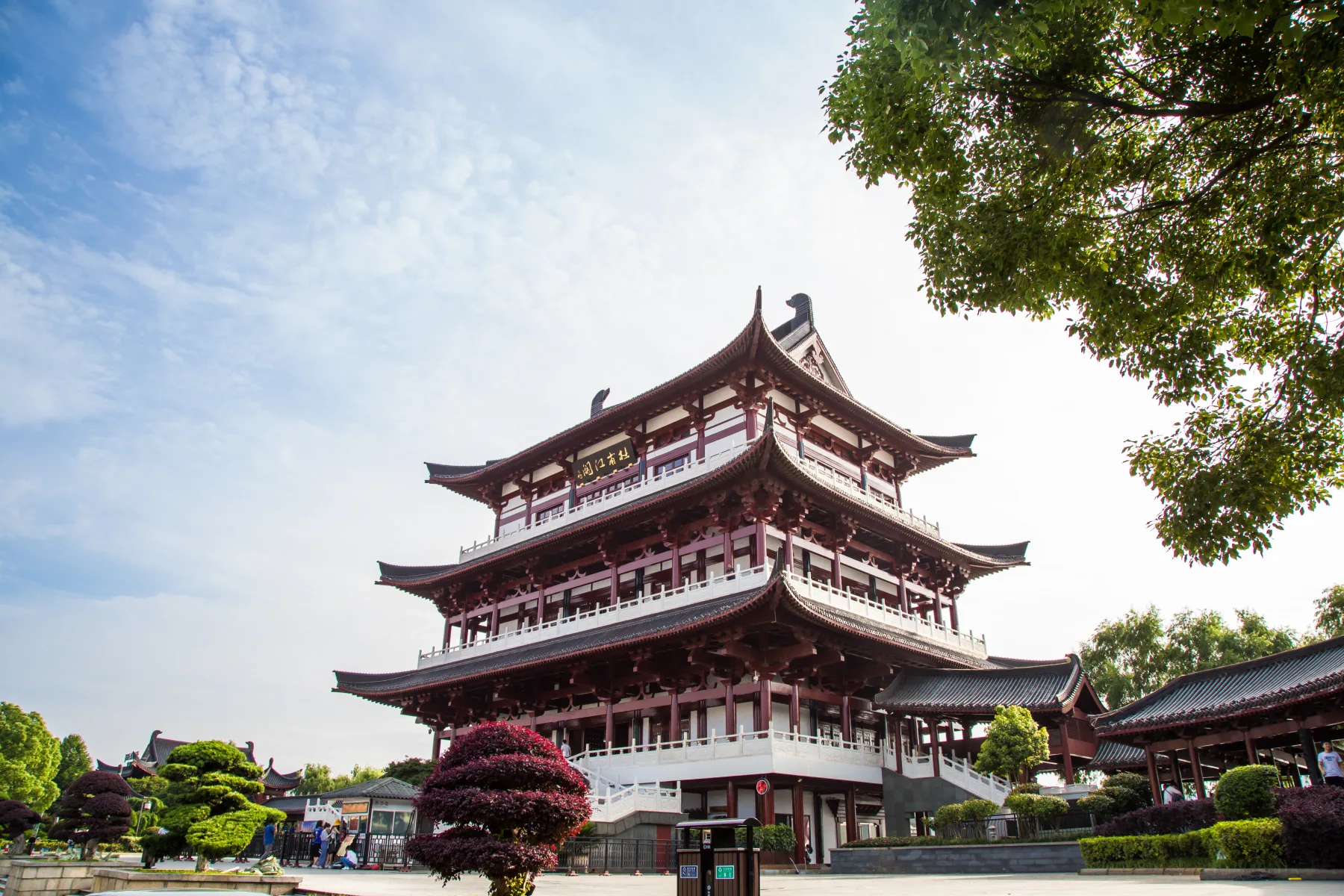
The pavilion is valuable when read as an act of commemoration. It tells us how the contemporary city wants poetry to stand beside the river. It does not transport visitors into an intact Tang landscape.
Changsha kiln ceramics show an outward-looking city region
The Changsha kiln, often associated with Tongguan, produced ceramics during the Tang period for domestic and overseas markets. Painted decoration, inscriptions and forms found along maritime routes show that inland production and global exchange were connected through rivers and ports.
This history complicates the idea that Changsha's international cultural production began with television. Media changed, but the region had already learned how images, words and objects travel.
Continue through Chinese porcelain for the wider ceramic story, while keeping kiln-specific claims tied to excavated objects and documented find sites.
Fire and war repeatedly remade the visible city
Changsha suffered severe destruction during twentieth-century war, including the 1938 Wenxi Fire and later fighting. Older institutions may have long histories without preserving complete original building fabric.
This is why reconstructed gates, pavilions and heritage streets require precise language. Reconstruction does not make a site meaningless; it changes what the site can prove. A modern building may preserve memory, support ritual or organize tourism, but it is not archaeological survival.
Hunan flavor is part of urban identity
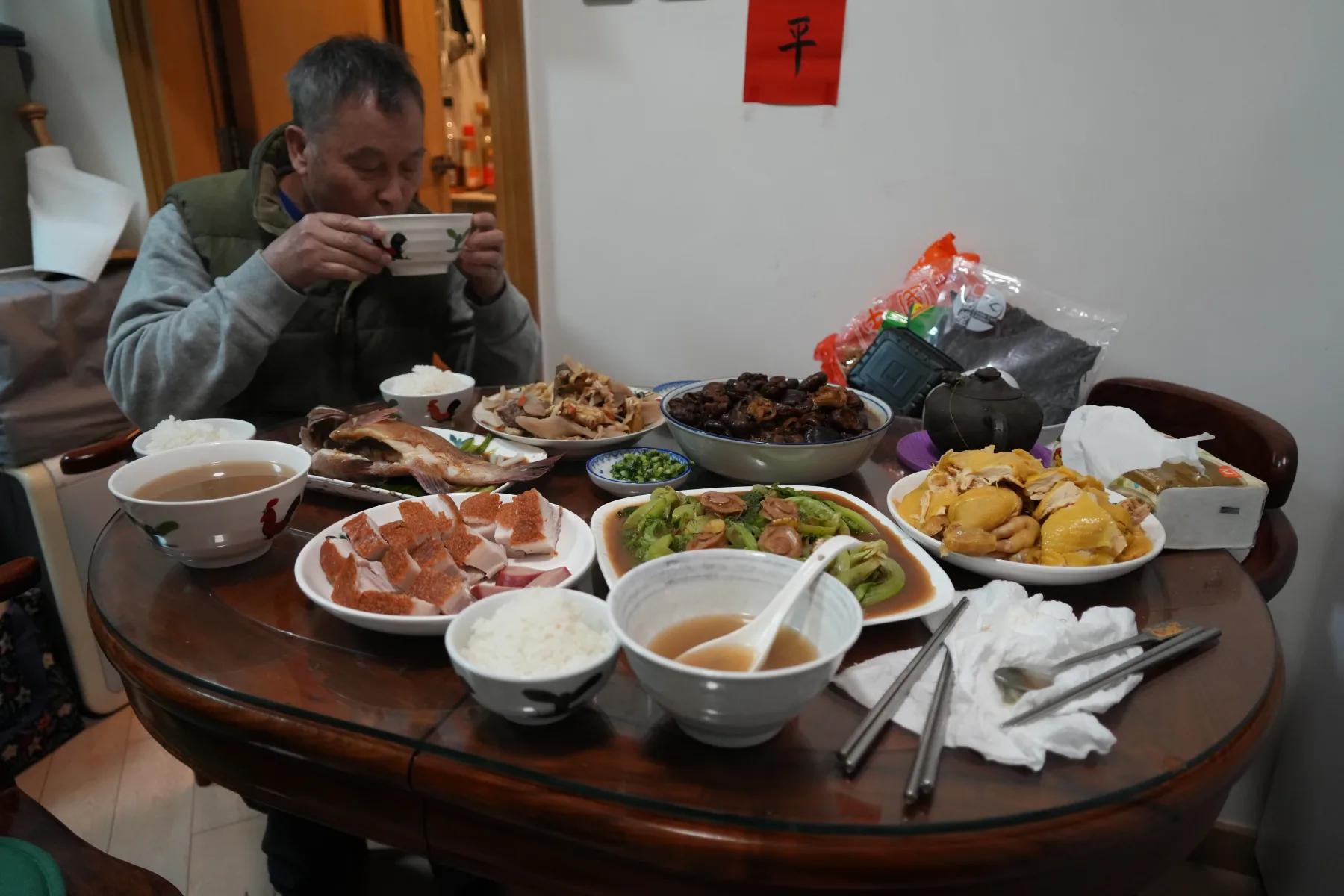
Food is one of Changsha's strongest forms of public culture. Rice-noodle shops structure mornings; snack streets and malls shape afternoons; late-night crayfish, skewers and shared Hunan dishes extend the city after dark. I insist on beginning with breakfast, because a normal bowl eaten before the queues exposes more of the city's rhythm than a whole evening of viral snacks.
Changsha does not own every dish served in the provincial capital. The broader Hunan cuisine guide distinguishes provincial traditions, while the Changsha food guide focuses on the city's eating rhythms.
Changsha became a media city by building an ecosystem
UNESCO recognizes Changsha as a Creative City of Media Arts. Television production is central to the city's national image, but contemporary media includes animation, short video, digital effects, live events, advertising and platform economies.
Malanshan represents this production landscape. Visitors should not expect one picturesque arts quarter. I believe Changsha's media power becomes interesting only when the camera turns around and shows the studios, editors, training, technology and distribution that manufacture public excitement.
Music belongs in that ecosystem too. C-BLOCK formed in Changsha and made local speech, neighborhood observation and city pride audible long before regional rap became a national television format. CSC works as a wider banner for Changsha rap rather than another name for the group. Our Changsha rap scene guide explains the wider history and the trio's contrasting roles; the Sheng Yu guide follows its commanding public voice, while the GAI profile shows how the Changsha and Chongqing stories later met in G-BLOCK.
| Media layer | What visitors may notice | Deeper question |
|---|---|---|
| Television | Familiar entertainment brands and celebrity culture | How did provincial broadcasting become nationally influential? |
| Short video | Food queues, city memes and rapid trends | Which urban experiences are being designed for circulation? |
| Live performance | Music, comedy, clubs and commercial shows | Who can afford space and attention in the center? |
| Digital production | Animation, visual effects and technical services | How does creative labor connect to software and industrial policy? |
| Retail spectacle | Giant signs, queues and photogenic interiors | When does public life become a production set? |
The night economy is real, but it is not the whole city
Changsha's central districts can remain intensely active late into the evening. Restaurants, tea drinks, retail, street food and social media reinforce one another. For younger visitors, this accessibility is part of the appeal.
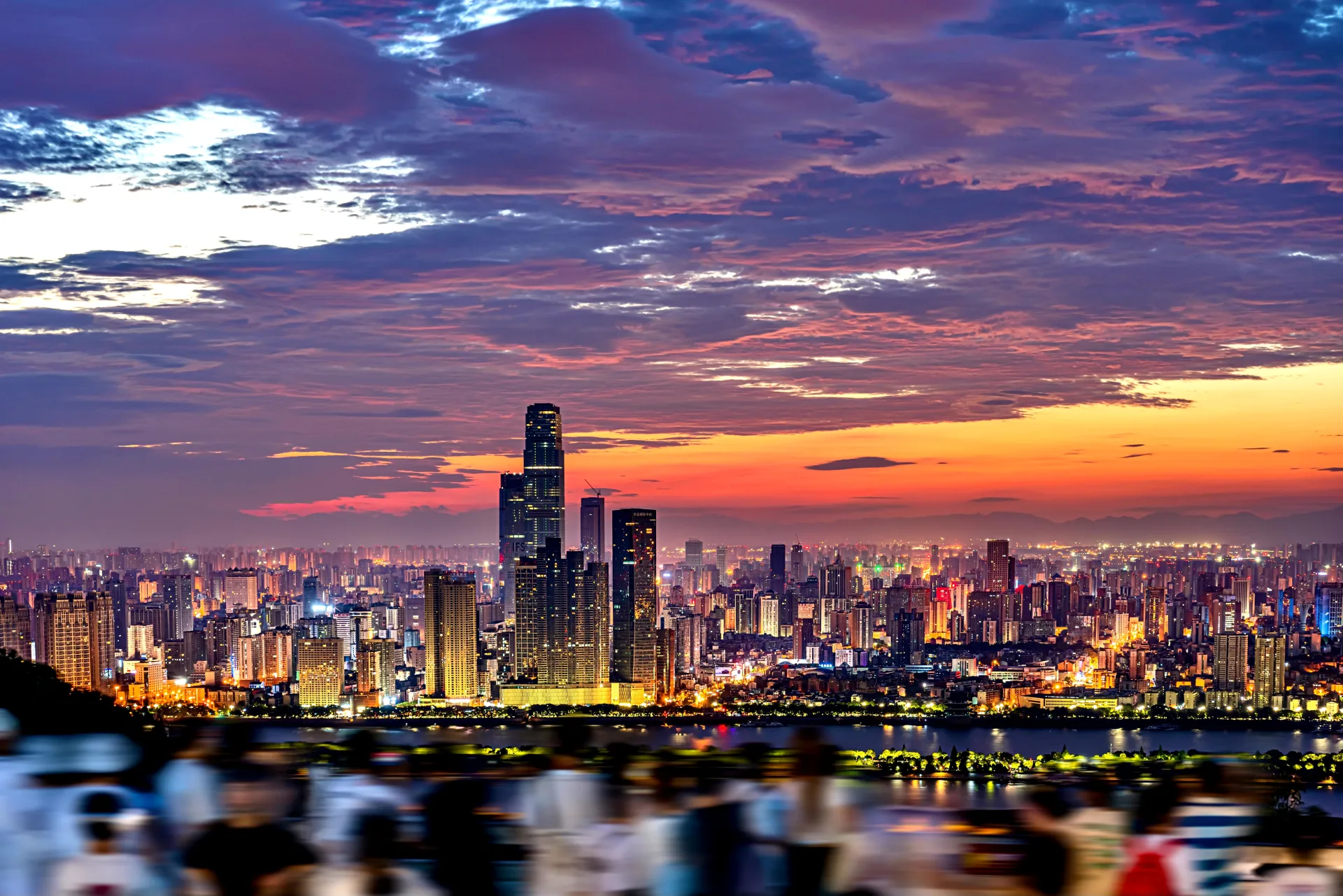
Changsha at dusk from Yuelu Mountain. Photograph by Jonasjiangming, CC BY-SA 4.0, via Wikimedia Commons. License record.
But a viral queue is not proof of quality, and a crowded pedestrian street is not the full local economy. The most persuasive accounts of Changsha are often smaller: a stranger walking a confused newcomer to the correct bus stop in the rain; students treating a midnight meal as ordinary rather than exceptional; a familiar C-BLOCK song leaking out of a shop without becoming a staged attraction. Those moments explain why the city can feel open without pretending that every encounter is warm or every district is easy.
I would spend one evening in the illuminated center and a second in a university, residential or riverside area where people are not performing Changsha for visitors. The contrast is the evidence. Neon proves that the city can manufacture attention; ordinary public generosity proves that people can still inhabit it.
A four-day Changsha itinerary
| Day | Focus | Suggested rhythm |
|---|---|---|
| 1 | Mawangdui | Hunan Museum, a quiet lunch and an early night walk rather than another major museum |
| 2 | Yuelu | Yuelu Academy, university surroundings, mountain paths and west-bank cafes or bookstores |
| 3 | River and memory | Orange Isle, Changsha Museum or wartime history, then Du Fu River Pavilion after daylight |
| 4 | Contemporary Changsha | Media or creative district, neighborhood food, central retail and one late-night meal |
Practical Changsha planning
| Issue | Useful approach |
|---|---|
| Museum access | Check reservation, closure and exhibition rules before building the trip around Mawangdui |
| Heat | Summer humidity can make midday outdoor routes exhausting; place museums at the hottest hours |
| Rain | Carry a compact rain layer and use metro-based alternatives for river and mountain days |
| Night crowds | Visit the most popular center once, then choose a less photographed district for comparison |
| Spice | Ask about fresh chili, dried chili and preserved chili; removing visible chili may not remove the sauce |
| Reconstructions | Read dates and labels before describing a pavilion, gate or street as ancient |
| Accessibility | Mountain paths, old thresholds and crowded pedestrian streets vary; check each site separately |
Changsha turns cultural memory into public energy
The city is compelling because it refuses to remain in one register. Tomb objects become national treasures, an academy becomes a modern campus, poetry becomes a new pavilion, television becomes a digital industry and dinner becomes nightlife. The mistake is to call all of this “vibrancy” and stop thinking. Changsha’s deeper skill is converting memory into something people can enter together.
That is why I would never sell the city as a list of photogenic stops. Give Mawangdui half a day, cross the Xiang River slowly, eat breakfast before chasing a queue and listen for the Hunan speech that carries from comedy and television into rap. A serious visit enjoys the energy while asking what was preserved, what was rebuilt and who is doing the work behind the screen.