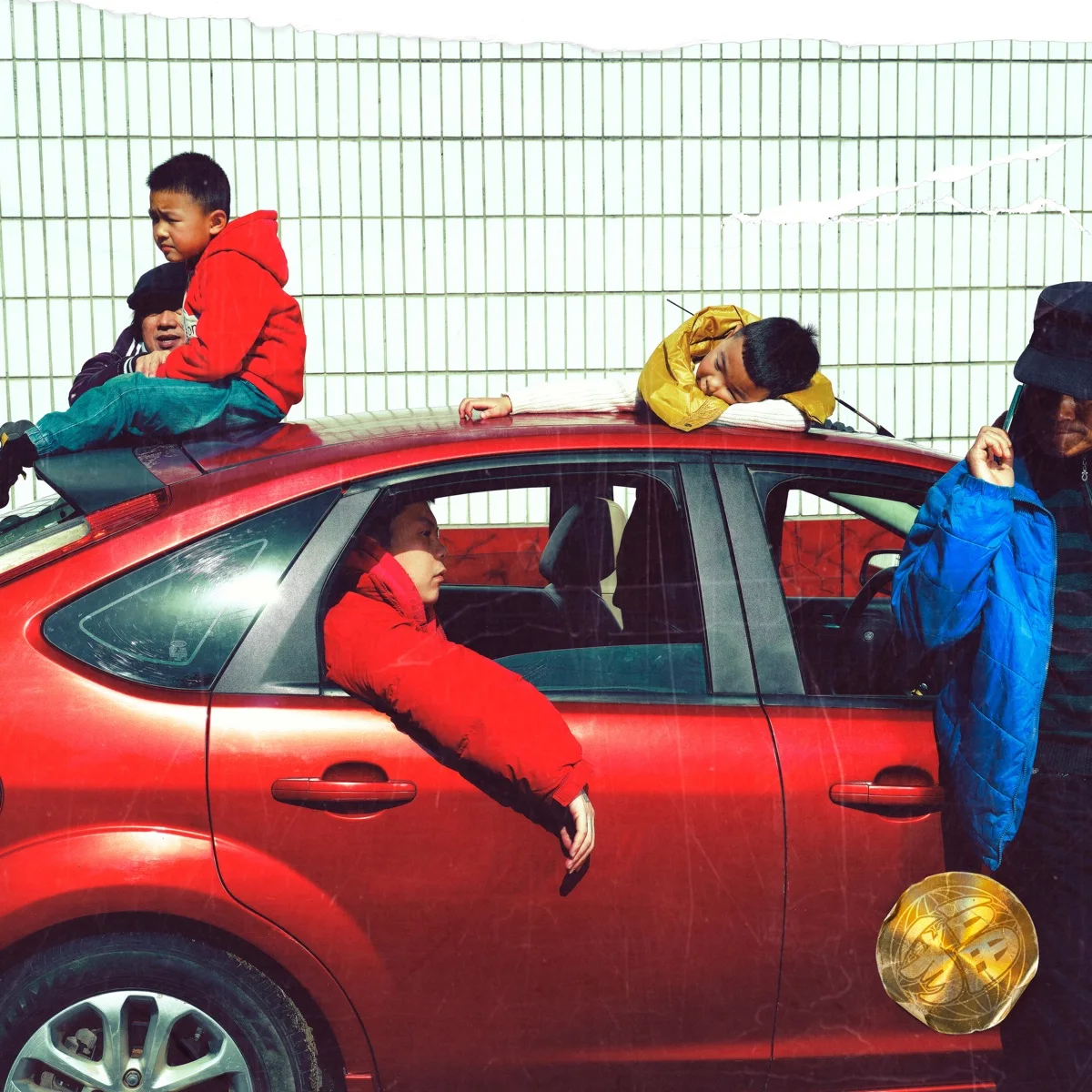
The Changsha rap scene has a resource that cannot be manufactured in one season: time. Crew identity, local speech and shared memory existed before solo branding and national television scale. The result is not nostalgia. It is a musical advantage: artists can disagree inside a history the audience already knows.
This is the Changsha quality that moves me most. C-BLOCK does not sound valuable because three people remained under one name; it sounds valuable when years of trust let the center move without anxiety. Sheng Yu can enlarge the room, KungFu-Pen can make a Hunan syllable strike like percussion, and KEY.L can slow the same group history into private memory. Longevity without changing roles is nostalgia. Longevity that permits difference is craft.
For overseas listeners, the names can be confusing. CSC is a broad Changsha scene banner. C-BLOCK is the defined trio of Sheng Yu, KungFu-Pen and KEY.L Liu Cong. G-BLOCK is their 2025 collaboration with GAI, not a replacement organization. Sio and Ranzer belong to the wider local conversation without being rewritten as members of either group.
This guide explains those distinctions, the three C-BLOCK roles, Sio's lateral connections, Ranzer's generational bridge, Hunan speech and why Changsha remains interesting after television discovered how well the scene could fill a large stage.
For a wider map of styles and cities, continue through East Moment's Chinese rappers guide; this page owns the relationships that make Changsha a scene rather than a roster.
Changsha rap scene carries time inside the crew
| What you want to understand | The short answer |
|---|---|
| Wider scene banner | CSC, used for Changsha rap identity and a broader local network |
| Defined central group | C-BLOCK: Sheng Yu, KungFu-Pen and KEY.L Liu Cong |
| Formation marker | Apple Music lists C-BLOCK as formed in 2007 |
| Three member strengths | Command, verbal snap and narrative restraint |
| Wider network | Sio's collaborations and Ranzer's newer-generation 湖湘 writing extend the map beyond C-BLOCK |
| Local musical resource | Hunan speech used as timing, percussion, humor and social position |
| Later cross-city project | 2025 G-BLOCK Mixtape with GAI |
| Common mistake | Treating Singer 2024 as the beginning rather than an amplification of long-developed group craft |
CSC is the banner; C-BLOCK is the group
The clean distinction comes first. CSC is commonly used as a banner for the wider Changsha scene. It can signal city identity, local affiliation and a history larger than one lineup. C-BLOCK is the specific three-member group.
Confusing the names makes the scene smaller than it is. It also makes C-BLOCK's achievement harder to understand. A scene can contain changing participants and relationships; a group has to solve the practical problem of how particular voices share records and stages.
Apple Music's official C-BLOCK page lists 2007 as the formation year. The date matters because it places the group's development before The Rap of China, before short-video visibility became a normal career tool and before overseas listeners could easily find official Chinese rap catalogs.
Time did not guarantee success. It created memory: old songs, local references, arguments, member roles and an audience able to hear when the group was changing.
C-BLOCK works because the center can move
A weak group is one front person plus two names in smaller type. C-BLOCK works differently. The members share a grammar, but the center changes according to the song.
The 2017 album Yixia Fanshang in Apple Music's official catalog is a useful central document. Its title carries the pressure of challenging upward from below. Yet the record is not only a victory statement. Humor, ordinary-life observation, melody and self-examination prevent scene pride from becoming a single repeated pose.
The three-member structure also gives solo work more meaning. Each catalog reveals a tool that was already changing the group from inside.
Three voices, three changing functions
C-BLOCK lasts because its members are recognizable without being trapped in permanent jobs. The following roles describe what each voice often contributes; they are listening tools, not fixed character assignments.
Sheng Yu supplies scale and command
Sheng Yu, also known as D-SHINE or Da Sha, can make a room feel larger. His stance is direct, the voice projects and hooks are built to return from a crowd.
Calling him only “the loud member” misses the organizational intelligence. Group leaders have to establish stakes quickly, leave room for contrast and make a shared performance feel intentional. Sheng Yu's command gives the other voices a clear surface to push against.
Jin Shang Tian Hua is a strong solo entrance because the performance turns recognition into a contest over who gets to define Changsha's position. The important word is not pride but authority. The song does not ask an outside platform to invent the scene; it demands that the platform recognize work already done.
KungFu-Pen makes Hunan speech strike like percussion
KungFu-Pen, also known as Shi Yifan or 功夫胖, makes language snap. Consonants, short phrase endings and Hunan speech become percussive choices rather than local decoration.
His role is valuable because verbal force can redirect a group record in seconds. A measured section gains edge; a slogan gains internal rhythm; a familiar idea sounds physically new because the mouth attacks it differently.
The 2026 album My Family Picture expands that tool beyond crew assertion. You Zi Yin, Yu Lan and the wider project bring family, absence and return into the frame. The development matters: local identity is no longer only a city shouted outward. It is also kinship, memory and the difficulty of coming home changed.
KEY.L Liu Cong gives the scene narrative patience
KEY.L Liu Cong was born in Hengyang and formed his defining rap community through Changsha and C-BLOCK. Preserving that distinction is more accurate than simply calling every scene member Changsha-born.
KEY.L rarely forces every bar to sound like a climax. His low, steady delivery allows objects and memories to accumulate. A street, an old device, a younger self or a small regret can carry more emotional weight than a large declaration.
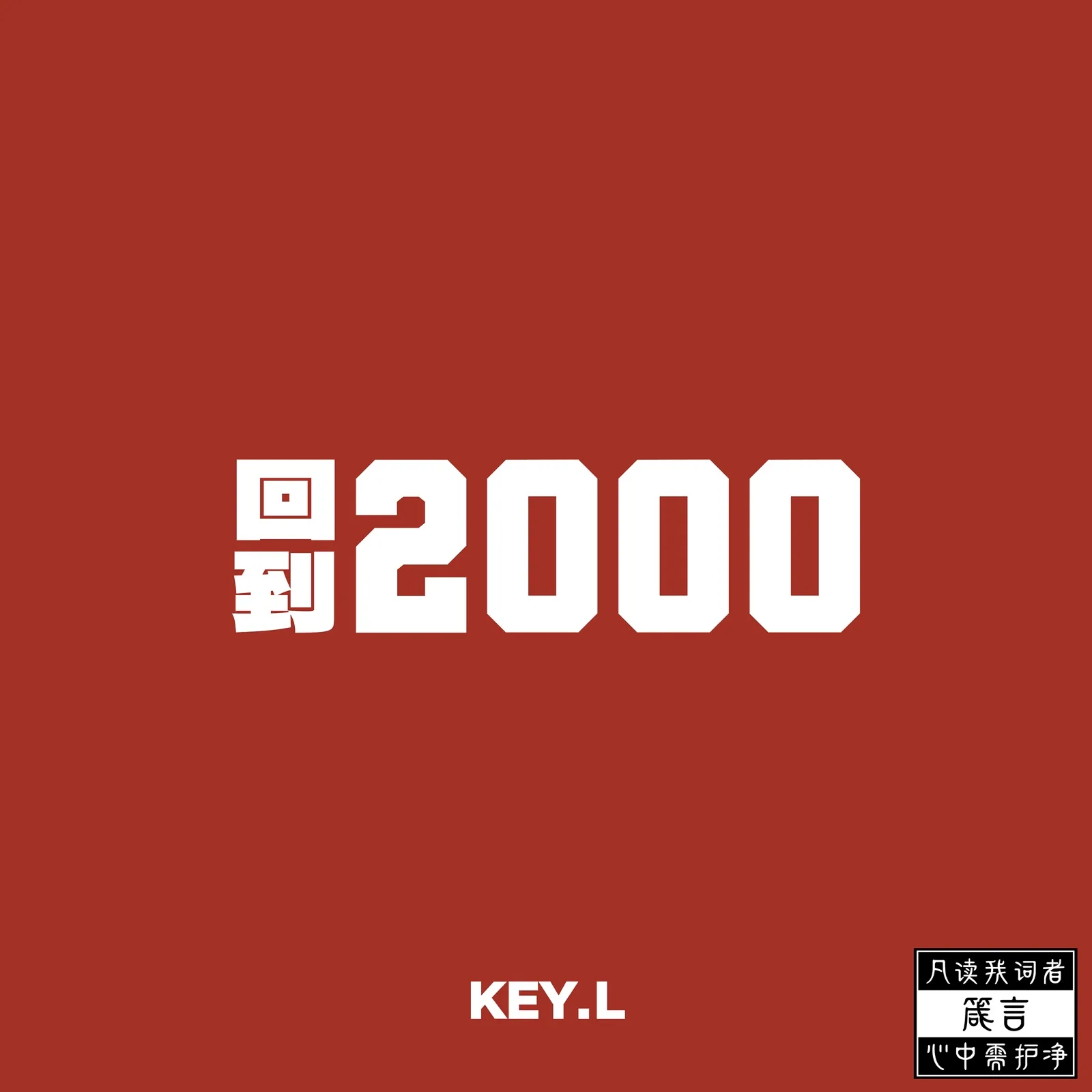
That restraint changes how C-BLOCK is heard. Sheng Yu can establish the room and KungFu-Pen can sharpen its language; KEY.L can reveal what the room remembers. Hey KONG, Future Awaits and Back to 2000 make the long timeline emotionally useful rather than merely impressive.
Changsha rap exceeds C-BLOCK
C-BLOCK is the strongest organizing story in Changsha rap, but a city collection page fails if the trio becomes its outer border. The broader scene is visible through recurring collaborations, local titles and artists who connect established figures without sharing one formal lineup.
Sio connects the scene sideways
Sio / 西奥Sio matters less as another name to place beneath a city heading than as a connector. His official Apple Music catalog documents 十字路口 and 别人家的孩子 with KEY.L Liu Cong, 活在当下 with KungFu-Pen and 牛逼 featuring Yee. The local title 湘A makes the regional coordinate explicit, while the catalog's spread across different release periods shows a career extending beyond one collaboration cycle.
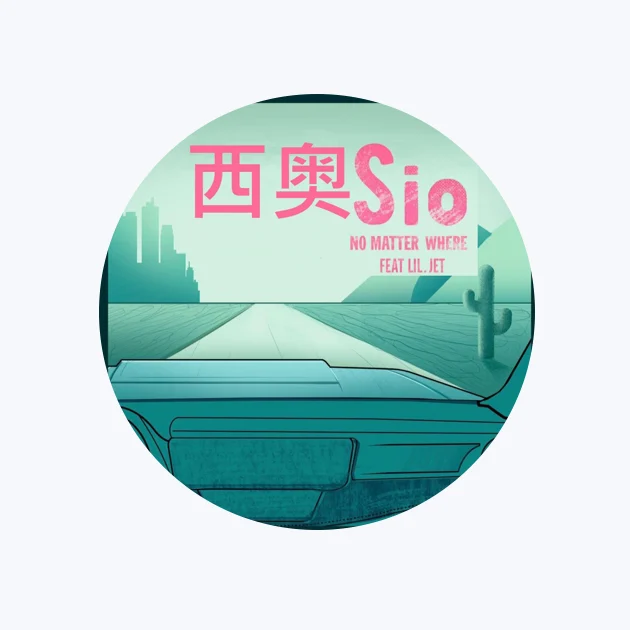
Official Apple Music artwork for Sio / 西奥Sio. The collaborations place him beside C-BLOCK members; they do not make him a C-BLOCK member. Image record.
The analytical value is lateral movement. Sheng Yu, KungFu-Pen and KEY.L can be heard as three fixed positions inside one durable group. Sio shows how ideas travel beside that structure: one song leans toward narrative exchange, another toward verbal force, another toward a broader SUP Music-linked catalog. A scene needs those side roads or its central group becomes a museum piece.
Ranzer turns inheritance into a live question
Ranzer / 叶润泽 represents a newer generational route. The 2025 album 湖湘浪子 names Hunan cultural geography directly, but the stronger evidence lies in the relationships around it: 故湘,风 with KungFu-Pen, Sheng Yu and GAI; 杯莫停 with KungFu-Pen; 从前以后PT.2 with Sheng Yu; and 酒歌 with GAI. The point is not proximity to famous names by itself; it is the repeated movement between generations that the official catalog makes visible.

Official Apple Music artwork for Ranzer / 叶润泽. His collaborations document a generational bridge, not automatic membership in a fixed crew. Image record.
Ranzer is useful because “legacy” can otherwise sound passive, as if younger artists only inherit approval. His catalog makes inheritance a negotiation. Hunan memory is present, but it has to survive newer production, newer stages and direct proximity to artists whose reputations were built before the current platform era.
Together, Sio and Ranzer change the city argument. Sio proves the network extends sideways; Ranzer proves it can extend forward. That is the difference between a famous group with neighbors and a scene capable of continuation.
Hunan speech is not an authenticity sticker
International coverage often celebrates dialect as proof that an artist is “real.” The intention is good, but the category is too easy. Anyone can repeat a local word. The artistic question is what regional speech does to the music.
In Changsha rap, Hunan speech can alter attack, pitch, comic timing and who appears to be inside the conversation. KungFu-Pen often makes it percussive. Sheng Yu uses directness to command collective response. KEY.L can let a familiar regional tone make memory sound socially located rather than generically sad.
Translation still matters, especially for narrative songs. But subtitles should be treated as scaffolding. Stress, vowel shape and local attitude carry information that a neat English sentence cannot reproduce.
The scene is distinctive when those features solve musical problems. Dialect without rhythmic purpose is branding; dialect that changes the beat is composition.
The most revealing audience question I found was not “Who is the best Changsha rapper?” It was much smaller: what does one word in a Sheng Yu line mean? That question matters because it begins with sound. The listener has already felt the phrase land and only then asks language to catch up.
This is exactly how regional rap should travel. A glossary can explain vocabulary; it cannot recreate the social voltage of a Changsha syllable arriving among people who know when to laugh, answer or shout it back. I would rather leave an overseas listener curious about one living word than flatten an entire verse into smooth global English.
Jianghu Flow connects Changsha and Chongqing without merging them
C-BLOCK released Jianghu Flow featuring GAI in 2017. The record works because two regional histories meet without becoming neutral. C-BLOCK brings established trio timing; GAI brings gravel, melody and a large jianghu persona from his Chongqing formation.
The word jianghu provides common imaginative territory: movement, codes, reputation and relationships outside simple institutional order. The voices still carry different cities. Collaboration is strongest when it preserves that friction.
The Chongqing rap scene offers the other side of the exchange through GO$H, GAI, Bridge and 023 identity.
Singer 2024 amplified craft that already existed
C-BLOCK's Jianghu Flow performance on MangoTV's Singer 2024 placed the trio inside a major live-vocal format. For new viewers, it may look like the moment Changsha rap arrived on a larger cultural stage.
The cover's audience-side photograph supplies what a catalog cannot: the bodily scale of KungFu-Pen carrying a large room. It does not prove that every seat heard the same mix or loved the same verse. It proves that the scene's present tense is not trapped in archive clips or small-room mythology.
The more accurate reading is that the stage exposed mature group architecture. Three voices knew how to trade focus, occupy different registers and keep a long performance moving. Television supplied production scale and a new audience. It did not teach the trio how to function.
This is why chronology matters. A scene with nearly two decades of shared memory behaves differently under the camera from a temporary collaboration assembled for one season. The entrances feel earned because each member knows what the others can leave unsaid.
The Changsha cultural guide supplies the city beyond rap: Hunan speech, media infrastructure, food and public temperament. It is context, not a claim that one urban stereotype explains every rapper.
G-BLOCK is a 2025 collaboration, not an organizational replacement
In 2025, GAI joined Sheng Yu, KungFu-Pen and KEY.L for the G-BLOCK Mixtape. Apple Music credits all four artists. The project continues a relationship already visible in Jianghu Flow and other collaborations.
The name invites confusion. G-BLOCK does not replace C-BLOCK, and it should not be presented as proof that Chongqing and Changsha merged into one permanent crew. It is a project in which GAI's singular force meets a trio with its own internal timing.
That distinction makes the mixtape more interesting. The listener can ask what changes when a large solo character enters a long-established group grammar. Does the trio absorb him, does he pull the frame toward himself, or does the track create a temporary fourth position? Those are musical questions. Inventing a new organization is not.
Eight records for hearing Changsha across time
C-BLOCK, Yixia Fanshang: the central group document
Use the album to hear scene ambition mixed with ordinary observation. It is richer than a victory slogan.
C-BLOCK featuring GAI, Jianghu Flow: regional chemistry
The song connects Changsha and Chongqing through shared imaginative language while preserving vocal difference.
Sheng Yu, Jin Shang Tian Hua: authority in public
This is Sheng Yu turning scene history into stage command. Listen for how the hook expects an answer.
KEY.L Liu Cong, Hey KONG: memory without self-pity
The track demonstrates why restraint can carry a scene as effectively as confrontation.
KEY.L Liu Cong, Future Awaits: time becomes dialogue
An older artist addresses aspiration without pretending the path was clean. Changsha's long timeline becomes personal.
KungFu-Pen, You Zi Yin: the route home
Use the song and My Family Picture to hear Hunan identity move from public crew pride toward family memory and return.
Sio, Xiang A: the network outside the trio
The title gives Hunan a compact coordinate, but use the wider Sio catalog to hear how collaborations keep Changsha's scene connected beyond one group.
Ranzer, Huxiang Langzi: inheritance under pressure
The 2025 album is a useful test of whether 湖湘 identity can become a current artistic problem rather than a respectful reference to established names.
Changsha rap is a conversation across generations
Changsha rap is especially attractive now because it offers continuity in an attention economy built around quick replacement. C-BLOCK can step onto a current television stage with relationships that predate the platform's rap era.
That continuity becomes physical in audience behavior: one listener remembers discovering the group on a Hunan television program while still in school; another walks into a Changsha underground show for the first time; another treats a full C-BLOCK reunion as proof that old friendship can still occupy a current stage. These memories do not prove that one group owns Changsha. They prove that a scene becomes durable when songs attach themselves to a person’s own timeline.
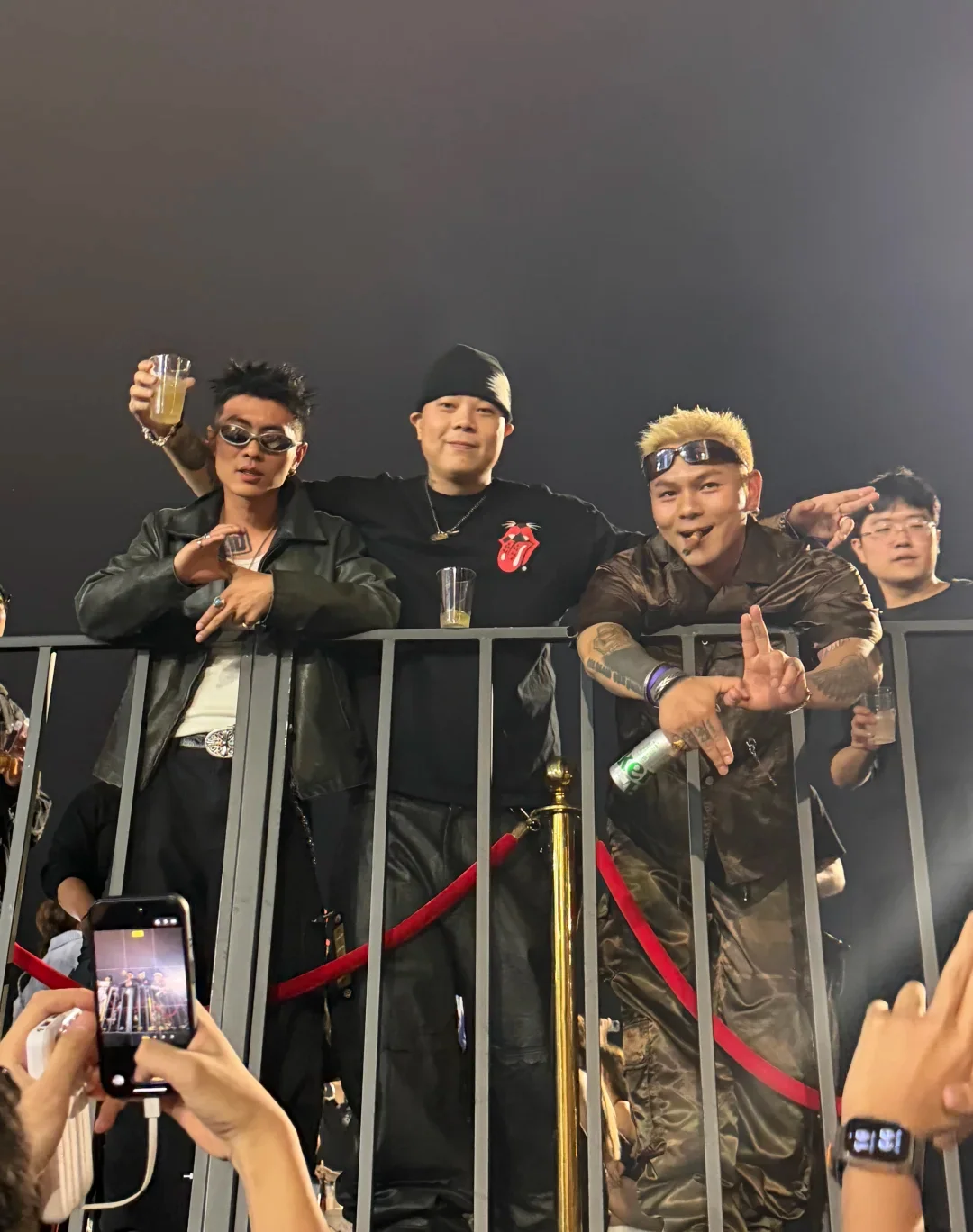
The image is informal, almost anti-poster. That is why I like it. Three recognizable solo careers still fit inside one candid frame without needing a reunion slogan. The picture cannot prove private friendship, but it makes the public relationship legible: C-BLOCK remains a group people notice together, not only three names linked by old metadata.
The correct editorial response is not a generic tourist itinerary. It is to explain why the group relationship remains audible when the listener reaches the city—and why a chorus can return someone to a classroom, a first show or an earlier version of themselves.
Continuity can also become a trap. Crew loyalty and hometown recognition are emotionally powerful, but neither guarantees that a new song makes a new decision. The least interesting releases ask the listener to applaud history instead of extending it.
I have no patience for that bargain. A respected crew does not earn immunity from a weak new track. The history matters precisely because it raises the cost of repetition: every return must add a new role, a new tension or a new handoff, or it is only selling the feeling of endurance.
The strongest recent work does extend it. KEY.L turns time into patient narrative. KungFu-Pen widens return and family memory. Sheng Yu tests leadership against newer stages. Sio keeps connections moving laterally, Ranzer turns inheritance into a present-tense problem, and G-BLOCK places an outside force inside the trio's established grammar.
Our view is that Changsha's special value is not simply loyalty. It is memory with multiple routes. The audience can hear three people age differently inside a shared structure, then hear adjacent and younger artists decide what to preserve, reject or redirect. A generic biography lists years and television appearances. A useful scene guide explains why those years change the sound.
Three doors into Changsha's sound
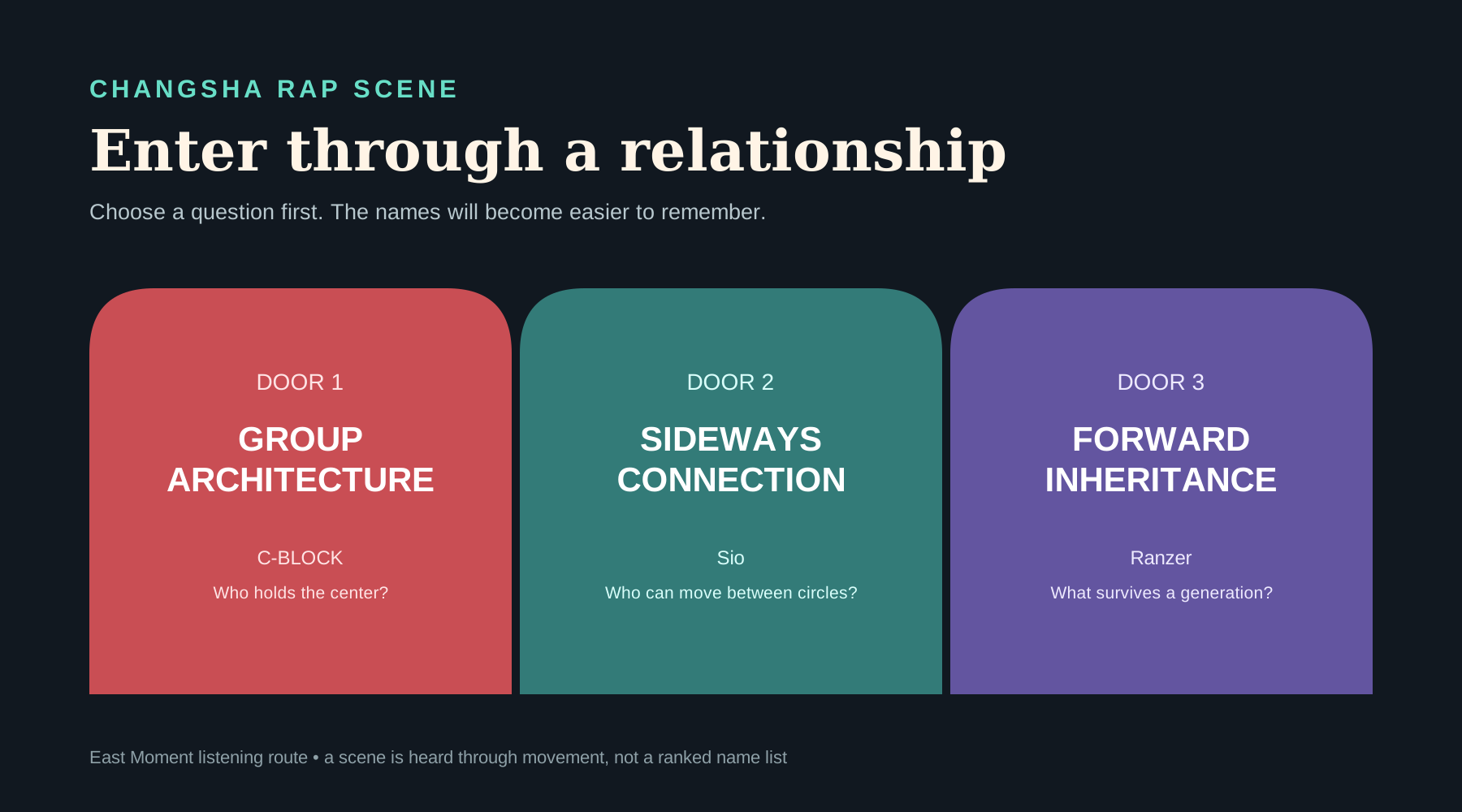
- Begin with C-BLOCK's Yixia Fanshang rather than a random singles playlist.
- Watch the official Singer 2024 performance of Jianghu Flow and track who controls each transition.
- Move into Sheng Yu's Jin Shang Tian Hua for command.
- Use KEY.L's Hey KONG and Future Awaits for memory and narrative patience.
- Hear KungFu-Pen's You Zi Yin, then explore My Family Picture as a 2026 return-and-family chapter.
- Move beyond the trio with Sio's 湘A and his collaborations with KEY.L and KungFu-Pen.
- Use Ranzer's 湖湘浪子 and 故湘,风 to hear a newer generation negotiate inheritance.
- Finish with G-BLOCK Mixtape and compare it with GAI's independent Chongqing formation.