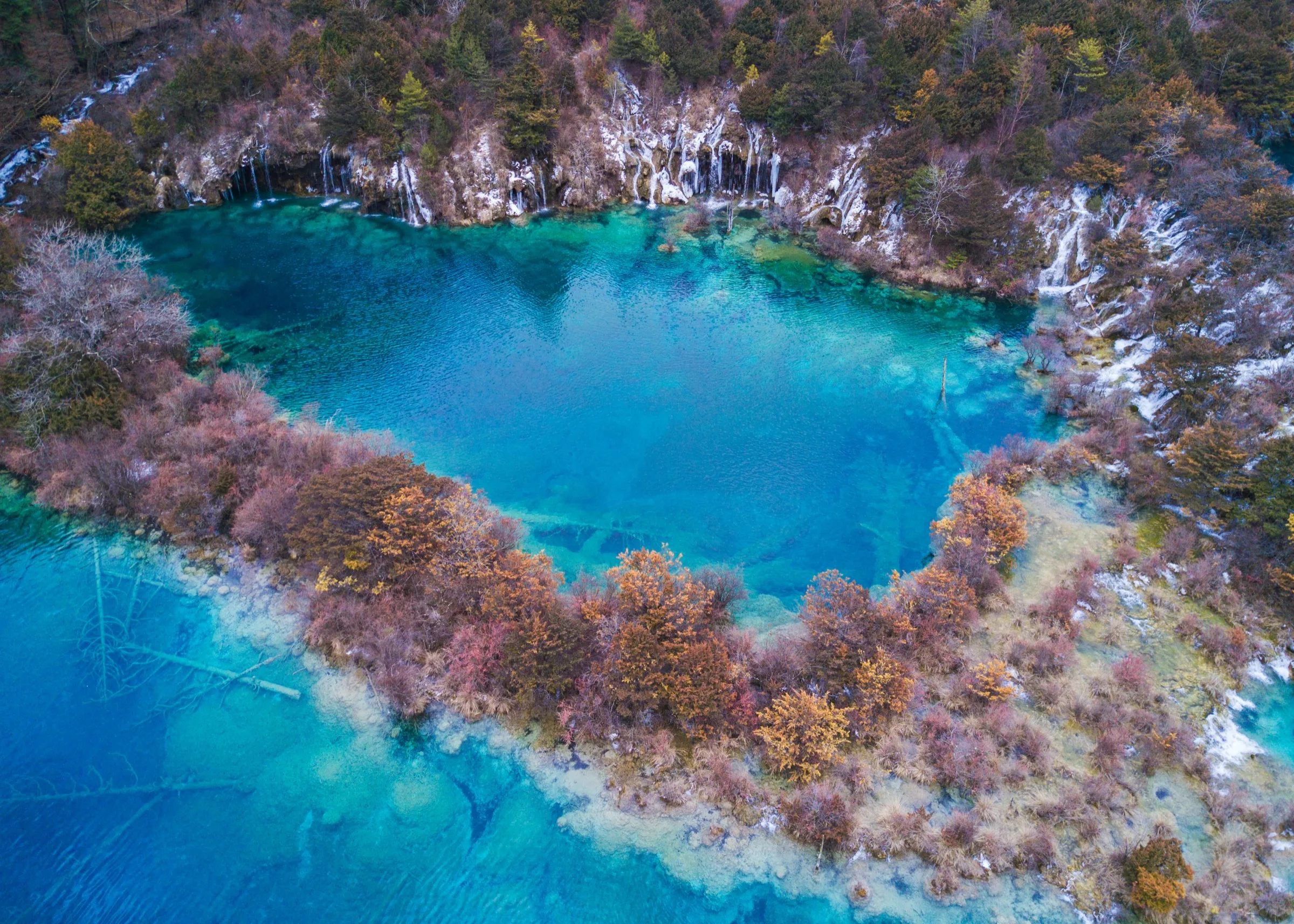
To travel to Jiuzhaigou is to discover that transparent water can hide a complicated system. Forest, limestone, fallen wood, minerals, snowmelt, earthquakes and human management all shape the blue lakes and white waterfalls. The valley deserves more than a race between photo stops. This is the slow-water route inside our wider travel to China guide, not a ranking of blue photographs.
Travel to Jiuzhaigou at a glance
UNESCO's World Heritage record for Jiuzhaigou identifies the valley as a protected system of forest, lakes and waterfalls. That status is not decorative prestige: it is the reason current paths, shuttle rules and closures must outrank an itinerary copied from an old social post.
The scenic-area authority's official ticket information is the operational check before payment: reservation rules, identity requirements, seasonal prices and transport tickets belong to the date of travel, not to this evergreen guide. Verify them again instead of treating any screenshot here as a permanent promise.
| Planning question | Practical answer |
|---|---|
| Ideal first stay | Two full park days plus arrival and departure time |
| Best known for | Clear and intensely colored lakes, waterfalls, autumn forest and mountain scenery |
| Route structure | A Y-shaped system usually discussed as Shuzheng, Rize and Zechawa valleys |
| How visitors move | Managed shuttle buses combined with designated boardwalk sections |
| Main physical issue | Long days, changing elevation, stairs, cold mornings and strong sun |
| Main planning mistake | Trying to cover every named lake in one hurried day |
Choose your route through this guide
| If you need... | Start with... |
|---|---|
| A one- or two-day plan | The three-valley structure and balanced itinerary |
| Seasonal advice | Waterfall flow, forest color and winter operations |
| Transport | Arrival routes, accommodation base and buffer time |
| Physical preparation | Altitude, boardwalk distance and weather layers |
| Responsible travel | Recovery, community context and protected-area rules |
Jiuzhaigou is a connected water landscape
UNESCO recognizes Jiuzhaigou for its exceptional scenery and ecological value. The valley's lakes are not separate blue objects placed for photography. Water moves through forest, rock, travertine barriers and waterfalls, creating a connected system.
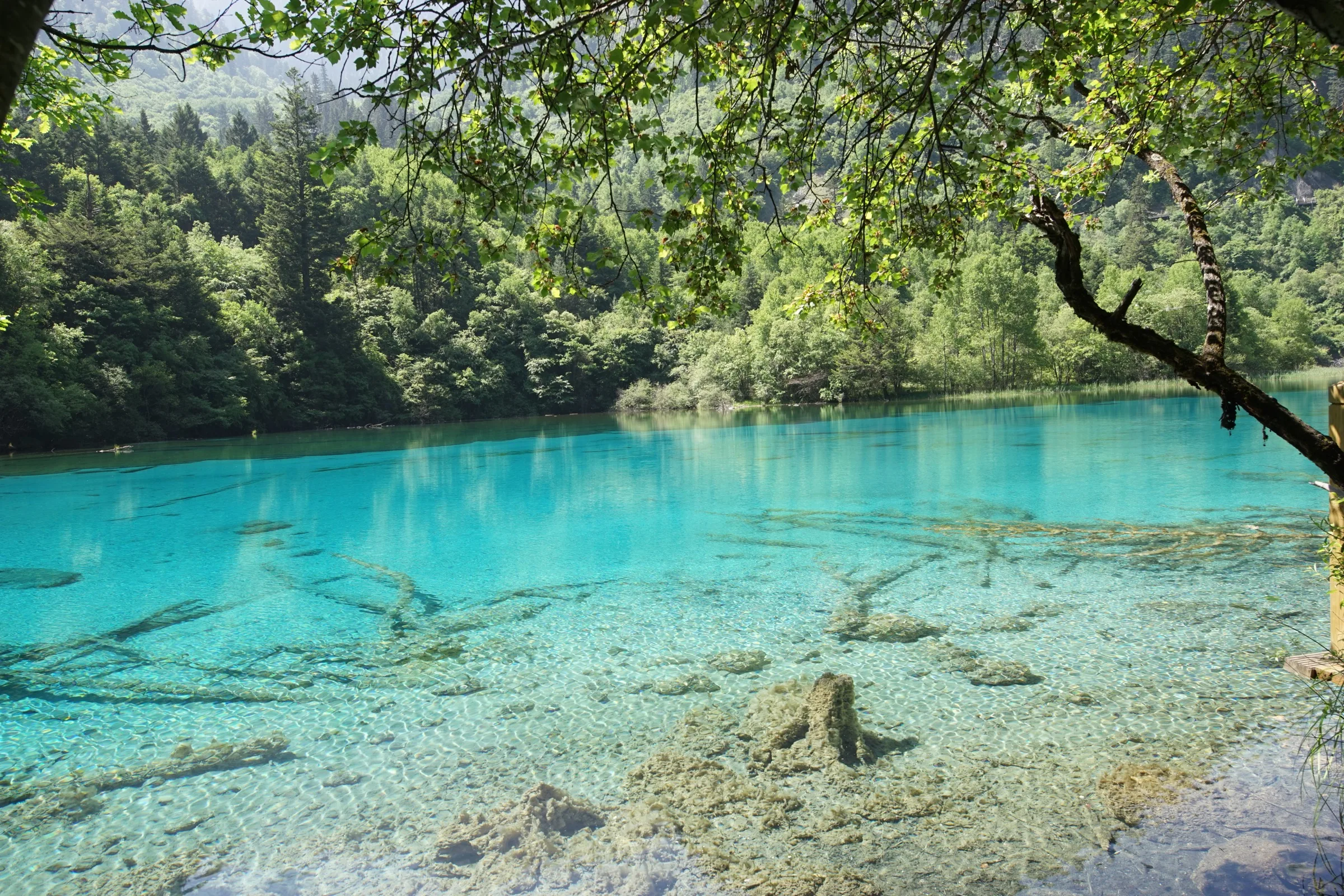
Color changes with depth, minerals, plants, sky, season and viewing angle. A lake that appears electric blue at midday may look dark green under cloud. This variability is part of the landscape, not a failed visit.
Travertine makes the water system fragile
Calcium-rich water can deposit travertine, creating natural barriers and surfaces that help form lakes and waterfalls. These formations are not stone platforms built for standing. They can be damaged by trampling, changed water flow and environmental disturbance.
Fallen trunks and submerged branches also belong to the system. Clear water makes them look available to touch, but entering the lake or moving wood alters habitat and can damage delicate deposits. The correct visitor distance is the boardwalk.
Photograph relationships, not only blue color
Include forest, slope, submerged wood or waterfall outlet in at least some frames. A tight image of turquoise water can be visually powerful but removes the geology and ecology that explain it. Return to one lake under different light rather than increasing saturation until every pool looks identical.
Understand the three-valley route before booking one day
Jiuzhaigou's classic visitor map resembles a Y. Exact stops, open boardwalks and shuttle patterns can change, but the valley framework helps prevent random movement.
| Valley | General character | Use your time for |
|---|---|---|
| Rize Valley | Dense concentration of famous lakes, forest and waterfalls | An early start, selective walking and close attention to water color |
| Zechawa Valley | Longer distances and high-elevation scenery, including Long Lake | Shuttle efficiency, weather layers and fewer but larger landscape stops |
| Shuzheng Valley | Linked lakes, waterfalls, villages and the lower route | Slower boardwalk sections and a strong second-day sequence |
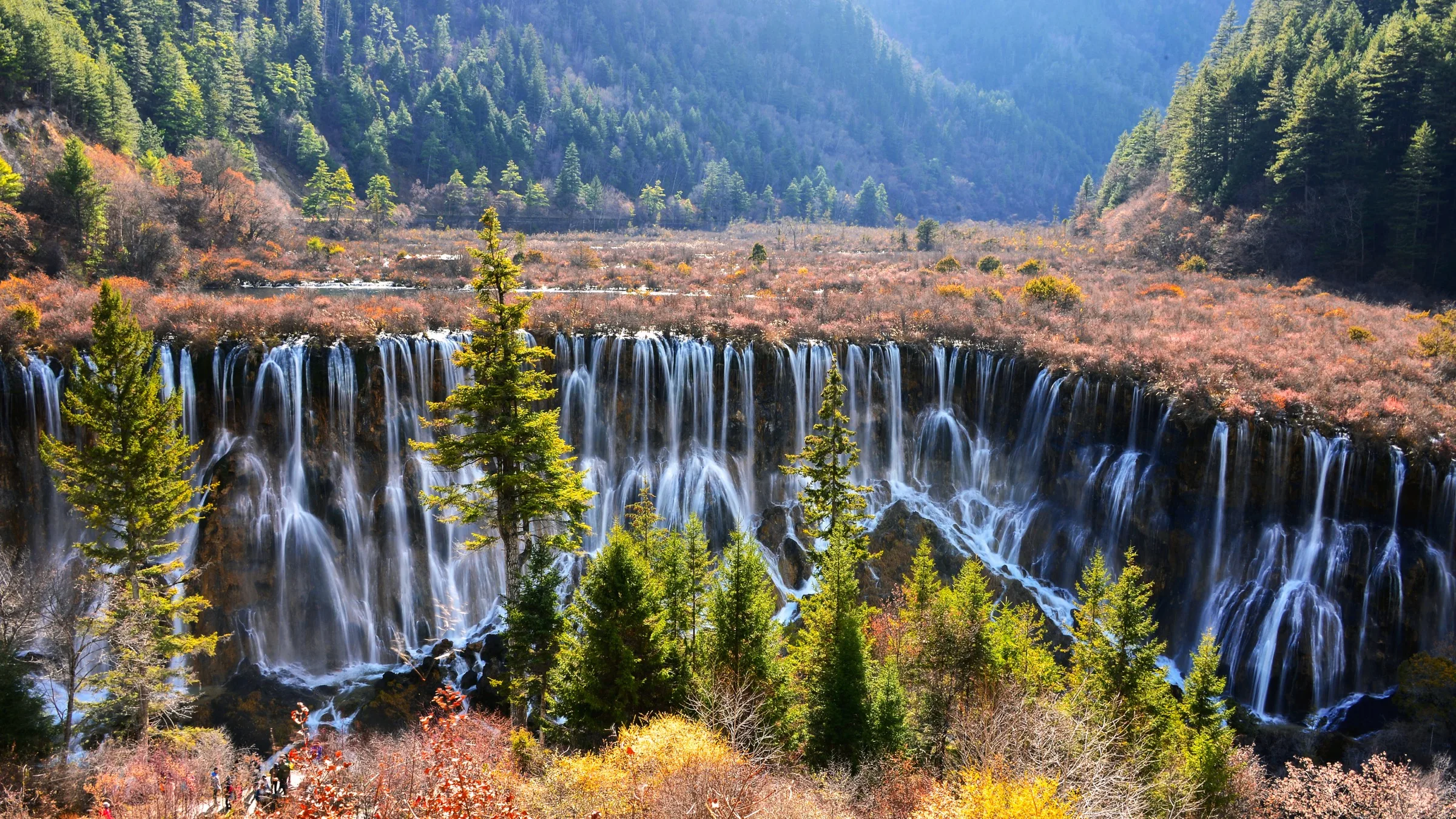
Do not build a route around an old blog's exact bus direction. Park operations respond to restoration, weather, capacity and environmental management. Use the current map after entry.
Shuttle buses are part of conservation logistics
The distances are too large for most visitors to walk the entire system, and unrestricted private transport would increase pressure. Buses concentrate movement and allow managers to redirect visitors as routes, weather and capacity change.
Treat the first shuttle instruction as live operational information. A driver or staff member may direct visitors differently from the route saved on a phone. Do not cross barriers or walk on a vehicle road because an old itinerary promised a particular sequence.
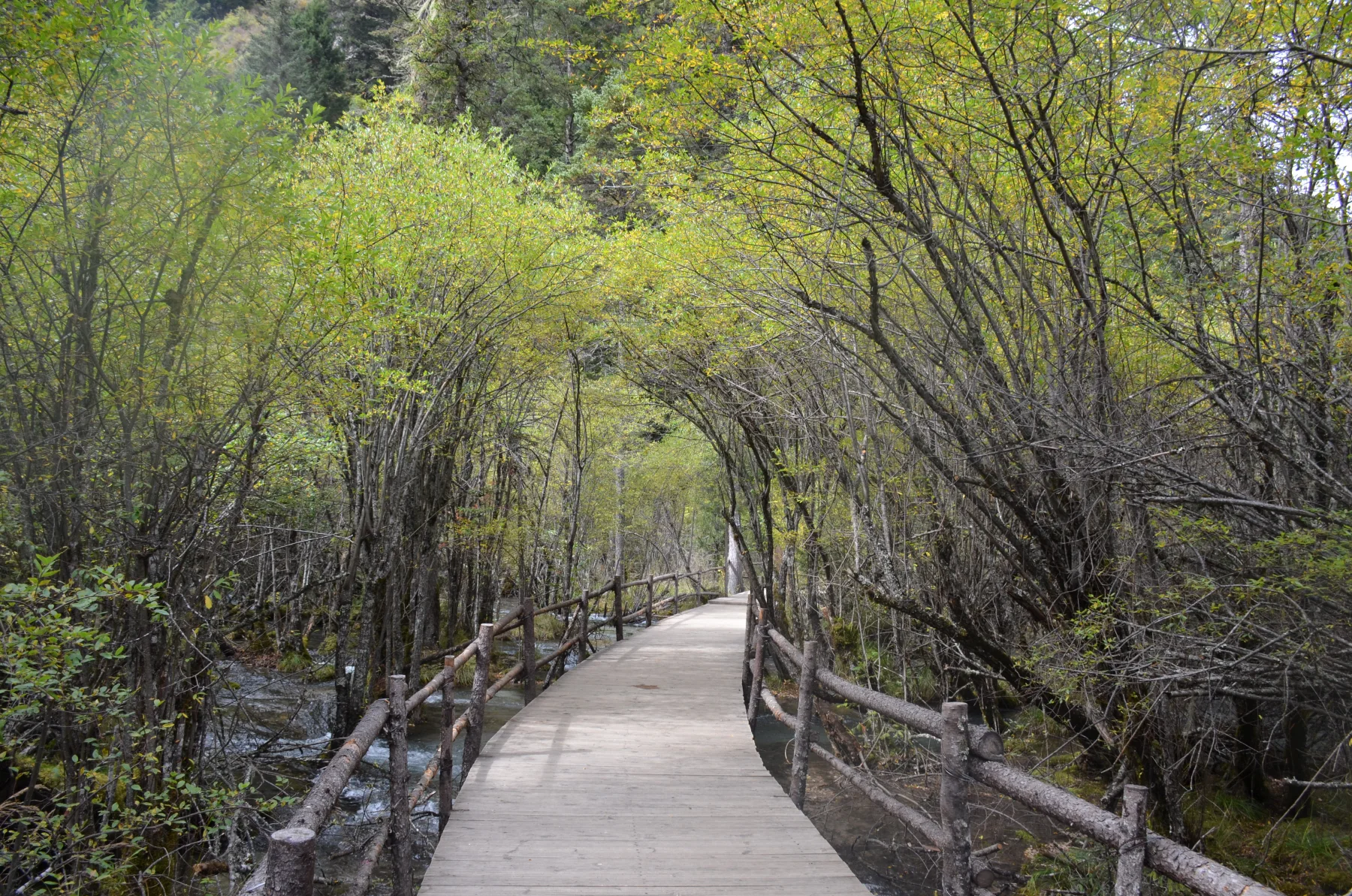
The best method is bus up, selective walk down or between permitted stops. Choose two or three connected boardwalk sections where the landscape can be experienced continuously. Repeatedly boarding for one photograph at every stop creates crowd stress without producing understanding.
One day versus two days
| Trip length | What works | What you sacrifice |
|---|---|---|
| One full day | One principal branch, selected major lakes and a few lower-valley stops | Slow boardwalks, weather flexibility and quieter observation |
| Two full days | Divide the branches, repeat a favorite area and walk more | Higher ticket and accommodation cost, but a much better pace |
| Three days or more | Useful mainly with nearby cultural or landscape extensions | Extra park days may repeat routes if access is limited |
A balanced two-day plan
| Day | Morning | Afternoon |
|---|---|---|
| 1 | Begin with the branch prioritized by current shuttle operations | Walk selected lake and waterfall boardwalks; stop before exhaustion |
| 2 | Cover the second branch or revisit a weather-sensitive area | Follow the lower Shuzheng sequence at a slower pace |
Protect at least one hour without a famous stop attached to it. Reflections, submerged trees and sound often become more memorable than the checklist.
The honest cost of a one-day visit
One day often begins with transport anxiety and ends with a race toward the gate. It can still work when budget or schedule is limited, but the traveler should choose one principal branch and a lower-valley sequence rather than pretending to complete the park.
Two days provide more than double the quality because the map becomes familiar. On the second morning, buses, junctions and distances require less attention. Weather may also reveal a peak or lake that was hidden the day before.
Keep the second day flexible until current operations are understood. Repeating a favorite section is not wasted admission. The same water under cloud, sun or wind can be a different landscape.
Manage the crowd by changing pace, not chasing an empty park
Jiuzhaigou is internationally famous and cannot be planned as a private wilderness. The first shuttle, major platforms and transfer points may be busy even outside the most famous autumn weeks. Waiting for every person to leave a viewpoint usually wastes time and encourages conflict over photographs.
Instead, use the managed system intelligently. Move through the most constrained platform without occupying the rail for long, then choose a permitted boardwalk where visitors spread along distance. Pause after large groups continue to the next bus. A quieter five-minute interval often appears without any need to block the route or cross a barrier.
Crowds also reveal scale. A photograph with a few people can show the height of a waterfall or width of a lake more honestly than an empty frame. Avoid treating other visitors as visual contamination while demanding access to the same protected place. The practical goal is enough personal attention, not the fantasy of exclusive ownership.
Waterfalls change with season and temperature
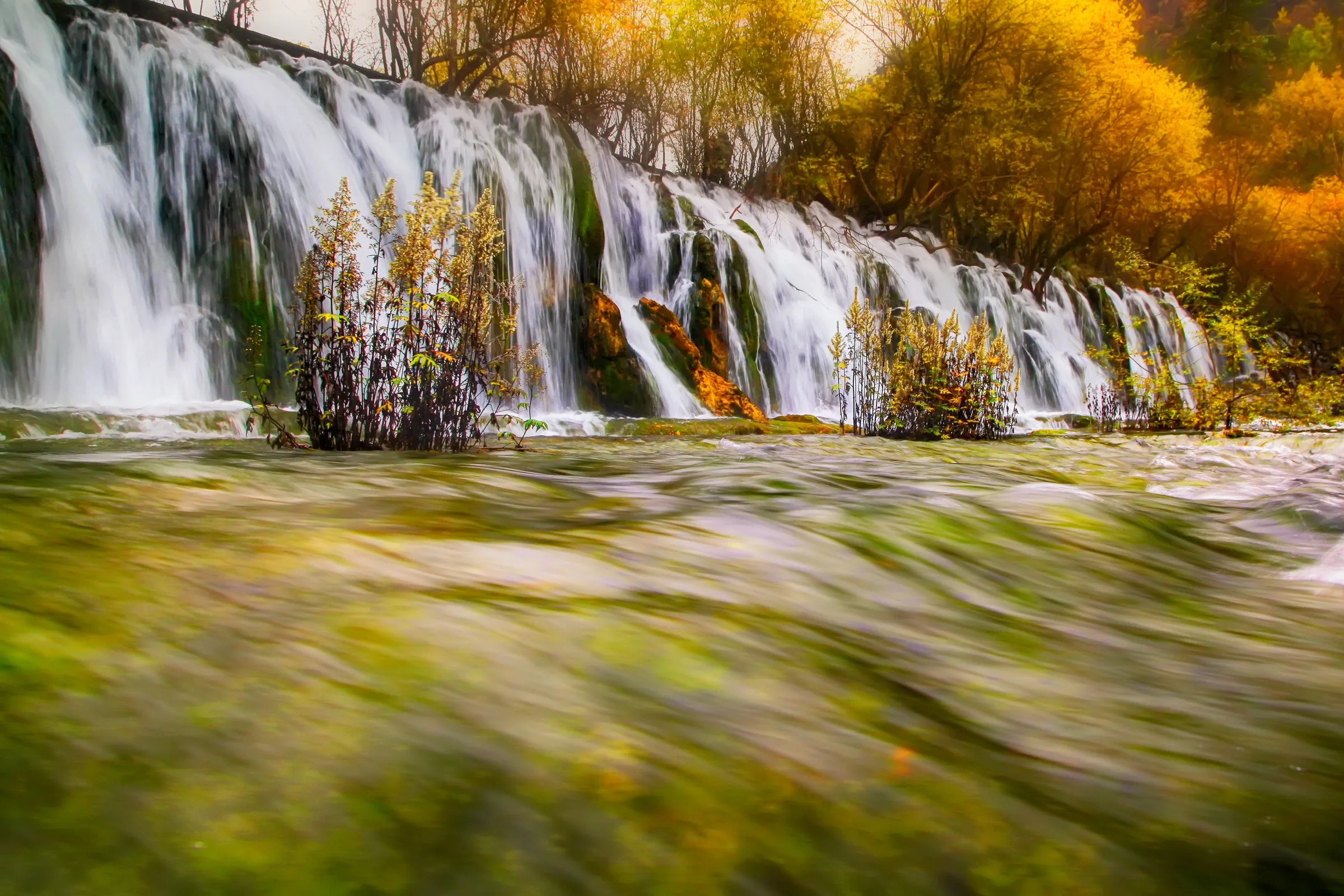
Water volume usually feels strongest after snowmelt and during wetter months, while winter can transform spray and smaller flows into ice. Conditions vary from year to year.
Boardwalk surfaces can be wet, frozen or crowded. Shoes with grip matter more than a perfectly styled outfit, and a waterproof layer is useful even when rain is not forecast.
Sound is part of waterfall scale. Stop where permitted and listen before taking video. A wide waterfall is not only a visual curtain; spray, air movement and the changing volume along the boardwalk reveal distance better than a phone lens.
Choose the season by experience, not only color
| Season | Landscape | Advantages | Tradeoffs |
|---|---|---|---|
| Spring | Snowmelt, new green and variable water | Cooler walks and transitional scenery | Some higher areas may remain cold or limited |
| Summer | Dense forest and active water | Long daylight and vivid green-blue contrast | Rain, humidity and holiday crowds |
| Autumn | Red and gold forest around blue lakes | Jiuzhaigou's most famous visual season | Peak demand, higher prices and crowded viewpoints |
| Winter | Snow, ice and quieter forest | Strong graphic landscapes and fewer visitors on some dates | Severe cold, short days and possible operational limits |
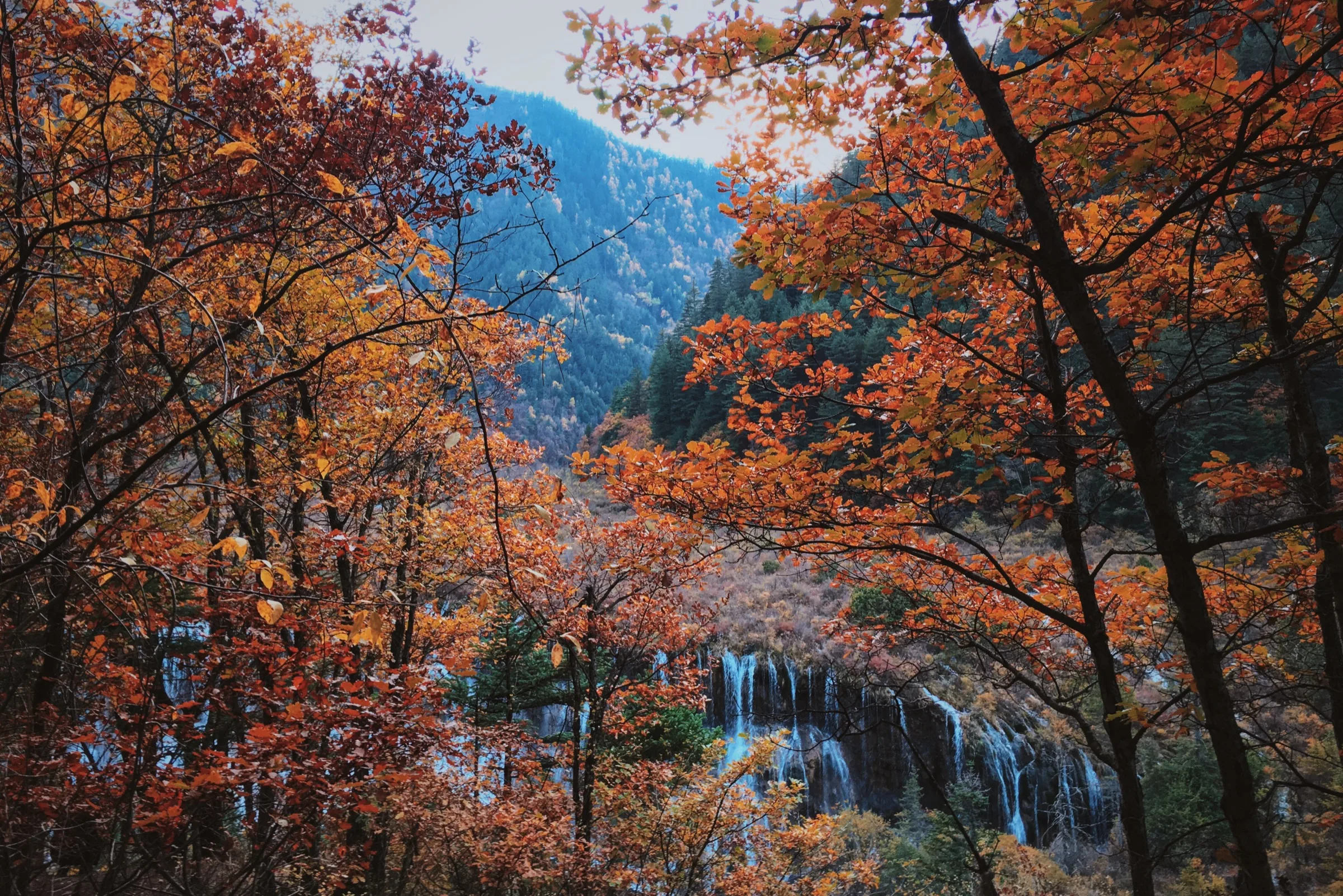
Autumn photographs often compress several weeks into one promise. Forest color moves through elevation and weather; no date guarantees every valley will peak together.
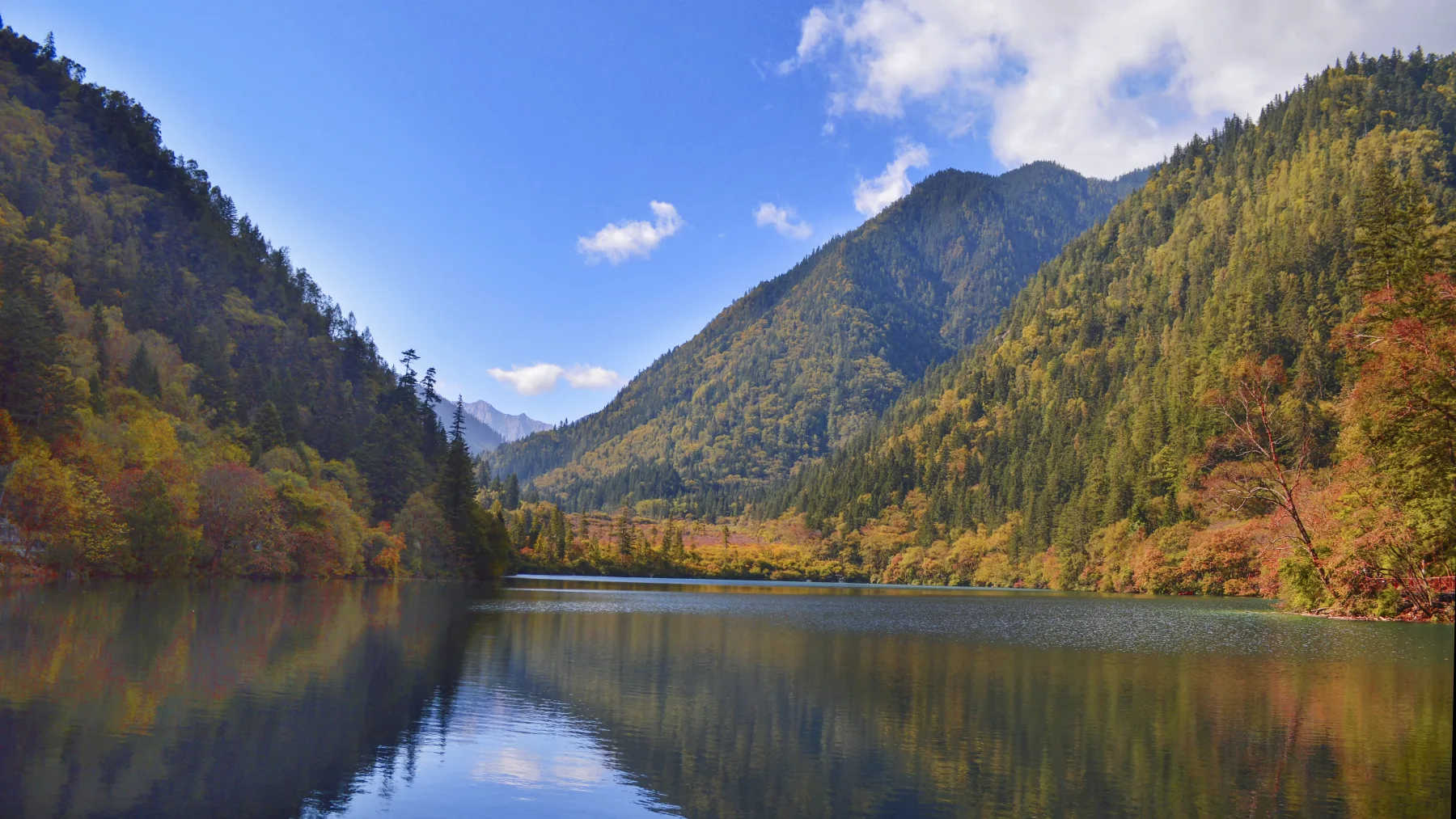
Winter is a different park, not a discounted autumn
Frozen surfaces, snow and reduced water flow simplify the landscape into strong lines and muted sound. Short daylight, cold batteries, ice and possible route restrictions also change the practical experience. Confirm which valleys and services are operating.
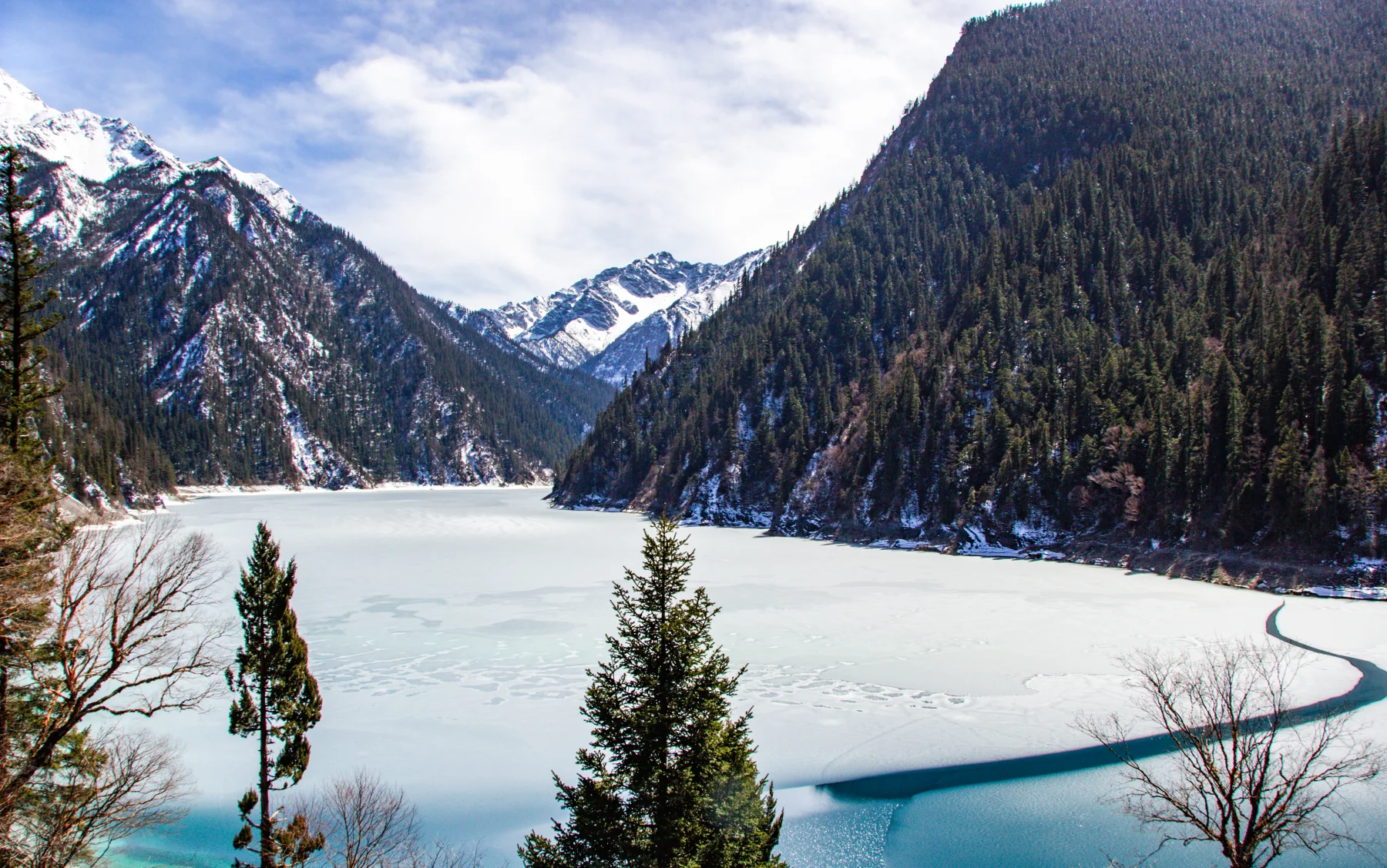
Dress for standing still as well as walking. Viewpoints can feel much colder once movement stops, and touching railings or handling cameras becomes difficult without gloves.
Getting to Jiuzhaigou requires a transport plan
Access has improved, but Jiuzhaigou remains a mountain destination rather than a quick Chengdu day trip.
- Air routes use Jiuzhai Huanglong Airport, which is itself at very high elevation and still requires a road transfer.
- Rail connections and station transfers in northern Sichuan continue to evolve; confirm the exact station and onward bus arrangement.
- Long-distance buses and private road transfers remain useful but are affected by mountain traffic and weather.
- A route combining Chengdu and Jiuzhaigou should include buffer time rather than treating travel as an invisible line on the itinerary.
Start with our travel to Chengdu guide if Chengdu is your arrival hub.
Choose the accommodation by entrance time
Hotels near the scenic-area entrance reduce the risk of losing the earliest park hours to road transfers. Properties farther away may offer quieter surroundings or lower prices, but the actual pickup and return arrangements must be clear.
Ask whether breakfast is available before entry time, whether heating or air conditioning suits the season and how luggage is handled on departure day. A mountain hotel name can sound close while still requiring a vehicle.
Do not plan a tight flight or train immediately after leaving the park. Traffic, weather and road controls can change transfer time. A final night near the transport hub may be more reliable than forcing a same-day connection.
Arrival day should remain deliberately small
Travel from Chengdu or another hub can be tiring even when the route is efficient. Check in, eat, prepare layers and sleep. Adding another scenic area because afternoon remains on the clock weakens the first park morning.
Jiuzhaigou and Huanglong need separate decisions
Huanglong is often packaged with Jiuzhaigou because both lie in northern Sichuan and both are shaped by striking water and mineral formations. They are not interchangeable stops. Huanglong involves a different high-elevation landscape, its own transport time and a physical response that may be harder for some visitors. Adding it should create another full excursion or overnight decision, not fill a spare afternoon after a long park day.
Choose the combination only after mapping the actual airport, station, hotel and road transfers. A flight using Jiuzhai Huanglong Airport does not automatically make Huanglong effortless, and a tour label saying “Jiuzhaigou plus Huanglong” does not show how much of each day remains after driving. Ask for departure time, time inside each scenic area and the sleeping location between them.
For a first trip with limited time, two deliberate Jiuzhaigou days usually produce more understanding than one rushed day in each landscape. Add Huanglong when the itinerary has another weather buffer, the visitor is comfortable with its elevation and the current operation is confirmed. Travelers seeking a much more demanding high-altitude route should compare Daocheng Yading, where acclimatization and turnaround judgment become central to the entire trip.
Altitude, weather and long park days
Jiuzhaigou's standard visitor experience is less extreme than the highest routes in western Sichuan, but elevation still combines with walking, dry air and temperature change.
| Issue | Better approach |
|---|---|
| Arrival fatigue | Keep the first evening quiet and sleep before the park day |
| Strong sun | Use sunscreen, a hat and eye protection even in cool weather |
| Temperature swing | Carry layers that can be removed on climbs and replaced at exposed lakes |
| Dehydration | Drink regularly without waiting for obvious thirst |
| Symptoms | Stop, descend or seek help when symptoms are significant rather than proving endurance |
This is general planning information, not personal medical advice.
Altitude interacts with cold, hunger and schedule pressure. A traveler may attribute fatigue to walking when the combination is the issue. Eat breakfast, carry compact food where rules permit and take the shuttle instead of forcing another long boardwalk after symptoms begin.
Travelers with heart, lung or other relevant health concerns should seek professional advice before the trip. Do not use portable oxygen as permission to continue against worsening symptoms. Staff instructions and descent decisions take priority over completing a valley.
Accessibility is route-specific
Shuttle access can reduce distance, but boardwalks include stairs, slopes and long connections. Confirm current accessible stops, restrooms and assistance directly with the park. A famous lake may have a more manageable viewpoint than the full walking circuit.
Tibetan and Qiang culture is not scenery
The wider region is home to Tibetan and Qiang communities, and the valley's name refers to villages. Cultural buildings, prayer flags, food and commercial products are often presented to visitors.
Avoid treating residents as part of the landscape package. Ask before photographing people, distinguish active religious practice from tourist display and buy from local businesses without demanding that every product perform ancient authenticity.
Tourism descriptions sometimes use Tibetan and Qiang identity as a decorative guarantee of remoteness. Communities have contemporary homes, education, businesses and changing relationships with the protected area. Cultural respect means allowing the present to remain visible.
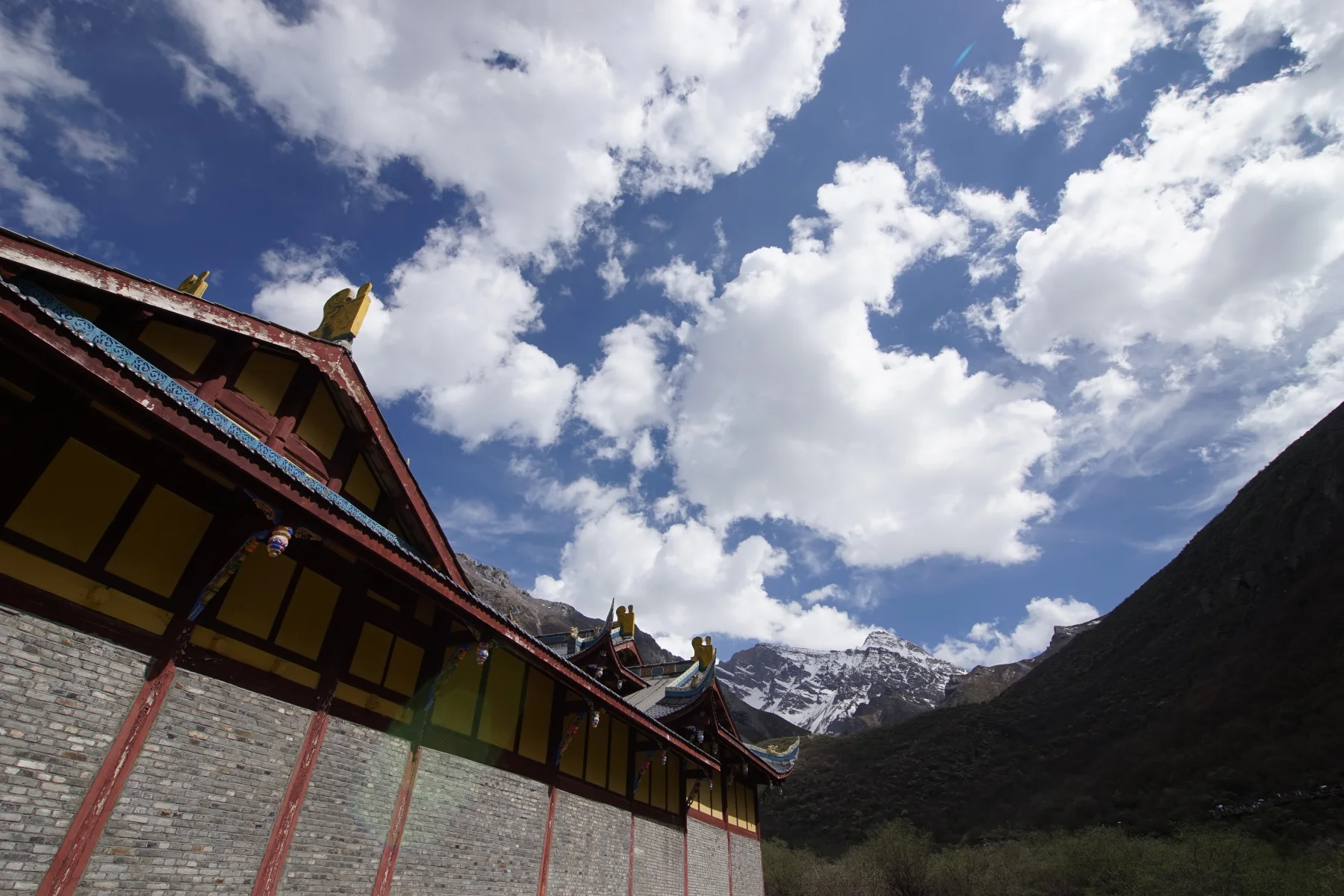
Food, architecture and religious symbols should be interpreted through responsible local or institutional context. Do not attach a specific ethnic or sacred meaning to an object simply because it looks unfamiliar.
The valley is recovering as well as being visited
The 2017 earthquake damaged infrastructure and changed parts of the landscape. Restoration and phased reopening required major engineering and conservation work.
Tourism management now carries a double responsibility: keeping visitors safe and limiting pressure on a fragile protected area. Shuttle buses, closed paths and visitor caps are not inconveniences separate from the experience; they are part of how access remains possible.
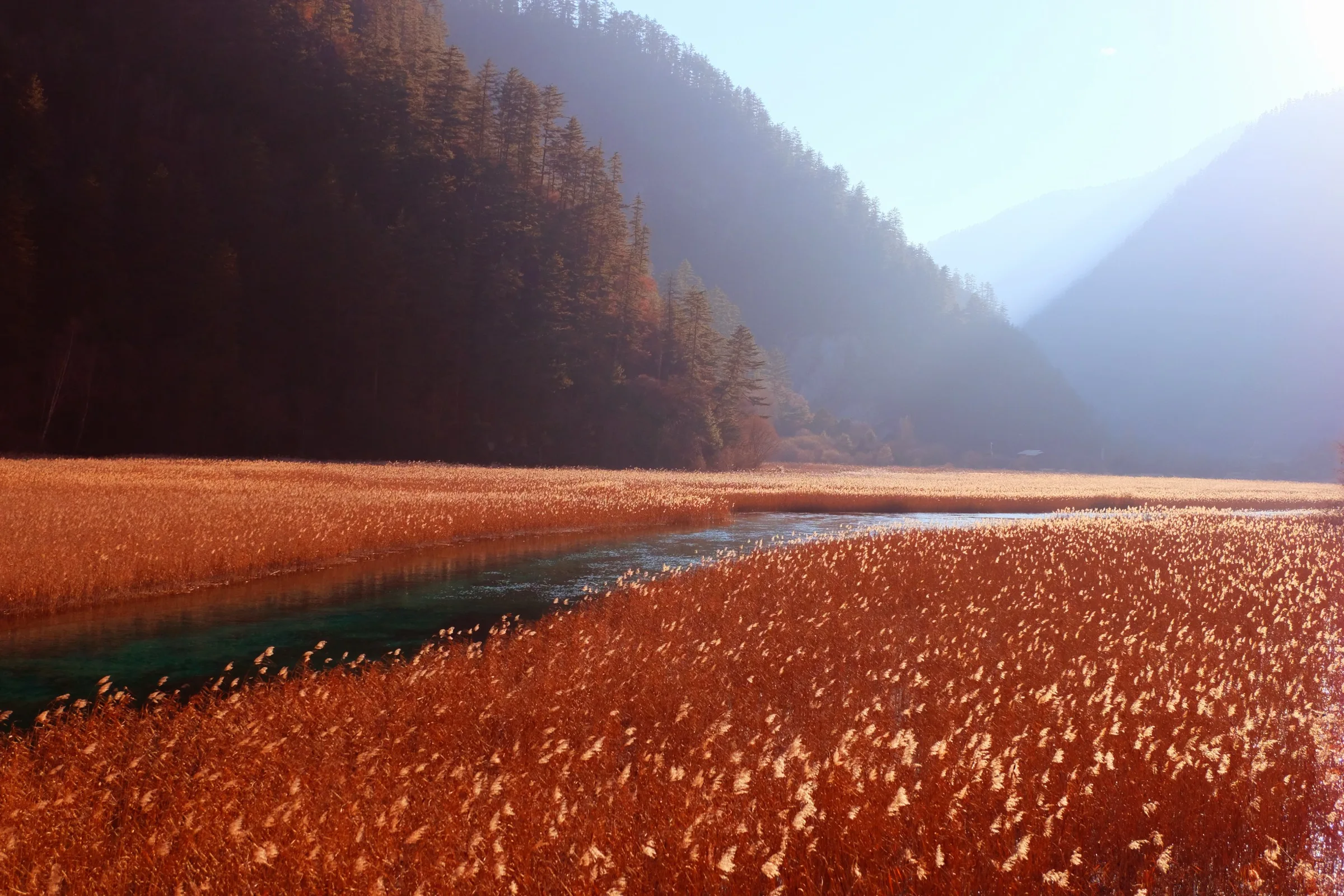
Recovery does not mean returning every surface to the exact visual state remembered from older photographs. Earthquakes are ecological and geological events as well as human disasters. Water paths, slopes and forests can change. Management must decide where access is safe and where natural processes need space.
Travelers should avoid before-and-after judgment based on one viewpoint. A closed path may reflect safety or restoration rather than failure. Current scientific and official interpretation is more reliable than nostalgic claims that the valley has been "ruined" or perfectly restored.
Travel responsibly in Jiuzhaigou
- Stay on open boardwalks and obey closure signs.
- Do not enter water, stack stones or remove plants and wood.
- Carry out waste and reduce single-use packaging.
- Keep noise low near wildlife and quieter lake sections.
- Follow current fire restrictions.
- Do not use drones unless rules explicitly permit them.
- Give yourself enough time that environmental controls do not feel like obstacles to defeat.
Crowd behavior is also environmental behavior. Do not stop across the full width of a boardwalk, climb rails for an unobstructed image or shout to coordinate a group. Moving predictably protects other visitors and the landscape edge.
Jiuzhaigou rewards selective attention
What most guides get wrong
They rank lakes by color and treat the shuttle map as a collection route. Jiuzhaigou is a connected hydrological landscape managed under ecological and safety constraints. Missing one named stop does not make the system less visible.
The valley is famous because it looks unreal. A better visit discovers why it is real: water moving through geology, forest recovering from disturbance and people managing access to a vulnerable system. See fewer stops, walk more carefully and let changing light do part of the itinerary.
Two park days are the East Moment recommendation for a first serious visit. One day is acceptable when chosen honestly; three rarely add equal value unless operations, research or nearby cultural routes justify the time. Arrival and departure days should remain separate from the park count.
If Jiuzhaigou is one stop in a wider route, use the Chinese cities guide to compare gateway cities before booking another remote landscape. The Chengdu travel guide is useful for the practical connection, but Jiuzhaigou should keep its own weather margin and park days rather than being squeezed into Chengdu's spare afternoon.
This also changes how photographs should be edited and remembered. Jiuzhaigou does not need artificial saturation to justify the journey. Cloud, brown submerged wood, mineral-white edges and crowded boardwalks belong to the truth of the place. The deeper story is not that every lake has an impossible color; it is that geology, water, forest, community and conservation management keep producing variation within one connected valley.
That connected system, rather than any single blue lake, is the reason to travel slowly.
Frequently asked questions about travel to Jiuzhaigou
How many days do I need in Jiuzhaigou?
One full day is possible but rushed. Two park days create room to divide the valleys, walk more boardwalk sections and adapt to weather or crowd controls. Add separate travel days because access from Chengdu or other hubs can take substantial time.
When is the best time to visit Jiuzhaigou?
Autumn is famous for colored forest but is often the busiest period. Late spring and summer bring strong water flow and green landscapes, while winter offers snow and ice with colder conditions and potentially reduced access. Check current operations before booking.
Is Jiuzhaigou difficult at altitude?
The scenic area rises across significant elevation, though most standard sightseeing is lower than the highest Tibetan plateau routes. Responses vary; pace yourself, hydrate, avoid heavy exertion on arrival and seek medical advice for individual risk or symptoms.
Can I explore Jiuzhaigou without the shuttle buses?
The protected area uses shuttle transport and designated boardwalks to manage distance and environmental pressure. Visitors can combine buses with permitted walking sections, but should not assume the whole valley can or should be covered on foot.
Has Jiuzhaigou recovered from the 2017 earthquake?
The park reopened through phased restoration and management after the earthquake, but landscapes and access arrangements can continue to change. Use current official information rather than an old itinerary or map.