Badminton in China succeeds first as an everyday agreement: two people can carry rackets into a park, find a patch of air and begin. Its flexibility is real, but incomplete. Wind, floor, ceiling, court booking and partner communication decide what kind of game is possible, while elite speed hides an enormous technical system.
Badminton in China begins by borrowing space
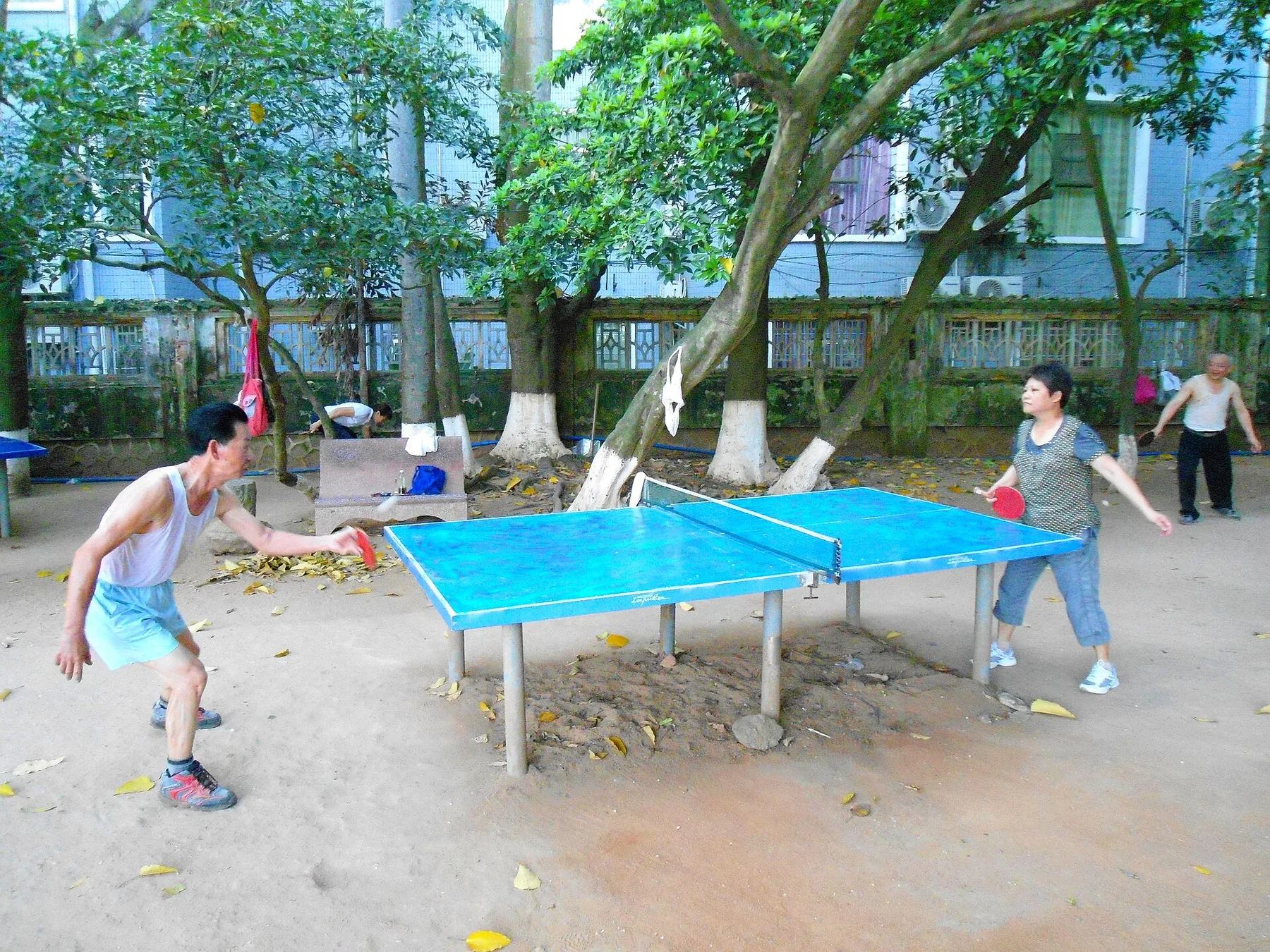
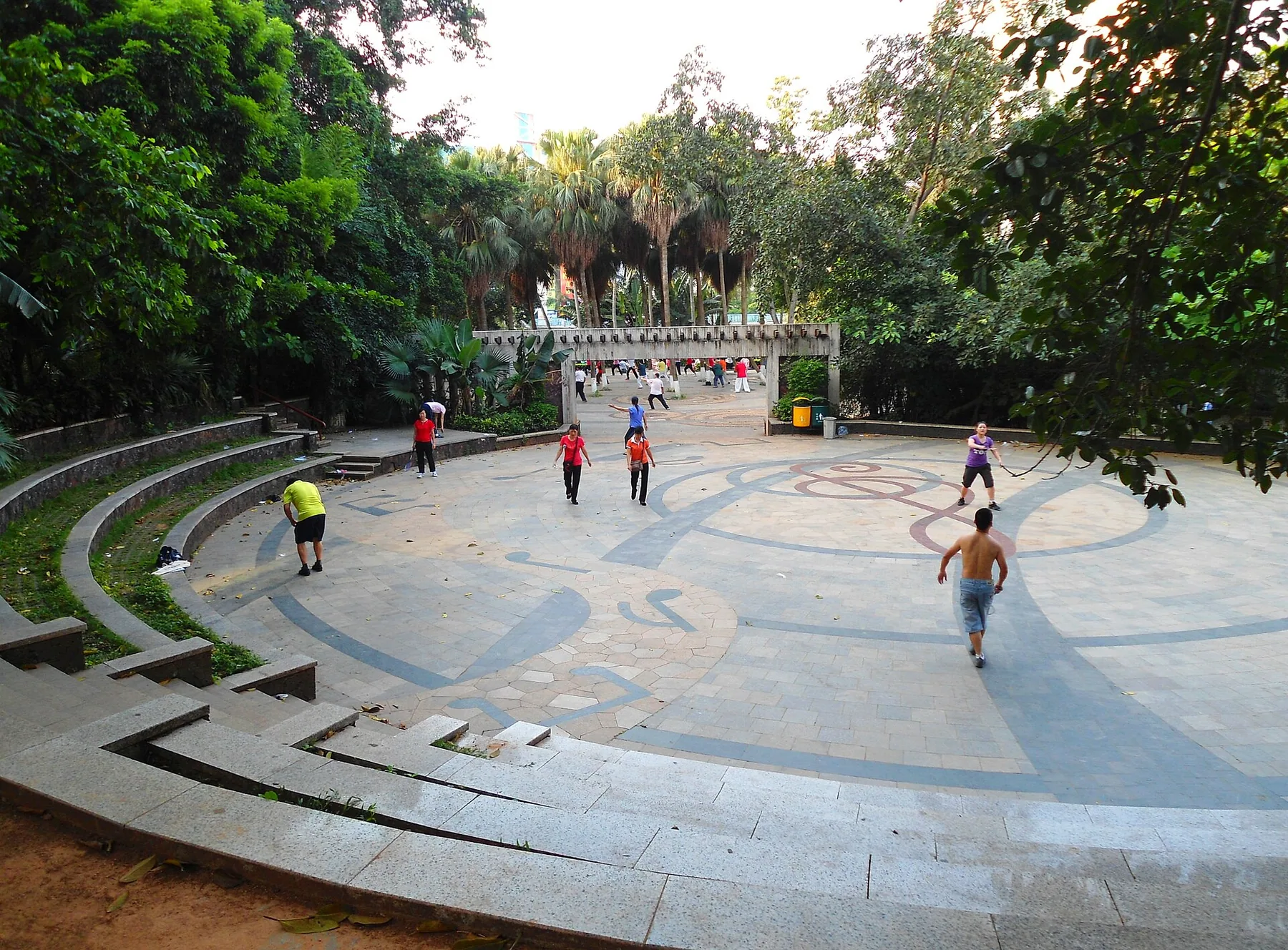
In Haikou People's Park, two adults face each other across open paving. There is no painted badminton court and no visible net. Trees frame the space. Other people walk or exercise nearby. The players have brought the essential objects and temporarily turned a public clearing into a game.
That transformation explains much of the everyday strength of badminton in China. A shuttle does not roll away like a ball. Two rackets are easy to carry. Two people are enough to produce a satisfying exchange. The basic visual task is instantly understood: send the shuttle up, keep it inside a shared patch of air and help the other person return it.
The game can be competitive, but it does not need competition to feel complete. Ten cooperative contacts may matter more than winning a point. A parent can feed a child. Friends can talk between rallies. Older adults can choose pace and distance without asking a league to validate the session.
My judgment is that badminton wins everyday life because it can adjust itself to a relationship. The rules can soften before the invitation disappears.
That is not the same as saying everyone in China plays. A vivid park scene is not a participation census. It shows one possibility: space becomes a court because two people agree to treat it as one.
Flexible access has physical limits
The General Administration of Sport of China's 2021 national sports-venue survey recorded 225,900 badminton venues and classified 85.52 percent as outdoor. These are dated survey figures, not a current inventory, and the category does not tell us whether every venue is maintained, bookable or suitable for formal play.
Still, the outdoor share helps explain why images of badminton in parks, squares and residential spaces feel plausible. The game can begin without the construction cost of a large field.
Then the shuttle reveals every compromise.
Wind is not background weather; it changes the object in flight. A small crosswind can push a high return beyond the partner's reach. Sun and tree shadows affect tracking. Uneven paving changes lunging from difficult to dangerous. Pedestrians cross the improvised court because, outside the players' agreement, it is not a court at all.
Indoor play solves wind and creates lines, nets and lighting, but introduces another scarcity: bookable time. A popular evening slot can cost money, require advance coordination and end exactly when the next group arrives. Ceiling height and air movement still matter. So does flooring. A surface made for walking is not automatically kind to repeated lunges and changes of direction.
The phrase "you can play anywhere" is affectionate and false. You can exchange a shuttle in many places. You cannot play every version of badminton there.
The everyday rally is a form of care
Casual badminton often depends on a choice elite competition punishes: hit a return the other person can reach.
That choice does not make the activity less real. It changes the goal. Instead of creating uncertainty, you create continuity. You adjust height for a shorter partner, reduce pace for a beginner, move closer when wind interferes or send the shuttle back toward the center after somebody has been stretched wide.
This cooperative version has social value because skill can be used to keep another person inside the exchange. The better player does not have to display superiority. They can make the rally longer.
I find that generosity more culturally interesting than another sentence about national champions. It shows why a racket sport can become time spent together: parent and child, partners after work, neighbors in a park, friends trying to rescue an evening from their phones.
But care can become control. One partner may insist on correcting every swing. A stronger player may pretend to be helpful while never allowing the other person to choose pace. A doubles group may say it welcomes beginners but roll its eyes at every missed rotation. The quality of the relationship is part of access.
This is why the useful question is not merely "Do you have someone to play with?" It is "What kind of game can the two of you honestly sustain?"
Doubles makes geometry social
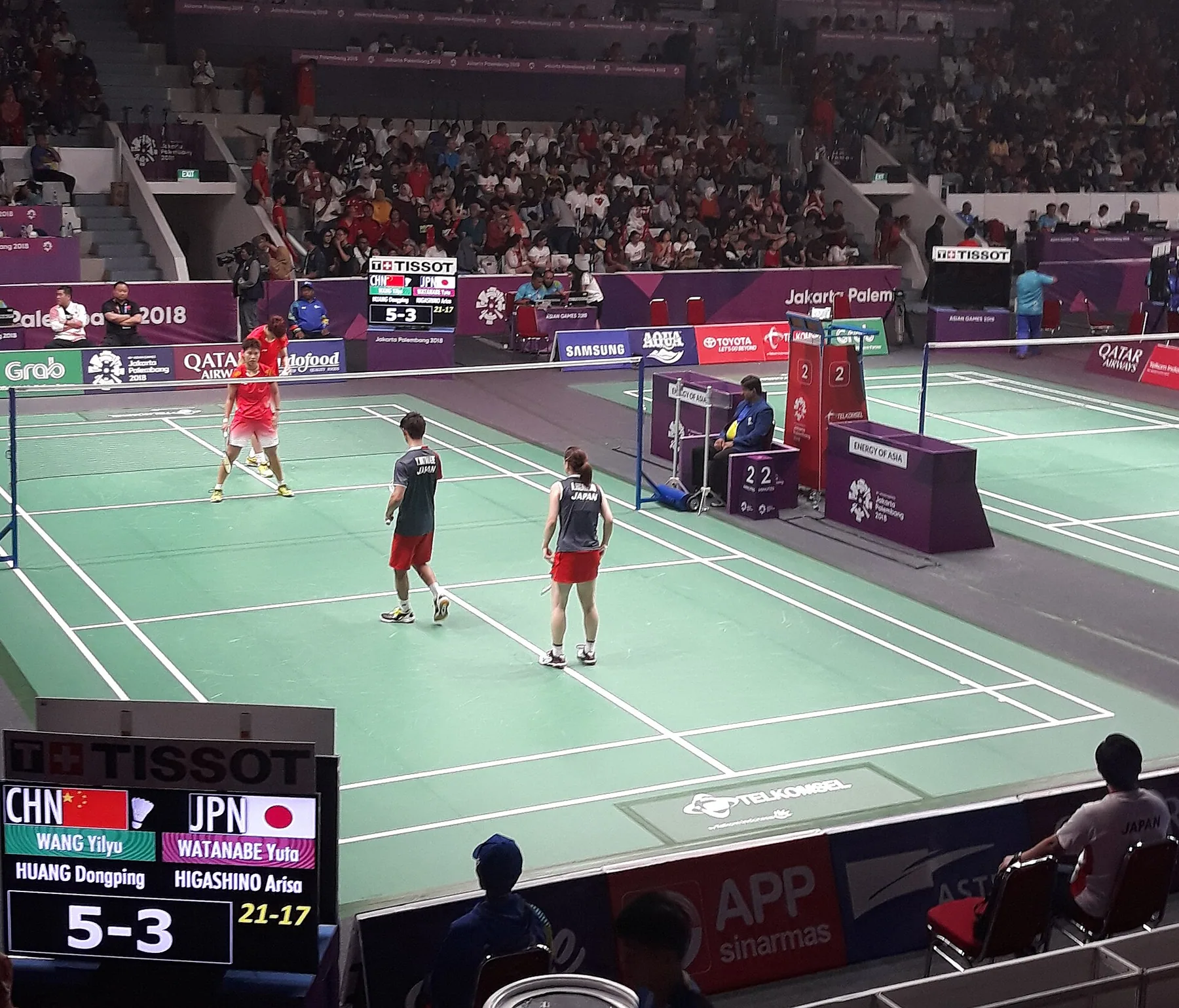
Four players occupy the 2018 Asian Games court, but the important visual fact is not the flags. It is division. Each pair must cover one side without trying to stand in the same solution.
Badminton doubles is often described through formations: front and back while attacking, side by side while defending. Those patterns are useful, not permanent. A lift, drive, block or weak return changes the relationship. Partners must recognize the transition at almost the same moment.
Communication therefore happens through words, calls and movement. A player who takes the shuttle also makes a promise about the space left behind. The partner reads that promise and moves. When both hesitate, the shuttle falls untouched. When both commit, rackets or bodies can collide.
This is why "badminton partner" culture should not be treated as a cute side effect. The partner is part of the playing intelligence. Trust appears in small acts: calling a middle shuttle, covering after an aggressive interception, admitting a bad leave, returning a borrowed tube of shuttles and arriving for the booked hour.
The photograph cannot prove how ordinary Chinese pairs communicate. It shows elite mixed doubles in a specific international match. Its value is anatomical: two people must organize one territory while two opponents try to break their agreement.
An all-China final does not explain everyday participation
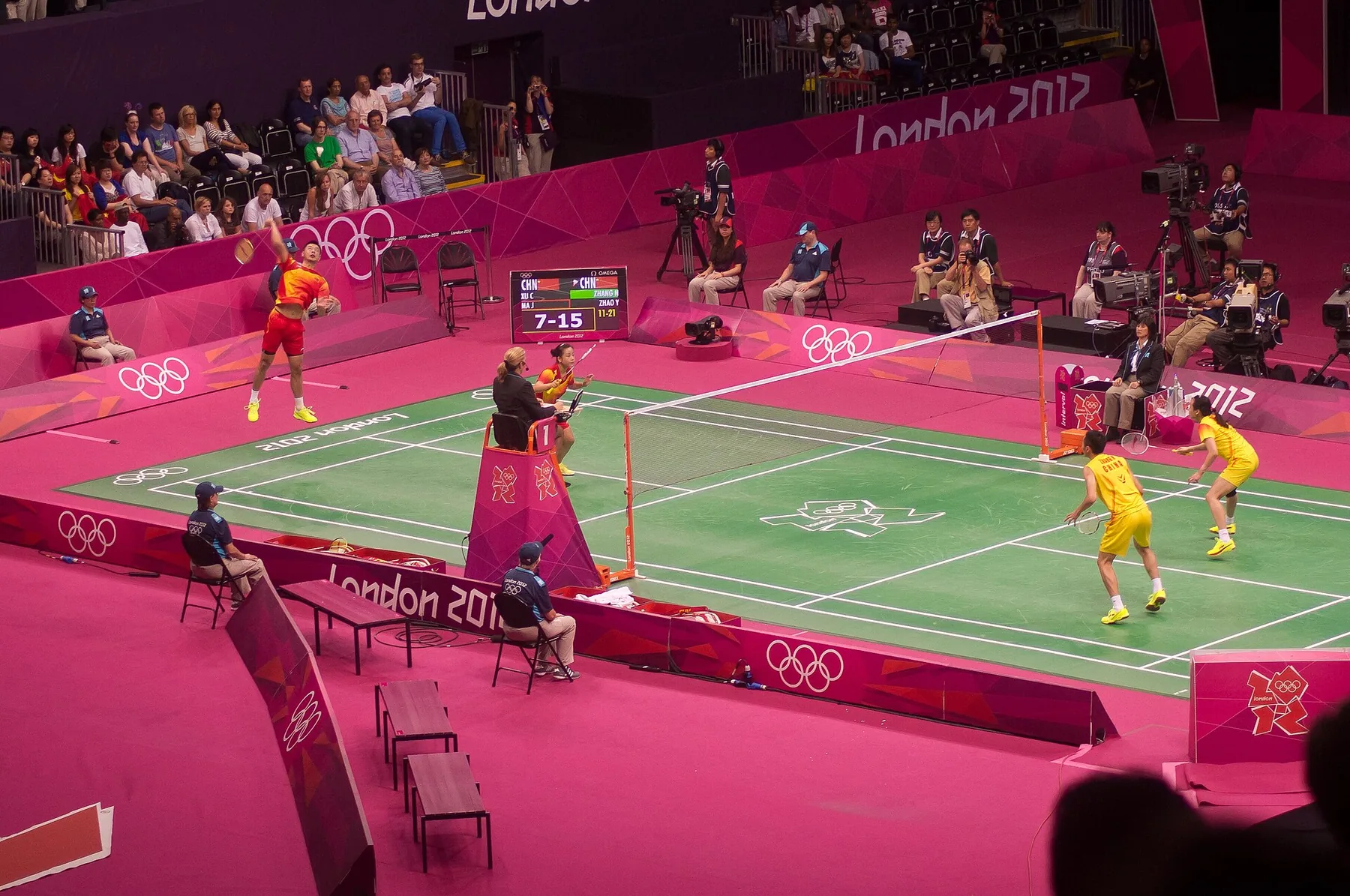
The London 2012 Olympic mixed-doubles final placed Xu Chen and Ma Jin opposite Zhang Nan and Zhao Yunlei. In this frame, one player rises into an overhead stroke while his partner holds a lower, alert position nearer the front. The opposing pair separates its coverage across the court.
An all-China final is evidence of elite depth at that event. It is not evidence that badminton participation is universal across China, that the development system is equally accessible or that every casual doubles pair uses elite rotations.
This boundary matters because championship images can make national strength look effortless. Four athletes reach the final after years of technical instruction, physical preparation, tactical learning, partner selection and competition. Their shared flag does not make their achievement biologically inevitable.
The better conclusion is institutional. China has produced environments capable of developing several world-class players and pairs in the same discipline. That success can inspire and teach. It can also cast such a bright light that the ordinary game looks simpler than it is.
The park rally and Olympic final belong in the same cultural story, but they do not validate each other. Casual pleasure does not need a medal. A medal does not prove casual access.
Elite speed hides preparation between contacts
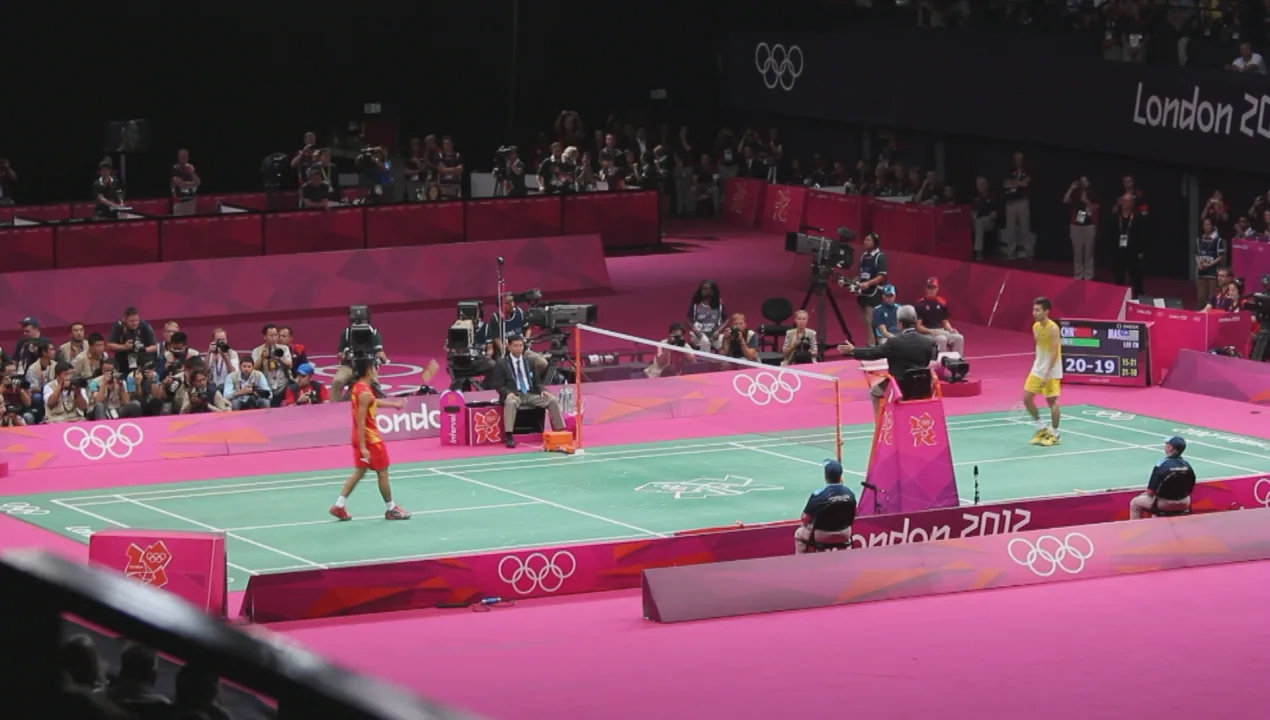
At match point in the 2012 Olympic men's singles final, Lin Dan and Lee Chong Wei occupy opposite ends of a court surrounded by officials, cameras and Olympic branding. The shuttle is not visible. The scoreboard supplies tension, but the athletes' distance is what matters.
Badminton looks explosive because the final movement is easy to see: jump, smash, lunge, dive. The hidden work is recovery. After each stroke, a player must regain a position from which the next possibilities remain reachable. Footwork is not merely running fast toward the shuttle. It is arriving balanced enough to hit a useful stroke and leave again.
The racket also lies beautifully. Similar preparation can produce different pace and direction. A shuttle that seems available can fall sharply. A player who watches only the arm misses information in the body, contact height and opponent's court position.
This technical density is why a strong television match should not be used as evidence that badminton is easy because the equipment is light. Lightness increases speed. It does not reduce the demand for timing.
For a beginner, the lesson is not to copy an Olympic jump smash. It is to value the recovery that makes the next shot possible. A smaller, balanced movement often creates more badminton than one dramatic stroke followed by helplessness.
Coaching appears in the pause, not only the victory
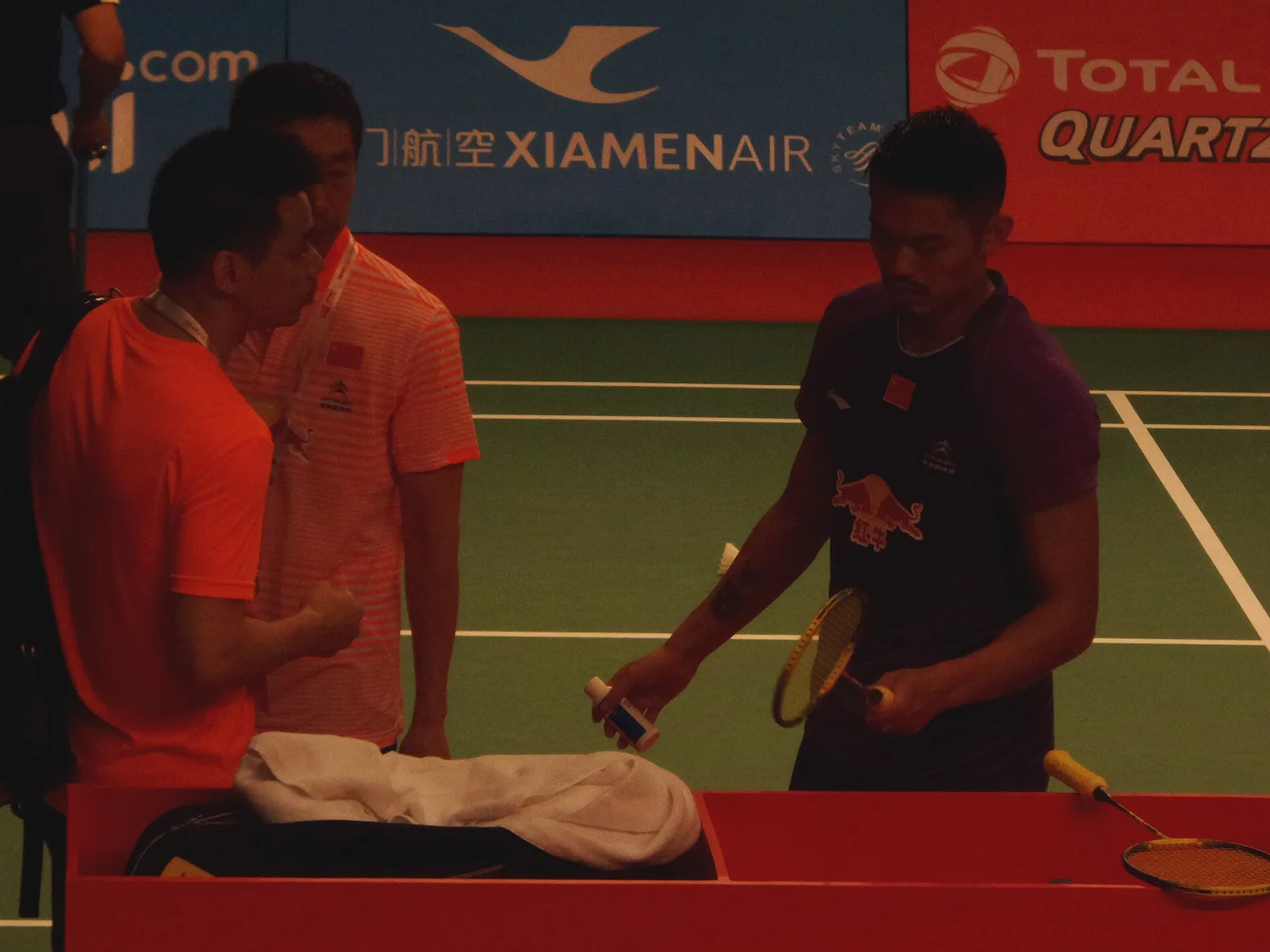
The coaching-break image is visually darker than the Olympic court, but editorially it reveals more. Lin Dan stands beside the court with a racket and drink. Two coaches lean into the exchange. A towel waits across the barrier. Elite play includes information, recovery and adjustment around the rally.
We cannot hear the advice and should not invent it. The frame does not prove a national coaching philosophy. It does show that even a celebrated player is not treated as an isolated reflex machine.
This is another reason natural-talent explanations fail. Technique is observed, named, corrected and rebuilt. Tactics respond to a particular opponent. Physical condition changes what is sensible on that day. Between points and games, a team tries to convert what just happened into a better next decision.
Casual players need less infrastructure, but the principle travels. One precise correction is more valuable than ten vague commands to "play harder." A partner who says the shuttle keeps arriving behind your body offers a problem you can test. A coach who feeds the same situation lets you feel the change. Feedback turns repetition into learning.
Bad coaching does the opposite. It floods a beginner with technical vocabulary, demands painful range too early or treats fear and fatigue as moral weakness. Badminton is accessible; joints are not disposable.
Choosing where to play changes what you can learn
For a first casual exchange, choose a clear, flat space away from traffic and fragile objects. Check the wind before setting a target. Agree whether the goal is cooperative rallying or points. If there is no net, create a shared height with judgment rather than turning every disagreement into a rules trial.
Move indoors when the task changes. Consistent air and marked lines help you understand length. A real net clarifies which flat drives are too low. Safer flooring supports repeated movement. A booked court creates enough continuity to practice rather than chase the shuttle across a square.
When joining an existing group, ask about level and format honestly. "Beginner" can mean anything from first contact to several years of recreational play. Describe what you can do: sustain a cooperative rally, serve legally, rotate in doubles, or play games but struggle with the back court. Specificity helps people make a fair match.
Bring shuttles and expect them to wear out. Do not assume the strongest player should always supply equipment, organize the booking and teach everyone. Everyday sport survives through small shared labor.
If you are evaluating coaching, watch how the session handles movement before power. Does the coach explain recovery? Are feeds appropriate to the player's level? Do players make decisions, or only repeat a memorized pattern? Is pain taken seriously? A neat row of fast swings may photograph well while teaching very little.
Badminton, table tennis and basketball make different invitations
Table tennis in China needs a fixed table but very little travel around it. Once the table exists, the bounce creates reliable repetition and the local queue becomes part of the game.
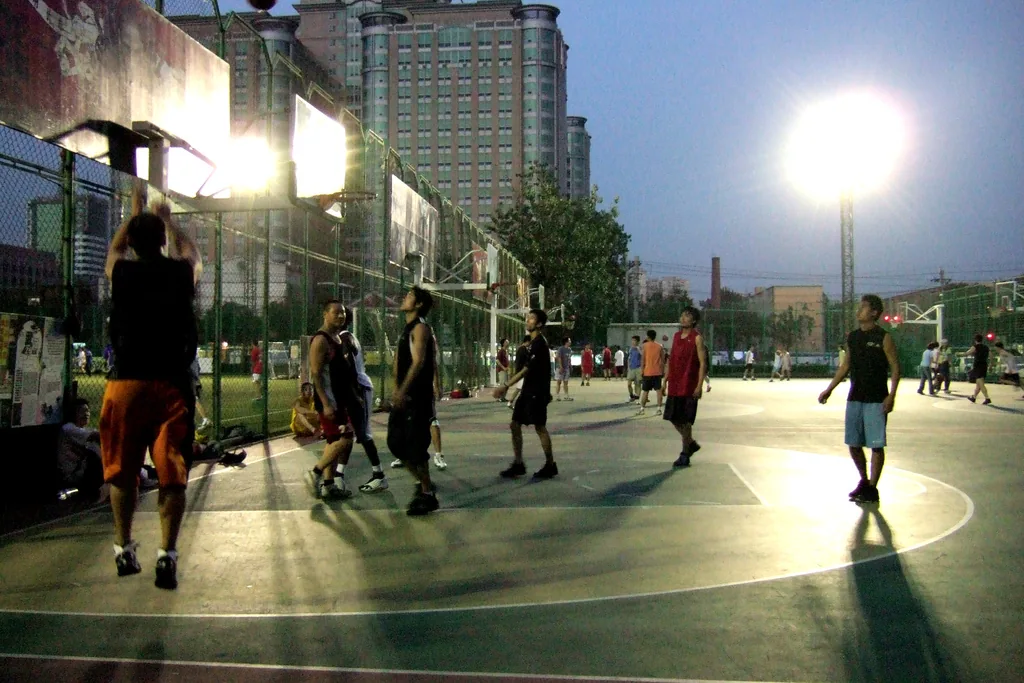
Basketball in China gathers more bodies and gives a public court enormous social energy. That same dependence on teams, hoops and shared time makes the route beyond casual play more complicated.
Badminton makes the lightest first invitation. Two people can begin without permanent furniture. The cost appears later: weather corrupts the flight, indoor courts become scarce, shuttles wear out, and serious movement asks more of technique and flooring.
None is simply "more accessible." Access depends on which resource is scarce: fixed infrastructure, open area, partner, coaching, money, time or confidence. The Chinese sports field guide is the wider route through those different relationships among bodies, spaces and institutions.
Badminton in China wins by remaining adjustable
The everyday strength of badminton in China is not that every person plays or that every park is a proper court. It is that the game tolerates several honest versions of success.
A child keeps the shuttle airborne three times. Two friends extend a cooperative rally. Four regulars learn to rotate without colliding. A coached player discovers that recovery matters more than one hard smash. An elite pair reorganizes the court in a fraction of a second.
These versions are connected by an object that slows visibly, then falls. The shuttle gives players time to hope and very little time to move.
I would protect that range instead of forcing every session to imitate competition. The everyday game deserves space, maintenance and respect precisely because it can hold pleasure before mastery. At the same time, admiration for casual access should not hide the skill, coaching and physical preparation required at higher levels.
In the comments, name the condition that repeatedly breaks a rally where you play. Is it wind, ceiling, floor, booking pressure, partner communication or one technical habit? What change actually improved the next session?
Then add a rally-pair record to East Moment Moments. Include the surface, wind or ceiling, partner agreement, one repeated breakdown and one repair. Return after playing with one changed condition or a different partner. The second record is the useful one: it shows whether your solution belonged to the game or only to one afternoon.