Table tennis in China is not explained by medals, diplomacy or "natural talent." Its real strength is a connected social system: a table can appear in a park or school, repetition can become feedback, selection can lead toward specialist training, and elite success can keep the game culturally visible. Remove any one layer and the story becomes thinner.
Table tennis in China begins before the first serve
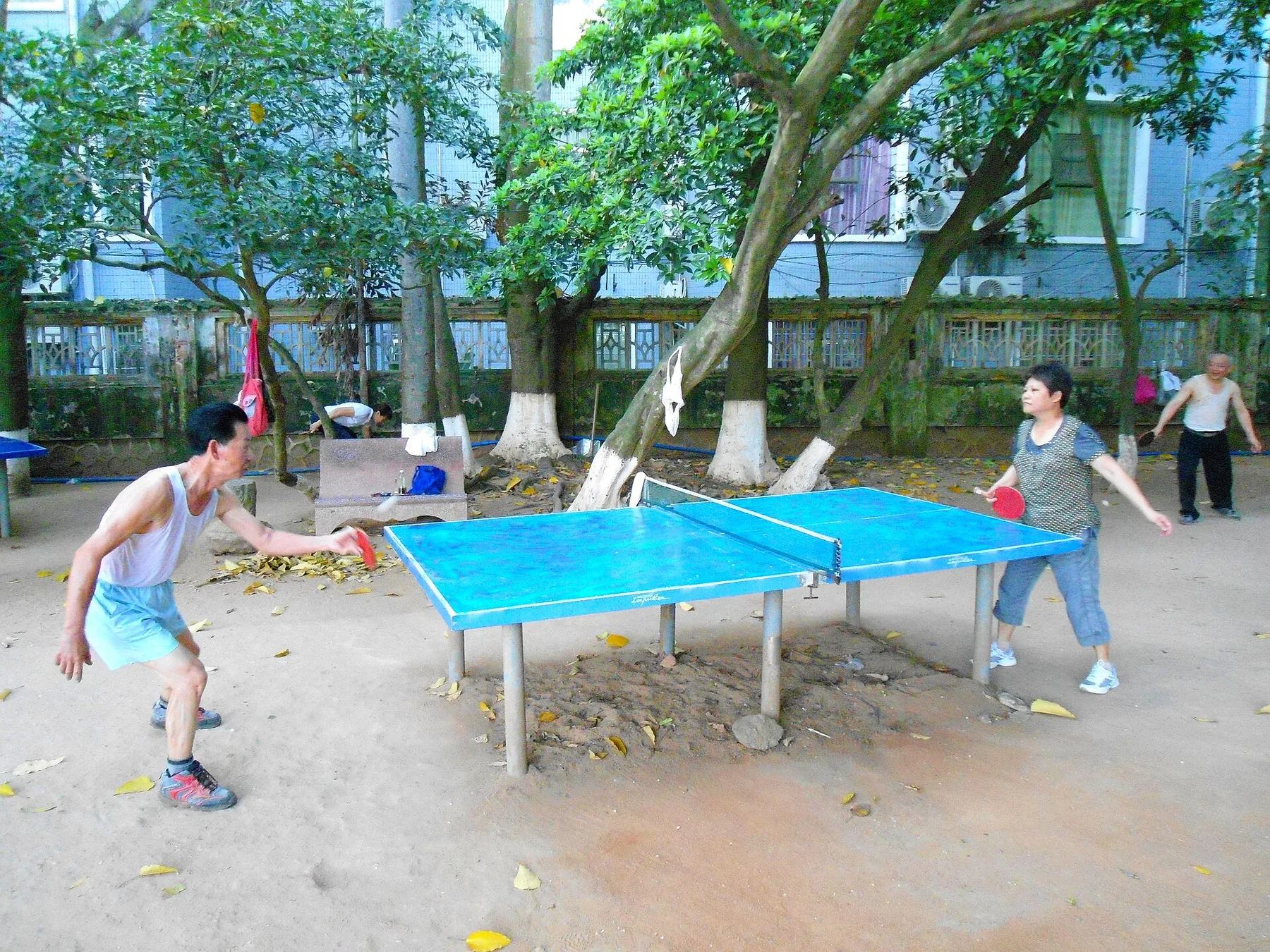
Two adults face each other across a blue concrete table in Haikou People's Park. Their clothes are ordinary exercise clothes. The ground is bare, roots and fallen leaves press close to the playing space, and another table is partly visible behind them. Nothing in the scene announces a formal club. Yet the bodies already know what the furniture asks: lean forward, find the bounce, return the ball, make room for the next point.
That is the best place to begin understanding table tennis in China. Not with a medal table. Not with a heroic childhood story. Begin with the object in the middle.
A table divides two players and holds them together. It sets distance, gives the ball a predictable surface and makes a game readable to anyone standing nearby. It also creates social questions. Who brought the ball? Who plays next? Does the winner stay? Can a beginner interrupt two strong regulars? Is the table public in law but privately controlled by habit?
My conclusion is simple: the table is a small social institution. Concrete and paint matter, but the invisible rules around them decide whether access becomes practice.
Public infrastructure lowers the threshold, not every barrier
The General Administration of Sport of China's 2021 national sports-venue survey recorded 884,800 table-tennis venues, with 88.51 percent classified as outdoor. Those figures are useful because they show how strongly the sport can live outside a ticketed arena. They are also dated survey figures, not a live counter and not proof that every listed venue is equally usable.
One outdoor table can be cheap to maintain compared with a full field. Several people can rotate through a small footprint. A paddle fits in a bag. A short exchange can happen before dinner or between other activities. Those are real advantages.
But "available" is not the same as "welcoming." A cracked surface changes the bounce. Wind turns a light ball into an argument. Strong regulars can occupy a table for hours. A child may have physical access but no partner. A newcomer may not know the local queue. Public infrastructure removes some costs while leaving social confidence, time and maintenance unresolved.
This is why I dislike the easy sentence that table tennis is popular because it needs little space. Small space explains why a table can be installed. It does not explain who returns tomorrow.
A school table creates repetition before it creates an athlete
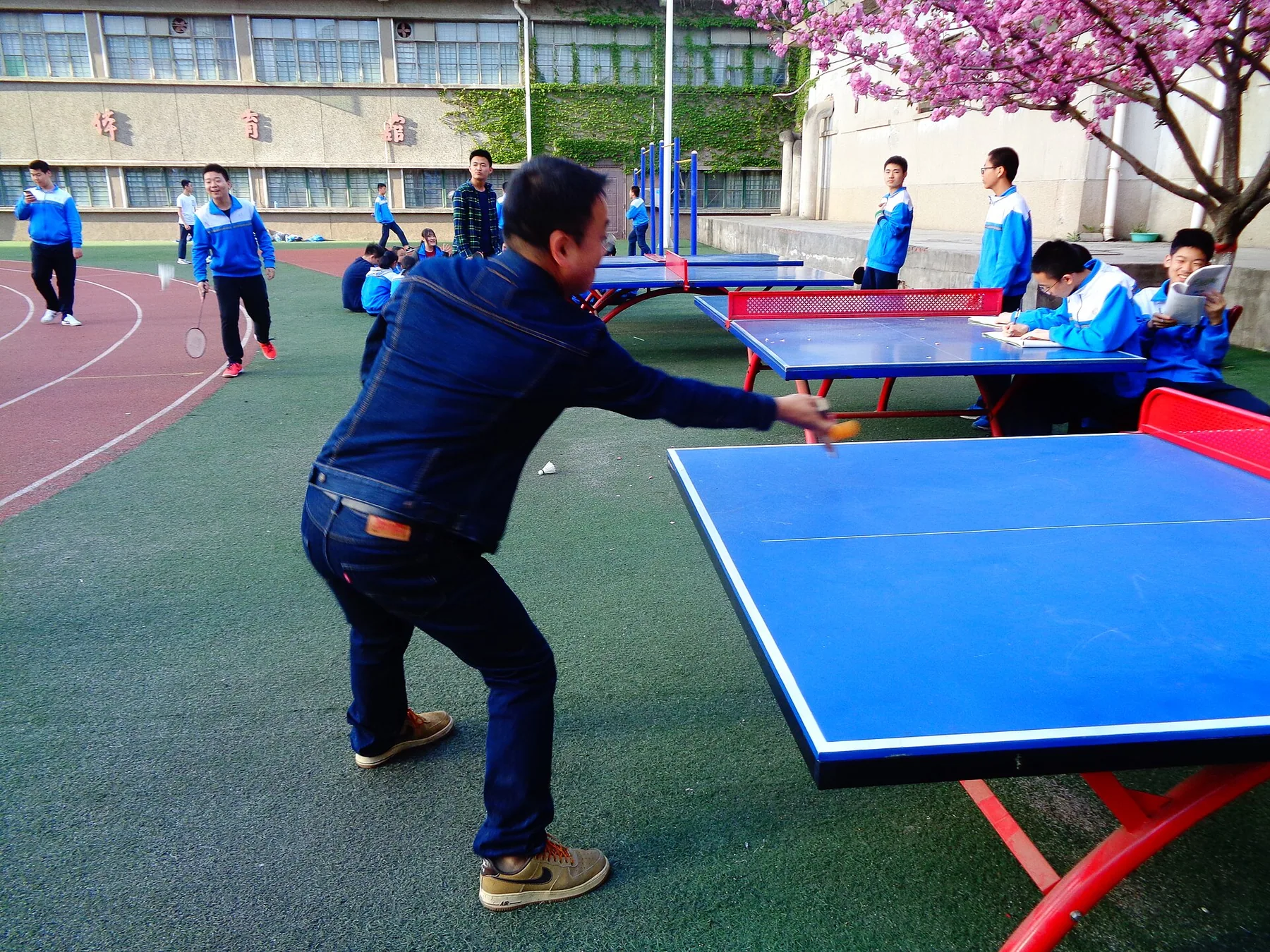
The Xi'an schoolyard above contains more than one kind of participation. An adult reaches into a forehand at the nearest table. Students in blue-and-white uniforms watch, write, talk, walk and wait. Other tables sit behind the action. The scene is messy in the best way: sport has not been isolated from the rest of school life.
A fixed table can turn ten spare minutes into hundreds of contacts with the ball over a term. That volume matters. Table tennis gives immediate feedback. The ball misses the end: the racket angle or force was wrong. It falls into the net: timing or height failed. It returns faster than expected: the opponent changed spin, placement or pace.
Repetition alone is not magic. Repeating a bad contact can make it stubborn. Progress accelerates when somebody can identify the error, feed a consistent ball and adjust one variable. That person might be a teacher, coach, older student or skilled regular. The crucial transition is from available repetition to informed repetition.
The photograph cannot tell us whether this school has a formal program, whether anyone in the frame receives coaching or whether a pathway continues beyond the yard. It proves something narrower and still valuable: tables, play and observation occupy one shared educational space. The school day can make the game familiar even when it does not produce an elite player.
China's elite system is built, not inherited
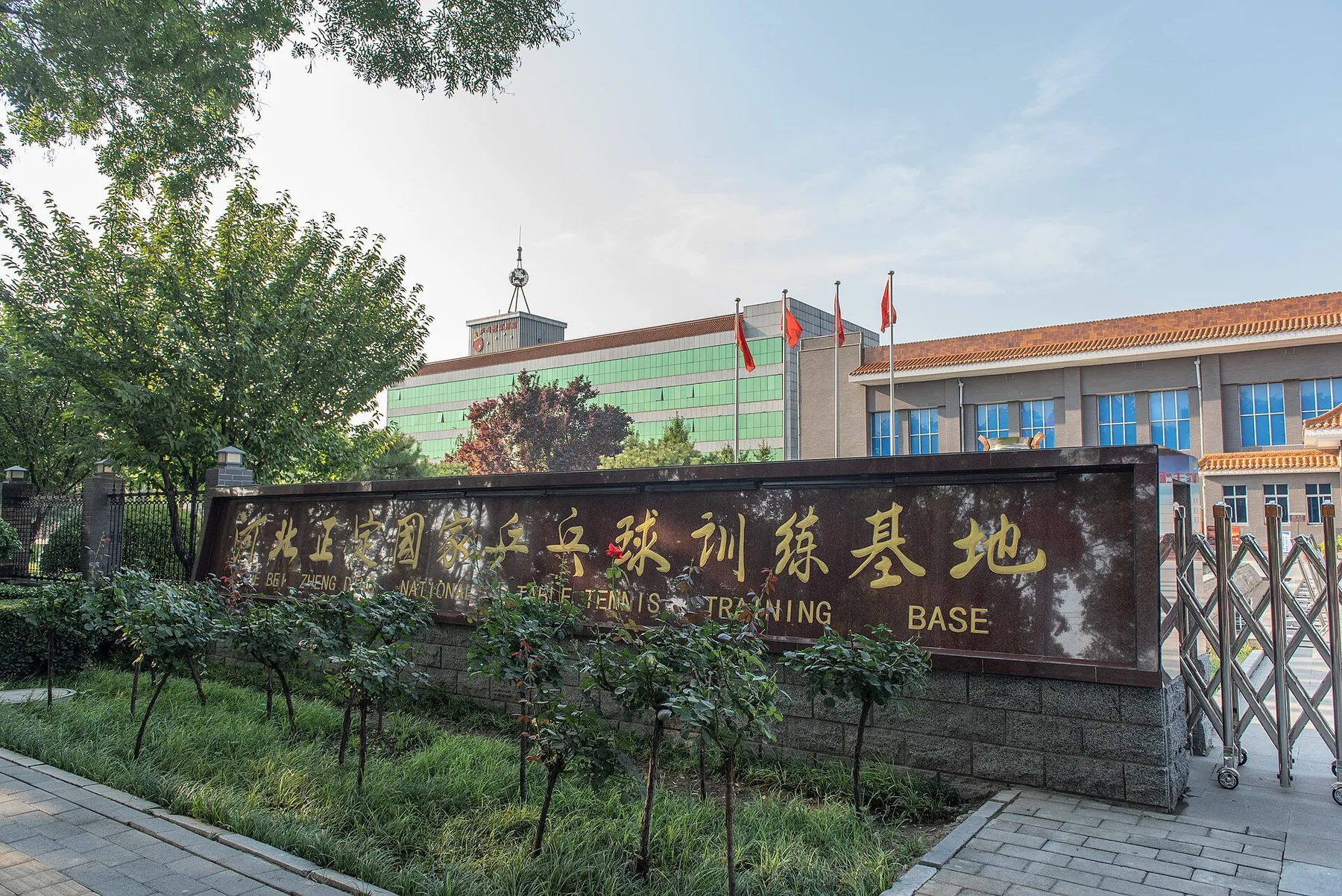
The sign at Zhengding changes the scale of the question. Here table tennis is not an improvised park exchange. It is named, enclosed and institutional: a national training base with buildings, gates and specialist purpose.
This image does not let us see inside the training hall. It cannot prove coaching quality, selection rules or athlete outcomes. What it does make visible is the existence of dedicated infrastructure at the opposite end of the casual table.
When people ask, "Why is China so good at table tennis?" they often want one secret: a special technique, a ruthless program, a huge population or a cultural obsession. The honest answer is less cinematic. Sustained elite performance requires layers that repeatedly encounter one another: early familiarity, competitive sorting, coaching knowledge, practice partners of increasing quality, sports science, domestic competition, international exposure and institutional memory.
Population provides possible players, not finished champions. A large population without usable tables, attentive coaches and competitive feedback is only a large population. Nor does elite success prove that every child plays. A system can be exceptionally good at identifying and developing a small group while millions of other people remain casual players or never pick up a paddle.
Natural-talent language hides this work. It turns years of correction into biology and makes institutional choices disappear. I find that explanation not only weak but disrespectful. The impressive thing is not that Chinese bodies somehow arrive pre-programmed for a 40-millimeter ball. It is that generations of players and coaches have accumulated a dense culture of noticing error.
Elite speed begins with reading, not spectacle
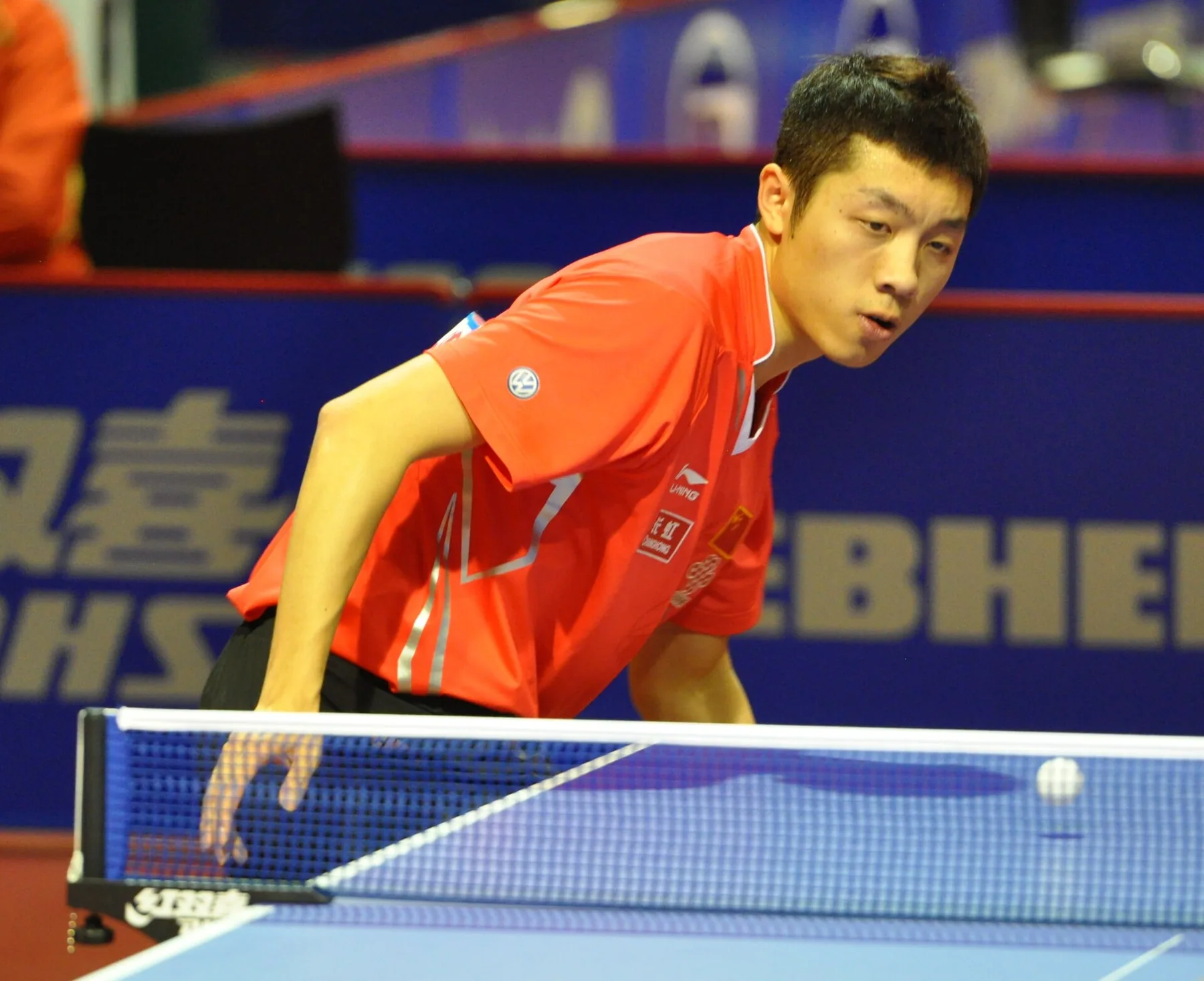
Xu Xin's body in this 2011 World Championships photograph is compressed toward the table. His eyes are forward, one hand hangs near the net line, and his weight looks ready to move before the ball enters the frame. The image is quiet compared with the speed we associate with elite rallies.
That quiet is the point. At high level, a player is not simply reacting after the ball arrives. He is reading the opponent's contact, wrist, racket face, body position and likely recovery. Spin changes the meaning of speed. Placement changes the available response. The visible strike is only the last part of a decision already forming.
This helps connect the public table to the elite one without pretending they are the same experience. A park player also learns to read a familiar opponent: the serve that always drifts long, the backhand that avoids one corner, the moment impatience appears. Elite training increases the precision, variation and punishment. The social pleasure of recognition remains.
The Chinese table-tennis system is powerful because feedback density can become extremely high. Good players meet other good players. Coaches carry old problems and solutions forward. Domestic competition makes reputation insufficient; the ball keeps testing the claim.
Ping-Pong Diplomacy enlarged the table, but it did not invent the game
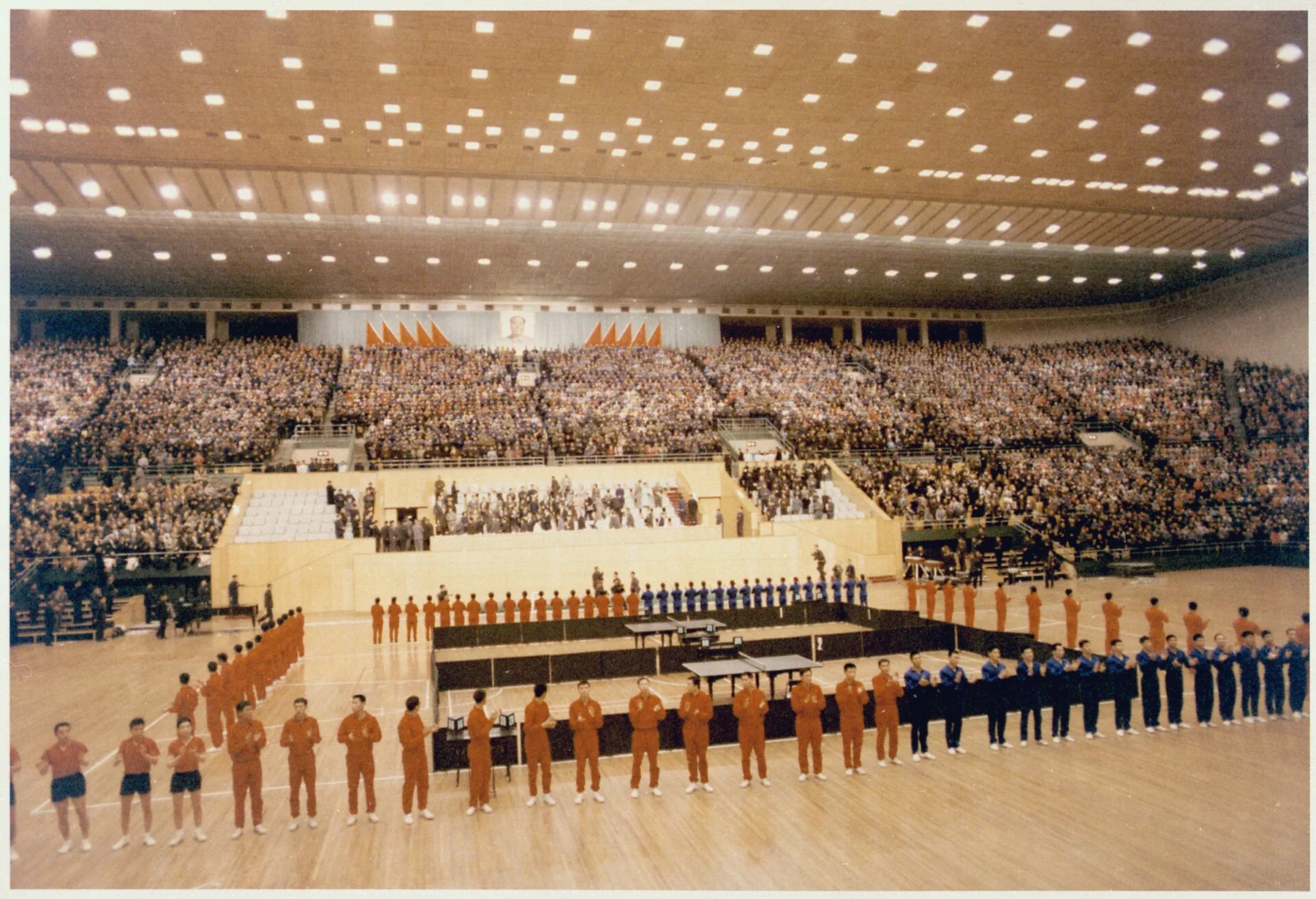
The 1972 Beijing exhibition is almost the visual opposite of the Haikou park. Athletes line a huge floor. Spectators fill the stands. Political symbols and official choreography surround several tiny tables. A game built around centimeters is asked to carry relations between nations.
The ITTF's history of Ping-Pong Diplomacy matters because table tennis did become a channel of encounter during a consequential change in China-US relations. But the phrase is often allowed to swallow the sport. Diplomacy did not manufacture every public table, every school rally or every technical tradition. Nor did one exchange single-handedly produce a complex diplomatic opening.
The historical episode reveals a special property of the game: opponents stand close, separated by a net but connected through a repeated object. The exchange is competitive and cooperative at once. Without the other person's return, there is no rally.
That symbolism is powerful because it grows from the structure of play. It becomes empty when repeated as a slogan without people actually meeting.
National celebration and everyday ownership are different things
In 2026, the ITTF reported World Table Tennis Day events across China, with a central gathering in Guiyang. National coordination can renew attention, connect organizations and invite participation. It cannot substitute for the ordinary table that is unlocked, maintained and socially usable next week.
The same distinction applies to medals. Elite victory creates images, memory and aspiration. It may encourage a parent to enroll a child or a city to support facilities. Yet watching a champion is not the same as having a partner. Broadcast visibility is not court access. Pride is not a coaching plan.
This gap also explains why international readers can overestimate how uniform Chinese affection for table tennis must be. Some people care deeply. Some played at school and stopped. Some know champions but prefer basketball. Some have never learned how to handle spin. A national sport is not a compulsory national personality.
The interesting question is not whether "the Chinese" love table tennis. It is where the game remains easy to enter, meaningful to repeat and possible to share.
How to read a Chinese table-tennis space
When you encounter a table in a Chinese park, residential compound, school or sports center, spend five minutes observing before asking to play.
Look first at the material. A permanent outdoor table tolerates weather but behaves differently from an indoor competition surface. Notice the ball path, wind, glare and room behind each end. Then look at the people. Are paddles placed to mark a queue? Are players rotating? Does one person feed balls while another practices, or is every point competitive? Who retrieves stray balls? Who is watching but never invited?
If you want to join, a simple request matters more than a performance of confidence. Ask whether there is a queue and how games rotate. Be ready for the local format to be shorter or more flexible than formal competition. Bring balls; they disappear easily. Do not interpret a refusal as a national attitude when a pair may be training, finishing a set or waiting for somebody else.
Most importantly, do not film strangers as cultural scenery without consent. A public table is public space, not free ownership of another person's face.
The three everyday sports solve different social problems
Basketball in China needs enough shared space for bodies to cut, collide, defend and assemble teams. Its public visibility can be enormous, but the step from a neighborhood game to structured development is uneven.
Badminton in China can begin with an even lighter kit and an improvised patch of space. Its doubles culture makes companionship central, while wind and indoor booking quickly reveal the limits of "play anywhere."
Table tennis sits differently between them. The table is a barrier, a surface and an invitation. Once installed, it makes one form of play unusually repeatable. It also concentrates control: if the only table is occupied, there is no second hoop or open patch to improvise around.
That comparison is more useful than declaring one sport China's favorite. Each sport organizes space, bodies and strangers differently; the Chinese sports field guide keeps those systems connected without pretending they are one national personality.
Table tennis in China is strongest when the layers still touch
The park table, schoolyard, specialist base, world championship and diplomatic arena do not form one smooth ladder. Most park players will never enter an elite institution. A national-team champion does not represent every casual exchange. A historic diplomatic image does not explain today's access.
Yet the layers can reinforce one another. Public familiarity makes the game legible. Schools make repetition ordinary. Coaching turns repetition into correction. Specialist institutions intensify competition. Elite performance returns attention to the object waiting in the park.
That is my answer to table tennis in China: not a miracle, not a gene and not one government program. It is a system strongest when ordinary and elite forms remain close enough to recognize each other.
In the comments, describe the unwritten rule at a table you know. Is it winner stays, a visible queue, an invitation from regulars or simply whoever arrived first? Who does that rule welcome, and who might it quietly exclude?
Then add one table record to East Moment Moments. Include the location, table material, access rule, usual players, how the next game begins and one obstacle. Return when someone records the same table at another hour or season. One photograph shows a game; repeated records can show a social system.