Chinese street style is not one look and it is certainly not a national uniform. The useful way to read it is to ask what survives after the photograph: Can the person walk, carry a bag, cross a road, handle the weather and still keep the silhouette? The best outfits make those ordinary demands part of the design.
Chinese street style begins where the pose stops
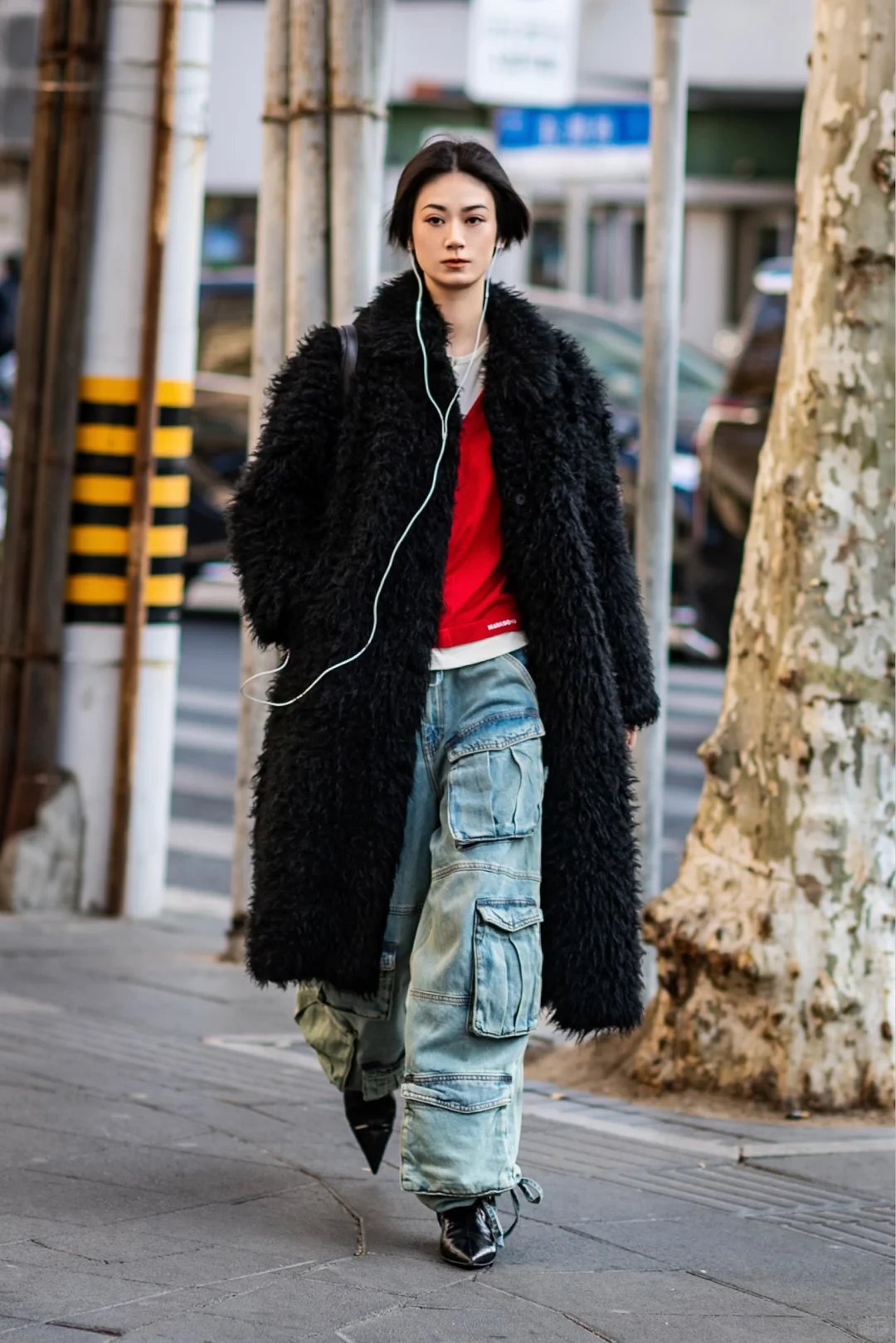
Search for Chinese street style and the screen quickly supplies a fantasy of certainty: a dramatic coat, a tiny top, impossible trousers, one clean stride through a city that seems to have removed every badly dressed person from the pavement. The images can be exciting. The conclusion people draw from them is often terrible.
Six photogenic pedestrians do not tell us what 1.4 billion people wear. One Shanghai photographer does not deliver a census. An algorithmic feed does not even show the whole street; it shows the frames someone selected because proportion, face, light and timing came together.
That limit does not make street photography useless. It makes the evidence more precise. A good frame can show how an outfit solves public life: where volume is placed, which layer meets the weather, how a shoe supports the trouser, what the hands must carry and whether the wearer still looks like themselves while moving.
My rule is simple: I trust a street look more when I can imagine the next ten minutes. The traffic light changes. The phone rings. A coffee must be carried. The subway stairs arrive. Fashion that survives those events has a life beyond the feed.
Start with proportion, not the logo hunt
The fastest way to miss an outfit is to treat it as a brand-identification puzzle. Logos can tell us about price, aspiration or subculture, but proportion tells us what the clothes are doing to the body.
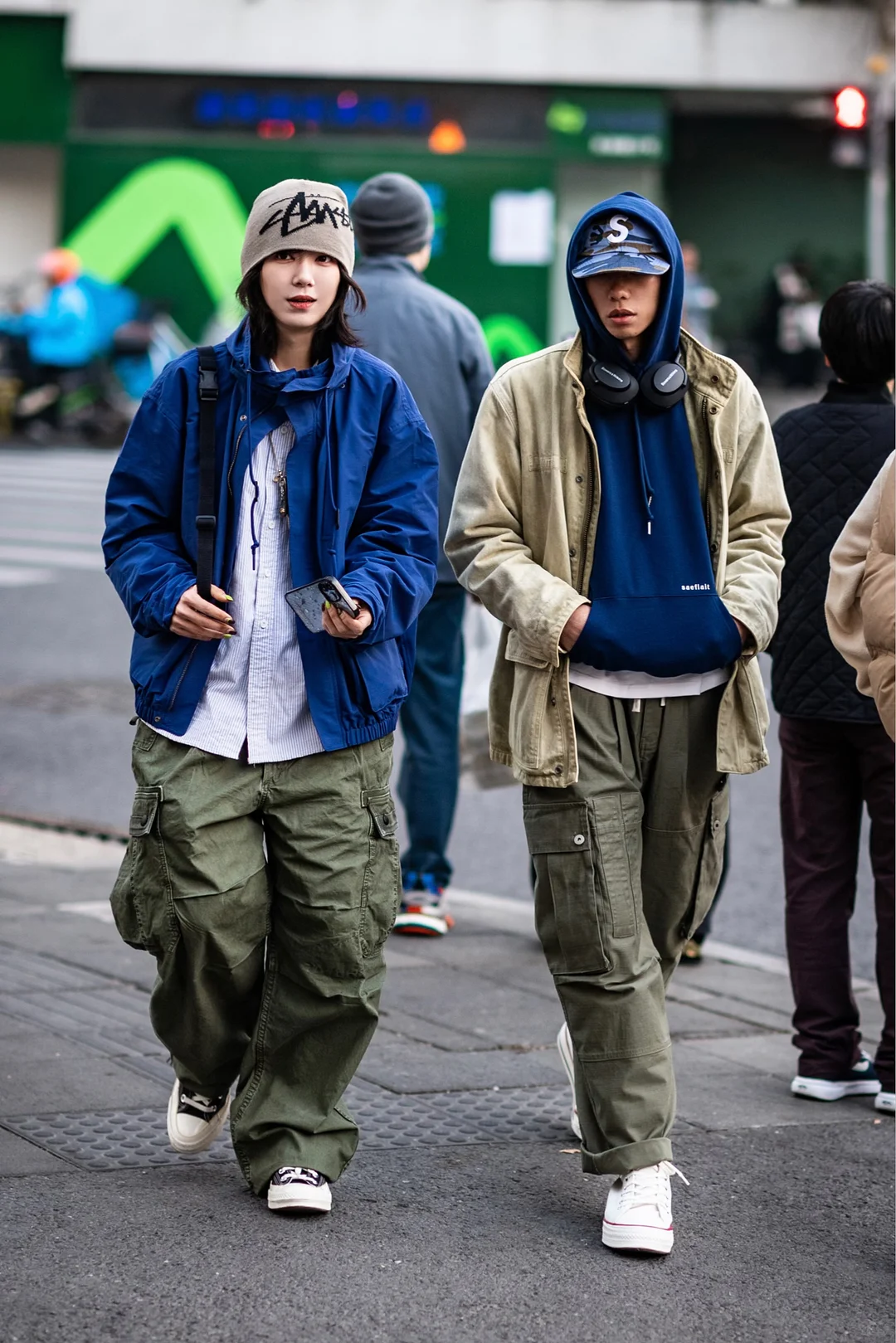
Look at the pair above. The shared idea is not one label. Both outfits put volume low and let outer layers stack loosely over it. The blue jacket on the left stops high enough to keep the cargo pockets visible. On the right, a longer khaki jacket covers part of the hoodie and extends the torso before the wide trousers begin. Similar vocabulary, different sentence.
The shoes matter because they prevent the trousers from becoming a puddle. The caps and hoods narrow the upper frame. Hands enter pockets; headphones hang at the chest. These are not styling notes pasted onto a still object. They are a system for moving through a cool city day.
Across the selected Shanghai series, wide trousers recur in denim, black, khaki and olive. That repetition is visible in this one photographic set; it is not proof that all young Chinese people dress this way. What it does prove is that width can carry several different moods. It can feel quiet, technical, protective, careless or deliberately theatrical depending on the shoe, outerwear and pace.
This is why “baggy is trending in China” teaches almost nothing. Width is the raw material. The decision is where it begins, how it falls and what contains it.
A useful layer has a job before it has a mood
Street styling is often described with aesthetic labels: gorpcore, preppy, retro, minimalist, Y2K. Those words can help you search. They can also stop you from looking.
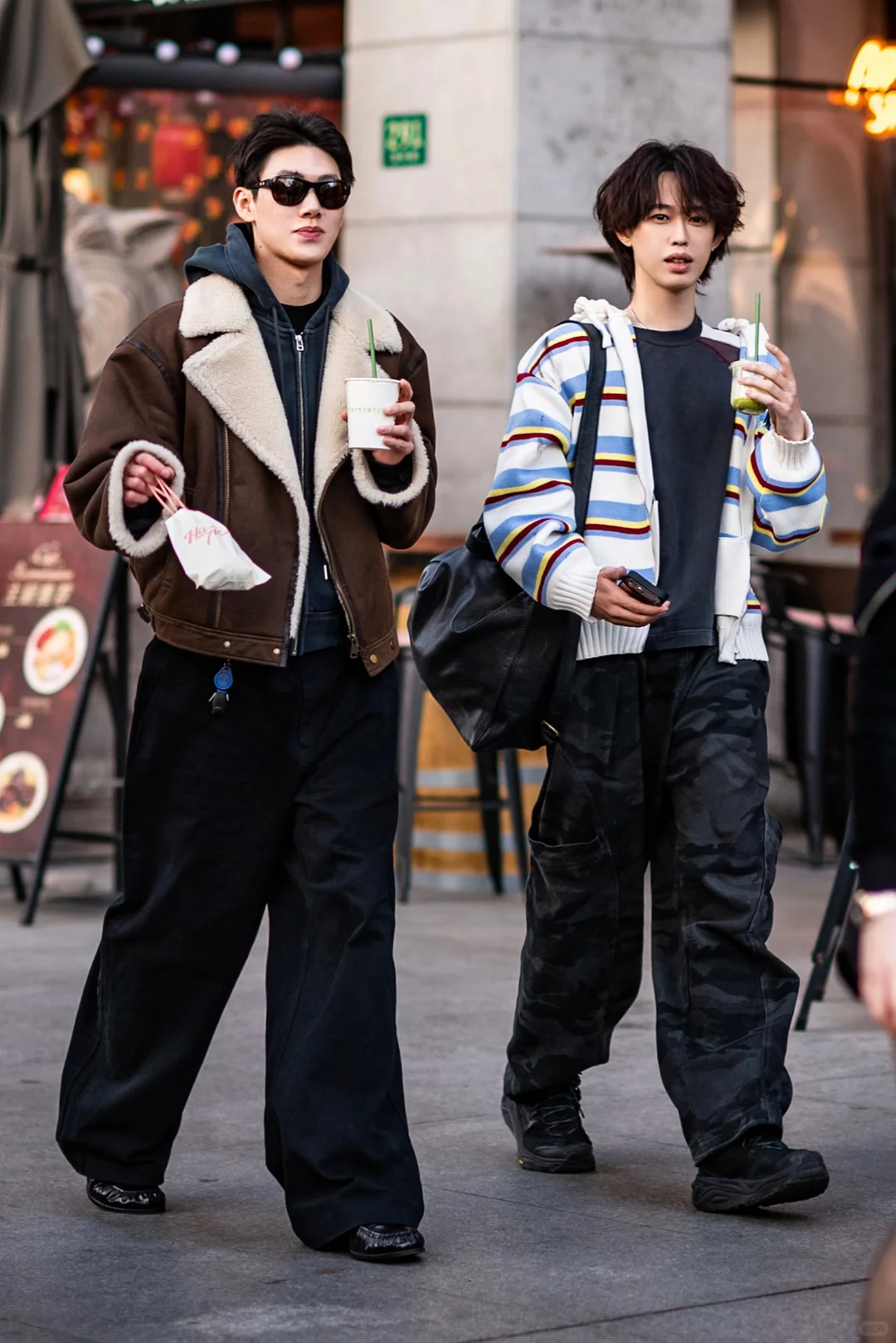
In this frame, one shearling-lined jacket supplies warmth and a heavy brown boundary around a charcoal hoodie. Beside it, a striped cardigan introduces bright horizontal rhythm over a much darker base. Both men carry drinks and bags. Their clothes allow the hands to remain active; neither look depends on a fragile pose.
The contrast is useful. The shearling jacket creates one large, decisive mass. The cardigan produces several smaller color events. The first outfit feels anchored; the second feels restless. That difference would remain even if every brand mark vanished.
When I look at layering, I ask four questions:
- What touches the weather? The outer layer should explain wind, temperature or rain, not merely create a shape.
- Where does one garment end against the next? A hoodie below a jacket or shirt below a sweatshirt changes the body's vertical rhythm.
- Can the wearer remove something without collapsing the outfit? A good city system anticipates the heated cafe and crowded train.
- What do the hands need to do? A look that requires constant adjustment may work for a shoot and fail before lunch.
This practical reading is not anti-fashion. It is more demanding. It asks beauty to remain persuasive while life interrupts.
Shanghai street style is a city edit, not a China label
Shanghai matters because it concentrates fashion retail, media, creative work, international references and a visible event calendar. Shanghai Fashion Week describes its own platform as connecting design presentation, commercial ordering and industry coordination. That ecosystem gives photographers, stylists, buyers, models and fashion-conscious pedestrians reasons to occupy the same districts.
But a fashion-week ecosystem is not the whole city, and Shanghai is not a convenient synonym for China. Street images made near fashionable commercial areas will overrepresent people who have time, access, confidence and a reason to be seen. Weather and local infrastructure also edit the wardrobe. A Shanghai winter pavement does not ask the same clothing question as humid Guangzhou, dry Beijing or a scooter-heavy street in another city.
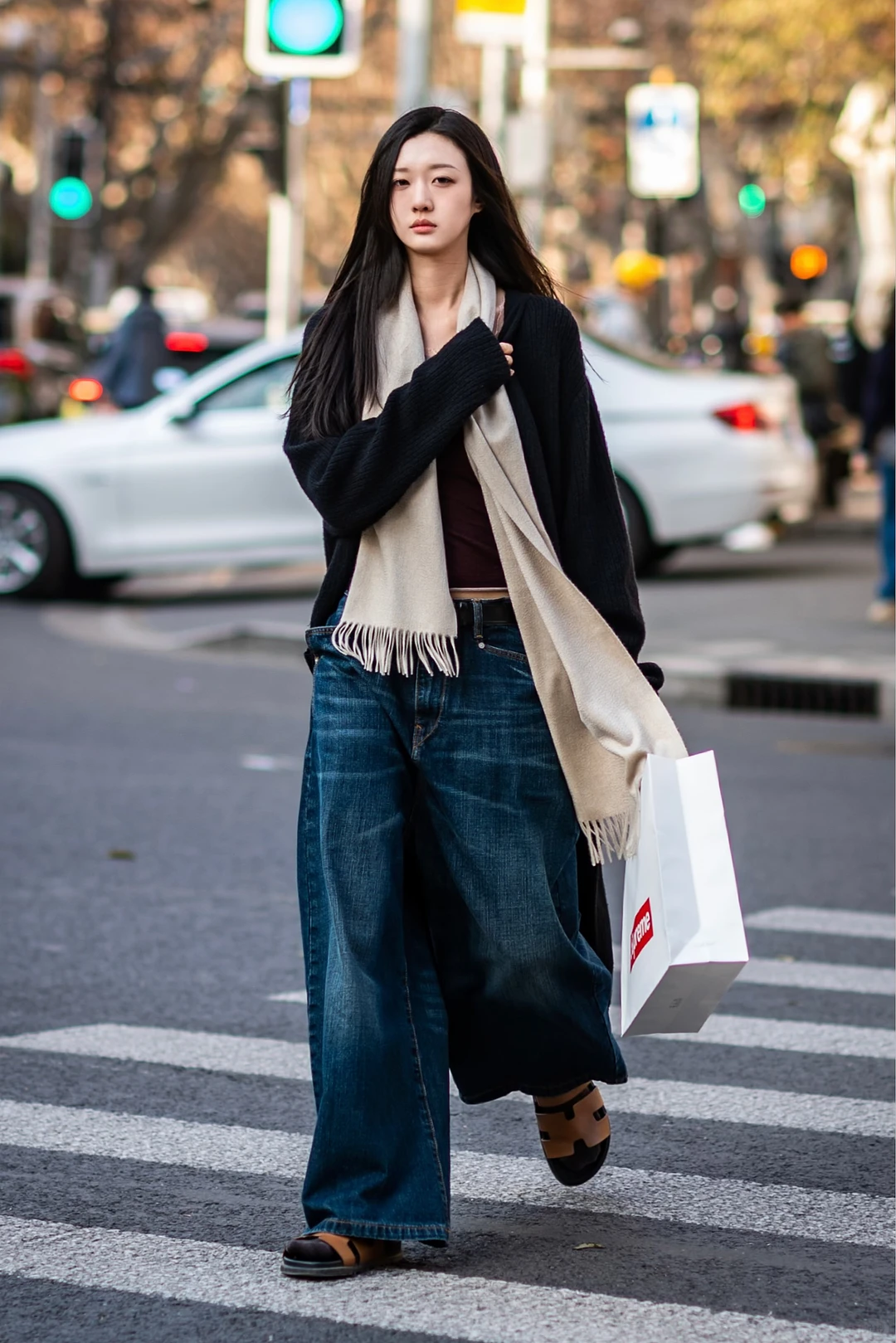
This outfit is powerful because it is almost quiet. The scarf lengthens the torso, the jeans hold a broad column and the flat shoes keep the stride credible. A shopping bag breaks the fantasy that the street exists only for fashion. Cars and traffic lights place the body in an actual crossing rather than a neutral studio.
There is also a useful refusal here. The look does not spend cultural symbols to prove its location. Nothing needs to announce “Chinese.” Chinese street style includes ordinary global garments selected, combined and inhabited in Chinese cities. Demanding a dragon, frog button or red accent from every image is a foreign gaze asking contemporary people to dress as their own caption.
For that explicit cultural-reference question, the better route is the Guochao fashion guide. Do not force Guochao to swallow every outfit made or worn in China.
The bag, phone and headphones reveal the hidden architecture
An outfit photograph becomes more honest when the person is carrying something. Bags pull on shoulders. Phones occupy hands. Headphones create a second shape around the neck. A drink tests sleeve length. These small frictions expose the difference between styled completeness and usable coherence.
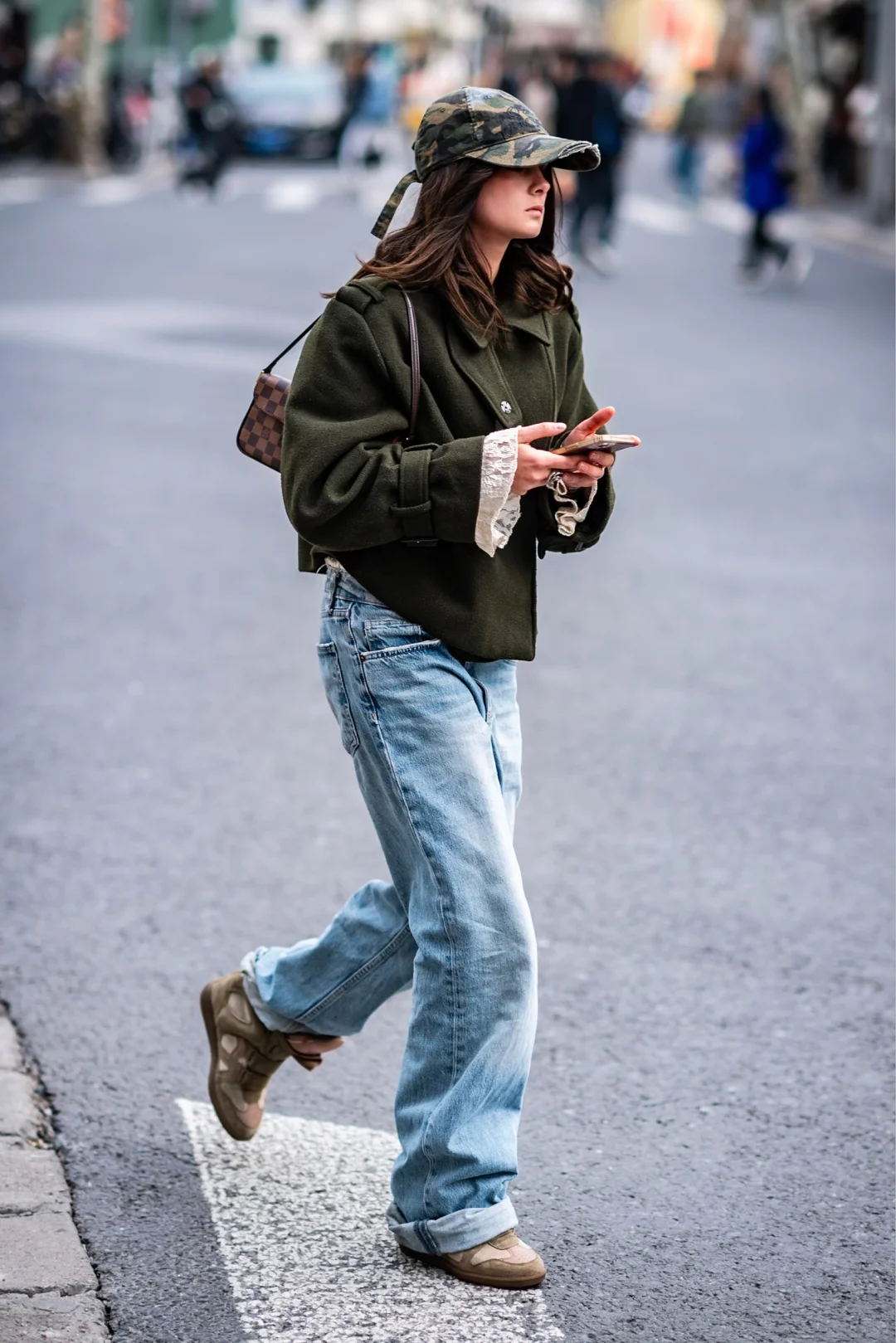
The cropped green coat here lets the wide faded jeans own most of the silhouette. Lace cuffs complicate the military associations of the cap and dark wool. The small shoulder bag sits close enough not to compete with the trouser volume. Most importantly, the person is crossing while using a phone. The outfit bends, swings and steps.
I like this tension more than a perfectly matched theme. Camouflage, lace, checked leather and washed denim do not belong to one neat category. The wearer makes them negotiate. That is style: not buying a finished identity, but deciding which contradictions can share one body.
The photograph cannot tell us whether the shoes hurt after an hour, whether the coat is warm enough or whether the look was assembled specifically to be photographed. Pixels do not supply comfort, ownership or motive. They show a moment of use. A responsible reading takes the gift and respects the limit.
Camera-ready is a skill, but it can distort the lesson
Street photography rewards clear silhouettes, confident pace, visible faces and garments that separate from the background. Dark clothing against a dark wall may disappear. A delicate texture may flatten. A bright glove, red layer or graphic stripe survives compression and earns the click.
That means online “street style” is partly fashion and partly image engineering. The photographer chooses focal length, shutter moment and background. The subject may notice the camera and lengthen a stride. The editor chooses one frame from many. The platform crops it again.
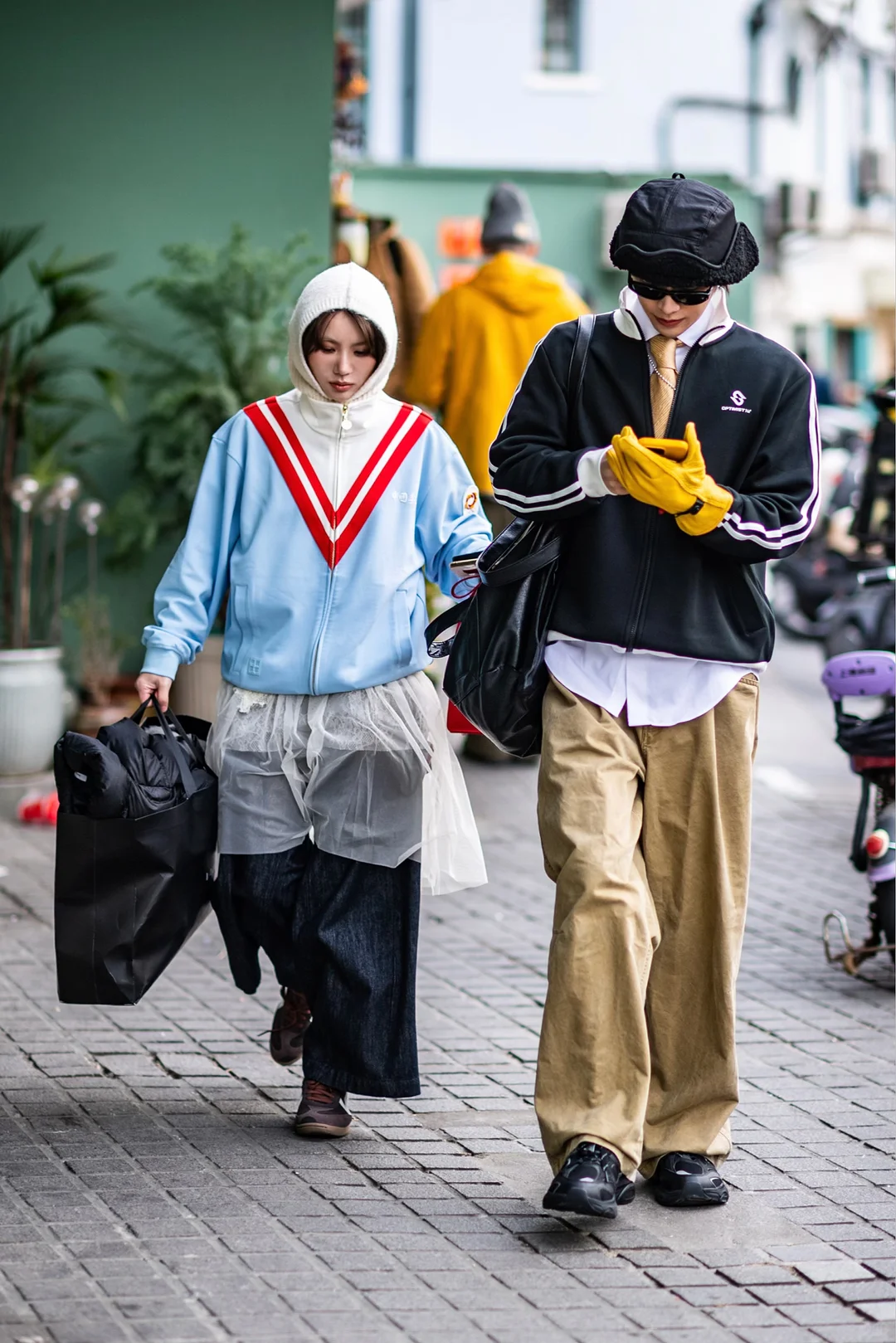
The yellow gloves above are a perfect camera event. They isolate the hands and make a phone-checking gesture legible from a distance. Beside them, a red V on a pale blue jacket organizes the upper body while a translucent layer interrupts the transition into dark trousers. The photograph gives us real clothing decisions, but it also explains why those decisions were selected for circulation.
Do not copy only the loudest element. Ask what supports it. The yellow works because black outerwear, a white collar and khaki trousers give it space. Remove that restraint and the accent loses force. The red V works because the rest of the palette is cool and pale. An outfit is an economy of attention.
The Liu Wen profile develops the same problem from a professional angle: a model's work is not simply to wear clothes beautifully, but to understand what a garment and a camera need. On the street, that labor is less formal, yet the image still depends on bodily intelligence.
Chinese streetwear is only one lane inside the street
“Chinese streetwear” and “Chinese street style” overlap, but they are not interchangeable. Streetwear usually points toward a product and subcultural lineage: sneakers, graphic garments, skate or hip-hop references, local labels, collaborations and a market. Street style is the broader observation of what people wear publicly, including tailoring, vintage, technical layers, luxury pieces, uniforms, quiet basics and combinations that refuse a clean category.
Reducing the street to streetwear makes every pedestrian look like a consumer segment. Reducing Chinese fashion to visible heritage symbols makes every pedestrian look like a national representative. Both readings flatten the person.
The better approach is to record decisions before categories:
| What to notice | The useful question |
|---|---|
| Silhouette | Where is the volume, and what keeps it controlled? |
| Layering | Which layer handles weather, movement or temperature change? |
| Footwear | Does it support the trouser length and the actual route? |
| Carrying | What happens when a phone, drink or bag enters the composition? |
| Cultural reference | Is it changing construction and use, or only supplying a symbol? |
| Camera effect | Which detail became louder because the image selected and cropped it? |
This table is not a grading sheet. A chaotic outfit can be brilliant. A practical outfit can be boring. The point is to describe the mechanism before announcing a verdict.
How to build a Chinese street-style reference board without lying to yourself
Begin with at least three contexts, not thirty images from one feed. Choose one commute or weekday set, one event-adjacent set and one different city or season. Record source, date, visible weather and the photographer's selection logic when available.
Then hide faces and logos for a first pass. Trace the silhouette. Mark where jackets end, where trousers break and how bags attach to the body. On a second pass, restore color and texture. Only on the third pass should brand and cultural reference enter.
This order prevents fame and price from doing all the interpretation. It also helps an overseas reader avoid the embarrassing leap from “I saw several Shanghai outfits” to “this is how Chinese people dress.”
Use the Chinese Fashion hub to separate the routes: living street combinations here, Guochao as a contested contemporary label, Chinese fashion designers as authored bodies of work and traditional Chinese clothing as historically located garment systems.
The final test is a second wear
The strongest street-style image gives you a desire. The strongest street-style record gives you a method.
My method is to follow one outfit past the flattering frame. What happens when the coat opens? When the bag gets heavy? When rain darkens the hem? When a wide trouser meets stairs? When the same person repeats the idea in warmer weather?
That second record is where style becomes knowledge. It tells us whether a proportion was a one-day performance or part of someone's durable visual language. It also makes the community more useful than an endless feed of disconnected approval.
In the comments, name one decision from your own city that photographs badly but lives beautifully—or the reverse. Be specific about the task: cycling, commuting, carrying groceries, standing through work, entering overheated rooms.
Then add an outfit decision to East Moment Moments. Include an original full look, one detail, the city, visible weather, the movement task and the compromise. Return after wearing it again. A real street-style atlas should improve with repetition, not merely grow with more faces.