Guochao fashion is contemporary fashion that makes Chinese cultural confidence visible—but the label becomes useful only when the reference changes construction, material, proportion or use. A peony printed onto an ordinary jacket may be attractive. It is not automatically a design argument.
Guochao fashion is a label under negotiation
The literal shortcut is easy: guochao (国潮) combines “national” or “Chinese” with “tide” or “trend.” In public use, however, Guochao fashion has never behaved like one fixed garment category. It can describe pride in domestic brands, contemporary design using Chinese visual language, a marketing campaign wrapped in cultural confidence or the more specific rise of xin Zhongshi (新中式), “new Chinese style.”
That looseness explains both the term's energy and its weakness. Guochao gave consumers a way to desire Chinese brands without treating foreign recognition as the final certificate. It also gave marketing departments a word broad enough to attach to almost anything red, embroidered, calligraphic or vaguely “Eastern.”
I do not want to rescue the label by pretending it has one pure definition. I want to make it harder to misuse.
My test has three levels. Reference is what the garment points toward. Transformation is what the designer actually changes. Use is what the wearer can now do. When all three are visible, Guochao becomes design. When only the first is present, “China” is packaging.
The standing collar is not the whole argument
A collar can create immediate recognition. A high neck, diagonal opening or row of knotted fasteners may recall several Chinese garment traditions in the viewer's mind. That recognition is an invitation, not proof.
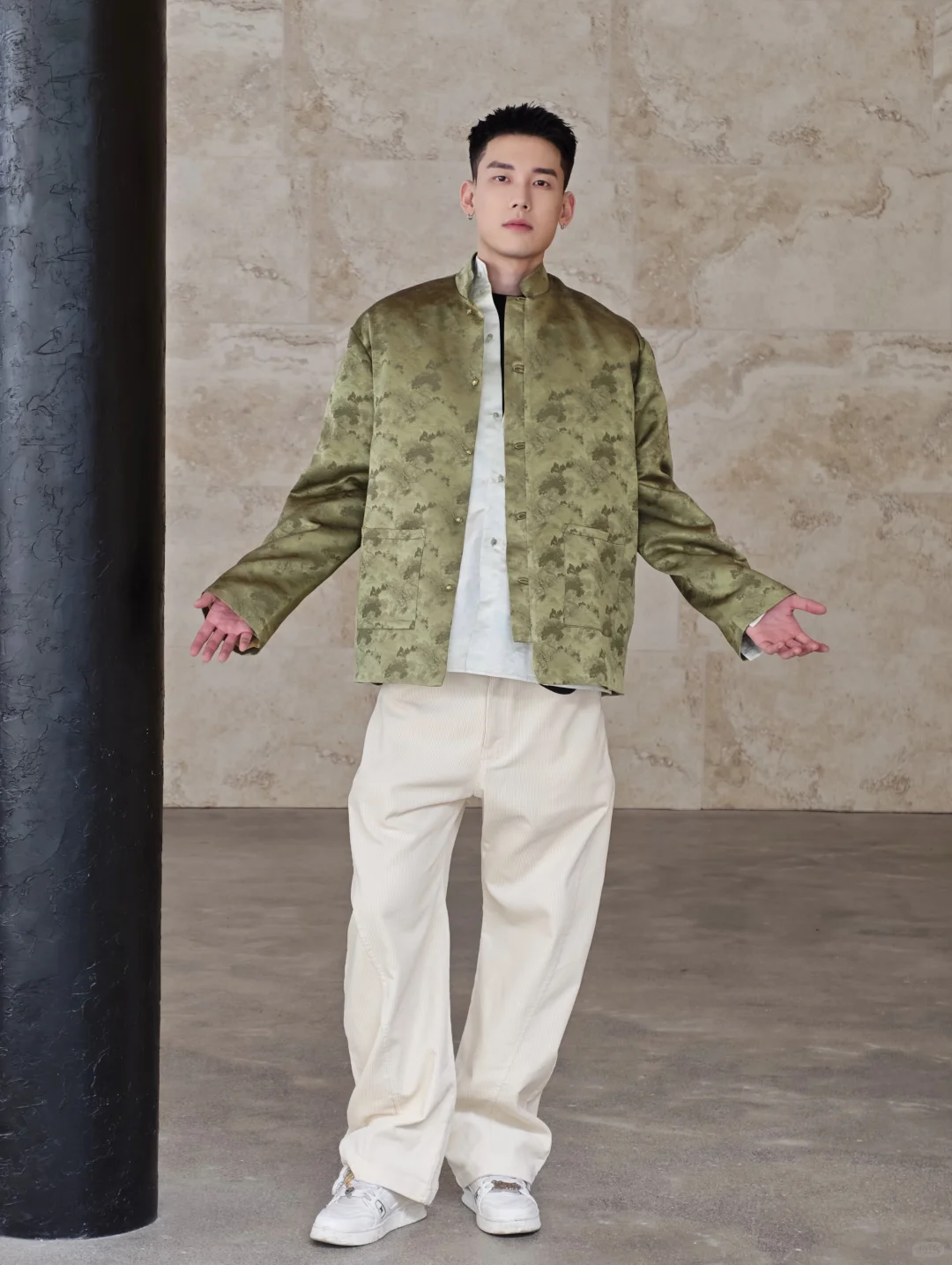
The olive jacket above earns attention before any historical label is applied. Its straight body sits away from the torso. The short standing collar closes the neckline without becoming theatrical. The patterned surface is quiet enough to emerge as light moves across it, while broad cream trousers pull the outfit toward contemporary ease.
Now ask the harder questions. Does the collar change posture? Does the front opening change how the jacket layers? Is the surface woven, printed or embroidered? The photograph can answer the first two partially. It cannot settle the textile technique or comfort by sight alone.
This distinction matters because “Mandarin collar” is often used as a universal English sticker for any raised Chinese-looking neckline. Chinese clothing history contains different collars, closures, cuts, periods and social uses. The traditional Chinese clothing guide is where those systems belong. A modern jacket may quote a visual relationship without reproducing a historical garment.
Guochao becomes more interesting when we permit transformation and demand precision at the same time.
New Chinese style works when it changes the sentence, not one noun
The phrase new Chinese style is useful for contemporary wardrobes that bring recognizable Chinese references into everyday combinations. It is also dangerously convenient. Add one knot button to a familiar bomber and the seller can rename the product without reconsidering the body inside it.
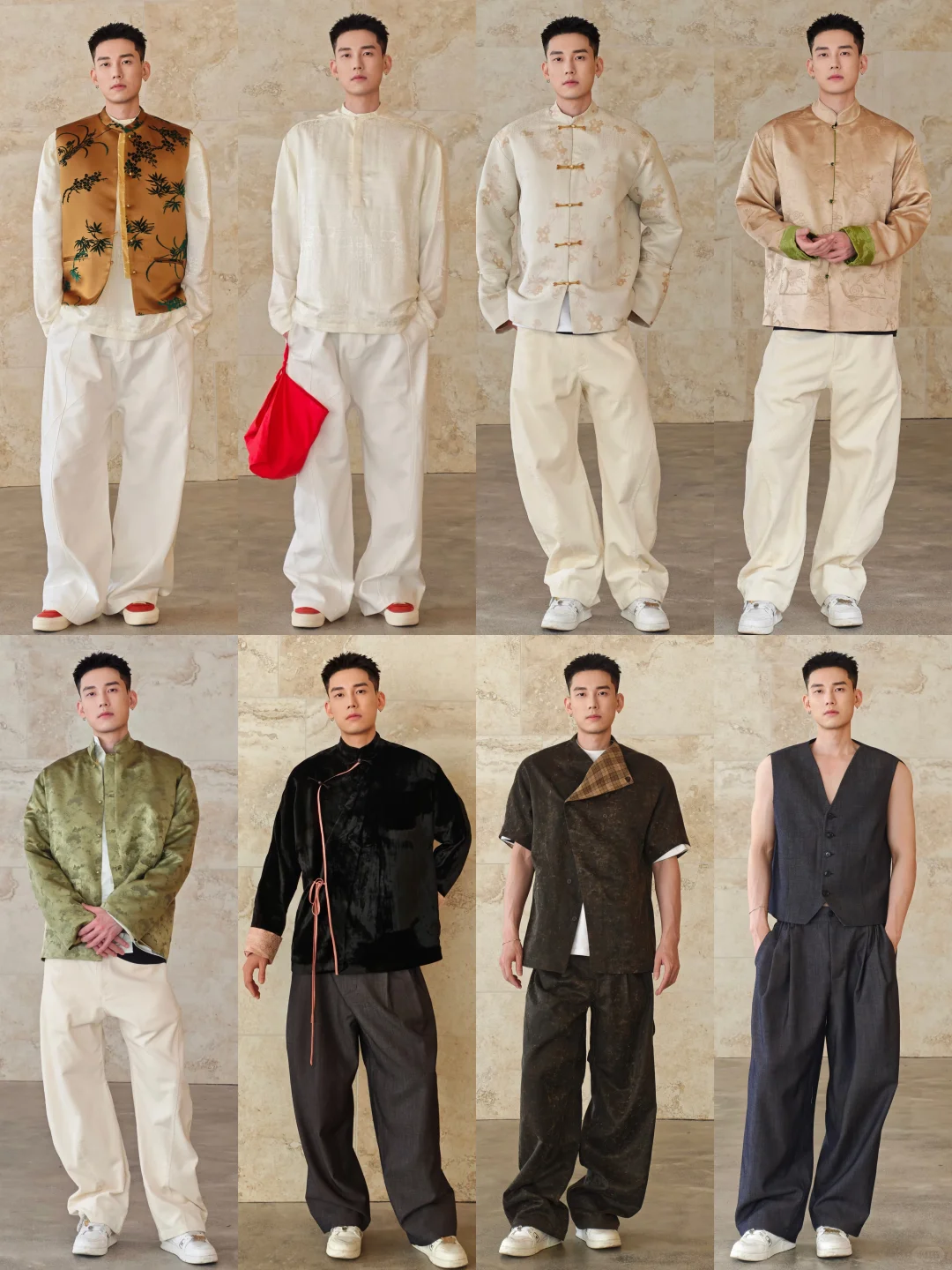
This eight-look comparison is valuable because the model, background and footwear remain largely controlled. The changing garment decisions become easier to isolate. A sleeveless botanical vest shifts attention to the shirt beneath. An ivory pullover reduces the front opening. A pale jacket uses a vertical run of fasteners. A black top moves the closure off-center. Wide trousers continue through nearly every variation, keeping the lower half relaxed while the upper half tests different degrees of formality.
The set does not show eight representative Chinese men or prove what the public widely wears. It is one styled proposal on one body. Yet as a controlled visual experiment, it reveals a crucial principle: cultural reference can enter through architecture, not only motif.
That is the difference between changing a noun and changing the sentence. A peony is a noun. A closure that redirects the eye and changes how the garment opens alters the sentence. A standing collar is a noun when pasted on; it becomes syntax when its height, stiffness and relationship to the shoulder change the body.
Motifs deserve more scrutiny, not automatic suspicion
I am not against flowers, clouds, bamboo, cranes or auspicious color. A motif can carry memory, humor, regional craft and pleasure. The problem begins when the symbol receives more thought than the garment.
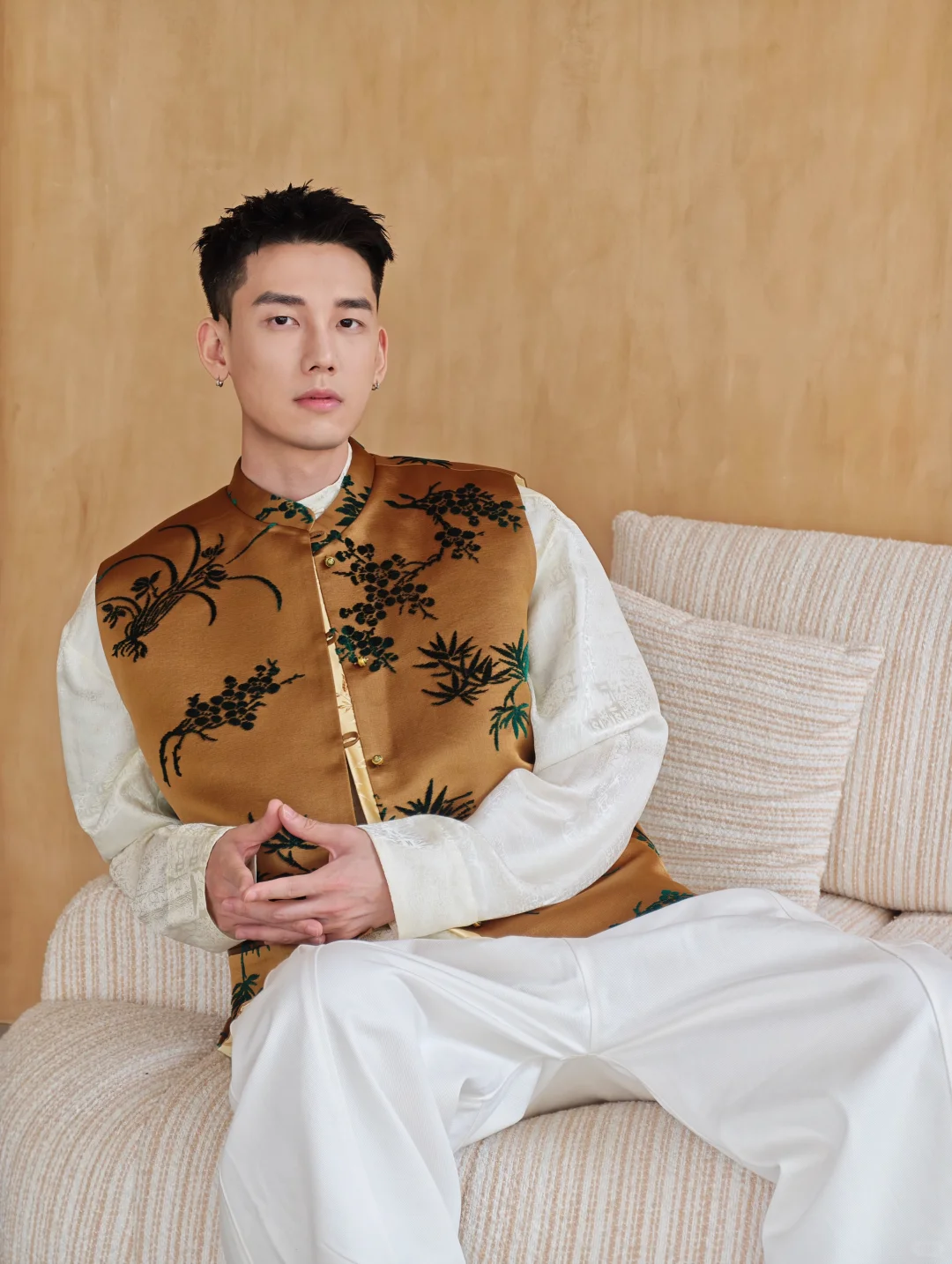
The botanical vest above is visually direct. Its dark branches and leaves stand sharply against a warm brown-gold field. But the image does more than display a pattern. The sleeveless cut lets the ivory shirt continue through the arm and softens the vest's block. The short length meets the trousers high enough to keep a long lower line. The garment behaves as a frame.
Cover the botanical surface with your hand. The proportion still works. That is a good sign.
Now reverse the test. Imagine the same motif printed across an undistinguished sweatshirt with no attention to scale, placement or construction. It might still sell. It might still express sincere cultural affection. But affection and design quality are separate judgments.
The V&A's contemporary fashion trail is useful because museum objects force references into conversation with material, silhouette and authorship. The strongest contemporary Chinese fashion does not ask a symbol to carry the full burden of identity.
A red accent can be memory, function or a cheap alarm
Red arrives in Guochao marketing with enormous baggage: celebration, luck, ceremony, political history, festival imagery and immediate screen visibility. Because it reads quickly, it is easily overused.
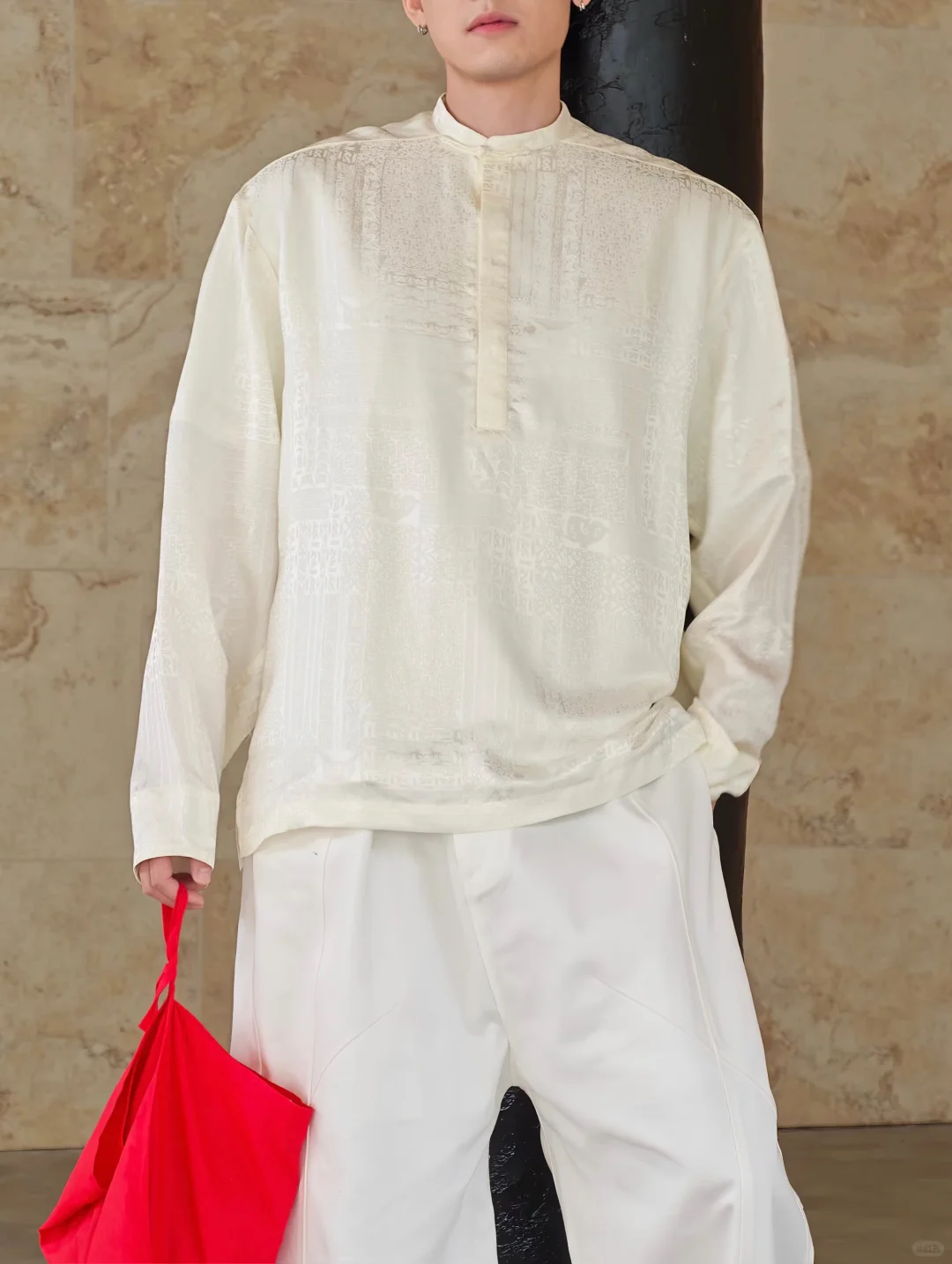
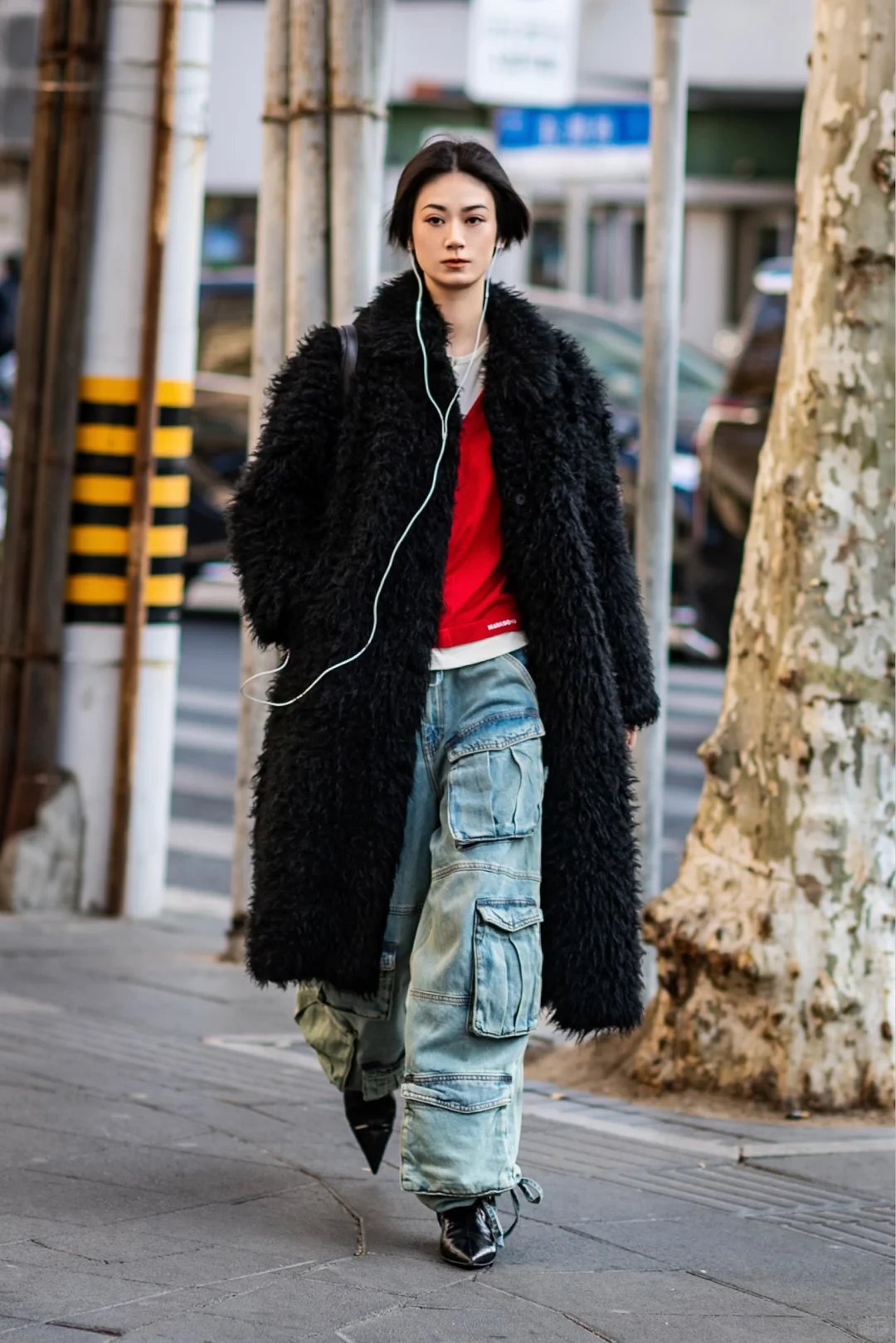
Here the red object is not the garment's proof of Chineseness. It is an interruption. The ivory pullover relies on subtle woven geometry and a restrained neckline; the saturated bag prevents the outfit from dissolving into pale texture. The red has a compositional job.
That is the standard I prefer. Color should do something before it symbolizes everything.
A useful Guochao reading therefore asks where the cultural association sits. Is it in the product, the styling, the campaign set, the caption or the viewer's expectation? Those layers can reinforce one another, but they are not interchangeable. A neutral garment photographed beside a lacquer-red wall may receive a “Chinese” reading created largely by art direction. A historically inspired closure may remain meaningful even on a plain background.
This matters online because the platform crop often removes the hem, back and movement. What survives is face, collar, motif and color: exactly the details most likely to produce instant cultural recognition. The feed is not lying, but it rewards shorthand.
Knot fastenings should make you look at the opening
Knot or frog fastenings are among the most recognizable details in Chinese-associated dress. They are also frequently reduced to decoration. The right question is not “Does this garment have knots?” It is “What kind of opening do the knots create?”
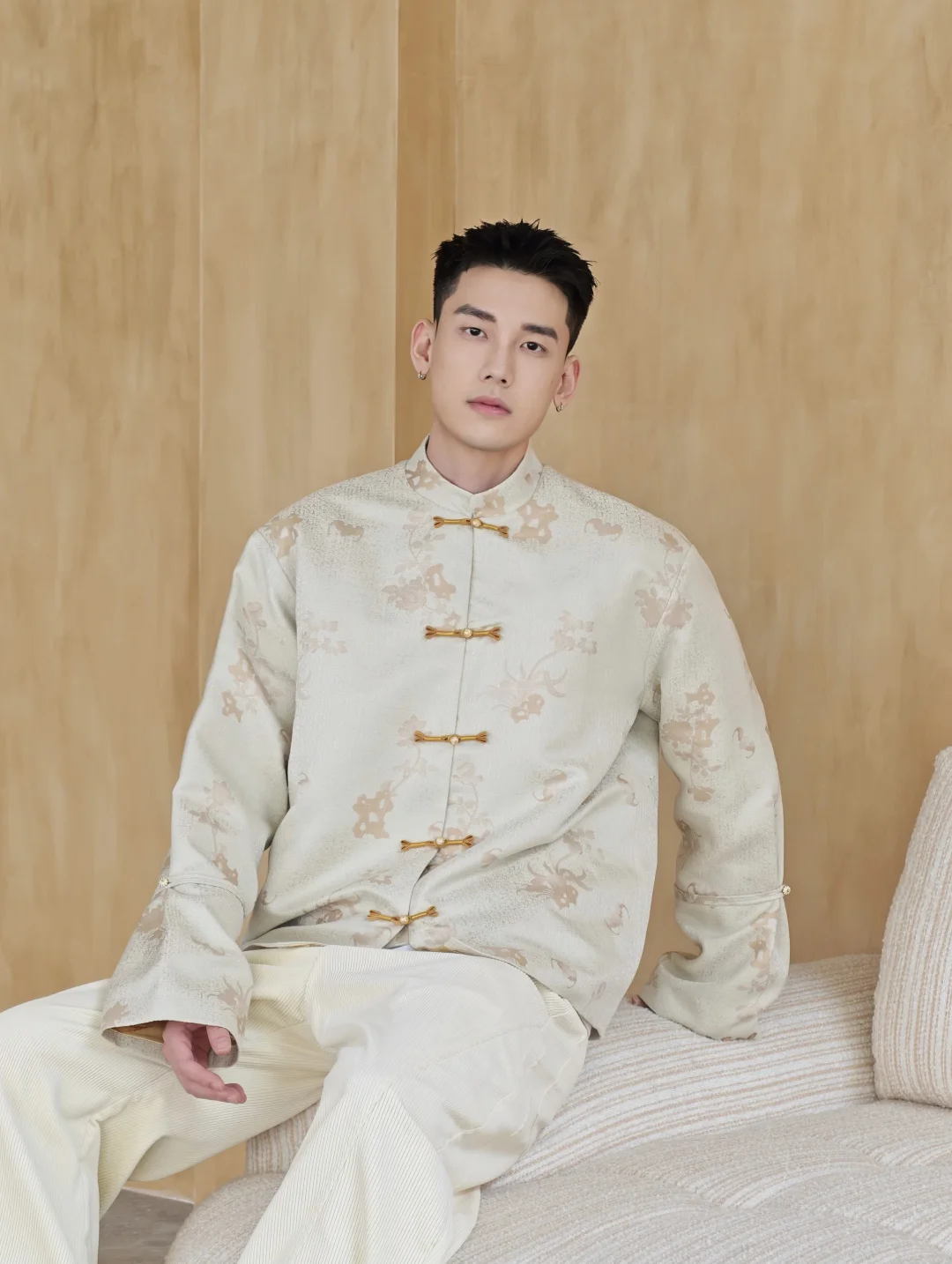
The ivory jacket uses a centered sequence that gives the torso a measured vertical rhythm. The fasteners remain small relative to the body. Pattern is present but low-contrast. A rounded shoulder and roomy sleeve prevent the front from becoming severe.
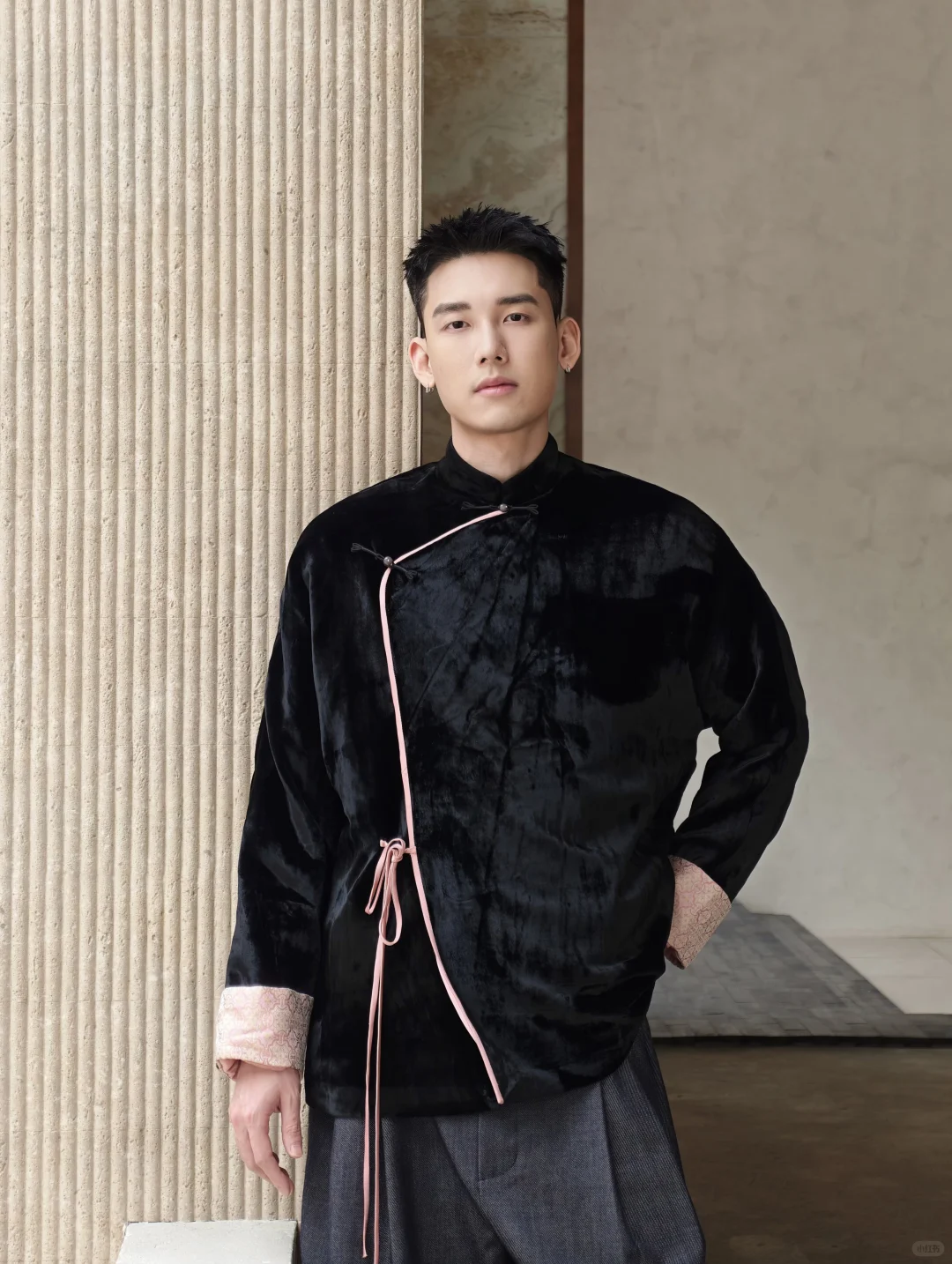
Compare that with the hero's black velvet jacket. Its fastening line moves diagonally, edged in pink, then extends into a loose hanging cord. The reference is not merely attached; it redirects the entire front.
This is where a modern designer can be faithful without reproducing a museum object. Faithfulness may mean understanding what a closure does—joins planes, regulates exposure, creates rhythm—then changing its route for a contemporary body. Historical exactness is a different task and should be named when claimed.
For readers trying to distinguish those tasks, compare the hanfu guide and qipao guide. Neither garment family is a generic ancestor of every modern high collar or side fastening. Good Guochao interpretation needs family names, periods and construction terms; otherwise admiration becomes blur.
Guochao and cultural confidence are real; the sales story is still a sales story
The rise of interest in Chinese labels and Chinese visual language matters. It changes who receives attention, which craft vocabularies enter contemporary wardrobes and whether young consumers imagine domestic design as compromise or desire.
But cultural confidence does not make every product good. A local brand can use Chinese symbolism cynically. An overseas-trained designer can transform Chinese material with care. A mass-market garment can create genuine pleasure. A costly “heritage” piece can hide weak construction behind a grand caption.
Nationality does not eliminate the need for criticism.
This is why I resist the easy celebratory paragraph in which Guochao proves that China has “arrived.” China did not need a campaign season to begin making clothes. The meaningful shift is in attention and authorship: which names are credited, which workshops remain visible, which references are explained and which consumers feel permitted to choose local design for desire rather than duty.
Guo Pei's couture shows the productive extreme. Her strongest garments do not become persuasive because they are covered in Chinese-looking luxury signals. They become persuasive when embroidery changes structure, weight changes movement and spectacle acquires rules. The same standard can be applied at a quieter everyday scale.
The fabric photograph is evidence with hard limits
Digital fashion culture invites us to describe fabric too confidently. A photograph may show shine, pile, translucency, stiffness or the way a surface catches light. It cannot tell us exact fiber content, hand-feel, breathability, seam durability or comfort after six hours.
The black velvet-like surface in the hero appears to shift between deep black and reflective patches. The pink edge clarifies the diagonal opening. That visual evidence supports an interpretation of contrast and structure. It does not justify calling the fabric silk velvet or praising its craftsmanship without a product record and close construction views.
This discipline sounds small, but it separates editorial trust from shopping fantasy. Guochao copy often races from “looks rich” to “revives intangible heritage.” Those are entirely different claims. One may be a visual impression; the other requires identified technique, maker, lineage and evidence.
The Chinese fashion designers guide uses the same discipline at creator level: follow repeated decisions and official records before turning one image into a career verdict.
How to judge Guochao fashion in five passes
When you encounter a Guochao or new-Chinese-style look, do not begin by asking whether it is “authentic.” Use a more precise sequence:
- Remove the label. What garment category and silhouette remain?
- Locate the reference. Is it motif, color, collar, closure, textile, cut, styling or campaign scenery?
- Name the transformation. What changed in construction, proportion, movement or use?
- Check the evidence. Can the image support the material or craft claim being made?
- Test ordinary life. Can the wearer sit, layer, wash, repeat and combine it beyond one styled image?
The final pass protects Guochao from becoming costume only for festival photographs. Everyday use is not the only measure of fashion—couture and performance have different goals—but a garment sold as daily style should survive daily questions.
I like Guochao most when the cultural reference is confident enough not to shout. A fastening takes a new route. A familiar textile enters an unfamiliar proportion. A historical relationship between body and garment is understood, then challenged. The wearer is not asked to become an exhibit.
That is also why Chinese street style is the necessary next page. A campaign proposes a look; the street reveals what people edit, repeat and abandon.
Return to the Chinese Fashion guide when you want to place that comparison beside designer authorship and historically located clothing without collapsing them into one aesthetic.
Do not ask whether it is Chinese enough; ask whether the design is doing enough
“Is this really Chinese?” can become an endless identity trial. “What did the designer transform?” produces evidence.
My conclusion is firm: symbolism alone is not enough. A cultural reference deserves the same design pressure as any other element. It must change the body's line, the garment's operation, the material logic or the wearer's possibilities. Otherwise the reference may still be sincere, beautiful or commercially effective, but it is doing the work of packaging.
In the comments, bring one example that passes this test and one that fails it. Name the visible decision rather than praising or mocking the whole aesthetic.
Then file a reference-to-design record in Moments: one garment image, the exact source reference, the transformation, the use case and the evidence limit. Return when another reader finds a back view, maker record or historical correction. Guochao needs less applause and better looking.