Guo Pei's couture is not memorable because it looks "royal." It is memorable because it makes clothing argue with the body: weight slows the walk, embroidery stores thousands of hand movements, and a silhouette can turn one person into moving architecture.
Guo Pei makes the wearer negotiate with the dress
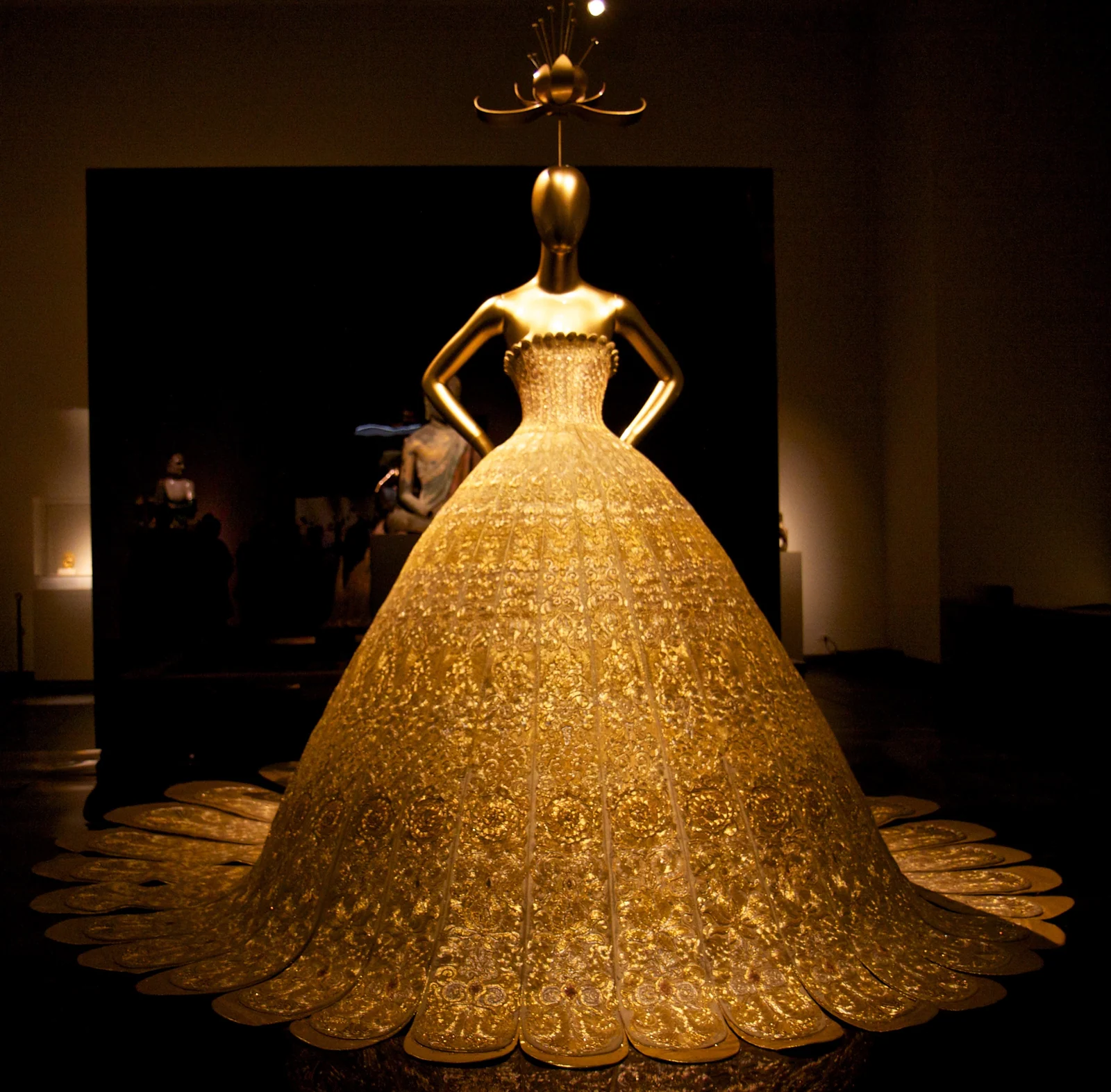
Look at a Guo Pei (郭培) gown from the floor upward. The hem often establishes the laws before the face appears. It may occupy several times the wearer's width, lift into a rigid bell or extend behind the body like ceremonial territory.

This is not clothing designed to disappear into ease. It asks the wearer to learn it. Step length changes. Turning becomes a planned maneuver. Shoulders, neck and hands must answer the volume below.
That physical negotiation is the best entrance to Guo Pei. A biography can list Beijing, Rose Studio, Paris and celebrity clients. The garment tells us how she thinks.
Before the cape, there was an atelier learning to make time visible
Guo Pei's story did not begin with a red carpet, and it did not begin in Paris. She studied fashion in Beijing, spent a decade working in ready-to-wear and founded Rose Studio in 1997. That sequence matters. Ready-to-wear teaches repetition, deadlines and bodies at scale; couture reverses the pressure and spends extraordinary time on one body, one object and one impossible idea.
Her official biography places the atelier team at the center, describing artisans personally selected and trained across embroidery and patternmaking. Brand biographies naturally celebrate their subject, so I do not treat every superlative as neutral proof. I do believe the emphasis on the team, because the clothes make solitary-genius mythology physically impossible. No designer's hand can complete that volume of stitching, metalwork, fitting and structural trial alone.
That is the first thing most celebrity coverage erases. “Guo Pei made a dress” sounds clean. A couture house made a dress: designer, pattern cutter, embroiderer, fitter, model and assistants solving different parts of one moving problem. Guo's authorship is real, but its scale depends on organized human skill.
I want the labor to remain visible because luxury becomes empty the moment it asks us to admire price instead of intelligence. The best Guo Pei dress is not impressive because it consumed hours. It is impressive when those hours produce an effect no shortcut could create: a surface that holds light differently at every turn, a train whose curve controls the room, or a bodice whose decoration becomes support.
Rihanna's yellow cape was a doorway, not the whole house
Rihanna wearing Guo Pei's enormous yellow cape at the 2015 Met Gala changed the designer's global recognizability in one night. The image was immediate: bright imperial yellow, an embroidered circular train and a pop star strong enough not to disappear inside it.
The cape is important because the pairing worked. Rihanna's pace, posture and appetite for scale activated the object. Put the same garment on a hesitant wearer and it might look like heritage pageantry dragging a person behind it.
But reducing Guo Pei to "the Chinese designer who made Rihanna's dress" repeats a familiar global habit. A Western celebrity becomes the event that makes years of Chinese work legible. The cape should open the archive, not replace it.
The better question is what the famous cape shares with less familiar work: a belief that clothing can command space before it flatters the body.
The yellow cape also exposes a useful truth about fashion fame. A garment can spend years in an archive before the right body and event make it globally legible. Rihanna did not merely “wear Chinese culture.” She understood scale. Her confidence prevented the train from becoming a joke at her expense, even as internet memes multiplied around it. That tension is not a failure. Pop culture carried the image farther than a fashion institution could have done alone.
Still, I would never recommend beginning and ending with the cape. It teaches scale, embroidery and celebrity activation. It does not show the full range of Guo's architecture, her darker collections, her experiments with volume away from imperial yellow, or the way a museum installation changes a garment after the model is gone.
Embroidery is structure, not expensive surface noise
From a distance, Guo Pei's embroidery reads as abundance. Close up, it becomes an argument about labor. Repeated metallic threads, beads and dimensional motifs alter the stiffness and weight of the cloth. Decoration changes engineering.

This is why generic praise such as "intricate" is not enough. Ask what the embroidery does. Does it create a hard shell? Direct light toward the chest? Make the skirt hold distance from the legs? Slow the model so the audience has time to read the surface?
Traditional techniques enter the work, but Guo Pei is not preserving one untouched national costume. Couture workshops select, enlarge and recombine. Motifs move between court association, opera-like theatricality, European silhouette and private fantasy.
The traditional Chinese clothing guide helps separate historical garment systems from contemporary couture interpretation. Calling every gold thread "imperial Chinese tradition" is not cultural fluency; it is visual laziness.
Costume or couture? The argument is useful only when it gets specific
Guo Pei is often accused of making costume rather than fashion. I understand the reaction. Crowns, towering shoulders, giant trains, gold surfaces and mythic staging can look designed for a character who does not exist outside the runway. But “costume” becomes a lazy insult when it simply means a garment refuses to be ordinary.
The real test is construction and purpose. Does the silhouette have an internal logic? Can the wearer animate it? Do motif, material and movement belong to the same world? Or is the garment only a pile of expensive signals asking us to applaud abundance?
Guo's strongest work passes that test because the fantasy has engineering. Weight changes tempo. A curved hem creates territory. Raised embroidery interrupts light. A rigid shoulder alters the wearer's posture before we read a single dragon, cloud or floral motif. The weaker moments are those in which symbolism arrives faster than the body can answer it. Then “China,” “royalty” and “luxury” become visual volume knobs all turned to maximum.
My position is deliberately not neutral: spectacle is Guo Pei's language, but excess is not automatically her achievement. Her achievement is giving excess rules.
The silhouette can protect and imprison at once
Some Guo Pei looks turn the torso into a tower, cage or vessel. The wearer gains authority because ordinary vulnerability has been replaced by structure. She can also appear trapped inside the authority.

That contradiction is the source of the drama. Fashion writing often treats fantasy as escape. Guo's strongest silhouettes suggest that fantasy has rules, weight and consequences. Becoming magnificent may require becoming less free.
This is also where criticism should remain awake. Monumental clothing can turn women into pedestals for craft. A look succeeds when the wearer and garment intensify one another. It weakens when the body exists only to provide scale.
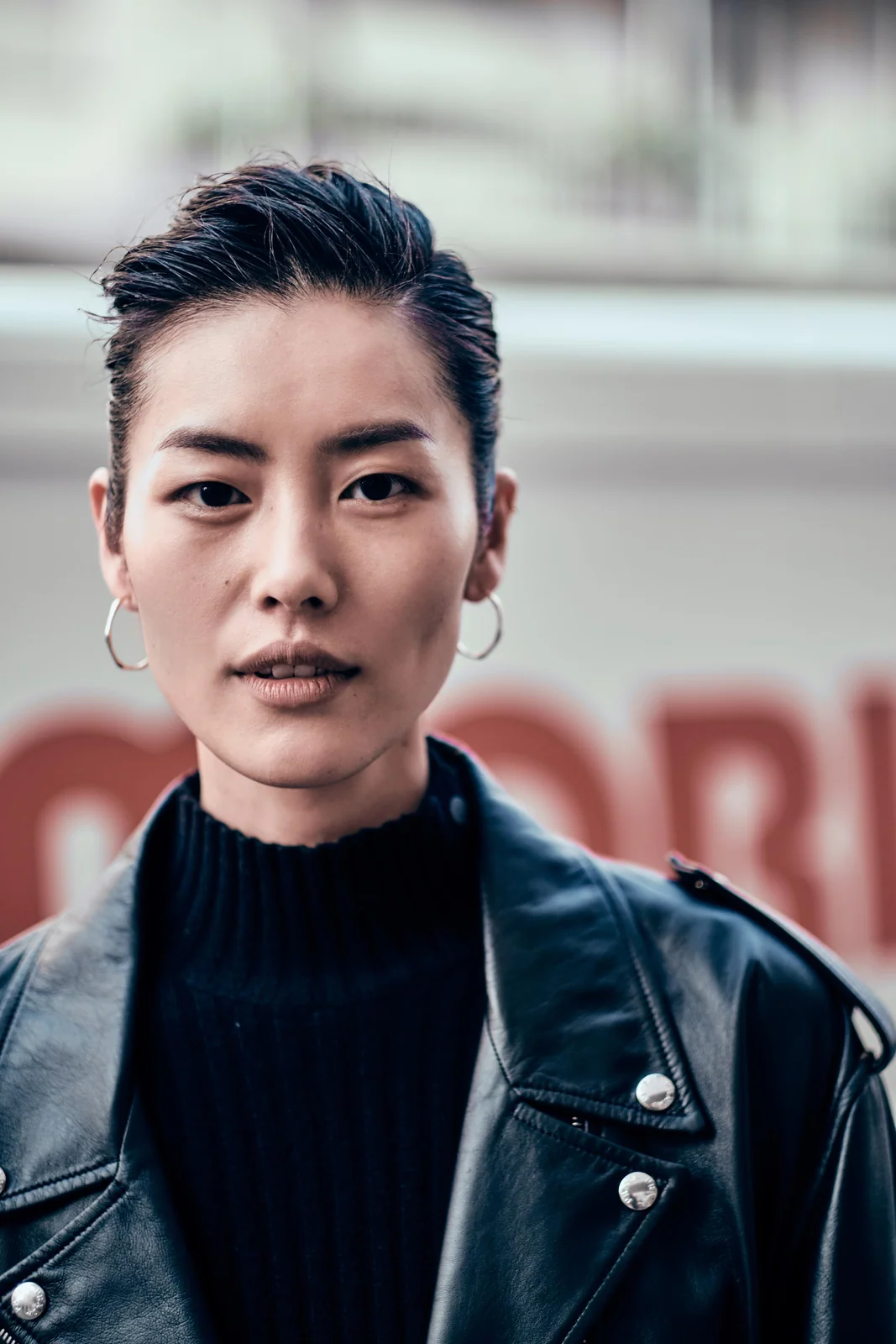
For the inverse problem, read Liu Wen's runway work: Guo Pei begins with a garment that can dominate a body, while Liu begins with a body trained to reveal what radically different garments need. Put the two pages together and “effortless fashion” becomes impossible to believe.
This is why the back view can matter more than the publicity front. The front gives symbol and face. The back reveals fastening, counterweight, train behavior and the practical violence of gravity. A runway turn exposes whether the object can move as one system or whether assistants must rescue the fantasy.
Museum display changes the evidence again. A mannequin never tires, catches a heel or negotiates a staircase. It lets us inspect embroidery for as long as we want, but it can make a physically demanding garment seem effortless. Read a museum photograph and a moving runway sequence together. Neither is complete alone.
Paris did not certify the beginning of her ambition
Guo Pei entered the official Paris haute couture calendar in the mid-2010s and presented successive collections there. The milestone matters because couture is an institution with rules, networks and concentrated symbolic power.
It should not be narrated as Paris granting quality to work that previously lacked it. Guo had already built a Beijing atelier and a demanding visual language. Paris changed the international frame around the work.

Her official archive lets readers follow collections rather than relying on one viral red-carpet image. Compare how a runway organizes movement with how a museum freezes the same kind of object. Couture loses bodily risk when displayed, but gains time for close looking.
The archive also makes one fact impossible to ignore: there is no single “Guo Pei look.” Courtyard turns architectural memory into space around the body. Legends pushes toward gilded myth and theatrical creatureliness. L'Architecture states the structural obsession openly. Later work continues to move through landscape, radiance and imagined worlds rather than repeating Rihanna's cape in new colors.
This range is why an artist page must resist the career-highlights trap. Dates create a line; collections create thought. The worthwhile question is not what happened next but what problem she kept returning to. In Guo Pei's case, it is how a body can carry a world without disappearing inside it.
The body pays for the fantasy
The most revealing Guo Pei image is not always the full frontal photograph. Look for the turn, the step, the assistant's hand, the distance required by a train and the pace imposed by weight. Couture becomes architecture only because a living body negotiates its rules.
That negotiation prevents me from describing the clothes as uncomplicated empowerment. Scale can magnify a wearer and restrict her at the same time. Embroidery can preserve extraordinary labor while the finished surface hides the workers' hours. The contradiction is the value: fantasy is not weightless, and luxury becomes more interesting when its physical and human cost remains visible.
There is another cost: cultural shorthand. International coverage repeatedly reaches for “imperial,” “dragon,” “East meets West” and “Chinese fairy tale.” Those phrases are not always wrong. They are simply too cheap for the work. A specific sleeve may borrow court association; a silhouette may owe as much to European couture engineering as to Chinese dress; a surface may be built by contemporary atelier practice rather than inherited intact from an ancient workshop.
The Chinese women's clothing guide is the necessary boundary. Guo Pei is not a shortcut to historical womenswear, and historical clothing is not merely a mood board waiting for couture. The more precisely we name the reference, the more interesting the transformation becomes.
For overseas viewers, this is a better entry than the vague word “royal.” Name the silhouette, material, technique and movement. Then ask what kind of person the garment permits the wearer to become—and what ordinary movement she must surrender to inhabit it.
Where should a new viewer begin?
Start with Rihanna's cape because it is already in public memory. Then leave it.
Choose one museum-displayed gold gown and inspect how the hem controls space. Find one close embroidery view and identify where surface becomes support. Watch a runway look turn a corner. Finally, compare a collection that leans toward Chinese court imagery with one built from a different fantasy vocabulary.
That sequence reveals a designer, not a national symbol. It also gives overseas viewers a more respectful task than asking whether a dress is "authentically Chinese." Ask which histories have been selected, what the workshop physically built and what the wearer must do to make the object live.
Use five minutes per look. First, ignore the motif and trace the silhouette. Second, find the place carrying the most weight. Third, follow one embroidered line until it changes direction. Fourth, imagine the turn rather than the pose. Only then read the collection title and cultural references. This order stops a gold dragon from doing all your thinking for you.
Guo Pei's legacy is a permission and a warning
Guo Pei gave younger Chinese designers visible proof that “Chinese fashion” did not have to mean inexpensive manufacturing, a qipao quotation or a Western runway waiting to approve local ambition. A Beijing atelier could claim couture scale, build its own fantasy language and enter global museum conversations without sanding away every Chinese reference.
The warning is just as important. Cultural spectacle travels quickly because it photographs well. That success can trap the next designer into making louder dragons, heavier gold and larger trains in order to appear legibly Chinese abroad. Guo Pei is worth studying precisely because imitation of her surface would miss her method. The lesson is not to look royal. The lesson is to build a visual world with enough technical discipline that the audience must enter it on your terms.
I admire the nerve of that ambition. I also want the wearer and the atelier to stay visible inside it. When they vanish, couture becomes a monument to itself. When they remain, cloth, labor and body produce something far stranger and more moving than luxury.
Continue through Chinese art for the material conversation or return to Chinese artists for other makers. Then choose one Guo Pei garment and read it from hem to shoulder. Spectacle is the first response. Construction is the second.
Bring that reading to Moments with one front view and, if available, one turn or back view. Name the exact construction decision that gives the look authority—and the point where it begins to overpower the wearer. Return when another reader finds evidence you missed. A serious couture conversation should become sharper every time the dress turns.