Cai Guo-Qiang is not important because he makes expensive fireworks. He is important because he chose a material that remembers every mistake: gunpowder burns, stains, escapes the plan and forces the artist to negotiate with an event that cannot be taken back.
Cai Guo Qiang begins where correction ends
A painter can cover a line. A designer can revise a file. Cai Guo-Qiang (蔡国强) lights a fuse.
That difference changes the emotional contract of the work. Before ignition there is drawing, calculation, placement and rehearsal. After ignition there is only response. The material may obey enough to reveal an image, or carry heat and smoke across an area the hand believed it controlled.
This is why a photograph of the final explosion is only half the artwork. The real form includes anticipation, danger, duration and the audience's knowledge that the exact event will not happen again.

Cai was born in Quanzhou in 1957, trained in stage design in Shanghai and developed his gunpowder practice further while living in Japan. Those facts matter because theatre, coastal trade history and transnational movement all help explain the scale of his visual thinking. They should not replace looking.
| If you came to find... | Begin here | The question that matters |
|---|---|---|
| Cai Guo-Qiang's signature medium | A gunpowder drawing | Is chance really allowed to alter the work? |
| His most personal spectacle | Sky Ladder | Can an enormous public image remain intimate? |
| His museum-scale installation | Inopportune: Stage One | Does suspended violence become thought or décor? |
| The strongest criticism | A site-specific explosion in fragile terrain | Who carries the environmental and social consequence? |
| A quieter counterexample | Cultural Melting Bath | What happens when participation replaces detonation? |
A gunpowder drawing is both picture and scar
In a gunpowder drawing, powder, fuse and sometimes templates are arranged across paper or another surface. When covered and ignited, the composition is drawn by pressure as well as intention. Brown clouds, sharp burns and drifting residue remain.

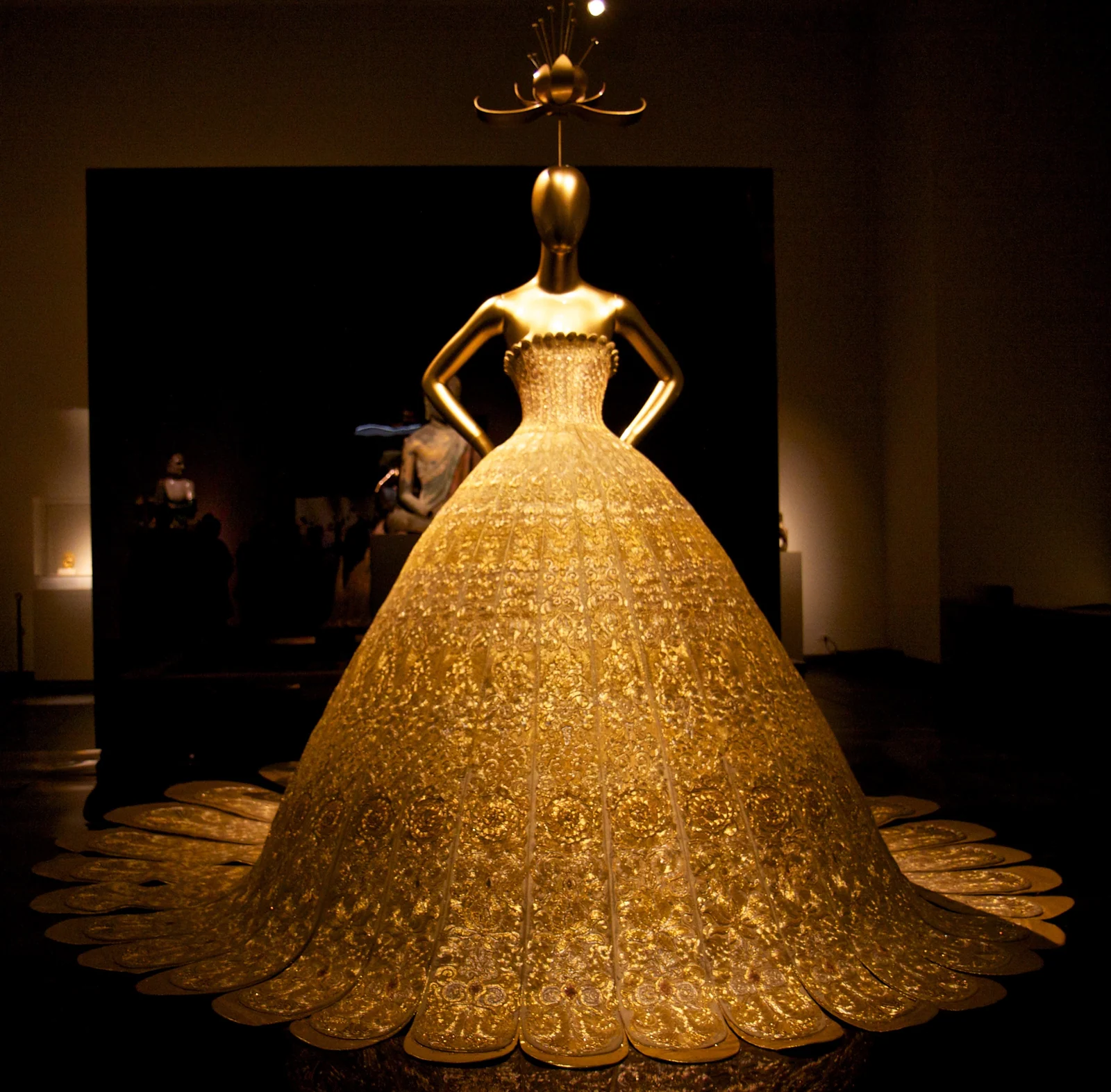
The collaboration with Issey Miyake makes the contradiction especially clear. Clothing normally asks the body to animate a designed surface. Here an explosion has already entered the cloth. The mark can resemble injury, shadow, flower or weather depending on how you approach it.
Calling this "painting with gunpowder" is useful only if we keep the verb unstable. Cai does not simply replace ink with a dramatic pigment. He designs conditions under which the material becomes a second author.
That shared authorship is not mystical. It is technical and ethical. How much uncertainty has the artist genuinely accepted? How much has been engineered to look uncertain? Those questions keep the work alive after the first surprise.
The paper is where I trust him most. A burn edge cannot pretend to be innocent: it records heat, timing, pressure and failure in one mark. Stand close and the heroic language of “explosion art” falls away. What remains resembles bruised weather. The work becomes slower than the event that made it.
This difference matters online. A vertical video rewards ignition, crowd noise and the single expanding cloud. The drawing asks for the opposite behavior: stop, inspect the area where control thinned, and notice that destruction made a surface more specific. If Cai's practice were only spectacular, the residue would be disposable. The best gunpowder drawings survive because the residue is the thought.
The Guggenheim car is funny until impact returns
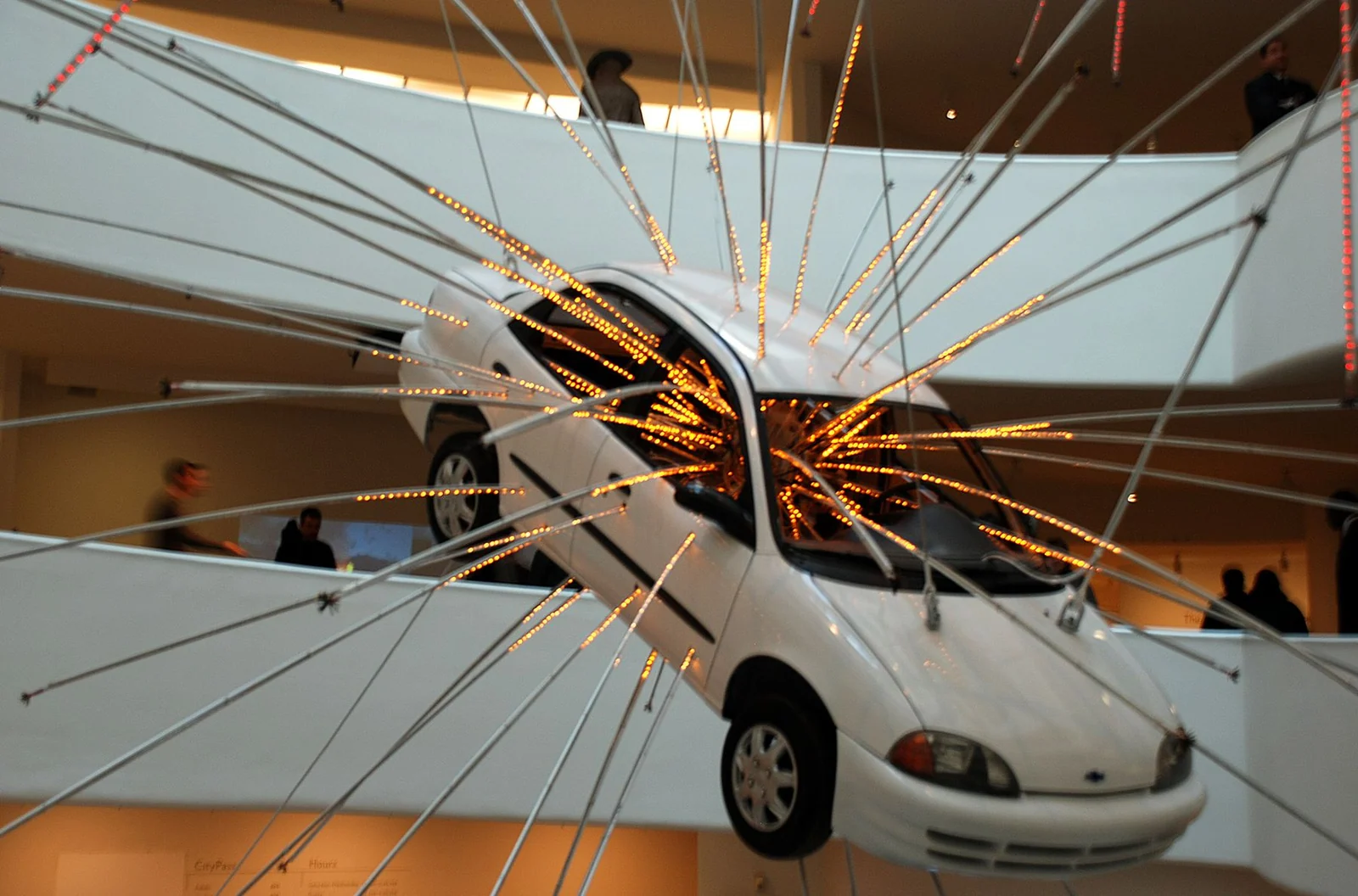
At the Guggenheim, an installation of cars suspended through the rotunda can initially read like an action film frozen at its most expensive second. Lines of light extend from the vehicles, making collision look graphic, fast and strangely festive.
Then the image becomes less comfortable. A vehicle is a machine of ordinary mobility and potential violence. By holding the sequence in the air, Cai gives viewers time that a real explosion would deny them. Spectacle becomes an anatomy lesson.
The Guggenheim's artist record documents his institutional context. East Moment's judgment is more specific: scale works when it gives the viewer a second thought, not when it merely makes a large room look occupied.
Public explosions ask who owns the sky
Cai's explosion events can feel communal because nobody experiences the sky alone. A line of fire appears, a crowd reacts together, and the work disappears into memory and documentation.

That temporary openness can hide a harder structure. Large events require land, permits, money, safety systems and institutional power. The artist who appears to release control has already gained unusual control over public space.
This does not invalidate the art. It improves the question. Sky Ladder, a ladder of fire raised into the sky, carries an intensely personal image of ascent and connection. But the moving story around one work should not turn every detonation into private sincerity. Each project must earn the scale it consumes.
My test is simple: after the smoke, does the work leave a thought more durable than "I wish I had been there"? The strongest pieces do. They make control, violence, celebration and disappearance difficult to separate.
Sky Ladder works because the impossible image stays private
Sky Ladder rose from Huiyu Island near Quanzhou in 2015 after earlier attempts had failed. Cai's own archive places the realized work in his hometown; the long effort and family address keep it from becoming merely a technical record. A fiery ladder is a blunt symbol. What saves it is vulnerability: it climbs, trembles and disappears before it can become a monument.
I do not read it as proof that persistence always triumphs. The failed versions belong to the work. They make the final ascent feel borrowed rather than conquered. The ladder is moving because it cannot remain in the sky, not because it dominates it.
This is also the right place to understand the Quanzhou connection. Firecrackers, ritual address, maritime distance and family memory do not form a tidy “Chinese inspiration” package. They create a local grammar for speaking to what is absent. The Quanzhou guide matters because a hometown is not a decorative birthplace line; it changes what the sky is being asked to carry.
The 2025 mountain controversy destroys the excuse of beautiful intention
A public explosion does not occur on a neutral screen. In September 2025, the Rising Dragon collaboration with Arc'teryx in high-altitude Himalayan terrain triggered intense criticism over ecological risk, cultural sensitivity and corporate spectacle. An advocacy account from the International Campaign for Tibet records the objections and demands for independent assessment; it represents a critical position, not the final scientific measurement of impact.
The uncertainty does not excuse the decision. If an artist's medium depends on wind, residue, sound, animals, soil and public land, then “loss of control” cannot remain a poetic benefit when consequences become inconvenient. Chance is not courageous when other people and ecosystems are forced to absorb it.
This is where my judgment is blunt: beauty is not mitigation. A dragon drawn across a mountain can be visually astonishing and still be a bad use of the site. The social response captured across Chinese discussion is powerful precisely because admiration and anger coexist. I feel that split too. I can see why the image seizes attention; I cannot accept seizure of attention as sufficient permission.
The controversy does not erase the gunpowder drawings or Sky Ladder. It changes the standard applied to every future event. Cai must now show not only what the explosion means to him, but why this place, this scale and this institution had the right to make it happen.
Cultural Melting Bath slows the body down
Not every Cai Guo-Qiang work moves at explosive speed. Cultural Melting Bath places rocks, garden space and a pool into a participatory environment. Its pace is bodily and social rather than ballistic.

That difference completes the person. A profile built only from ignition turns him into the brand manager of one spectacular technique. The bathing work still deals with encounter, mixture and designed conditions, but asks visitors to remain rather than gasp.
It also reveals a recurring risk in globally circulating Chinese art. Symbols of medicine, cosmology, garden culture and "East meets West" can become immediately marketable atmospheres. Cai is most convincing when the installation complicates that easy fusion rather than decorating it.
A phone records the bang and loses the artwork
Most people now meet Cai Guo-Qiang through a vertical clip. The format gives us ignition, color and the crowd's first cry, then cuts before the site returns to ordinary time. That is almost perfectly designed to misread his work.
An explosion event begins long before the fuse. The artist and production team choose a line, calculate distance, negotiate access, place material, rehearse failure and decide where bodies may stand. It continues after the color disappears: smoke moves, residue lands, animals and residents remain, and documentation starts competing with memory. The clip preserves the most marketable seconds while removing the decisions for which the artist should be accountable.
When you watch one event, therefore, replay it three ways. First, allow the visual shock. Second, mute it and inspect the geography: what surface is being used, who is absent, and where will the material fall? Third, ignore ignition and look at the aftermath. Does the site become newly legible, or was it only rented as a background?
This method changes Sky Ladder. The coastal darkness, local spectators and failed history make the disappearing line feel addressed. It also changes a branded mountain event, where landscape can be reduced to a giant screen whose silence is mistaken for consent.
The strongest Cai work makes documentation feel insufficient. The weakest is already complete as a promotional clip. I should still need the paper, place, waiting and aftermath after the screen goes dark. That distinction is brutal, but an artist who works at this scale should be judged brutally.
For a broader map of materials and contemporary practice, continue through Chinese art. His coastal origin also makes Quanzhou a useful context: a city formed through maritime exchange is a better background than the vague label "East and West."
Five works are enough to begin, if you look twice
Begin with a gunpowder drawing and inspect the border between intended line and burnt escape. Move to the Guggenheim car installation for suspended impact. Watch a documented explosion event while remembering that the recording is not the event. Then compare Sky Ladder with Cultural Melting Bath: ascent versus immersion, seconds versus duration, distant spectacle versus bodily participation. End with the mountain controversy, because a mature reading must include the places where an artist's favorite idea fails its own ethical test.
The second look matters more than the fifth biography fact. Cai Guo-Qiang makes images that arrive quickly. Criticism begins by refusing to leave at the same speed.
Return to the Chinese artists collection, then add one work below. Say what remains after its first visual shock. If the answer is nothing, that is a defensible judgment too.