Liu Wen's influence is easiest to understand in motion. She made a Chinese model internationally legible not through one ceremonial "first," but through the repeated work of entering a runway, reading a garment, meeting the camera and returning season after season without becoming one fixed image.
Liu Wen enters before the headline does
Watch Liu Wen (刘雯) step onto a runway and resist the urge to call the walk effortless. "Effortless" is fashion's favorite way to hide labor.
The entrance has several jobs. It must establish pace without racing the person ahead. It must make the garment readable before the face becomes the entire story. It must acknowledge the room while appearing untouched by it. Too much self-display competes with the collection; too little presence makes the clothes look uninhabited.
Liu Wen's strength is calibration. She can arrive clearly without announcing that arrival as a personal triumph. That quality helped international fashion see a Chinese face without demanding that every appearance perform an obvious lesson about China.
| Search question | East Moment answer |
|---|---|
| Why is Liu Wen famous? | She made elite-fashion recurrence, not one symbolic booking, the foundation of a global Chinese modeling career. |
| Is her runway walk the industry's most dramatic? | No. Its value is adaptability and garment service, not a signature theatrical stomp. |
| What should I watch first? | Compare one fluid dress, one hard tailored look and one street photograph. |
| What made her historically important? | High-profile runway, editorial and beauty work became sustained employment rather than a single “Asian first.” |
| What is the wrong way to read her? | Treating nationality, friendliness or off-duty style as a substitute for modeling craft. |
The garment changes the body, and the model answers
A model is not a neutral hanger. The same walk cannot serve a floating dress, a hard shoulder and a narrow tailored coat.

In a softer look, Liu can let the hips and fabric create a shared rhythm. In stricter tailoring, the line becomes cleaner and the face more withheld. These are small decisions, but fashion photography preserves their consequences. A sleeve catches air differently. A coat appears to lead rather than follow. The garment gains a character without becoming costume.
This is the point many celebrity profiles miss. They list brands as trophies. A useful Liu Wen profile asks why brands with different visual languages could repeatedly use the same model without receiving the same performance.
Liu Wen's walk is not legendary because it is loud
The most useful criticism I found refuses the worshipful vocabulary around “supermodel.” Compared with runway performers whose stride is instantly theatrical, Liu Wen can look ordinary. I agree with the observation and reject the conclusion that ordinary means weak.
Her walk is not a logo stamped over every garment. That is precisely why it travels. A sharp personal gait can dominate a collection, while Liu's calibration allows the jacket, hem, shoe and casting brief to decide how much body enters the image. On some runways that restraint will be less memorable than a spectacular walk. On others it is the reason the clothes remain believable.
Look at the shoulders before the legs. Do they resist a heavy coat or let it lead? Does the arm swing give a soft dress air, or interrupt the line? At the turn, does she lengthen the pause because the back of the garment carries information? These are professional decisions, not a generic aura called “relaxed.”
The limitation should stay visible. Adaptability can become neutrality. A model who never interrupts the designer may disappear into competent service. Liu's strongest work avoids that by changing the temperature of the face and the amount of space she claims without turning every look into autobiography.
Readers interested in the construction behind silhouette can continue to traditional Chinese clothing. Liu Wen's international work is not a history lesson in Chinese dress, but both subjects reward the same habit: read how fabric organizes the body before judging the image as pretty.
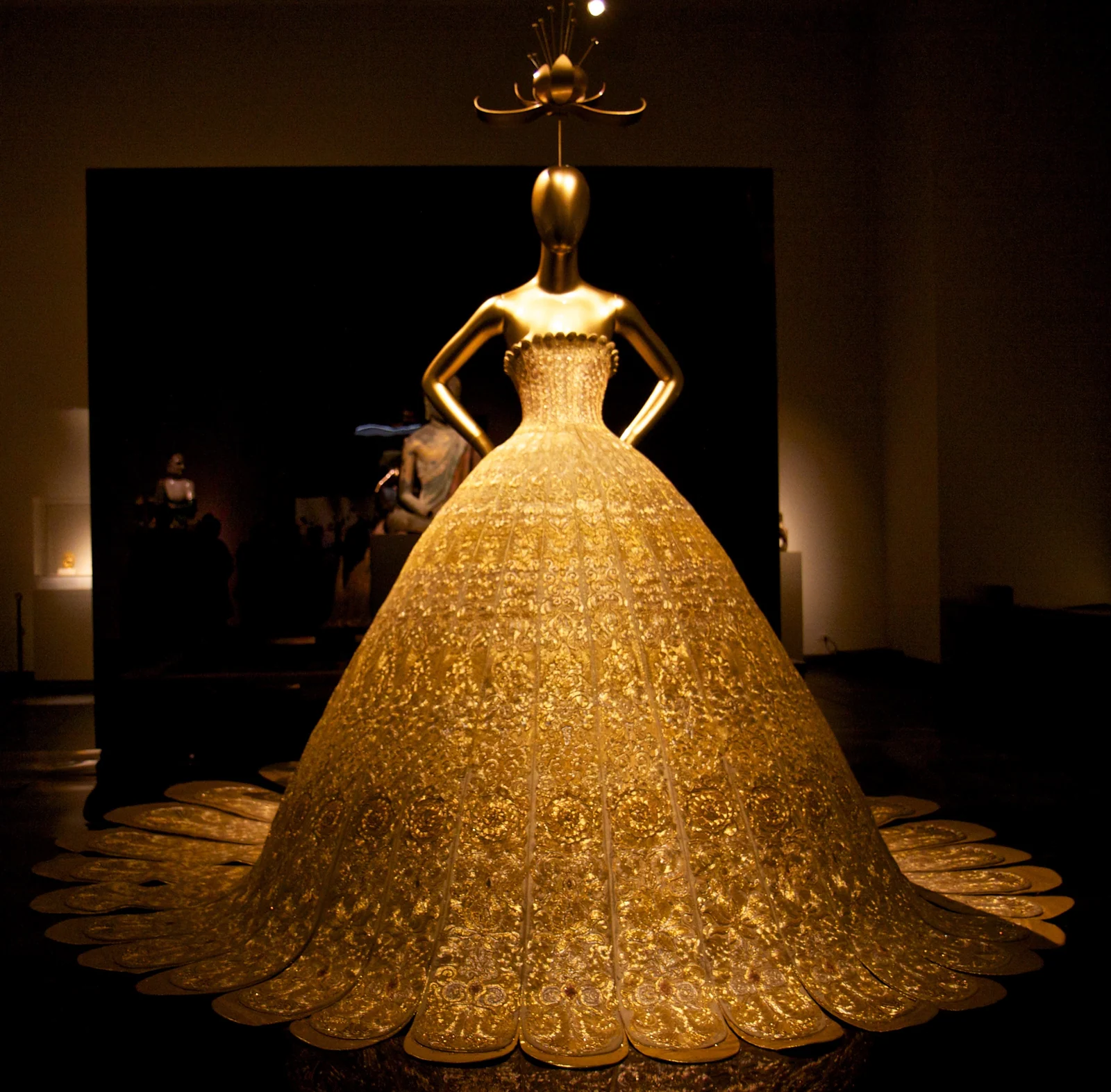
That habit becomes extreme in Guo Pei's couture, where weight and structure can dictate the walk before a model takes the first step. Liu Wen's craft is the answering intelligence: she must decide how much resistance, pace and personality the garment can survive.
At the turn, the camera receives a decision
The runway turn lasts seconds. It must close one image and begin another. A held gaze can make the look confrontational; a softer face can preserve distance; an overly theatrical gesture may sell the model instead of the garment.

Liu's camera intelligence lies in not repeating one solution. Her face can look open in street photography and architecturally controlled on a runway. That range is why the word "natural" can be misleading. The apparent ease is selected for the situation.
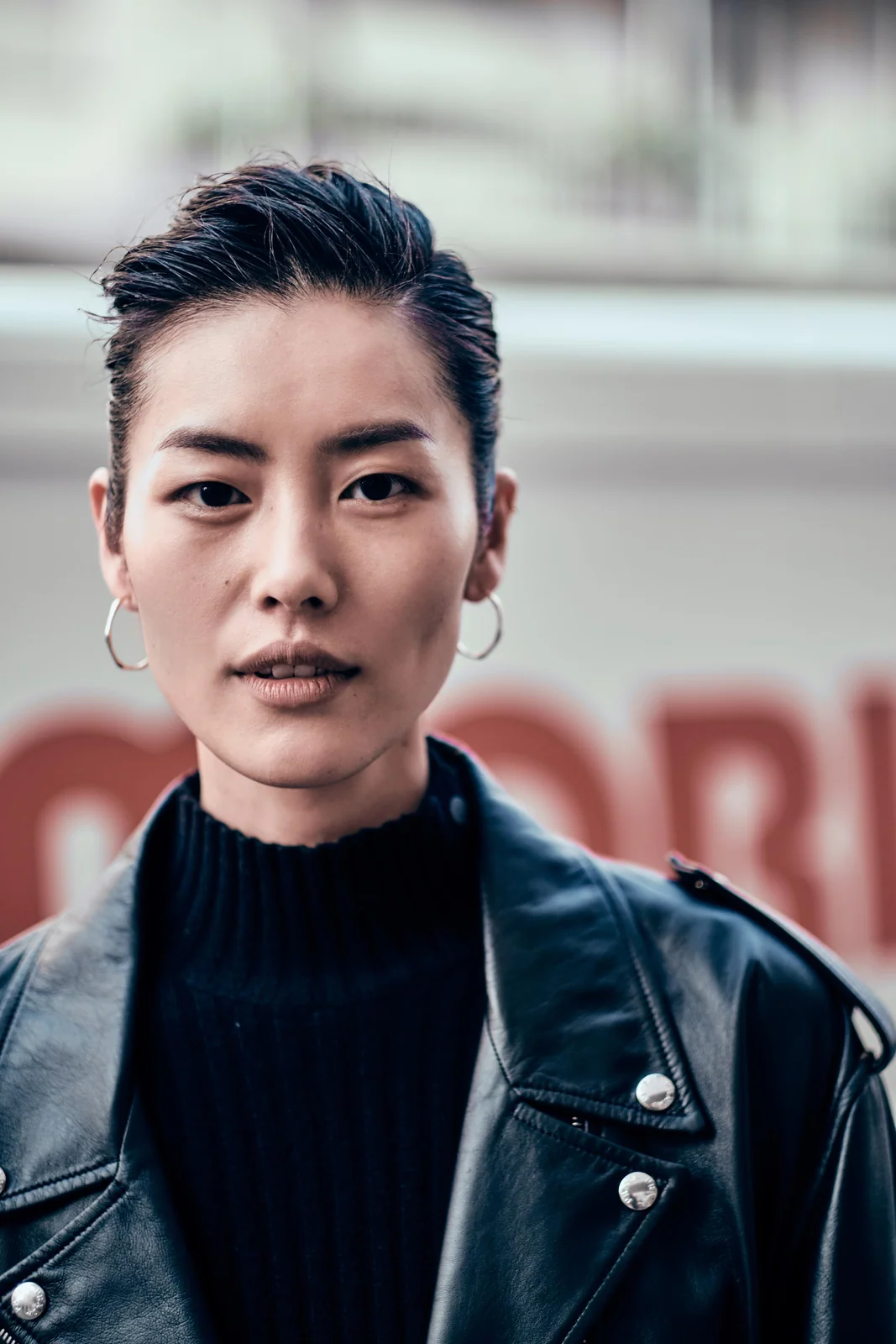
The 2013 portrait below makes the difference visible. Removed from runway momentum, the face carries more of the frame's responsibility. Directness replaces transition.

This is also where representation becomes more complicated than a list of milestones. A single historic booking can create a headline. A career changes visual expectation through recurrence. Viewers stop treating the Chinese model as a special theme and begin expecting her to occupy romance, tailoring, sportswear, beauty and ordinary street photography with the same freedom granted to peers.
The milestone list matters only when it changes the next booking
Industry records associate Liu Wen with landmark East Asian visibility in global beauty and the Victoria's Secret runway. Those milestones matter, but “first” is fragile language: categories shift between Chinese, East Asian, Asian, spokesmodel, campaign face and runway participant. A page that repeats the largest version without defining it turns representation into marketing.
The durable achievement is easier to verify. After the headline, she kept working across seasons, houses, editorials and markets. The exceptional booking became an employment pattern. That recurrence expanded what casting directors, photographers and audiences could imagine without requiring each image to explain its own diversity.
There is a cost hidden inside the celebratory story. A visible Chinese model can be asked to carry an entire population's pride and every industry's failure at once. One missed season becomes a referendum; one campaign becomes national proof. Liu's career deserves a more professional reading. Judge the fit between body and garment, the consistency of work, and the range of visual problems solved. Representation becomes stronger when the person is allowed to be excellent, average, surprising or wrong on a specific day.
The exit proves whether a career can repeat
Fashion celebrates the entrance, but careers are built through exits and returns: fitting finished, garment delivered, another city, another call time, another designer's demands.

This image from an earlier runway period matters beside the later Milan portrait because it shows duration without pretending time is a simple improvement montage. The younger model is not an unfinished version waiting to become sophisticated. Each period solves a different visual task.
Repeatability is Liu Wen's deeper contribution. International fashion did not only photograph her once as evidence of widening representation. It repeatedly trusted her with different clothes, moods and markets. That distinction is more substantial than carelessly declaring a universal "first," a category whose exact boundary often changes from headline to headline.
Vogue's long profile documents the scale of that career, while East Moment's judgment is narrower: consistency made representation feel less ceremonial and more like work.
Street style returns the clothes to time and weather
Runway imagery is controlled down to the minute. Street style introduces cold, transit, waiting, phones, bags and the practical question of what a person keeps when no collection is dictating the full look.
Vogue's documented street-style evolution from 2012 onward is valuable because it lets readers compare across years instead of treating one outfit as permanent essence. Liu often makes proportion do the work: a long coat against a narrow base, a relaxed layer beside a precise bag, one strong shape with little visual pleading around it.
Street style is not unmediated private life; photographers, events and brand relationships remain present. Still, it reveals a different kind of authorship. The model is no longer interpreting one designer's complete proposition. She is arranging movement between propositions.
“Effortless” is the word I would delete from fashion criticism
Current runway clips repeatedly describe Liu Wen as relaxed enough to be walking through her own living room. The feeling is real; the explanation is wrong. A runway is timed, watched and physically unforgiving. Ease is not the absence of effort. It is effort redistributed so the viewer notices the garment before the calculation.
That distinction changes how I see a recovery from a difficult shoe, a crowded turn or fabric that catches unexpectedly. The professional response is not heroic because disaster was conquered. It is valuable because the garment's story continues without the audience being forced to watch the model panic.
I want East Moment readers to stop praising women in image industries for looking naturally unbothered. The labor is the point. Liu Wen's calm has value because it is repeatable under changing demands, not because she was born immune to pressure.
A portrait and a runway frame demand opposite kinds of courage
On a runway, duration protects the model. If one angle is awkward, motion replaces it. A portrait removes that escape. The body must decide where tension lives while the face accepts prolonged inspection.
Liu's close photographs work when she does not imitate runway momentum. She can let asymmetry remain: one shoulder nearer, one eye carrying more challenge, the mouth refusing the easy smile that would make the image socially comfortable. The still becomes an encounter rather than proof of facial proportion.
The reverse is also true. A memorable portrait expression cannot simply be carried down the runway. Hold it too fiercely and every garment becomes the same story about the model. Liu's real range lies in switching systems: personal intensity for the still, temporal intelligence for the walk, practical proportion for the street.
This is why a slideshow of beautiful images is inadequate evidence. Arrange them by job. Ask what the photographer, garment, room and movement demanded, then identify the adjustment. Beauty may explain why the image is easy to open. It cannot explain why different clients kept receiving different answers from the same face and body.
Where should a first-time reader look?
Do not begin with a list of "first Asian model" claims. Begin with five frames: entrance, garment, turn, exit and street. Compare the 2010 runway image with the 2019 Milan portrait. Notice what changes when movement stops. Then open Vogue's street-style sequence and ask which decisions recur across years.
That route answers why Liu Wen matters without reducing her to nationality or beauty. She is a worker in an image industry, and her influence comes from making difficult visual negotiation look calm enough that viewers forget negotiation occurred. The correct compliment is not “effortless.” It is “precisely adjusted.”
Return to the Chinese artists collection for other creators, or follow the urban context through Beijing. In the comments, bring one Liu Wen image and identify the actual work inside it: posture, pace, fabric, gaze or proportion. "Elegant" is a conclusion. Show us the evidence.