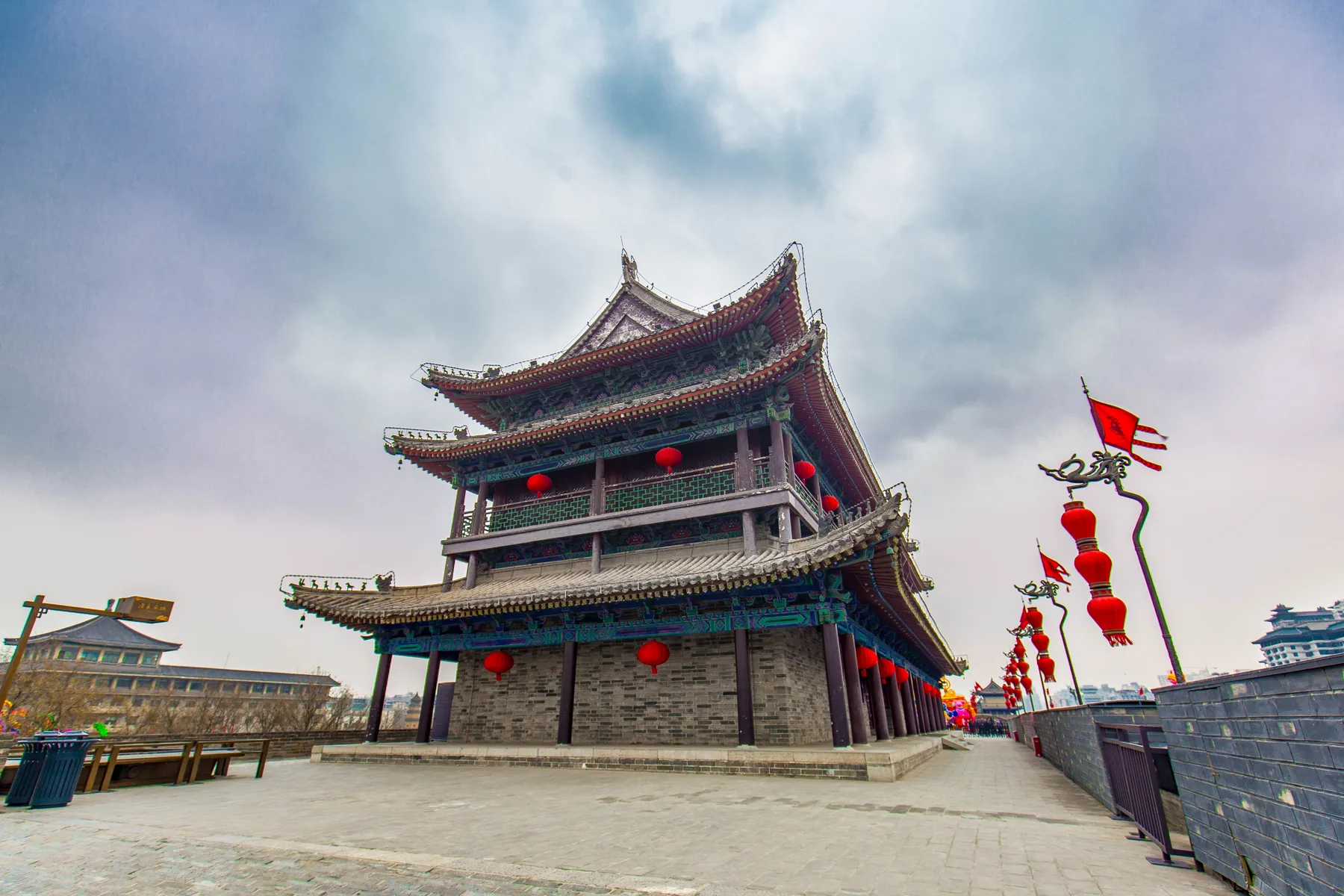
The history of Chinese culture is the history of changing languages, texts, beliefs, arts, foodways and social ties across many places and communities. Early ritual bronzes, Confucian texts, Buddhist cave sites, tea, regional opera and diaspora life are all part of it. No dynasty list can contain the whole story: region, ethnicity, religion, class, migration and generation continually alter what culture means.
I reject the version of this history that marches from dynasty to dynasty as if ordinary life changed costume whenever a court fell. The best history follows the carriers: a bowl fired in one kiln, a text copied by another generation, a recipe moved by a family, a ritual rebuilt after rupture. I want dates and institutions, but I also want to know whose hands kept the thing alive. Without that question, a “complete history” is only an orderly way to forget people.
What is the history of Chinese culture?
The phrase is useful when it describes connections across time. It becomes misleading when it makes China sound culturally uniform or untouched by exchange. What we call Chinese culture has been made through inherited practices and repeated adaptation: people copied texts, repaired objects, changed recipes, translated religions, moved across borders, argued about correct conduct and decided what to pass on.
Dynasties are the usual frame because governments commissioned objects, collected texts, regulated institutions and left records. They are not the only frame. A family language can outlast a regime. A borderland practice may fit a local ecology better than a capital's rule. A craft may travel through trade, while a community abroad develops a tradition that is recognizably Chinese and particular to its new home.
So this is a chronological guide, not a claim that history moves in one straight line. Dates help readers orient themselves; they do not tell us, by themselves, how a bowl was used, who learned a song, or what a custom meant in a particular household. I believe chronology must serve the human question, never replace it.
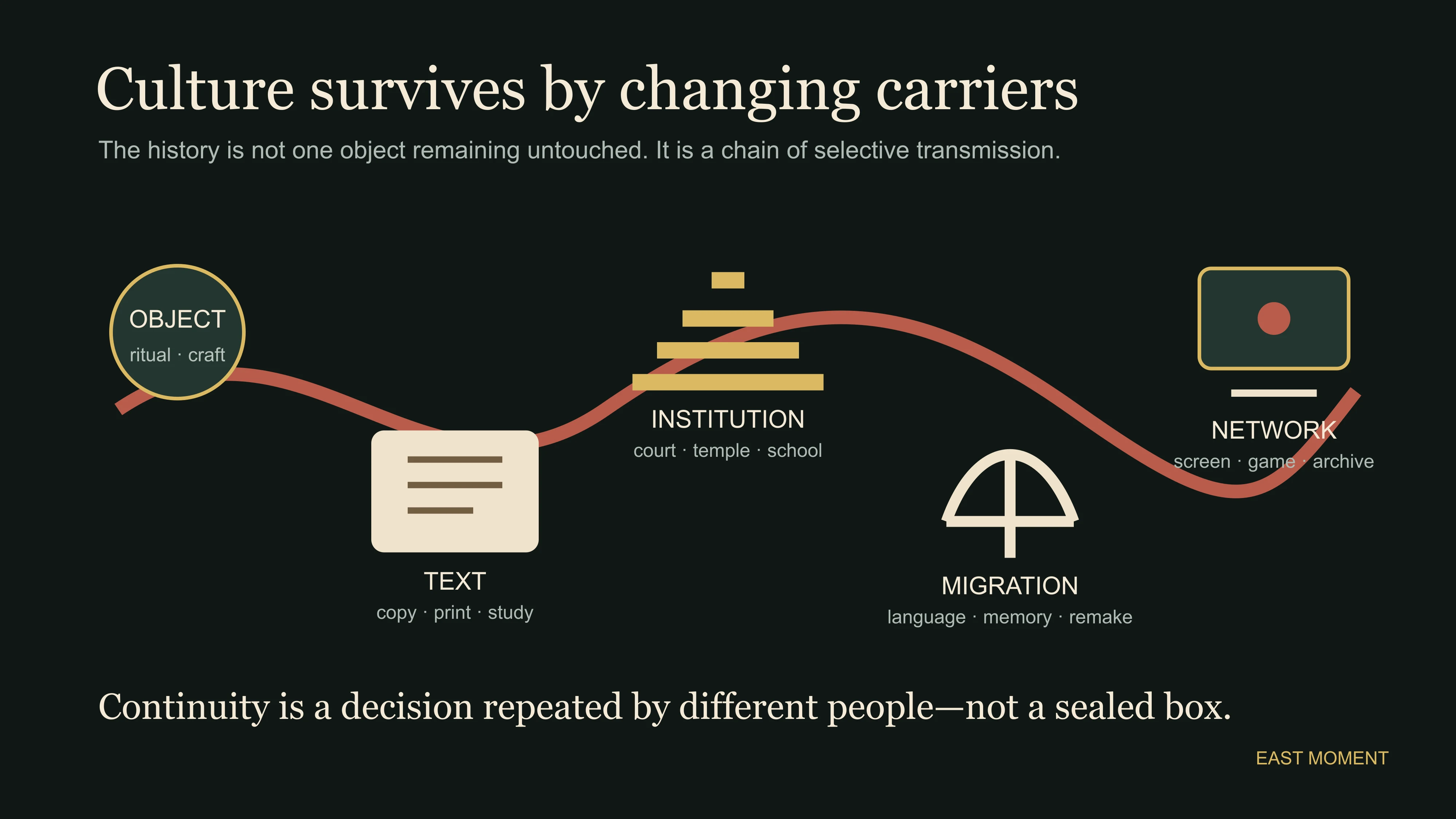
A chronology becomes human only when we can name what carried culture across the break: an object, a copied text, an institution, a migrating family or a network of exchange.
An object that keeps an earlier story in motion
A handscroll is a reminder that cultural history is not only an archive of finished facts. The Metropolitan Museum of Art records Biographies of Lian Po and Lin Xiangru, an ink-on-paper handscroll attributed to Huang Tingjian and dated about 1095. Its subject looks further back, to figures known from early historical writing; its material form belongs to the Northern Song. The object therefore carries at least two historical moments at once: an older story and a later reader-writer's act of transmission. The object record identifies its date, medium and attribution.
We do not know how every viewer encountered this scroll, and one object cannot speak for a civilization. It does show something concrete: texts and stories survive because people choose, in particular circumstances, to copy, edit, study, display and argue with them.
The same care is needed with large labels. "Confucian," "Buddhist," "Daoist," "Han," "imperial," "modern" and "Chinese" name real traditions and histories, yet each contains internal disagreement and many local forms. A timeline should make those differences easier to ask about, not erase them.
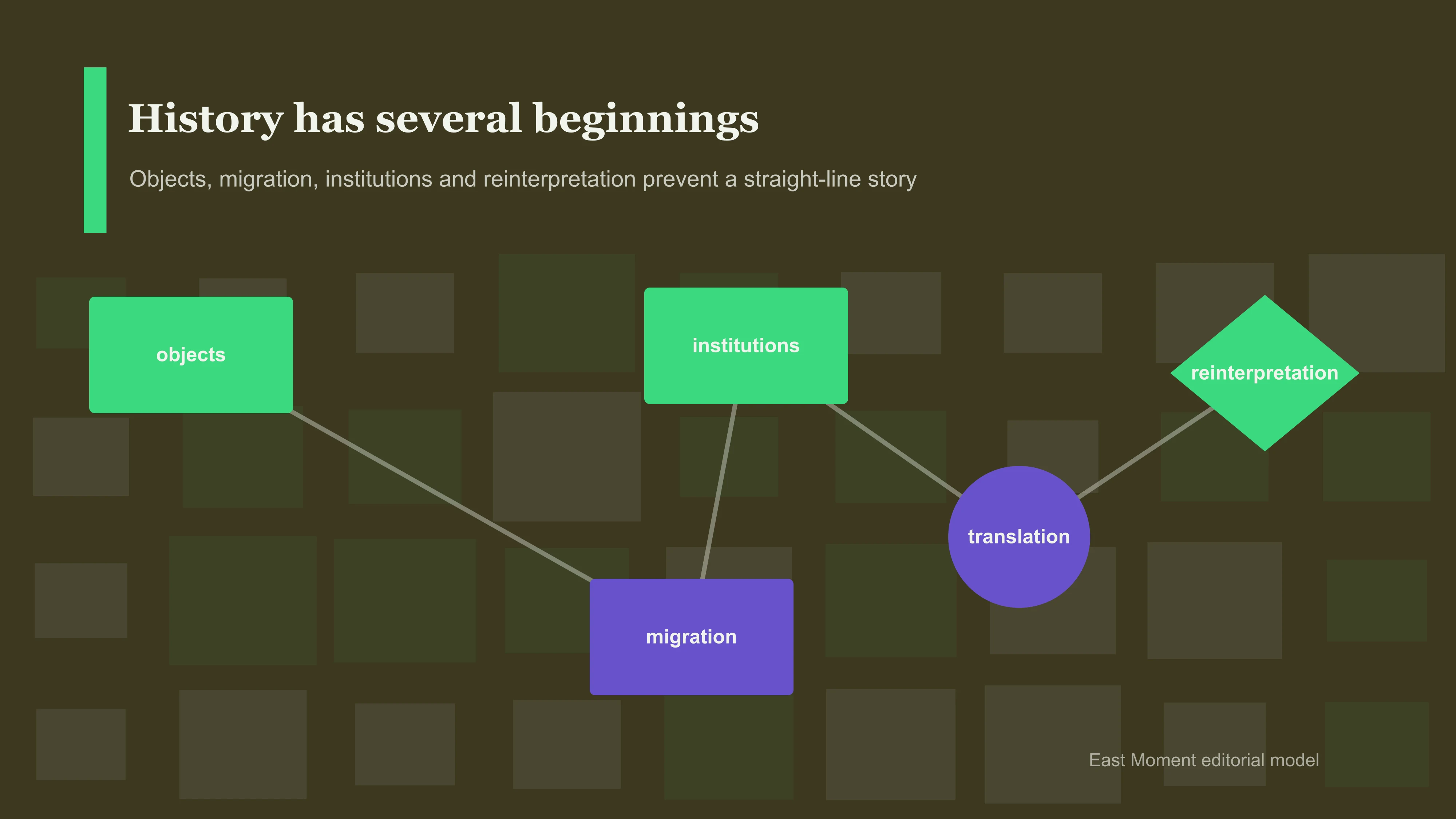
Historical foundations: several beginnings, not one starting gun
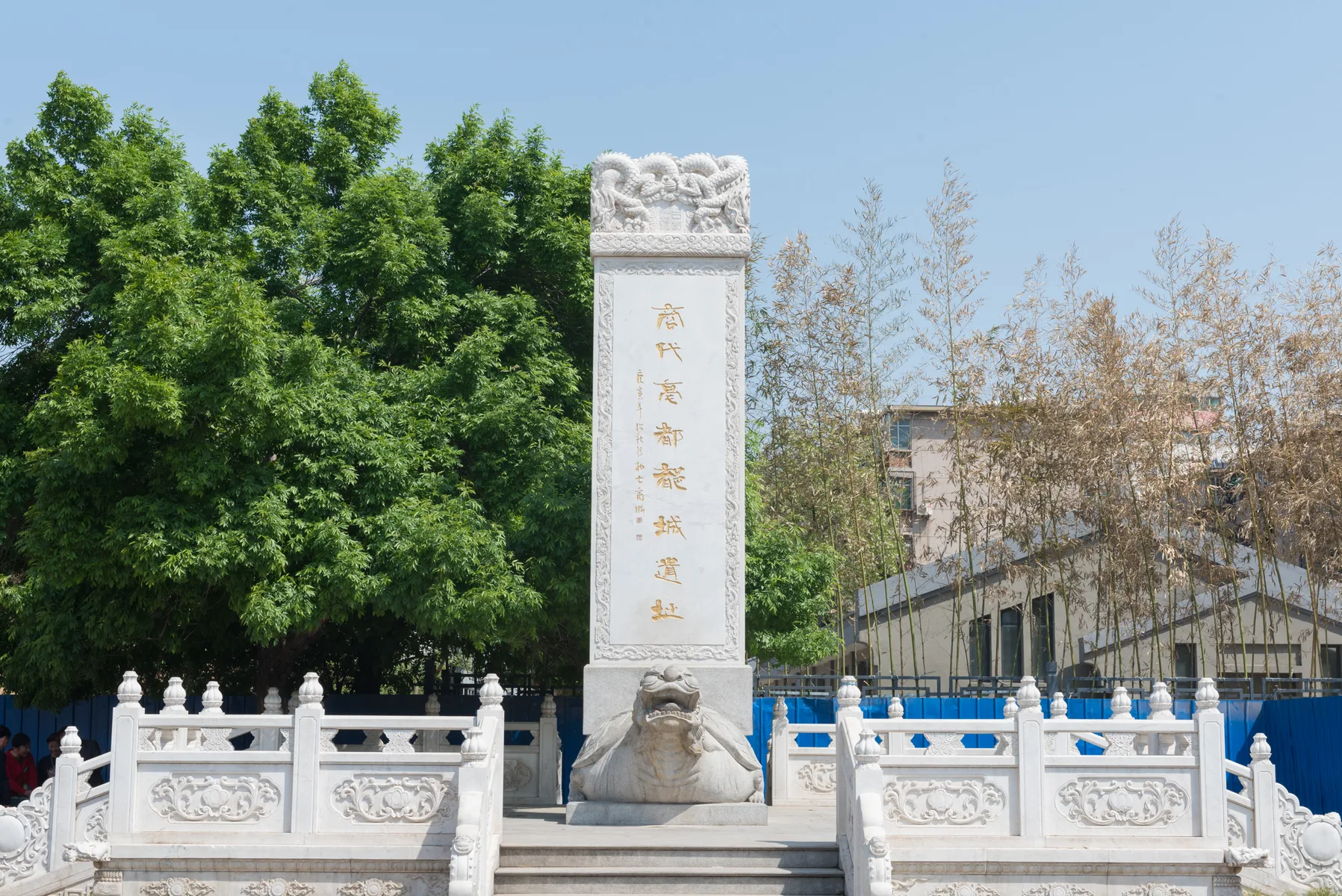
The Zhengzhou marker does not reveal an ancient capital by itself. It shows a different historical fact: an early city now sits inside a modern one and must be identified, protected and interpreted in public space. Archaeology supplies the evidence; the monument records a present-day decision about memory.
Many narratives begin with early states in the Yellow River region and with the Shang and Zhou periods. Those settings matter for writing, ritual bronzes, divination practices, political vocabulary and later ideas about antiquity. They are not a complete origin story for all people now included within China or the Chinese diaspora.
During the Zhou dynasty, dated 1046-256 B.C. by the Met's timeline, networks of courts, ritual specialists, farmers, artisans and regional polities produced many of the texts and concepts later readers treated as classical. The Analects, for example, preserves sayings and dialogues associated with Confucius and his followers; a digital text is not a substitute for its long and complicated transmission, but the Chinese Text Project's Xue Er chapter lets readers see the text that later traditions repeatedly interpreted.
The Qin unification in 221 B.C. and the Han dynasty that followed created influential models of empire, administration, writing and historical record. Yet unity was never a simple cultural fact. Trade, warfare, diplomacy and migration linked the court-centered world to Central Asia, the steppe, the south and maritime routes. Communities met one another unevenly, sometimes through collaboration and sometimes through coercion.
"Chinese" therefore does not mean culturally sealed. Buddhism entered through long networks of movement and translation. New crops, pigments, musical instruments, religious ideas, luxury materials and artistic conventions moved in multiple directions. The question is not whether China was open or closed; it is which people, routes and institutions shaped an exchange at a particular time.
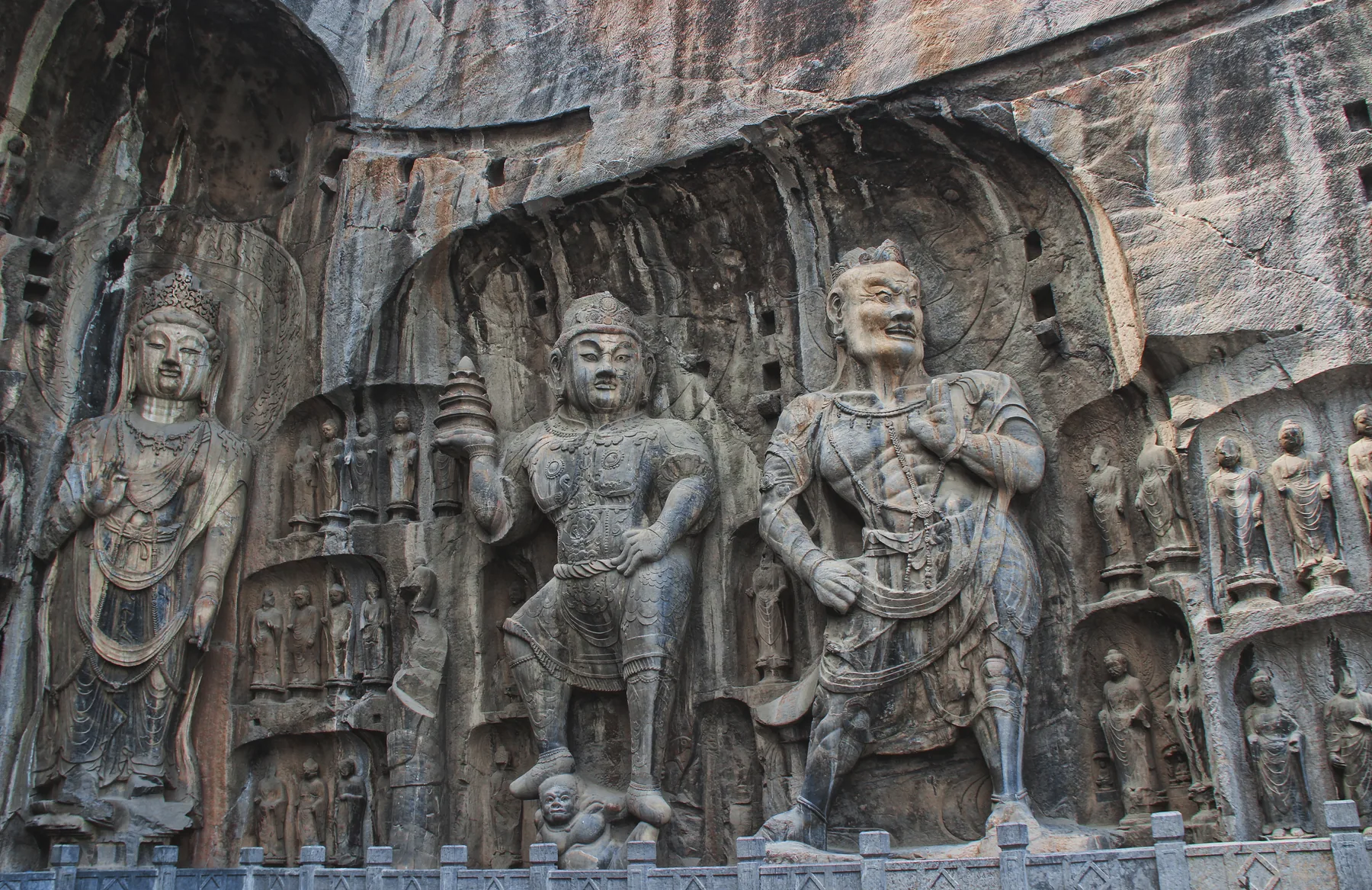
At Longmen, stone records patronage, religious movement, skilled labor and changing visual conventions in one surface. Calling it simply "ancient Chinese art" would throw away most of the evidence visible in the frame.
A working chronology of Chinese cultural history
The table is a map for a first reading, not a ranking of dynasties or a substitute for regional history. Dates identify political periods; cultural forms frequently continue across their boundaries.
| Period or topic | Core definition | Key examples | Related page | Source |
|---|---|---|---|---|
| Early states and Zhou era | Early political and ritual worlds from which later traditions drew texts, bronzes and ideas of antiquity | Oracle-bone writing, bronze vessels, Shijing, Analects traditions | Ancient Chinese Culture | Met: Zhou dynasty |
| Qin and Han | Successive imperial formations that shaped administrative, textual and historical models | Standardization projects, tomb art, Silk Road connections, historical writing | History & Society | Met: Han dynasty |
| Sui and Tang | Periods of political consolidation and cosmopolitan exchange, especially important for Buddhism, poetry and urban life | Chang'an, Buddhist translation, tomb figures, regulated verse | History & Society | Met: Tang dynasty |
| Song through Qing | A long span of commercial growth, print culture, examination systems, regional arts, conquest dynasties and global trade | Landscape painting, porcelain, vernacular fiction, tea, export goods | Chinese Art | Met: Song dynasty |
| Twentieth century to the present | Republican, socialist, reform-era and global histories that reshaped institutions, memory and mobility | New media, mass education, migration, heritage work, online communities | Chinese Cultural Revolution | Britannica: Cultural Revolution |
The language of "dynastic China" is especially limited for the last row. The Republic of China was established in 1912; the People's Republic of China was founded in 1949. These political changes reorganized education, property, institutions and public culture, but they did not make every earlier practice vanish at once. Some traditions were interrupted, regulated, repurposed, revived or carried elsewhere. The scale of change differed by place and person.
Period changes do not replace every cultural world
A dynasty can end in a year; a cultural habit rarely does. This is not an argument that political change is superficial. Regime change can redistribute land, offices, military power, tax obligations and access to education. It can destroy books, relocate populations and reorder the institutions that support a ritual or an art. But historical writing becomes misleading when it imagines all homes and regions turning a page at the same moment.
The Song period, for example, is often associated with printing, expanding commercial networks, examination culture, landscape painting and major advances in ceramics. Those labels help identify influential developments. They do not mean that every household owned books, that all painters worked in the same style, or that a potter in one kiln experienced a change in court at the same pace as a merchant in a port city. The Met's Song overview is useful for period orientation; local histories and objects are needed for the next question: who had access to these worlds?
The Ming and Qing periods similarly cannot be described by one cultural temperature. Printing and publishing widened the circulation of novels, handbooks, religious texts and examination aids. Regional markets linked places through silk, tea, porcelain, salt and grain. At the same time, literacy, wealth, legal status, gender and distance from a market town shaped what someone could read, buy or make. A famous literati painting and a household almanac may both be historical evidence, but they document different social horizons.
Conquest dynasties complicate an easy story of continuous ethnic or cultural sameness. The Yuan was founded by Mongols; the Qing was founded by Manchus. Their courts used Chinese institutions while also preserving and governing through languages, customs and political forms that cannot be reduced to a single Han-centered narrative. This does not make Chinese cultural history incoherent. It makes it more accurate: the institutions called Chinese were repeatedly built through encounters among different peoples, languages and claims to authority.
Locality matters just as much as the court. A temple fair, village school, guild hall, lineage archive, urban theater, mosque, church or market can be a cultural institution even when it appears briefly in a national textbook. They support different kinds of memory. Some preserve written genealogies; others preserve a performance repertory, a food technique, a pilgrimage route or a way of addressing kin. Their records may be uneven, and some may be lost, but absence from a famous archive is not proof of cultural absence.
This is also why the history of Chinese culture cannot be told only from elite men who left the most visible texts. Women, laborers, artisans, servants, performers, soldiers, migrants and people on frontiers made and transmitted culture under different conditions of documentation. A woven textile, kitchen utensil, opera script or school notebook may carry evidence that an official history overlooks. The ethical task for a general guide is to name that imbalance without filling the silence with imagined stories.
For readers, the practical lesson is simple: treat an era as an orientation, then ask for the smaller coordinates. What was the language? Which town or trade route? Was this a court commission, a workshop product, a family practice or a ritual object? Who could participate, and whose account is missing? Those questions turn a dynasty list back into human history.
Major forms and the people who keep them legible
Culture becomes abstract when it is reduced to famous symbols. It becomes more precise when we ask what a form required and who made it possible.
Texts, languages and education
Classical Chinese circulated through manuscript, print, commentary and education, while spoken varieties developed in many regions. Mandarin is important in contemporary national life, but it is not the only Chinese language. Cantonese, Hokkien and other Sinitic languages, along with the languages of many ethnic communities in China, carry their own literary, musical and social histories.
The Library of Congress's Chinese Rare Book Collection is a useful institutional reminder of the physical labor behind a text. Books have paper, bindings, marks of ownership, damaged edges and routes of collection. A title can be copied across centuries, but each surviving version is also an object with a history.
Ritual, religion and ethical life
Confucian traditions have shaped discussions of learning, family responsibility, governance and ritual. Daoist and Buddhist traditions have shaped philosophy, religious institutions, healing practices, visual worlds, pilgrimage and local ritual. None is a single rulebook followed by all Chinese people.
Religious life also cannot be separated neatly from household, temple, festival, ancestry, place and local deity traditions. A person may use terms such as Confucian, Buddhist, Daoist, secular or folk religion differently from a textbook. The appropriate question is often not "What do Chinese people believe?" but "Who practices what, where, and in what setting?"
Art, craft and technology
Bronze casting, silk weaving, papermaking, printing, ceramics, lacquer, carving, calligraphy, painting, performance and architecture all connect material skill to social life. They belong to courts and temples, but also to workshops, markets, villages and households. A craft tradition may be sustained by anonymous specialists whose names a museum label does not preserve.
This is why a porcelain bowl is more than a symbol of refinement. It joins clay, fuel, glaze knowledge, labor, trade, dining and later collecting. A printed book joins a writer, editor, block cutter, printer, seller and reader. The Chinese Art guide follows these material questions across objects rather than treating artistry as an anonymous national trait.
Food, dress and performance
Regional foodways and clothing carry climate, labor, religion, trade, class and taste. Wheat foods are central to many northern traditions, while rice is central to many southern ones; neither contrast explains every local meal. Chinese opera names many regional forms, not one universal performance style. A qipao, a Miao textile, a temple costume and an everyday school uniform should not be collapsed into one idea of "traditional dress."
The ordinary is historical evidence too. The recipe adjusted for an apartment kitchen, the dialect used with a grandparent, the school song remembered imperfectly, and the festival food prepared on a weekend abroad all show culture continuing through practical choices.
Lived experience, rupture and the limits of a general guide
The twentieth century makes generalization especially risky. War, revolution, displacement, changing state policy and rapid urbanization altered family archives, religious spaces, education, housing and the public use of tradition. The Cultural Revolution began in 1966 and formally ended in 1976; even this basic periodization needs care because experiences differed sharply across locality, occupation, age and political position. Britannica's overview is an orientation source, not sufficient evidence for an individual's experience.
The human center cannot be a generalized sentence about “the Chinese experience.” Memory of political violence, migration or family separation has stakes across generations. Museum and library collections can preserve objects and documents, but they cannot tell us that every family remembers rupture in the same way. My judgment is deliberately narrow and firm: show the institutional history, name the limit of the evidence and never borrow emotional authority from an anonymous composite life. I would rather leave one honest silence than fill it with a polished invented memory.
Change, diaspora and global influence
Chinese communities have long moved across regions and seas. In newer diaspora settings, language schools, clan associations, temples, restaurants, family businesses, art groups and online networks can carry culture in forms that differ from those in any one place in China. Adaptation may be a response to racism, immigration policy, available ingredients, intermarriage, work schedules or a younger generation's interests. It is not automatically cultural loss.
The same principle applies within China. An urban resident, a rural returnee, a university student, a religious practitioner, a factory worker, a farmer, a curator and a musician may all inherit the same broad historical references while using them differently. Cultural continuity is not a test of purity. It is a relationship to what people choose, are able, or are required to carry forward.
Global interest can make Chinese culture more visible and more easily flattened. Tea becomes a wellness prop; calligraphy becomes decoration; a festival becomes a costume; a regional dish becomes "Chinese food." Better engagement restores specificity: name the region, language, maker, community, historical period and source when they are known.
How to study the history of Chinese culture responsibly
Begin with a narrow question. Instead of asking for the meaning of all Chinese culture, ask how a particular text was transmitted, why a vessel was used, which community keeps a festival, or how a dish changed after migration. That method makes it easier to notice evidence and uncertainty.
Use more than one kind of source. A primary text can show what it says, but not automatically how every reader understood it. A museum object can establish material facts, but its later collection history may need separate investigation. A family memory can reveal lived consequence, while not representing an entire region. Each source answers a different question.
When visiting a museum, reading a translation or attending a community event, credit the people and institutions doing the work. Ask before photographing ritual or private family activity. Learn the name used locally. Let a contradiction remain visible when the evidence does not support a neat conclusion.
Explore the history cluster
This article is a starting point for the History & Society hub. Continue with Ancient Chinese Culture for a closer look at early society, ideas and daily life. The planned Chinese Cultural Revolution guide will need its own specialist review and oral-history safeguards before it can responsibly address a period that this overview only locates.
The history of Chinese culture is therefore broader than a dynasty chart: it is the changing history of languages, texts, beliefs, arts, foodways and ordinary practices across regions and diasporas. I insist on a specific route—name the object, date, place, community and source—then let disagreement remain visible where the evidence does not support a neat conclusion. That is not cautious decoration. It is the only history I trust.