The most famous Chinese poems are not famous for the same reason. Li Bai's Quiet Night Thought fits a world of homesickness into four short lines; Du Fu's Spring View lets a damaged city wound the speaker's private life; Wang Wei makes an almost empty landscape feel inhabited by sound. This is a reading route, not a claim that one measured global chart can rank 1,400 years of poetry. Start with the poem whose question you actually feel, then return to the Chinese words and the historical pressure behind them.
The most famous Chinese poems need a reading route, not a scoreboard
Search results often present “top ten Chinese poems” as if fame were a single number. Famous where? In school memorization, in English translation, in calligraphy, in family speech or in the history of criticism? Those forms of recognition overlap, but they do not make an objective league table. My selection favors works that a new reader can enter quickly and that reveal different powers of Chinese poetry: compression, landscape, friendship, public grief, motion and a speaking voice able to turn a setback into art.
The Tang period supplies many of these first encounters. The Metropolitan Museum's chronology of China from 500 to 1000 identifies Li Bai, Du Fu, Wang Wei and others within a major flowering of short lyric poetry. That context matters, but a visitor should not have to memorize dynasties before feeling a poem. Read one small image closely first. Then ask why a poet chose that image instead of a direct explanation.
Here is my route. It is deliberately not only a “great men” list: after seven widely recognizable works, I point to the people and forms such lists leave out. Where English titles vary, I give pinyin and Chinese characters so that you can find the poem rather than mistake two translations for separate works. The descriptions below are my own readings, not reproductions of a translator's copyrighted English text.
| Start with | Chinese title | What to notice first |
|---|---|---|
| Li Bai, Quiet Night Thought | 静夜思, Jing ye si | One glance upward and one downward turn homesickness into movement. |
| Wang Zhihuan, On the Stork Tower | 登鹳雀楼, Deng Guan que lou | A view becomes a choice to climb higher. |
| Wang Wei, Deer Enclosure | 鹿柴, Lu zhai | A human voice enters an apparently empty mountain. |
| Du Fu, Spring View | 春望, Chun wang | Spring persists while a city and family are broken. |
| Li Bai, Seeing Meng Haoran Off to Guangling | 黄鹤楼送孟浩然之广陵, Huang He lou song Meng Haoran zhi Guangling | A departing boat becomes a point of attention until it disappears. |
| Li Bai, Bringing in the Wine | 将进酒, Jiang jin jiu | Exuberance argues with time and loss. |
| Su Shi, Water Melody | 水调歌头, Shui diao ge tou | A moonlit address crosses distance between people. |
Li Bai's Quiet Night Thought: a Chinese poem about the moon and home
Quiet Night Thought is often a child's first memorized classical poem and an adult's sudden return to one. Its action is tiny: a sleepless observer notices brightness near the bed, lifts his head toward the moon and lowers it toward home. Nothing travels, yet the mind crosses a great distance. That is why I would start here instead of with a poem selected because it sounds grand in English.
床前明月光,疑是地上霜。
举头望明月,低头思故乡。
A reading in English: Light near the bed looks like frost. The speaker looks up toward the moon, then lowers his head as home enters his thoughts. This is the familiar Three Hundred Tang Poems wording. Earlier collected versions read “看月光” and “山月” instead; the small variants are a useful reminder that a memorized text also has a textual history.
The moon is not a code that simply means “China,” and the floor's pale appearance is not a meteorological report. The visual uncertainty creates the pause before recognition. Then two opposite movements of the head turn sight into memory. If an English version makes this feel like a sentimental statement about longing, look again at the choreography. The body does the thinking before the speaker names the emotion.
Translation is not a transparent window. A Poetry Foundation essay on translating Li Bai and Du Fu uses Quiet Night Thought to show how a translator can reshape spacing and cadence while staying close to the poem's economy. I would read two translations beside the Chinese, even if I could recognize only the repeated words for head, moon and home. The variations make visible where interpretation enters. We do not need to declare one modern rendering “the original in English.”
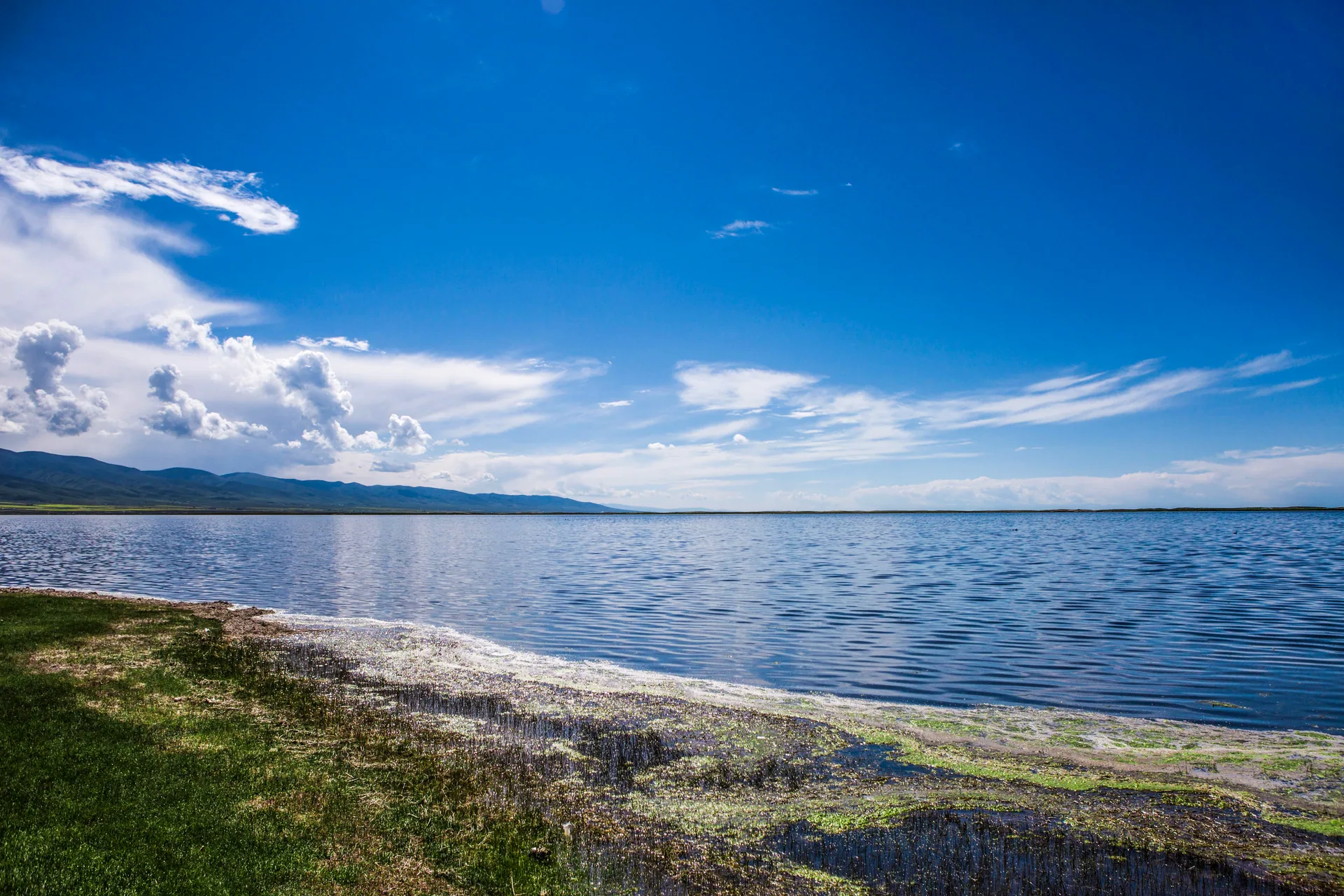
This page's Yellow River photograph does not depict Li Bai's bedroom or his moon. It introduces a different poetic problem: when a river appears in a poem, the exact image, location and motion matter. A real photograph can help us look, but it cannot retrospectively illustrate a scene the camera never witnessed.
On the Stork Tower and Deer Enclosure: two ways to use a landscape
Wang Zhihuan's On the Stork Tower looks outward: the sun is dropping, the Yellow River runs toward the sea, and the speaker wants a wider view. Its unforgettable turn is practical. To see farther, go up another level. English readers often treat the line as a motivational poster. That is too neat. The force comes from the physical stair: aspiration is attached to a body, a building and a horizon that does not yield itself at the first vantage point.
白日依山尽,黄河入海流。
欲穷千里目,更上一层楼。
A reading in English: The sun disappears behind the mountains; the river runs toward the sea. If the eye wants to travel farther, the feet must take another floor. That last motion is the poem's argument, not just an inspirational caption.
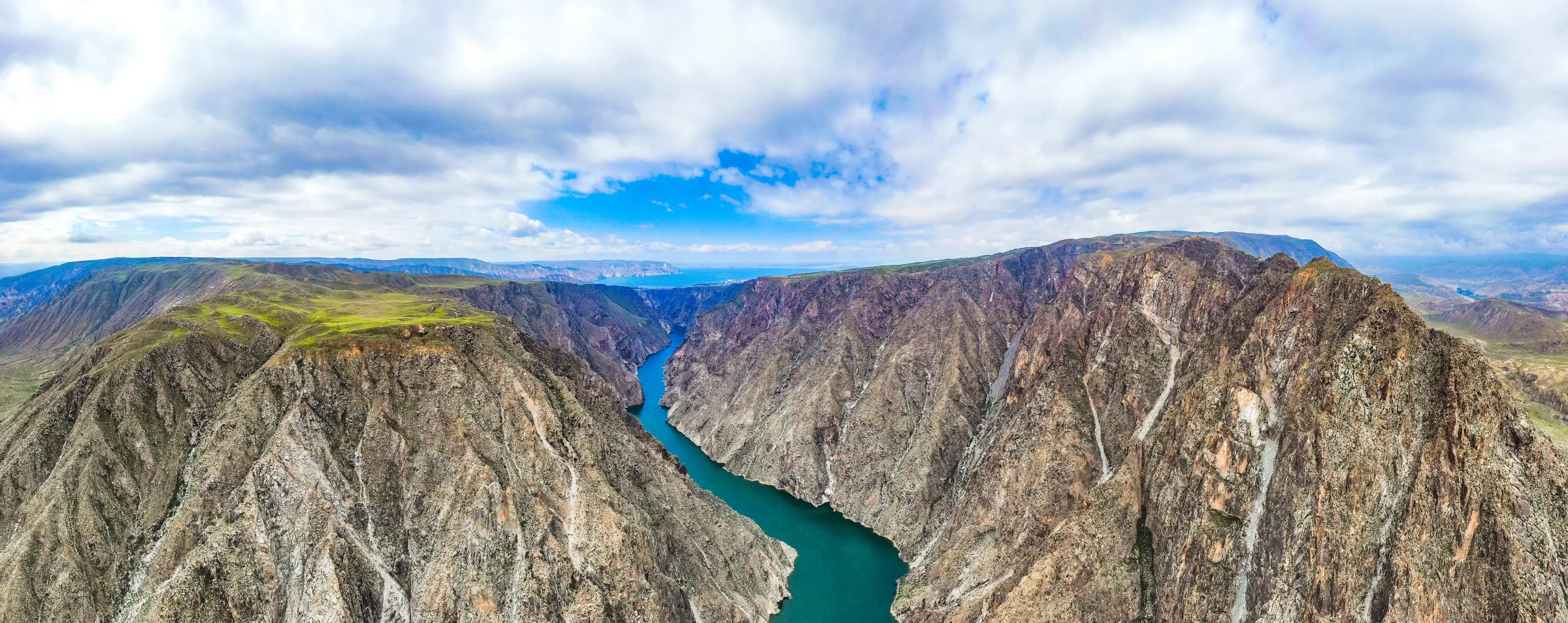
The hero photograph is of a Yellow River canyon in Qinghai. It is not the view from Stork Tower and cannot establish the poem's original sightline. It does show why the river resists becoming a line on a map: from one height it seems enclosed by rock; from another, it opens into a larger route. I care about that shift more than the poster slogan. The poem asks the eye to admit it has a limited position.
Wang Wei's Deer Enclosure does nearly the opposite. Instead of climbing toward more, it makes less feel charged. A mountain seems empty; a voice is heard; late light reaches into shade. “Empty” is not the absence of life. The poem's intelligence lies in the interruption: the ear detects someone the eye cannot see. English translation has to decide how much explanation to add, but I prefer versions that allow the silence to remain a little unsettled.
空山不见人,但闻人语响。
返景入深林,复照青苔上。
A reading in English: No one appears in the mountain, yet voices reach the listener. Returning light enters the deep woods and touches the moss. Notice how the poem offers sound before it offers visible life.
These two poems should be read consecutively. The first says movement can change what you see. The second says attention can change it without moving at all. That contrast teaches more about Chinese landscape poetry than a gallery of interchangeable mountains.
Du Fu's Spring View: when spring is not consolation
Du Fu's Spring View begins from a city hurt by war. Vegetation grows, birds and flowers remain, and private grief keeps breaking through the public scene. Its title may sound restful to a reader who expects “spring” to be a universal promise of renewal. In this poem, renewal is precisely the problem: nature can continue while human order fails.
国破山河在,城春草木深。
感时花溅泪,恨别鸟惊心。
A reading in English: The state is broken, but mountains and rivers remain; spring growth fills the city. Flowers and birds do not cancel grief. These are the opening four lines of an eight-line poem, not a replacement for reading the rest.
That is the poem I would put in the hands of anyone who says classical Chinese poetry is merely delicate scenery. Du Fu refuses to let a flower stay innocent once separation and violence have entered the reader's view. His scale keeps changing. A damaged capital is enormous; a family letter is small enough to hold. The poem makes both pressures felt in the same body.
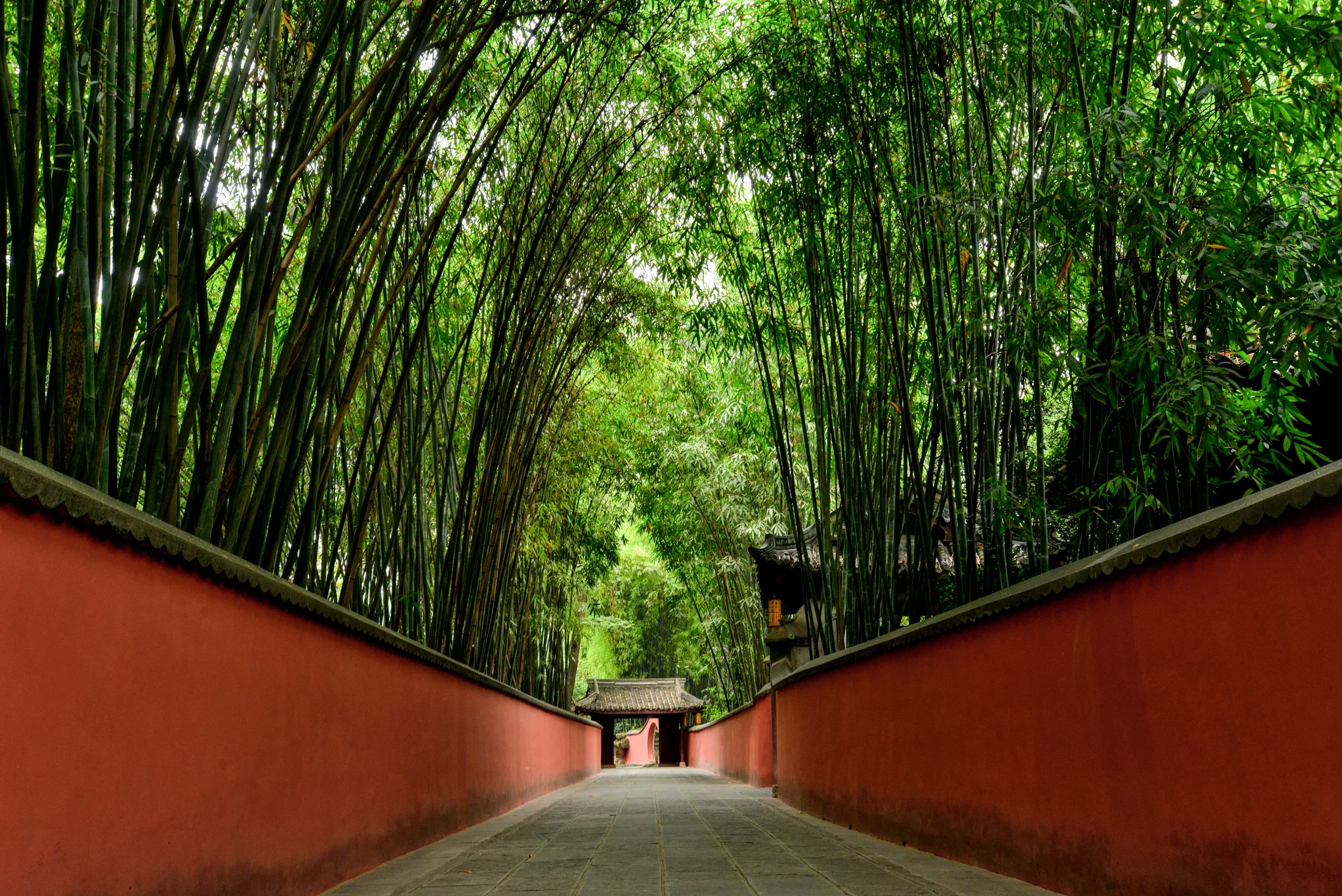
The photograph shows a bamboo corridor at Du Fu Cottage in Chengdu, a later memorial landscape associated with the poet. It is not a photograph of the city in Spring View, and it cannot prove what Du Fu saw while writing that poem. It can, however, prevent another mistake: Du Fu is not only a textbook name. Places still organize cultural memory around him, and a visitor who follows the corridor can ask which poem belongs to which period of a moving life. For the actual story of the city, start from the poem and reliable historical scholarship, not from a modern garden photograph.
Farewell at Yellow Crane Tower: watch the boat until it is gone
Li Bai's farewell to Meng Haoran is one of the clearest Chinese poems about friendship without a speech about friendship. A friend leaves for Guangling, associated with Yangzhou; the departing sail becomes smaller; the observer stays. The last visible trace of the boat matters because the poem does not rush to replace the absent person with a moral lesson.
I love how much emotional labor the watching does. A lesser account would tell us the friends are sad and move on. Li Bai gives the eye a task it does not want to finish. If you are reading in English, check whether a translation allows that duration. If the poem is reduced to “my friend sailed away and I missed him,” you have received the plot but lost the experience.
This is also where Chinese geography matters. A place-name in a Tang poem is not a tourism keyword inserted for color. It fixes a route, a social world and the consequence of distance. The Chinese culture guide connects texts with art, language and lived practice; this article stays with a small number of poems and the actions inside them.
Bringing in the Wine: Li Bai's loudness has a shadow
Readers sometimes meet Li Bai through spectacular drinking lines and imagine an uncomplicated poet of pleasure. Bringing in the Wine is bigger and less comfortable. Its exuberance is driven by an awareness that youth and time run in one direction. The feast is not an escape from mortality; it is an argument shouted against it. That is why the poem can feel both excessive and painfully clear.
I would not make this the first poem for every reader. Its energy, allusions and performance are easier to appreciate after the quiet control of Quiet Night Thought. Together the two works also stop Li Bai from becoming a one-note personality. One poem compresses a whole homesickness into a gesture; another expands anxiety until it fills the room. A good selection should show a poet's range, not only his most shareable line.
In translation, be alert to voice. A translator may make the poem sound solemn, comic, drunken or philosophical by changing rhythm and address. Read for the repeated turns of invitation and refusal, not only for a phrase attractive enough to print on a poster.
Su Shi's moon: the person far away remains part of the poem
Water Melody, often known through its moonlit opening and the phrase “when will the bright moon appear,” belongs to ci, a lyric form associated with a tune pattern, rather than the same short Tang verse pattern as Quiet Night Thought. For a first reader, the formal label is useful because it explains why this voice seems to unfold differently. The poem speaks toward someone absent; distance is not erased by wishing it away. The moon becomes a shared object visible to people apart.
Su Shi should not be flattened into “the Chinese moon poet” any more than Li Bai should be flattened into “the drinking poet.” The Metropolitan Museum's record of a later calligraphy work transcribing another Su Shi lyric shows a different register: awkwardness, self-mockery and a wish to step away from official life. I include Su Shi here because his moon poem gives an accessible route beyond the Tang, then invite readers to follow his changeable voice elsewhere.
Compare Su Shi's moon with Li Bai's. In Quiet Night Thought, looking at it triggers a thought of home. In Water Melody, speaking under it connects people who cannot occupy the same place. Same heavenly object, different relationship. “Chinese poems about the moon” should begin with that distinction, not with the claim that every moon means homesickness.
A famous-poems list can hide a whole literary world
These seven works are an entrance, not the final map. Any list built only from frequently translated male Tang poets risks making Chinese poetry look narrower than it was. Women wrote, printed texts circulated unevenly, forms changed, and what schools teach is not identical to what households remember. Xue Tao, associated with Chengdu, is one name a new reader should seek after the first seven, not because a token woman will fix a list but because her voice requires a different account of who could write, exchange and be remembered.
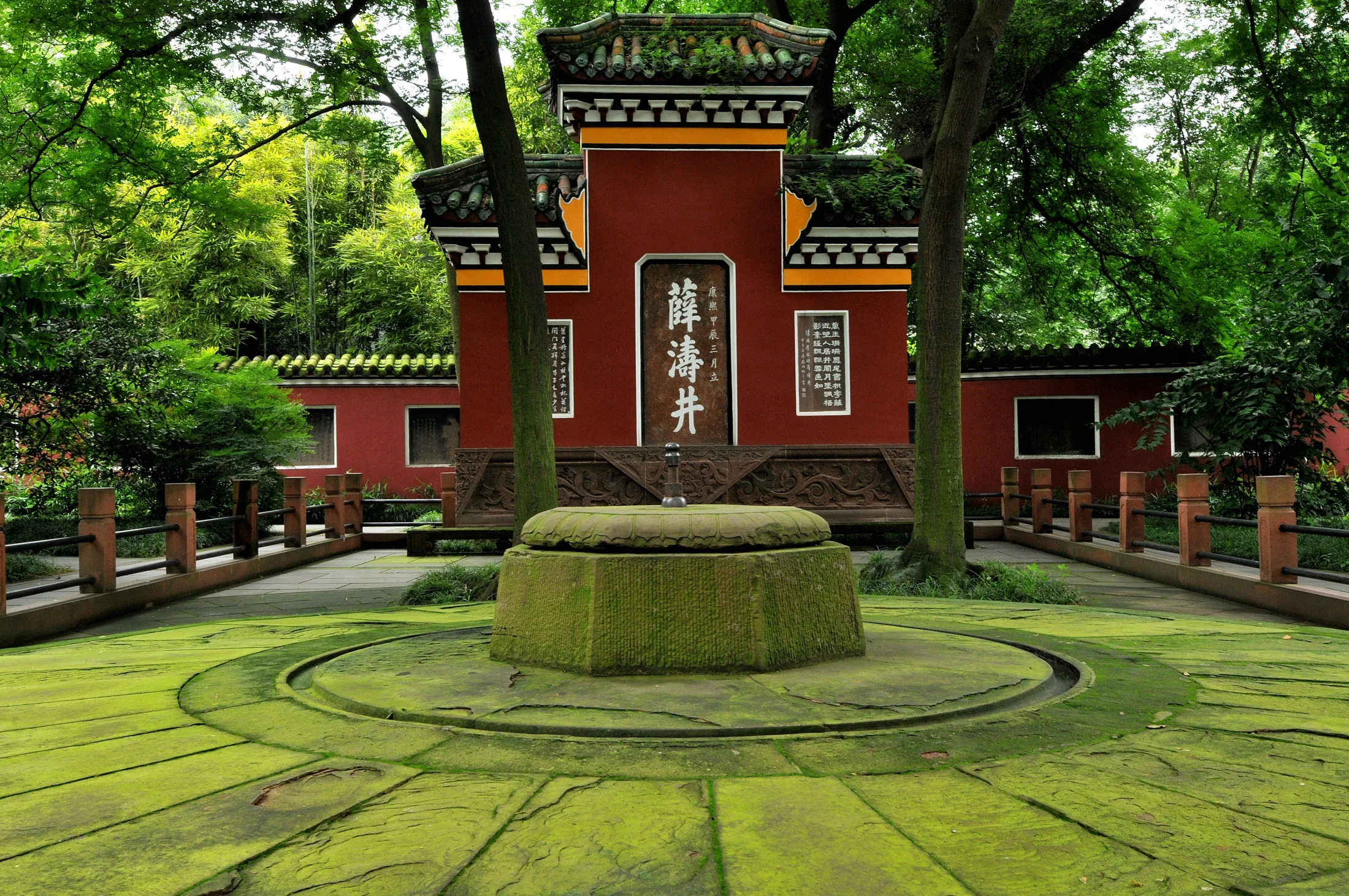
This authorized archive image shows a memorial site connected with Xue Tao in Wangjiang Park, Chengdu. It is a contemporary photograph of remembrance, not visual proof of a particular Tang poem or a claim that she stood at this exact spot. I include it to make the limit of the “seven famous poems” visible. A culture remembers through schools, editions, parks, performances and family speech; those routes can amplify some poets and make others harder for an overseas reader to encounter.
If your interest is epic narrative rather than lyric concentration, continue through the Chinese culture guide to Journey to the West. Do not expect a novel to reward the same reading pace as a four-line poem. The pleasure of the poem is that a single change of view, sound or address can reorganize an entire emotional world.
My reading order is Quiet Night Thought, Deer Enclosure, On the Stork Tower, Spring View, the farewell poem, Bringing in the Wine, then Su Shi's Water Melody. It moves from a room to a mountain, a tower, a wounded city, a river route, a feast and a sky shared across distance. The most famous Chinese poems deserve that kind of attentive sequence, not seven thumbnails under a claim of absolute rank. Which one became more interesting when you looked past the English title? Bring your own authorized image and a short explanation to Moments so the next reader can test your interpretation against the place, object and words rather than another slogan.