Keep four dietary questions separate
The same dish may pass one test and fail another.
| Need | Question that decides | Shortcut that fails |
|---|---|---|
| Vegetarian or vegan | Do broth, lard, oyster sauce, fish sauce, egg, dairy and garnish fit the person’s practice? | Tofu or vegetables mean the whole dish is vegetarian. |
| Halal | Ingredient, slaughter, alcohol, pork contact and kitchen practice are verified for the diner’s standard. | Northwestern, lamb or Hui-themed branding guarantees compliance. |
| Kosher | Certification, meat/dairy separation, ingredients and equipment match the observer’s requirements. | No pork or shellfish makes a restaurant kosher. |
| Gluten or allergy | Sauces, starches, wrappers, fryers, stock and cross-contact are checked dish by dish. | Rice-based cuisine or tamari alone makes the meal safe. |
Ethics, religion, allergy and intolerance are not interchangeable
A vegetarian may avoid meat but eat egg; a Buddhist household may avoid pungent alliums in a particular context; a vegan avoids animal-derived ingredients; an allergy can make trace contact dangerous; celiac disease requires a medical gluten boundary. The restaurant cannot answer correctly until the diner states the actual requirement. The page cannot answer correctly if it treats every restriction as preference.
Use plain language and, when traveling, carry the key ingredients and cross-contact concern in written Chinese. Ask one focused question at a time. Staff may understand the recipe but not an imported dietary label. Translation should make the decision observable rather than demand that one word do all the work.
A vegetable can arrive in meat broth without anyone thinking the name is dishonest
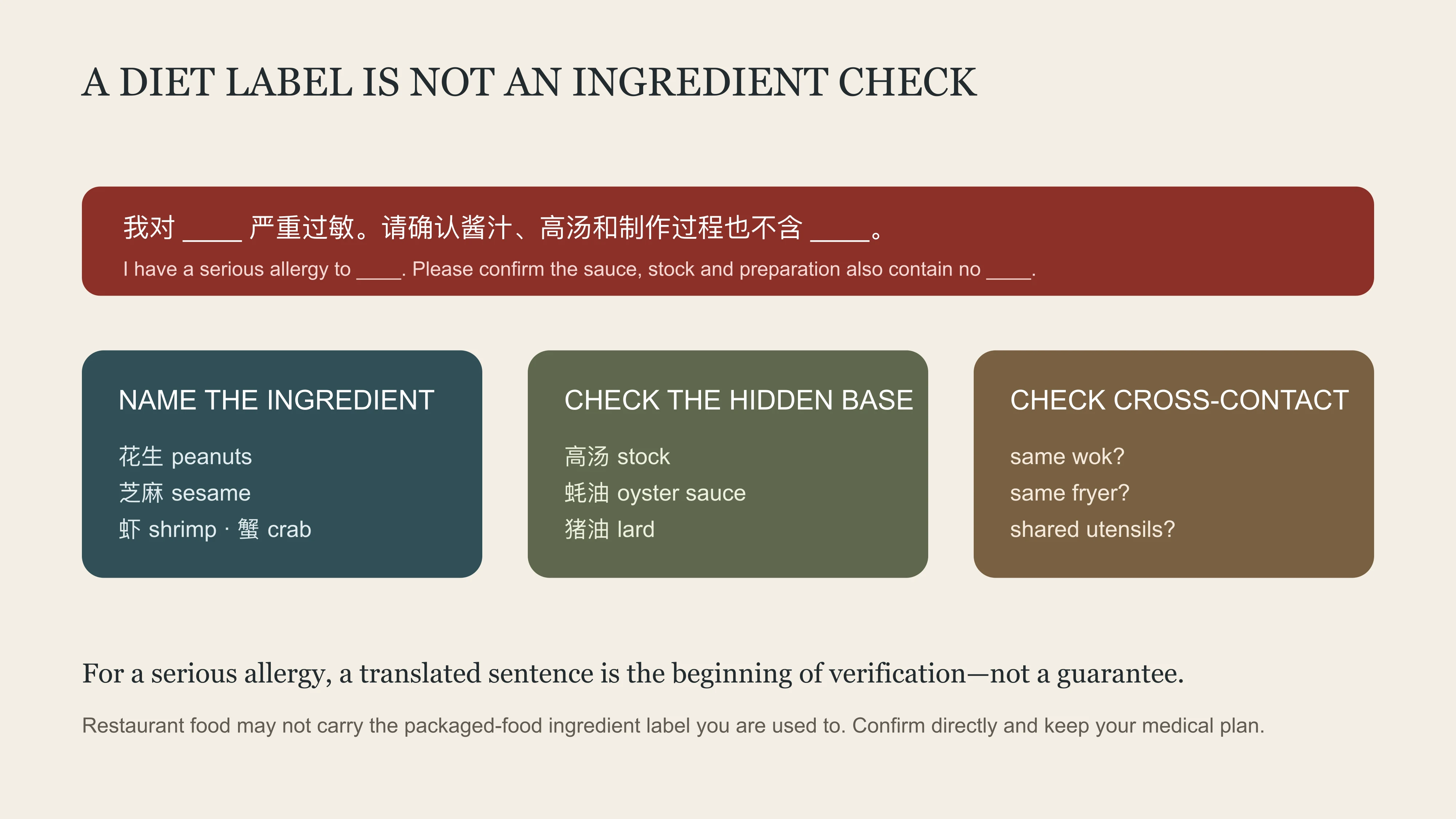
Stock, lard, oyster sauce, dried shrimp, minced meat and animal-based seasoning may be used for depth while the visible ingredient remains vegetable or tofu. In many menus, the dish name describes the main material rather than a dietary certification. That naming logic is culturally ordinary and practically dangerous for someone assuming the English category vegetarian.
Ask about broth, cooking fat, sauce and garnish. If the answer is uncertain, choose a restaurant experienced with the restriction or a simpler dish whose process can be explained. I would rather miss one famous plate than ask a reader to gamble with their body.
The ingredient list is only half the safety question
Woks, ladles, chopping boards, steamers, strainers and frying oil move rapidly through a busy kitchen. A recipe may contain no declared allergen while shared equipment creates contact. For religious practice, the same equipment may also matter. The acceptable level differs by person and tradition, so a guide must not promise that one kitchen arrangement is safe for everyone.
State the seriousness calmly and specifically. Ask whether separate utensils or oil are used and whether the restaurant can realistically control contact during peak service. If staff cannot guarantee it, accept the boundary. Pressure does not create a safer kitchen.
Traditional does not mean balanced, and modern does not mean harmful
China’s official dietary guidance, summarized by FAO, emphasizes variety, vegetables, fruits, whole grains, soybeans, moderate animal foods, less salt, sugar and oil, hygiene and reduced waste. Those are population-level recommendations, not proof that a named regional dish is healthy or unhealthy. Portion, frequency, preparation and the rest of the diet matter.
Do not use Chinese food culture to prescribe treatment or shame a person’s body. A registered dietitian or clinician belongs in decisions about disease, pregnancy, medication and severe allergy. East Moment can explain ingredients and context; it must not impersonate individualized care.
Build one safe dish before building the shared table
Identify a plain staple, a simply prepared vegetable and a protein or bean dish that can be verified. Confirm sauces and stock, then add variety only when the kitchen understands the need. Keep serving utensils separate at a shared table if cross-contact matters. For packaged foods, read the local label and allergen statement rather than relying on the front image.
My position is practical: the best cultural exchange is one everyone can survive and enjoy. A host who adapts carefully has not weakened tradition; they have made hospitality real. A guest who states a boundary clearly is not rude; they are giving the table a chance to care correctly.
Never let a cuisine stereotype overrule a verified ingredient
Rice does not make every dish gluten-free. Tofu does not make every dish vegan. Lamb does not make every kitchen halal. Avoiding pork does not make a restaurant kosher. These sentences sound obvious until a beautiful menu and social pressure make them inconvenient.
The highest standard is certainty where certainty is possible and an honest ‘we cannot verify this’ where it is not. That answer may reduce options. It also respects the reader far more than a confident guess wrapped in cultural enthusiasm. If a dish cannot be verified, record the uncertainty and move to the safe fallback already chosen. Hunger, embarrassment and a crowded table are exactly the conditions in which people accept risks they rejected calmly beforehand; careful planning removes that needless social pressure before it starts.
Do the ingredient work before the guest reaches the table
Ask about restrictions before choosing the restaurant or menu. Contact the kitchen outside peak hours, write down the exact concern and identify at least one fallback food. Keep packages or ingredient labels when cooking at home. If one guest needs strict separation, plan utensils, oil and serving spoons before food begins moving around the table.
A host should never challenge the seriousness of a restriction or demand a personal medical explanation. ‘I cannot eat this’ is enough. Care is practical: a separate bowl, verified sauce, clean utensil and no pressure. Chinese hospitality is strengthened when generosity includes restraint.
Carry the boundary in writing and carry a backup meal
Translation apps fail in loud rooms, and a familiar brand may use a different formula in another market. Save a short Chinese card naming the ingredient, cross-contact concern and consequence. Show it before ordering. Photograph labels for later review and keep a simple packaged backup when the risk is serious.
This preparation is not fear. It is freedom from having every meal become a negotiation. The goal is to participate in food culture without asking a stranger’s kitchen to promise what it cannot control.