Teresa Teng did not make Mandarin pop intimate by sounding fragile. She controlled breath, consonants and conversational timing so precisely that a recorded voice could feel personally addressed, even when millions were listening.
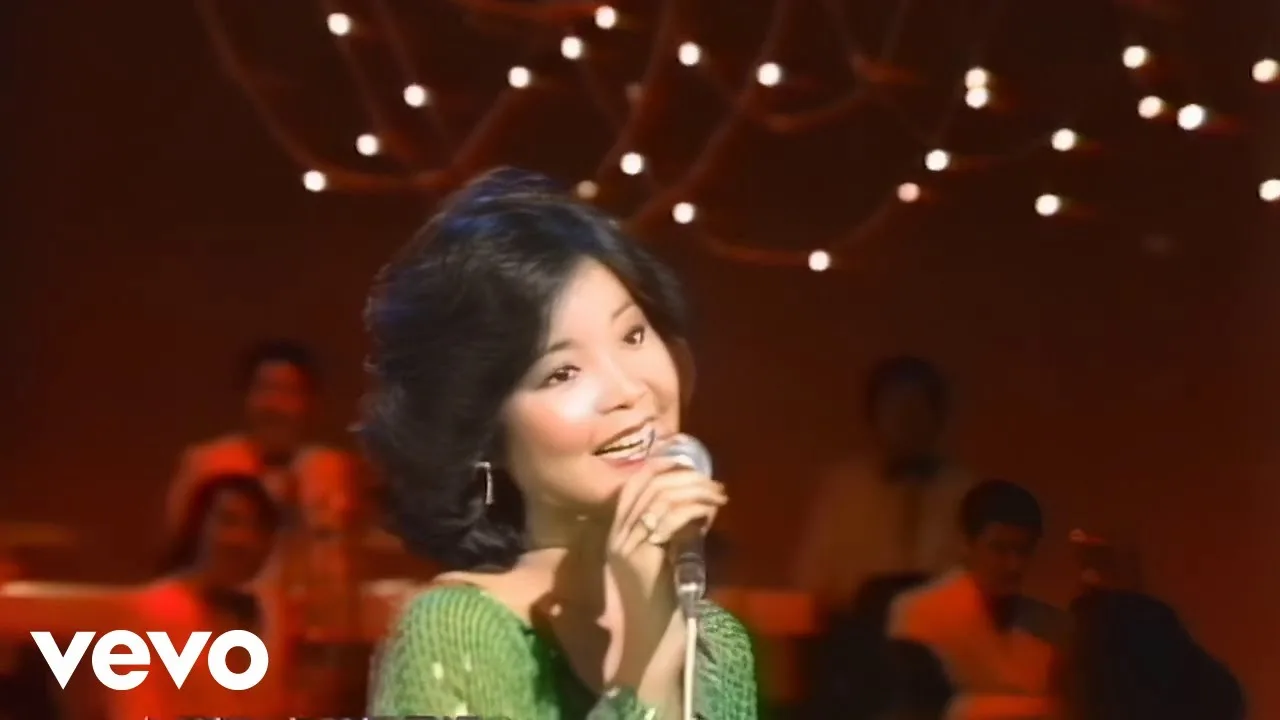
The surprise in an old Teresa Teng performance is not the dress, the orchestra or the softness everyone remembers. It is the distance.
She stands in a television studio, yet sings as if the microphone were one listener. A phrase arrives cleanly, the final consonant relaxes, and the next breath appears before the emotion becomes theatrical. She does not chase you across the room. She makes you lean closer.
Watch Teresa Teng singing Sweet as Honey in an official performance
Teresa Teng made Mandarin pop feel like a private conversation
Teresa Teng (邓丽君, Deng Lijun) was a Taiwanese singer whose Mandarin, Cantonese and Japanese recordings became central to twentieth-century Chinese-language popular music. Begin with that fact, but do not stop there. Her importance lies in a method: she made emotional clarity feel effortless.
In Mandarin, every syllable can become too square when a singer tries to pronounce it perfectly. Teng keeps the words legible without pinning them to the beat. She lets vowels travel, then lands the consonant lightly enough that the sentence continues to breathe. The result is neither speech nor grand bel canto. It is speech lifted just far enough to become melody.
That is why “sweet” is an incomplete description. Sweetness is a colour. Teng's real achievement is proximity.
| If you want to understand... | Begin with... | Listen for... |
|---|---|---|
| the famous Mandarin intimacy | Sweet as Honey | speech remaining alive inside melody |
| restrained confrontation | What Do You Say | politeness tightening without a shout |
| classical poetry in popular song | Wishing We Last Forever | old language brought down to breathing scale |
| her Japanese career | Tsugunai and Toki no Nagare ni Mi o Makase | another language changing attack but not closeness |
| the person behind the memorial image | a complete live performance | teasing, timing and control between songs |
Listen to the question inside What Do You Say

This official image proves the recording's visual presentation, not the singer's private relationships.
In What Do You Say (《你怎么说》), the title is already a confrontation. A less disciplined singer could turn each repetition into accusation. Teng does something sharper: she withholds full force. The line remains polite enough to expose the other person's evasion.
Listen to how a question can remain melodically smooth while the emotional temperature changes underneath it. That tension is her dramatic intelligence. She does not need a scream to establish that trust has been damaged.
For overseas listeners learning Mandarin, her diction is unusually useful because clarity and natural movement coexist. But do not treat the songs as language exercises. The point is to hear how social restraint becomes musical pressure.
The playful Teresa Teng corrects the marble-statue image
Why do Teresa Teng's live appearances feel more affecting than polished variety shows? The question matters because I discover a woman more playful than the memorial image whenever the formal frame loosens.

Watch the space between sung lines in Roadside Wildflowers, Do Not Pick (《路边的野花不要采》). Her face, timing and address to the room keep the warning from becoming moral instruction. The song flirts with its own rules.
This is the human correction a standard biography misses. Teresa Teng was not merely a disembodied “gentle voice.” Onstage, gentleness could include comic timing, teasing and command. Soft delivery did not mean passive presence.
One voice moved because it could be translated without becoming empty
Teng's career crossed Mandarin, Cantonese and Japanese markets. That multilingual movement should not be romanticized as proof that all Asian audiences heard the same meaning. They did not. Lyrics, titles, arrangements and cultural associations changed.

What remained recognizable was the relationship between voice and distance. In Japanese material, phrasing adapts to another language's rhythm; in Cantonese songs such as Strolling Along the Road of Life, articulation meets a different melodic contour. The identity survives because it was never attached to one decorative accent.
This mobility also helps explain why Teresa Teng memories appear across families and cities rather than inside one national narrative. A cassette, restaurant speaker, karaoke machine, migrant home or late-night radio could each make a different Teng. The Hong Kong guide provides one city context; the wider Chinese culture collection shows why circulation often matters as much as origin.
Wishing We Last Forever turns an old poem into present tense

Wishing We Last Forever (《但愿人长久》) sets lines associated with Su Shi's Prelude to Water Melody. The easy story says she “combined tradition and modernity.” That phrase explains nothing.
The meaningful decision is scale. The classical text contemplates separation, the moon and people sharing one sky. Teng does not make it monumental. She brings the poem down to human breathing size. Ancient language stops sitting behind glass and becomes something a person might need tonight.
That is cultural translation rather than costume. The song gives an overseas listener a door into classical Chinese feeling without pretending the pop recording replaces the poem.
Teresa Teng's Japanese recordings are not translated leftovers
The Japanese career is essential because it tests whether the famous intimacy belonged only to Mandarin. It did not. Universal Music Japan's official biography documents a sustained Japanese recording life rather than a brief export chapter.
In Tsugunai (《偿还》) and Toki no Nagare ni Mi o Makase (later known widely in Mandarin as I Only Care About You), the language changes the mouth. Japanese morae organize time differently from Mandarin syllables; consonants arrive with another weight; emotional emphasis cannot simply be copied into the same melodic slots.
Teresa adapts without putting on a theatrical “Japanese” voice. The line remains close, but the closeness is rebuilt. Compare versions and you can hear where a phrase lengthens, where an attack becomes cleaner, and where the emotional climax moves because the language will not carry it in the same place.
This is why I reject the easy label “multilingual singer” when it functions as a trophy. Pronouncing several languages is an achievement. Recreating the relationship between singer and listener inside each one is artistry.
The mainland memory entered through speakers before stages
Many Chinese listeners did not first meet Teresa Teng through a grand concert. The voice arrived through cassettes, copied tapes, radio, restaurant speakers and family rooms. That route matters because it explains why the music feels less like a historical period than a person who was already inside the household.
Private circulation changed the scale of popular feeling. A love song did not require public ceremony. It could accompany washing dishes, a long drive, a shop closing or one adult refusing to explain why a particular line had made the room quiet.
I do not claim those scenes as my own biography, and I do not need to. They describe the material life of recorded music: cheap repetition, imperfect sound and emotional privacy. The song became intimate partly because the listening technology placed it close enough to ordinary work.
That history also explains why remastered perfection can miss something. Tape hiss, a speaker pushed too hard and a family member singing over the record are not part of Teresa's original performance, but they are part of how millions learned to need it. Cultural impact happens after the studio master leaves the studio.
Nostalgia can hide the discipline

The danger of loving Teresa Teng is turning her into atmosphere: an old street, a warm lamp, a parent humming. Those memories are real, but they can flatten the singer into a mood supplied by the listener.
The Moon Represents My Heart intensifies that danger because it is so perfectly available as a symbol. The moon, devotion and simple melody can stand for “Chinese romance” before anyone has listened to the performance. I would never remove the song from a beginner's route, but I refuse to let it become the whole route.
Hear how little she forces the declaration. The melody could invite sentimental inflation; she keeps it near speech. Then move immediately to What Do You Say, where closeness becomes accusation, and to Roadside Wildflowers, Do Not Pick, where control becomes play. The contrast restores a working singer to the icon.
One universally recognized song is a door, not a house. Teresa Teng matters because she could change the social use of proximity—comfort, flirtation, confrontation, memory—without abandoning the vocal scale that made listeners lean in.
Test the craft instead. Compare how she enters a phrase, how long she withholds vibrato, when she allows a word to harden and how little volume she needs to change the room. Then compare a studio recording with a live one. The consistency is not mechanical. It is control flexible enough to feel spontaneous.
Her live humor is evidence against the fragile-angel myth
The memorial image often removes everything unruly: wit, teasing, timing and the authority required to hold a room between songs. Current circulation of complete stage moments restores that person. She can turn an introduction into a joke, let the audience answer, then begin singing without losing the intimate scale.
That transition is harder than it looks. Spoken comedy opens the room; the song must narrow it again. Teresa does not become solemn to manufacture importance. She changes breath and focus until thousands of listeners accept the fiction that one sentence has been addressed privately.
Softness therefore was never passivity. It was command without visible force. The distinction matters for women performers, who are too often praised as naturally gentle when the evidence shows disciplined control of pace, attention and social distance.
The limitation is equally important. An arrangement can lean so heavily on her established sweetness that risk disappears. Not every recording needs to break the image, but the best live performances remind us that the person was larger, funnier and more decisive than the adjective attached to the voice.
Where should a new listener begin?
| If you want to hear... | Begin with... | Notice... |
|---|---|---|
| conversational intimacy | Sweet as Honey | how clearly the sentence moves without sounding recited |
| restrained confrontation | What Do You Say | politeness becoming pressure |
| classical text made personal | Wishing We Last Forever | a vast poem reduced to breathing distance |
| live wit | Roadside Wildflowers, Do Not Pick | timing between the lines |
| cross-language identity | Repayment, then a Japanese recording | what changes and what remains recognizable |
| mature directness | I Only Care About You | simplicity supported by exact phrasing |
Do not ask first which Teresa Teng song is “the best.” Ask which performance feels addressed to one person, and identify the breath, consonant or pause that creates the effect. Then compare that exact phrase in another language or a live version. Leave the change in the comments, then bring the recording into the East Moment community. The Chinese musicians collection will take you from this private scale to very different models of Chinese-language stardom.