To travel to Kashgar responsibly is to arrive knowing that "Silk Road" is a historical frame, not permission to turn a living Uyghur city into an exotic stage. The best itinerary separates the city itself from the much longer journeys into the surrounding region. It belongs in our Chinese cities guide as a city to stay with, not as a scenic stop on the way to somewhere else.
Kashgar rewards travelers interested in Uyghur food, urban form, oasis history, craft and Central Asian connections. It also requires more preparation than China's largest eastern cities: distances are greater, English-language support is less consistent and access arrangements can change.
Travel to Kashgar at a glance
The Kashgar prefectural visitor overview names the city's major public sites. Use that official list for orientation, then let ordinary transactions, shade, bread and repeated walks supply the human scale that a landmark inventory cannot.
| Travel decision | East Moment recommendation |
|---|---|
| Ideal first stay | 3 city days; 4 or more if adding a long regional excursion |
| Best first base | A registered hotel with straightforward access to the old city and reliable transport help |
| Strongest city route | Old-city lanes, food and craft; then a separate market and heritage day |
| Best for | Uyghur culture, street life, architecture, bread and noodle traditions, photography with restraint |
| Main mistake | Spending one day in the city and one exhausting day in a vehicle, then claiming to have understood Kashgar |
Choose your route through this guide
| If you need... | Start with... |
|---|---|
| A city-first itinerary | The city-versus-region decision and three-day sequence |
| Old-city context | Oasis geography, courtyards and repeat walks |
| Food priorities | Naan, noodles, polo and market transactions |
| Photography guidance | Public-space boundaries and the camera section |
| Regional planning | Access, road time, climate and hotel support |
First decide whether this is a city trip or a regional trip
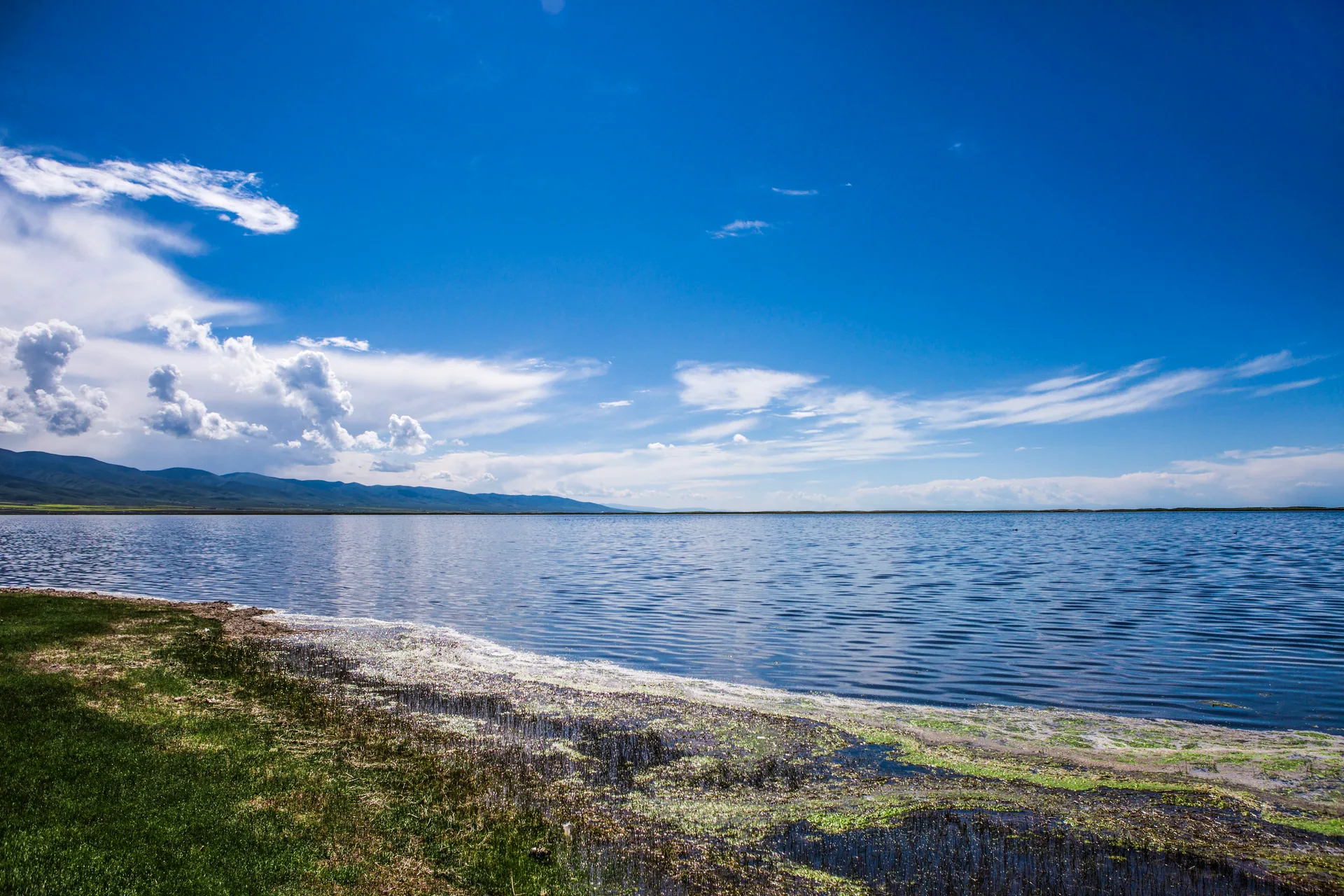
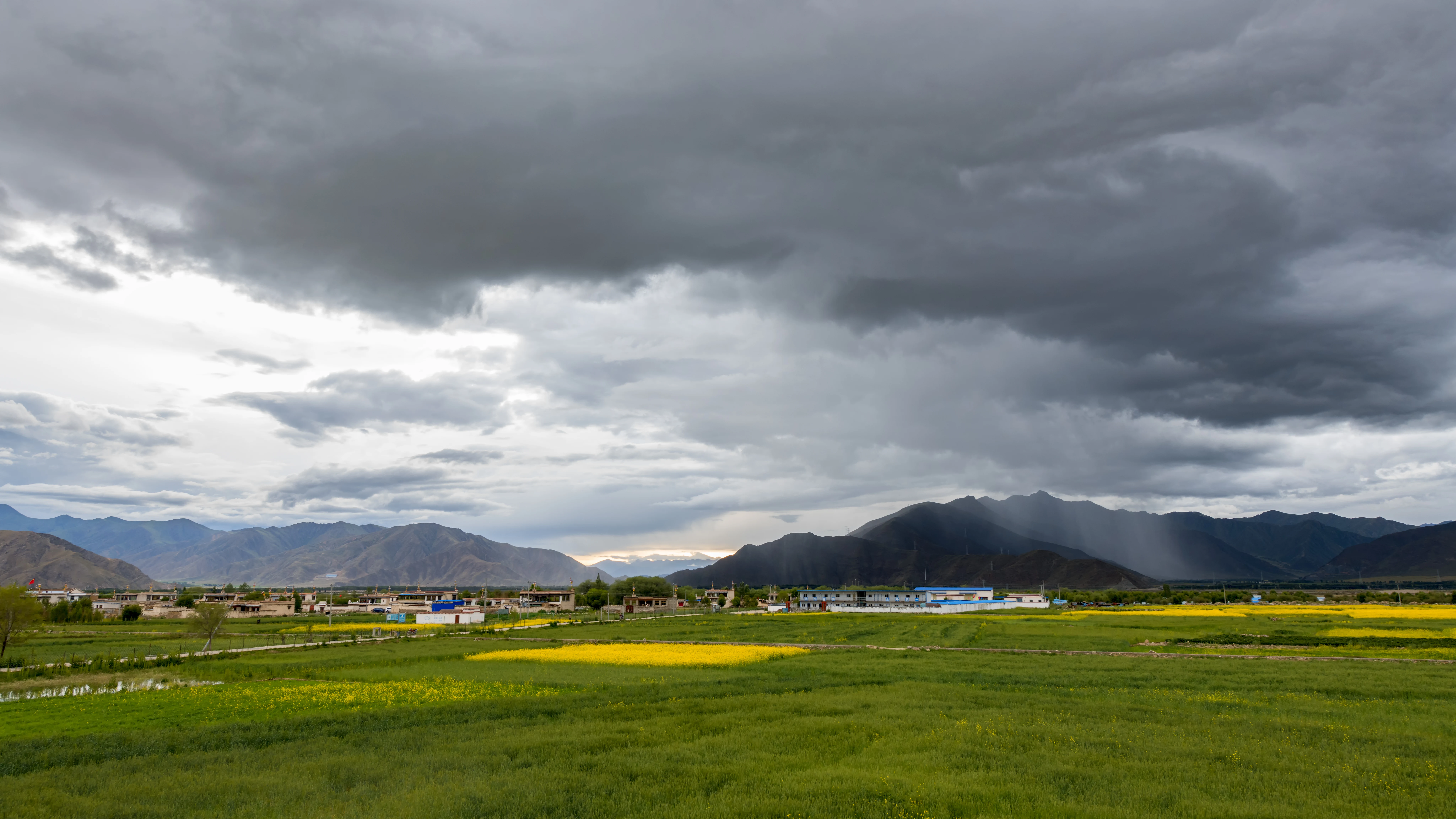
Kashgar city can fill three days without repetition. Mountain roads, highland lakes and border-region routes are separate journeys that may involve permits, checkpoints, long driving, weather and changing access. A scenic point that looks close on a social feed may consume most of the daylight.
Book transport through a source that can explain the current route, document requirements, turnaround time and cancellation conditions. Keep a city alternative. The responsible plan accepts that geography and current procedures can overrule an image saved months earlier.
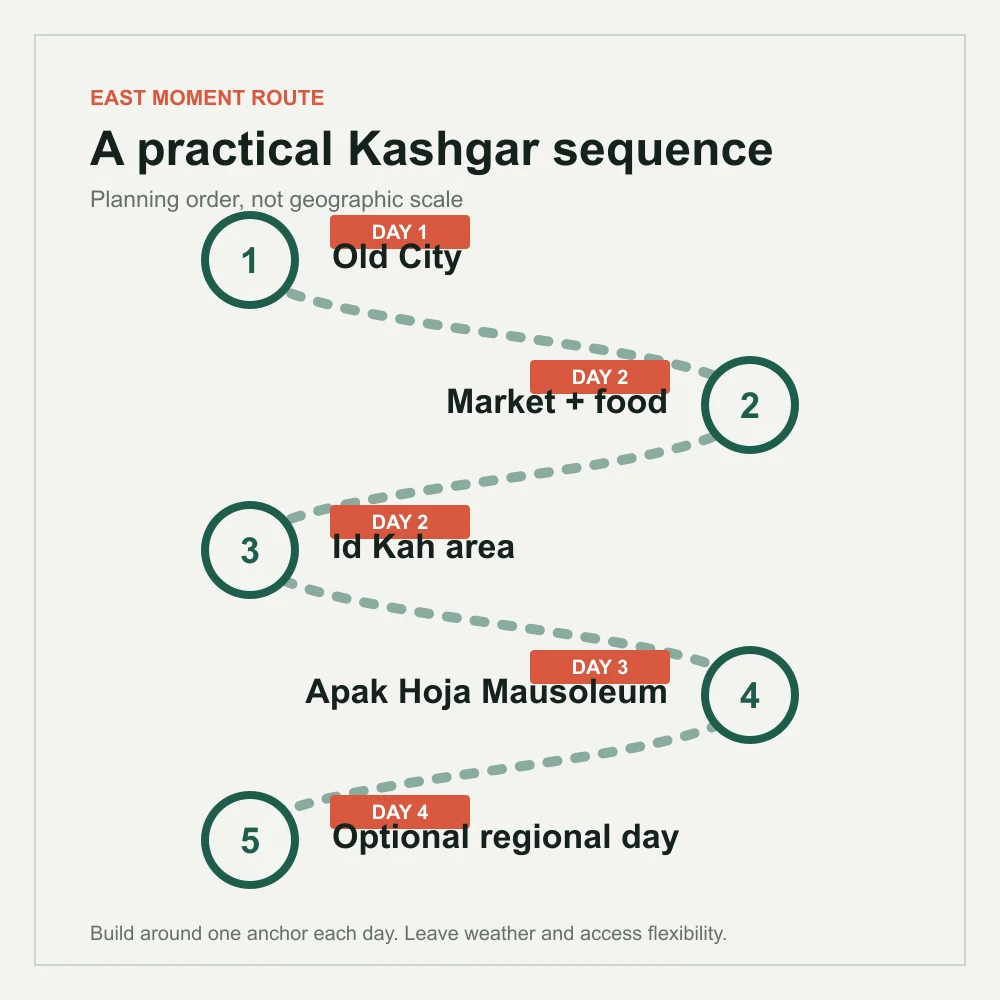
Keep the first three days city-focused; add a regional journey only after current access and road time are confirmed.
How to read Kashgar responsibly
Oasis geography explains more than the Silk Road label
"Silk Road city" tells a visitor that Kashgar was connected. It does not explain why settlement was possible here. The more useful starting point is oasis geography: water, cultivated land, desert margins and mountain routes created the conditions for agriculture, markets and long-distance movement. Trade depended on a living local economy; the city was never only a stop between more important places.
This perspective changes what deserves attention. Fruit and nuts in a market are not colorful props for a caravan story. They point toward irrigation, seasonality and the productive landscape around the city. Shade in a lane is not only architectural charm. It responds to strong sun and dry conditions. The width of a road, the material of a wall and the presence of courtyards all become environmental evidence.
Before taking a regional excursion, look at a physical map rather than only a road itinerary. Identify the directions of the major mountain systems, the broad relationship between oasis and desert and the distance to any lake or pass being advertised. The terrain explains why road times are long and why weather far outside the city can change access.
Kashgar's importance came from connections across several directions, but "crossroads" should not erase local continuity. People did not exist merely to serve travelers. Families farmed, made food, practiced religion, built homes and maintained regional relationships. A responsible trip treats mobility and settled life as parts of the same story.
Let the landscape change your schedule
Strong midday light can flatten streets and make long walks exhausting. Use morning and late afternoon for exterior observation, then place lunch, a museum or a rest break at the center of the day. This rhythm is not lost time. It follows the environmental logic that shaped shaded streets and interior courtyards.
Walk the old city as inhabited space
The old-city area contains visitor streets, shops, homes, courtyards, food businesses and extensively renewed or rebuilt sections. Do not label every earth-colored wall "ancient." Ask what is old, what has been reconstructed and how the space is used now.
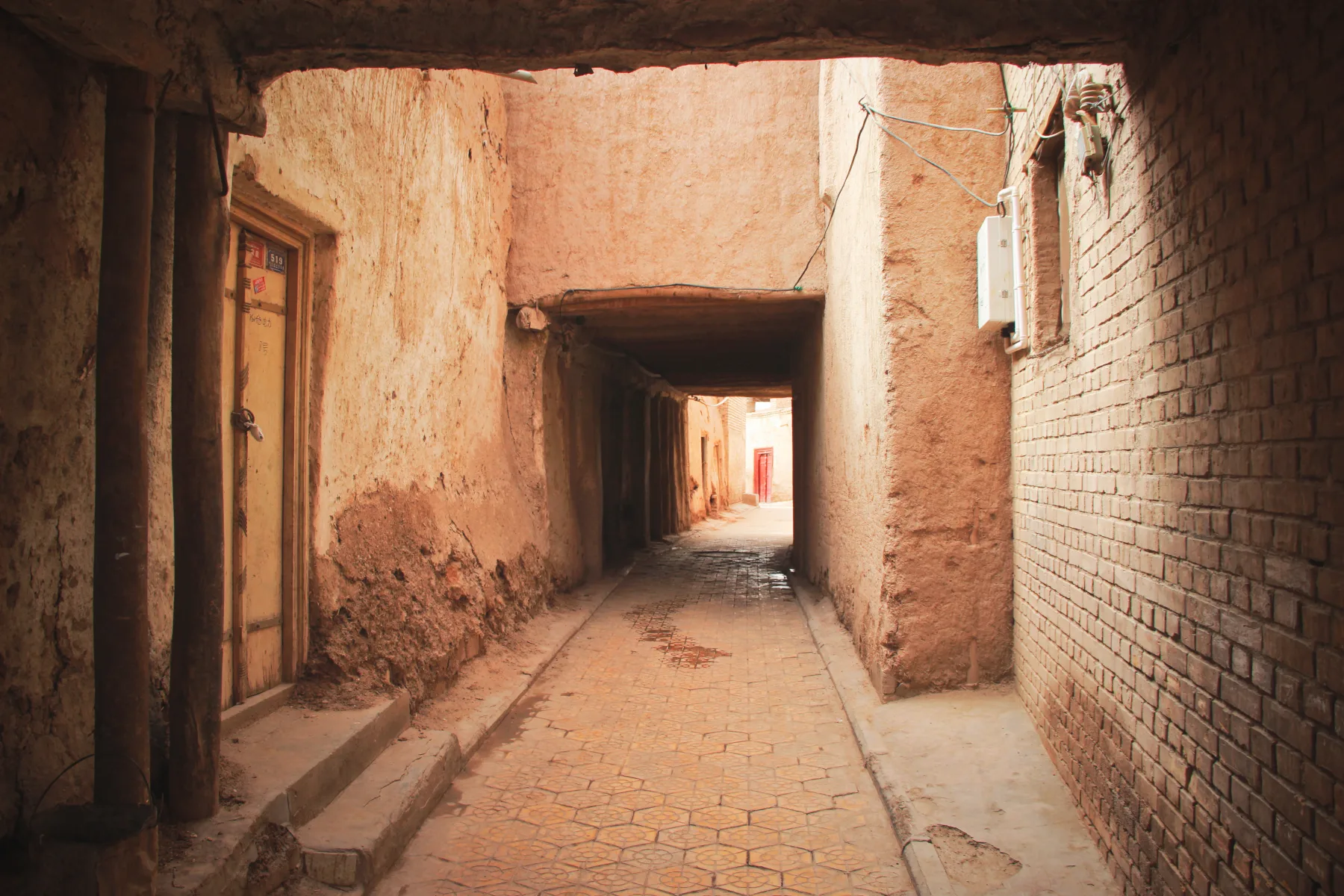
Start early enough to see deliveries and breakfast, but do not expect the district to perform for you. Return in late afternoon when light and street use change. Use the first walk to learn orientation and the second to notice doors, shade, drainage, threshold space and the transition between commercial and residential lanes.
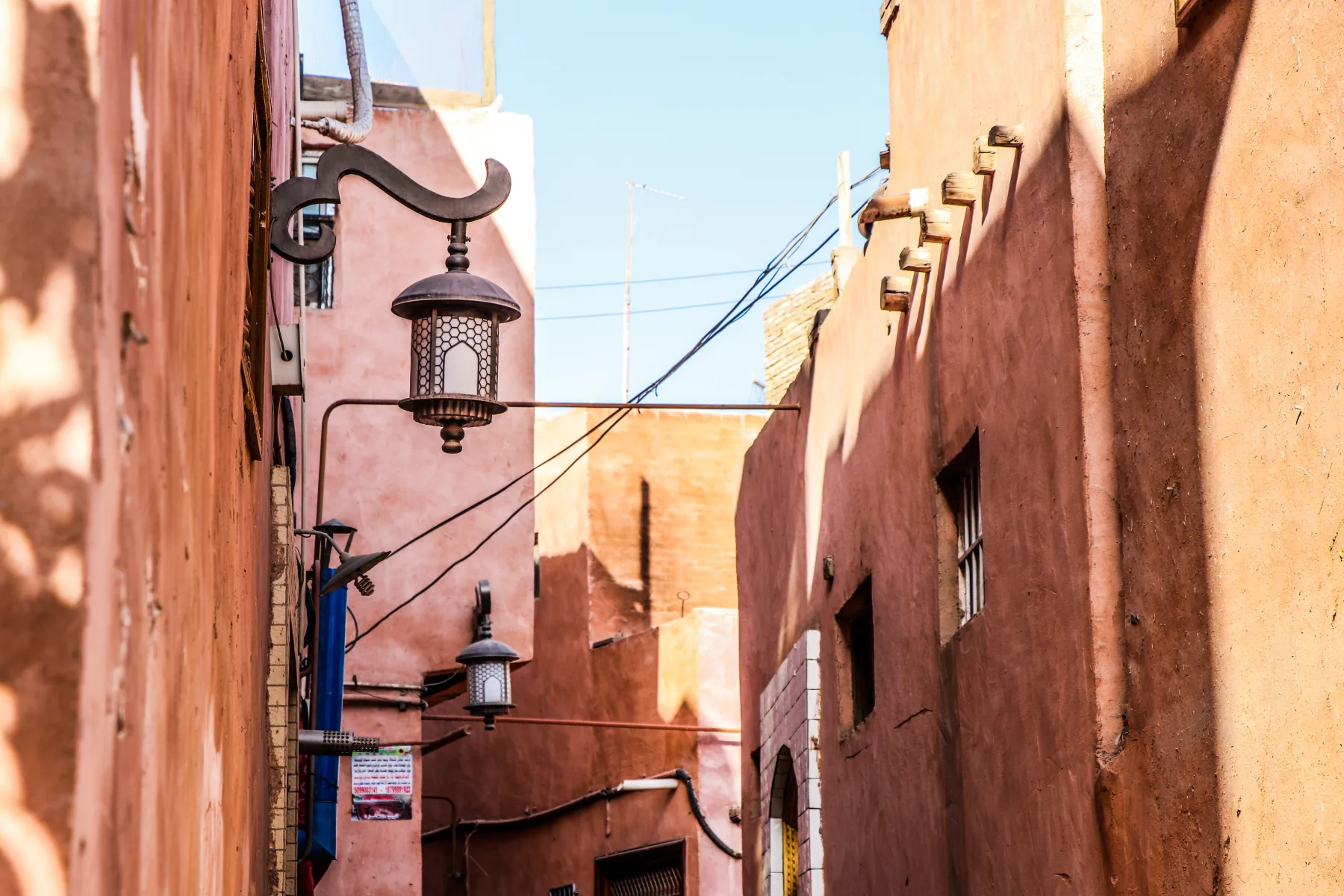
The wires, repairs and modern fixtures in this image matter. They prevent the old city from becoming a fantasy of timelessness. Heritage and ordinary infrastructure occupy the same wall.
Courtyards, thresholds and shade are the old city's real vocabulary
The old city is often photographed as a sequence of textured walls and decorative doors. Its deeper spatial language lies in the transition between public lane, threshold and private interior. A door may reveal nothing of the courtyard behind it, and that privacy is part of the architecture rather than an obstacle for the visitor to overcome.
Notice how upper floors project, where a passage becomes covered and how a small turn creates shade. Look for benches or raised edges that support short pauses, work or conversation. Observe drainage, paving and repairs. These details show how climate and social life shape space more clearly than a list of ornamental motifs.
Color-coded routes, renovated facades or visitor performances may help newcomers navigate, but they also create a curated reading. Step off the principal commercial path only where public access is clear. A quiet lane is not automatically a discovery waiting to be photographed. If residents are entering homes or children are playing, move without blocking the space.
Courtyard visits offered through a formal attraction, guesthouse or invited experience can be valuable because they make interior organization visible. Confirm whether photography is permitted and whether the visit is genuinely hosted rather than assumed. Do not infer an entire Uyghur household pattern from one decorated room prepared for visitors.
The strongest old-city walk alternates scale. First read a whole slope or network of lanes from a viewpoint. Then focus on one threshold, one shaded passage and one working storefront. Finally, return to a main route and ask how visitor circulation has been separated from or integrated with residential movement.
Visit the old city more than once
Morning emphasizes bread, deliveries and the opening of businesses. Afternoon emphasizes shade, tourism and slower movement. Evening changes food, social activity and lighting. A single walk cannot represent all three, especially when weather or a tour schedule pushes everyone through the same streets.
On the first visit, keep the camera mostly away and learn orientation. Mark a bakery, square, gate or public building that will help you return without constant navigation. On the second, choose one theme such as doors, food production or the boundary between visitor and residential space. A third short walk after dinner can focus on sound and public life rather than architecture.
Repetition is a form of depth. The moment a lane becomes recognizable, you stop consuming it as scenery and begin noticing change. This is one reason three city days are not excessive.
Id Kah Square is a public center, not a guaranteed interior visit
The square and mosque area are central to Kashgar's urban identity, but visitor access, opening arrangements and photography rules can vary. Check current local guidance, dress respectfully and never interrupt worship. If an interior is closed or restricted, accept the boundary without trying to negotiate through another entrance.
Islam is fundamental to Uyghur history and life. A short visitor description cannot reduce that religious world to architecture. Read signs carefully, keep voices low and avoid close photographs of worshippers.
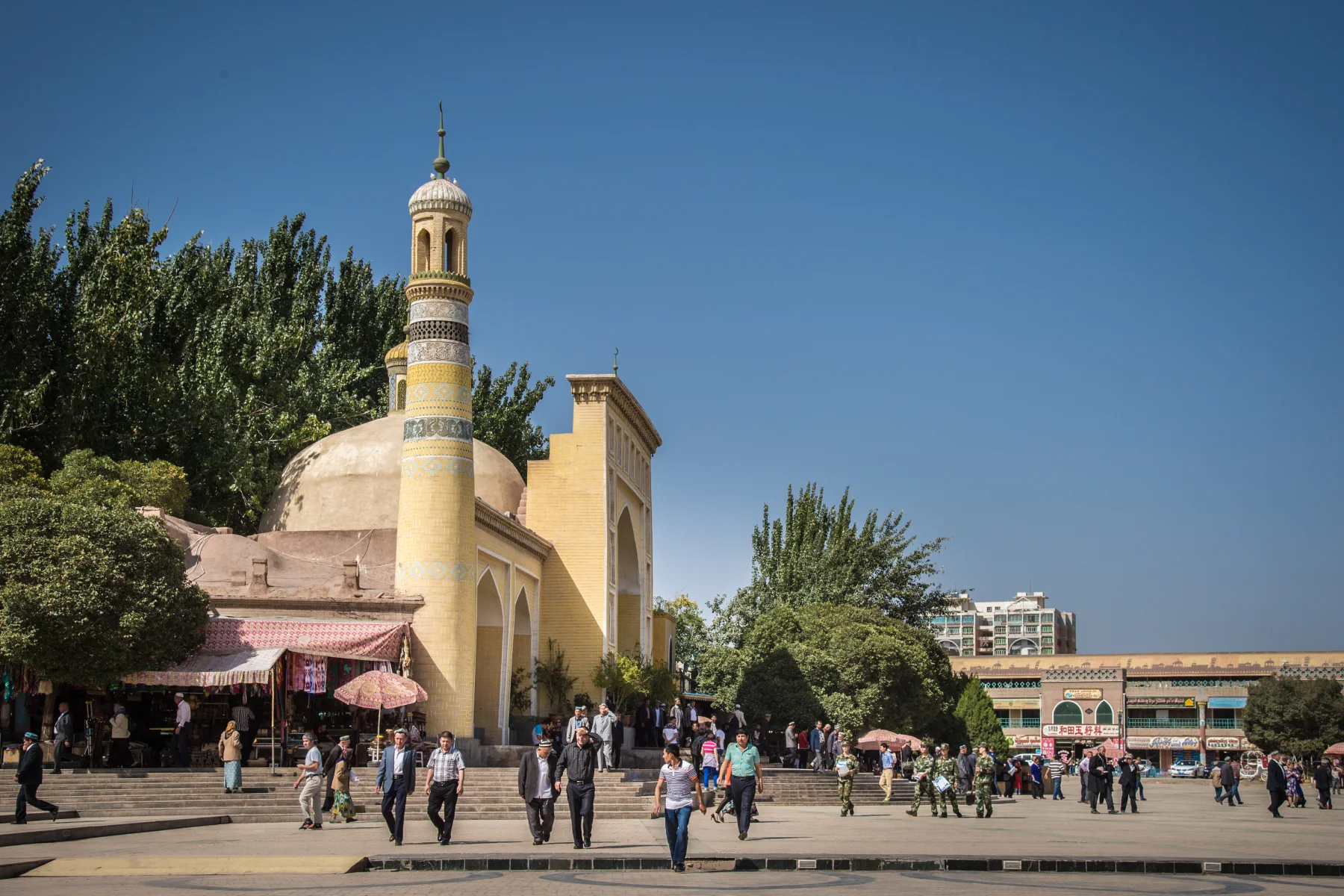
Public space requires more attention than confidence
Id Kah Square, market streets and old-city routes can feel visually open, but openness does not make every activity available for documentation. The same space may support worship, commuting, tourism, family time and official events at different hours. Visitor behavior should respond to what is happening, not to a general rule learned from another trip.
If access is unclear, ask hotel staff, site personnel or a responsible guide rather than following another visitor through a doorway. If a sign conflicts with an old online guide, follow the current sign. If an area is closed, change the route without turning the closure into a confrontation or a dramatic story.
Dress for climate and respect. Clothing does not need to imitate local dress, but shoulders, coverage and overall presentation should suit religious and family-oriented spaces. During periods of worship or religious observance, food schedules and street rhythms may differ; confirm current local conditions without making assumptions about individual practice.
Language preparation is a form of respect. Save the Uyghur or Chinese name of key destinations where available, keep your hotel address in Chinese and learn a simple greeting from a reliable source. Do not use a few words as a performance or expect every resident to reward the effort. The practical goal is to reduce friction and show that communication is shared work.
Use a separate route for the Apak Hoja Mausoleum area
The Apak Hoja Mausoleum is visually distinct from the old-city lanes, with glazed tile, domes and a memorial landscape connected to important local religious and political history. It sits outside the core walking route, so give it its own transport window and verify current access.
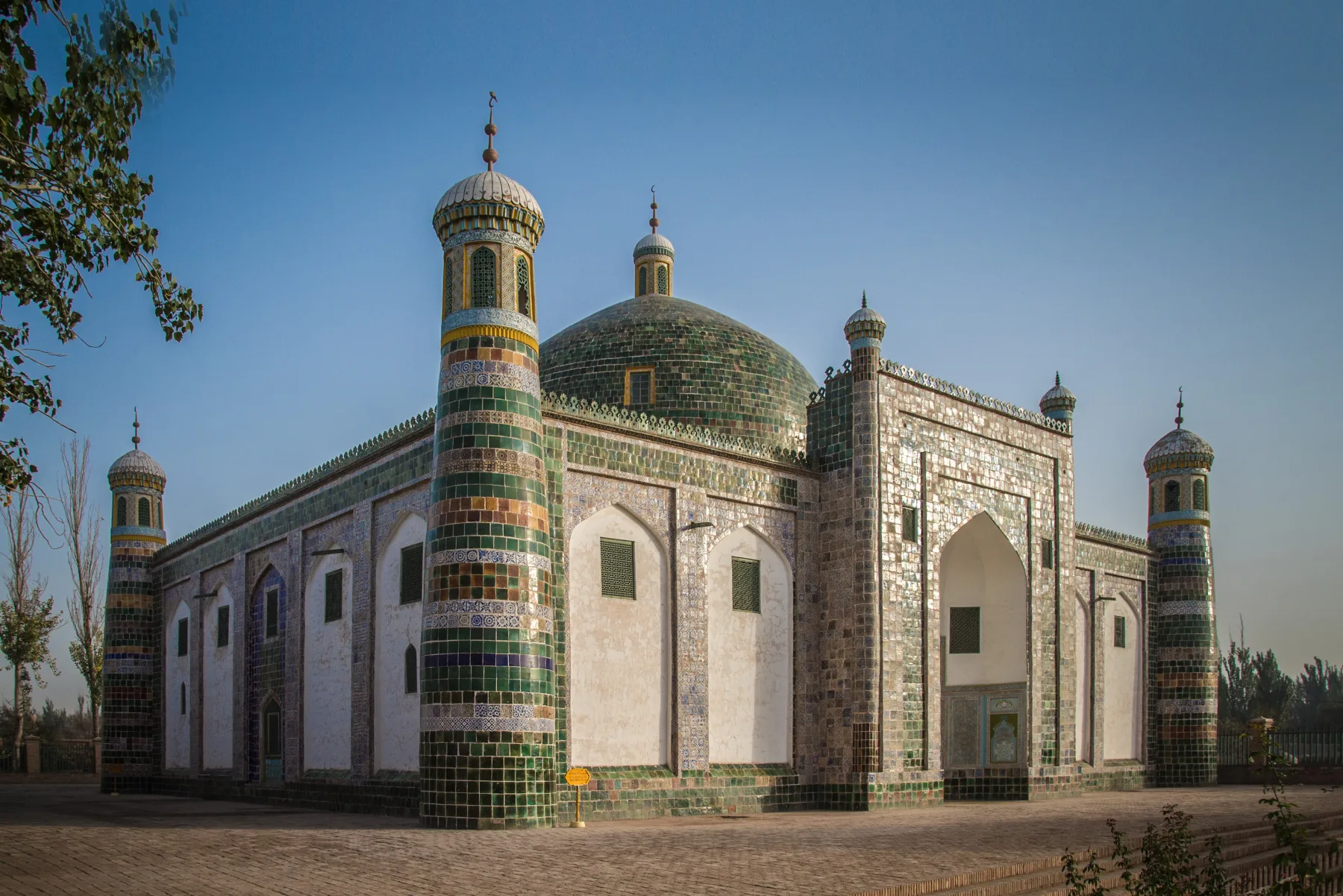
Treat the site as a place of memory, not merely a colorful facade. Names, popular stories and historical interpretations can be simplified in tourism retellings, so prefer on-site or institutional context over a dramatic guide anecdote.
Decorative surfaces should lead to historical questions
Glazed tile and patterned brick make the mausoleum highly photographable, but visual beauty can cause context to disappear. Begin with the site's plan. Identify entrances, tomb or memorial spaces, prayer-related areas and later visitor facilities. Ask which surfaces have been repaired and what interpretation explains the work.
Popular narratives often attach a famous person, romance or royal connection to a site because a memorable story travels faster than a complicated chronology. Treat those stories as claims to be checked, not as captions ready for publication. Where institutional explanations distinguish documented history from legend, preserve the distinction.
The mausoleum also widens the city route beyond commerce. It introduces religious authority, lineage, memory and regional architectural language. Give it enough time that it does not become a colorful stop between a market and lunch. A slower visit should include moments when the camera is down and the building is read through movement, proportion and changing light.
Markets are economic systems before they are visual experiences
Kashgar's markets connect fruit, nuts, bread, meat, craft and household demand to oasis agriculture and regional trade. Schedules and locations change, and the large livestock market traditionally associated with particular days should be verified before building a trip around it.
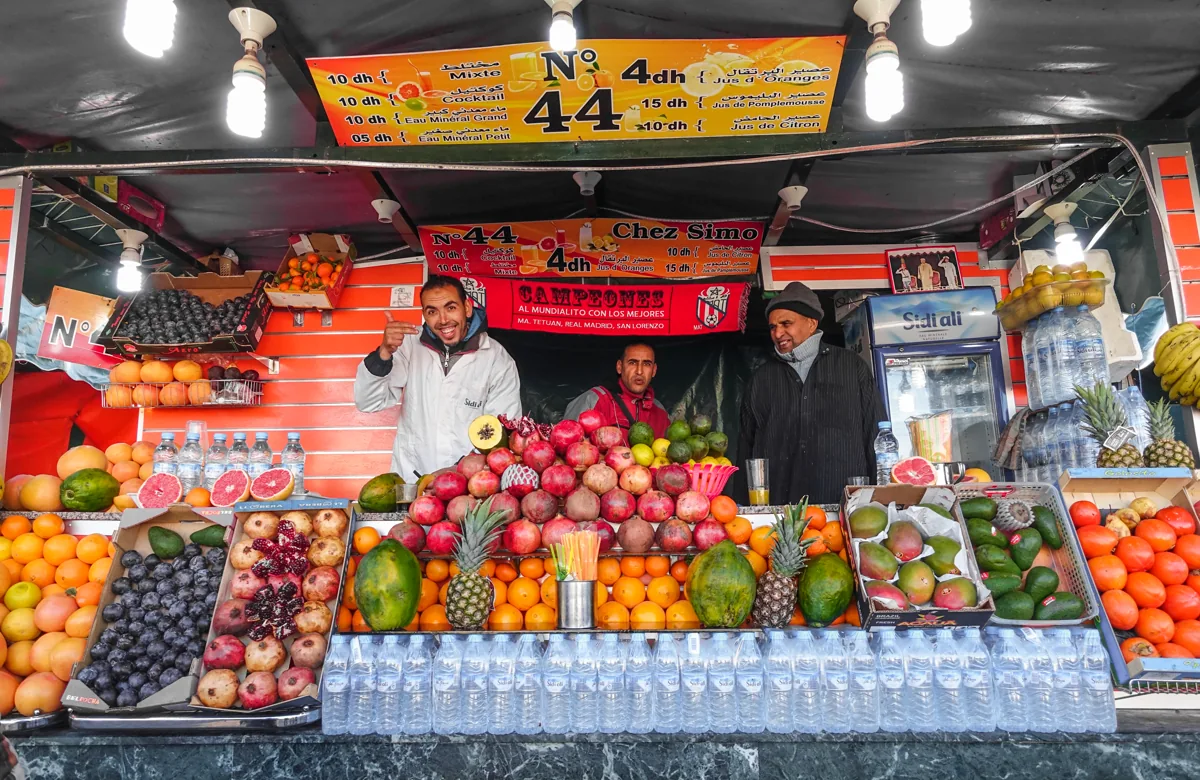
Buy something you actually want, ask prices clearly and do not photograph a vendor at close range without permission. An image of trade should not cost another person control over their own face.
Markets make sense through transactions
Looking without buying is acceptable, but the market becomes clearer when you understand how an exchange works. Observe units, weighing, packaging and the difference between goods sold for immediate eating and goods intended for households or wholesale movement. Ask a price before requesting a sample or photograph, and do not bargain aggressively over a small amount merely because a market is described as traditional.
Different markets serve different functions. A tourist-oriented food street, a neighborhood produce market and a periodic livestock market should not be treated as versions of the same attraction. Their schedules, participants, hygiene conditions and photography sensitivities differ. Verify the exact current location and operating day rather than asking a driver to take you to "the Kashgar market."
At a livestock market, if it is open and appropriate to visit, stay clear of animals, loading routes and active negotiation. Dust, noise, heat and physical movement are part of the environment. Closed shoes and distance are practical forms of respect. Avoid using a close portrait to turn difficult work into visual theater.
Craft shopping needs similar precision. Ask whether an object was made locally, where the maker works and what material or technique justifies the price. A workshop where production can be observed is more informative than a shop that attaches a Silk Road story to every item. Buy because the object and explanation satisfy you, not because you feel required to prove cultural appreciation.
Eat by technique, not by a top-ten list
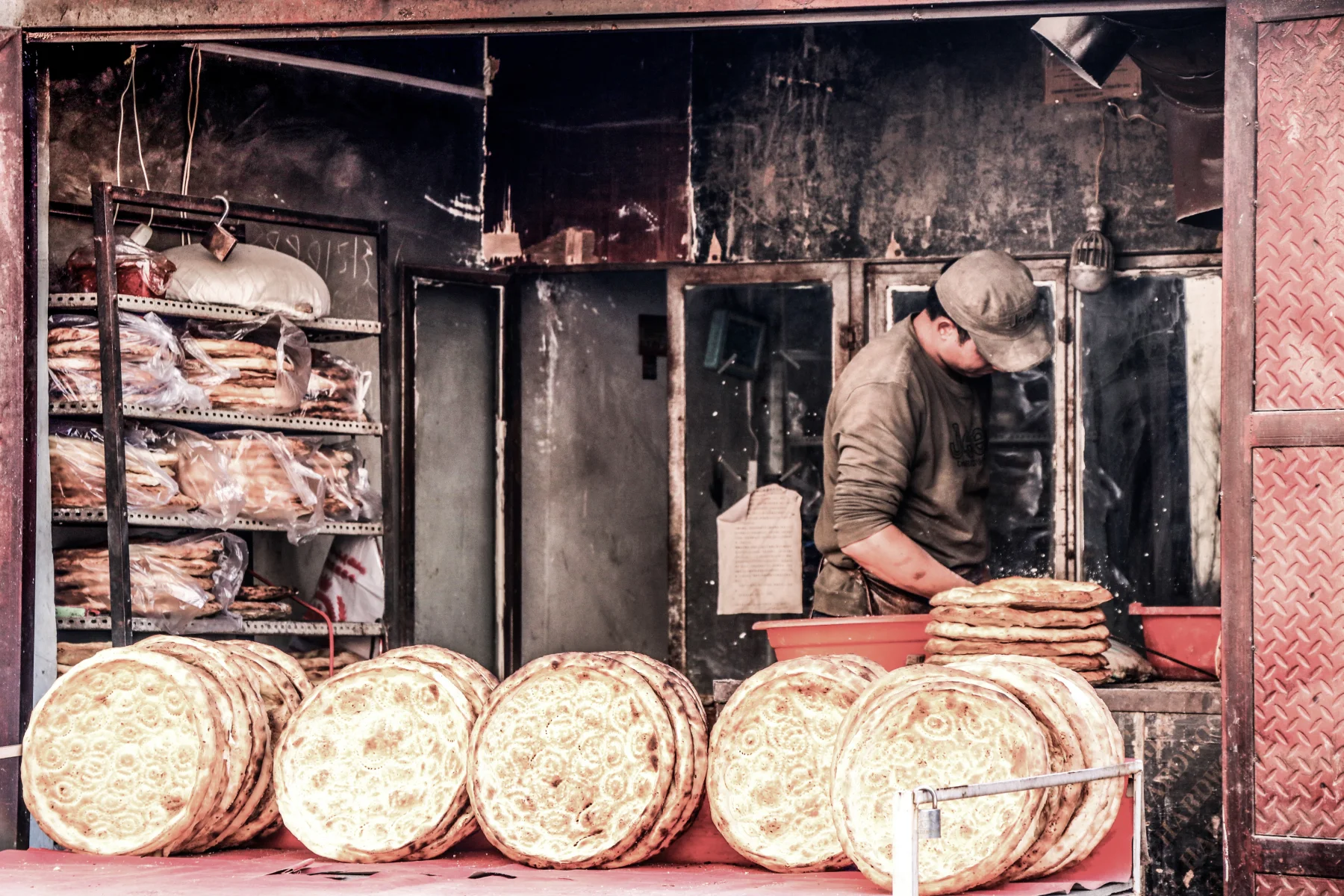
Build a day around how food is made. Watch dough become naan, compare hand-pulled laghman with rice-based polo, notice how lamb fat, onions, carrots, cumin, yogurt and seasonal fruit answer the climate and local agriculture.
Uyghur cuisine should not be flattened into "Chinese Muslim food." It has its own language, regional variation, domestic traditions and relationships with Central Asian food cultures. Dietary practice also matters: do not bring pork products into a setting where they are inappropriate, and ask rather than assume when you have restrictions.
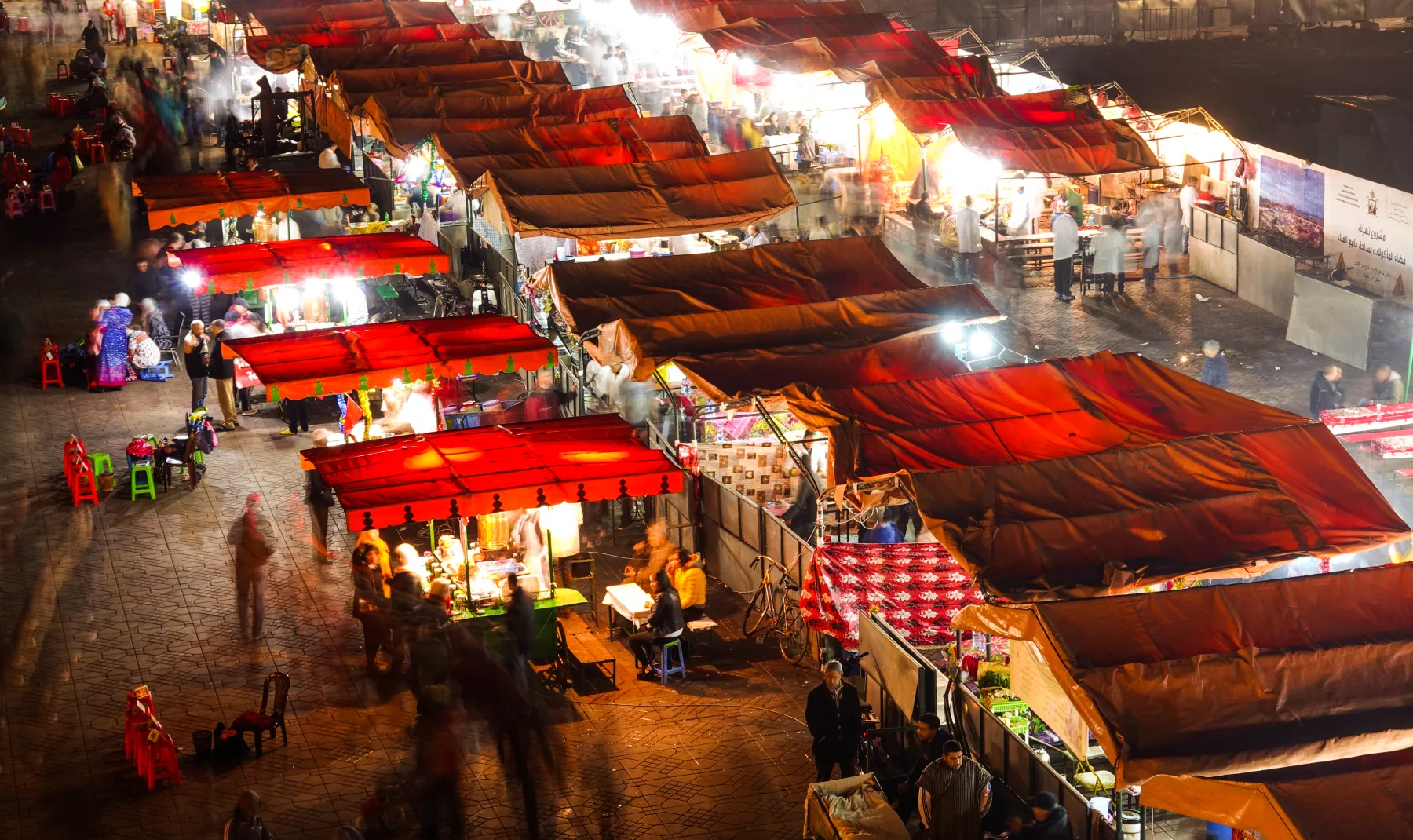
Night markets are easy to over-order. Start with one hot dish, share where possible and return another evening. Our guides to Chinese noodles and Chinese street food provide wider comparisons without treating Kashgar as a generic example.
Food explains household life, agriculture and hospitality
Naan is a strong place to begin because it connects grain, oven technique, neighborhood production and everyday portability. Watch from a respectful distance and buy before asking for photographs. Compare shapes and toppings over several days instead of declaring one bakery the winner after a single hot loaf.
Laghman reveals another relationship between technique and meal structure. The noodles, stir-fried topping and balance of vegetables and meat vary by kitchen. Polo organizes rice, carrot, onion and meat differently, while skewers foreground fire and fat. Eating these foods as methods rather than checklist names makes variation visible.
Seasonal fruit deserves its own pause. Quality and availability change across the year, so an itinerary copied from another month may be irrelevant. Buy a manageable quantity, ask whether washing or peeling is recommended and avoid wasting fruit for a photograph. Dried fruit and nuts can be compared by origin, texture and intended use rather than simply purchased as generic souvenirs.
Hospitality is often emphasized in descriptions of Uyghur culture, but visitors should not expect private access or free generosity. Accept invitations carefully, contribute appropriately when guided by a local host and do not publish a person's home or family without explicit permission. A commercial meal can be culturally meaningful without pretending to be intimate household life.
Travelers with dietary restrictions should prepare precise translations. Lamb is common, but sauces, broths and shared preparation require specific questions. Halal practice is important locally, yet a visitor should still confirm ingredients rather than using a broad label as a substitute for allergy information.
Modern Kashgar belongs in the frame
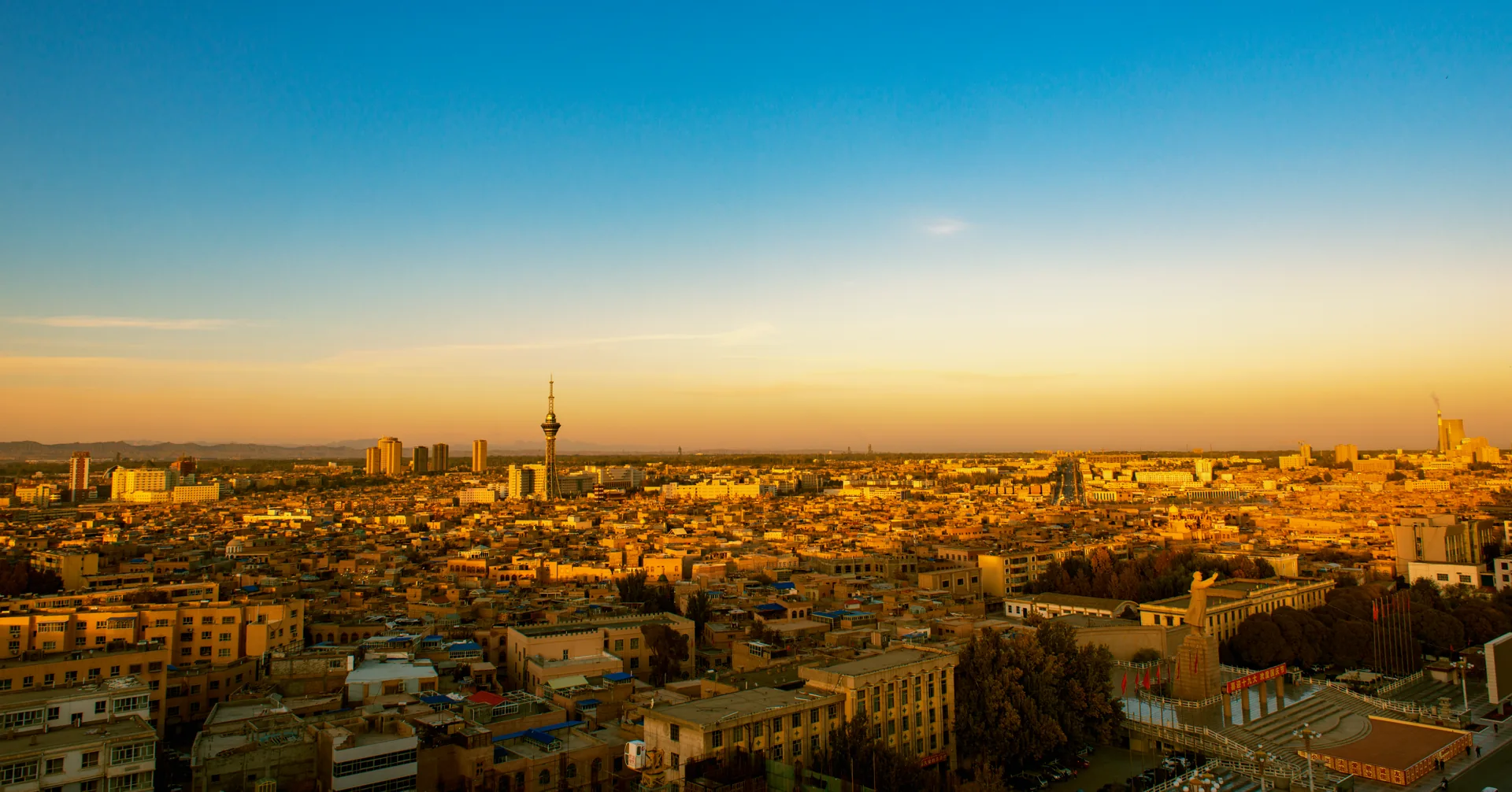
Wide roads, newer housing, transport infrastructure, malls and contemporary public buildings are not interruptions between heritage sites. They are where much of the city's present life occurs. A guide that crops them out produces an attractive but incomplete Kashgar.
Use one bus or car journey to look deliberately at the transition from the old-city visitor zone to newer districts. Notice changes in block size, building height, signage, greenery and traffic. Ask where residents shop, study and spend leisure time. The answer will not always be inside the area that travel media presents as the city.
Modernity does not erase Uyghur identity, and heritage design does not automatically preserve it. Both are complex processes lived by residents rather than visual categories a visitor can settle in one afternoon. Write and photograph with that humility.
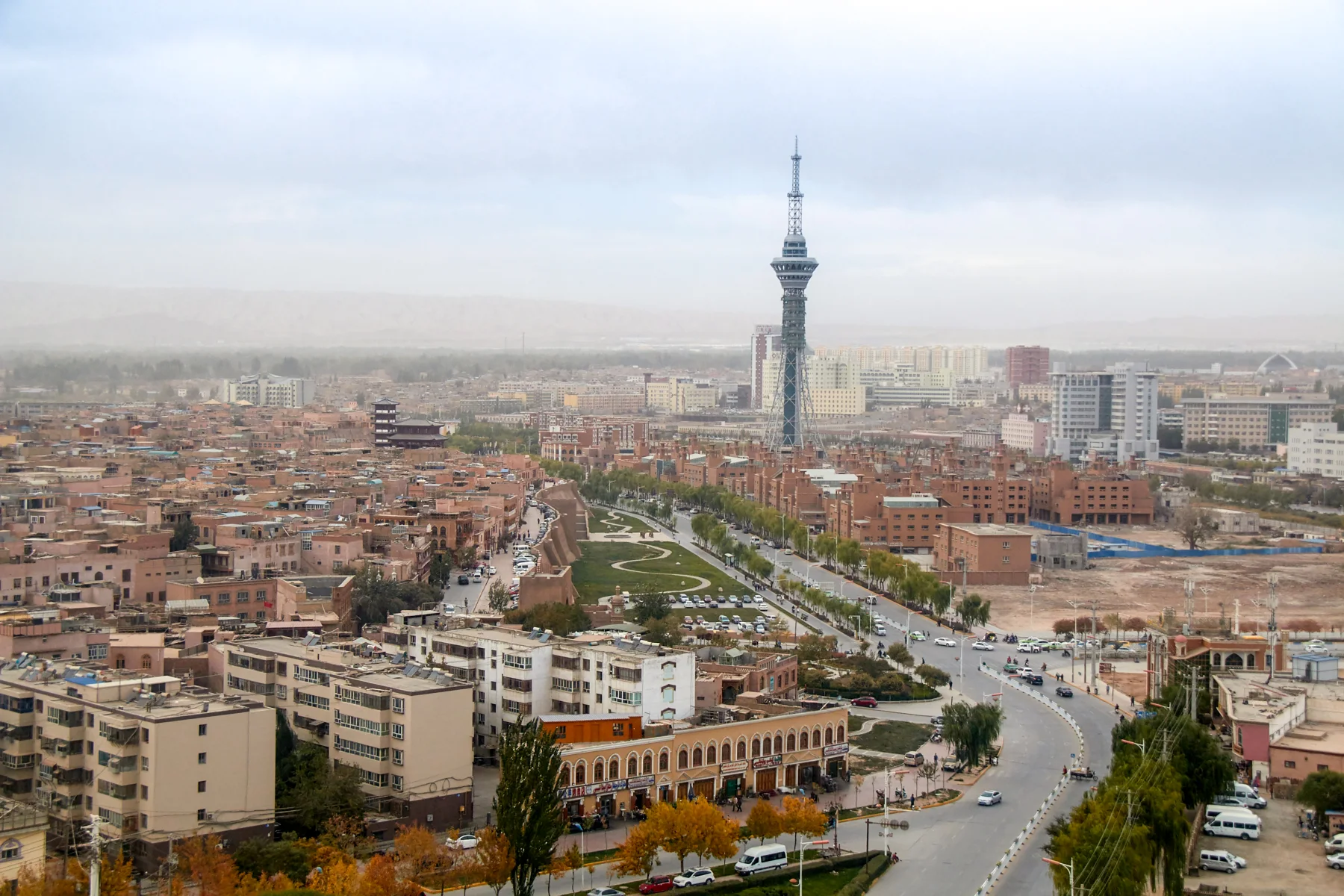
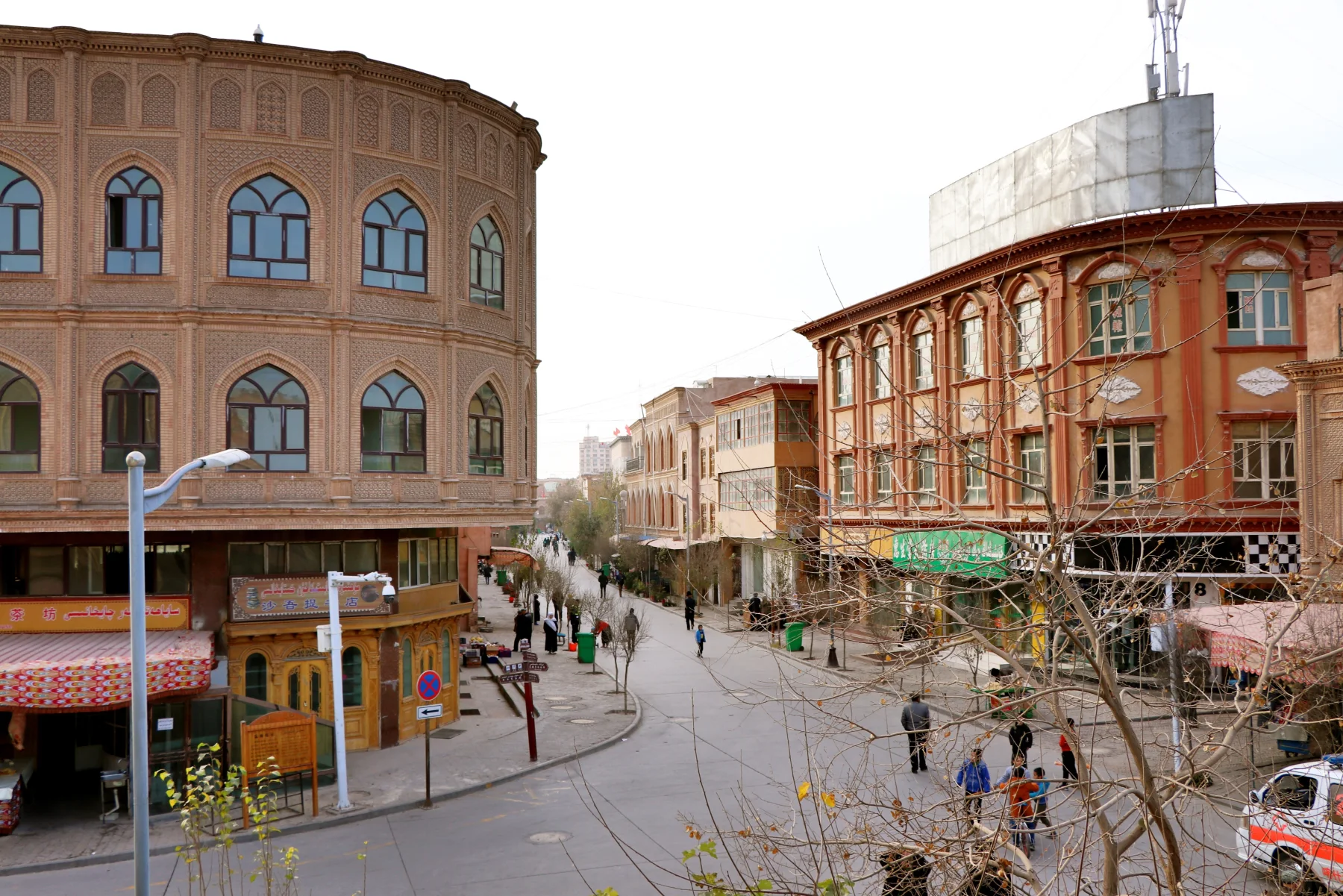
This wider frame also improves logistics. Restaurants, hotels and transport services in newer areas may be easier to use than the most atmospheric old-city option. Choosing convenience for part of the trip does not make the experience less serious; it can free time and energy for more attentive walking.
Stay in the city long enough to recognize it
What most guides get wrong
They use Kashgar as a launch point for distant scenery and reduce the city to one old-town walk. Three city days create the repetition needed to distinguish working streets, visitor presentation, religious boundaries, food production and modern urban life.
Build a 2, 3 or 4-day Kashgar itinerary
| Length | Recommended sequence | What to leave out |
|---|---|---|
| 2 days | Old city and food; then market plus one heritage route | Any long mountain or lake excursion |
| 3 days | Add museum or craft context, repeat the old city at another hour and eat in different neighborhoods | A regional drive that returns late at night |
| 4 days | Keep three city days and add one carefully verified excursion | Multiple distant scenic routes |
A strong three-day city sequence
- Walk the old city twice, early and late, with a museum or documented cultural stop between.
- Visit a market, eat a long lunch and use the afternoon for craft, architecture and the Id Kah area where access permits.
- Take a separate route to the Apak Hoja Mausoleum or another verified city-edge site, then return for a final meal chosen by technique rather than fame.
Where to stay
Choose a hotel that explicitly confirms it can register overseas guests under current requirements. Old-city proximity is useful, but reliable vehicle access, air conditioning or heating, breakfast timing and staff able to help with current transport can matter more than a decorative courtyard.
Before paying for a regional tour, ask the hotel or operator to state what is included, how documents are handled, how much time is spent driving and what happens if weather or access changes. Save the hotel name, address and phone number in Chinese.
Photography: the camera is not neutral
Kashgar can make a visitor visually greedy. Color, faces, bread, carved doors and market movement all seem to ask for the camera. They do not. Ask before close portraits, respect refusals and use particular care around children, worship, homes and people at work.
Architecture and public street scenes still require judgment. A long lens can invade private space even when you remain on a public lane. Sometimes the honest cultural experience is to lower the camera, buy bread, listen and accept that another person's ordinary afternoon is not your content.
A practical photography rule
Take the wide scene first, where individuals are part of public space rather than isolated subjects. For a closer image, make eye contact and ask. Show the result if appropriate. Do not photograph children closely without a responsible adult's permission, and do not interpret a smile, pose or traditional clothing as permanent consent for commercial reuse.
Captioning matters as much as taking the picture. Avoid words such as "timeless," "untouched" and "lost world" unless you are directly critiquing them. Name the location and visible activity accurately, and admit when you do not know a person's occupation, identity or intention. A careful caption preserves dignity and improves factual quality at the same time.
Climate, transport and current conditions
Flights are often the most practical way to reach Kashgar from distant Chinese cities; rail journeys can be very long. Dry air, strong sun and large temperature changes call for water, sun protection and layers. Dust, wind, winter cold and summer heat can materially change walking comfort.
Carry your passport where required, keep offline copies of reservations and do not rely on one payment or navigation app. Current transport, accommodation registration, attraction access and regional route conditions should be confirmed close to departure through official or directly responsible local sources.
The national Travel to China guide covers mobile payment, rail, connectivity and translation preparation. Kashgar adds one rule: leave enough unscheduled time for distance, procedure and respectful attention.
Frequently asked questions about travel to Kashgar
How many days do I need in Kashgar?
Three days allows time for the old city, markets, food and a separate heritage route. Four days is better if you want a long regional excursion, because mountain and lake routes involve substantial road time and should not be treated as city sightseeing.
What language is spoken in Kashgar?
Uyghur is central to local cultural life, while Mandarin is also used. English coverage is limited compared with major eastern cities, so saved addresses and translation preparation are especially useful.
Can I freely photograph people in Kashgar?
No person should be treated as public scenery. Ask before close portraits, respect refusals and be especially careful around worship, homes, children and work.